
American Poetry Since 1945 Robert Lowell Silvia Plath
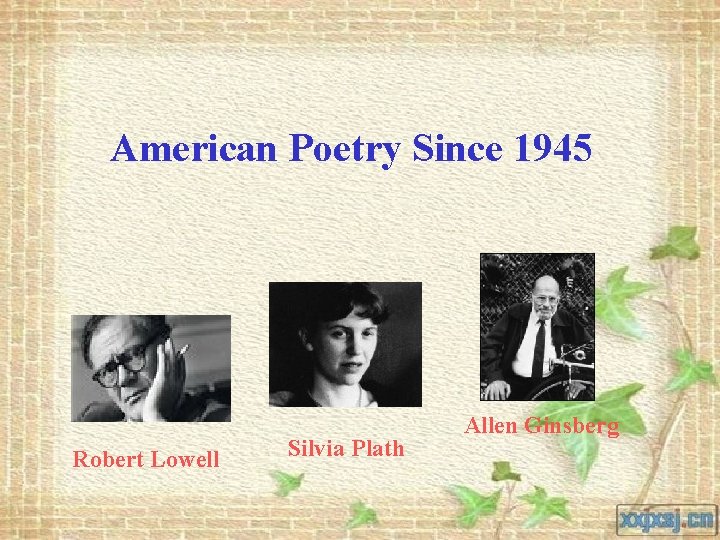
American Poetry Since 1945 Robert Lowell Silvia Plath Allen Ginsberg
Contents Ⅰ. Idiosyncratic/ Confessional Poetry Ⅱ. Experimental Poetry
Ⅰ. Idiosyncratic/Confessional Poetry 1. History of Development This new poetry school emerged in 1950 s 1960 s in America. The first confessional poem is Life Studies written by Robert Lowell, a famous American poet. Just like a guilty Christian confessed to the priest, he disclosed his privacy, inner sufferings, spiritual wounds and sexual desire and impulse completely and directly in this poem, which caused a strong reaction in poetry circle.
Ⅰ. Idiosyncratic/Confessional Poetry 1. History of Development And then 1960 s’ “Confessional Poetry” movement started in America. Because of the influence of existentialism and dissatisfaction to the irrational material civilization and rigid life -style, many young poets who couldn’t find lofty ideal and living purpose imitated Robert Lowell to regard poetry as a tool to self-disclose and selfvent. Furthermore, some of them expressed their disgust of existence and suicide after being wellknown.
Ⅰ. Idiosyncratic/Confessional Poetry 2. Main Features Poems of this school are usually absurd, depressed and lacking reason, and reflect intellectuals’ distress, up-set, confusion and desperation. 3. Representative Writers and Works u. Robert Lowell: Lord Weary’s Castle (1946) u. Anne Sexton: Live or Die (1966) u. Silvia Plath: Ariel (1965) The Applicant (1966)

Ⅱ. Experimental Poetry Experimentation is one aspect of all Modernist and Postmodernist poetry, but experimental poetry makes a special point of innovation. The contemporary poetry with experimentation which began in the 1950 s may be divided into five loose schools The young experimental writers have tended to be counter-culture intellectuals who disassociated themselves from universities and American society. Their poetry is daring, original, and sometimes shocking.
Five Schools of Experimental Poetry 1. The Black Mountain School 2. The San Francisco School 3. Beat Poets 4. The New York School 5. Surrealism and Existentialism
(Ⅰ) The Black Mountain School 1. History of Development This American poetry school emerged in 1950 s and consisted of a group of writers, professors and artists in Black Mountain College, a school of literature and art in North Carolina which established in 1933 and suspended in 1956. The writers and professors teaching here established their own publications——Black Mountain Review, in which they published innovative yet disciplined verse.
(Ⅰ) The Black Mountain School 1. History of Development Their experimental yet disciplined style took its impetus from the essay “Projective Verse” (1950) by Charles Olson. They developed and perfected theory of “Projective Verse”, and gradually formed the new poetry school—— Black Mountain. In the later of 1950 s, this significant school converged with The Beat Generation.
(Ⅰ) The Black Mountain School 2. Main Features u. In form, it advocates free verse instead of traditional metric foot. u. In content, it believes poets transmit “energy” to readers through poems which accordingly are “energy structure” and “energy radiation”. u. It stands for spontaneity and colloquialism, and objects exquisite style of academicism
(Ⅰ) The Black Mountain School 3. Representative Writers and Works u Charles Olson: Projective Verse(1950) u Robert Creeley: The Warning (1955)
(Ⅱ) The San Francisco School The work of the San Francisco School owes much to Eastern philosophy and religion, as well as to Japanese and Chinese poetry. Many of their poems are set in the mountains or take place on backpacking trips. The poetry looks to nature instead of literary tradition as a source of inspiration
(Ⅱ) The San Francisco School San Francisco poets include Jack Spicer, Lawrence Ferlinghetti, Robert Duncan, Phil Whalen, Lew Welch, Gary Snyder, Kenneth Rexroth, Joanne Kyger, and Diane di. Prima. Many of these poets identify with working people. Their poetry is often simple, accessible, and optimistic. San Francisco poetry evokes the delicate balance of the individual and the cosmos.
(Ⅲ) Beat Poets The San Francisco School blends into the next grouping -- the "Beat" poets, who emerged in the 1950 s. Major Beat writers have included Allen Ginsberg, Gregory Corso, Jack Kerouac, and William Burroughs. Beat poetry is oral, repetitive, and immensely effective in readings, developing out of poetry readings in underground clubs.
(Ⅲ) Beat Poets Beat poetry was the most anti-establishment form of literature in the United States, but beneath its shocking words lies a love of country. The poetry is a cry of pain and rage at the loss of America's innocence and the tragic waste of its human and material resources.
Howl (Allen Ginsberg, 1956) I saw the best minds of my generation destroyed by madness, starving hysterical naked, dragging themselves through the negro streets at dawn looking for an angry fix, angelheaded hipsters burning for the ancient heavenly connection to the starry dynamo in the machinery of night. . . A Supermarket in California
(Ⅳ) The New York School In general, the poets of the New York School steer clear of political issues. They have the best formal educations of any group. The major figures of the New York School are John Ashbery, Frank O'Hara, and Kenneth Koch. They are quintessentially urban, cool, nonreligious, witty with a poignant, pastel sophistication. Their poems are fast moving, full of urban detail, incongruity, and an almost palpable sense of suspended belief.
(Ⅴ) Surrealism and Existentialism This vague group includes recent movements and experiments. Chief among these are surrealism, which expresses the unconscious through vivid dreamlike imagery written by women and ethnic minorities. Though superficially distinct, surrealists, feminists, and minorities appear to share a sense of alienation from white, male, mainstream literature.
(Ⅴ) Surrealism and Existentialism Not until the 1960 s did surrealism (along with existentialism) become domesticated in America under the stress of the Vietnam conflict. Surrealists like Merwin tend to be epigrammatic, as in lines such as: "The gods are what has failed to become of us / If you find you no longer believe enlarge the temple. "
(Ⅴ) Surrealism and Existentialism Bly's political surrealism harshly criticized American values and foreign policy during the Vietnam era in poems like "The Teeth Mother Naked at Last": It's because we have new packaging for smoked oysters that bomb holes appear in the rice paddies
(Ⅴ) Surrealism and Existentialism The more pervasive surrealist influence has been quieter and more contemplative, like the poem Charles Wright describes in "The New Poem" (1973): It will not attend our sorrow. It will not console our children. It will not be able to help us. Mark Strand's surrealism, is often bleak; it speaks of an extreme deprivation. Theodore Roethke: The Waking
Homework Introduce us some information about Salinger and Updike and their masterpieces.
- Slides: 22