
American Modernism 1910 1945 F Scott Fitzgerald Ernest
![The Code Ηero • “[A] man who lives correctly, following the ideals of honor,](https://slidetodoc.com/presentation_image_h2/2bb5cb3a77a49d6c9aab6072c7dff73e/image-16.jpg "The Code Ηero • “[A] man who lives correctly, following the ideals of honor,")
- Slides: 22
American Modernism 1910 -1945 F. Scott Fitzgerald & Ernest Hemingway
Periodisation • The Colonial Period (1500 -1830) • The Post-Revolutionary Period of Romanticism and Transcedentalism leading almost up to the end of the 19 th century. • Realism and Naturalism (1870 -1910) • The Modernist period spanning roughly from the pre-WWI (turn of the century) years through to the interwar period and leading up to WWII • The Post-war / contemporary period.
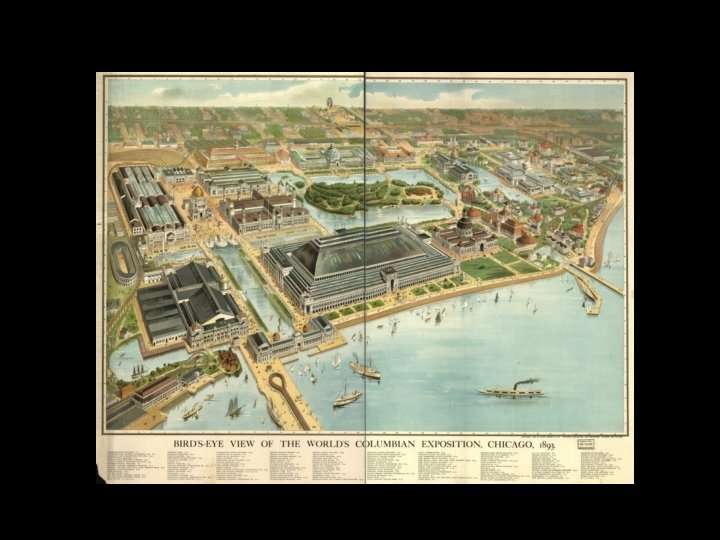
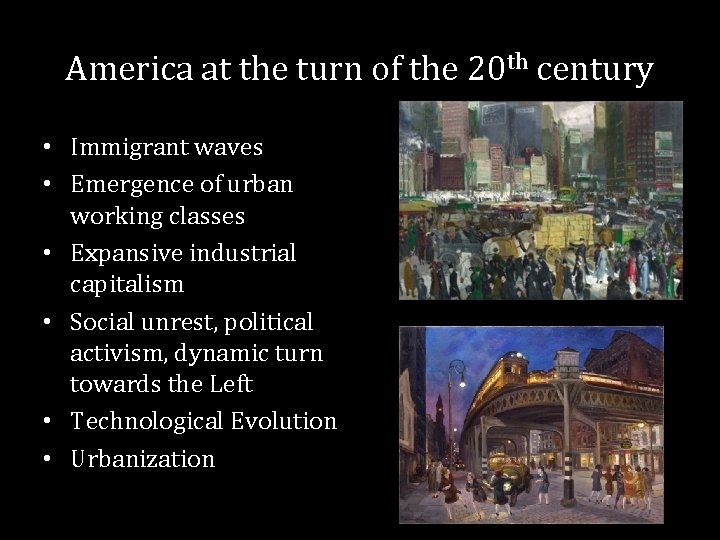
America at the turn of the 20 th century • Immigrant waves • Emergence of urban working classes • Expansive industrial capitalism • Social unrest, political activism, dynamic turn towards the Left • Technological Evolution • Urbanization
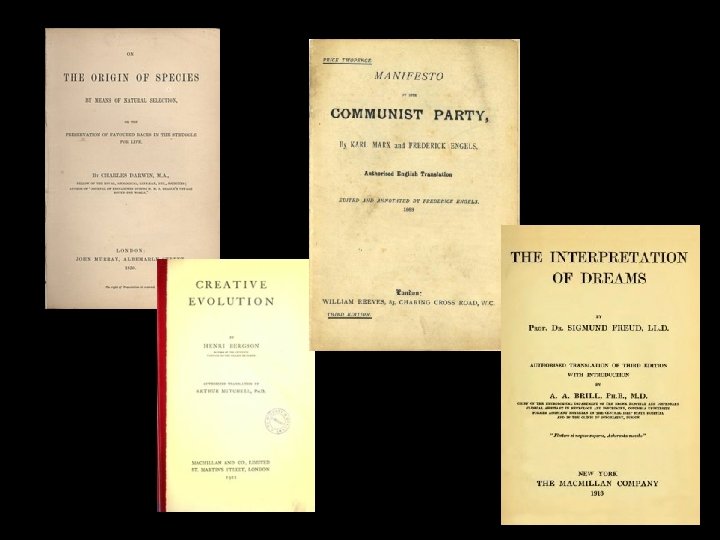
THE SPIRIT OF MODERNIST LITERATURE • Conviction that the previously sustaining structures of human life, whether social, political, religious, or artistic, had been either destroyed or shown up as falsehoods or fantasies. Therefore, art had to be renovated. • Modernist writing is marked by a strong and conscious break with tradition. It rejects traditional values and assumptions. • “Modern” implies a historical discontinuity, a sense of alienation, loss, and despair. • It rejects not only history but also the society of whose fabrication history is a record. Poetry tended to provide pessimistic cultural criticism or loftily reject social issues altogether. • Literature, especially poetry, becomes the place where the one meaningful activity, the search for meaning, is carried out; and therefore literature is, or should be, vitally important to society. Imaginative vision is thought to give access to an ideal world, apart and above reality, or to contain alternative, higher values than those reigning in the statehouse and the marketplace, which could enrich life. Furthermore, modernists believed that we create the world in the act of perceiving it.
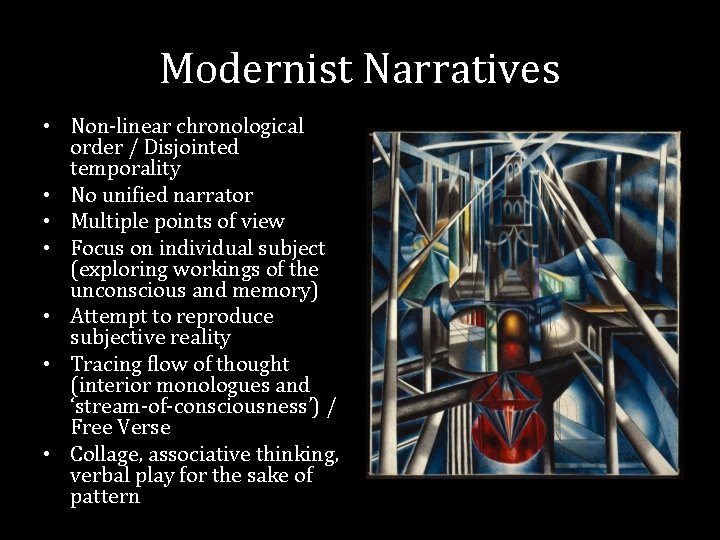
Modernist Narratives • Non-linear chronological order / Disjointed temporality • No unified narrator • Multiple points of view • Focus on individual subject (exploring workings of the unconscious and memory) • Attempt to reproduce subjective reality • Tracing flow of thought (interior monologues and ‘stream-of-consciousness’) / Free Verse • Collage, associative thinking, verbal play for the sake of pattern
Themes • Psychological wounds and spiritual scars of war experience • Unsettling/destruction of traditions – Breakdown of social norms and cultural certainties • Loss of self and need for re -definition (alienation) • Development of regional trends • Moving from agrarian to urban nation
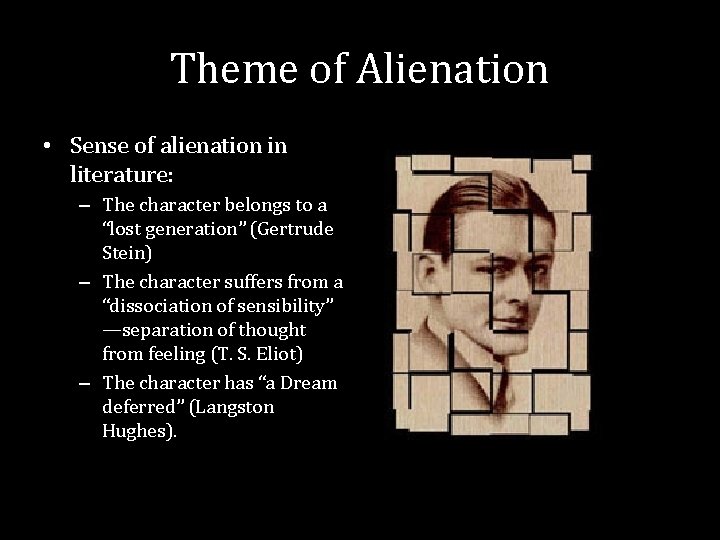
Theme of Alienation • Sense of alienation in literature: – The character belongs to a “lost generation” (Gertrude Stein) – The character suffers from a “dissociation of sensibility” —separation of thought from feeling (T. S. Eliot) – The character has “a Dream deferred” (Langston Hughes).
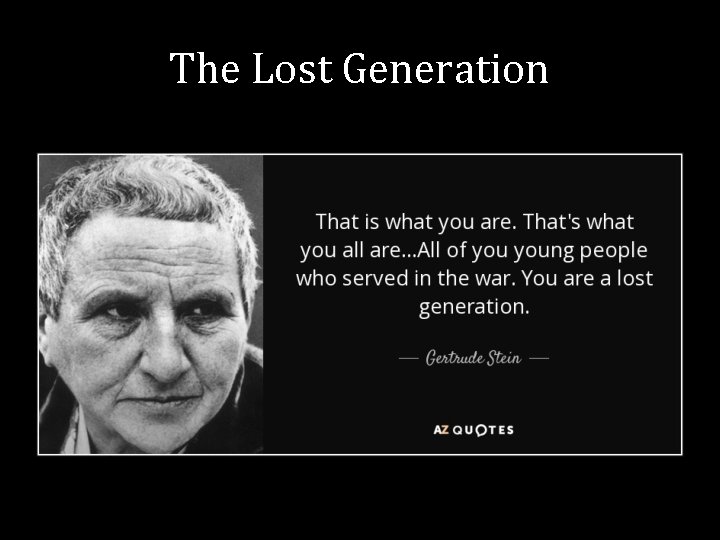
The Lost Generation
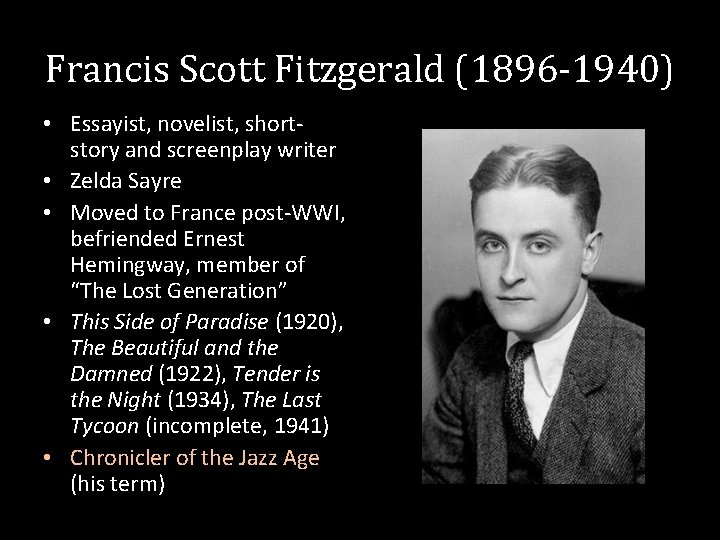
Francis Scott Fitzgerald (1896 -1940) • Essayist, novelist, shortstory and screenplay writer • Zelda Sayre • Moved to France post-WWI, befriended Ernest Hemingway, member of “The Lost Generation” • This Side of Paradise (1920), The Beautiful and the Damned (1922), Tender is the Night (1934), The Last Tycoon (incomplete, 1941) • Chronicler of the Jazz Age (his term)
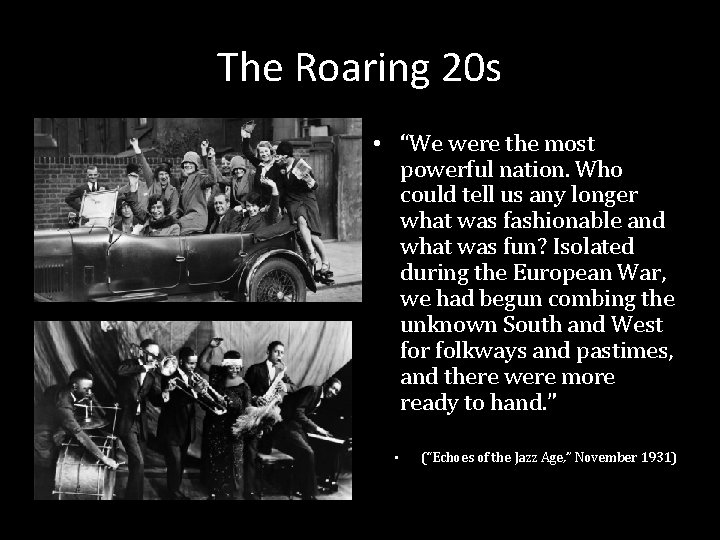
The Roaring 20 s • “We were the most powerful nation. Who could tell us any longer what was fashionable and what was fun? Isolated during the European War, we had begun combing the unknown South and West for folkways and pastimes, and there were more ready to hand. ” • (“Echoes of the Jazz Age, ” November 1931)
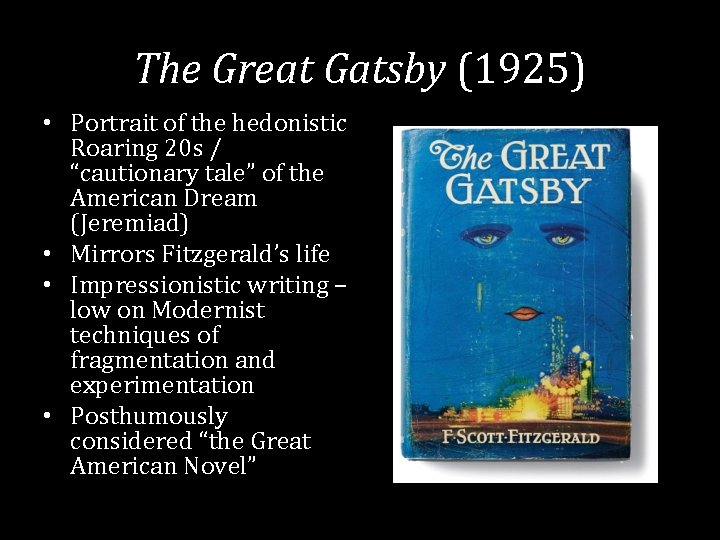
The Great Gatsby (1925) • Portrait of the hedonistic Roaring 20 s / “cautionary tale” of the American Dream (Jeremiad) • Mirrors Fitzgerald’s life • Impressionistic writing – low on Modernist techniques of fragmentation and experimentation • Posthumously considered “the Great American Novel”
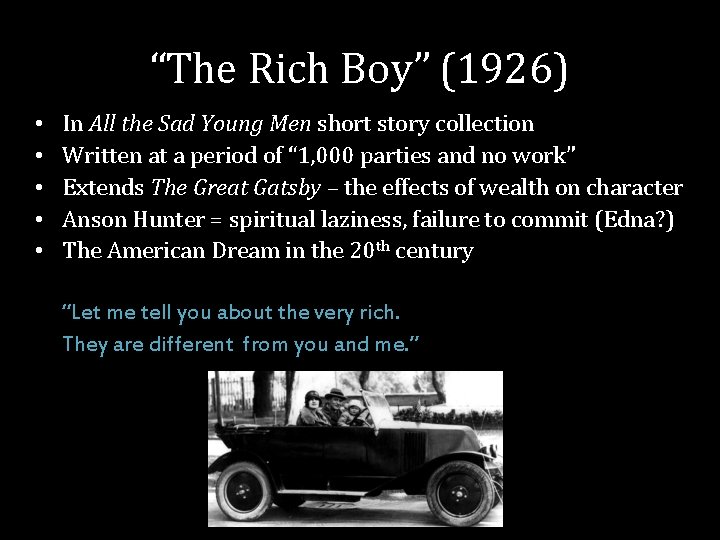
“The Rich Boy” (1926) • • • In All the Sad Young Men short story collection Written at a period of “ 1, 000 parties and no work” Extends The Great Gatsby – the effects of wealth on character Anson Hunter = spiritual laziness, failure to commit (Edna? ) The American Dream in the 20 th century “Let me tell you about the very rich. They are different from you and me. ”
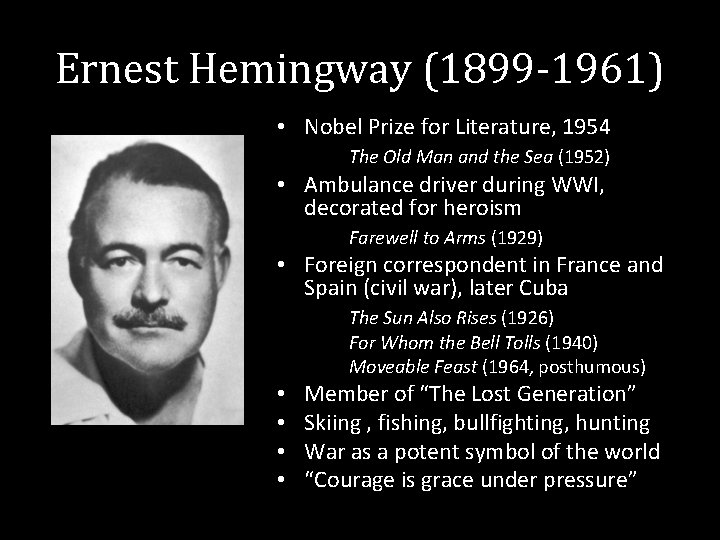
Ernest Hemingway (1899 -1961) • Nobel Prize for Literature, 1954 The Old Man and the Sea (1952) • Ambulance driver during WWI, decorated for heroism Farewell to Arms (1929) • Foreign correspondent in France and Spain (civil war), later Cuba The Sun Also Rises (1926) For Whom the Bell Tolls (1940) Moveable Feast (1964, posthumous) • • Member of “The Lost Generation” Skiing , fishing, bullfighting, hunting War as a potent symbol of the world “Courage is grace under pressure”
The Code Ηero • “[A] man who lives correctly, following the ideals of honor, courage and endurance in a world that is sometimes chaotic, often stressful, and always painful. ” • Own set of morals and principles based on his belief in honor, courage and endurance; free will • Measures himself by how well he copes under pressure- faces death with valiance • Believes in nada, the only guarantee is death • Never shows emotions • Afraid of the dark
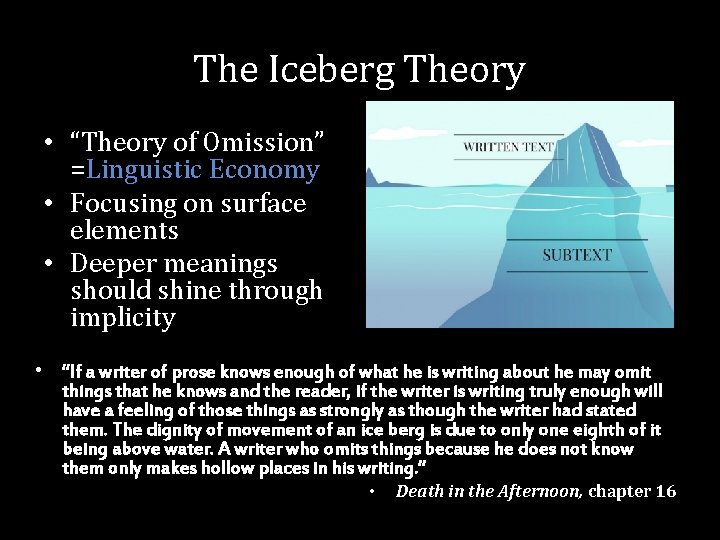
The Iceberg Theory • “Theory of Omission” =Linguistic Economy • Focusing on surface elements • Deeper meanings should shine through implicity • “If a writer of prose knows enough of what he is writing about he may omit things that he knows and the reader, if the writer is writing truly enough will have a feeling of those things as strongly as though the writer had stated them. The dignity of movement of an ice berg is due to only one eighth of it being above water. A writer who omits things because he does not know them only makes hollow places in his writing. ” • Death in the Afternoon, chapter 16
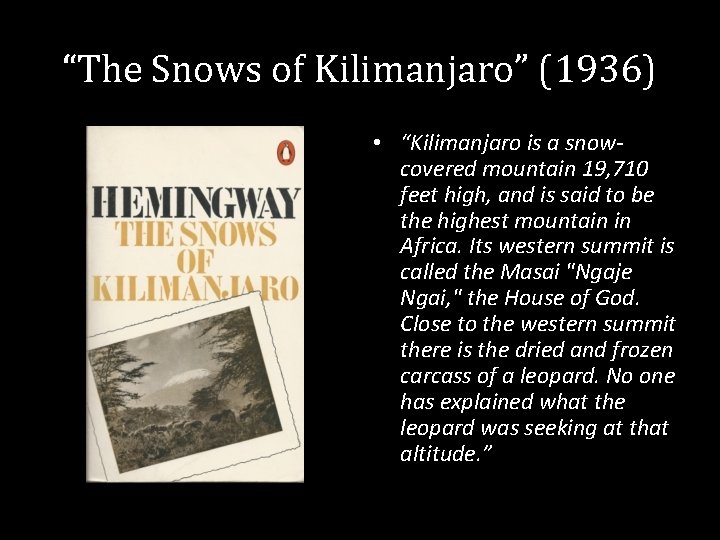
“The Snows of Kilimanjaro” (1936) • “Kilimanjaro is a snowcovered mountain 19, 710 feet high, and is said to be the highest mountain in Africa. Its western summit is called the Masai "Ngaje Ngai, " the House of God. Close to the western summit there is the dried and frozen carcass of a leopard. No one has explained what the leopard was seeking at that altitude. ”
“The Snows of Kilimanjaro” (1936) • Structure: Six sections – flashbacks inserted in italics; common theme? • Interior monologues • Opening / Ending • Themes: Ø Trauma and Loss (war) Ø Ø Ø Memory, writing Erosion of values, decay Wealth = sloth • Symbolism Ø Kilimanjaro vs the plains Ø Leopard, vultures, hyena Ø Snow Ø Airplane
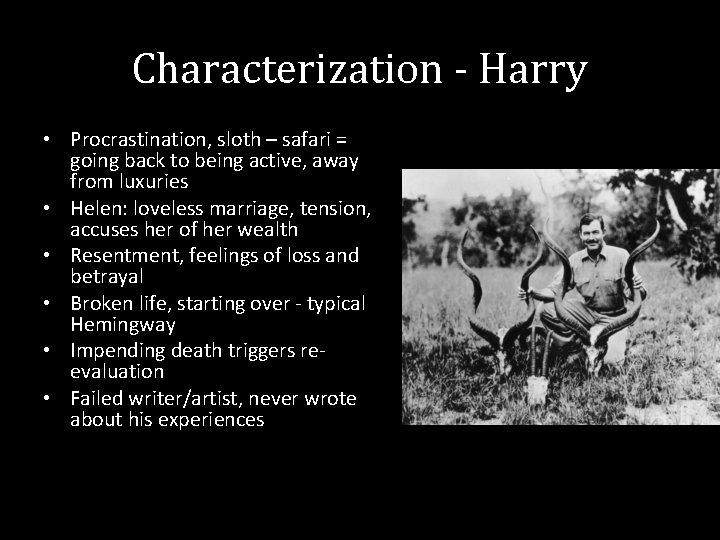
Characterization - Harry • Procrastination, sloth – safari = going back to being active, away from luxuries • Helen: loveless marriage, tension, accuses her of her wealth • Resentment, feelings of loss and betrayal • Broken life, starting over - typical Hemingway • Impending death triggers reevaluation • Failed writer/artist, never wrote about his experiences
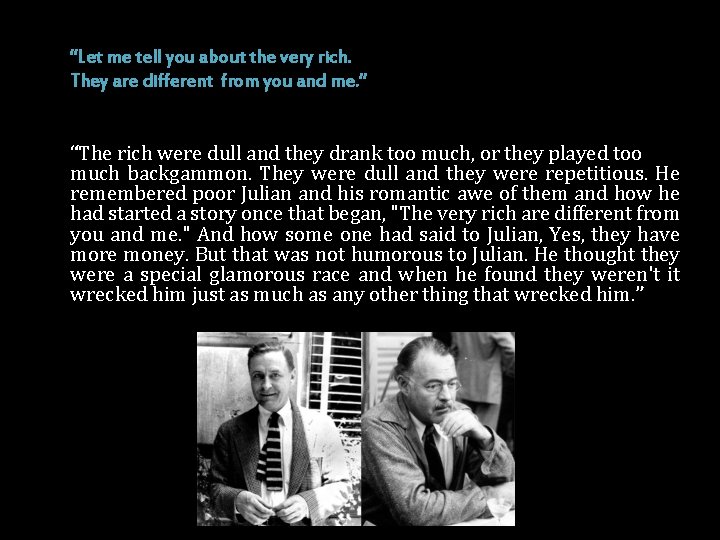
“Let me tell you about the very rich. They are different from you and me. ” “The rich were dull and they drank too much, or they played too much backgammon. They were dull and they were repetitious. He remembered poor Julian and his romantic awe of them and how he had started a story once that began, "The very rich are different from you and me. " And how some one had said to Julian, Yes, they have more money. But that was not humorous to Julian. He thought they were a special glamorous race and when he found they weren't it wrecked him just as much as any other thing that wrecked him. ”