
American Landrace The American Landrace is a white

- Slides: 16
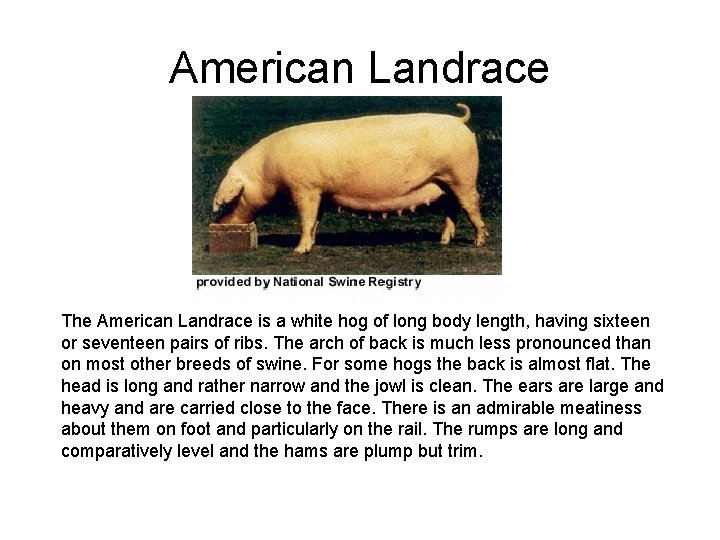
American Landrace The American Landrace is a white hog of long body length, having sixteen or seventeen pairs of ribs. The arch of back is much less pronounced than on most other breeds of swine. For some hogs the back is almost flat. The head is long and rather narrow and the jowl is clean. The ears are large and heavy and are carried close to the face. There is an admirable meatiness about them on foot and particularly on the rail. The rumps are long and comparatively level and the hams are plump but trim.
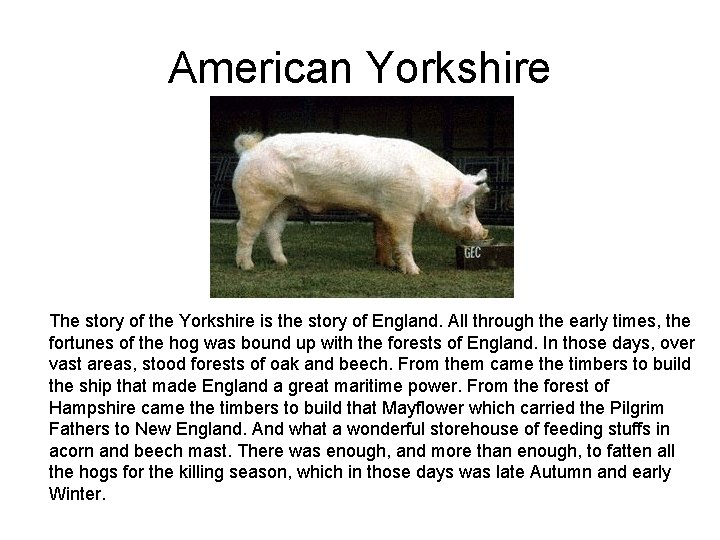
American Yorkshire The story of the Yorkshire is the story of England. All through the early times, the fortunes of the hog was bound up with the forests of England. In those days, over vast areas, stood forests of oak and beech. From them came the timbers to build the ship that made England a great maritime power. From the forest of Hampshire came the timbers to build that Mayflower which carried the Pilgrim Fathers to New England. And what a wonderful storehouse of feeding stuffs in acorn and beech mast. There was enough, and more than enough, to fatten all the hogs for the killing season, which in those days was late Autumn and early Winter.
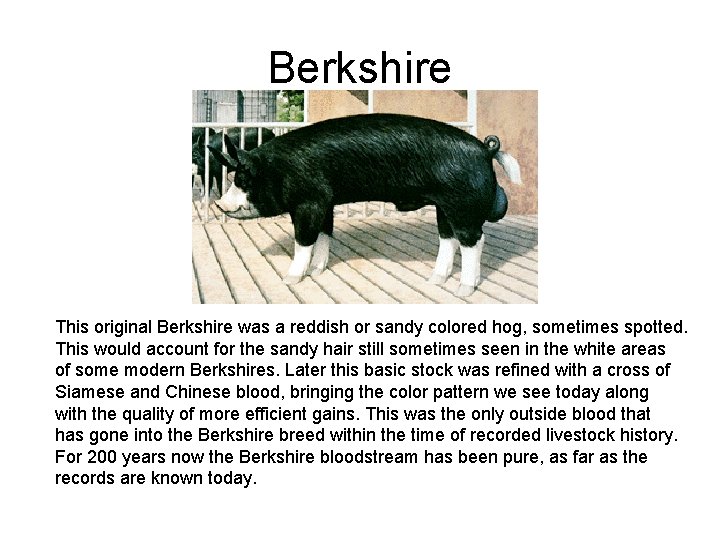
Berkshire This original Berkshire was a reddish or sandy colored hog, sometimes spotted. This would account for the sandy hair still sometimes seen in the white areas of some modern Berkshires. Later this basic stock was refined with a cross of Siamese and Chinese blood, bringing the color pattern we see today along with the quality of more efficient gains. This was the only outside blood that has gone into the Berkshire breed within the time of recorded livestock history. For 200 years now the Berkshire bloodstream has been pure, as far as the records are known today.
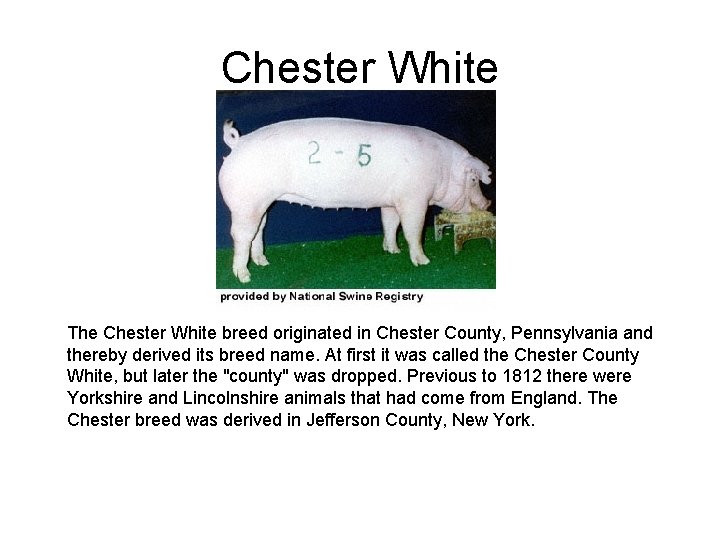
Chester White The Chester White breed originated in Chester County, Pennsylvania and thereby derived its breed name. At first it was called the Chester County White, but later the "county" was dropped. Previous to 1812 there were Yorkshire and Lincolnshire animals that had come from England. The Chester breed was derived in Jefferson County, New York.
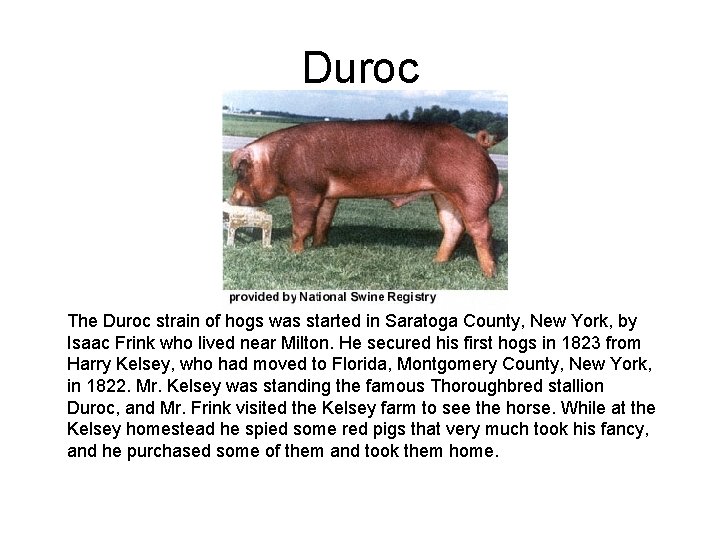
Duroc The Duroc strain of hogs was started in Saratoga County, New York, by Isaac Frink who lived near Milton. He secured his first hogs in 1823 from Harry Kelsey, who had moved to Florida, Montgomery County, New York, in 1822. Mr. Kelsey was standing the famous Thoroughbred stallion Duroc, and Mr. Frink visited the Kelsey farm to see the horse. While at the Kelsey homestead he spied some red pigs that very much took his fancy, and he purchased some of them and took them home.
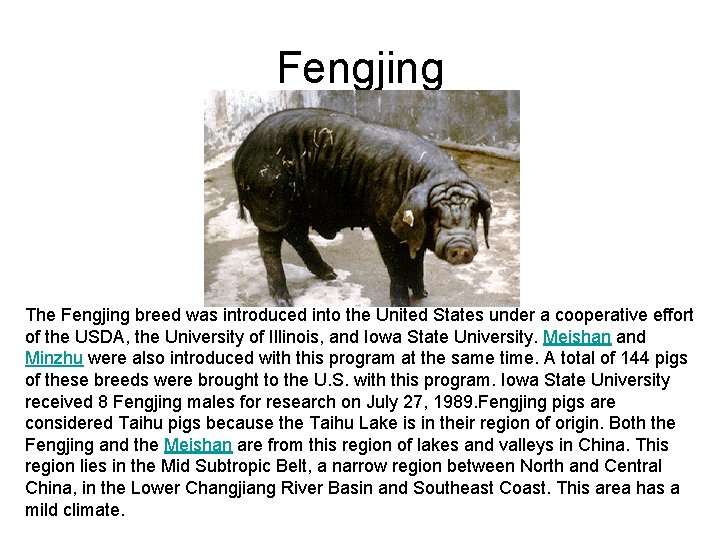
Fengjing The Fengjing breed was introduced into the United States under a cooperative effort of the USDA, the University of Illinois, and Iowa State University. Meishan and Minzhu were also introduced with this program at the same time. A total of 144 pigs of these breeds were brought to the U. S. with this program. Iowa State University received 8 Fengjing males for research on July 27, 1989. Fengjing pigs are considered Taihu pigs because the Taihu Lake is in their region of origin. Both the Fengjing and the Meishan are from this region of lakes and valleys in China. This region lies in the Mid Subtropic Belt, a narrow region between North and Central China, in the Lower Changjiang River Basin and Southeast Coast. This area has a mild climate.
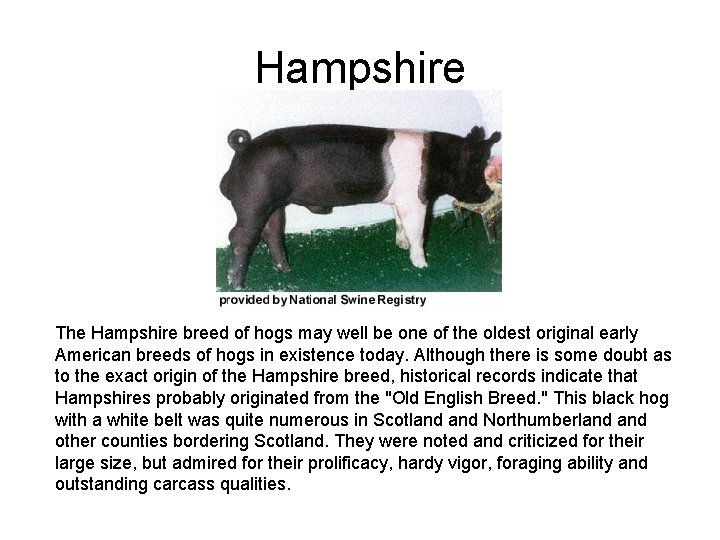
Hampshire The Hampshire breed of hogs may well be one of the oldest original early American breeds of hogs in existence today. Although there is some doubt as to the exact origin of the Hampshire breed, historical records indicate that Hampshires probably originated from the "Old English Breed. " This black hog with a white belt was quite numerous in Scotland Northumberland other counties bordering Scotland. They were noted and criticized for their large size, but admired for their prolificacy, hardy vigor, foraging ability and outstanding carcass qualities.
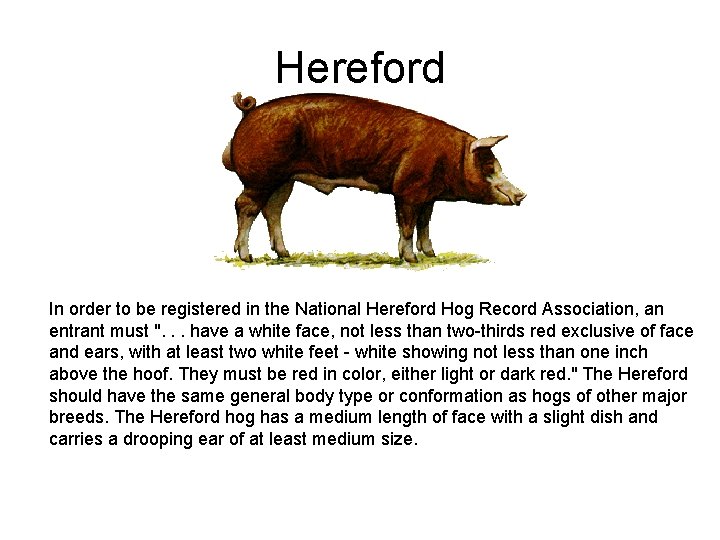
Hereford In order to be registered in the National Hereford Hog Record Association, an entrant must ". . . have a white face, not less than two-thirds red exclusive of face and ears, with at least two white feet - white showing not less than one inch above the hoof. They must be red in color, either light or dark red. " The Hereford should have the same general body type or conformation as hogs of other major breeds. The Hereford hog has a medium length of face with a slight dish and carries a drooping ear of at least medium size.
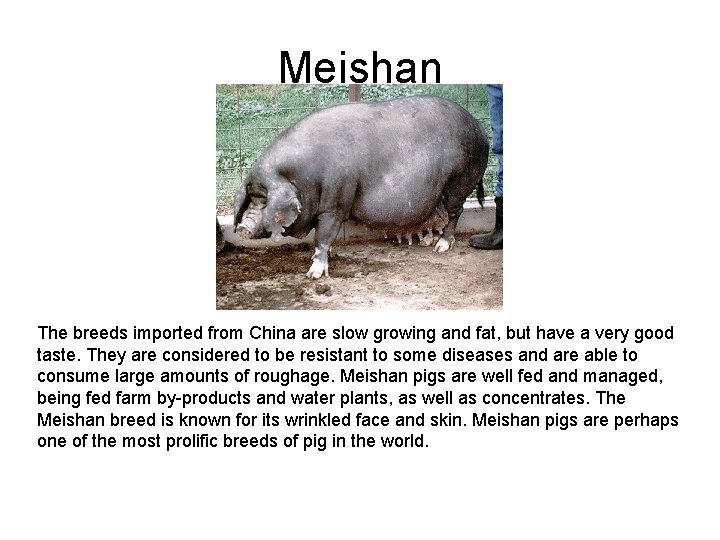
Meishan The breeds imported from China are slow growing and fat, but have a very good taste. They are considered to be resistant to some diseases and are able to consume large amounts of roughage. Meishan pigs are well fed and managed, being fed farm by-products and water plants, as well as concentrates. The Meishan breed is known for its wrinkled face and skin. Meishan pigs are perhaps one of the most prolific breeds of pig in the world.
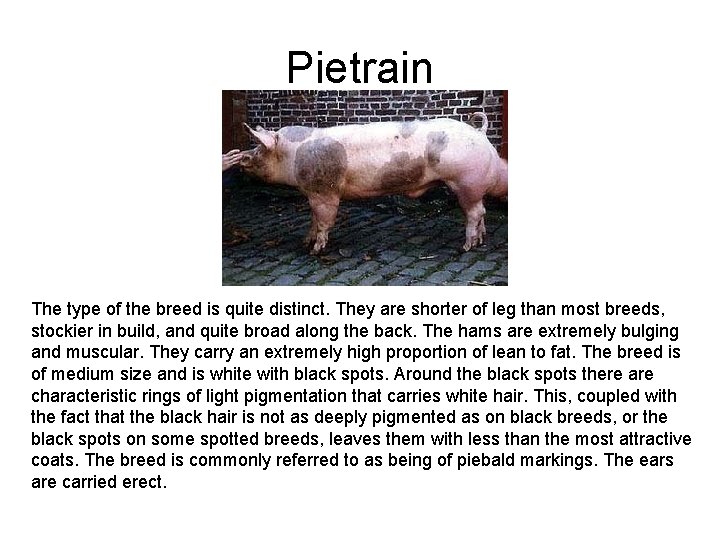
Pietrain The type of the breed is quite distinct. They are shorter of leg than most breeds, stockier in build, and quite broad along the back. The hams are extremely bulging and muscular. They carry an extremely high proportion of lean to fat. The breed is of medium size and is white with black spots. Around the black spots there are characteristic rings of light pigmentation that carries white hair. This, coupled with the fact that the black hair is not as deeply pigmented as on black breeds, or the black spots on some spotted breeds, leaves them with less than the most attractive coats. The breed is commonly referred to as being of piebald markings. The ears are carried erect.
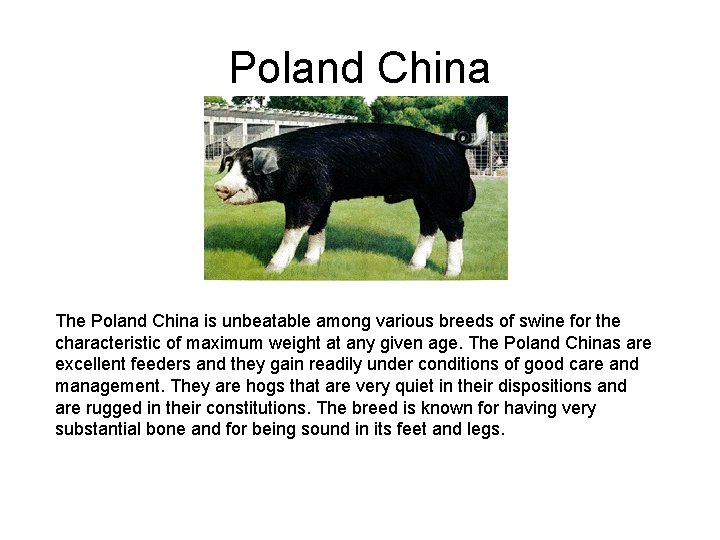
Poland China The Poland China is unbeatable among various breeds of swine for the characteristic of maximum weight at any given age. The Poland Chinas are excellent feeders and they gain readily under conditions of good care and management. They are hogs that are very quiet in their dispositions and are rugged in their constitutions. The breed is known for having very substantial bone and for being sound in its feet and legs.
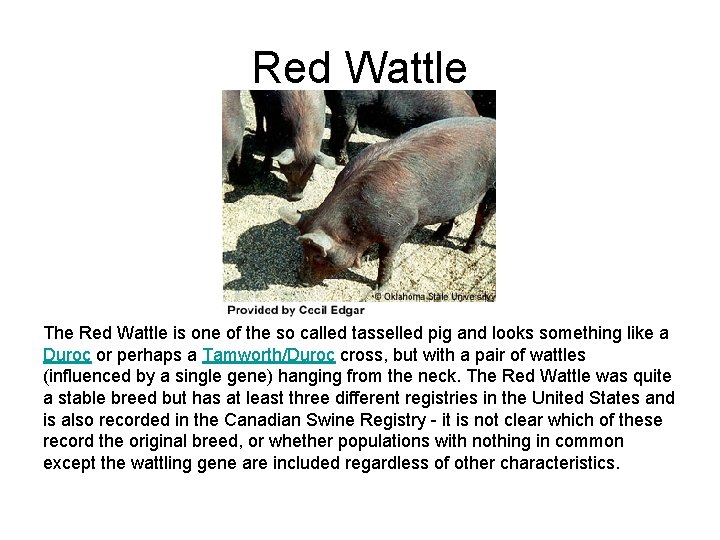
Red Wattle The Red Wattle is one of the so called tasselled pig and looks something like a Duroc or perhaps a Tamworth/Duroc cross, but with a pair of wattles (influenced by a single gene) hanging from the neck. The Red Wattle was quite a stable breed but has at least three different registries in the United States and is also recorded in the Canadian Swine Registry - it is not clear which of these record the original breed, or whether populations with nothing in common except the wattling gene are included regardless of other characteristics.
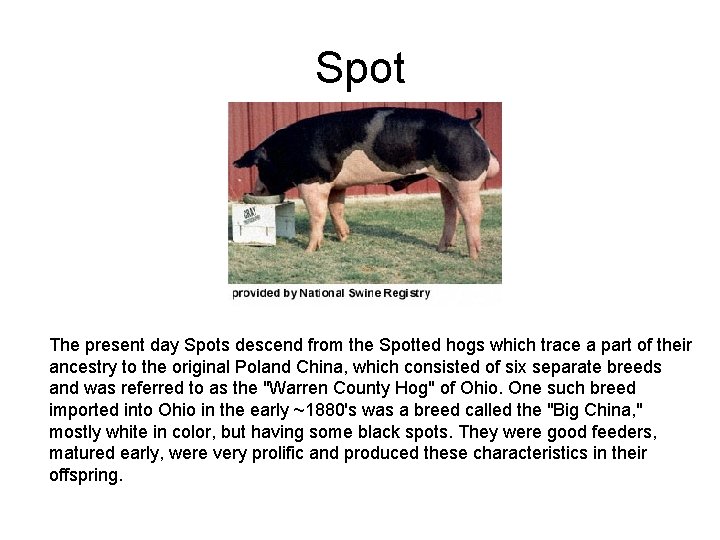
Spot The present day Spots descend from the Spotted hogs which trace a part of their ancestry to the original Poland China, which consisted of six separate breeds and was referred to as the "Warren County Hog" of Ohio. One such breed imported into Ohio in the early ~1880's was a breed called the "Big China, " mostly white in color, but having some black spots. They were good feeders, matured early, were very prolific and produced these characteristics in their offspring.
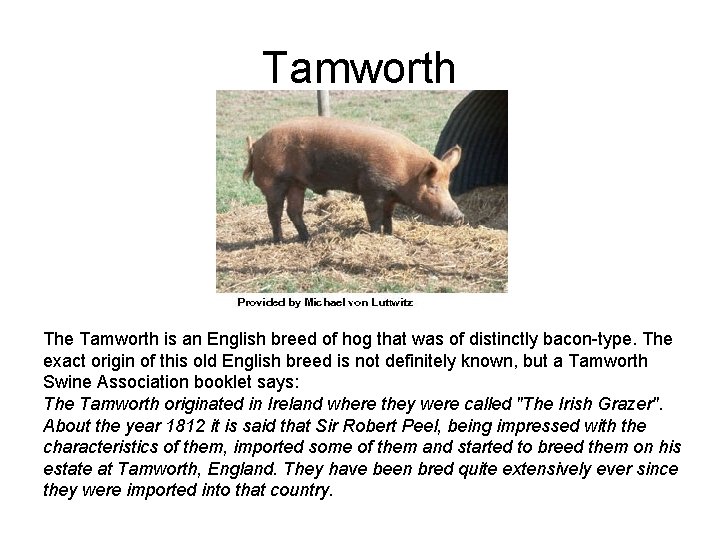
Tamworth The Tamworth is an English breed of hog that was of distinctly bacon-type. The exact origin of this old English breed is not definitely known, but a Tamworth Swine Association booklet says: The Tamworth originated in Ireland where they were called "The Irish Grazer". About the year 1812 it is said that Sir Robert Peel, being impressed with the characteristics of them, imported some of them and started to breed them on his estate at Tamworth, England. They have been bred quite extensively ever since they were imported into that country.
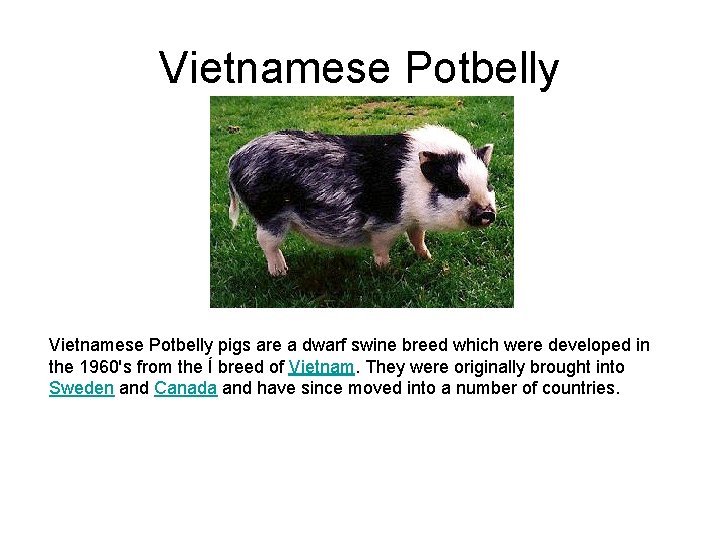
Vietnamese Potbelly pigs are a dwarf swine breed which were developed in the 1960's from the Í breed of Vietnam. They were originally brought into Sweden and Canada and have since moved into a number of countries.
Resources http: //www. ansi. okstate. edu/breeds/swine/