
AMERICAN GROWTH AFTER 1800 USHC STANDARD 2 THE


- Slides: 118
AMERICAN GROWTH AFTER 1800 - USHC STANDARD 2 THE STUDENT WILL DEMONSTRATE AN UNDERSTANDING OF HOW ECONOMIC DEVELOPMENTS AND THE WESTWARD MOVEMENT IMPACTED REGIONAL DIFFERENCES AND DEMOCRACY IN THE EARLY NINETEENTH CENTURY.
USHC Standard 2 Indicators USHC 2. 1 – Summarize the impact of the westward movement on nationalism and democracy, including the expansion of the franchise, the displacement of Native Americans from the southeast and conflicts over states’ rights and federal power during the era of Jacksonian democracy as the result of major land acquisitions such as the Louisiana Purchase, the Oregon Treaty, and the Mexican Cession.
USHC Standard 2 Indicators USHC 2. 2 – Explain how the Monroe Doctrine and the concept of Manifest Destiny affected the United States’ relationships with foreign powers, including the role of the United States in the Texan Revolution and the Mexican War. USHC 2. 3 – Compare the economic development in different regions (the South, the North, and the West) of the United States during the early nineteenth century, including ways that economic policy contributed to political controversies.
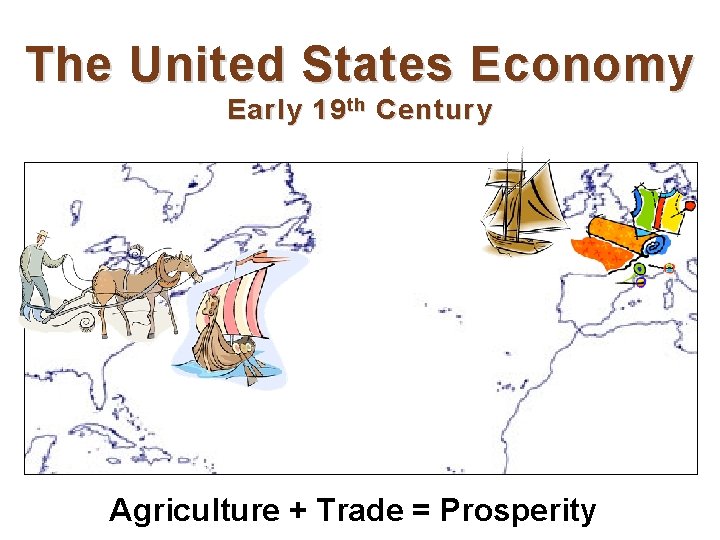
The United States Economy Early 19 th Century Agriculture + Trade = Prosperity
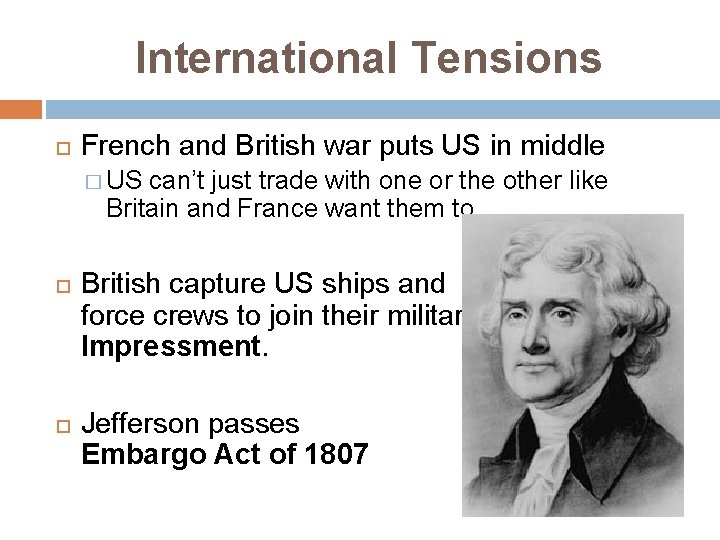
International Tensions French and British war puts US in middle � US can’t just trade with one or the other like Britain and France want them to. British capture US ships and force crews to join their military Impressment. Jefferson passes Embargo Act of 1807
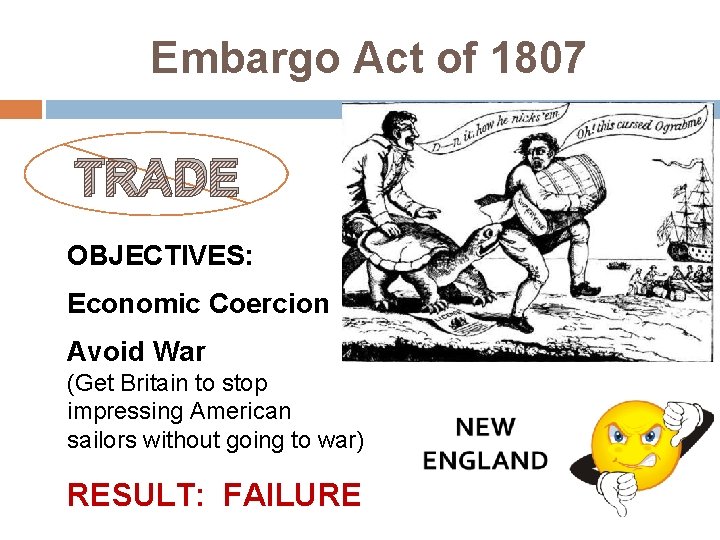
Embargo Act of 1807 TRADE OBJECTIVES: Economic Coercion Avoid War (Get Britain to stop impressing American sailors without going to war) RESULT: FAILURE
CFU 1. What is impressment of sailors? � Great Britain was capturing US ships and forcing the crews to join their military against the French in the Napoleonic Wars. 2. What did the Embargo Act of 1807 do? � Halted all trade with France and England, hoping to result in economic hardship that forced an end to impressment. 3. Was the Embargo Act of 1807 effective? � No. It was ineffective and revoked.
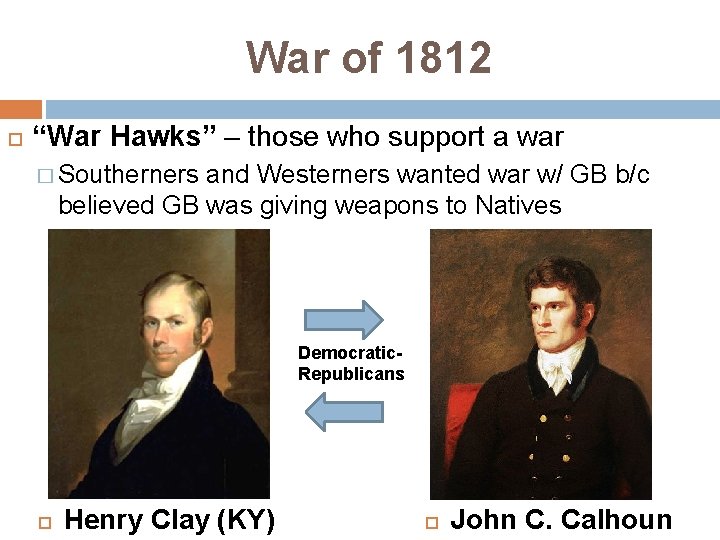
War of 1812 “War Hawks” – those who support a war � Southerners and Westerners wanted war w/ GB b/c believed GB was giving weapons to Natives Democratic. Republicans Henry Clay (KY) John C. Calhoun
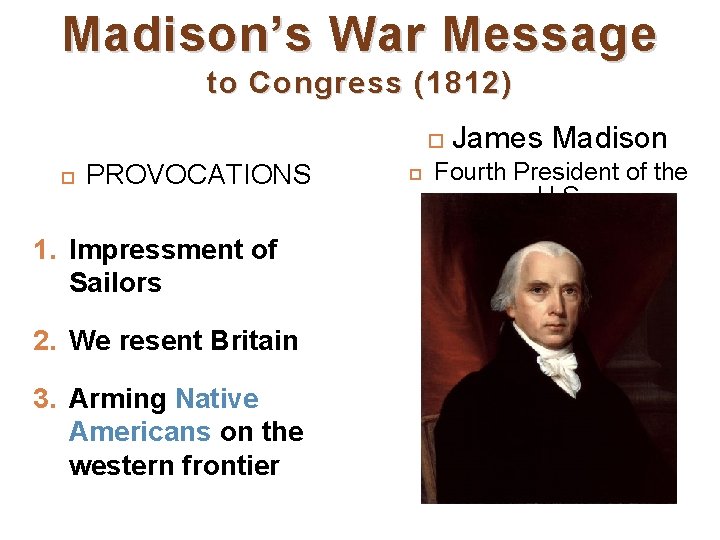
Madison’s War Message to Congress (1812) PROVOCATIONS 1. Impressment of Sailors 2. We resent Britain 3. Arming Native Americans on the western frontier James Madison Fourth President of the U. S.
Results of War of 1812 1. Growth of Nationalism 2. US wanted more isolationism from Europe 3. 4. 5. Spurred westward migration b/c of job loss and decreased trade Encouraged Industrial Rev. b/c cut off trade from GB Ended Federalist Party (didn’t support war)
CFU 4. What are “War Hawks”? � Congressmen who supported a war against Britain (War of 1812) – Henry Clay and John C. Calhoun 5. What was the cause of the War of 1812? � British impressment of soldiers, suspicion of Britain arming Native Americans, and overall resentment. 6. Was the effect of the War of 1812? � British finally removed from American land. Rise of nationalism and industry, Thomas Jefferson
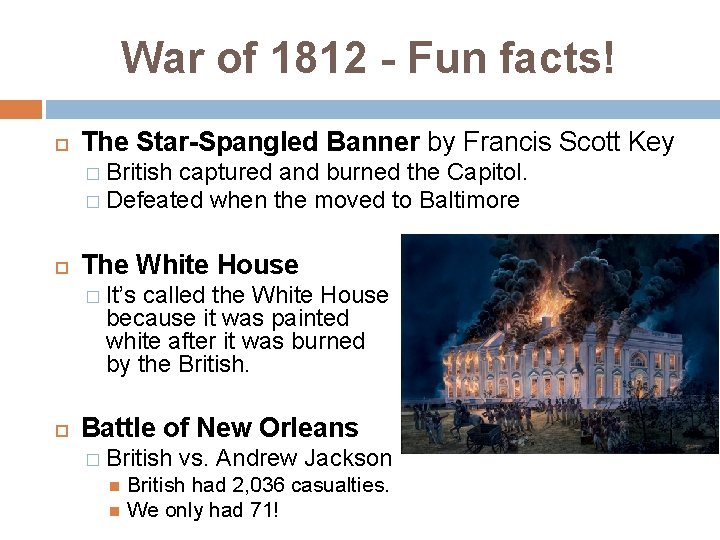
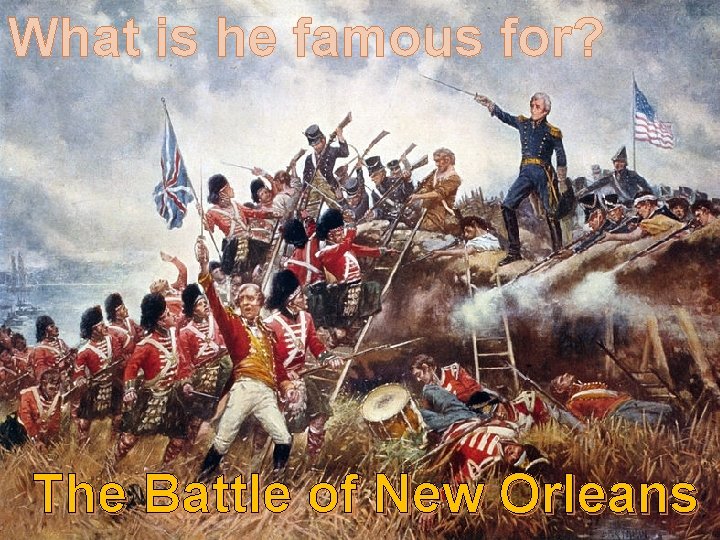
War of 1812 - Fun facts! The Star-Spangled Banner by Francis Scott Key � British captured and burned the Capitol. � Defeated when the moved to Baltimore The White House � It’s called the White House because it was painted white after it was burned by the British. Battle of New Orleans � British vs. Andrew Jackson British had 2, 036 casualties. We only had 71!
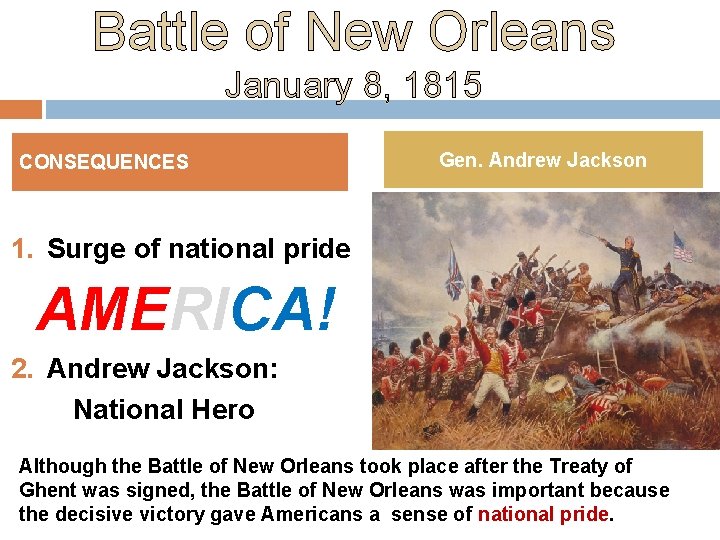
Battle of New Orleans January 8, 1815 CONSEQUENCES Gen. Andrew Jackson 1. Surge of national pride AMERICA! 2. Andrew Jackson: National Hero Although the Battle of New Orleans took place after the Treaty of Ghent was signed, the Battle of New Orleans was important because the decisive victory gave Americans a sense of national pride.
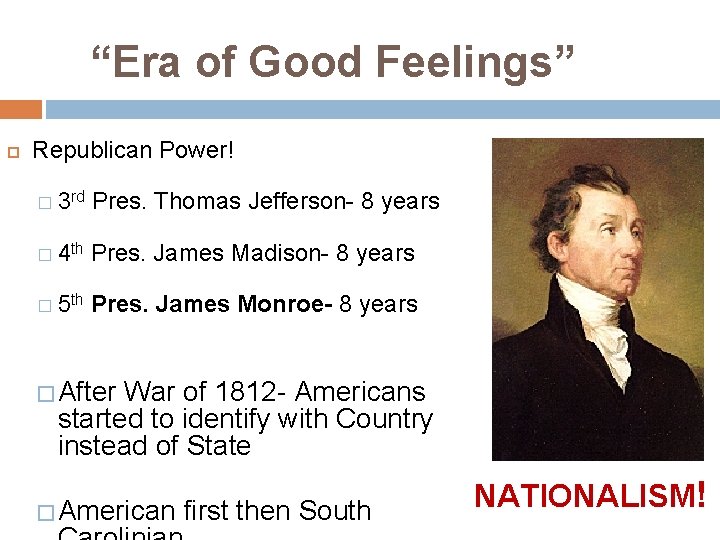
“Era of Good Feelings” Republican Power! � 3 rd Pres. Thomas Jefferson- 8 years � 4 th Pres. James Madison- 8 years � 5 th Pres. James Monroe- 8 years � After War of 1812 - Americans started to identify with Country instead of State � American first then South NATIONALISM!
CFU 7. Why is it called the “Era of Good Feelings”? � Rise of nationalism after a victorious War of 1812. 8. Why do the Republicans have 24 years of presidential power? � The Federalists died out with President Adams and their opposition of the War of 1812. 9. What is nationalism? � Love for your country – country first, then state.
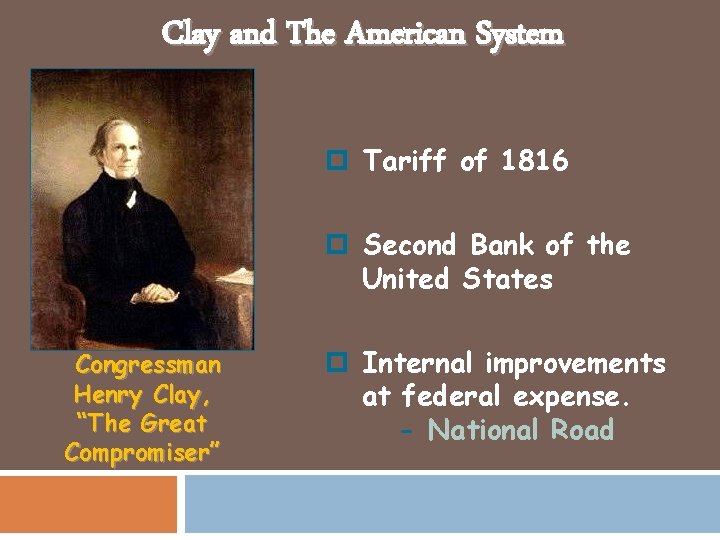
Clay and The American System p Tariff of 1816 p Second Bank of the United States Congressman Henry Clay, “The Great Compromiser” p Internal improvements at federal expense. - National Road
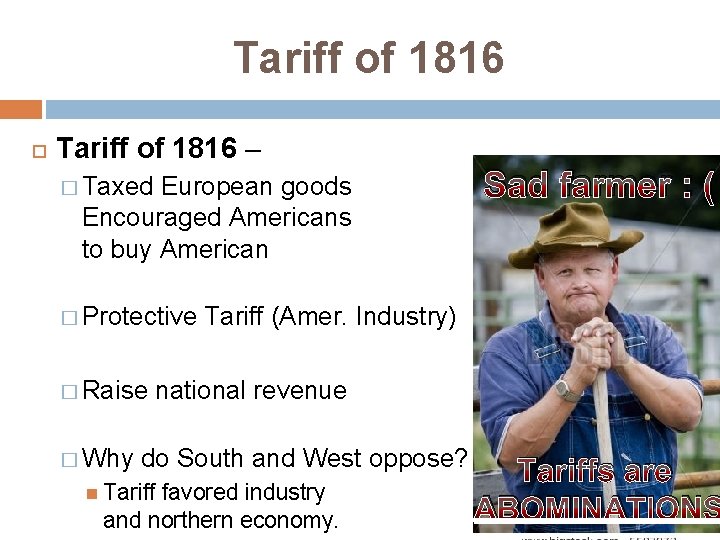
Tariff of 1816 – � Taxed European goods Encouraged Americans to buy American � Protective � Raise � Why Sad farmer : ( Tariff (Amer. Industry) national revenue do South and West oppose? Tariff favored industry and northern economy. Tariffs are ABOMINATIONS
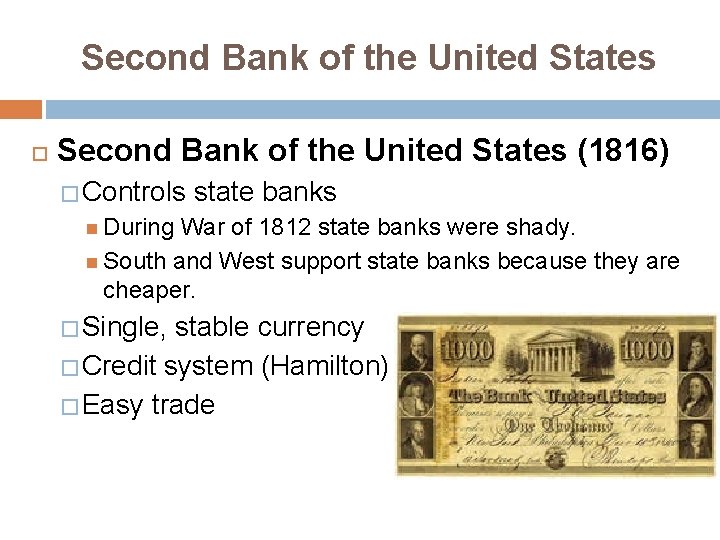
Second Bank of the United States (1816) � Controls state banks During War of 1812 state banks were shady. South and West support state banks because they are cheaper. � Single, stable currency � Credit system (Hamilton) � Easy trade
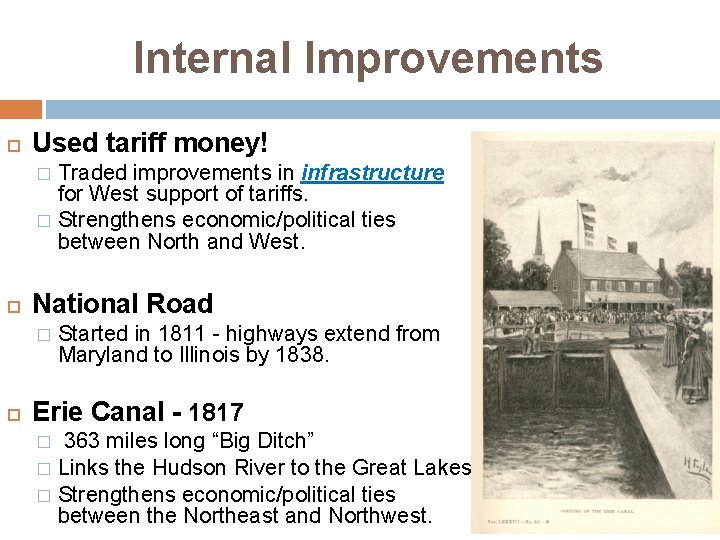
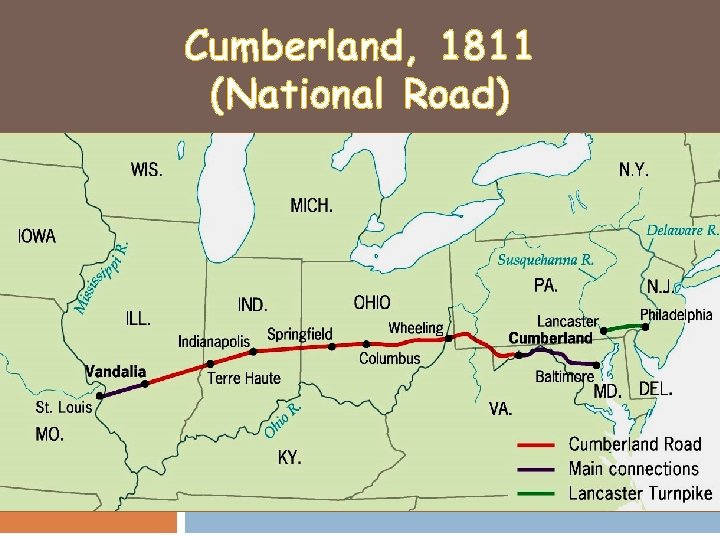
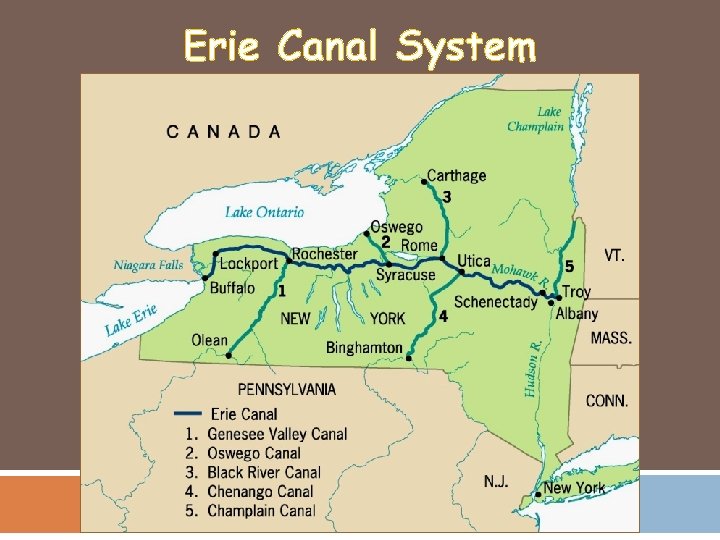
Internal Improvements Used tariff money! Traded improvements in infrastructure for West support of tariffs. � Strengthens economic/political ties between North and West. � National Road � Started in 1811 - highways extend from Maryland to Illinois by 1838. Erie Canal - 1817 363 miles long “Big Ditch” � Links the Hudson River to the Great Lakes. � Strengthens economic/political ties between the Northeast and Northwest. �
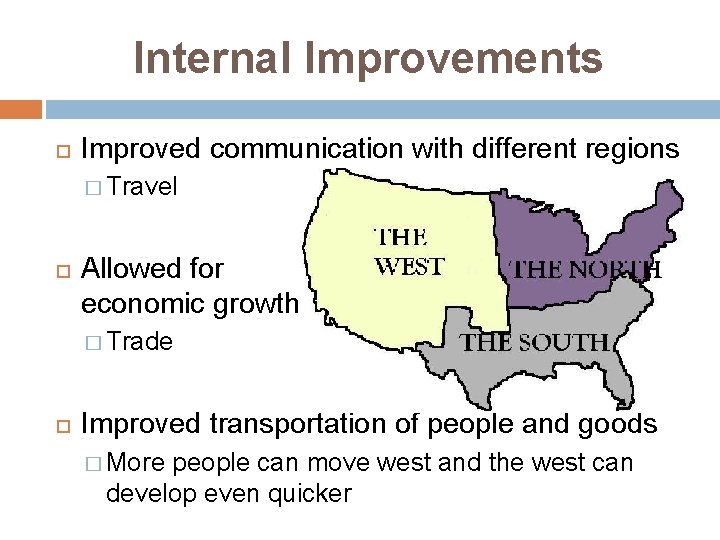
Internal Improvements Improved communication with different regions � Travel Allowed for economic growth � Trade Improved transportation of people and goods � More people can move west and the west can develop even quicker
CFU 10. Why did the South and West oppose tariffs? � The tariffs protected emerging northern businesses. Southerners viewed tariffs as “abominations”. 11. Why did the South and West oppose the Second National Bank? � They like state based banks because they offered cheaper loans. 12. What are internal improvements?
CFU 13. Why did the West begin to support protective tariffs? � North agreed to share infrastructural improvements with West if they supported protective tariffs. 14. What was the benefit of the Erie Canal? � Interconnectedness between NE and NW. Expedites communication/travel/trade. 15. In what ways did internal improvements change the United States? � Increased communication, travel, trade, and American economic growth.
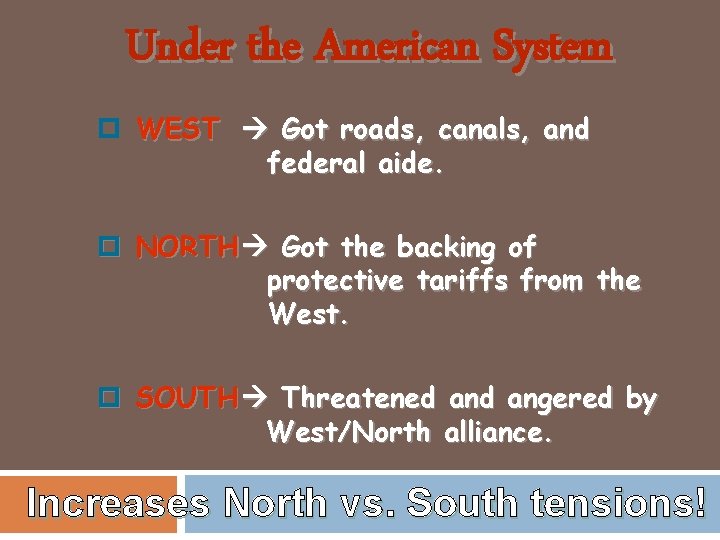
Under the American System p WEST Got roads, canals, and federal aide. p NORTH Got the backing of protective tariffs from the West. p SOUTH Threatened angered by West/North alliance. Increases North vs. South tensions!
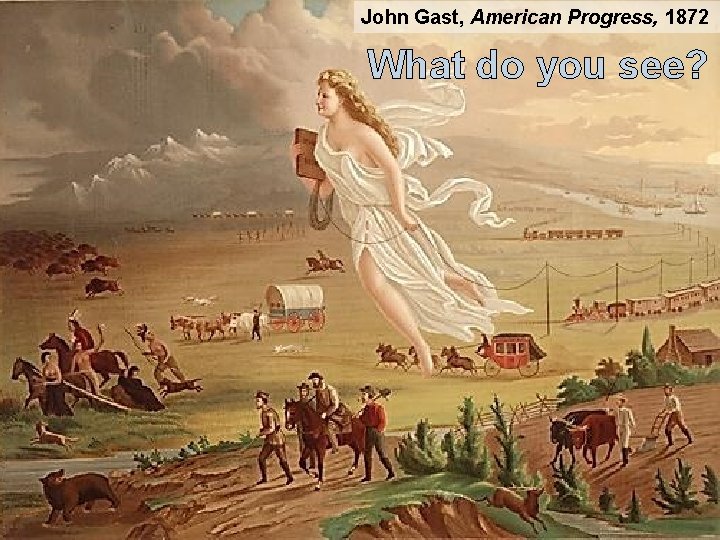
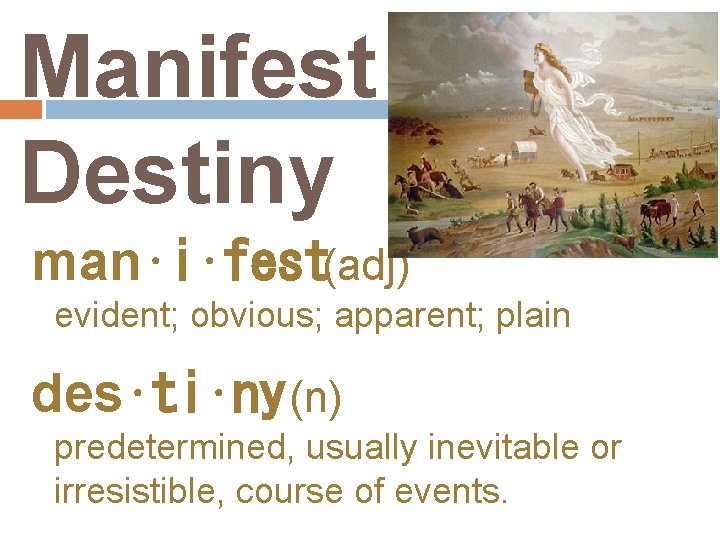
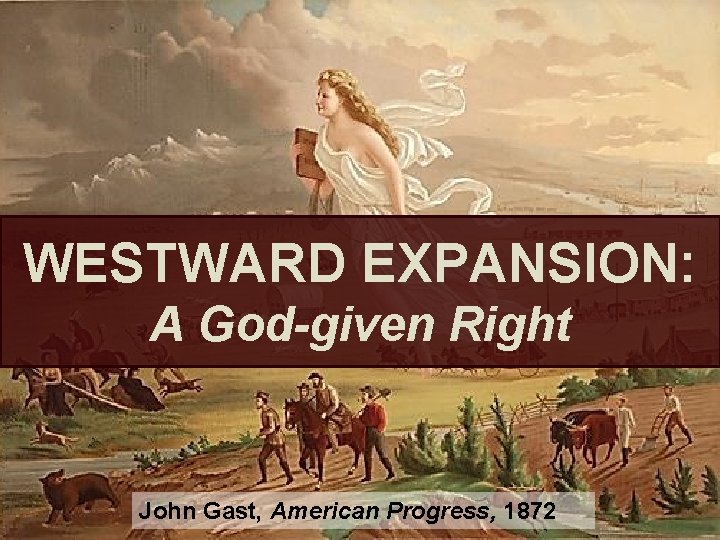
John Gast, American Progress, 1872 What do you see?
Manifest Destiny man⋅i⋅fest(adj) evident; obvious; apparent; plain des⋅ti⋅ny (n) predetermined, usually inevitable or irresistible, course of events.
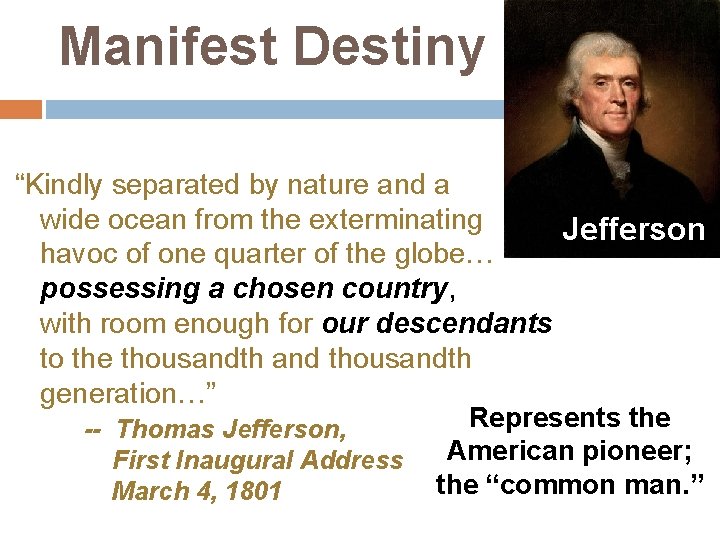
Manifest Destiny “Kindly separated by nature and a wide ocean from the exterminating Jefferson havoc of one quarter of the globe… possessing a chosen country, with room enough for our descendants to the thousandth and thousandth generation…” Represents the -- Thomas Jefferson, American pioneer; First Inaugural Address the “common man. ” March 4, 1801
WESTWARD EXPANSION: A God-given Right John Gast, American Progress, 1872
CFU 16. What is Manifest Destiny? � An obvious course of predetermined events; it’s meant to happen because God wants it to. 17. What do Americans use Manifest Destiny to justify? � Westward expansion, a God-given right. 18. Whose bright idea was it anyway? � Thomas Jefferson – and he uses it!
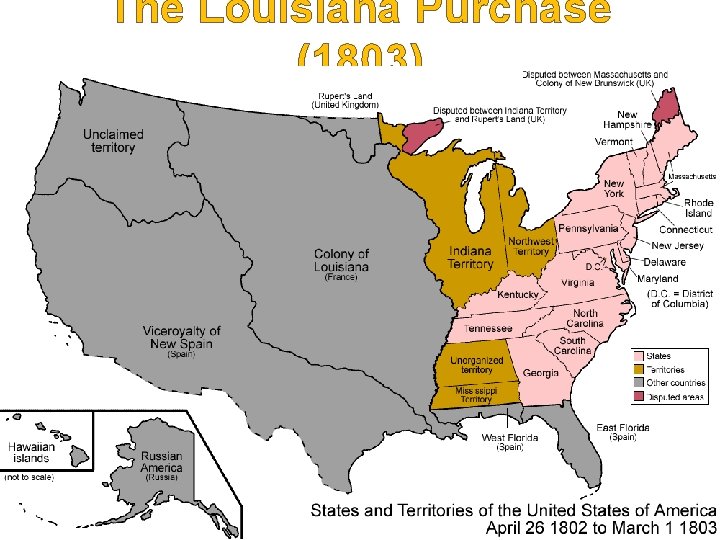
The Louisiana Purchase (1803)
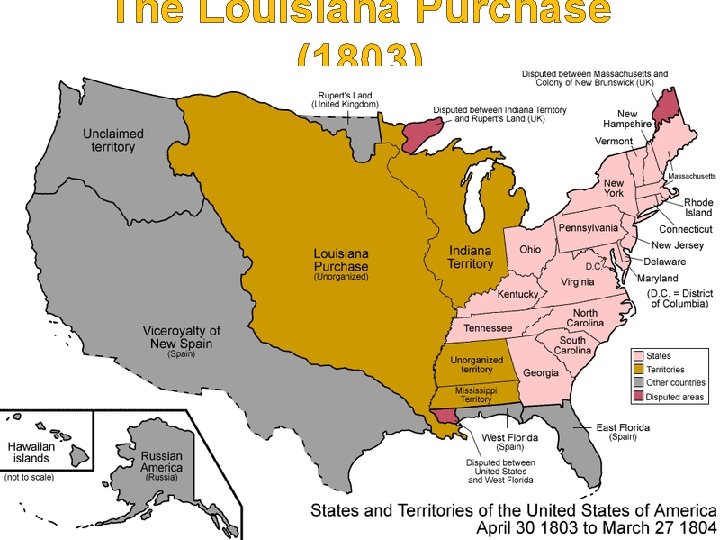
The Louisiana Purchase (1803)
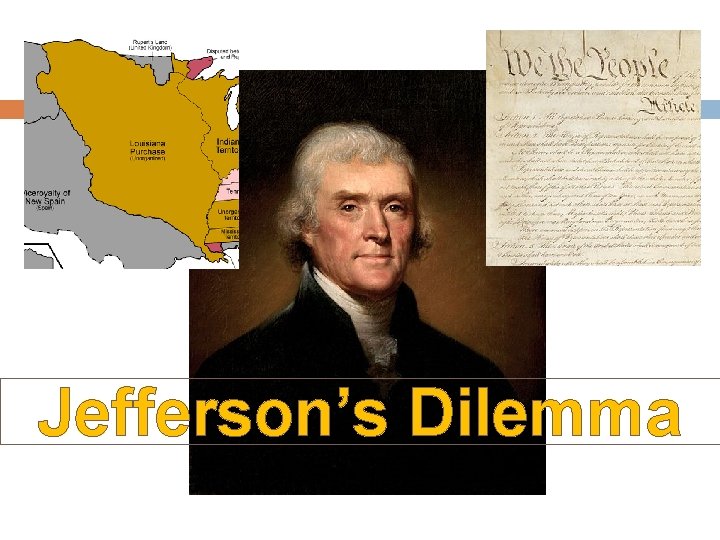
Jefferson’s Dilemma
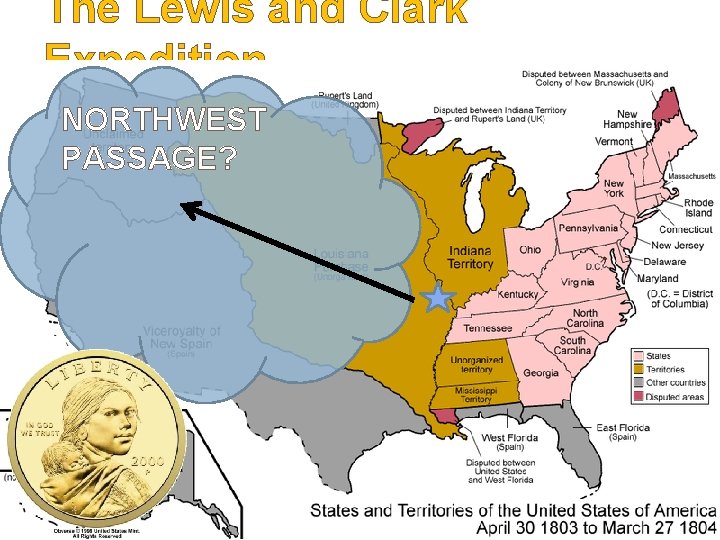
The Lewis and Clark Expedition NORTHWEST PASSAGE?
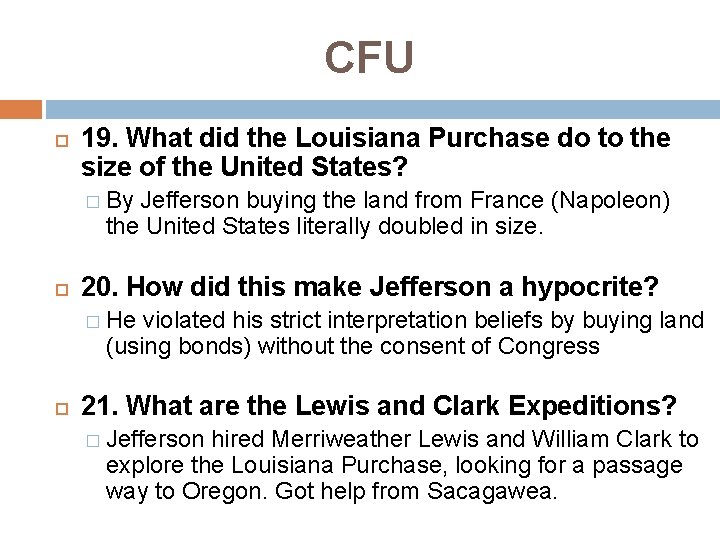
CFU 19. What did the Louisiana Purchase do to the size of the United States? � By Jefferson buying the land from France (Napoleon) the United States literally doubled in size. 20. How did this make Jefferson a hypocrite? � He violated his strict interpretation beliefs by buying land (using bonds) without the consent of Congress 21. What are the Lewis and Clark Expeditions? � Jefferson hired Merriweather Lewis and William Clark to explore the Louisiana Purchase, looking for a passage way to Oregon. Got help from Sacagawea.
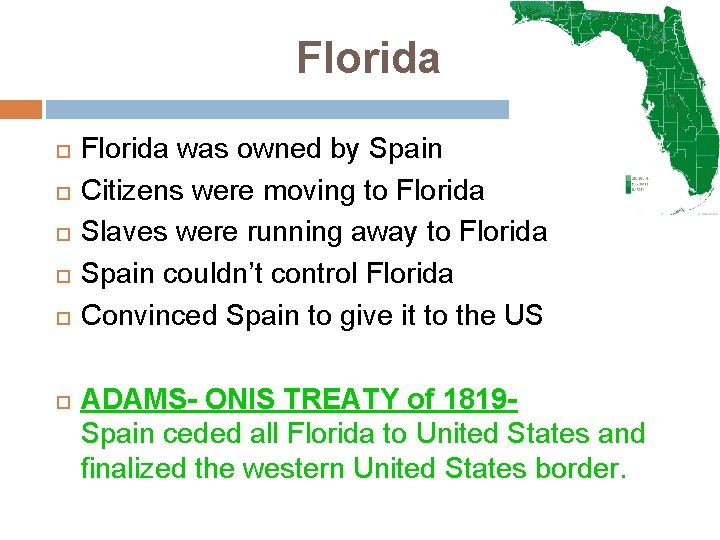
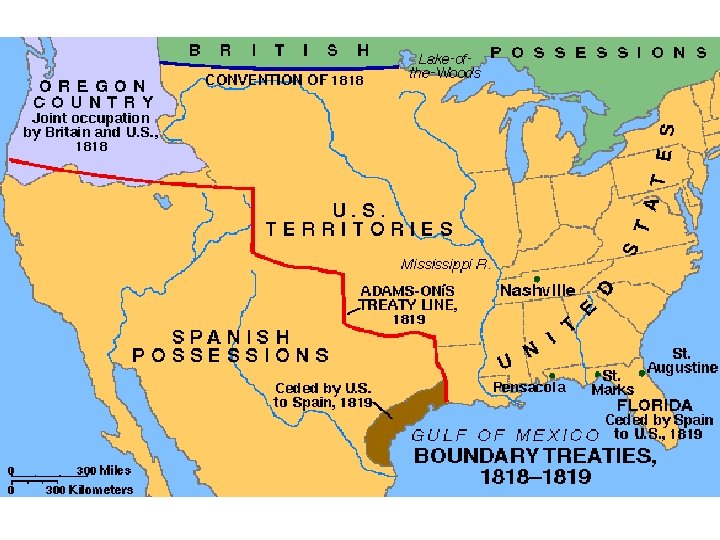
Florida Florida was owned by Spain Citizens were moving to Florida Slaves were running away to Florida Spain couldn’t control Florida Convinced Spain to give it to the US ADAMS- ONIS TREATY of 1819 Spain ceded all Florida to United States and finalized the western United States border.
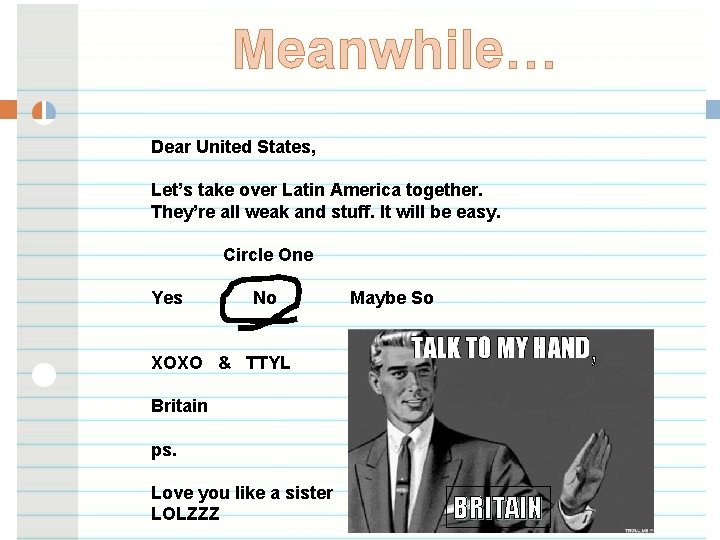
Meanwhile… Dear United States, Let’s take over Latin America together. They’re all weak and stuff. It will be easy. Circle One Yes No Maybe So , XOXO & TTYL Britain ps. Love you like a sister LOLZZZ BRITAIN
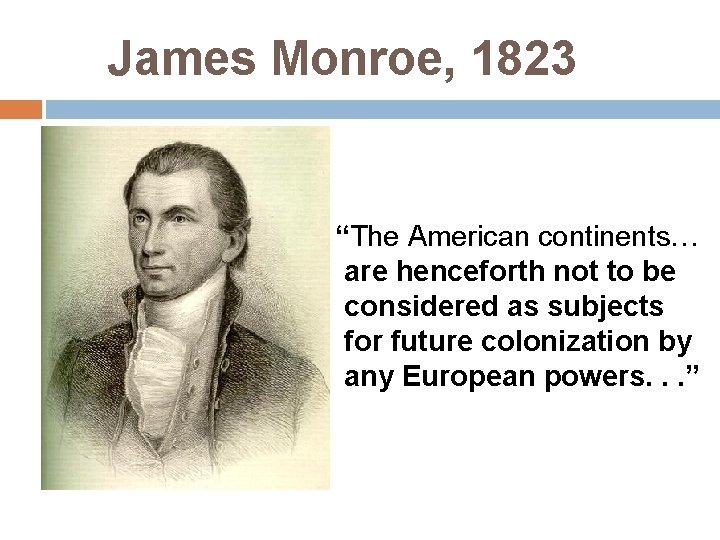
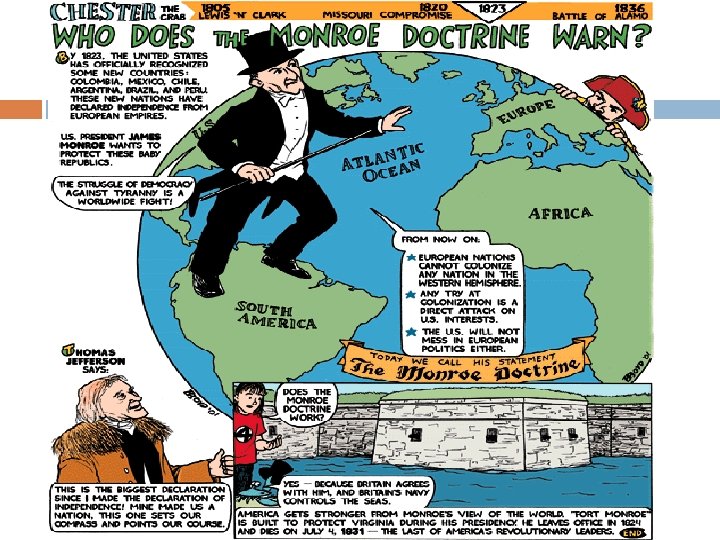
James Monroe, 1823 “The American continents… are henceforth not to be considered as subjects for future colonization by any European powers. . . ”
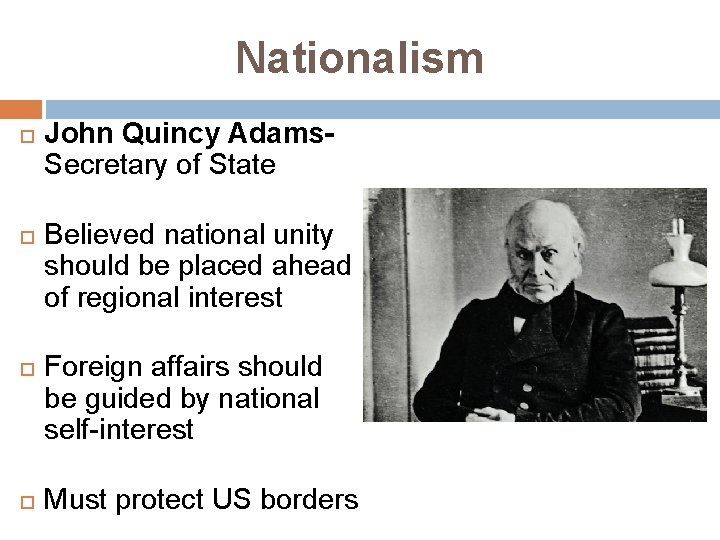
Nationalism John Quincy Adams. Secretary of State Believed national unity should be placed ahead of regional interest Foreign affairs should be guided by national self-interest Must protect US borders
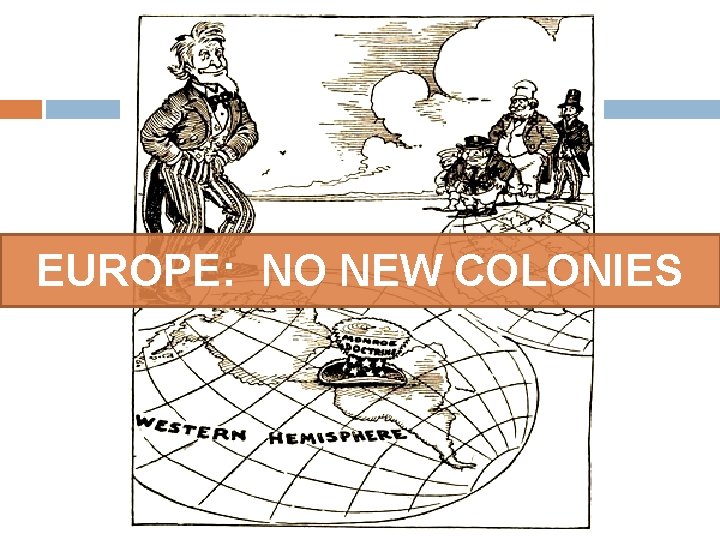
Monroe Doctrine, 1823 America is tired of the French, British and Spanish military presence in North and South American waters Pres. James Monroe and Sec. of State, John Quincy Adams, draft the Monroe Doctrine Declares American dominance in the Western Hemisphere Told Europe to stay out
EUROPE: NO NEW COLONIES
Monroe Doctrine, 1823 By 1824, all of Spain’s colonies had declared independence (like the United States in 1776) United States wanted to prevent any European countries trying to retake over the new, weak independent countries of Latin America First of many times for us to prevent other great powers from interfering into other countries (Presidents T. Roosevelt, Wilson, and Taft)
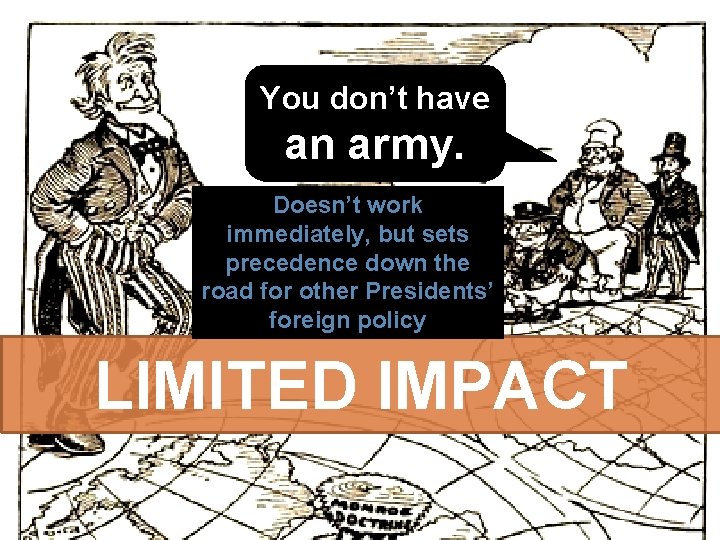
You don’t have an army. Doesn’t work immediately, but sets precedence down the road for other Presidents’ foreign policy LIMITED IMPACT
The Monroe Doctrine, 1823 Memory Trick! Monroe = Mono Doctrine = Doctor When you have Mono the doctor tells you to stay away from everyone. James Monroe told Europe to stay out of the Western Hemisphere Monroe Doctrine = Mono Doctor
CFU 22. How did the United States acquire Florida? � It was too difficult for Spain to control from Europe. 23. What was the Monroe Doctrine? � Told all Europeans to stay out of the business of the western hemisphere. 24. What was the motivation behind the Monroe Doctrine? � To protect US interest in the newly independent Latin American countries.
CFU 25. Why was the immediate impact of the Monroe Doctrine limited? � We didn’t have a Navy to back it up. 26. What is the long-term importance of the Monroe Doctrine? � Was used for future foreign policy protecting Latin America (Presidents Roosevelt, Wilson, and Taft). 27. What’s the memory trick for remembering the Monroe Doctrine? � Mono Doctor.
People Push West More and more moving west A territory can apply for statehood once had it has 60, 000 residents Missouri wants to be a state… � But what kind? � Slave or Free?
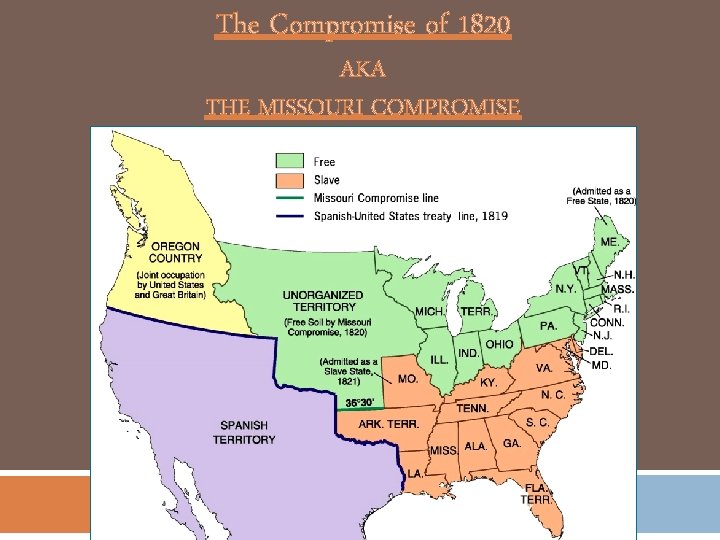
The Compromise of 1820 AKA THE MISSOURI COMPROMISE
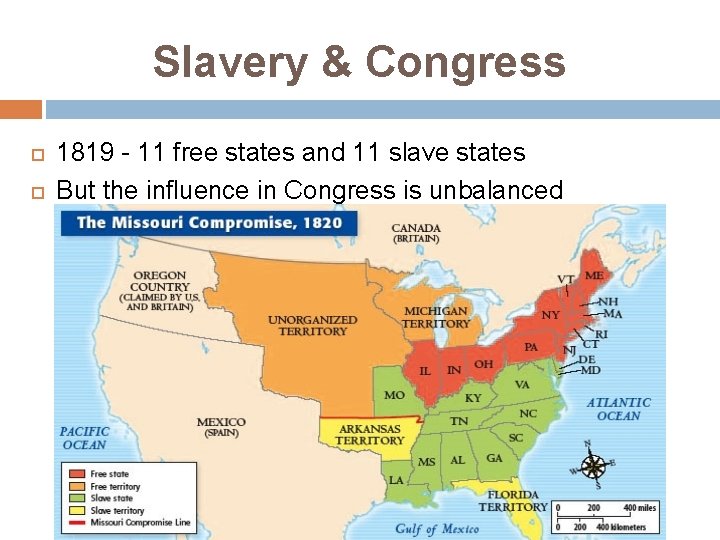
Slavery & Congress 1819 - 11 free states and 11 slave states But the influence in Congress is unbalanced
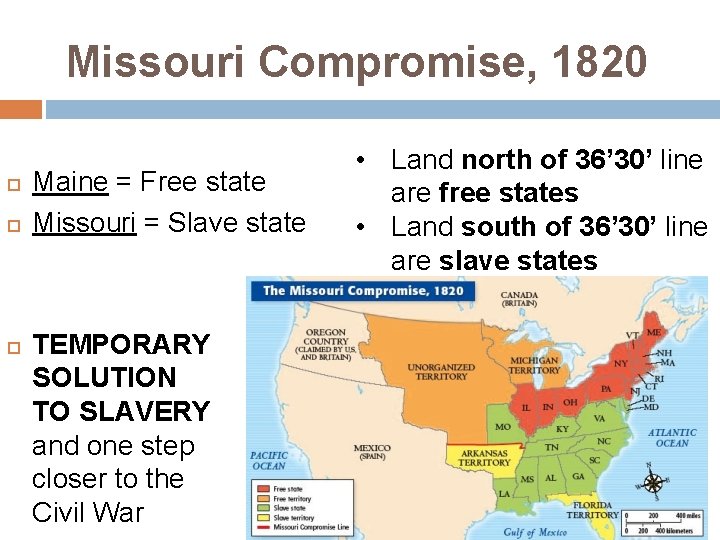
Missouri Compromise, 1820 Maine = Free state Missouri = Slave state TEMPORARY SOLUTION TO SLAVERY and one step closer to the Civil War • Land north of 36’ 30’ line are free states • Land south of 36’ 30’ line are slave states
CFU 28. What was the issue that led to the Missouri Compromise (Compromise of 1820)? � Adding Missouri creates an imbalance of slave and free states in Congress. 29. What did the Missouri Compromise establish? � 36’ 30’ line – free states above, slave state below. Missouri becomes slave, Maine becomes free. 30. Was the Missouri Compromise a permanent solution? � Not at all. It’s only temporary and leads to more
Westward Expansion Overall 1. Intensifies Nationalism � War of 1812 and Manifest Destiny 2. Intensifies Sectionalism � Cheap land, infrastructure, tariffs, and slavery 3. The Civil War is coming soon � North vs. South tensions at an all-time high � Slavery extension into new states? � States’ Rights vs. Federal Government power
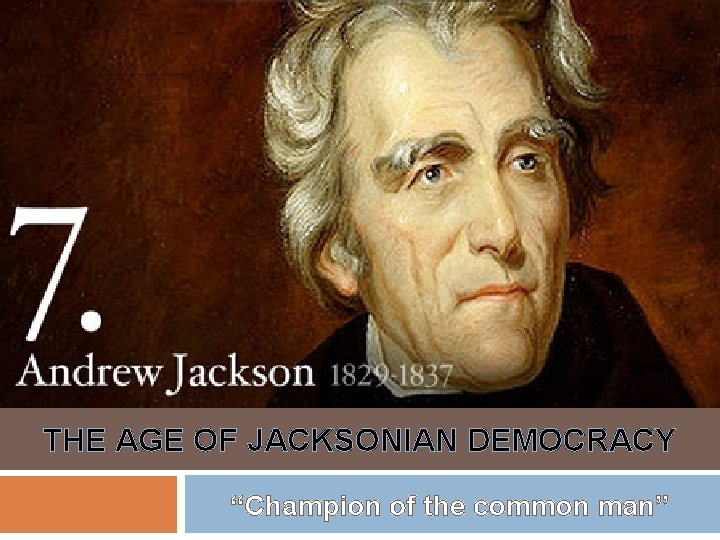
THE AGE OF JACKSONIAN DEMOCRACY “Champion of the common man”
What is he famous for? The Battle of New Orleans
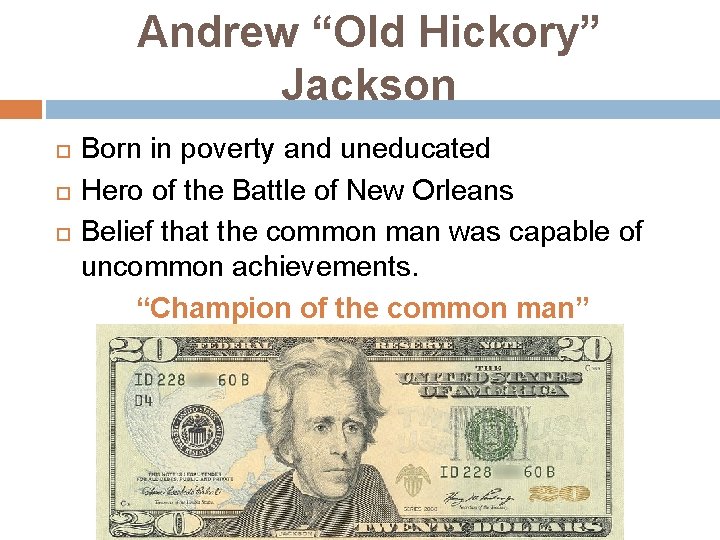
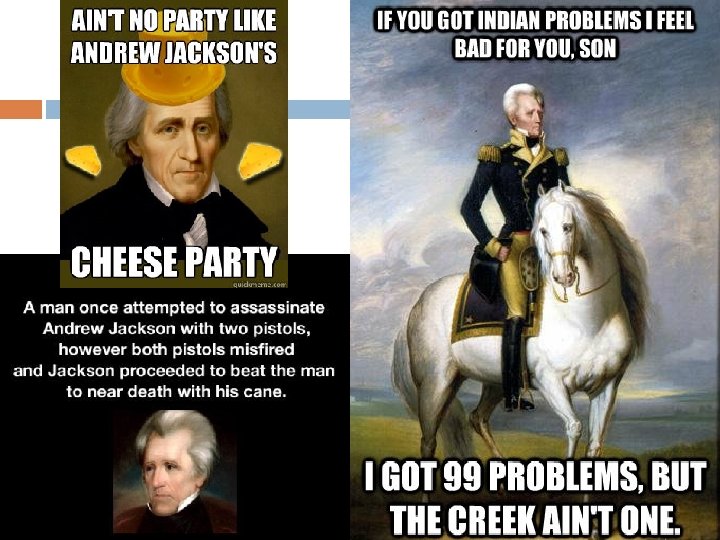
Andrew “Old Hickory” Jackson Born in poverty and uneducated Hero of the Battle of New Orleans Belief that the common man was capable of uncommon achievements. “Champion of the common man”
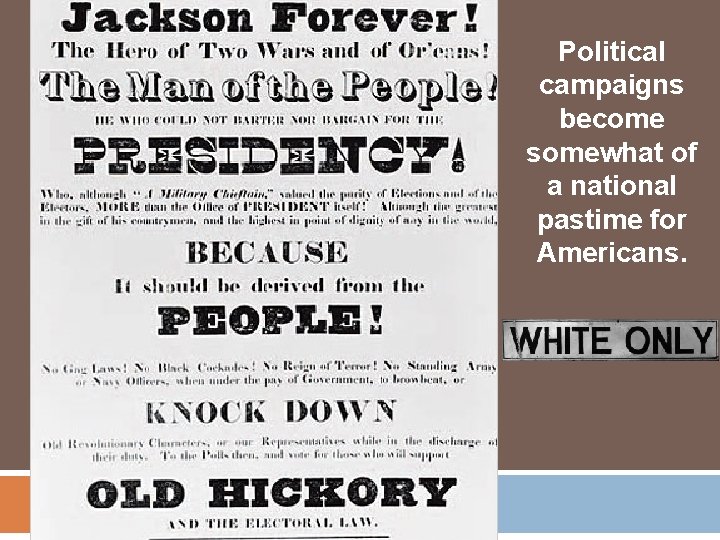
Political campaigns become somewhat of a national pastime for Americans.
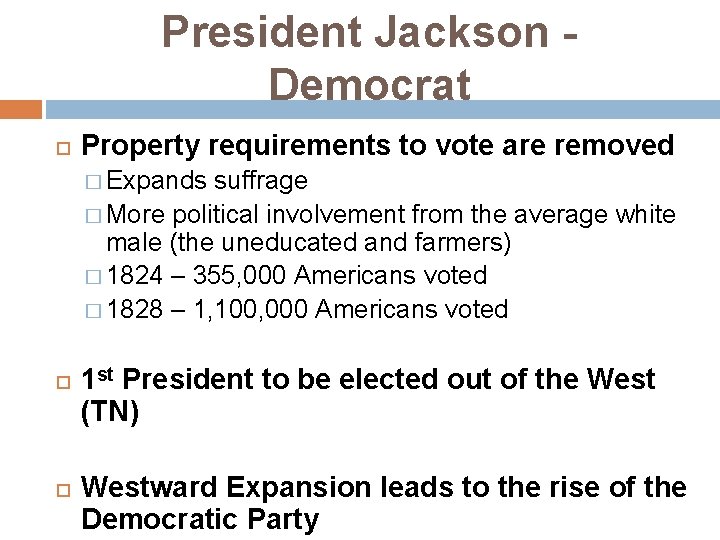
President Jackson Democrat Property requirements to vote are removed � Expands suffrage � More political involvement from the average white male (the uneducated and farmers) � 1824 – 355, 000 Americans voted � 1828 – 1, 100, 000 Americans voted 1 st President to be elected out of the West (TN) Westward Expansion leads to the rise of the Democratic Party
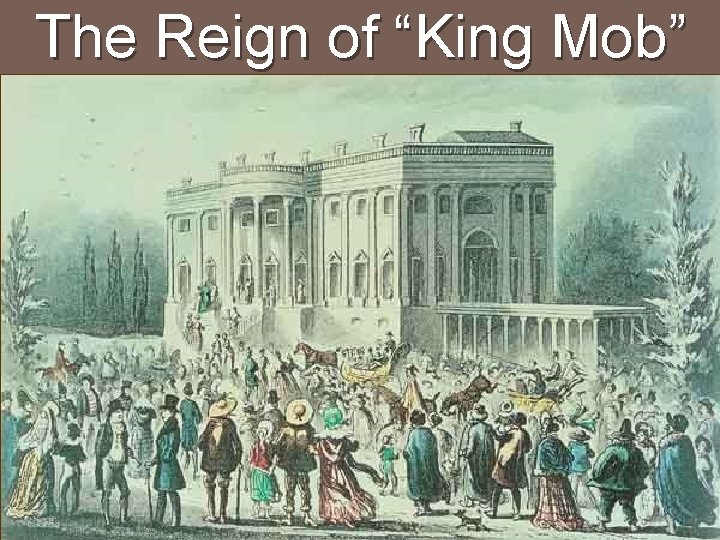
The Reign of “King Mob”
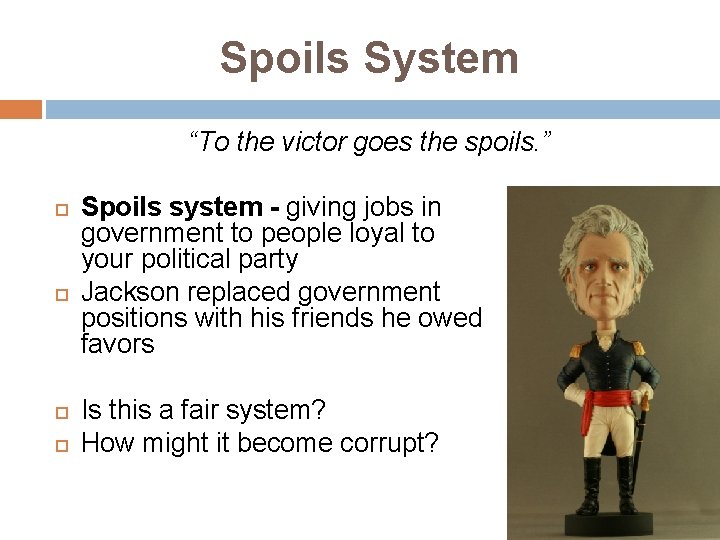
Spoils System “To the victor goes the spoils. ” Spoils system - giving jobs in government to people loyal to your political party Jackson replaced government positions with his friends he owed favors Is this a fair system? How might it become corrupt?
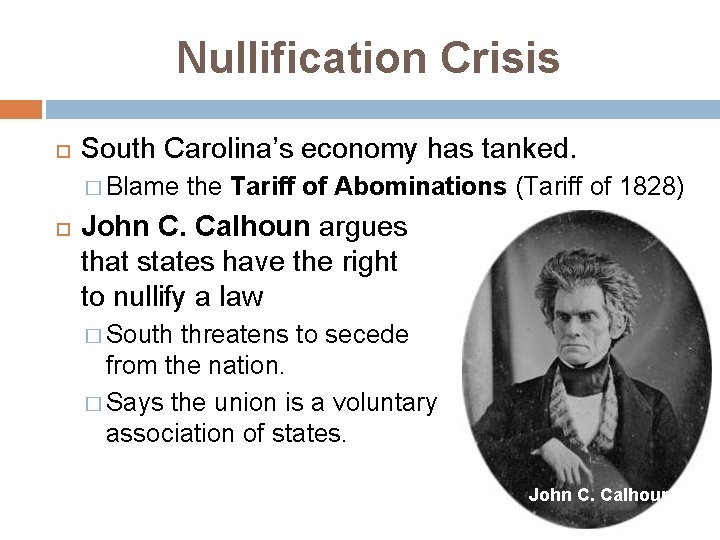
Nullification Crisis South Carolina’s economy has tanked. � Blame the Tariff of Abominations (Tariff of 1828) John C. Calhoun argues that states have the right to nullify a law � South threatens to secede from the nation. � Says the union is a voluntary association of states. John C. Calhoun
Nullification Crisis “Our federal Union – it must be preserved. The union, next to our liberty, is most dear. ” - Andrew Jackson President Jackson sends troops to Charleston � Doesn’t want state power to trump national power A compromise is reached: � Tariffs will be reduced, but South Carolina must repeal claims of nullification.
he Indian Removal Act Jackson supports the relocation of Native Americans � Indian Removal Act of 1830 � Moving west should avoid future conflicts with Indians Creates more “white man opportunity” Worcester v. Georgia � Cherokee Indians of Georgia sue � Supreme Court (John Marshall) says the Cherokee had “an unquestionable right” to their Supreme Court has made its decisio territory. let them enforce it. ”
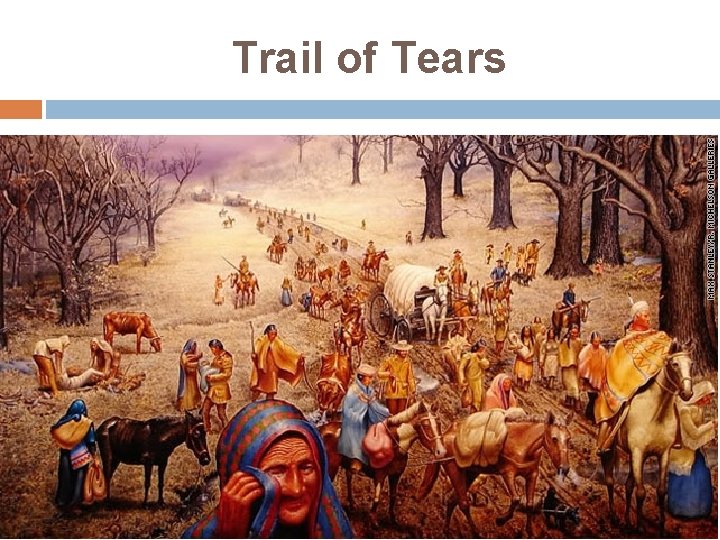
Trail of Tears
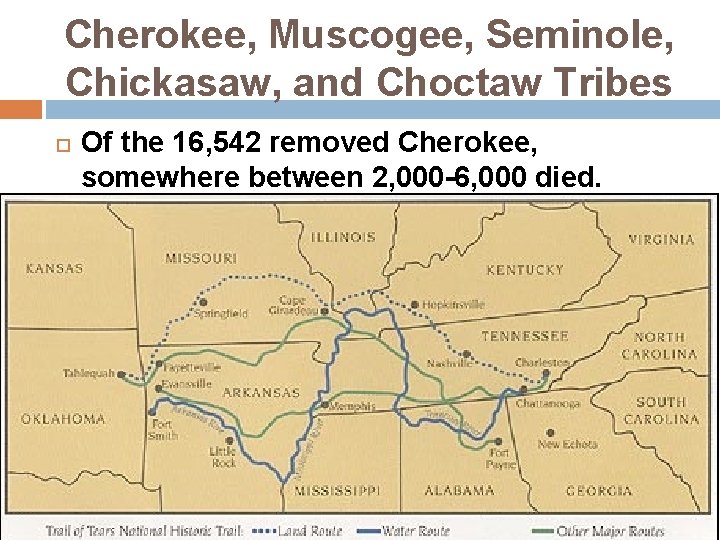
Cherokee, Muscogee, Seminole, Chickasaw, and Choctaw Tribes Of the 16, 542 removed Cherokee, somewhere between 2, 000 -6, 000 died.
Trail of Tears Native Americans suffered and died from: � Exposure, disease, and starvation Most American whites supported the forceful relocation of Native Americans. Indians were sent to Oklahoma to be put on “reservations” Wanted to take advantage of the natural resources on Cherokee land GOLD
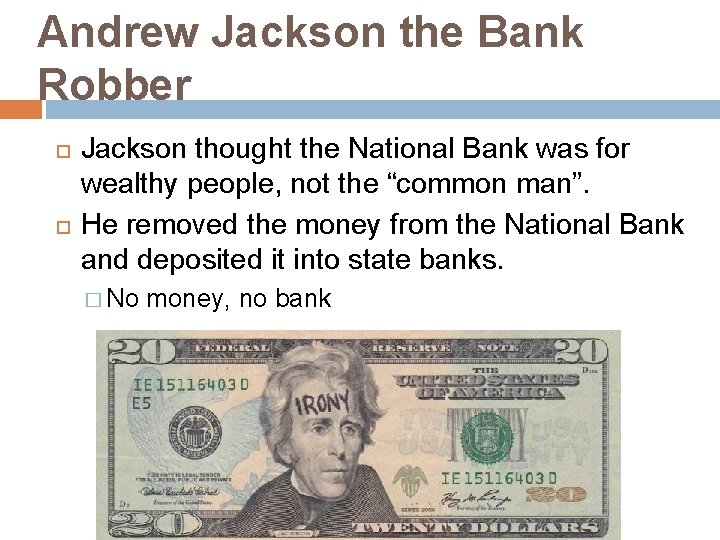
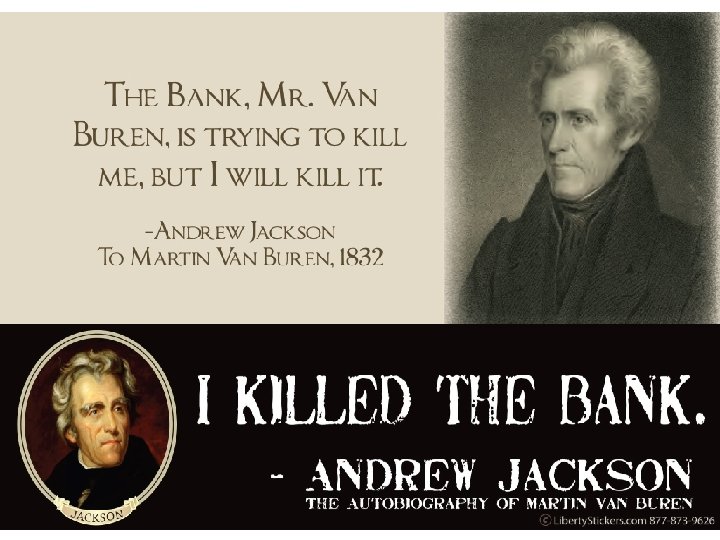
Andrew Jackson the Bank Robber Jackson thought the National Bank was for wealthy people, not the “common man”. He removed the money from the National Bank and deposited it into state banks. � No money, no bank
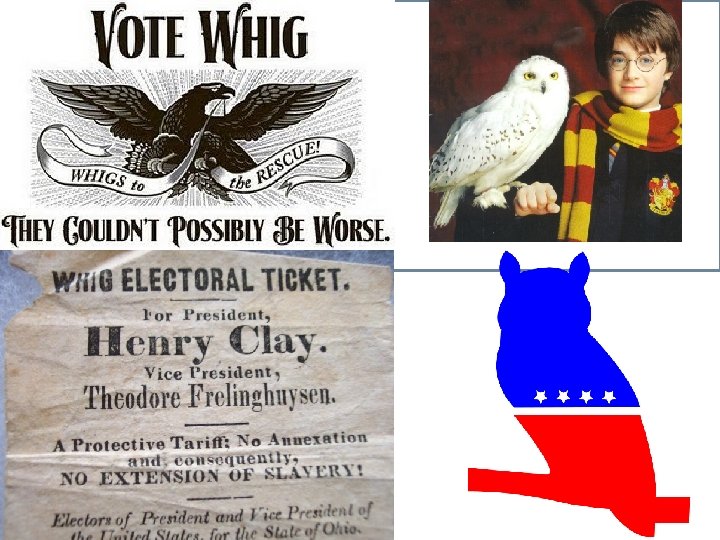
Whigs – The New Political Party Formed in opposition to Andrew Jackson � Definition of Whig – American colonist who supported the Revolution. Political views: � Congress over President � Modernization and industry � Centralized economy � No extension of slavery
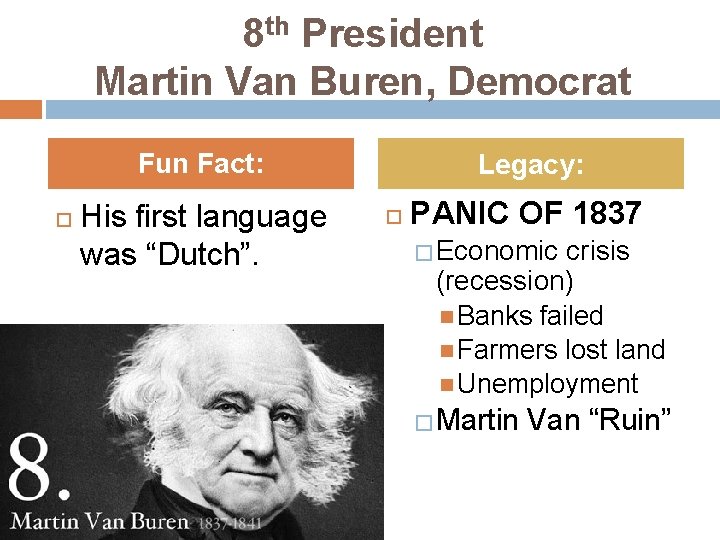
8 th President Martin Van Buren, Democrat Fun Fact: His first language was “Dutch”. Legacy: PANIC OF 1837 � Economic crisis (recession) Banks failed Farmers lost land Unemployment �Martin Van “Ruin”
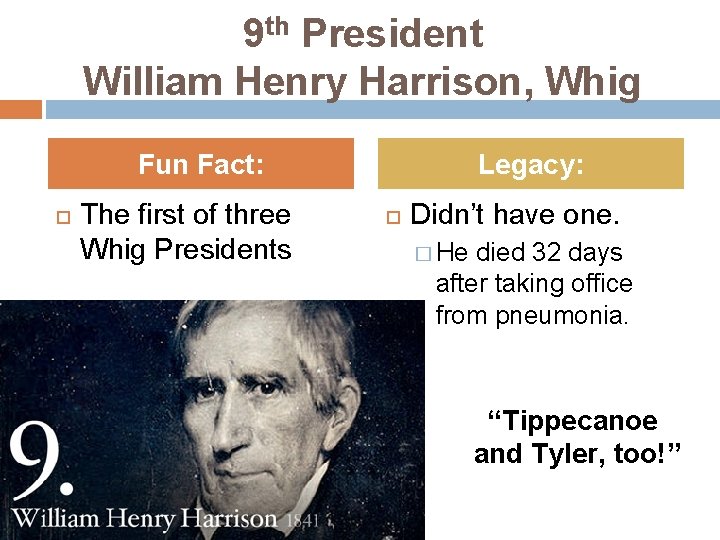
9 th President William Henry Harrison, Whig Fun Fact: The first of three Whig Presidents Legacy: Didn’t have one. � He died 32 days after taking office from pneumonia. “Tippecanoe and Tyler, too!”
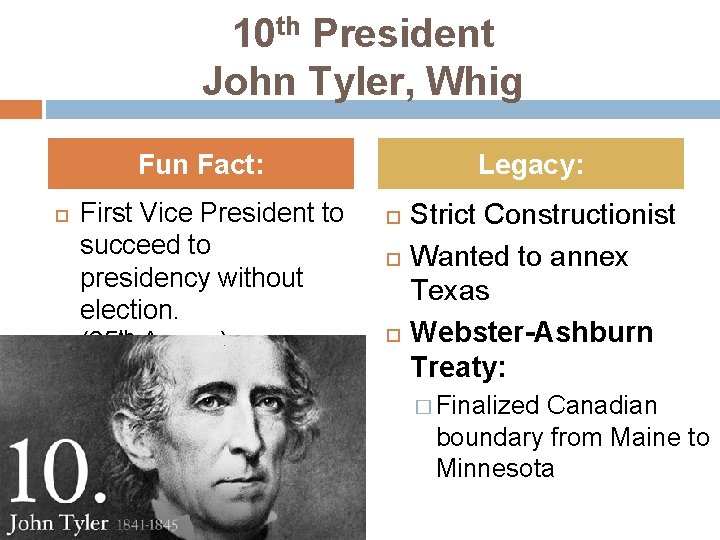
10 th President John Tyler, Whig Fun Fact: First Vice President to succeed to presidency without election. (25 th Amen. ) Legacy: Strict Constructionist Wanted to annex Texas Webster-Ashburn Treaty: � Finalized Canadian boundary from Maine to Minnesota
Legacy of Jacksonian Democracy Politicians now appeal to passion more than reason. Political speeches become a form of mass entertainment; involving more Americans in the political process. The average citizen is now more involved in politics (white men)
USHC Standard 2 “Conquering the West” USHC 2. 2 – Explain how the Monroe Doctrine and the concept of Manifest Destiny affected the United States’ relationships with foreign powers, including the role of the United States in the Texan Revolution and the Mexican War.
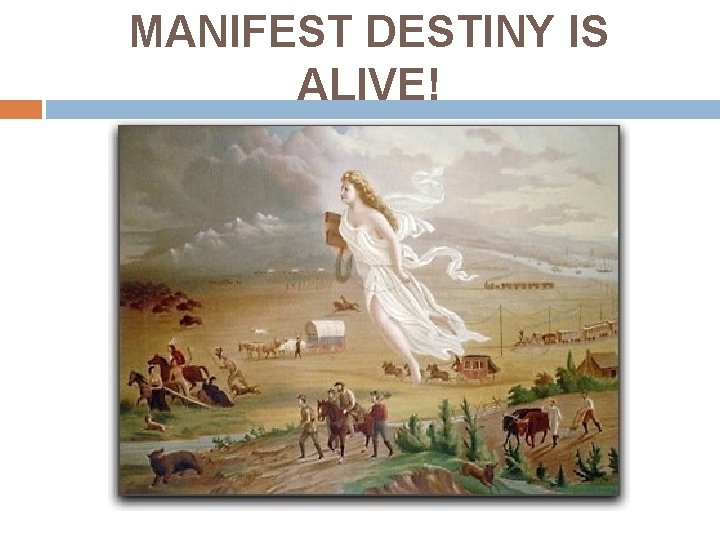
MANIFEST DESTINY IS ALIVE!
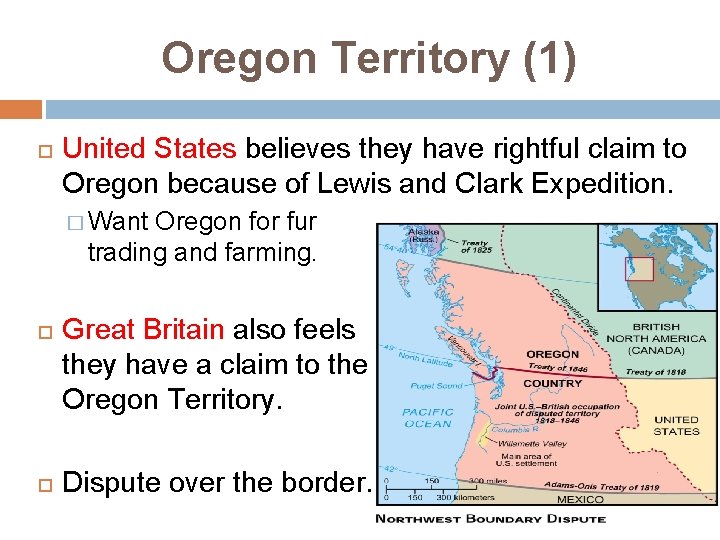
Oregon Territory (1) United States believes they have rightful claim to Oregon because of Lewis and Clark Expedition. � Want Oregon for fur trading and farming. Great Britain also feels they have a claim to the Oregon Territory. Dispute over the border.
Oregon Territory “Fifty-four forty or fight!” - President James K. Polk America wants the 54’ 40 line as the border between Great Britain and the US. (2) Compromise at the 49’ parallel in 1846. � Even if it meant less land, the border is finalized with Canada. (3)
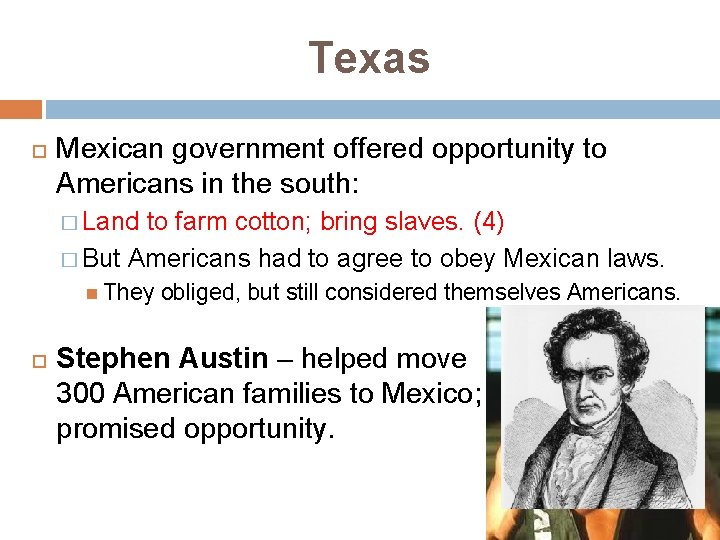
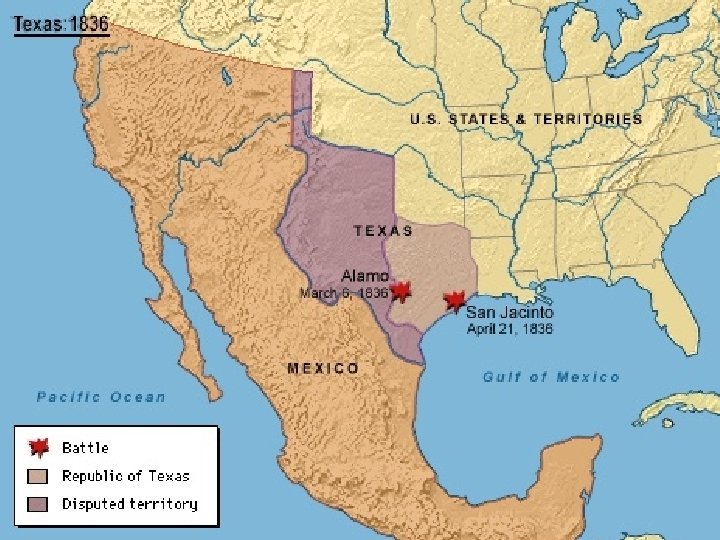
Texas Mexican government offered opportunity to Americans in the south: � Land to farm cotton; bring slaves. (4) � But Americans had to agree to obey Mexican laws. They obliged, but still considered themselves Americans. Stephen Austin – helped move 300 American families to Mexico; promised opportunity.
IN DE PE Mexican government did not trust the Americans § Cheap land 10 year tax exemption § 3) 4) ND E Passed colonization laws 1) 2) Texas But must convert to Catholicism and become a Mexican citizen NC Closed borders to Americans in 1830 Taxes imported goods Mexico then banned slavery (5) E
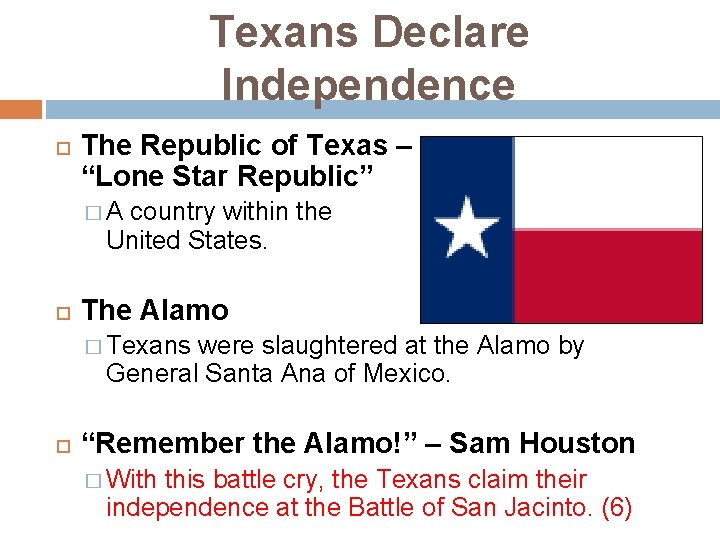
Texans Declare Independence The Republic of Texas – “Lone Star Republic” �A country within the United States. The Alamo � Texans were slaughtered at the Alamo by General Santa Ana of Mexico. “Remember the Alamo!” – Sam Houston � With this battle cry, the Texans claim their independence at the Battle of San Jacinto. (6)
The Lone Star State Mexico does not accept/recognize the proposed treaty from Texas (7) Sam Houston become the first President of the Republic of Texas in 1836 � Texas wants to be annexed by the United States Annexed – to become a part of; brought into Andrew Jackson does not want to interrupt the balance of slave and free states in
Texas Problems President John Tyler (Whig) wants to annex Texas, but it would be a slave state. Why? � Below the Missouri Compromise Line (36’ 30’ line)! (9) � Northern states vote against the annexation. John C. Calhoun (SC) makes a pro-slavery speech that makes northern states furious. John C. Calhoun
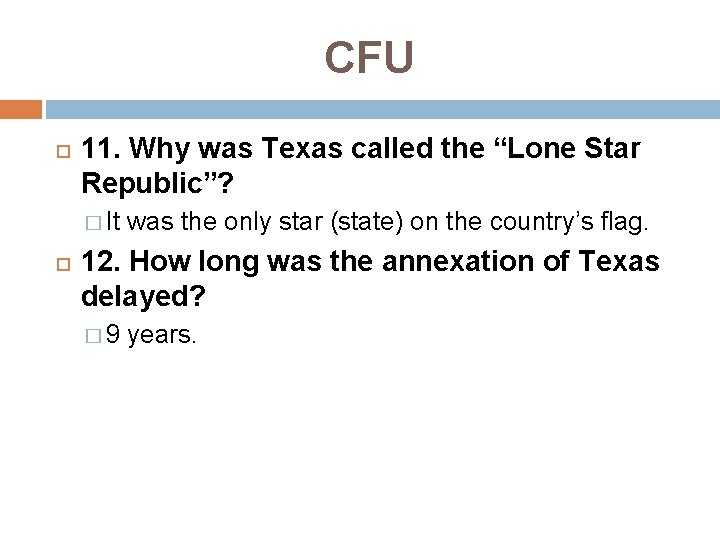
11 th President James K. Polk, Democrat Fun Fact: Won the Presidential election on a Manifest Destiny platform Legacy: Wants to annex Texas as a slave state. � Then add California as a free state. (10) Texas annexed by joint resolution in Congress. � Delayed 9 years. Compromised Oregon Territory with Britain.
CFU 11. Why was Texas called the “Lone Star Republic”? � It was the only star (state) on the country’s flag. 12. How long was the annexation of Texas delayed? � 9 years.
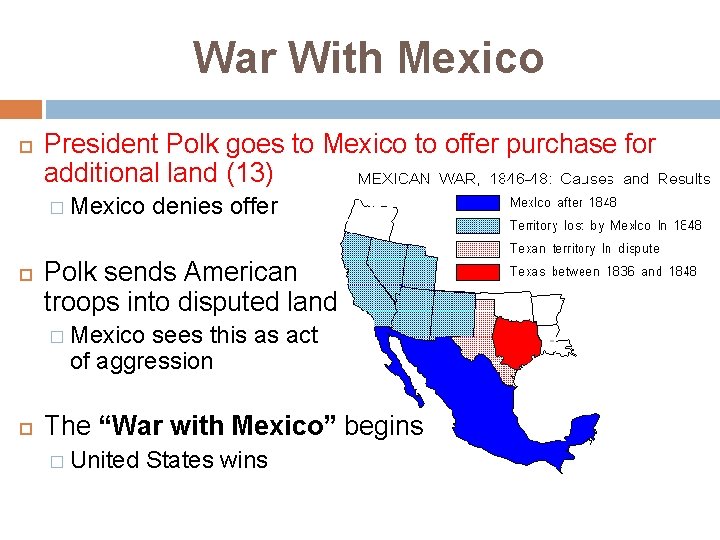
War With Mexico President Polk goes to Mexico to offer purchase for additional land (13) � Mexico denies offer Polk sends American troops into disputed land � Mexico sees this as act of aggression The “War with Mexico” begins � United States wins
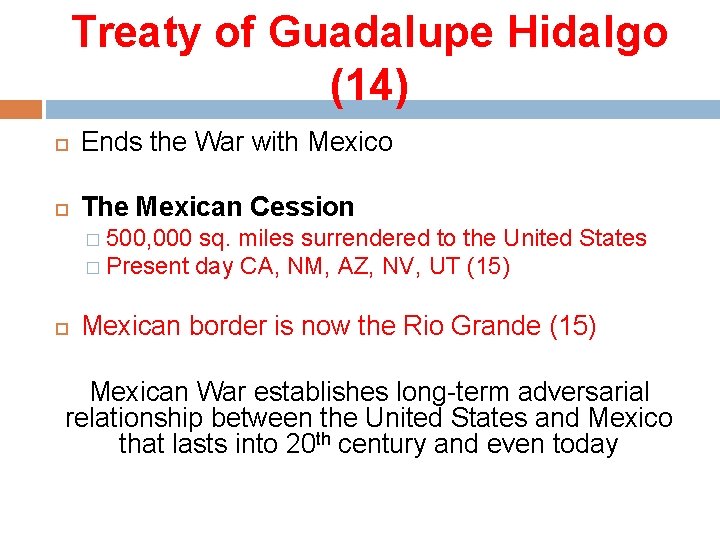
Treaty of Guadalupe Hidalgo (14) Ends the War with Mexico The Mexican Cession � 500, 000 sq. miles surrendered to the United States � Present day CA, NM, AZ, NV, UT (15) Mexican border is now the Rio Grande (15) Mexican War establishes long-term adversarial relationship between the United States and Mexico that lasts into 20 th century and even today
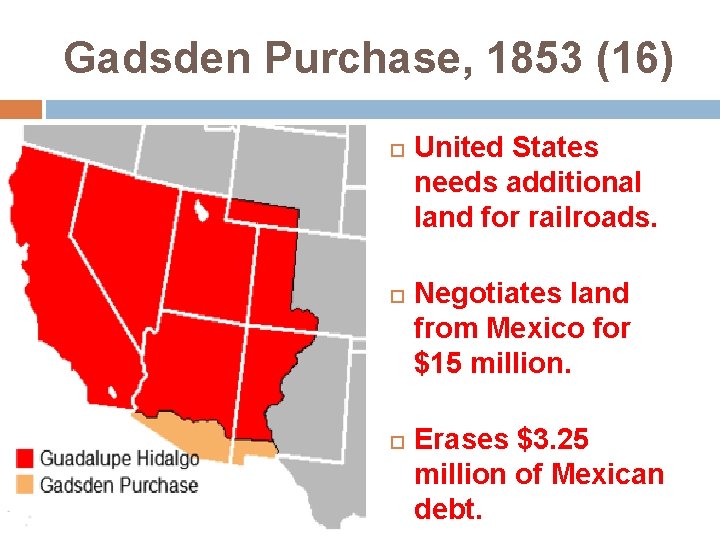
Gadsden Purchase, 1853 (16) United States needs additional land for railroads. Negotiates land from Mexico for $15 million. Erases $3. 25 million of Mexican debt.
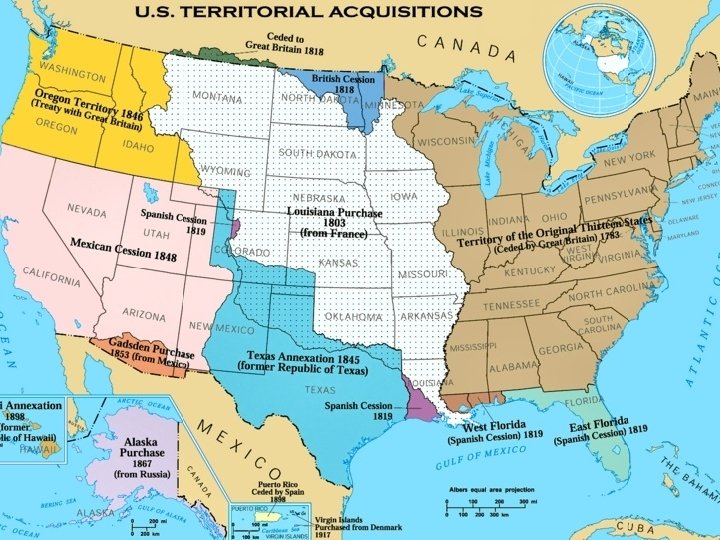
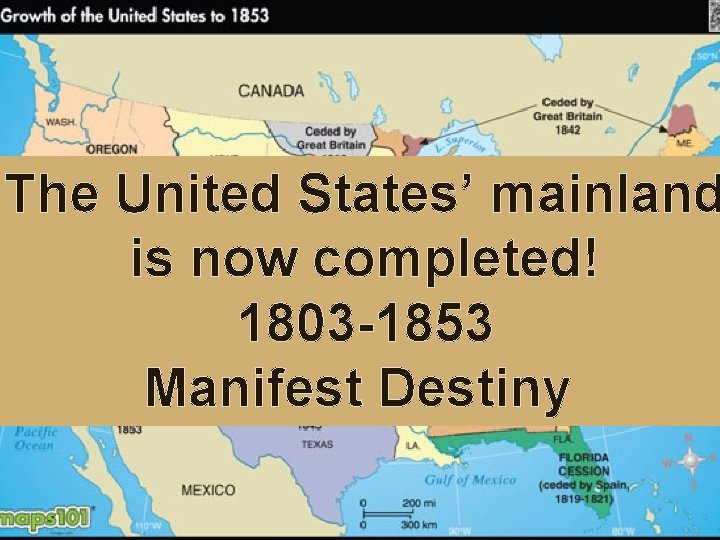
The United States’ mainland is now completed! 1803 -1853 Manifest Destiny
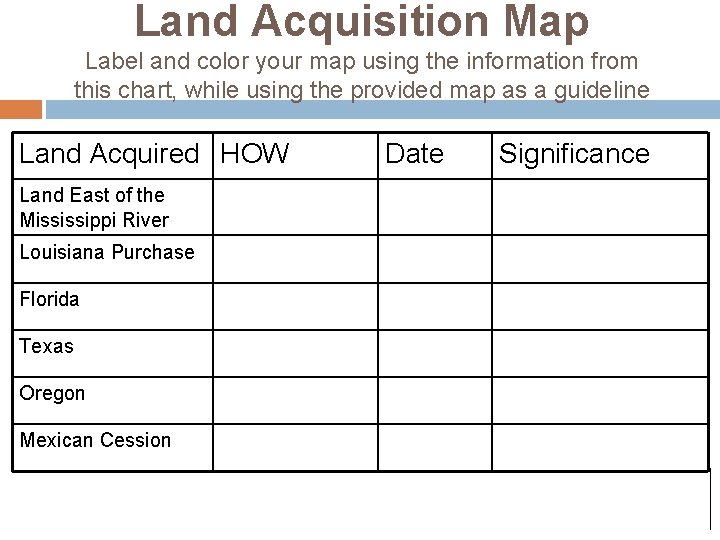
Land Acquisition Map Label and color your map using the information from this chart, while using the provided map as a guideline Land Acquired HOW Land East of the Mississippi River Louisiana Purchase Florida Texas Oregon Mexican Cession Date Significance
USHC Standard 2 “Industrial Revolution; Growth in America” USHC 2. 3 – Compare the economic development in different regions (the South, the North, and the West) of the United States during the early nineteenth century, including ways that economic policy contributed to political controversies.
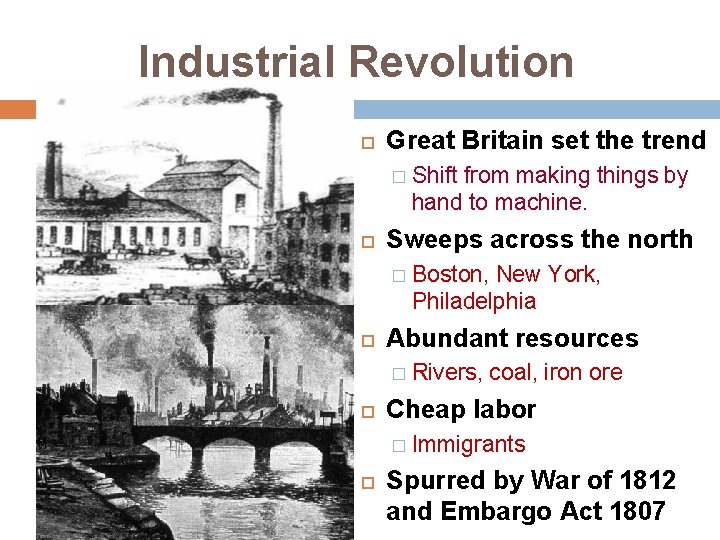
Industrial Revolution Great Britain set the trend � Sweeps across the north � Rivers, coal, iron ore Cheap labor � Boston, New York, Philadelphia Abundant resources � Shift from making things by hand to machine. Immigrants Spurred by War of 1812 and Embargo Act 1807
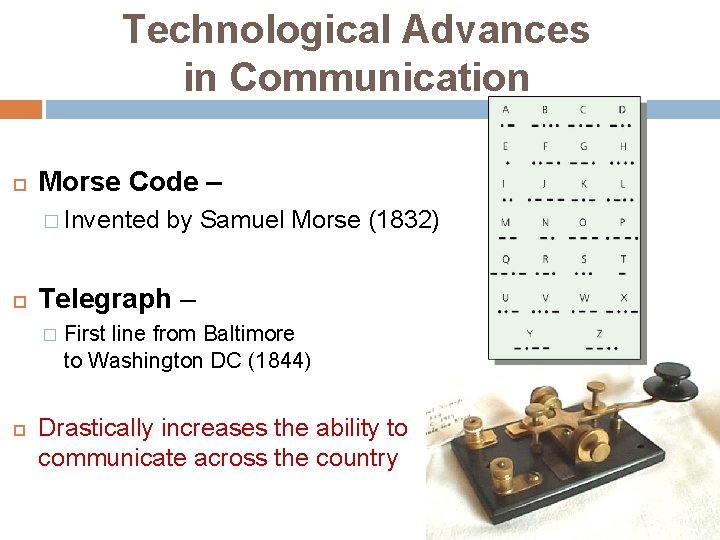
Technological Advances in Communication Morse Code – � Invented Telegraph – � by Samuel Morse (1832) First line from Baltimore to Washington DC (1844) Drastically increases the ability to communicate across the country
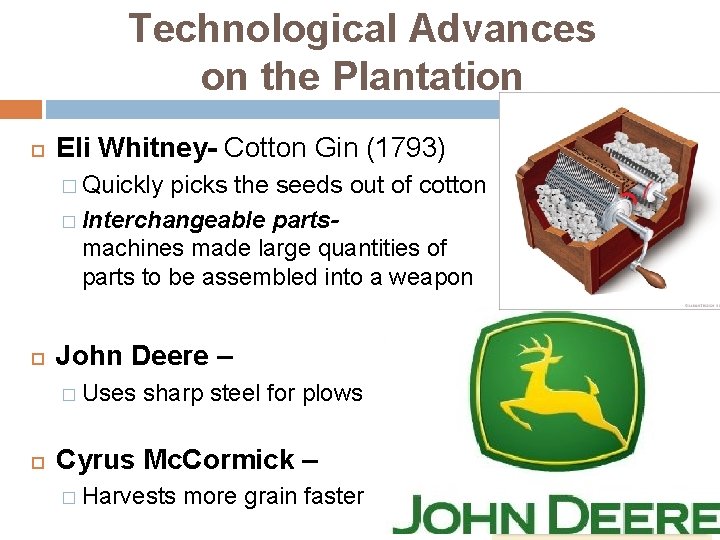
Technological Advances on the Plantation Eli Whitney- Cotton Gin (1793) � Quickly picks the seeds out of cotton � Interchangeable partsmachines made large quantities of parts to be assembled into a weapon John Deere – � Uses sharp steel for plows Cyrus Mc. Cormick – � Harvests more grain faster
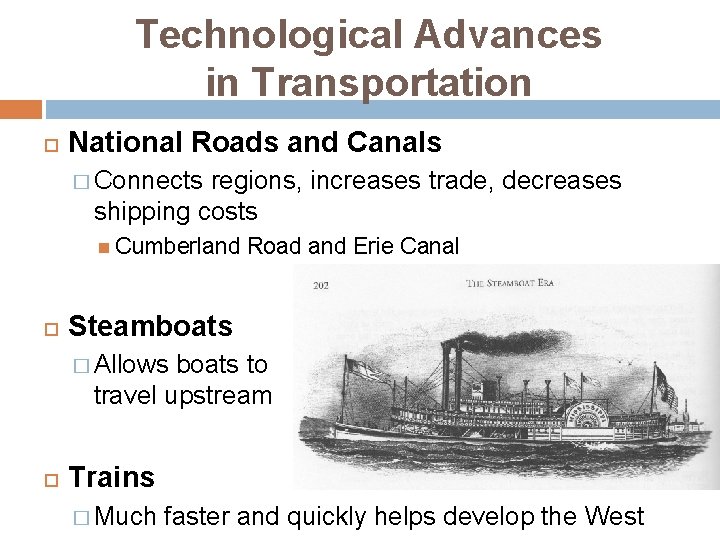
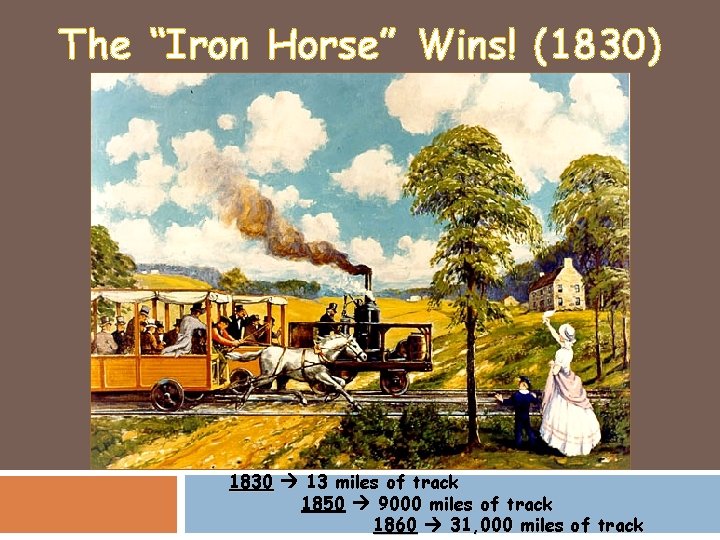
Technological Advances in Transportation National Roads and Canals � Connects regions, increases trade, decreases shipping costs Cumberland Road and Erie Canal Steamboats � Allows boats to travel upstream Trains � Much faster and quickly helps develop the West
Cumberland, 1811 (National Road)
Erie Canal System
The “Iron Horse” Wins! (1830) 1830 13 miles of track 1850 9000 miles of track 1860 31, 000 miles of track
CFU 1. Why does American industrialize? � The War of 1812 showed us we could not rely on foreign countries for finished goods 2. What assets did America have for industrialization? � Lots of land, abundant resources, and cheap labor from immigrants 3. Why is the North fit for industrialization? � Because it doesn’t have the soil for agriculture
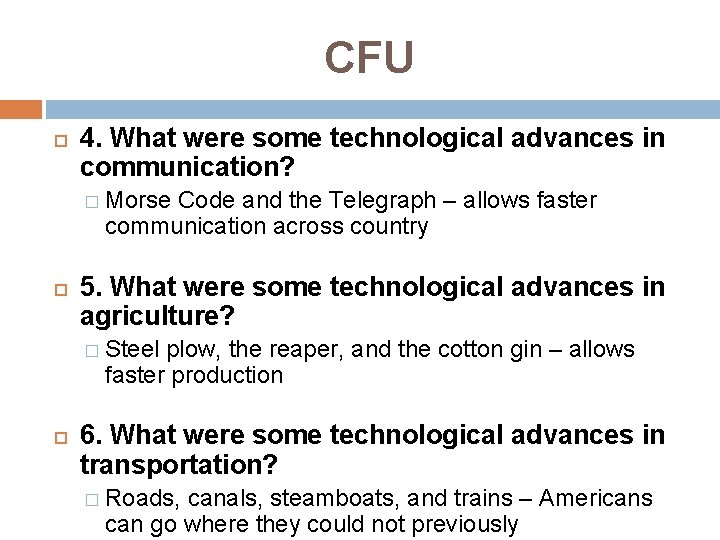
CFU 4. What were some technological advances in communication? � Morse Code and the Telegraph – allows faster communication across country 5. What were some technological advances in agriculture? � Steel plow, the reaper, and the cotton gin – allows faster production 6. What were some technological advances in transportation? � Roads, canals, steamboats, and trains – Americans can go where they could not previously
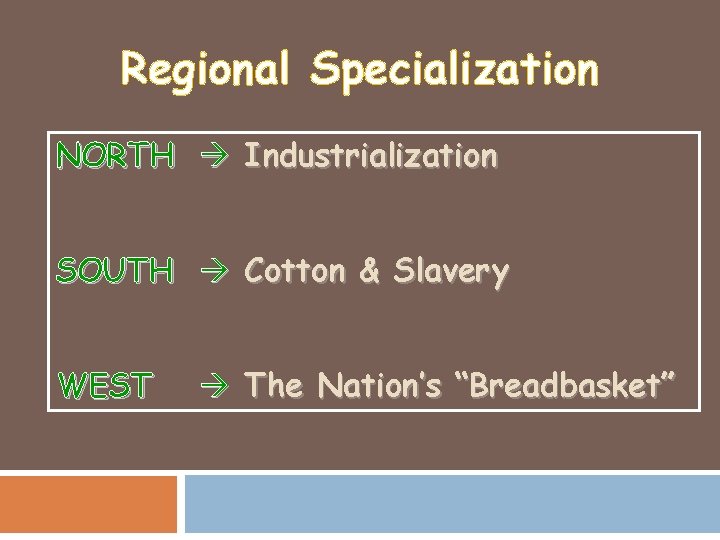
Regional Specialization NORTH Industrialization SOUTH Cotton & Slavery WEST The Nation’s “Breadbasket”
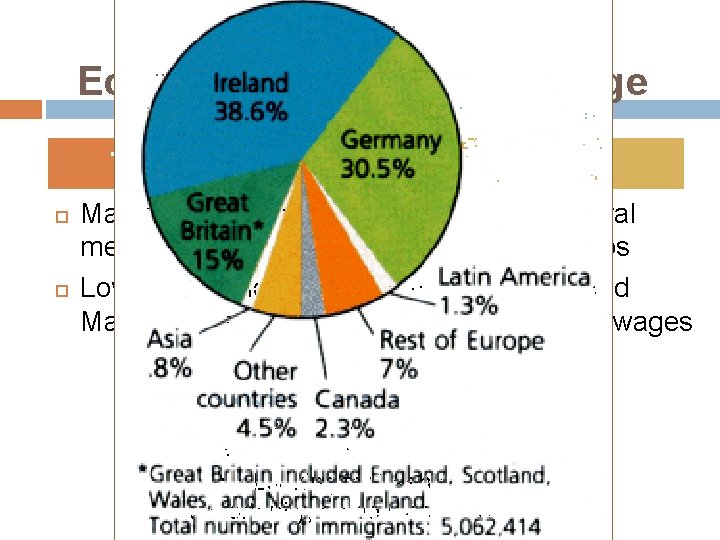
New England Economy and Culture Change Textile Mills Making clothes is mechanized Lowell Factories of Massachusetts Factories People leave rural farms for city jobs Hired women and Children for low wages Immigrants § 5 million immigrants § Ireland Germany § Looking for fresh start, opportunity, money, and to escape
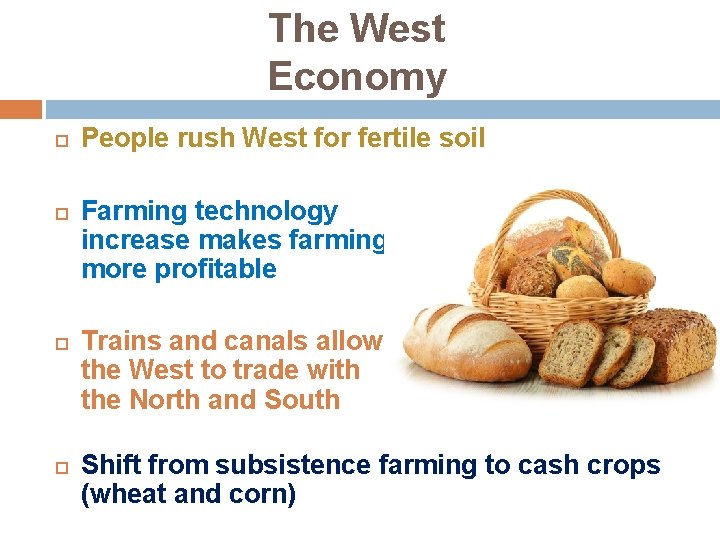
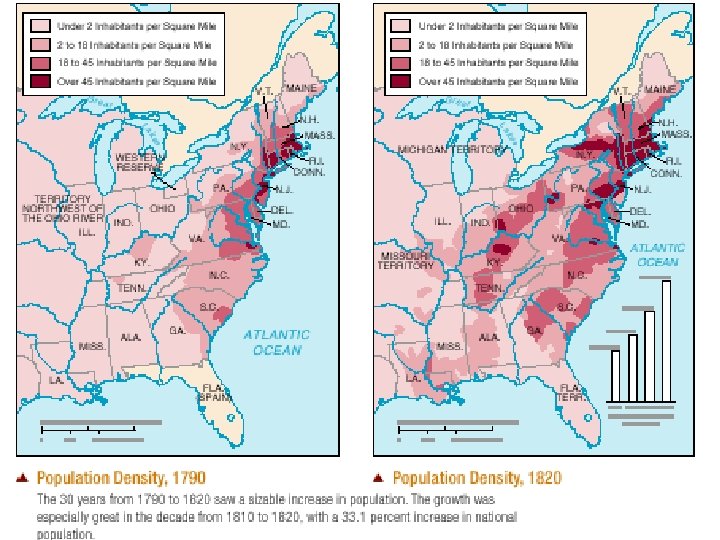
The West Economy People rush West for fertile soil Farming technology increase makes farming more profitable Trains and canals allow the West to trade with the North and South Shift from subsistence farming to cash crops (wheat and corn)
CFU 7. Why were Northerners living in rural settings moving to the cities? � Job 8. What two groups made up the majority of northern immigrants? � Irish opportunities – factories have better pay and German (Britain gets 3 rd place) 9. Why was the West called “America’s Breadbasket”? � Their economy focused on grains and wheat
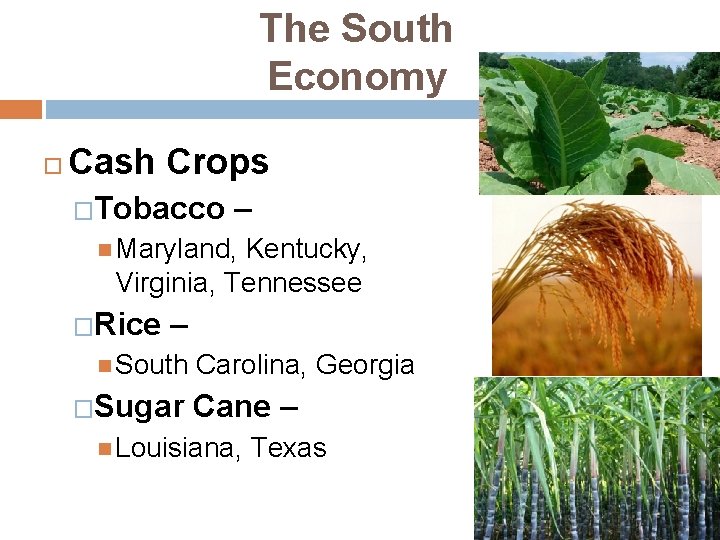
The South Economy Cash Crops �Tobacco – Maryland, Kentucky, Virginia, Tennessee �Rice – South �Sugar Carolina, Georgia Cane – Louisiana, Texas
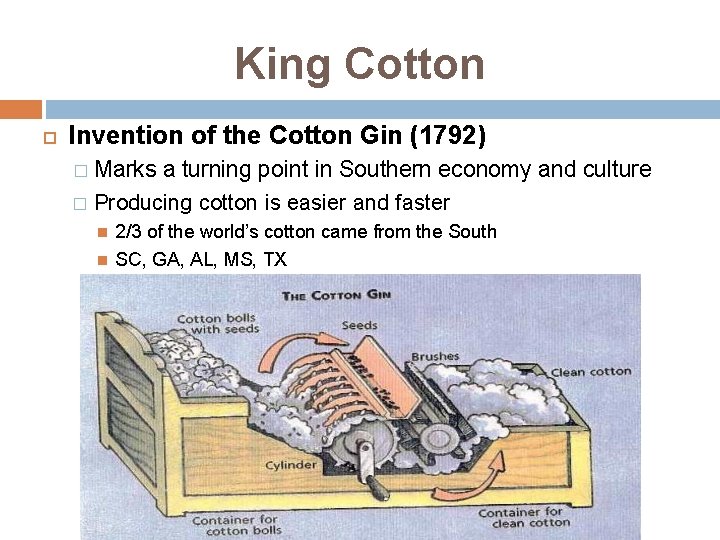
King Cotton Invention of the Cotton Gin (1792) Marks a turning point in Southern economy and culture � Producing cotton is easier and faster � 2/3 of the world’s cotton came from the South SC, GA, AL, MS, TX
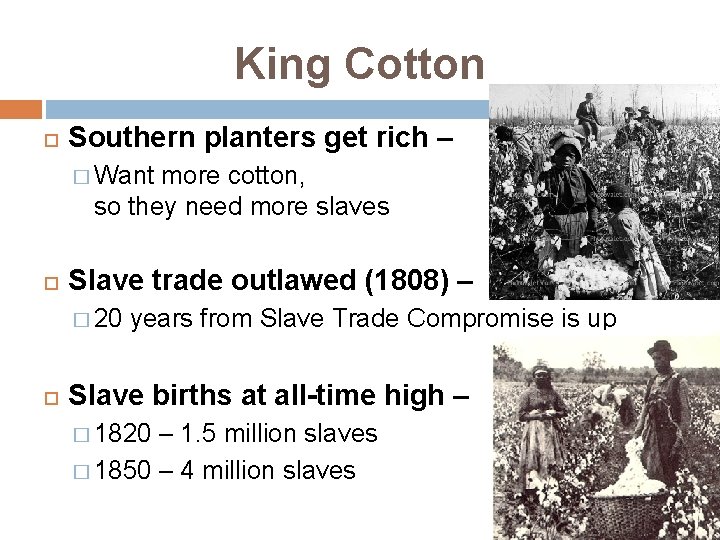
King Cotton Southern planters get rich – � Want more cotton, so they need more slaves Slave trade outlawed (1808) – � 20 years from Slave Trade Compromise is up Slave births at all-time high – � 1820 – 1. 5 million slaves � 1850 – 4 million slaves
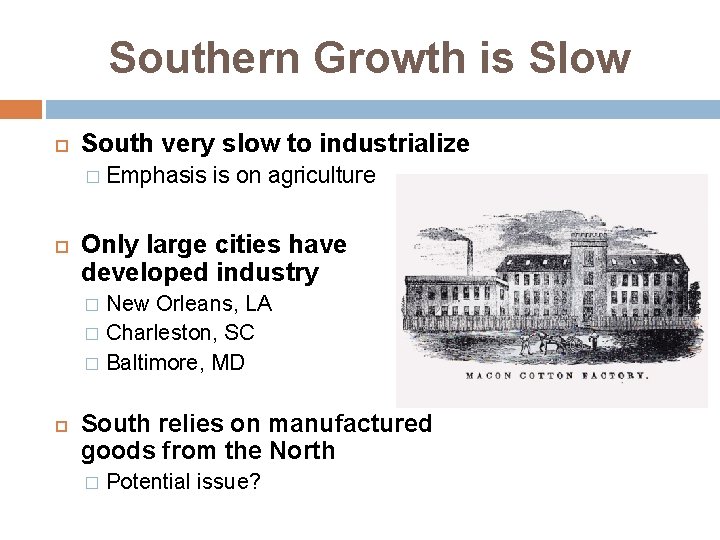
Southern Growth is Slow South very slow to industrialize � Emphasis is on agriculture Only large cities have developed industry New Orleans, LA � Charleston, SC � Baltimore, MD � South relies on manufactured goods from the North � Potential issue?
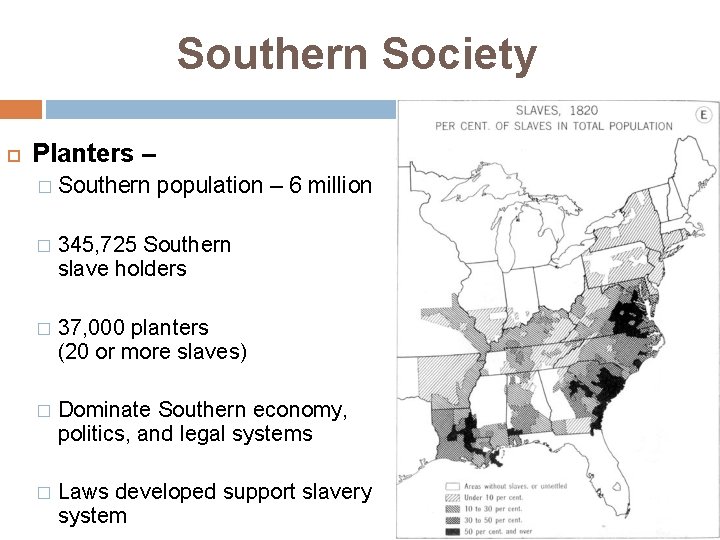
Southern Society Planters – � Southern population – 6 million � 345, 725 Southern slave holders � 37, 000 planters (20 or more slaves) � Dominate Southern economy, politics, and legal systems � Laws developed support slavery system
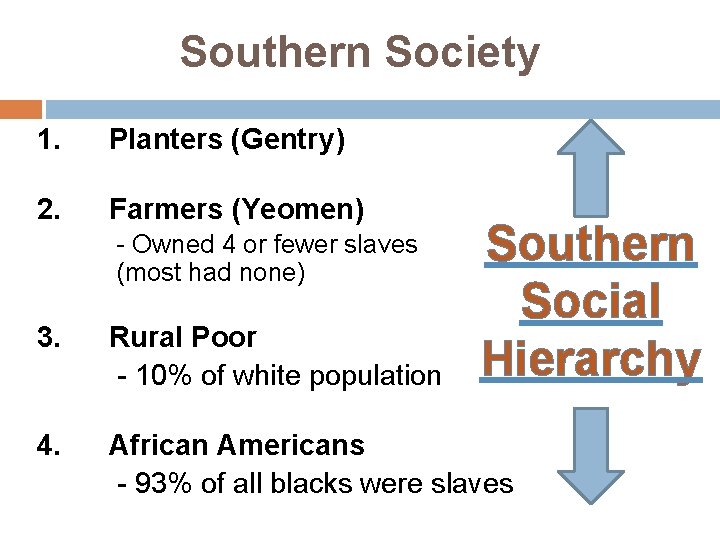
Southern Society 1. Planters (Gentry) 2. Farmers (Yeomen) - Owned 4 or fewer slaves (most had none) Southern Social Hierarchy 3. Rural Poor - 10% of white population 4. African Americans - 93% of all blacks were slaves
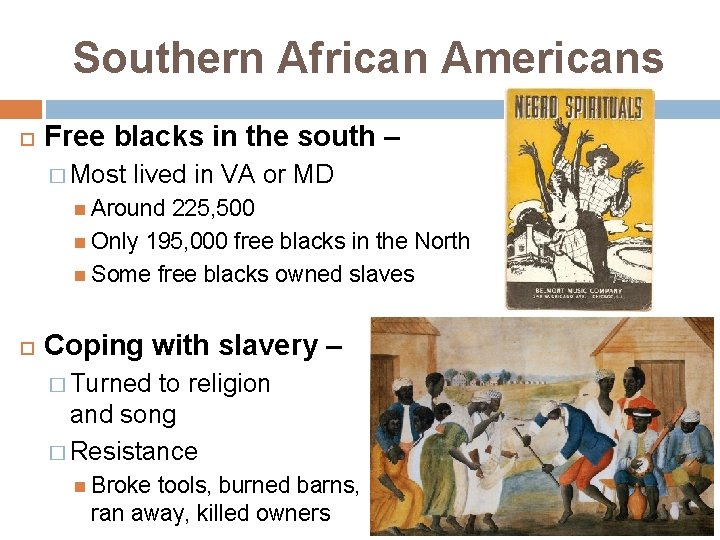
Southern African Americans Free blacks in the south – � Most lived in VA or MD Around 225, 500 Only 195, 000 free blacks in the North Some free blacks owned slaves Coping with slavery – � Turned to religion and song � Resistance Broke tools, burned barns, ran away, killed owners
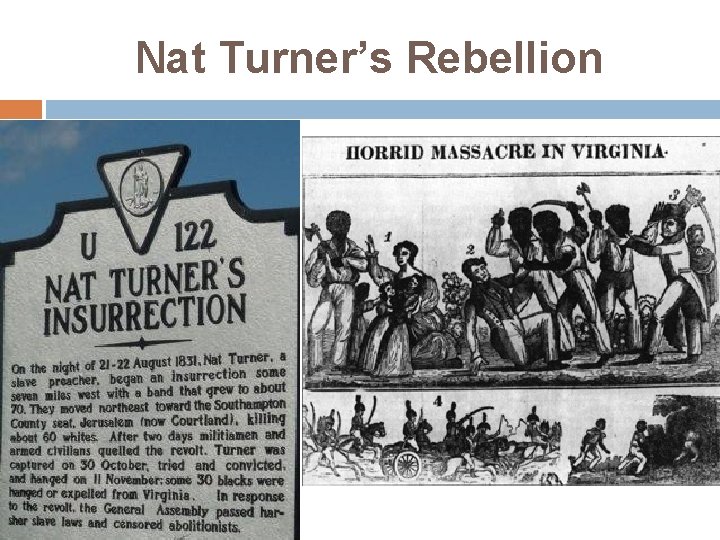
Nat Turner’s Rebellion
CFU 10. What was the foundation of Southern economy? � Cash crops fueled by slavery – tobacco, rice, sugar cane, and cotton (after the cotton gin) 11. What does the cotton gin do to Southern society and economy? � Places focus on cotton, and slavery booms so the rich can get richer. Southern industrialization is slowed. 12. What happened to the slave trade? � Outlawed (Slave Trade Compromise 20 years was up)
CFU 13. What effect did Southern planters have on Southern society and politics? � Money allowed them to dominate the legal system – the law makers and policy pushers are pro-slavery 14. How did slaves cope with slavery? � Through religion (Christianity) and songs (call and response/negro spirituals) 15. What was the Southern response to Nat Turner’s slave revolt? � Strict laws and legislation were passed to further restrict African Americans, both slave and free.