
American Government Roots and Reform Thirteenth Edition Chapter
- Slides: 27
American Government Roots and Reform Thirteenth Edition Chapter 15 Social and Economic Policy
Learning Objectives 15. 1 Trace the stages of the policy-making process. 15. 2 Describe the scope of the federal budget, and analyze problems associated with the national deficit and debt. 15. 3 Assess the effectiveness of the monetary policy tools used by the federal government to manage the economy. 15. 4 Describe current U. S. policy in health care. 15. 5 Describe current U. S. policy in primary, secondary, and higher education. 15. 6 Describe U. S. social welfare policy and programs. 15. 7 Review ongoing challenges in U. S. social and economic policy making.
15. 1 Roots of Public Policy: The Policy-Making Process • Theories of the Policy-Making Process • The Policy-Making Cycle
15. 1 Theories of the Policy-Making Process • Elite Theory - all societies are divided into elites and masses. The elites have power to make and implement policy. (Done 1 st Semester) • Bureaucratic Theory - all institutions, governmental and nongovernmental, have fallen under the control of a large and ever-growing bureaucracy that carries out policy using standardized procedures. • Special Interest Theory - narrow, specialized groups—not elites or bureaucrats— control the governmental process. • Pluralist Theory - argues that political resources in the United States are scattered so widely that no single group or interest could ever gain monopoly control over any substantial area of policy. (Done 1 st Semester) • Choice of Theory Depends on the Type of Policy. – Distributive policy - These policies are the most common and, typically, the least controversial form of federal action to solve public problems, providing tangible benefits to the recipient. – Regulatory policy - limit the activities of individuals and corporations or prohibit certain types of unacceptable behavior. – Redistributive policy - involves transferring resources from one group to assist another group.
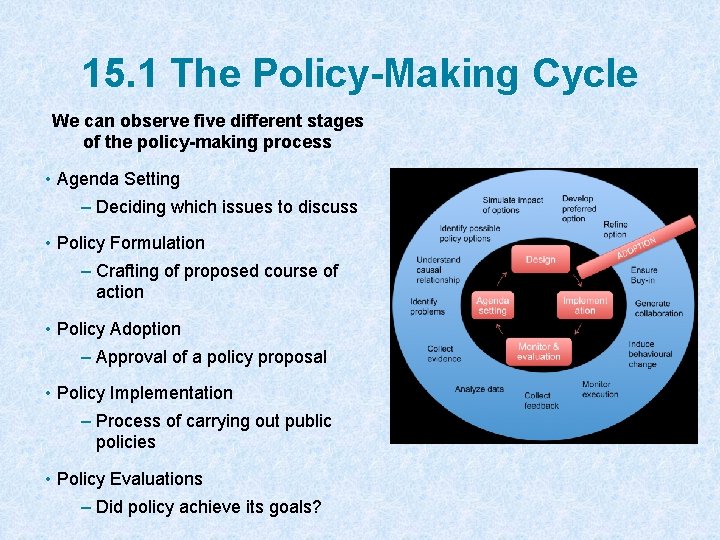
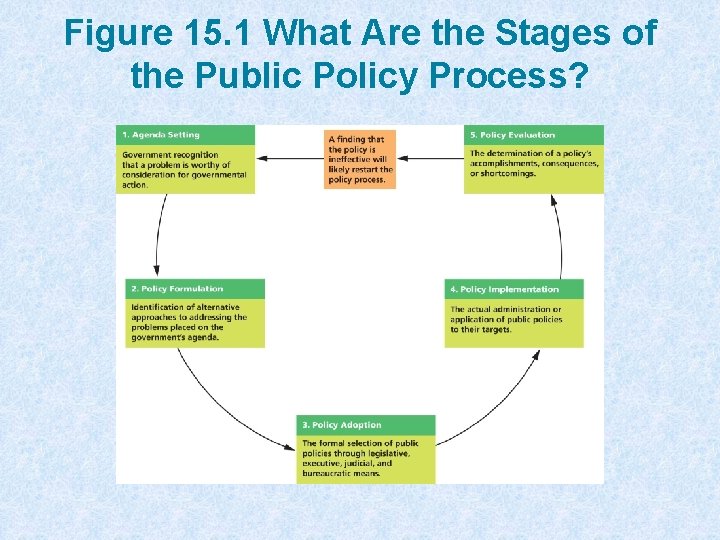
15. 1 The Policy-Making Cycle We can observe five different stages of the policy-making process • Agenda Setting – Deciding which issues to discuss • Policy Formulation – Crafting of proposed course of action • Policy Adoption – Approval of a policy proposal • Policy Implementation – Process of carrying out public policies • Policy Evaluations – Did policy achieve its goals?
Figure 15. 1 What Are the Stages of the Public Policy Process?
15. 2 Fiscal Policy • The Foundations of Fiscal Policy • The National Deficit and Debt
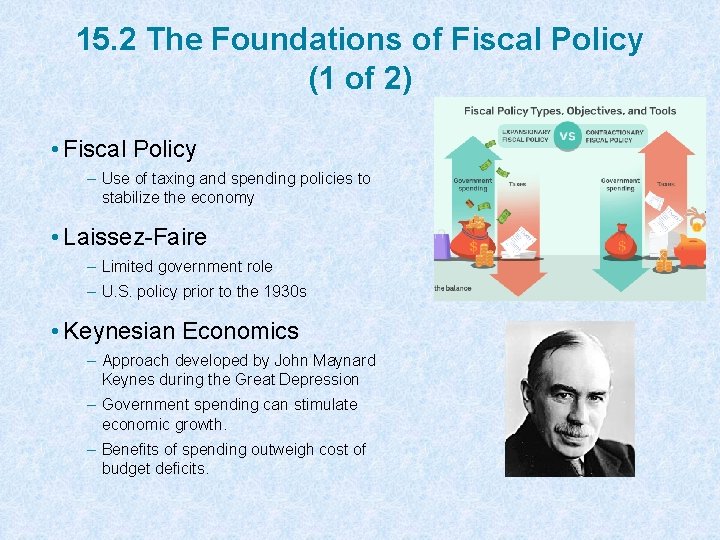
15. 2 The Foundations of Fiscal Policy (1 of 2) • Fiscal Policy – Use of taxing and spending policies to stabilize the economy • Laissez-Faire – Limited government role – U. S. policy prior to the 1930 s • Keynesian Economics – Approach developed by John Maynard Keynes during the Great Depression – Government spending can stimulate economic growth. – Benefits of spending outweigh cost of budget deficits.
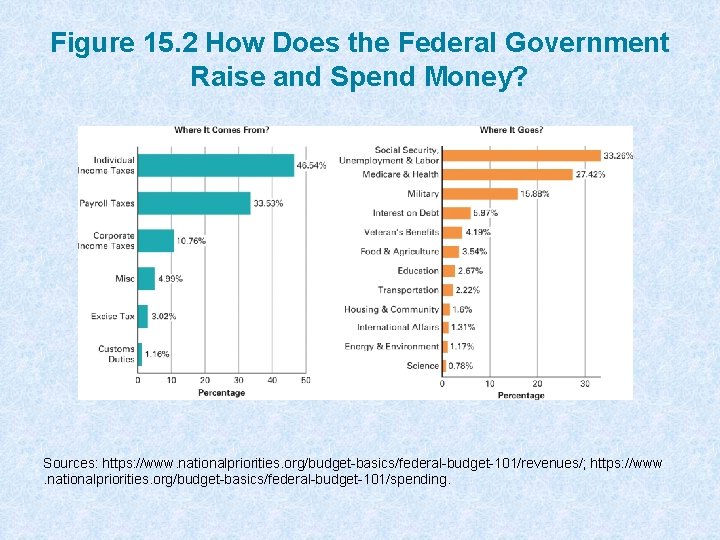
Figure 15. 2 How Does the Federal Government Raise and Spend Money? Sources: https: //www. nationalpriorities. org/budget-basics/federal-budget-101/revenues/; https: //www. nationalpriorities. org/budget-basics/federal-budget-101/spending.
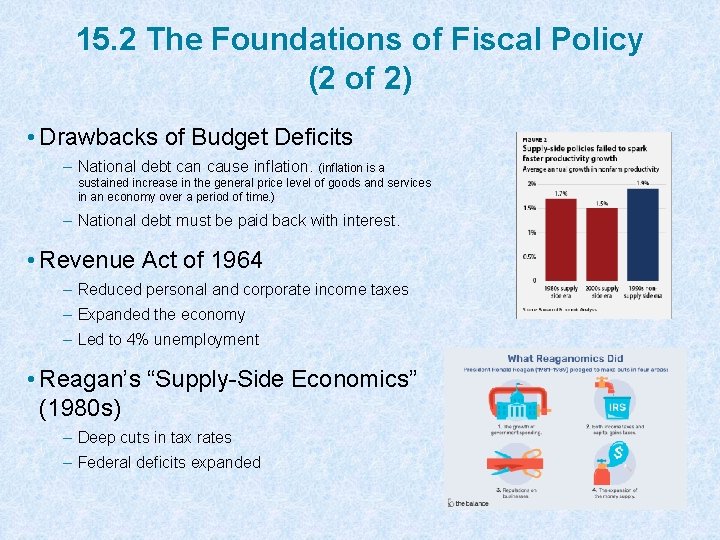
15. 2 The Foundations of Fiscal Policy (2 of 2) • Drawbacks of Budget Deficits – National debt can cause inflation. (inflation is a sustained increase in the general price level of goods and services in an economy over a period of time. ) – National debt must be paid back with interest. • Revenue Act of 1964 – Reduced personal and corporate income taxes – Expanded the economy – Led to 4% unemployment • Reagan’s “Supply-Side Economics” (1980 s) – Deep cuts in tax rates – Federal deficits expanded
15. 2 The National Debt and Deficit • No Limit to Annual Federal Budget Deficit or National Debt – The Constitution does not limit the annual deficit nor the overall level of debt for the federal government. – For most of the first 200 years of U. S. history, the federal government usually ran annual budget deficits only in times of war or economic downturns. – This pattern was broken in the 1980 s, with peacetime deficits averaging $206 billion between 1983 and 1992. • Economic Slowdown of 2008 – Troubled Assets Relief Program (TARP) a program of the United States government to purchase toxic assets and equity from financial institutions to strengthen its financial sector – American Recovery and Reinvestment Act (Similar to TARP in 2009) • Budget Control Act of 2011 – Automatic debt ceiling increases – Triggered automatic spending cuts in 2013
15. 3 Monetary Policy • The Federal Reserve System • The Tools of Monetary Policy
15. 3 The Federal Reserve System • Federal Reserve Board – The Fed is made up of the Federal Reserve Board, the Federal Open Market Committee, 12 federal reserve banks, member banks and the Board of Governors. • Board of Governors – The Board of Governors is a seven-member board that makes most economic decisions regarding interest rates and the supply of money. – The board is designed to be politically independent. – Federal reserve board: Monitors Fed Banks. – Short term Loans: Allows banks to borrow from each other to prevent failures. – Federal Reserve Notes: Creates the National currency.
15. 3 Tools of Monetary Policy • Open Market Operations – Buying and setting of government securities, or debt • Discount Rate – Rate of interest at which it lends money to member banks • Reserve Requirements – Designate the portion of deposits that member banks must retain on hand • Extraordinary Measures to Stimulate Bank Lending – Purchase of mortgage-backed securities – Credit easing – Quantitative easing
15. 4 Health Policy • Medicare and Medicaid • The Affordable Care Act • Public Health
15. 4 Medicare and Medicaid Medicare was passed in 1965. It covers people who are 65 and over or disabled. • Medicare – Health insurance for people sixty-five and older – Administered by the Department of Health and Human Services • Medicaid – Health insurance for the poor and disabled ▪ Recipients must meet eligibility requirements. – Joint venture between the national and state governments
15. 4 The Affordable Care Act • Enacted in 2010 • Goal: Ensure Nearly All Americans Access to Health Coverage • Major Provisions – Government-run exchanges – Individual mandate • States Have Challenged the Program. • Republicans Vow to “Repeal and Replace. ”
15. 4 Public Health • Tools to Protect Public Health – Immunizations, education, advertisements, regulations • Medical Research – National Institutes of Health – The government also plays a role managing the spread of infectious and chronic disease through immunizations, education, advertisements and regulations. • Health Threats Related to the Environment – Air and water pollution – Lead poisoning
15. 5 Education Policy • Primary and Secondary Education • Higher Education
15. 5 Primary and Secondary Education • No Child Left Behind Act (2002) – Greater federal control over education policy – High standards and measurable goals – Became unpopular over time • Every Student Succeeds Act (2015) – Returned control to the states – Withdrew federal support for the Common Core • School Choice (controversial in terms of should taxes pay for it) – Vouchers - a government-funded voucher redeemable for tuition fees at a school other than the public school that a student could attend free. (Not done yet) – Charter schools - a publicly funded independent school established by teachers, parents, or community groups under the terms of a charter with a local or national authority.
Higher Education • Research grants – Federal government policies tend to provide indirect support of higher education through research grants and financial assistance to students. • Military academies – Government funded academies for all branches of the government. • Improving access to affordable higher education – Federal Direct Student Loan Program – College Work Study – Pay As You Earn loan repayment plans (2015) ▪ Cap repayments at 10% of income
15. 6 Social Welfare Policy • The Foundations of Social Welfare Policy • Social Welfare Programs Today
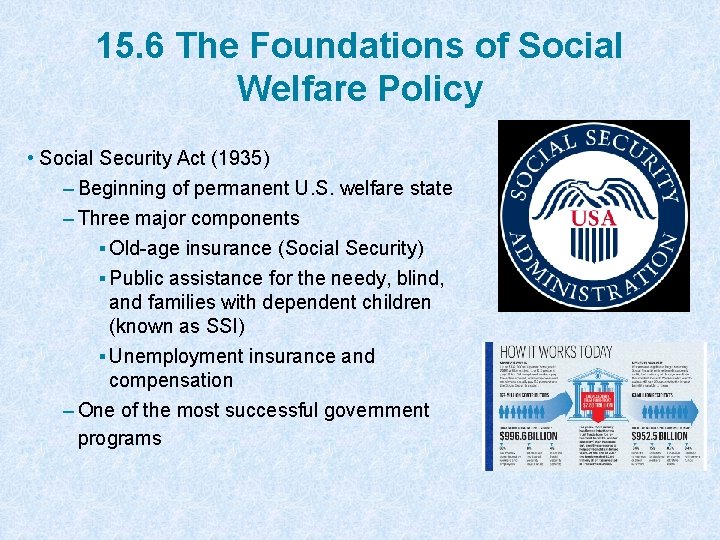
15. 6 The Foundations of Social Welfare Policy • Social Security Act (1935) – Beginning of permanent U. S. welfare state – Three major components ▪ Old-age insurance (Social Security) ▪ Public assistance for the needy, blind, and families with dependent children (known as SSI) ▪ Unemployment insurance and compensation – One of the most successful government programs
15. 6 Social Welfare Programs Today (1 of 2) • Entitlement Programs – Non–means-tested – Means-tested • Old Age, Survivors, and Disability Insurance – Most employees covered by Social Security – Current workers fund benefits for retirees. • Unemployment Insurance – Covers people who lose their jobs through no fault of their own
15. 6 Social Welfare Programs Today (2 of 2) • Supplemental Security Income –Covers needy elderly and disabled citizens • Family and Child Support –Aid to Families with Dependent Children –Temporary Assistance for Needy Families • Supplemental Nutrition Assistance Program –Food assistance for the poor
15. 7 Toward Reform: Ongoing Challenges in Social and Economic Policy Making • Agenda Setting – Opportunities are rare. – Social and economic policy has a long and complex history in the United States, as has been discussed in this chapter. – However, in each of the issue areas considered, public policy challenges have yet to be solved. • Policy Adoption – Incrementalism • Implementation – Policies change shape as they are carried out. – Policies subject to challenge
Photo Credits Chapter 15 357: Bill Clark/AP Images; 365: Bettmann/Getty Images; 368: Chip Somodevilla/Getty Images; 369: Brendan Hoffman/Getty Images; 369: Jens Kuhfs/Getty Images; 369: Toshifumi Kitamura/AFP/Getty Images; 373: Mike Householder/AP Images; 375: The Washington Post/Getty Images; 377: MPI/Archive Photos/Getty Images