
American Government Basics Lecture 1 What is political
American Government: Basics Lecture #1
What is political power? 1. Terms a. Power: ability for one body (person, government) to get another person or government institution to do something i. Is force used? ii. Does the government have too much power? Who decides? b. Authority: right to use power i. Tend to only have authority to use power if you have…. c. Legitimacy: determination of who has authority i. Can the President issue a travel ban? ii. Can Congress pass healthcare legislation? iii. Can the Courts legalize gay marriage?
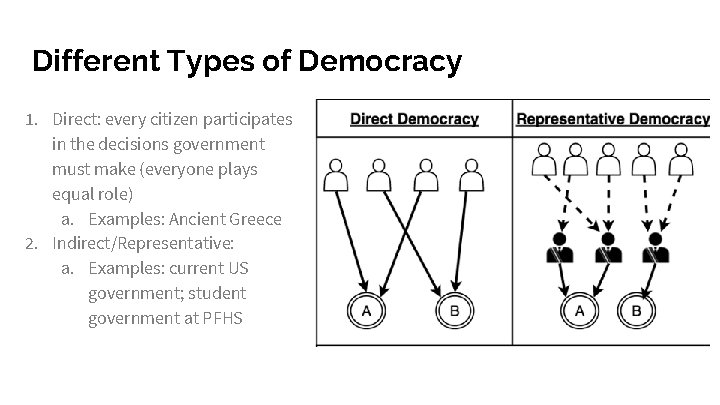
Different Types of Democracy 1. Direct: every citizen participates in the decisions government must make (everyone plays equal role) a. Examples: Ancient Greece 2. Indirect/Representative: a. Examples: current US government; student government at PFHS
Who Governs? 1. Marxist Theory a. Control economic system, control government b. Based on writings from Karl Marx 2. Elitist Theory a. Top, powerful leaders (some economic, some not) make decisions and do not typically represent popular beliefs b. Started with C. Wright Mills, American sociologist
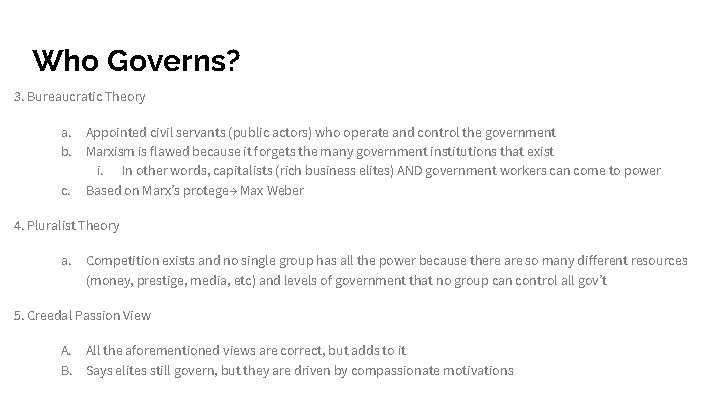
Who Governs? 3. Bureaucratic Theory a. Appointed civil servants (public actors) who operate and control the government b. Marxism is flawed because it forgets the many government institutions that exist i. In other words, capitalists (rich business elites) AND government workers can come to power c. Based on Marx’s protege→ Max Weber 4. Pluralist Theory a. Competition exists and no single group has all the power because there are so many different resources (money, prestige, media, etc) and levels of government that no group can control all gov’t 5. Creedal Passion View A. All the aforementioned views are correct, but adds to it B. Says elites still govern, but they are driven by compassionate motivations
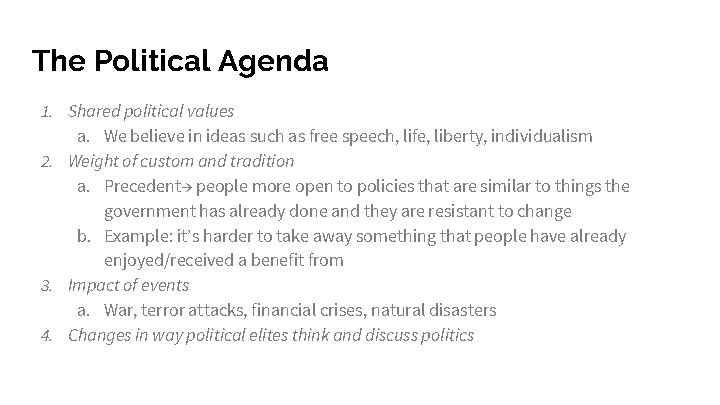
The Political Agenda 1. Shared political values a. We believe in ideas such as free speech, life, liberty, individualism 2. Weight of custom and tradition a. Precedent→ people more open to policies that are similar to things the government has already done and they are resistant to change b. Example: it’s harder to take away something that people have already enjoyed/received a benefit from 3. Impact of events a. War, terror attacks, financial crises, natural disasters 4. Changes in way political elites think and discuss politics
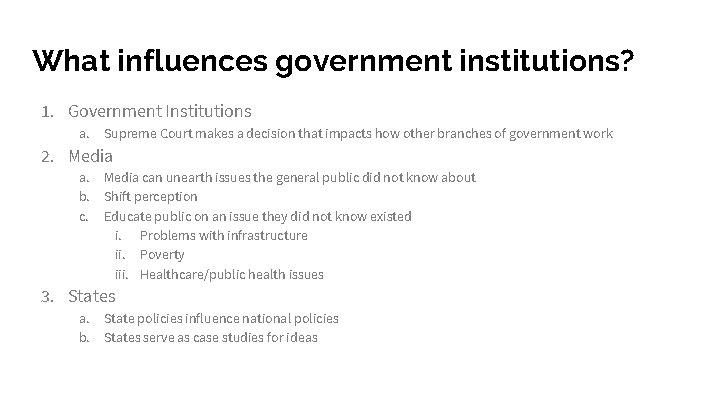
What influences government institutions? 1. Government Institutions a. Supreme Court makes a decision that impacts how other branches of government work 2. Media a. Media can unearth issues the general public did not know about b. Shift perception c. Educate public on an issue they did not know existed i. Problems with infrastructure ii. Poverty iii. Healthcare/public health issues 3. States a. State policies influence national policies b. States serve as case studies for ideas
- Slides: 7