
AMERICAN COLONIAL LITERATURE 1750 1820 The Age of
- Slides: 27
AMERICAN COLONIAL LITERATURE (1750 – 1820) The Age of Reason
Development of American colonial literature. “The Autobiography” by Benjamin Franklin. The essay “The American crisis” by Thomas Paine. “The Declaration of Independence” by Thomas Jefferson. Native American myths and legends.
AMERICAN COLONIAL LITERATURE OF THE 18 TH CENTURY CONSISTS OF Practical books Sermons Tracts Medical books Scientific books Satires Poetry The main principle: COMMON SENSE IN A COMMON LANGUAGE
BRITISH CONTROL OF COLONIAL TRADE Hat Can (1732) – a British law restricting colonial manufacture and export of hats in direct competition with English hatmakers. Molasses Act (1733) - a British law that imposed a tax on molasses, sugar, and rum imported from non -British foreign colonies into the North American colonies. The act specifically aimed at reserving a practical monopoly of the American sugar market to British West Indies sugarcane growers, who otherwise could not compete successfully with French and other foreign sugar producers on morefertile neighbouring West Indian islands.
BRITISH CONTROL OF COLONIAL TRADE The Stamp Act (1765) – first British parliamentary attempt to raise revenue through direct taxation of all colonial commercial and legal papers, newspapers, pamphlets, cards, almanacs, and dice. The Tea Act (1773) - a legislative maneuver by the British ministry of Lord North to make English tea marketable in America. Colonial resistance culminated in the Boston Tea Party (December 1773), in which tea was dumped into the ocean, and in a similar action in New York (April 1774).
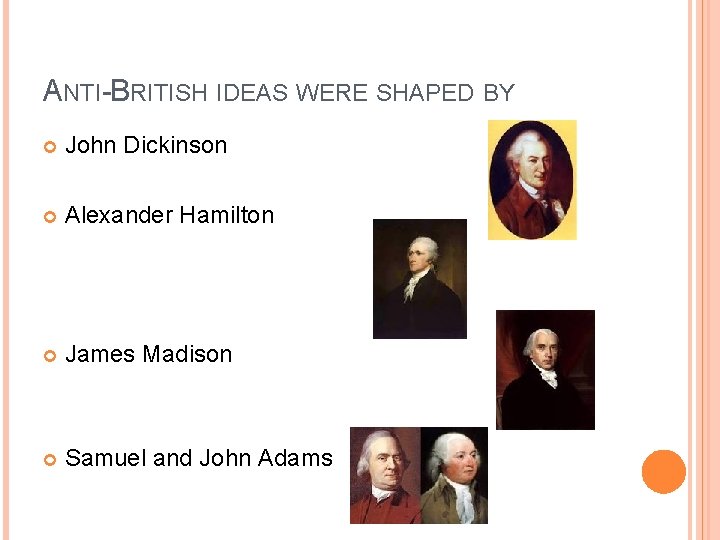
ANTI-BRITISH IDEAS WERE SHAPED BY John Dickinson Alexander Hamilton James Madison Samuel and John Adams
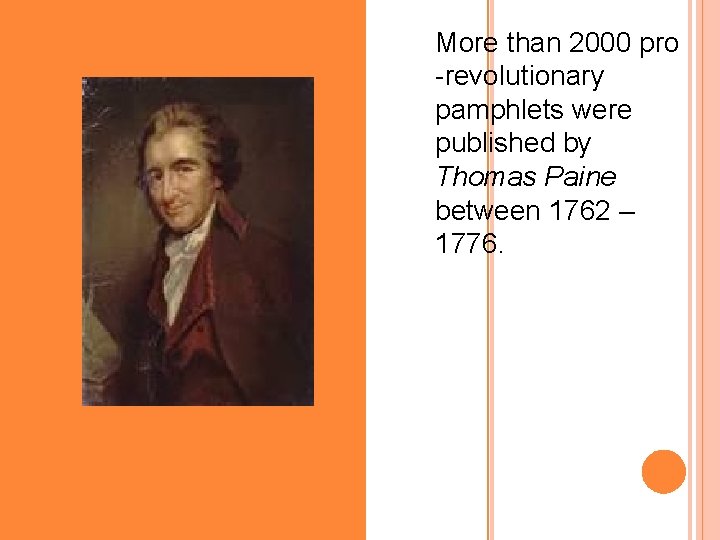
More than 2000 pro -revolutionary pamphlets were published by Thomas Paine between 1762 – 1776.
“THE AMERICAN CRISIS” IS A COLLECTION OF ARTICLES WRITTEN BY THOMAS PAINE DURING THE AMERICAN REVOLUTIONARY WAR (1776 - 1783) “THESE are the times that try men's souls. The summer soldier and the sunshine patriot will, in this crisis, shrink from the service of their country; but he that stands by it now, deserves the love and thanks of man and woman. Tyranny, like hell, is not easily conquered; yet we have this consolation with us, that the harder the conflict, the more glorious the triumph. What we obtain too cheap, we esteem too lightly: it is dearness only that gives every thing its value. ”
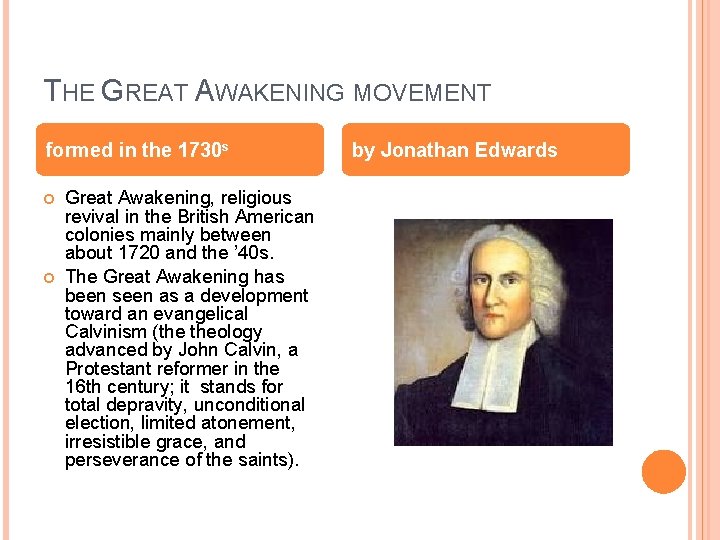
THE GREAT AWAKENING MOVEMENT formed in the 1730 s Great Awakening, religious revival in the British American colonies mainly between about 1720 and the ’ 40 s. The Great Awakening has been seen as a development toward an evangelical Calvinism (the theology advanced by John Calvin, a Protestant reformer in the 16 th century; it stands for total depravity, unconditional election, limited atonement, irresistible grace, and perseverance of the saints). by Jonathan Edwards
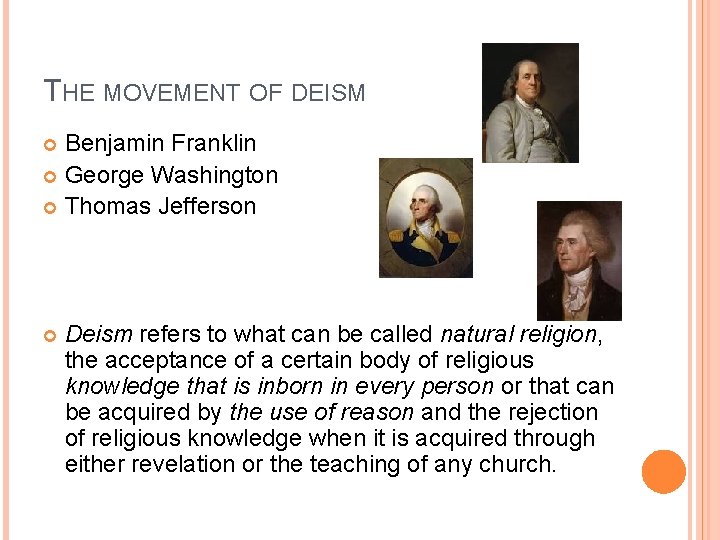
THE MOVEMENT OF DEISM Benjamin Franklin George Washington Thomas Jefferson Deism refers to what can be called natural religion, the acceptance of a certain body of religious knowledge that is inborn in every person or that can be acquired by the use of reason and the rejection of religious knowledge when it is acquired through either revelation or the teaching of any church.
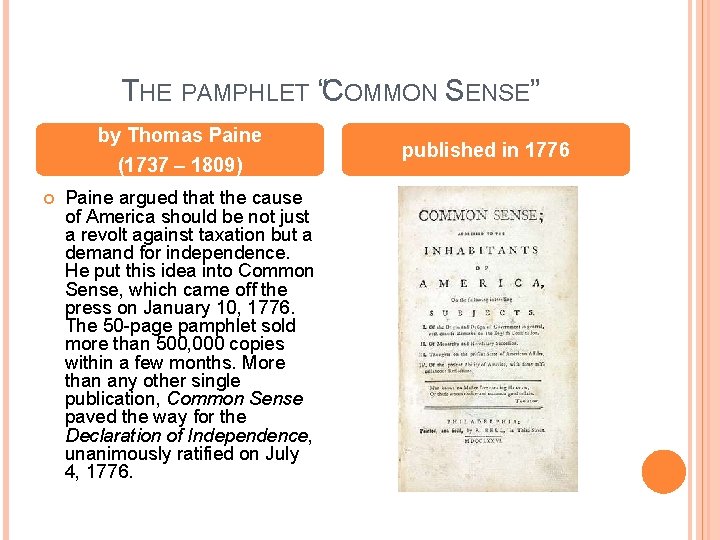
THE PAMPHLET “COMMON SENSE” by Thomas Paine (1737 – 1809) Paine argued that the cause of America should be not just a revolt against taxation but a demand for independence. He put this idea into Common Sense, which came off the press on January 10, 1776. The 50 -page pamphlet sold more than 500, 000 copies within a few months. More than any other single publication, Common Sense paved the way for the Declaration of Independence, unanimously ratified on July 4, 1776. published in 1776
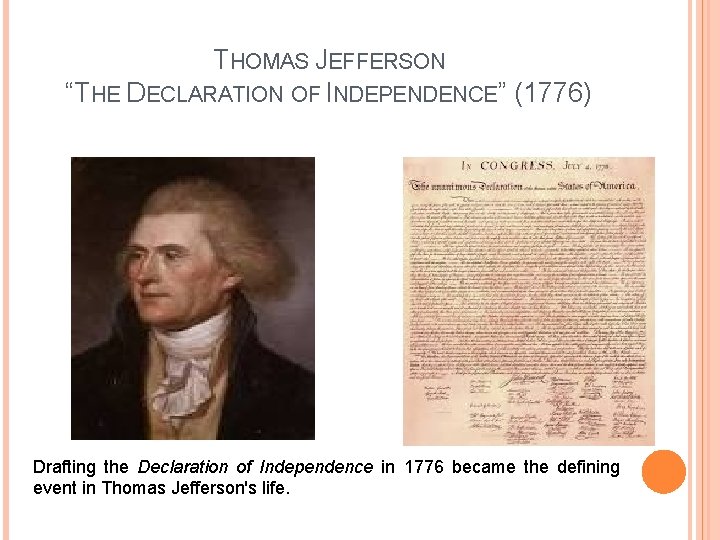
THOMAS JEFFERSON “THE DECLARATION OF INDEPENDENCE” (1776) Drafting the Declaration of Independence in 1776 became the defining event in Thomas Jefferson's life.
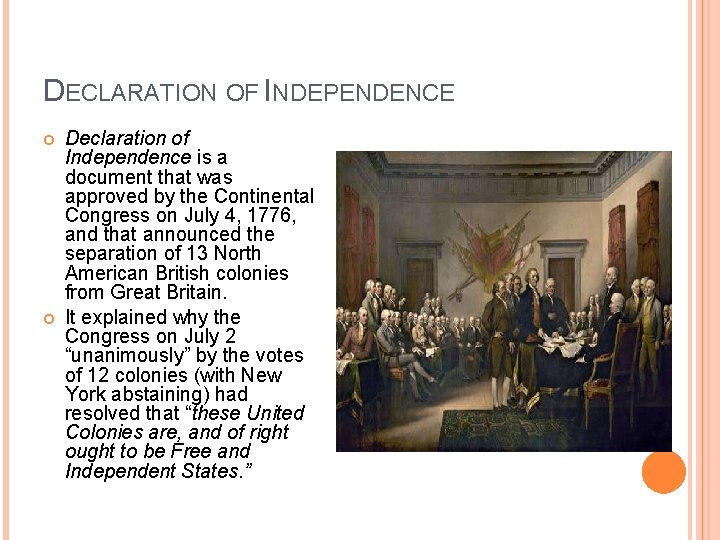
DECLARATION OF INDEPENDENCE Declaration of Independence is a document that was approved by the Continental Congress on July 4, 1776, and that announced the separation of 13 North American British colonies from Great Britain. It explained why the Congress on July 2 “unanimously” by the votes of 12 colonies (with New York abstaining) had resolved that “these United Colonies are, and of right ought to be Free and Independent States. ”
DECLARATION OF INDEPENDENCE INTRODUCTION AND PREAMBLE Introduction Jefferson lays out that the document is an explanation of why the colonies are breaking ties with Great Britain. v The unanimous Declaration of the thirteen united States of America, When in the Course of human events, it becomes necessary for one people to dissolve the political bands which have connected them with another, and to assume among the powers of the earth, the separate and equal station to which the Laws of Nature and of Nature's God entitle them, a decent respect to the opinions of mankind requires that they should declare the causes which impel them to the separation. Preamble The paragraph where Jefferson discusses the rights of the people with relation to their government. The government exists to protect people's inherent human rights, and Jefferson presents the accusation that the British government has become tyrannical and no longer protects the citizens in the colonies.
DECLARATION OF INDEPENDENCE THE BODY AND CONCLUSION Body, Part 1: Indictment of King George III The first part of the body is the list of relatively specific examples of the British government, primarily King George III, abusing the colonists and acting despotically. Body, Part 2: Indictment of the British People Jefferson reminds the readers that the colonists have tried a number of times to plead their case for better treatment, even appealing directly to the British people for support. Conclusion Because of everything stated above, the U. S. A is now independent and can do the things independent countries do. v We, therefore, the Representatives of the united States of America, in General Congress, Assembled (…) and declare, that these United Colonies are, (…) be Free and Independent States; as Free and Independent States, they have full Power to levy War, conclude Peace, contract Alliances, establish Commerce, and to do all other Acts and Things which Independent States may of right do. v And for the support of this Declaration, with a firm reliance on the protection of divine Providence, we mutually pledge to each other our Lives, our Fortunes and our sacred Honor.
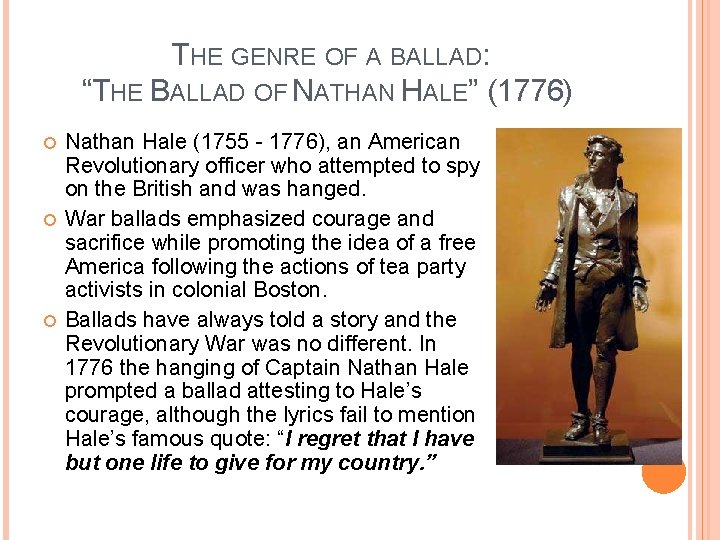
THE GENRE OF A BALLAD: “THE BALLAD OF NATHAN HALE” (1776) Nathan Hale (1755 - 1776), an American Revolutionary officer who attempted to spy on the British and was hanged. War ballads emphasized courage and sacrifice while promoting the idea of a free America following the actions of tea party activists in colonial Boston. Ballads have always told a story and the Revolutionary War was no different. In 1776 the hanging of Captain Nathan Hale prompted a ballad attesting to Hale’s courage, although the lyrics fail to mention Hale’s famous quote: “I regret that I have but one life to give for my country. ”
THE GENRE OF A FOLK SONG: “YANKEE DOODLE” During the Revolutionary War era in America, settlers would commonly walk around town singing songs that celebrated the American colonies and poked fun at their British homeland. The song “Yankee Doodle” is believed to have originated with British troops during the American Revolution as a way to make fun of the colonists. “Yankee Doodle” summarized widespread British contempt for American soldiers. But Americans had developed a different sense of themselves being an “American” was nothing to be ashamed of. These “Yankee doodles” embraced the song and made it their own. Of course, they changed many of the lyrics, but what’s interesting is that even in these new lyrics they poked fun at themselves. Rather than retaliate by directing abuse at the British, they continued to mock their own simplicity. According to the Library of Congress, Yankee Doodle quickly became a form of prideful boasting after the colonists saw Britain surrender at Yorktown in 1781.
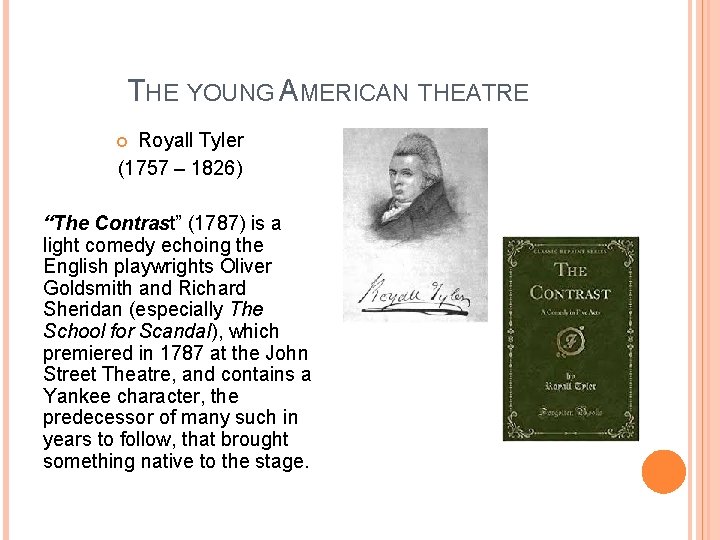
THE YOUNG AMERICAN THEATRE Royall Tyler (1757 – 1826) “The Contrast” (1787) is a light comedy echoing the English playwrights Oliver Goldsmith and Richard Sheridan (especially The School for Scandal), which premiered in 1787 at the John Street Theatre, and contains a Yankee character, the predecessor of many such in years to follow, that brought something native to the stage.
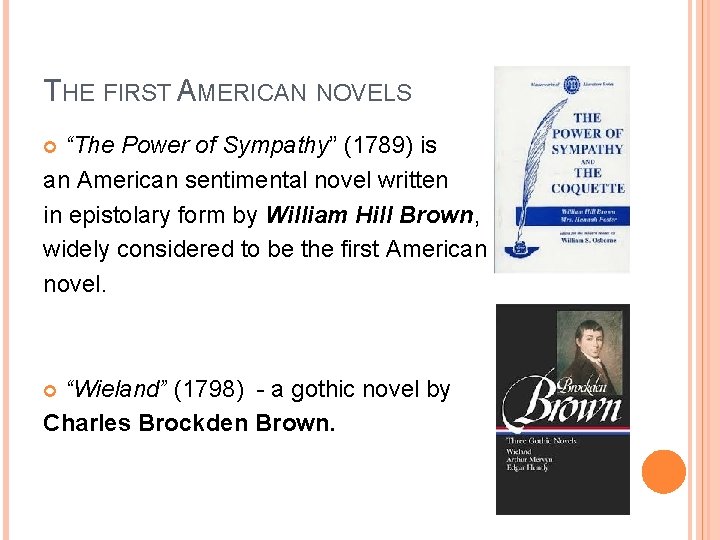
THE FIRST AMERICAN NOVELS “The Power of Sympathy” (1789) is an American sentimental novel written in epistolary form by William Hill Brown, widely considered to be the first American novel. “Wieland” (1798) - a gothic novel by Charles Brockden Brown.
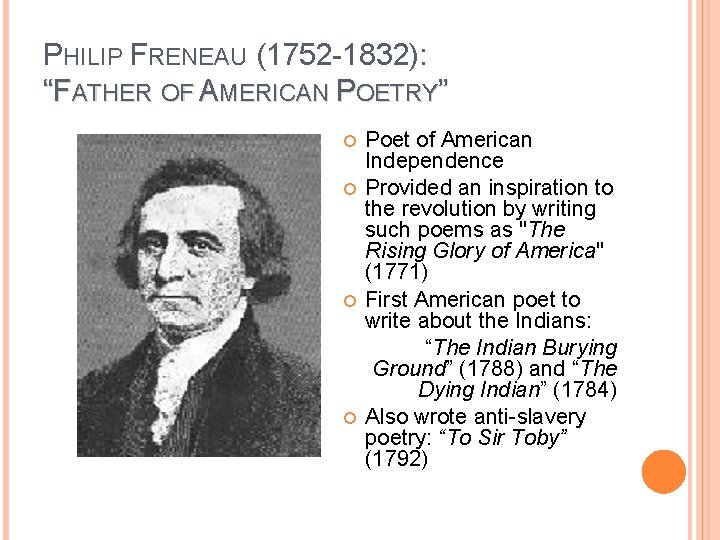
PHILIP FRENEAU (1752 -1832): “FATHER OF AMERICAN POETRY” Poet of American Independence Provided an inspiration to the revolution by writing such poems as "The Rising Glory of America" (1771) First American poet to write about the Indians: “The Indian Burying Ground” (1788) and “The Dying Indian” (1784) Also wrote anti-slavery poetry: “To Sir Toby” (1792)
YOUNG AMERICAN POETRY: THE CONNECTICUT WITS (OR HARTFORD WITS) The group of poets known as the Connecticut (or Hartford) Wits, who formed the first major American literary circle. This group consisted of well-known poets such as John Trumbull, Timothy Dwight, Joel Barlow and David Humphreys, and lesser poets, including Lemuel Hopkins, Theodore Dwight, and Richard Alsop. They produced a considerable body of political satire just after the American Revolution. “The Progress of Dullness” (1772, 1773) is a satirical poem, in which John Trumbull combined Enlightenment rationalism with Protestant religion. In his long poem “America” (1780) Timothy Dwight, borrowing a famous phrase from Philip Freneau and Hugh Henry Brackenridge’s long poem The Rising Glory of America (1771), confidently predicted that America’s “rising glory shall expand its rays, / And lands and times unknown rehearse their endless praise. ” praise
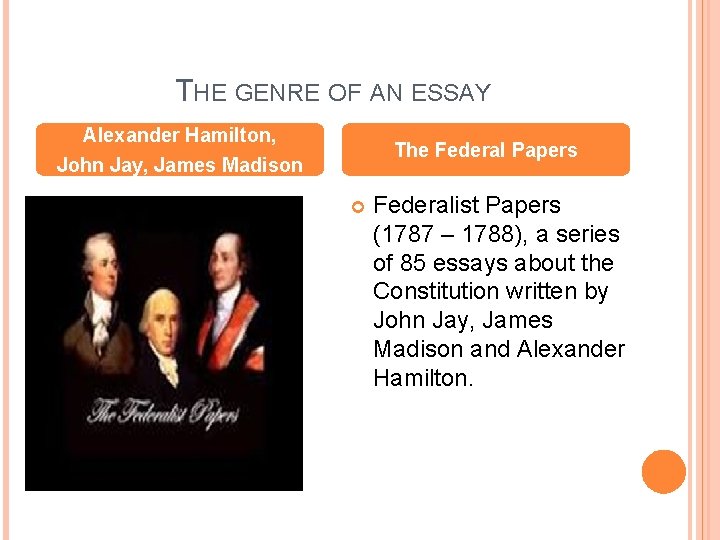
THE GENRE OF AN ESSAY Alexander Hamilton, The Federal Papers John Jay, James Madison Federalist Papers (1787 – 1788), a series of 85 essays about the Constitution written by John Jay, James Madison and Alexander Hamilton.
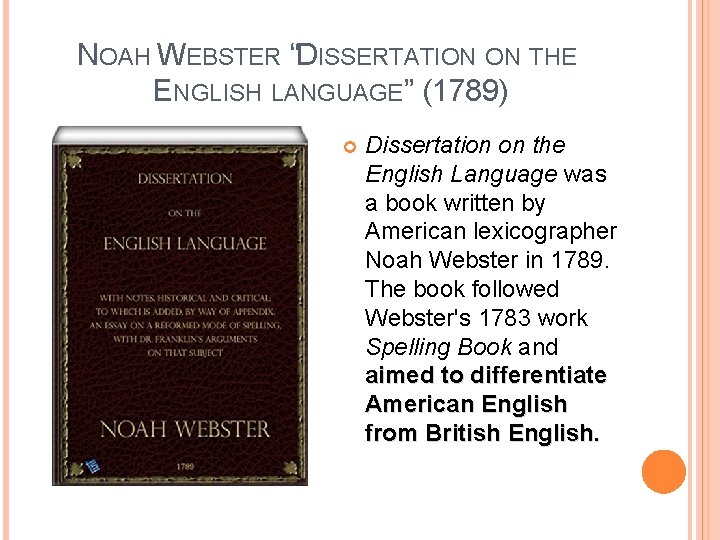
NOAH WEBSTER “DISSERTATION ON THE ENGLISH LANGUAGE” (1789) Dissertation on the English Language was a book written by American lexicographer Noah Webster in 1789. The book followed Webster's 1783 work Spelling Book and aimed to differentiate American English from British English.
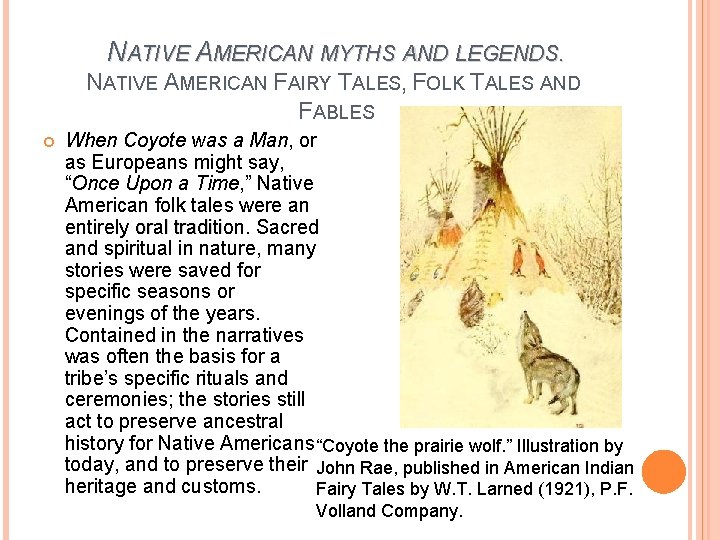
NATIVE AMERICAN MYTHS AND LEGENDS. NATIVE AMERICAN FAIRY TALES, FOLK TALES AND FABLES When Coyote was a Man, or as Europeans might say, “Once Upon a Time, ” Native American folk tales were an entirely oral tradition Sacred and spiritual in nature, many stories were saved for specific seasons or evenings of the years. Contained in the narratives was often the basis for a tribe’s specific rituals and ceremonies; the stories still act to preserve ancestral history for Native Americans “Coyote the prairie wolf. ” Illustration by today, and to preserve their John Rae, published in American Indian heritage and customs. Fairy Tales by W. T. Larned (1921), P. F. Volland Company.
NATIVE AMERICAN MYTHS AND LEGENDS. Native American myths and folklore vary greatly across the great expanse of North, Central and South America; just as the sea turns into plains, turns into mountains, so the myths and deities evolve with the ever-changing landscape. If one thing connects all Native American folklore, it is that of the Great Spirit, Spirit and how spiritual forces can be felt and experienced in the physical world. The culture’s folk tales are known to symbolize seasons and nature as they honor our connection to the Earth.
NATIVE AMERICAN MYTHS AND LEGENDS. Creation myths abound within Native American folklore, as well as tales explaining how death came into the world. Migration myths are also a common theme, but most pervasive is the wily Trickster archetype The Trickster is a consistent character within Native American folklore and mythology revealing himself in various animals or deities. Able to balance the vulgar with the sacred, the always mischievous Trickster tales were born from one’s own imagination and meant to delight and entertain rather than to pass down tribal traditions.
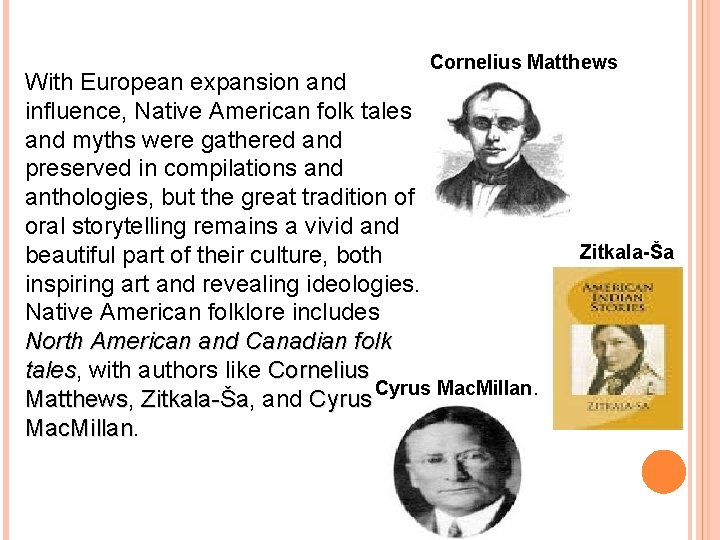
Cornelius Matthews With European expansion and influence, Native American folk tales and myths were gathered and preserved in compilations and anthologies, but the great tradition of oral storytelling remains a vivid and beautiful part of their culture, both inspiring art and revealing ideologies. Native American folklore includes North American and Canadian folk tales, tales with authors like Cornelius Cyrus Mac. Millan. Matthews, Matthews Zitkala-Ša, Zitkala-Ša and Cyrus Mac. Millan Zitkala-Ša