
American Academy of Sleep Breathing Phoenix AZ April
American Academy of Sleep & Breathing, Phoenix AZ, April 2017 Ronald S. Brown, DDS, MS, Dipl. ABOM Past President AAOM & ABOM Past Director (Secretary) ABDS Professor, Howard Univ College of Dentistry Clin Assoc Professor, Georgetown Univ Med Ctr Volunteer Clin Research Assoc, NHLBI/NIH Hematology Br
Specialty Recognition For Emerging Dental Specialties • The American Medical Association (AMA) controlled medical specialty recognition until the 1930’s. In 1933, there were only four recognized medical specialties, ophthalmology, otolaryngology, obstetrics-gynecology, and dermatology (and syphilogy). • Brown & Mashni, 2015
Disclosure Slide • I have no disclosures to make. I am a pastpresident of both the ABOM and the AAOM. I was previously the Secretary of the ABDS, but I do not presently have an appointment within that Board as I completed my term. I was one of the original founding board members. I am not receiving an honorarium, although my travel fees, expenses, and hotel expenses are being covered by the American Academy of Sleep & Breathing.
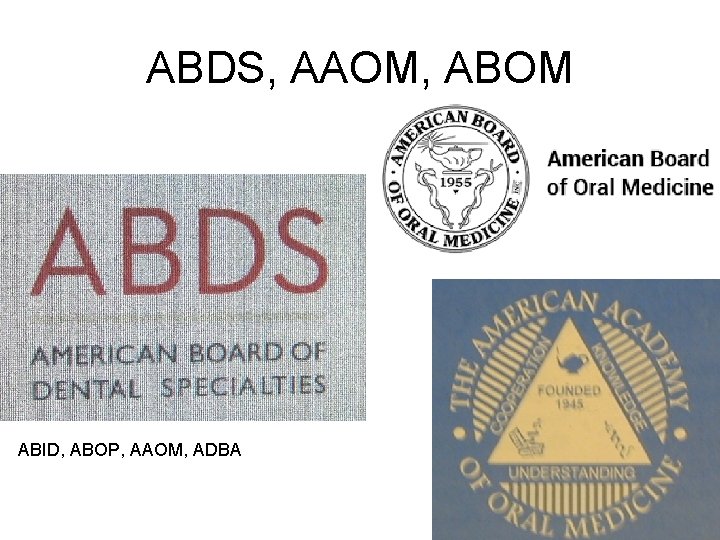
ABDS, AAOM, ABOM ABID, ABOP, AAOM, ADBA
Some History • The American Board of Medical Specialties was formed which took over the process of specialty recognition away from the AMA. Later, the American Osteopathic Association Bureau of Osteopathic Specialists, and the American Board of Physicians’ Specialties were formed.
The formation of Dental Specialties • 1947 -ORAL SURGERY, ORTHODONTICS, PEDODONTICS, PERIODONTIA, PROSTHODONTICS • 1949 -ORAL PATHOLOGY • 1950 -PUBLIC HEALTH • 1963 -ENDODONTICS • 1999 -ORAL RADIOLOGY • (This and following legal slides stolen from Dr. Frank Recker, Esq. )
SPECIALTY APPLICATION DENIALS: 1986 -2012 • IMPLANT DENTISTRY-THE AMERICAN ACADEMY OF IMPLANT DENTISTRY (AAID): 1986; 1988; 1993 • ORAL MEDICINE-THE AMERICAN ACADEMY OF ORAL MEDICINE (AAOM): 1996; 1999 • ORAL FACIAL PAIN-THE AMERICAN ACADEMY OF OROFACIAL PAIN (AAOP): 2000
SPECIALTY APPLICATION DENIALS: 1986 -2012 • DENTAL ANESTHESIOLOGY-THE AMERICAN SOCIETY OF DENTIST ANESTHESIOLOGISTS (ASDA): 1994; 1997; 1999; 2012 • The ADA next discontinued the specialty application process for two years, and instituted changes to make the application process more difficult and more expensive.
ADVERTISING SPECIALTIES PRE 1980’S • PROFESSIONAL ADVERTISING DID NOT EXIST FOR PRACTICAL PURPOSES • CREDENTIALS AND SPECIALTIES WERE AN ‘INTRA PROFESSIONAL’ ISSUE • WHAT THE LAW ALLOWED RELATIVE TO PROFESSIONAL ADVERTISING, AND WHEN? • THE EVOLUTION OF THE LAW
Virginia State Board of Pharmacy 1975 • Supreme Court decides that advertising price, although commercial speech, should receive freedom protections under the First Amendment; public is entitled to have knowledge about competitive pricing terms. • OPENS THE DOOR FOR PROFESIONAL ADVERTISING
BATES V STATE BAR 1977 • ARIZONA ATTORNEYS NOT ALLOWED TO ADVERTISE • COMMERCIAL SPEECH MERITS FIRST AMENDMENT PROTECTION, PROVIDING CONSUMERS INFORMATION ABOUT SERVICES AND PRODUCTS • WOULD NOT HARM LEGAL PROFESSION
State Restrictions • COURTS BEGIN TO ANALYZE THE POWER OF THE STATE TO RESTRICT COMMERCIAL SPEECH • SUPREME COURT ISSUES PIVOTAL DECISION IN MID 1980’S; COMMERCIAL FREE SPEECH ENTITLED TO PROTECTION UNDER FIRST AMENDMENT • BURDEN ON STATE TO JUSTIFY RESTRICTIONS
What is a Specialist? And who Cares? • Advanced Education and Training • Certification by the Specialty Board (Diplomate) • A Clinician who specializes in particular conditions, illnesses, and diseases, with expertise pertaining to the diagnosis and treatment of those particular conditions, illnesses and diseases. • Better diagnosis? treatment? more expensive? less expensive? Too focused? • Generalists, Other Specialists, The Public
What About CODA? • CODA has the authority from the DOE to credential dental residency programs, including dental specialty residency programs.
What about General Dentistry? • Should General Dentistry be a specialty? • Isn’t this a contradiction of terms? • But aren’t Internal Medicine, and Family Medicine, Medical Specialties? • So being certified by the Board denotes expertise beyond those clinicians who aren’t certified by the Board.
Internal Medicine & Family Medicine • These medical residencies are credentialed • Physicians boarded in these residencies must pass psychometrically evaluated examinations
Emerging Dental Specialties • A dentist is defined as a dental specialist when they have been certified by an ADA-approved or ABDS-certified Specialty Board or is eligible to be certified by graduating from a Department of Education-approved Advanced Dental Specialty Education Program of at least 2 -year or equivalent (First Level Specialists) • A dentist is defined to have a dental sub-specialty (Second Level Specialists) when the have been certified by an ABDS-certified Sub-Specialty Board or is eligible to be certified by graduating from a DOE-approved Advanced Dental Sub-Specialty (Second Level Specialist) Residency/Education Program.
The ADA Response to the TX Legal Decision • Resolution 65 • Shifts the issue of specialty recognition onto the individual state boards (among other things)
ADA Resolution 65 • Broadening the Specialties that can be Ethically Announced. Section 5. H. of the Code states: “The dental specialties recognized by the American Dental Association and the designation for ethical specialty announcement and limitation of practice are…” and then proceeds to list the nine dental specialties recognized by the ADA. As noted above, however, there is movement in certain jurisdictions to recognize areas of dentistry as specialties beyond those recognized through the specialty recognition process established by the ADA.
• Consider a jurisdiction that recognizes oral medicine as a specialty and allows a dentist who has successfully completed an advanced dental education program in oral medicine accredited by the Commission on Dental Accreditation to announce as a specialist in oral medicine. A dentist who did so, however, might be accused of violating the Code because oral medicine is not one of the nine specialties recited for which “ethical specialty announcement” is presently permitted. • The Council proposes to amend Section 5. H. of the Code so that it aligns with the changes in the scope of specialty recognition in some jurisdictions. The amendment to Section 5. H. of the Code would permit educationally qualified dentists practicing in areas of dentistry recognized as specialties in their jurisdictions, but not by the ADA, to announce as specialists. The Council requested that the Council on Dental Education and Licensure (CDEL) review and comment on this proposed revision of Section 5. H. of the Code and have been informed that CDEL is supportive of the amendment.

Questions? ? ?

- Slides: 22