
AMERICA CLAIMS AN EMPIRE CHAPTER 10 IMPERIALISM AND
- Slides: 77
AMERICA CLAIMS AN EMPIRE CHAPTER 10
IMPERIALISM AND AMERICA American Expansionism Americans sought to increase the size of their nation � wanted to establish colonies overseas. IMPERIALISM – the policy in which stronger nations extend their economic, political, or military control over weaker territories. Imperialism was already a trend around the world.
GLOBAL COMPETITION � Imperialism �Africa taken over by Europeans �Imperialists competed over territory in Asia, especially in China. � Japan formed a strong central govt. and joined in the competition for China in the 1890’s.
3 FACTORS FUELED THE NEW AMERICAN IMPERIALISM 1. Desire for military strength 2. Thirst for new markets 3. Belief in cultural superiority
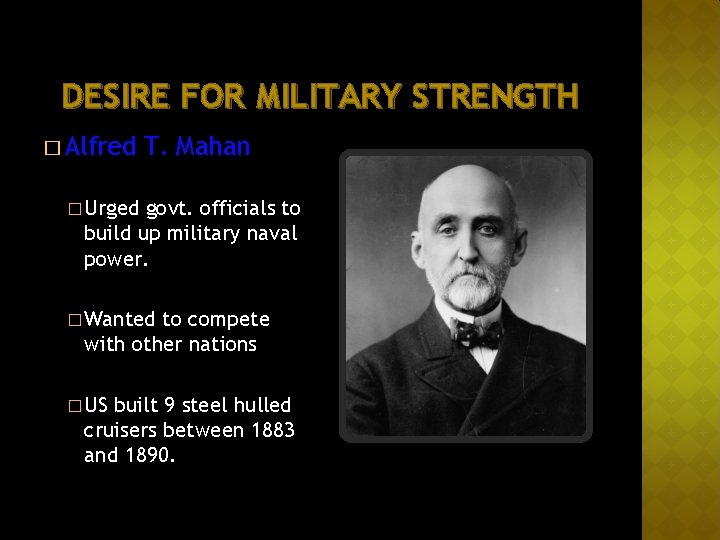
DESIRE FOR MILITARY STRENGTH � Alfred T. Mahan � Urged govt. officials to build up military naval power. � Wanted to compete with other nations � US built 9 steel hulled cruisers between 1883 and 1890.
THIRST FOR NEW MARKETS � Factories were now producing more than Americans could consume. �Americans wanted: Raw materials New markets � Imperialists viewed foreign trade as the solution to American over-production, unemployment, and economic depression.
BELIEF IN CULTURAL SUPERIORITY � Many Americans thought they were superior to other peoples because they were Anglo. Saxon. �felt they should inferior peoples of Christianity and “civilization”
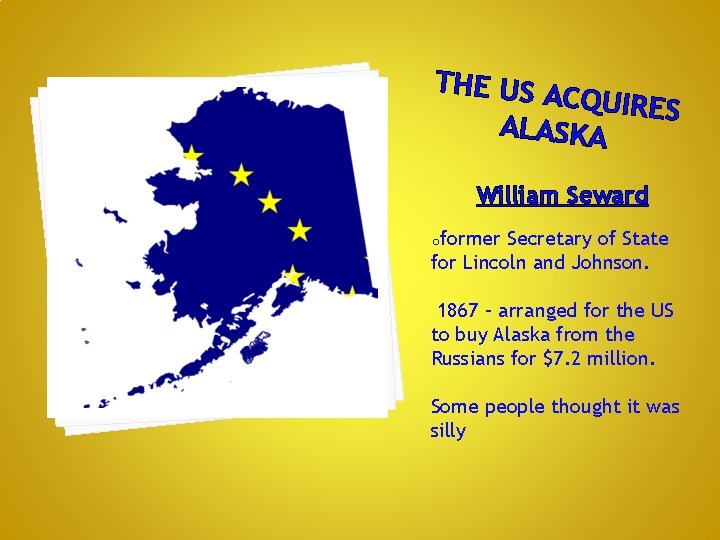
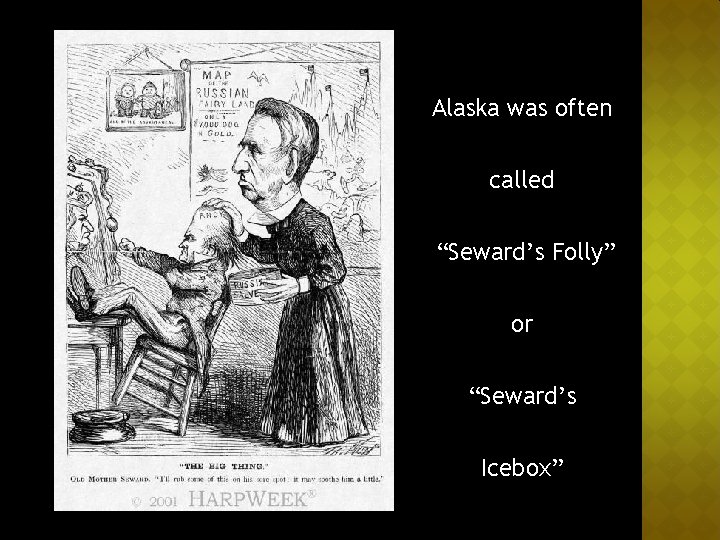
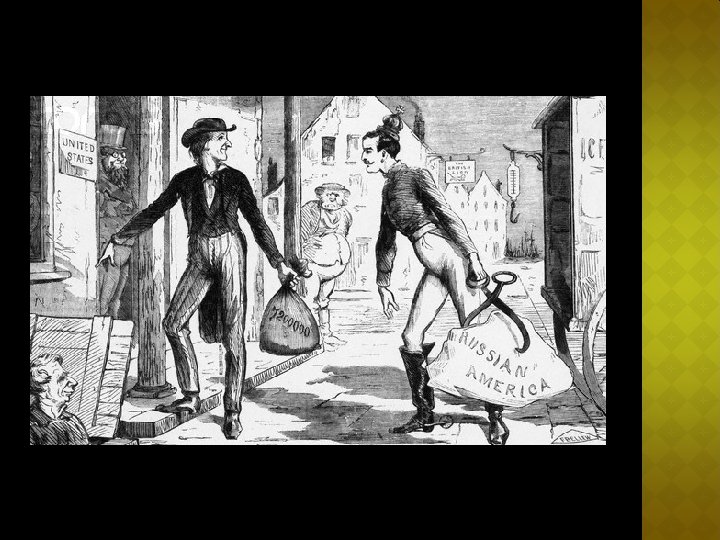
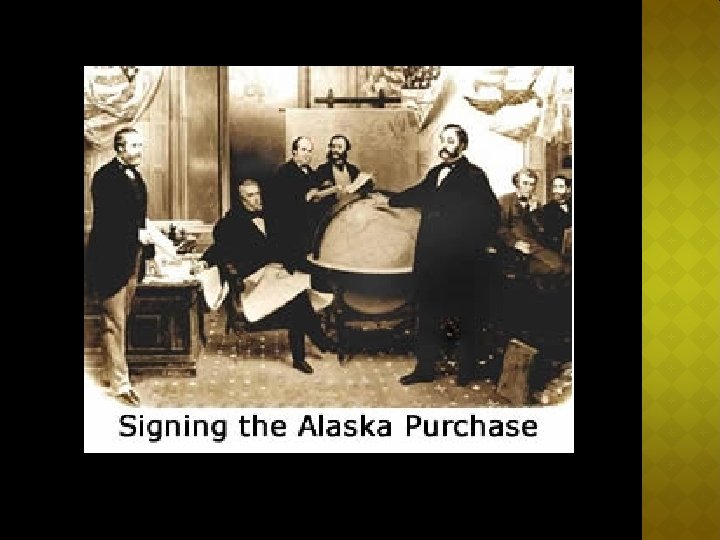
THE US A CQUIRES ALASKA William Seward oformer Secretary of State for Lincoln and Johnson. 1867 – arranged for the US to buy Alaska from the Russians for $7. 2 million. Some people thought it was silly
Alaska was often called “Seward’s Folly” or “Seward’s Icebox”
TIME SHOWED HOW WRONG THEY WERE 1959 – Alaska became a state • Cost was about 2 cents per acre • Land was rich in timber, minerals, and oil. Oil was not discovered until after the purchase.
THE UNITED STATES TAKES HAWAII 1867 - The US took over the Midway Islands Lie in the pacific Ocean abt. 1300 miles north of Hawaii. � Uninhabited �
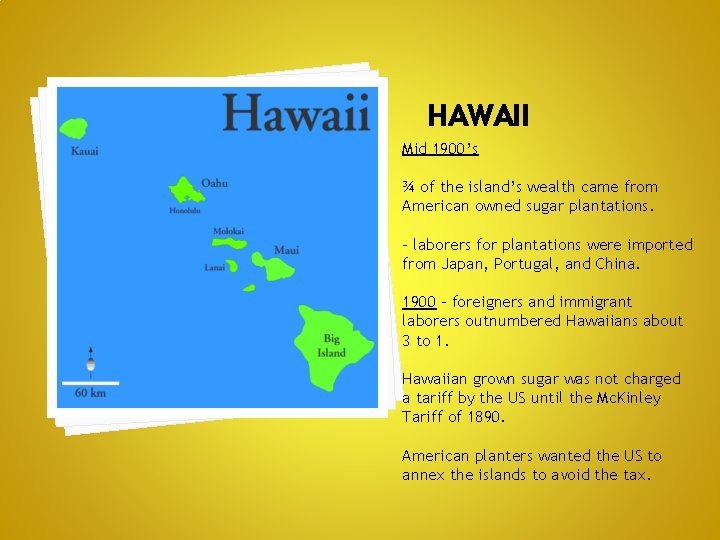
HAWAII Mid 1900’s ¾ of the island’s wealth came from American owned sugar plantations. - laborers for plantations were imported from Japan, Portugal, and China. 1900 – foreigners and immigrant laborers outnumbered Hawaiians about 3 to 1. Hawaiian grown sugar was not charged a tariff by the US until the Mc. Kinley Tariff of 1890. American planters wanted the US to annex the islands to avoid the tax.
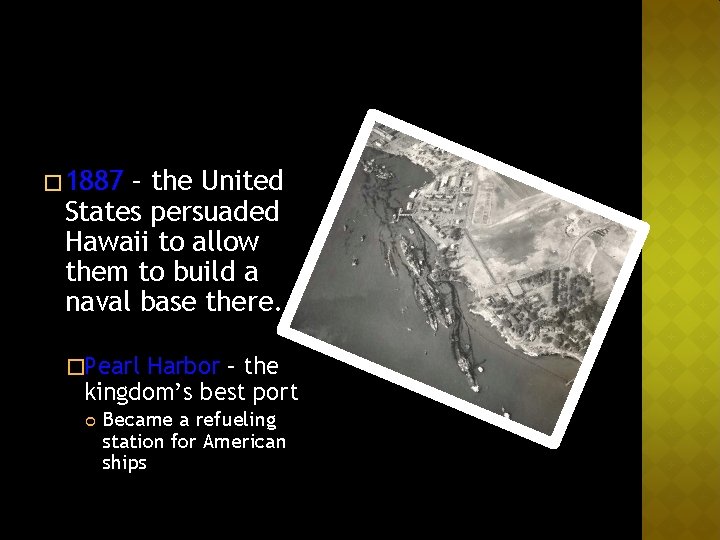
� 1887 – the United States persuaded Hawaii to allow them to build a naval base there. �Pearl Harbor – the kingdom’s best port Became a refueling station for American ships
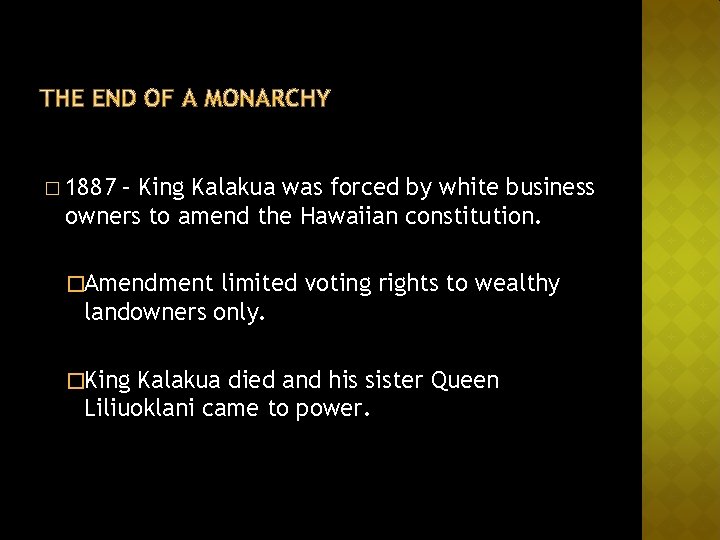
� 1887 – King Kalakua was forced by white business owners to amend the Hawaiian constitution. �Amendment limited voting rights to wealthy landowners only. �King Kalakua died and his sister Queen Liliuoklani came to power.
� She had only Hawaiians in mind for her agenda and wanted to revise the constitution leaving the white businessmen out. � Ambassador John L. Stevens organized a revolution. Queen Liliukalani
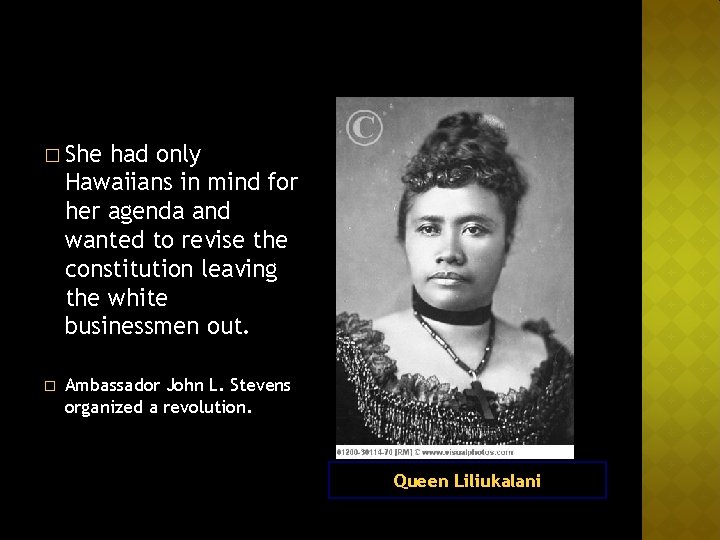
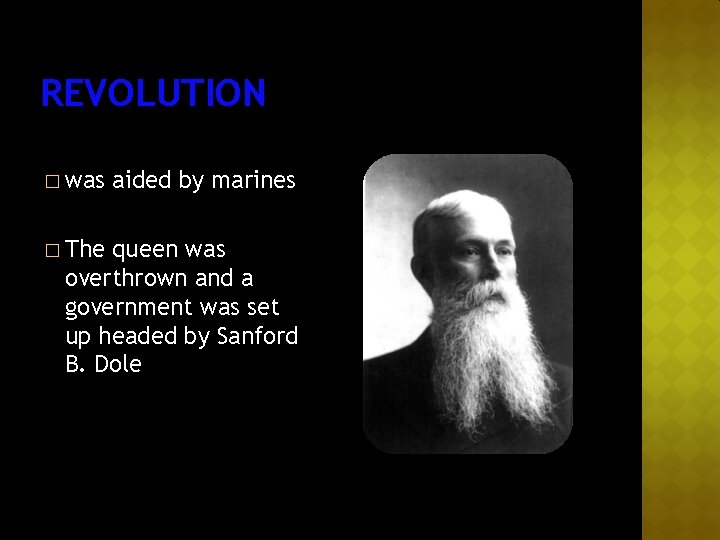
REVOLUTION � was � The aided by marines queen was overthrown and a government was set up headed by Sanford B. Dole
� President Cleveland directed that the queen be restored to her throne. �Dole refused to surrender �Cleveland recognized the Republic of Hawaii Would not consider annexation unless a majority of Hawaiians favored it.
� 1897 – Mc. Kinley became president � August 12, 1898, Congress proclaimed Hawaii an American territory. � Hawaiians were never given the chance to vote � 1959 – Hawaii became the 50 th state of the United States.
ACQUIRING NEW LANDS Section 3
RULING PUERTO RICO � When Puerto Rico became part of the U. S. Puerto Ricans feared that the U. S. would not give them the same freedom of self-rule they had under Spanish rule.
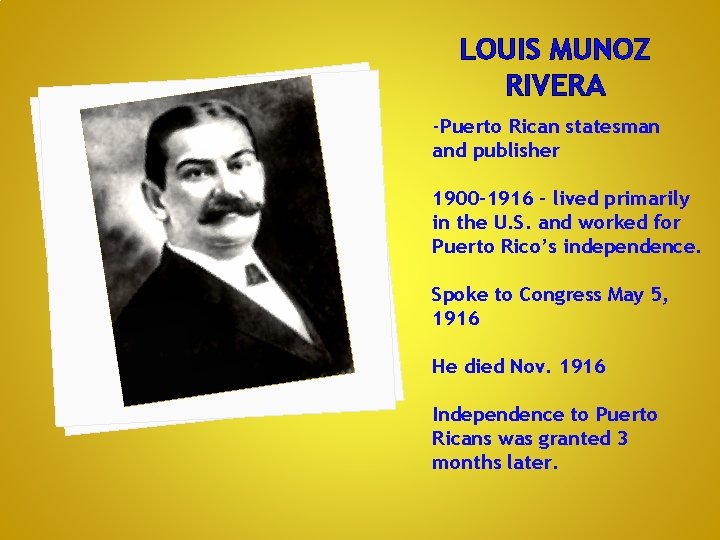
LOUIS MUNOZ RIVERA -Puerto Rican statesman and publisher 1900 -1916 – lived primarily in the U. S. and worked for Puerto Rico’s independence. Spoke to Congress May 5, 1916 He died Nov. 1916 Independence to Puerto Ricans was granted 3 months later.
� Not all Puerto Ricans wanted independence. � Some wanted statehood. � Military Rule � During the S/A War, U. S. forces, under direction of General Nelson A. Miles, occupied the island. � Miles told Puerto Ricans that troops were there for protection.
RETURN TO CIVIL GOVERNMENT � The U. S. would control Puerto Rico until Congress decided otherwise. � Puerto Rico was strategically important to the U. S. �For maintaining a U. S. presence in the Caribbean �For protecting a U. S. canal that leaders wanted to build in the future. � Foraker Act – ended military rule in PR and set up a civil govt.
�The act gave the president of the U. S. power to appoint members of Puerto Rico’s governor and members of its upper house of legislature. Puerto Ricans could only appoint the lower house of legislature. � Insular Cases – Congress ruled that the Constitution did not apply to people in acquired territories. �Congress retained the right to extend citizenship Granted that right to Puerto Ricans in 1917.
CUBA AND THE UNITED STATES � When the U. S. declared war on Spain in 1898, it recognized Cuba’s independence. Teller Amendment – �Stated that the U. S. had no intention of taking over any part of Cuba. Treaty of Paris – ended the war � Guaranteed Cuba’s independence
AMERICAN SOLDIERS � Cuba was occupied by American soldiers when the war ended. � The same officials who served Spain remained in office. �Cuban’s who protested this policy were imprisoned or exiled.
AMERICAN MILITARY �Provided �Helped food and clothing for families farmers put land back into cultivation �Organized �Helped elementary schools. eliminate yellow fever through improvement of sanitation and medical research.
PLATT AMENDMENT � 1900 – Cuba wrote its own constitution for independence, leaving out the relationship between the U. S. and Cuba. � 1901 – U. S. demanded that several provisions be added to the constitution. � These provisions were known as the Platt Amendment.
� Provisions were as follows: �Cuba could not make treaties that might limit its independence or permit a foreign power to control any part of its territory. �The U. S. reserved the right to intervene in Cuba �Cuba was not to go into debt that its government could not repay �The U. S. could buy or lease land on the island for naval stations and refueling stations.
� The U. S. made it clear that troops would not withdraw from Cuba until the Platt Amendment was approved. �Cubans marched in protest against the U. S. � 1903 – the Platt Amendment became part of the treaty between the two nations. Remained in effect for 31 years. Cuba became a U. S. protectorate - a country whose affairs are partially controlled by a stronger power.
PROTECTING AMERICAN BUSINESS INTERESTS � The most important reason for the U. S. to maintain a strong political presence in Cuba was to protect American businesses that invested in the island’s: �Sugar �Tobacco �Mining industries �Railroads and public utilities
� Many business people were convinced that annexing and imposing colonial rule on new territories was necessary to protect American interests. � Some were concerned about colonial entanglements. � Andrew Carnegie argued against the taking of nations as colonies.
FILIPINOS REBEL � Treaty of Paris – Filipinos were outraged by the annexation of the Philippines by America. � Emilio �Rebel Aguinaldo leader �believed that the U. S. had promised independence. � vowed to fight for freedom once they realized the terms of the treaty.
PHILIPPINE-AMERICAN WAR � 2/1899 - the Filipinos rose in revolt with Aguinaldo as their leader. � U. S. imposed authority on them. �Forced Filipinos to live in designated zones. Poor sanitation, disease, and starvation killed thousands. Just like Spain did with Cuba Americans looked on Filipinos as inferior � Many of the troops sent to the Philippines were African Americans – 70, 000. � Many deserted to the Filipino side – did not want racial prejudice.
� Took 3 years to put down the rebellion � About 20, 000 of them died fighting for independence. � 4000 Americans died � Cost of war $400 million
AFTERMATH OF THE WAR � After the war the U. S. set up a govt. similar to the one Puerto Rico had. � Philippines became an independent republic on July 4, 1946.
FOREIGN INFLUENCE IN CHINA � U. S. saw the Philippines as a gateway to the rest of Asia. � China was seen as a vast potential market for American products. � Opportunity for railroad construction
� China had been weakened by war and foreign intervention. � Known as the “sick man of Asia” � France, Germany, Britain, Japan, and Russia had established settlements along the coast.
JOHN HAY’S OPEN DOOR � 1899 - U. S. Secretary of State John Hay issued a series of policy statements called the Open Door notes.
� The notes were letters addressed to the leaders of imperialist nations proposing that the nations share their trading rights with the United States, creating an open door. � No nation would have a monopoly on trade with any part of China.
THE BOXER REBELLION IN CHINA � Europeans dominated much of China’s large cities. � Some Chinese formed secret societies �Boxers – most famous of these groups
BOXERS � Killed hundreds of missionaries and other foreigners. �Chinese converts to Christianity � August 1900 – troops from Britain, France, Germany, and Japan joined 2, 500 American forces and marched on the Chinese capital. � 2 months – they put down the rebellion
PROTECTING AMERICAN RIGHTS � 2 nd Series of Open Door notes was issued announcing that the U. S. would safeguard for the world the equal and impartial trade with all parts of the Chinese empire. � Paved the way for greater American influence in America.
2 ND OPEN DOOR NOTES � Reflected �Growth 3 American beliefs of economy depended on exports �Felt U. S. had to intervene abroad to keep foreign markets open. �Feared the closing of an area to American products, citizens, or ideas threatened U. S. survival.
THE IMPACT OF U. S. TERRITORIAL GAINS � under Mc. Kinley the U. S. had gained an empire. � Anti-Imperial �People League sprang into being against imperialism �Grover Cleveland, Jane Addams, Mark Twain
AMERICA AS A WORLD POWER � Teddy Roosevelt and the World � �Roosevelt was unwilling to allow the imperial powers of Europe to control the world’s political and economic destiny. �In 1905, Roosevelt mediated a settlement in a war between Russia and Japan.
� 1904 – Tsar Nicholas II of Russia declared war on Japan. � Russia and Japan were competing for control of Korea. �Japanese – attack on the Russian Pacific fleet �Japan destroyed a second fleet. Won a series of land battles securing Korea and Manchuria.
� Japan began to run out of men and money � They approached Roosevelt in secret and asked him to mediate peace negotiations. � 1905 – 1 st meeting – Portsmouth, NH � They negotiated and the Treaty of Portsmouth won the Nobel Peace Prize for Roosevelt in 1906
Many Americans felt there should be a canal cutting through Central America. - would reduce travel time for military and commercial ships. - United States and Britain agreed to share the rights to the canal. 1901 – Hay-Pauncefote Treaty – - Britain gave the U. S. exclusive rights to build and control a canal through Central America.
� 2 possible routes were identified � 1 through Nicaragua – crossed a lake � 1 through Panama – shorter, but filled with mountains and swaps. �A French company had attempted to build a canal through Panama and after 10 years they gave up. �It sent an agent, Phillippe Bunau-Varilla to the U. S. to convince them to buy the claim.
� The U. S. decided on the Panama route and purchased the area for $40 million. � The U. S. had to get permission from Columbia which ruled Panama at that time. � Negotiations broke down and Bunau-Varilla helped organized a rebellion against Columbia.
� 11/3/03 – nearly a dozen U. S. warships were present as Panama declared its independence from Columbia. � 15 days later, the U. S. and Panama signed a treaty in which the U. S. agreed to pay Panama $10 million plus an annual rent of $250, 000 for an area of land across Panama Called the Canal Zone. Payments were to begin in 1913.
� construction of the Canal ranks as one of the world’s greatest engineering feats. � Problems �Soft � Work – diseases – malaria, yellow fever volcanic soil – difficult to work with began in 1904 � Employed 43, 400 workers
� Many workers came from Italy and Spain, but ¾ were blacks from the British West Indies. � More than 5, 600 workers on the canal died from accidents or disease. � Total cost to the United States was about $380 million. � Completed on 8/15/1914
� U. S. –Latin American relations were damaged because the U. S. supported the rebellion of Panama.
� Roosevelt was determined to make the U. S. a dominate power in the Caribbean and Central America. � He reminded European powers of the Monroe doctrine which demanded that European countries stay out of the affairs of Latin America.
� Roosevelt Corollary – added to the Monroe Doctrine �Warned that disorder in Latin America would force the States to become an International police power. �Also said that the U. S. would use force to protect economic interests in Latin America.
� 1911 – rebellion broke out in Nicaragua �Left the nation in bankruptcy �Taft arranged for American bankers to loan Nicaragua enough money to pay its debts. �Bankers could collect Nicaragua’s custom duties also gained control of the Nicaraguans state owned railroad and its national bank.
� Nicaraguans revolted and marines were sent to Nicaragua to put down the rebellion. � Some � Dollar marines stayed there until 1933. diplomacy – policy of U. S. to guarantee loans made to foreign countries by American businesspeople.
� Said the U. S. had the right to deny recognition to any Latin American government it viewed as oppressive. � Prior to this the U. S. recognized any government that controlled a nation, regardless of how it came to power.
� Porfirio Diaz – �Military dictator �Ruled Mexico for about 30 years �Friend of the U. S. � 1911 – Mexican peasants and workers led by Francisco Madero overthrew Diaz. �Madero promised reforms Unable to fix the gap and conflicts between classes
� 2 years later Gen. Victoriano Huerta took over the government. �Madero was murdered �Wilson refused to recognize “a government of butchers”
� 1914 – small group of American sailors were arrested. � They were quickly released and Mexico apologized, but Wilson used the opportunity to intervene in Mexico. � He ordered U. S. marines to occupy Veracruz, an important Mexican port.
� 18 Americans and 200 Mexicans died during the invasion. � Argentina, Brazil, and Chile stepped in to mediate the conflict. �Proposed that Huerta step down �U. S. withdraw without paying for damages. �Mexico rejected the plan �U. S. refused to recognize Huerta �Huerta regime eventually fell apart
� Venustiano Carranza �Became president in 1915 �U. S. recognized his government and withdrew troops.
� Mexican rebel � Opposed Carranza � Dedicated reform. to land
� Francisco “Pancho” Villa – � Mexican rebel � Resented rule of Huerta � Villa threatened reprisals against the U. S. � Took Americans off a mining train and shot them.
� Wilson ordered Gen. John J. Pershing and 15, 000 soldiers into Mexico to capture Villa dead or alive. � Villa still ran. � Wilson called out 150, 000 National Guardsmen and stationed them along the Mexican border.
� Mexicans grew angry over the U. S. invasion of their land. � 1916 U. S. troops clashed with Carranza’s army � Carranza demanded U. S. withdrawal and Wilson refused. � Both sides backed down.
� Wilson ordered troops home. � Mexico adopted a constitution that gave the govt. control of the nation’s oil and mineral resources. �Placed strict regulations on foreign invasions �Carranza ruled oppressively until 1920.
� Came to power after Carranza � Marked the end of civil war and beginning of Mexican reform.
� Americans believed in the superiority of freeenterprise democracy. � The American govt. attempted to extend its reach of this economic and political system, even through armed intervention. � U. S. expanded its access to foreign markets in order to ensure growth of domestic economy.
� U. S. built a modern navy to protect its interest abroad � U. S. exercised its international police power to ensure dominance in Latin America.