
America Between the World Wars Class 1 William
America Between the World Wars Class 1 William A. Reader E-mail: williamreader 40@gmail. com 1
Why Is This Important? • The era between America’s entry into World War I and America’s entry into World War II is an important era – much that defines our modern world and modern America had its roots in this era • Many of you had parents and/or grandparents who came of age and lived through this era – Understanding the world they lived in will help us understand them 2
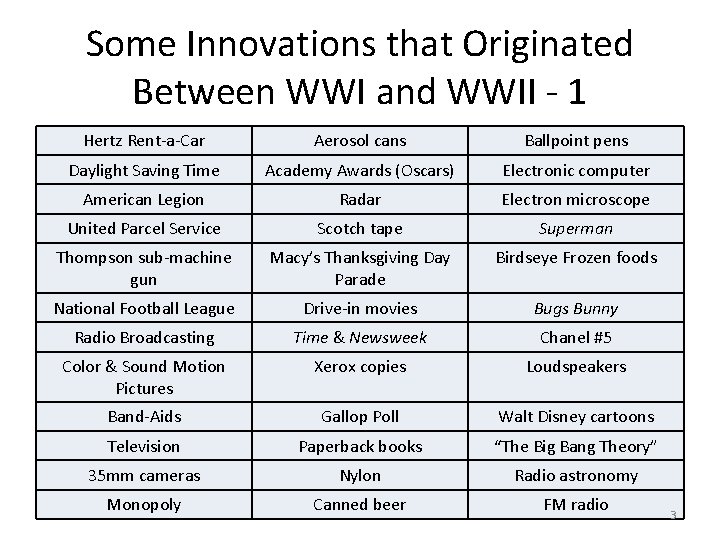
Some Innovations that Originated Between WWI and WWII - 1 Hertz Rent-a-Car Aerosol cans Ballpoint pens Daylight Saving Time Academy Awards (Oscars) Electronic computer American Legion Radar Electron microscope United Parcel Service Scotch tape Superman Thompson sub-machine gun Macy’s Thanksgiving Day Parade Birdseye Frozen foods National Football League Drive-in movies Bugs Bunny Radio Broadcasting Time & Newsweek Chanel #5 Color & Sound Motion Pictures Xerox copies Loudspeakers Band-Aids Gallop Poll Walt Disney cartoons Television Paperback books “The Big Bang Theory” 35 mm cameras Nylon Radio astronomy Monopoly Canned beer FM radio 3
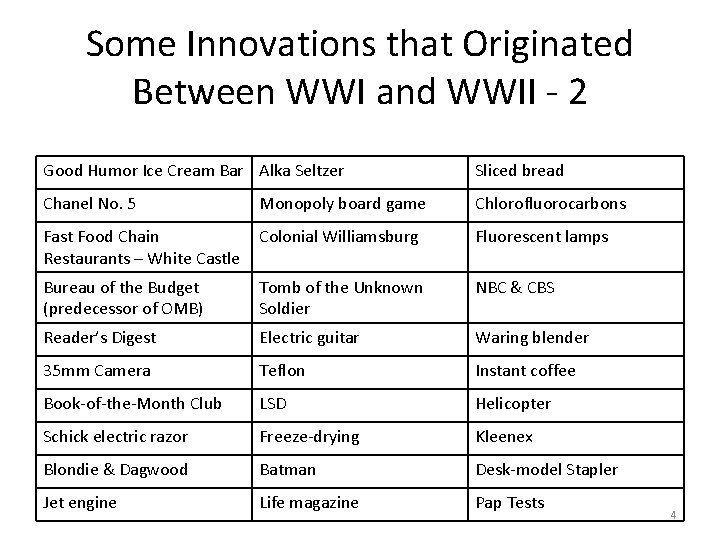
Some Innovations that Originated Between WWI and WWII - 2 Good Humor Ice Cream Bar Alka Seltzer Sliced bread Chanel No. 5 Monopoly board game Chlorofluorocarbons Fast Food Chain Restaurants – White Castle Colonial Williamsburg Fluorescent lamps Bureau of the Budget (predecessor of OMB) Tomb of the Unknown Soldier NBC & CBS Reader’s Digest Electric guitar Waring blender 35 mm Camera Teflon Instant coffee Book-of-the-Month Club LSD Helicopter Schick electric razor Freeze-drying Kleenex Blondie & Dagwood Batman Desk-model Stapler Jet engine Life magazine Pap Tests 4
What We Will Cover Today • Impacts of World War I and the Treaty of Versailles – Economic, Social & Political Effects • • • Financial Agricultural Industrial Political Other – Impacts of the Russian Revolution – The Influenza Pandemic – Immigration Restriction • Woodrow Wilson’s Four Great Mistakes • Begin discussion of Prohibition 5
Effects of World War I • You can’t understand the 1920 s and 1930 s without understand the impact of WWI • Most of what happened in the 20 th century had its roots in WWI and the resulting peace treaties – The Russian Revolution – The Great Depression – World War II – The Cold War – Vietnam – The Arab-Israeli Wars – The two U. S. wars with Iraq 6
The Russian Revolution -1 • The war placed a major strain on the Russian economy – Decline in civilian production – Rampant inflation, especially in the cities • Inadequate railroad infrastructure – The Ottoman Empire cut Russia off from the Western Allies • Prevented the Allies from shipping supplies to Russia • Led to the ill-fated Dardanelles campaign – Made Kamal Ataturk and unmade Winston Churchill – Fostered a sense of Turkish, Australian, and New Zealand identity 7
The Russian Revolution - 2 • Decline of the Russian economy led to the “February” Revolution • The failures of the Provisional Government led to the “October” Bolshevik coup • Intermediate result: Russian Civil War • End Result: A Communist Russia 8
Effects of a Communist Russia • Split the World Socialist movement into a Communist wing and a Democratic Socialist wing. – Founding of the American Communist Party as a response to the events in Russia • The Communist Revolution in Russia and the Founding of the American Communist Party Led to: – The “Red Scare” in the U. S. & – A fear of Communist revolution among both political elites and the political Right in Europe 9
Impact of the US Involvement in WWI • US involvement in WWI had impacts in many different areas – Financial – Agricultural – Industrial – Political – Other 10
Financial Impact of WWI - 1 • Sizable increase in the national debt – Led to postwar policies of cutting federal govt expenditures • Income Tax becomes the dominant mode of taxation • Mass marketing of war bonds as both an investment and as a means of showing one’s patriotism – Made a large proportion of the American public bondholders 11
Financial Impact of WWI - 2 • Generated a high-degree of inflation – CPI doubled between 1915 and 1920 • Led the Federal Reserve to raise the discount rate from 4% to 7% • The resulting recession was a major factor in the defeat of the Democrats in the 1920 Election – Other factors were the abrupt cancellation of war contracts and the process of demobilization 12
Agricultural Impact of WWI - 1 • European food production declined as agricultural manpower was drafted into military service – Led U. S. farmers to vastly expand agricultural production • Farmers took on mortgages to purchase land to mechanize agricultural production • Mechanization and chemical fertilizers led to a vast increase in productivity 13
Agricultural Impact of WWI - 2 • A Depressed agricultural economy in the 1920 s due to: – Post-war return of European agriculture to normal levels of production – The increased productivity and expanded output of American agriculture which led to: • Crop surpluses, • Low farm prices • Farmer agitation for measures that would restore parity 14
Industrial Impact of WWI - 1 • Created a big demand for munitions, steel, motor vehicles, communications equipment, and ships – Turned Du. Pont into a chemical-industrial giant • Created a planned economy run largely by big business interests via the Federal Government’s War Industries Board (WIB) – WIB had over 60 commodity divisions relating to specific industries that: • Were largely staffed by people from the industry • Were interwoven with the supply departments of the Army, Navy, other Federal agencies, and even the Allies 15
Industrial Impact of WWI - 2 • WIB Conservation Division standardized a whole host of products in terms of size, color, versions, and variety – E. g. Sizes, colors, & varieties of clothing; the shaping and sizes of drill bits & screw threads • Prior to WWI, each company and industry had determined its own standards • 250 types of plow models • 755 types of drills 16
Industrial Impact of WWI – 3 • WIB Price-Fixing Committee was responsible for: – Setting prices to control inflation – Guaranteeing a ‘fair profit’ to the producers in order to stabilize the market 17
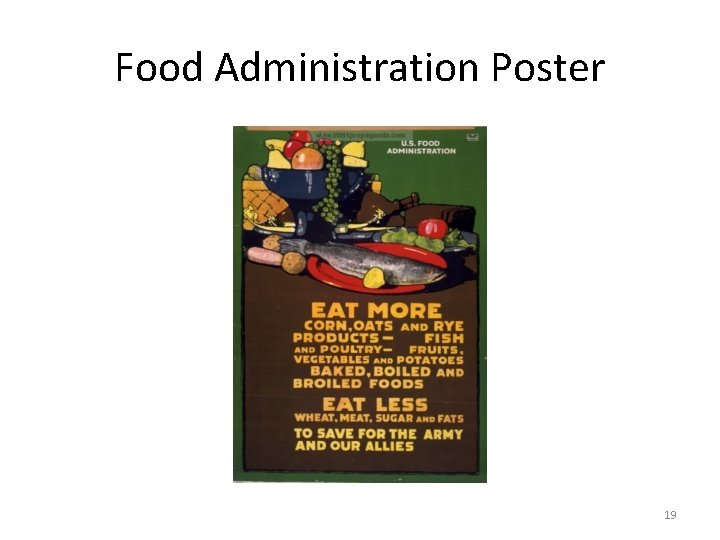
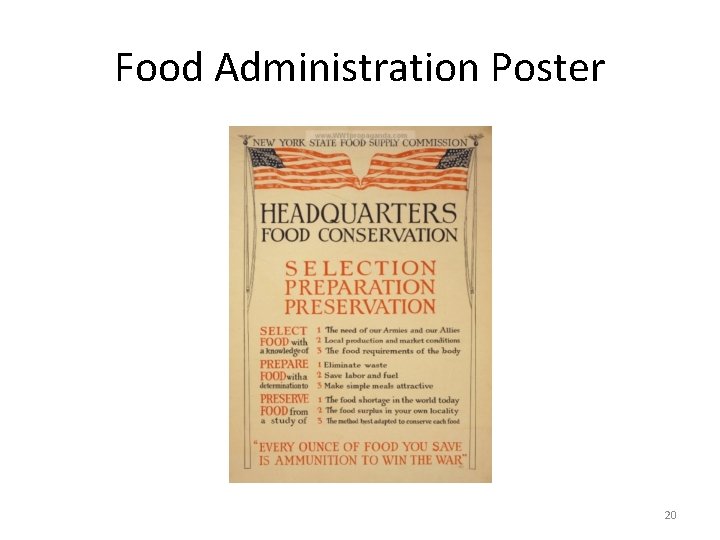
Industrial Impact of WWI - 4 • The Food Administration – Headed by Herbert Hoover – Persuaded Americans to eat fish and vegetables in place of wheat and meat • Promoted “wheatless’ and ‘meatless’ days – Popularized spaghetti (pasta with tomato sauce) as both a meat strecher and as a dish for meatless days – Standardized food sizes & portions • Standardized the size of bread loaves 18
Food Administration Poster 19
Food Administration Poster 20
Industrial Impact of WWI – 5 • Provided a model – For big business, a model of what could be achieved by national coordination and cartelization – For liberal intellectuals, a model that was • An alternative to both laissez-faire capitalism and Soviet communism • A way of transcending the weaknesses and social conflicts of both of the above – For the FDR Administration, a model for many New Deal agencies and programs 21
Political Impact of WWI - 1 • Wilson created the Committee on Public Information headed by George Creel (CPI) to create the war spirit necessary to fight the war – Led to an upsurge of anti-German hysteria • Based on propaganda demonizing everything German – Pioneered in the use of media celebrities to propagandize and sell war bonds • Erosion of civil liberties – Suppression of anti-war groups – Suppression of the American Socialist Party 22
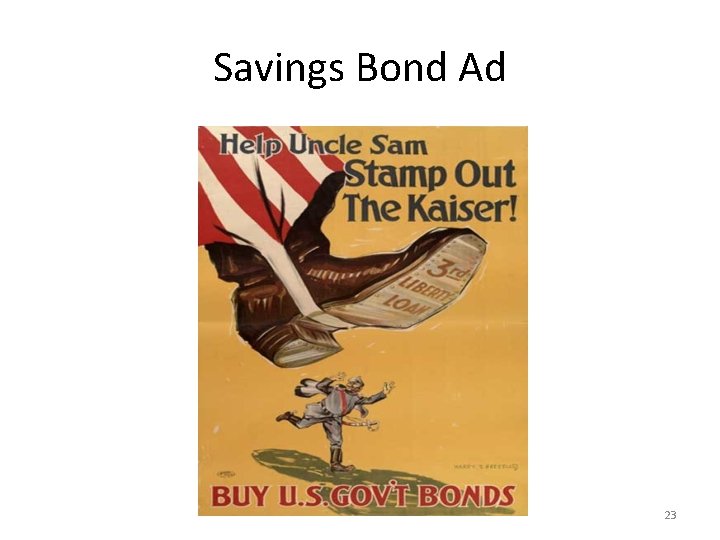
Savings Bond Ad 23
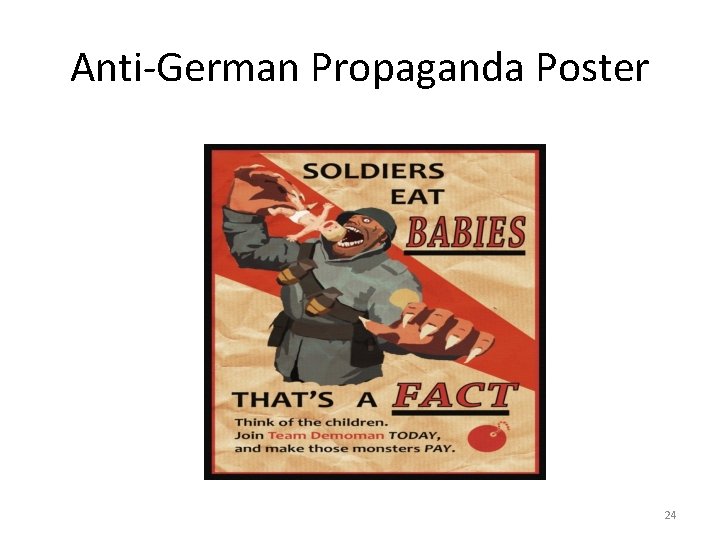
Anti-German Propaganda Poster 24
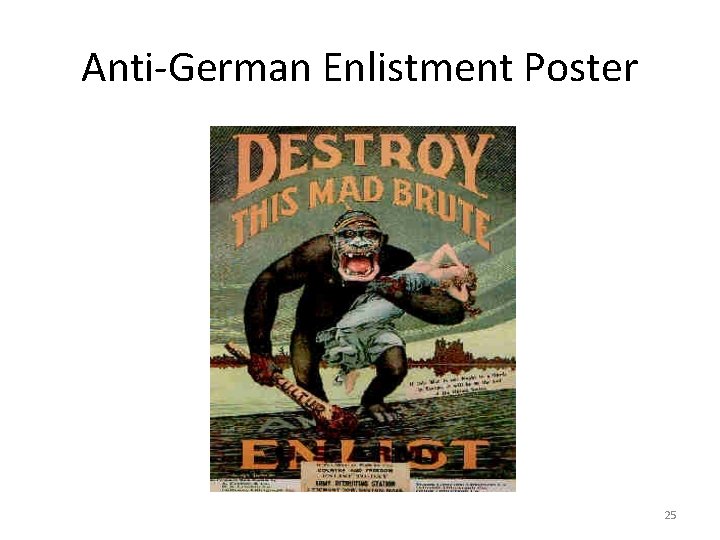
Anti-German Enlistment Poster 25
Political Impact of WWI - 2 • Made possible the enactment of Prohibition – Supporters of Prohibition exploited the belief that drink impeded industrial productivity and soldierly fighting ability – The Anti-Saloon League successfully linked liquor to disloyalty and beer-drinking with sympathy to the kaiser and his Huns • Led to the Post-war “Red scare” – The Russian Revolution and the founding of the American Communist Party led to a fear that revolution could happen here – This fear was intensified by the “ 100% Americanism” promoted by the war and the Creel Committee 26
Political Impact of WWI – 3 • Anti-German hysteria (and the Red Scare) in turn led to: – A stress on 100% Americanism – Immigration Restriction • Immigration Act of 1917 • Emergency Quota Act of 1921 • Immigration Act of 1924 (National Origins Act) 27
Immigration Restriction Acts • Immigration Act of 1917 – Barred entry to immigrants from most of Asia – Barred many categories of “undesirables” – Barred immigrants age 16 and above who were illiterate • Immigration Act of 1921 – Limited the annual number of immigrants from each country to 3% of the number of persons from that country living in the U. S. in 1910 28
Immigration Restriction Acts -2 • Asian Exclusion Act of 1924 • Barred immigration from an Asia-Pacific triangle from Japan, China, Korea, India, and Southeast Asia • Barred immigration of any persons ineligible for naturalization – Non-whites were not deemed eligible for naturalization • Provoked an official diplomatic protest from Japan 29
Immigration Restriction Acts -3 • National Origins Act of 1924 – Temporarily limited the annual number of immigrants – After July 1, 1927 (later postponed to July 1, 1929) • Imposed a total annual quota of 150, 000 with the annual quota for any country or nationality being proportional to their proportion of the U. S. population in 1920 • Gave non-quota status to wives and unmarried children of U. S. citizens and natives of Western Hemisphere countries 30
Other Impacts of WWI -1 • Airplane • Gave Hollywood dominance in the motion picture industry • Consumer products – Safety razors – Wrist watches – Kotex – Cigarettes 31
Other Impacts of WWI – 2 • Spread Jazz from New Orleans to the cities of the North • Created New Standards of What Was Considered to be Attractive – From full-bodied to slim – From Gibson Girl to Flapper • Created the Conditions for the Great Influenza Pandemic of 1917 -1919 32
The Influenza Pandemic - 1 • Started on a pig farm in Haskell County Kansas • Two events led to the virus becoming a pandemic: – Annual Iowa Cedar Rapids Swine Show in September 1917, and – Large-scale induction of Iowa & Kansas farm boys at Fort Funston • First wave in the spring and summer of 1918 – Unlike most flu, which have U-shaped death graphs, this flu had a W-shaped graph 33
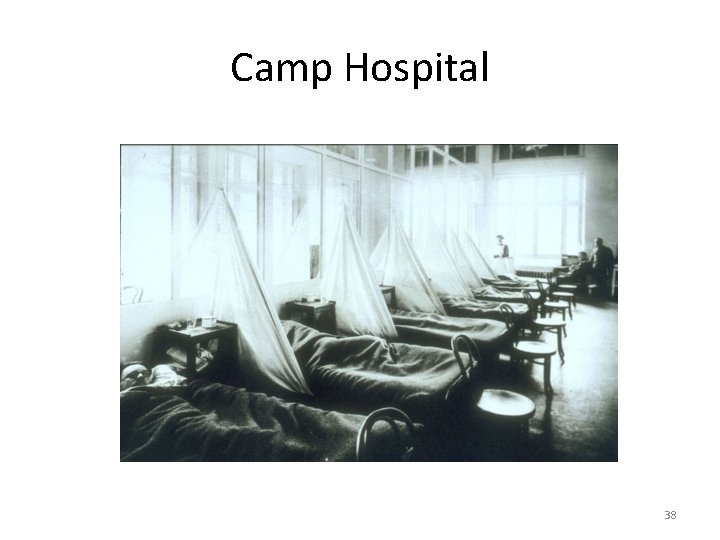
The Influenza Pandemic – 2 • Flu spread from Camp Funston to other Army training camps and to Europe thanks to crowded barracks, sealed troop ships, and the fetid trenches of the Western Front • Called “Spanish Flu” since neutral Spain did not censor news accounts of the flu • Second (and most lethal) wave first appeared in September 1918 at Camp Devens MA 34
The Influenza Pandemic – 3 • Second wave virus singled out 20 - and 30 -year olds – By the end of October 1918, 1 in 5 U. S. soldiers had been infected • Virus provoked a hyper immune response which flooded the lungs with fluid – This allowed secondary bacterial infections (most commonly pneumonia) to deliver the fatal blow 35
The Influenza Pandemic - 4 • An estimated 50 million people died of the flu – This included 550, 000 Americans – Roughly half who died were people in their 20 s and 30 s • May have killed as many as 8%-10% of the people in the 20 s-30 s age group – In many American cities, over half the population was infected 36
The Influenza Pandemic – 5 • WWI contributed to the Flu Pandemic in several ways: – Providing an initial funnel of infection at Fort Funston – Creating population movements of both refugees from areas of fighting and rural workers to areas of war-time employment in cities – Creating a malnourished population in Europe – By channeling more and more doctors and nurses into military-related medicine, it caused a deterioration of civilian medical care 37
Camp Hospital 38
Other Impacts of WWI – 3 • Created a potential market for ham and broadcast radio – Large number of wartime radio operators • American Legion and other veterans organizations • Tomb of the unknown soldier • Armistice Day (November 11 th) as a national holiday – Later renamed Veterans’ Day 39
Four Key Wilson Decisions - 1 1. The decision to turn the Paris peace negotiations into an extended summit – Kept Wilson out of touch with what was going on in the U. S. – Led Wilson to ignore the problems of war-related inflation and postwar demobilization • This was to have deep implications for the Democrats in the 1920 election 40
Four Key Wilson Decisions – 2 2. The decision to accept a flawed treaty in order to win foreign acceptance of the League of Nations – Treaty contained provisions and omissions that • Were politically unpalatable to the U. S. Senate • Were to cause future trouble 3. The refusal to accept any changes or reservations in the Treaty to win Republican support 41
Four Key Wilson Decisions - 3 4. The Decision not to resign the Presidency after his stroke – Led to the U. S. being governed by Wilson’s wife • This meant that the problems of postwar inflation, demobilization, and recession were totally ignored – Let the Lodge Republicans dominate the debate over ratification of the Versailles Treaty • This sapped support for the Treaty and led to its eventual defeat 42
Impact of the Treaty of Versailles • Led to great resentment in Germany – Signing the Versailles “diktat” weakened the Weimar Republic, giving the German Right (and the Nazis) a tool with which to attack the Republic • Created instability in Eastern Europe – Created weak and unstable states – Strengthened Germany strategically – Constituted a peace settlement that neither Germany nor Soviet Russia supported 43
Impact of Failed Ratification • Greatly weakened the League of Nations • Fostered a sense of disillusionment – With World War I and its results – With U. S. participation in the war – With U. S. engagement with the world • This in turn fostered a spirit of isolationism that was reflected in restrictive immigration laws, high tariffs, and the Neutrality Acts of the 1930 s 44
The Impact of High Tariffs • Harding and Coolidge Administrations followed a policy of: – Mimimalist government • Lowering taxes • Paying down the National Debt – Support of high tariffs • High tariffs – Reduced European access to the U. S. market – Made Europe dependent on U. S. bank loans to pay war debts, reparations, and buy U. S. goods 45
- Slides: 45