
AMERICA AN EMERGING WORLD POWER APUSH Oseas Romero


- Slides: 56
AMERICA: AN EMERGING WORLD POWER APUSH Oseas Romero Stafford High School
Progressive Challenges � The Progressive Agenda is fluid � Government must play an important role in the process � Difficult to find a broad coalition to defend it Failure of early Progressive parties � Muckrakers � Exposed scandals, corruption and perceived injustice Railroads were primary target �Ida Tarbell As the decade progresses government, labor unions, corporations, women, child labor, immigration, and other hot button topics would be attacked analyzed �Jacob Riis, Upton Sinclair, John Ryan, and others
Social Gospel � While the Muckrakers were willing to expose the underbelly of American society, regular folks have never been willing to do so � However American Protestantism took the charge Social and economic injustice would no longer be acceptable �Salvation Army �Clergy working in urban areas Walter Rauschenbusch �Individuals should work together to enhance the social standing among all � Social Gospel was aided by moralistic and religious tendencies � Settlement House Movement Environment had powerful effect on development �Jane Addams
Reformers Make a Move � The Progressive Era is not over yet, the biggest impact would happen in 1920 � 19 th � Amendment Unlike the woman’s suffrage movement of the 19 th century, the movement bean to win key endorsements � Due to better organization Anna Howard Shaw and Carrie Chapman Catt �The National American Woman Suffrage Association became extremely powerful �Allied themselves with the temperance movement
Women and Children � Women are going to resist the ideals of domesticity (Victorian) and are going to enter the workforce � Women’s labor unions will defend women rights and child laborers Sheppard-Towner Act(1921)- protects the health of pregnant workers and the infants � Women filled Progressive ranks � � � National Conference of Social Work General Federation of Women’s Clubs 1890: National American Woman Suffrage Association formed 1920: Nineteenth Amendment passed Suffrage seen as empowering women to benefit the disadvantaged
� Politically active women push reforms of social justice movement � Maximum number of working hours for women in 39 states by 1913 � Keating-Owen Act of 1916 limited child labor, but was declared unconstitutional in Hammer v. Dagenhart
WCTU � Women’s Christian Temperance Union- at first attacked saloons, but the demand grew to include the complete prohibition of the sale and manufacture of alcoholic beverages � It was contented that alcohol was a leading reason for domestic violence on women By 1916, 19 states had passed prohibition laws WWI allowed the creation of the 18 th Amendment which took effect January 1920
Challenging the Status Quo � Progressives, pragmatists measured value of ideas by actions they inspire � Rejected social Darwinism � John Dewey: Education should stress personal growth, free inquiry, creativity � Judge Lindsey, Louis Brandeis and “Sociological Jurisprudence
� 1901: Socialist party formed, uniting intellectuals, factory workers, tenant farmers, miners, lumberjacks � By 1911, 32 cities have Socialist mayors � Promise of Progressive reform rather than overthrow of capitalism � 1912: Socialist presidential candidate Eugene Debs polls over 900, 000 votes
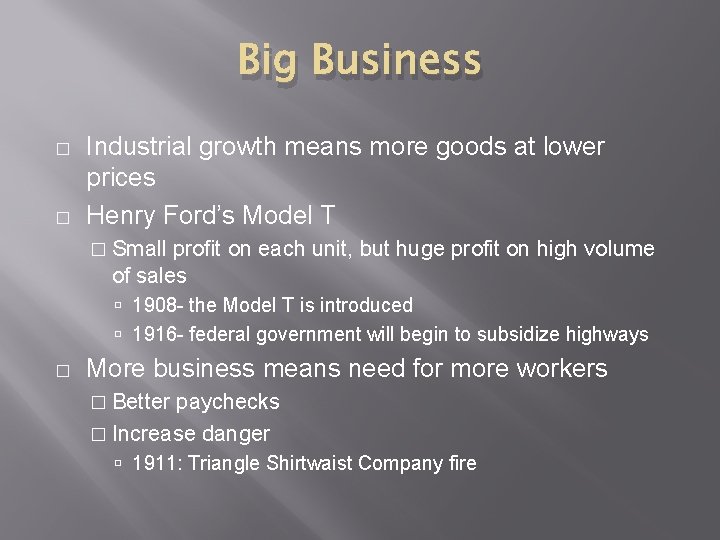
Big Business � � Industrial growth means more goods at lower prices Henry Ford’s Model T � Small profit on each unit, but huge profit on high volume of sales 1908 - the Model T is introduced 1916 - federal government will begin to subsidize highways � More business means need for more workers � Better paychecks � Increase danger 1911: Triangle Shirtwaist Company fire
The Trust � Trend towards bigger and better in business is accelerated after 1900 � Bankers will provide integrated control through interlocking directorate � Trust are extremely controversial � Often denounced as threats to equality � Some defended as more efficient
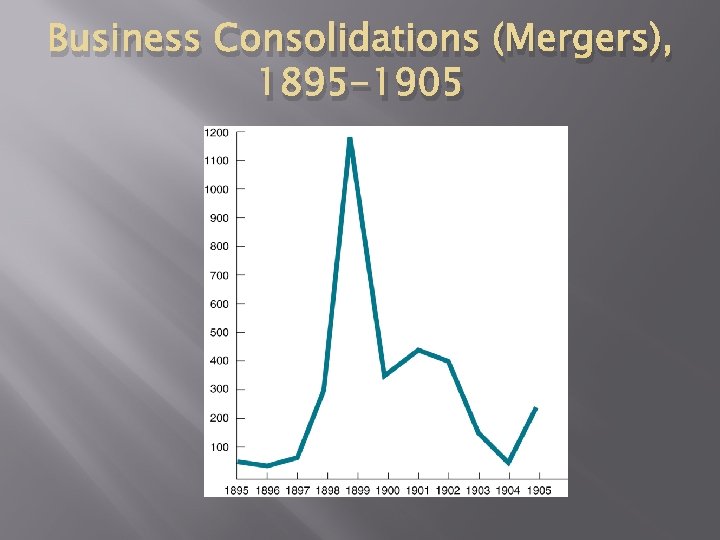
Business Consolidations (Mergers), 1895 -1905
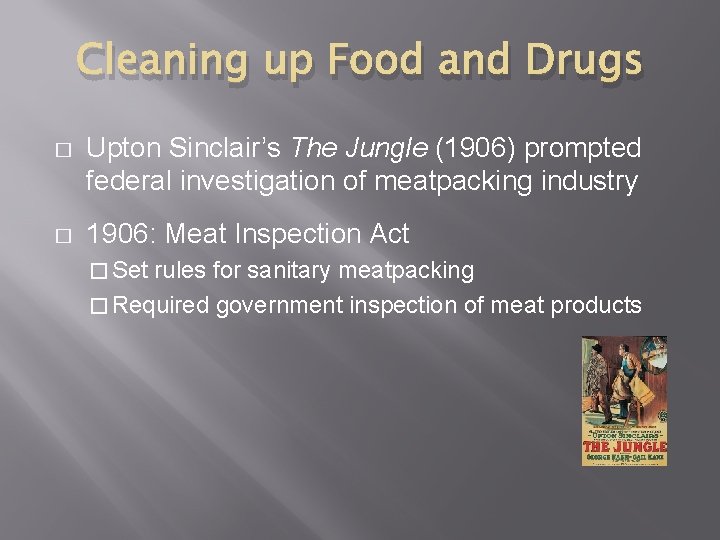
Cleaning up Food and Drugs � Upton Sinclair’s The Jungle (1906) prompted federal investigation of meatpacking industry � 1906: Meat Inspection Act � Set rules for sanitary meatpacking � Required government inspection of meat products
� Samuel Hopkins Adams exposed dangers of patent medicines � 1906: Pure Food and Drug Act � Required manufacturers to list certain ingredients � Banned manufacture and sale of adulterated drugs
The New Negro Movement � The two leading Black Leaders in America at the turn of the century were, Booker T Washington and W. E. B. Du Bois � � Self help v. academically trained Du Bois, had never been a slave, was college educated and had a different prospective of AA goals in America The Souls of Black Folk(1903) attacked Washington’s views and proclaimed that he was working with the white man by promoting segregation and limiting the AA. � Du Bois believed education over everything else and so in Niagara Falls, Canada. He began the Niagara movement � After a race riot in Springfield, Illinois, the Niagara movement aligned itself with white progressives. Formed the most powerful race-based group, didn’t happen until Washington’s death in 1915 �National Association for the Advancement of Colored People (NAACP) �Guinn v. United States �Buchanan v. Worley �Anti-lynching �Jessie Daniel Ames �Ida Wells
Progressivism means expertise � Education and expertise were necessary to solve all kinds of problems � Scientific management Increases efficiency �Frederick Taylor � Could no longer justify the status quo � A new American needed to take shape � Rise of Professions- progressive leaders � Law � Medicine � Business � Education � Social work
Social Justice Movement � Reforms are going to forgo individual reform per se and address larger societal problem � Will apply scientific to methods to social reform
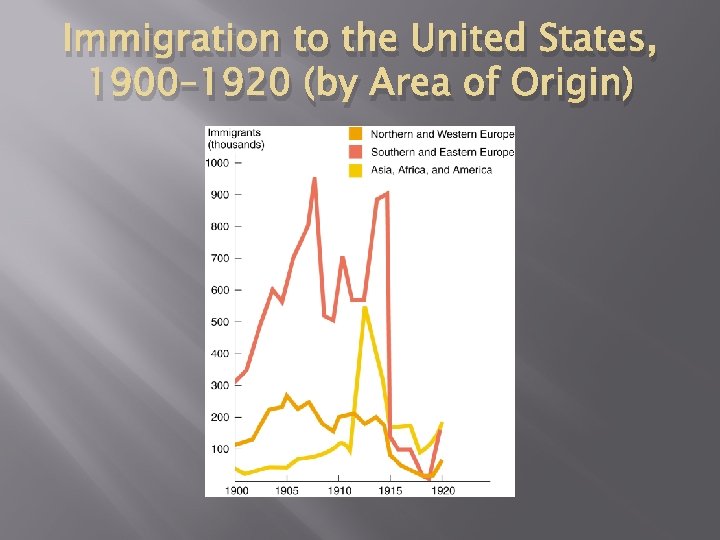
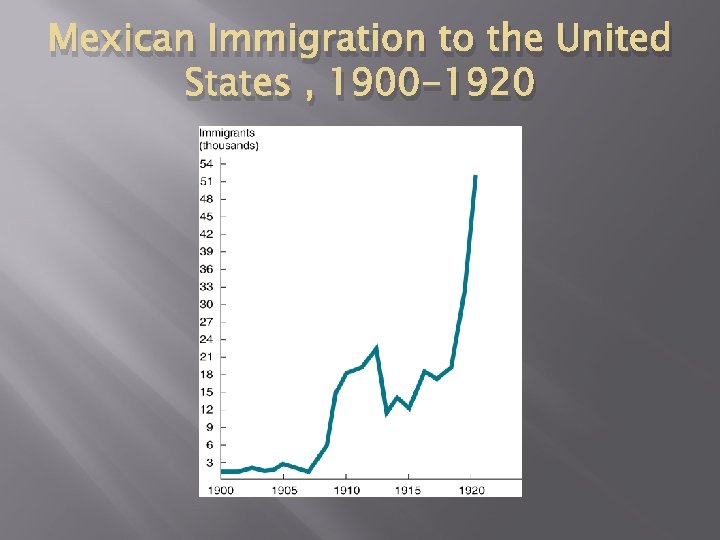
Immigrants � 1901 -1920: influx of European, Mexican, and Asians immigrants to the labor force � If you were non-English speaker you were a problem Programs were created to Americanize the immigrant population Immigrants will become public enemy number one during the Progressive Era �Remember the Exclusion Acts
Immigration to the United States, 1900– 1920 (by Area of Origin)
Mexican Immigration to the United States , 1900 -1920
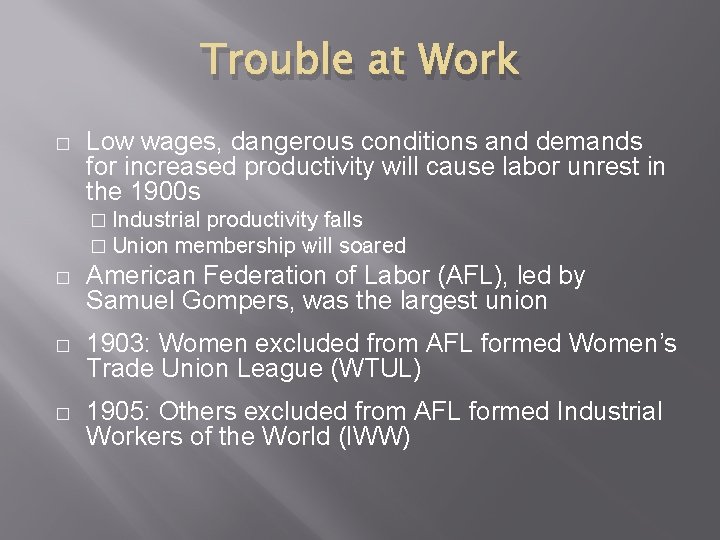
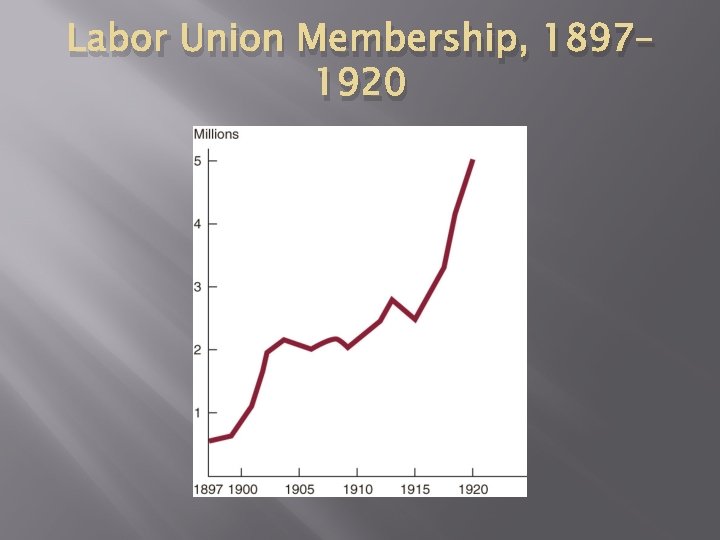
Trouble at Work � Low wages, dangerous conditions and demands for increased productivity will cause labor unrest in the 1900 s � Industrial productivity falls � Union membership will soared � American Federation of Labor (AFL), led by Samuel Gompers, was the largest union � 1903: Women excluded from AFL formed Women’s Trade Union League (WTUL) � 1905: Others excluded from AFL formed Industrial Workers of the World (IWW)
Labor Union Membership, 1897– 1920
Some concessions � Employers improved working conditions to avoid trouble � Henry Ford doubled wages, shortened workday � Plant production increased � Union activity ended � Amoskeag mills modeled paternalistic approach to labor management � Company � Benefits hired whole families included playgrounds, health care, home-buying plans, recreation
Reform in Cities � The Democratic and Republican Parties were both targets of the Progressives � � Greenbacks and Populism, are two early examples Old ballot boxes were done in the open, a key change would emerge Secret ballot boxes � Lincoln Steffens argued that party rule was most damaging in municipal life aka cities � � � Major change usually happens when tragedy strikes. This tragedy strikes in the form of the Great Storm of 1900 which destroyed Galveston, Texas � � Politics was considered dirty by respectable citizens Political Machines had a stranglehold on city government They replaced the mayor and councilmen wit a nonpartisan Commission City-Manager Plan- city leaders would hire an outside expert � Reform mayors Tom Johnson of Cleveland “Golden Rule” Jones of Toledo
� Decline in voter participation � 77% from 1876– 1900 � 65% from 1900– 1916 � 52% in the 1920 s � Remained near 52% through 20 th century � Interest groups got favorable legislation through lobbying
States begin Reform � State regulatory commissions created to investigate business conduct � Initiative, referendum, and recall created � All but 3 states used primary elections by 1916 � 1913: Seventeenth Amendment provided for direct election of U. S. senators
� Robert La Follette of Wisconsin � “Wisconsin Idea” tapped experts in higher education for help in sweeping reforms � Other Progressive governors � Joseph Folk of Missouri � Hiram Johnson of California � Charles Evans Hughes of New York � Woodrow Wilson of New Jersey
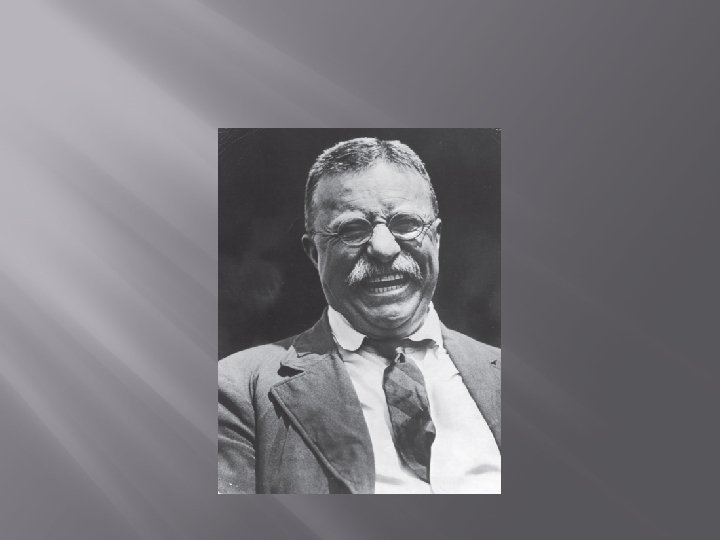
The Accidental President � Mc. Kinley was assassinated in 1901, at 42 Roosevelt is the youngest man to assume the Presidency � Trust Buster? Commerce and Labor � Bureau of Corporations Northern Securities Company � JP Morgan Strikes � Would force both sides to the table. � Considered himself a champion of labor and management � Square Deal-everyone would get a fair chance in the US Hepburn Act- regulatory authority of the railroads fell to the government � Better explanation in upcoming slide � Roosevelt loved the wild. First conservationist in office � Restricted the private development on government land Alongside Pinchot, they would seize all forest and water power sites before Congress could take them away Creation of the National Forest Service � National Reclamation Act or Newlands Act � Fund dams, reservoirs, and canals � His success led to great radicalism
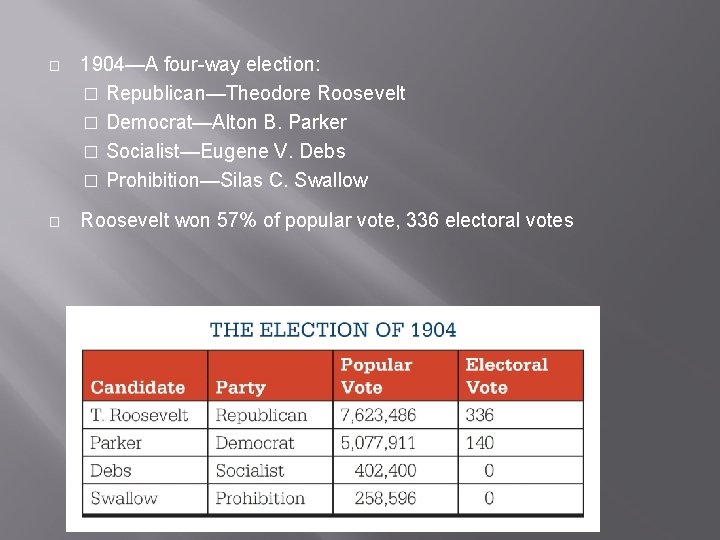
� 1904—A four-way election: � Republican—Theodore Roosevelt � Democrat—Alton B. Parker � Socialist—Eugene V. Debs � Prohibition—Silas C. Swallow � Roosevelt won 57% of popular vote, 336 electoral votes
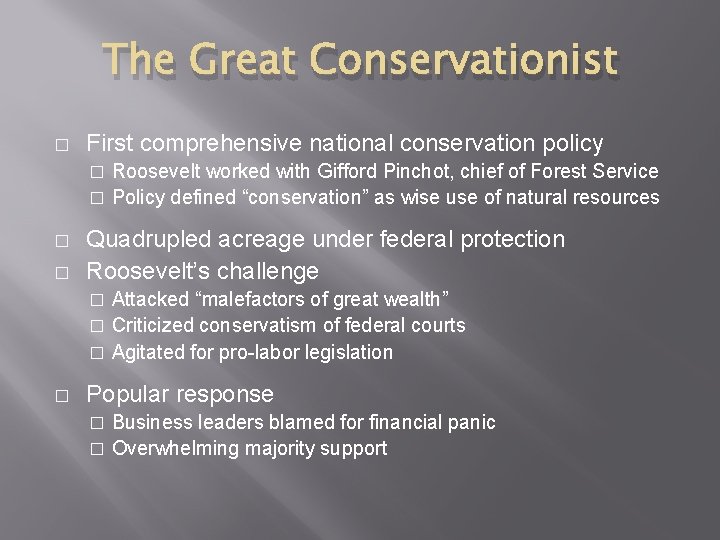
The Great Conservationist � First comprehensive national conservation policy Roosevelt worked with Gifford Pinchot, chief of Forest Service � Policy defined “conservation” as wise use of natural resources � � � Quadrupled acreage under federal protection Roosevelt’s challenge Attacked “malefactors of great wealth” � Criticized conservatism of federal courts � Agitated for pro-labor legislation � � Popular response Business leaders blamed for financial panic � Overwhelming majority support �
National Parks and Forests © 2013 Pearson Education, Inc. All rights reserved.
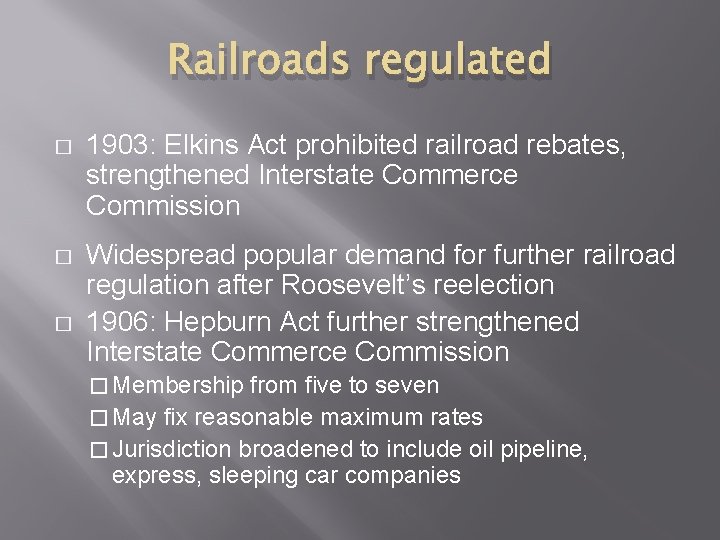
Railroads regulated � 1903: Elkins Act prohibited railroad rebates, strengthened Interstate Commerce Commission � Widespread popular demand for further railroad regulation after Roosevelt’s reelection 1906: Hepburn Act further strengthened Interstate Commerce Commission � � Membership from five to seven � May fix reasonable maximum rates � Jurisdiction broadened to include oil pipeline, express, sleeping car companies
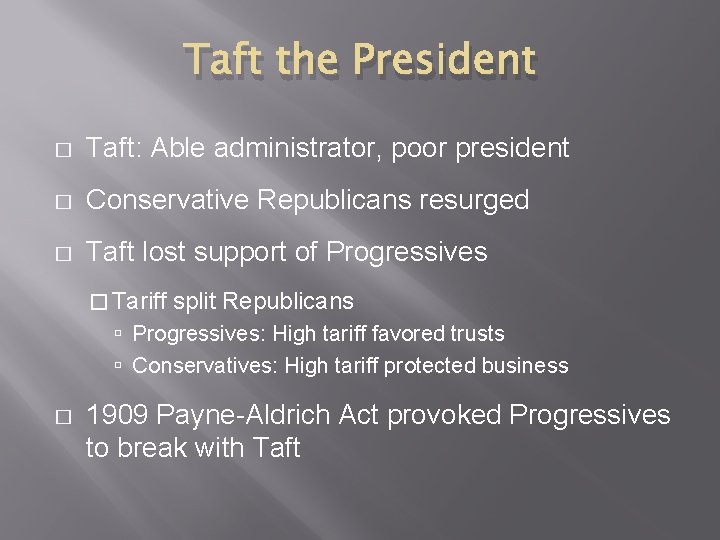
Taft the President � Taft: Able administrator, poor president � Conservative Republicans resurged � Taft lost support of Progressives � Tariff split Republicans Progressives: High tariff favored trusts Conservatives: High tariff protected business � 1909 Payne-Aldrich Act provoked Progressives to break with Taft
Gifford-Ballinger Affair � Gifford Pinchot was leading conservationist, Roosevelt appointee � Pinchot accused Interior Secretary Richard Ballinger of selling public lands to friends � Taft fired Pinchot � Progressives antagonized
Taft vs. Progressives � 1910: Taft successfully pushed Mann-Elkins Act to strengthen ICC � Empowered ICC to fix railroad rates � Progressive Republicans attacked Taft’s plan of a Commerce Court to hear ICC appeals � Progressives obstructed Taft’s negotiations � 1910: Taft attacked Progressive Republicans, Democrats gained Congress
� Legislation protecting laborers � Sixteenth Amendment created income tax � Taft a greater trustbuster than Roosevelt � Taft, Roosevelt attacked one another publicly � 1912: Taft nominated again by Republicans, little chance for victory
Wilson Moves Toward the New Freedom � Reasons for the move: � � Wilson renewed reform in reelection bid � � � � Distracted by the outbreak of war in Europe Needed conservative Southern support Republicans seemed to gain by attacking his programs Federal Farm Loan Act Intervened in strikes on behalf of workers Attempted to ban child labor Increased income taxes on the rich Supported women’s suffrage Program won Wilson a close election Fruits of Progressivism � Reform of government at all levels � Intelligent planning of reform World War I ends Progressive optimism
American exceptionalism � We have discussed this topic briefly last semester � The idea that the United States had a unique destiny among the great civilizations of the world. � Eugenics and Nativist Cuba, Puerto Rico, Virgin Islands, Hawaii, Guam, Samoa, and the �Insular Cases, 1901 �Jones Act of 1916 � Sided with the Chinese nationalist in the Chinese Revolution of 1911. In direct competition with Japanese � Would lead to tensions in the future
The Americas � Hay-Pauncefote Treaty- Britain acknowledged the US right to build and maintain a canal in Central America � Panama Canal 10 million dollar investment with 250 K per year to purchase the land from Colombia �This offer was rejected �America would lead a revolution of Panama �Opened in 1914 � No official alliance emerged, but a lasting friendship was built � Big Stick Diplomacy � Roosevelt proclaimed that the US would police all parts of the Caribbean Roosevelt Corollary
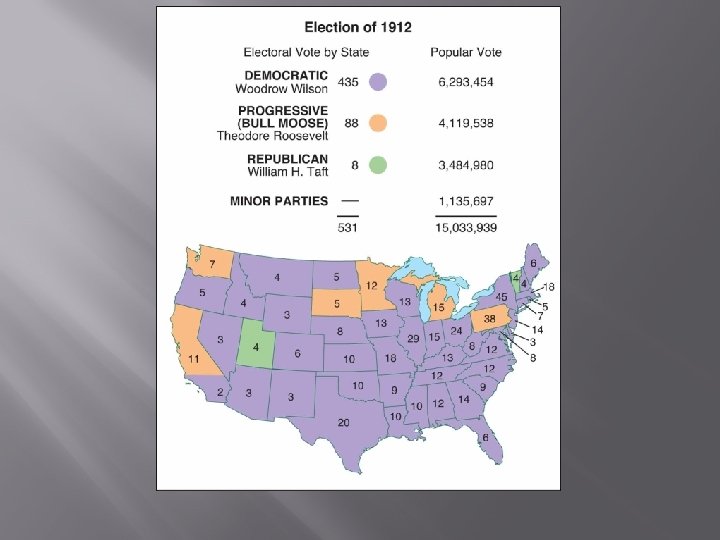
Differing Philosophies in the Election of 1912 � Roosevelt: Progressive (“Bull Moose”) � “New Nationalism” � Federal regulation of economy � Wasteful competition replaced by efficiency � Woodrow Wilson: Democrat � “New Freedom” for individual � Restrain big business, government � Democrats won White House, Congress
Wilson and Mexico � Wilson was not an expansionist like Roosevelt or Taft � � “never again seek one additional foot of territory by conquest” Since the 1870’s, Porfirio Diaz had become allies with American interest � By 1900’s he began to nationalize. Forced American business to back his opponent Francisco Madero. 1911, Madero forced Diaz to abdicate and he became President � The following conflict would be known as the Mexican Revolution of 1910 � By 1913, Madero was considered weak and the leading general, Victoriano Huerta, had Madero murdered � Wilson feared the conflict would threatened US interest, so against the advice of his strongest Mexican supporter, Venustiano Carranza, the United States sent in troops � The occupation of Veracruz � Lost 19 Americans and 126 Mexicans � Allowed Carranza to overtake Huerta � Pancho Villa- the most famous Mexican General. In 1916, Villa attacked the city of Columbus, New Mexico Killing 16 American civilians � Wilson sent General John Pershing into Mexico after Villa � Public opinion in Mexico turned quickly against the US. Wilson was forced to retreat. The US would finally recognize Carranza’s government a year later, but it showed Americas willingness to meddle in Mexican affairs as well.
New Freedoms � Woodrow Wilson: Former president of Princeton, governor of New Jersey � Progressive, intellectual, inspiring orator � One of America’s most effective presidents � � 1913: Underwood Tariff cut duties � 1913: Federal Reserve Act reformed banks, established stable currency � 1914: Clayton Antitrust Act outlawed unfair trade practices, protected unions � 1914: Federal Trade Commission November, 1914: Austin Wilson announces “New Freedom” has been achieved � � “a time of healing because a time of just dealing” Statement stunned many progressives
MAIN � � Militarism Alliance System Imperialism Nationalism � The four root causes of WWI The trigger was the assassination of Archduke Ferdinand � Wilson decided on the onset that the United States would stay impartial � The United States however was not in fact impartial Many in the United States were actually sympathizers with Germany Still many more people in the US supported Great Britain in the struggle � Within months this became apparent as the US ignored Germany blockades of GB and became an extremely important trading partner of the allies Germany in turn resorted to submarine warfare- U Boats � Germany declared that any enemy ship would be destroyed without warning � An enemy ship would be considered a ship carrying supplies to the war effort � Lusitania is bombed 1, 198 dead, 128 of them Americans � Sussex- French streamer ivs also attacked in 1916 � Wilson demands Germany to stop, each time Germany stops for a time, not wanting to draw the US into the conflict
Peace Without Victory � Once his reelection bid had concluded, Wilson began to prepare the country for battle � He believed the United States was destined to maintain a new world order via a league of nations � Germany unable to make any leeway in the war made a strategic decision to attack the allies on all sides � This meant American ships would be in the crosshairs � Zimmerman and Russia � The United States officially declared war on April 6, 1917
Liberty Bonds � The War itself was going to cost a massive amount of money � � The US Government appropriated more than eighty percent of the 1910 GDP to the war effort To raise money the US decided to launch a fundraiser � Liberty Bonds would be sold to the public More than 20 billion dollars were raised � � Wilson created the Council of National Defense � � America also raised taxes Worked to create an economy ready for war War Industries Board � Coordinated the governments response to military needs Decided which factory would create what and when �Also set prices of goods and where they should go �Extremely powerful organization led by Wall Street financier Bernard Baruch �In reality Baruch was a partner of corporate interest �Made them filthy rich
Doughboys take the field � � Originally Americans believed that providing naval support would be enough, they were wrong Not having enough men to fight in the war in Europe, Wilson won passage of the Selective Service Act � More than three million men were conscripted alongside the two million more men who had volunteered American Expeditionary Force (AEF) � 1 st time women were able to enlist �More than 250, 000 blacks soldiers enlisted, though the Marines would not accept them
� War in Europe sucked � � When American soldiers were given leave they would go to European towns and villages and sleep with every prostitute � � Trench warfare was dangerous 1 in 10 soldiers contracted venereal disease Black Soldiers in Europe understood that things did not have to be the same � They faced racism and hatred at home, while they were fighting for the very same rights in a faraway land WWI would create a new kind of AA, one that wasn’t going to just wait to be helped � 1917 at Camp Logan, Black soldiers took to the streets and attacked white civilians � 17 whites were killed � 13 black soldiers were hanged, 40 more spent the rest of their lives in prison
� The American fighting experience was difficult but brief � With more than a million new soldiers ready to fight the Allies were able to counter the German offensive Meuse-Argonne Offensive showed Germany that it had lost November 11, 1918, the war had ended
Impact of the War � The immediate effect of the war was simple � � A Boom to the economy A secondary, but probably more important impact of the war was “The Great Migration” � Some estimates say that more than ten percent of all AA moved from the rural South to the North during the 10’s The North would become the escape of the poor Black and in time created black communities in the North �New York, Chicago, Cleveland, Detroit, Philadelphia, and Boston �These new communities would lead to tensions in the North �Red Summer of 1919 � Women were able to obtain new employment � Industrial work for the first time in the industries of steel, munitions, trucking, and others After the war most of the women, were fired or quit their jobs
Unity � The Peace Movement had a troubling effect on the US government � While many people supported the war and many former opposition leaders now supported them as well. A large number of people still opposed the fighting Billy Sunday � In response the Committee on Public Information was created Basically a propaganda campaign �In time it became absurd and flat out lies � Espionage Act of 1917, Sabotage Act of April 20 and the Sedition Act of May 16 Could no longer speak ill of the war effort. If you did you would be investigated for seditious behavior �Anticapitalist groups were targeted �Irish �Germans
Fourteen Points � The plan that Wilson had envisioned for the world had been called the Fourteen points � Postwar boundaries especially the now defunct Austro. Hungarian and Ottoman Empires � Rules for international conduct � League of Nations Serious flaws �How to implement these proposals �Economic situation �Already competing against Lenin and Russia �Wilson did not realize the bitterness GB and France would have towards Germany �The Republicans took over the Congress and Wilson had antagonized them
A Savior Comes and Paris � Wilson was a Jesus-like figure in Europe � � One of the largest crowds ever welcomed him to Paris The Allied Powers were represented there: Italy, GB, France, and the US Russia had not been invited �Wilson had ordered American troops to land in the Soviet Union �Was supposed to be a humanitarian effort, but the Americans got involved against the Bolsheviks �America would not recognize the Russian government until 1933 The biggest flaw of the Paris Peace Conference was deciding Germany’s fault �The entirety of the blame was put on Germany and it fostered nationalistic and economic ideals that would lead to the rise of Adolf Hitler � Wilson was able to get some former colonies under the protection of the League of Nations including Palestine League of Nations came into being January 25, 1919
League of Nations at home? It’s a no go � WWI left a bitter taste in the collective mouths of most Americans � It seemed like Europeans were ungrateful for the assistance the United States had provided in the war � The United States had not gained anything either � Many were also weary getting involved in the politics of their European neighbors Isolationists � Henry Cabot Lodge hated Wilson and in the end made it that much more difficult for the League to pass at home Wilson would suffer a stroke and become indigent �The US never ratified the treaty