
AMEE 2014 Identifying EPAs for Undergraduate Medical Education

- Slides: 16
AMEE 2014 Identifying EPAs for Undergraduate Medical Education Y Holzhausen, A Maaz, A Degel, H Peters Charité Universitätsmedizin Berlin Dieter Scheffner Center for Medical Teaching and Educational Research UUNNI IVVEERRSSI ITTÄÄTTSSMMEEDDI IZZI INN BBEERRLLI INN
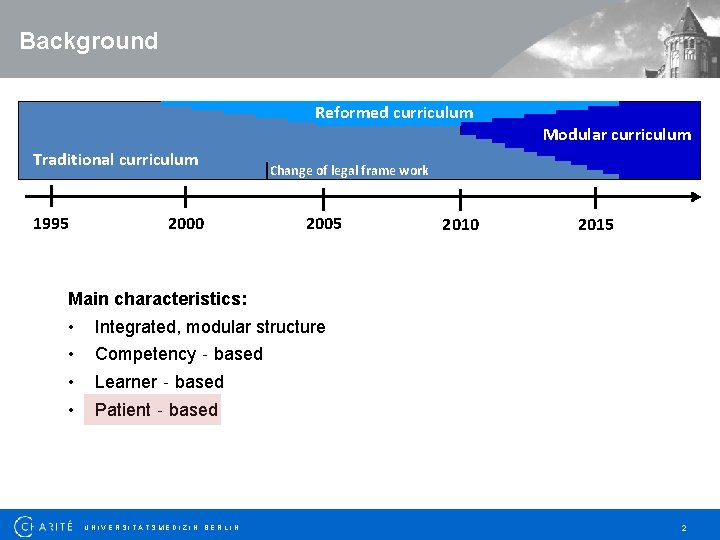
Background Reformed curriculum Modular curriculum Traditional curriculum 1995 2000 Change of legal frame work 2005 2010 2015 Main characteristics: • • Integrated, modular structure Competency‐based Learner‐based Patient‐based UNIVERSITÄTSMEDIZIN BERLIN 2
Background • EPAs (ten Cate, 2005) • Widely applied in postgraduate medical education • Trend to apply it in undergraduate medical education AAMC: 13 Core Entrustable Professional Activities for Entering Residency (2014) UNIVERSITÄTSMEDIZIN BERLIN 3
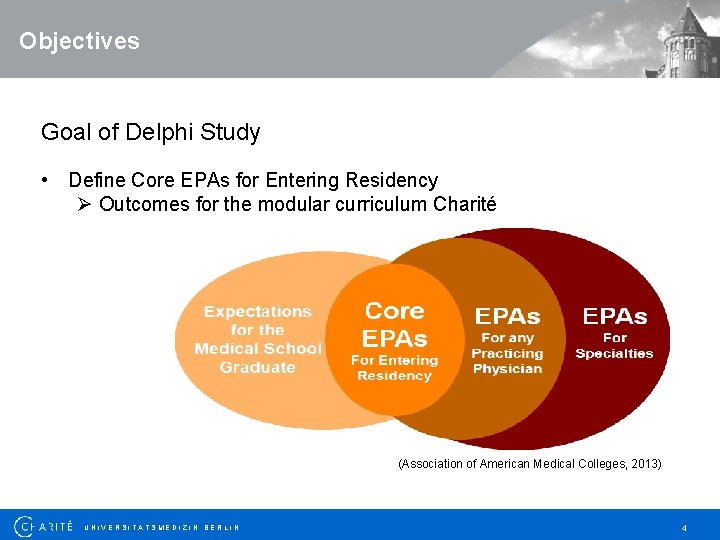
Objectives Goal of Delphi Study • Define Core EPAs for Entering Residency Outcomes for the modular curriculum Charité (Association of American Medical Colleges, 2013) UNIVERSITÄTSMEDIZIN BERLIN 4
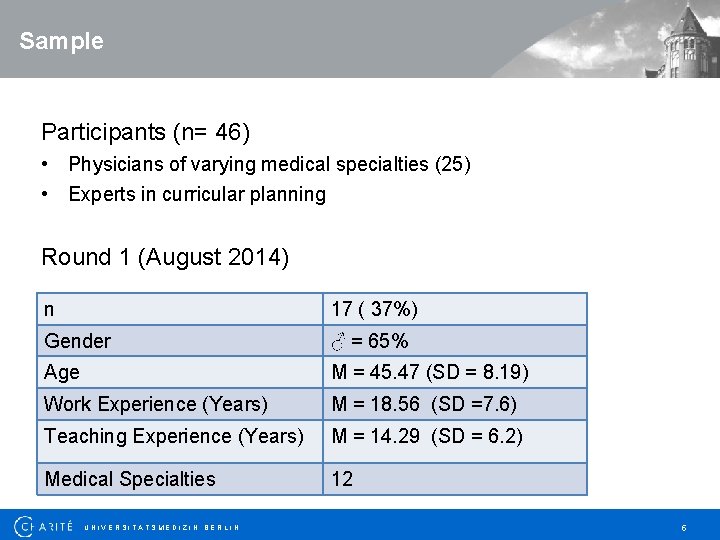
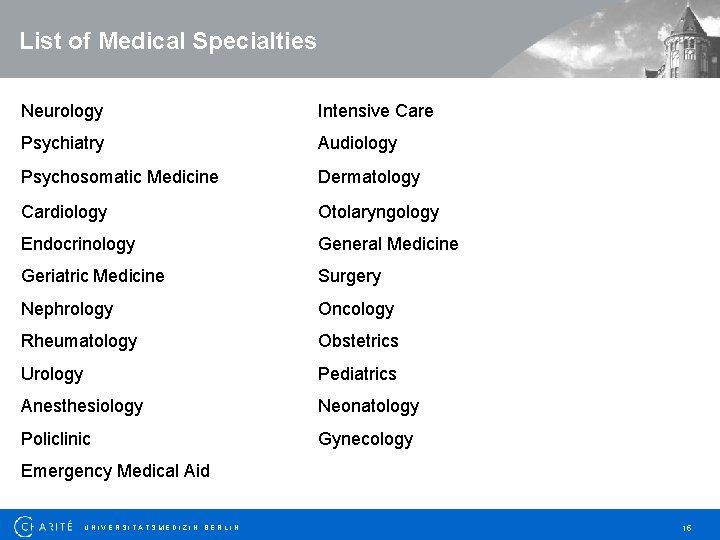
Sample Participants (n= 46) • Physicians of varying medical specialties (25) • Experts in curricular planning Round 1 (August 2014) n 17 ( 37%) Gender ♂ = 65% Age M = 45. 47 (SD = 8. 19) Work Experience (Years) M = 18. 56 (SD =7. 6) Teaching Experience (Years) M = 14. 29 (SD = 6. 2) Medical Specialties 12 UNIVERSITÄTSMEDIZIN BERLIN 5
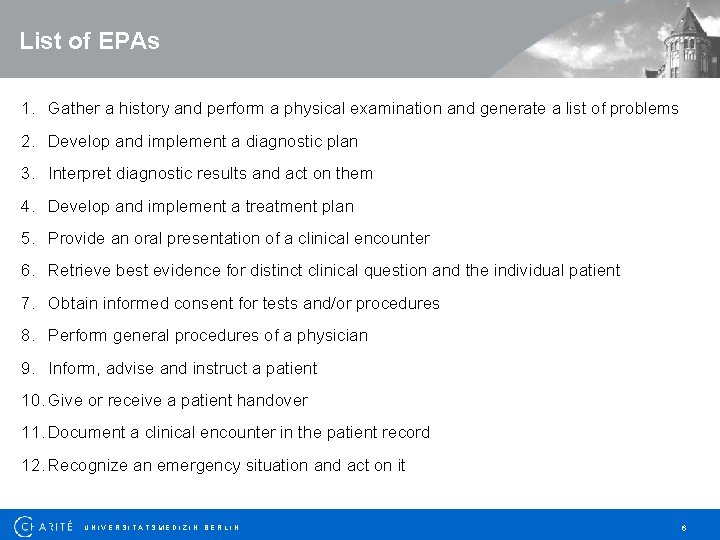
List of EPAs 1. Gather a history and perform a physical examination and generate a list of problems 2. Develop and implement a diagnostic plan 3. Interpret diagnostic results and act on them 4. Develop and implement a treatment plan 5. Provide an oral presentation of a clinical encounter 6. Retrieve best evidence for distinct clinical question and the individual patient 7. Obtain informed consent for tests and/or procedures 8. Perform general procedures of a physician 9. Inform, advise and instruct a patient 10. Give or receive a patient handover 11. Document a clinical encounter in the patient record 12. Recognize an emergency situation and act on it UNIVERSITÄTSMEDIZIN BERLIN 6
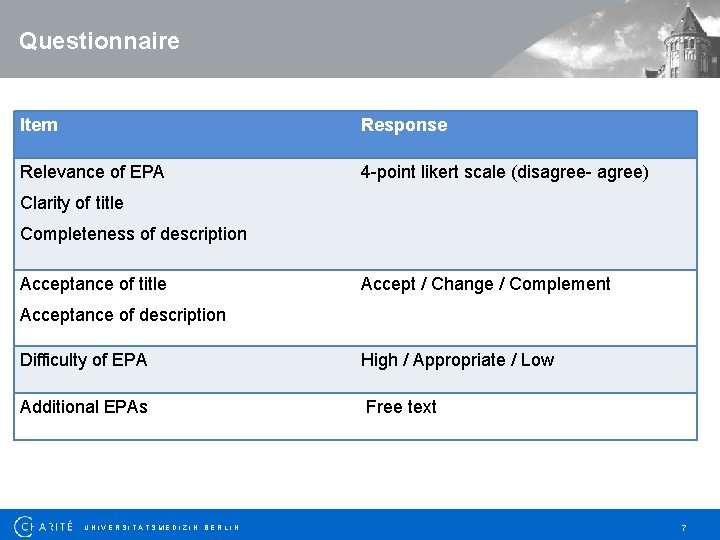
Questionnaire Item Response Relevance of EPA 4 -point likert scale (disagree- agree) Clarity of title Completeness of description Acceptance of title Accept / Change / Complement Acceptance of description Difficulty of EPA High / Appropriate / Low Additional EPAs Free text UNIVERSITÄTSMEDIZIN BERLIN 7
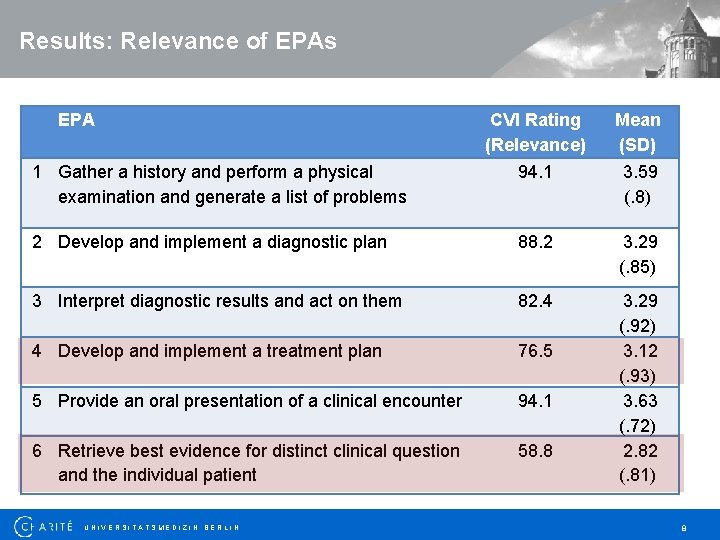
Results: Relevance of EPAs EPA CVI Rating (Relevance) Mean (SD) 1 Gather a history and perform a physical examination and generate a list of problems 94. 1 3. 59 (. 8) 2 Develop and implement a diagnostic plan 88. 2 3. 29 (. 85) 3 Interpret diagnostic results and act on them 82. 4 4 Develop and implement a treatment plan 76. 5 5 Provide an oral presentation of a clinical encounter 94. 1 6 Retrieve best evidence for distinct clinical question and the individual patient 58. 8 3. 29 (. 92) 3. 12 (. 93) 3. 63 (. 72) 2. 82 (. 81) UNIVERSITÄTSMEDIZIN BERLIN 8
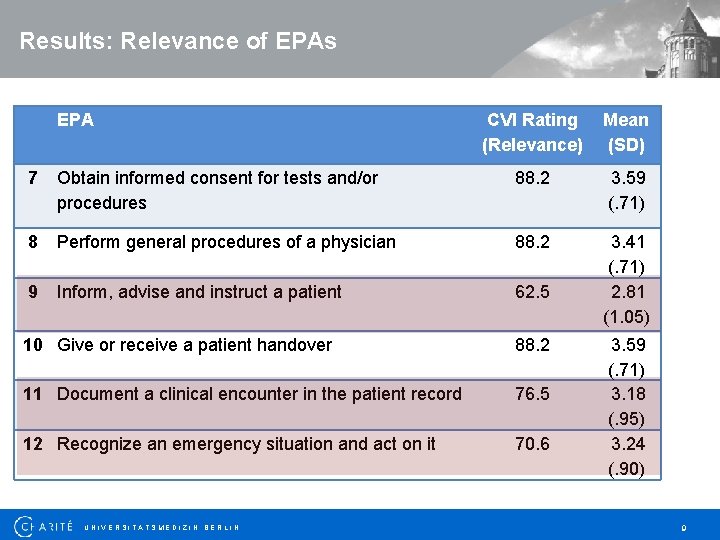
Results: Relevance of EPAs EPA CVI Rating (Relevance) Mean (SD) 7 Obtain informed consent for tests and/or procedures 88. 2 3. 59 (. 71) 8 Perform general procedures of a physician 88. 2 9 Inform, advise and instruct a patient 62. 5 3. 41 (. 71) 2. 81 (1. 05) 10 Give or receive a patient handover 88. 2 11 Document a clinical encounter in the patient record 76. 5 12 Recognize an emergency situation and act on it 70. 6 UNIVERSITÄTSMEDIZIN BERLIN 3. 59 (. 71) 3. 18 (. 95) 3. 24 (. 90) 9
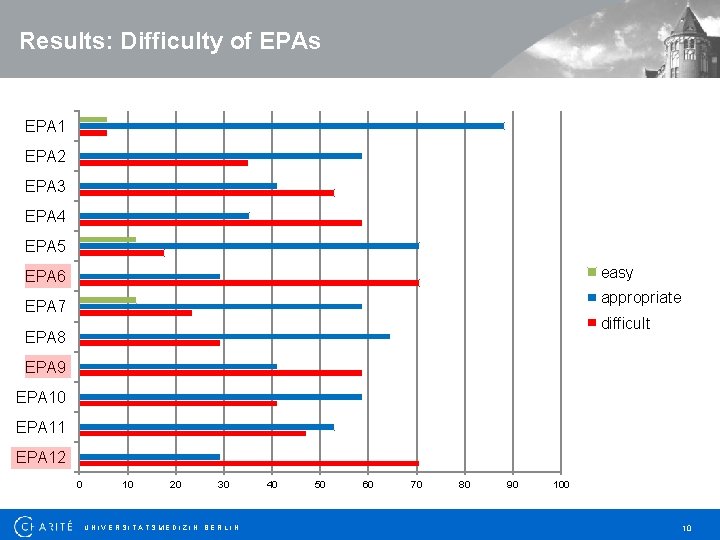
Results: Difficulty of EPAs EPA 1 EPA 2 EPA 3 EPA 4 EPA 5 easy EPA 6 appropriate EPA 7 difficult EPA 8 EPA 9 EPA 10 EPA 11 EPA 12 0 10 20 30 UNIVERSITÄTSMEDIZIN BERLIN 40 50 60 70 80 90 10
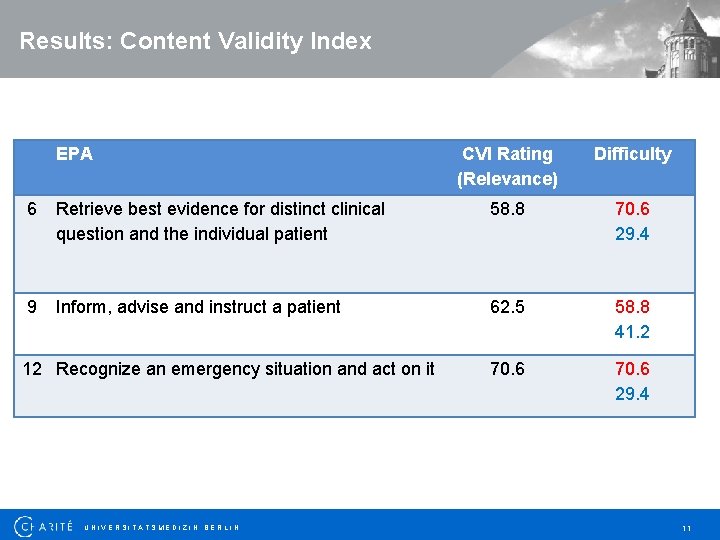
Results: Content Validity Index EPA CVI Rating (Relevance) Difficulty 6 Retrieve best evidence for distinct clinical question and the individual patient 58. 8 70. 6 29. 4 9 Inform, advise and instruct a patient 62. 5 58. 8 41. 2 70. 6 29. 4 12 Recognize an emergency situation and act on it UNIVERSITÄTSMEDIZIN BERLIN 11
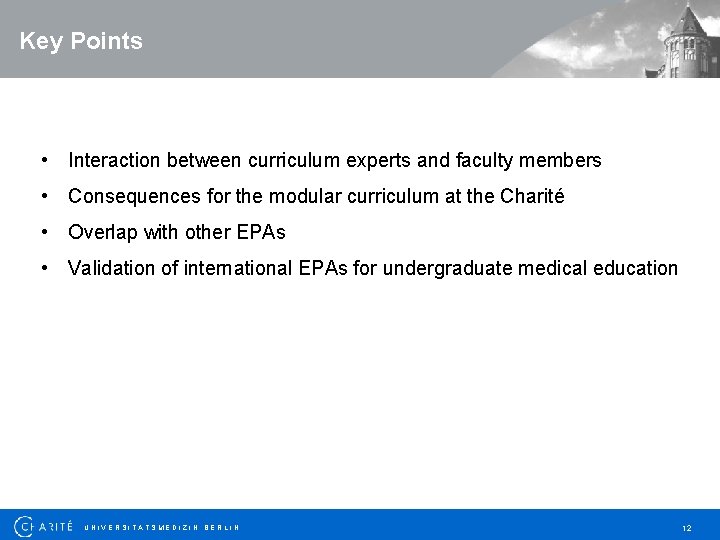
Key Points • Interaction between curriculum experts and faculty members • Consequences for the modular curriculum at the Charité • Overlap with other EPAs • Validation of international EPAs for undergraduate medical education UNIVERSITÄTSMEDIZIN BERLIN 12
Thank you for your attention Ylva Holzhausen Charité - Universitätsmedizin Berlin Dieter Scheffner Center for Medical Teaching and Educational Research Charitéplatz 1 10117 Berlin Tel. +49 30 450 576 457 ylva. holzhausen@charite. de UNIVERSITÄTSMEDIZIN BERLIN 13
References 1. ten Cate, O. (2005). Entrustability of professional activities and competencybased training. Medical Education, 39(12), 1176 -1177. 2. Core entrustable professional´activities for entering residency (CEPAER). Available at https: //www. mededportal. org/icollaborative/resource/887 UNIVERSITÄTSMEDIZIN BERLIN 14
List of Medical Specialties Neurology Intensive Care Psychiatry Audiology Psychosomatic Medicine Dermatology Cardiology Otolaryngology Endocrinology General Medicine Geriatric Medicine Surgery Nephrology Oncology Rheumatology Obstetrics Urology Pediatrics Anesthesiology Neonatology Policlinic Gynecology Emergency Medical Aid UNIVERSITÄTSMEDIZIN BERLIN 15
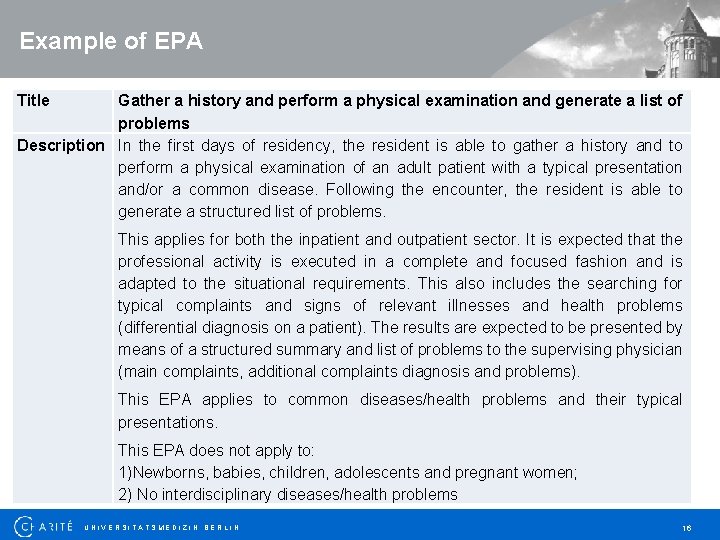
Example of EPA Title Gather a history and perform a physical examination and generate a list of problems Description In the first days of residency, the resident is able to gather a history and to perform a physical examination of an adult patient with a typical presentation and/or a common disease. Following the encounter, the resident is able to generate a structured list of problems. This applies for both the inpatient and outpatient sector. It is expected that the professional activity is executed in a complete and focused fashion and is adapted to the situational requirements. This also includes the searching for typical complaints and signs of relevant illnesses and health problems (differential diagnosis on a patient). The results are expected to be presented by means of a structured summary and list of problems to the supervising physician (main complaints, additional complaints diagnosis and problems). This EPA applies to common diseases/health problems and their typical presentations. This EPA does not apply to: 1)Newborns, babies, children, adolescents and pregnant women; 2) No interdisciplinary diseases/health problems UNIVERSITÄTSMEDIZIN BERLIN 16