
AME 60634 Int Heat Trans Internal Convection Overview

- Slides: 6
AME 60634 Int. Heat Trans. Internal Convection: Overview • Internal Flows: Thermal Effects – assume laminar flow with uniform inlet temperature Ti – two common boundary conditions • uniform heat flux • uniform surface temperature – simplest internal flow: laminar flow in circular tube • thermal boundary layer thickens on surface of tube with increasing x • isothermal core shrinks as boundary layer grows. • subsequent to boundary layer merger at the centerline, dimensionless forms of the temperature profile become invariant with x thermally fully developed D. B. Go Convection - 1
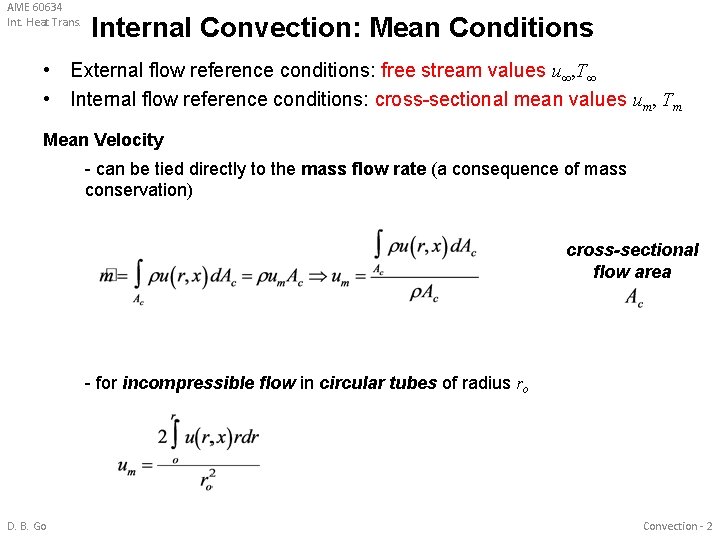
AME 60634 Int. Heat Trans. Internal Convection: Mean Conditions • External flow reference conditions: free stream values u∞, T∞ • Internal flow reference conditions: cross-sectional mean values um, Tm Mean Velocity - can be tied directly to the mass flow rate (a consequence of mass conservation) cross-sectional flow area - for incompressible flow in circular tubes of radius ro D. B. Go Convection - 2
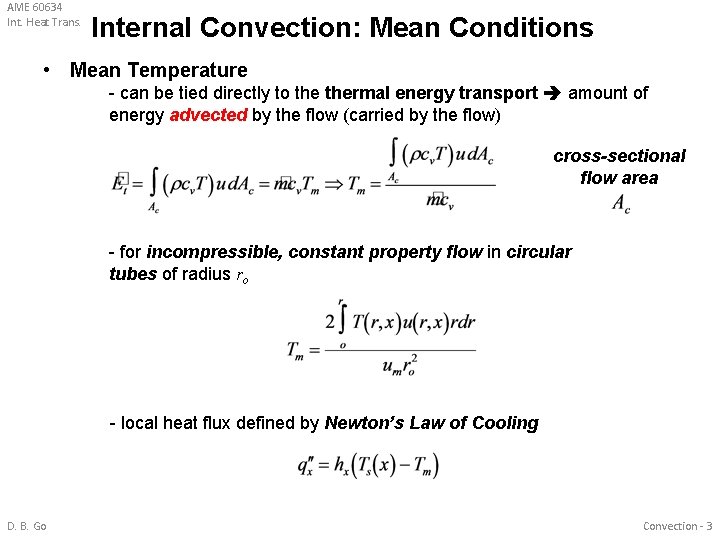
AME 60634 Int. Heat Trans. Internal Convection: Mean Conditions • Mean Temperature - can be tied directly to thermal energy transport amount of energy advected by the flow (carried by the flow) cross-sectional flow area - for incompressible, constant property flow in circular tubes of radius ro - local heat flux defined by Newton’s Law of Cooling D. B. Go Convection - 3
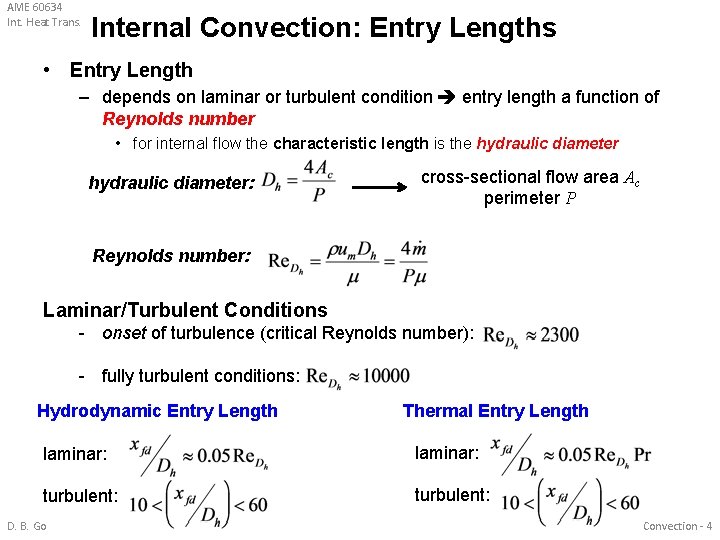
AME 60634 Int. Heat Trans. Internal Convection: Entry Lengths • Entry Length – depends on laminar or turbulent condition entry length a function of Reynolds number • for internal flow the characteristic length is the hydraulic diameter: cross-sectional flow area Ac perimeter P Reynolds number: Laminar/Turbulent Conditions - onset of turbulence (critical Reynolds number): - fully turbulent conditions: Hydrodynamic Entry Length Thermal Entry Length laminar: turbulent: D. B. Go Convection - 4
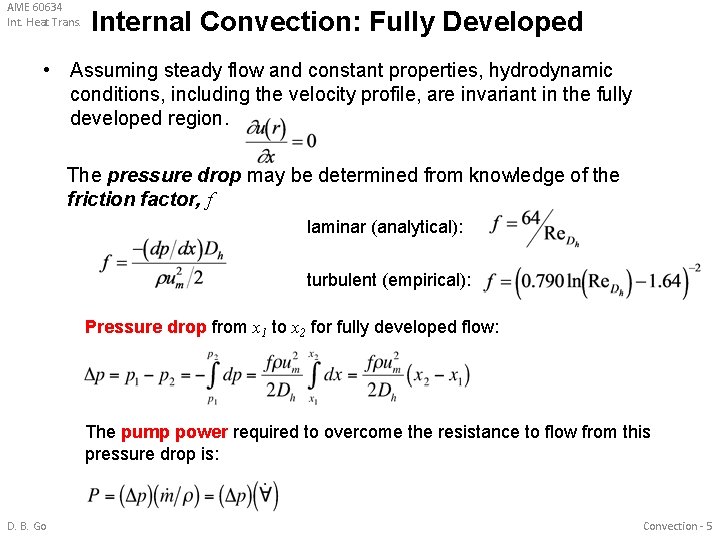
AME 60634 Int. Heat Trans. Internal Convection: Fully Developed • Assuming steady flow and constant properties, hydrodynamic conditions, including the velocity profile, are invariant in the fully developed region. The pressure drop may be determined from knowledge of the friction factor, f laminar (analytical): turbulent (empirical): Pressure drop from x 1 to x 2 for fully developed flow: The pump power required to overcome the resistance to flow from this pressure drop is: D. B. Go Convection - 5
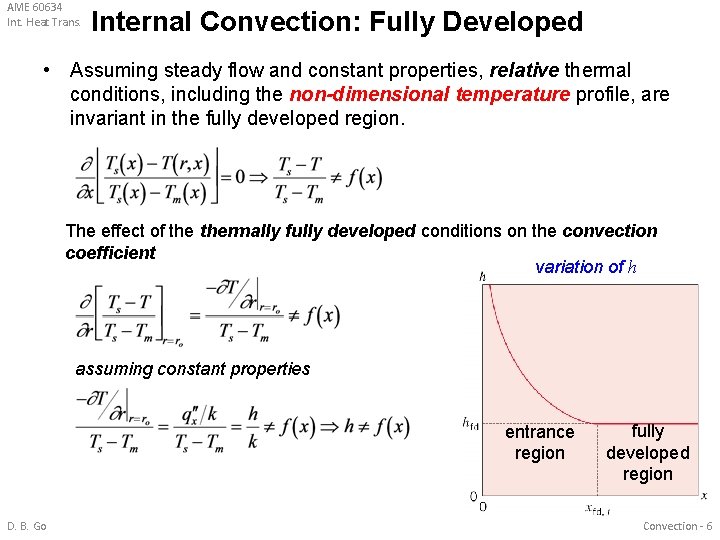
AME 60634 Int. Heat Trans. Internal Convection: Fully Developed • Assuming steady flow and constant properties, relative thermal conditions, including the non-dimensional temperature profile, are invariant in the fully developed region. The effect of thermally fully developed conditions on the convection coefficient variation of h assuming constant properties entrance region D. B. Go fully developed region Convection - 6