
AME 60634 Int Heat Trans Free Convection Overview

- Slides: 19
AME 60634 Int. Heat Trans. Free Convection: Overview • Free Convection (or Natural Convection) – fluid motion induced by buoyancy forces – buoyancy forces arise when there are density gradients in a fluid and a body force proportional to density arises • Density Gradient – due to temperature gradient thermally driven flow • Body Force – gravity (function of mass) Basic Principle: heavy fluid falls and light fluid rises creating vortices D. B. Go
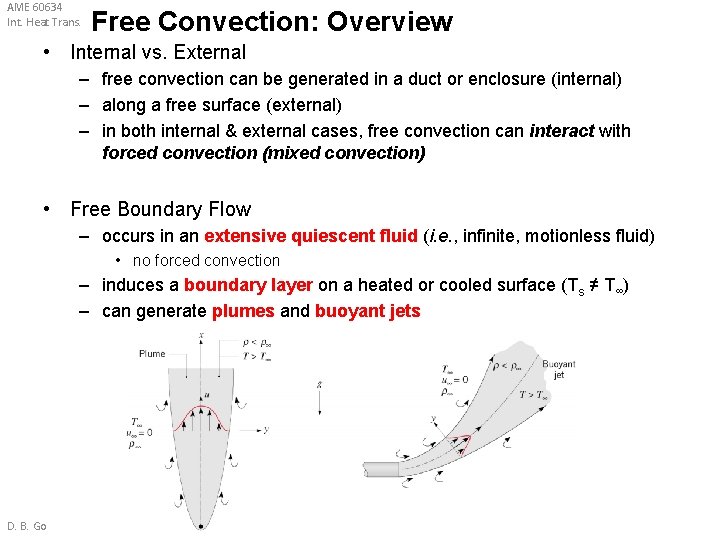
AME 60634 Int. Heat Trans. Free Convection: Overview • Internal vs. External – free convection can be generated in a duct or enclosure (internal) – along a free surface (external) – in both internal & external cases, free convection can interact with forced convection (mixed convection) • Free Boundary Flow – occurs in an extensive quiescent fluid (i. e. , infinite, motionless fluid) • no forced convection – induces a boundary layer on a heated or cooled surface (Ts ≠ T∞) – can generate plumes and buoyant jets D. B. Go
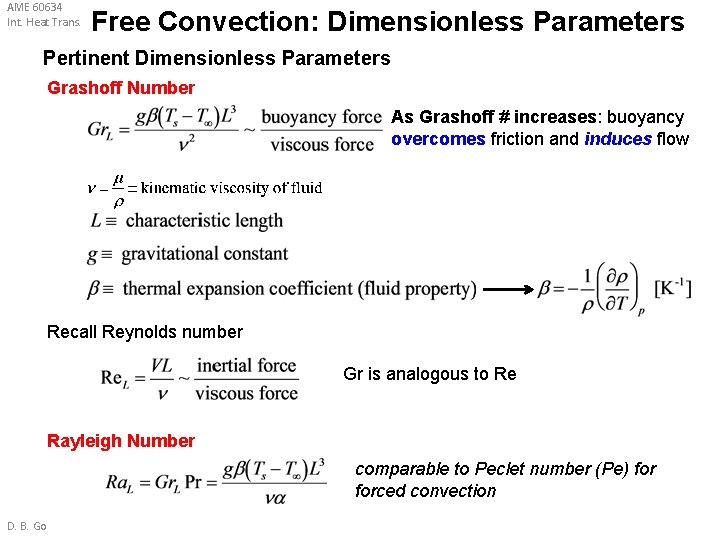
AME 60634 Int. Heat Trans. Free Convection: Dimensionless Parameters Pertinent Dimensionless Parameters Grashoff Number As Grashoff # increases: buoyancy overcomes friction and induces flow Recall Reynolds number Gr is analogous to Re Rayleigh Number comparable to Peclet number (Pe) forced convection D. B. Go
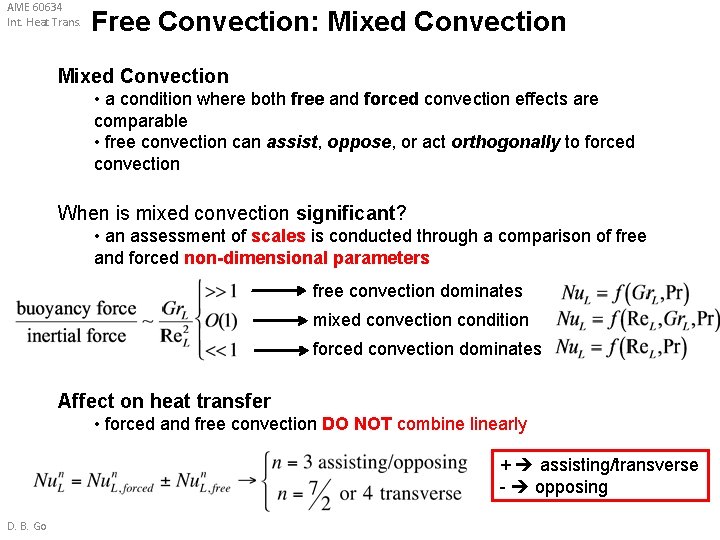
AME 60634 Int. Heat Trans. Free Convection: Mixed Convection • a condition where both free and forced convection effects are comparable • free convection can assist, oppose, or act orthogonally to forced convection When is mixed convection significant? • an assessment of scales is conducted through a comparison of free and forced non-dimensional parameters free convection dominates mixed convection condition forced convection dominates Affect on heat transfer • forced and free convection DO NOT combine linearly + assisting/transverse - opposing D. B. Go
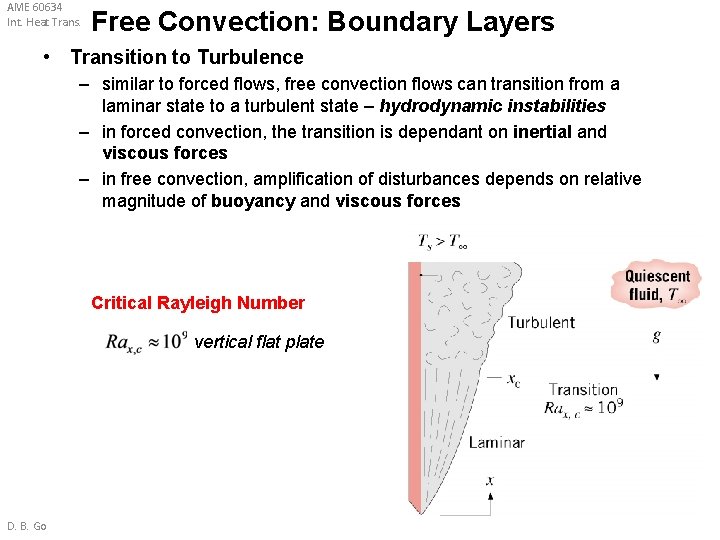
AME 60634 Int. Heat Trans. Free Convection: Boundary Layers • Transition to Turbulence – similar to forced flows, free convection flows can transition from a laminar state to a turbulent state – hydrodynamic instabilities – in forced convection, the transition is dependant on inertial and viscous forces – in free convection, amplification of disturbances depends on relative magnitude of buoyancy and viscous forces Critical Rayleigh Number vertical flat plate D. B. Go
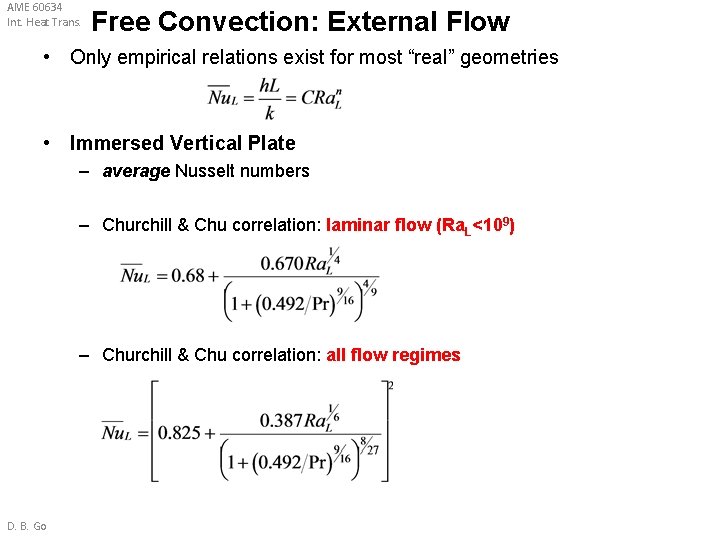
AME 60634 Int. Heat Trans. Free Convection: External Flow • Only empirical relations exist for most “real” geometries • Immersed Vertical Plate – average Nusselt numbers – Churchill & Chu correlation: laminar flow (Ra. L<109) – Churchill & Chu correlation: all flow regimes D. B. Go
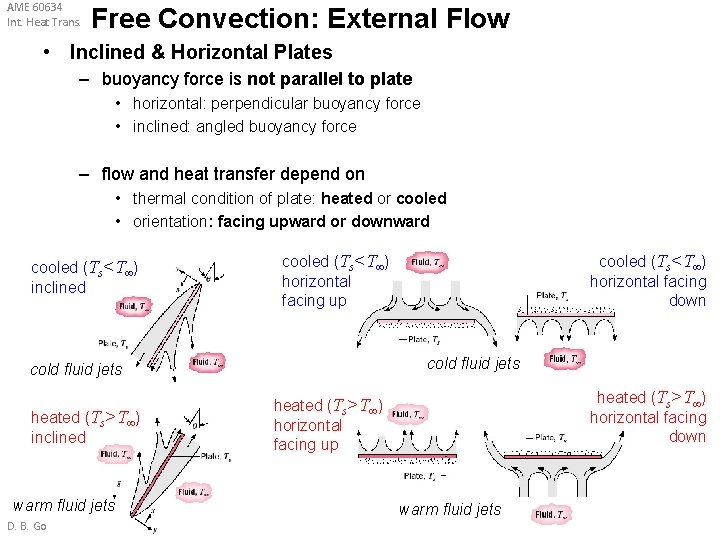
AME 60634 Int. Heat Trans. Free Convection: External Flow • Inclined & Horizontal Plates – buoyancy force is not parallel to plate • horizontal: perpendicular buoyancy force • inclined: angled buoyancy force – flow and heat transfer depend on • thermal condition of plate: heated or cooled • orientation: facing upward or downward cooled (Ts<T∞) inclined cooled (Ts<T∞) horizontal facing up cold fluid jets heated (Ts>T∞) inclined warm fluid jets D. B. Go cooled (Ts<T∞) horizontal facing down heated (Ts>T∞) horizontal facing up warm fluid jets
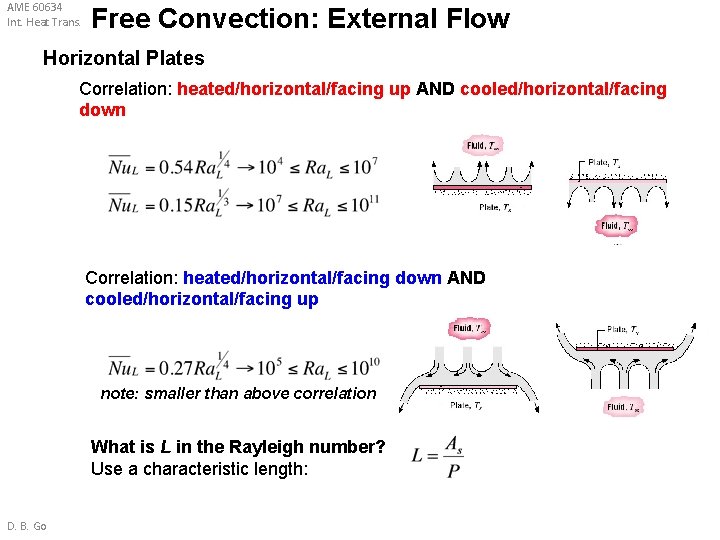
AME 60634 Int. Heat Trans. Free Convection: External Flow Horizontal Plates Correlation: heated/horizontal/facing up AND cooled/horizontal/facing down Correlation: heated/horizontal/facing down AND cooled/horizontal/facing up note: smaller than above correlation What is L in the Rayleigh number? Use a characteristic length: D. B. Go
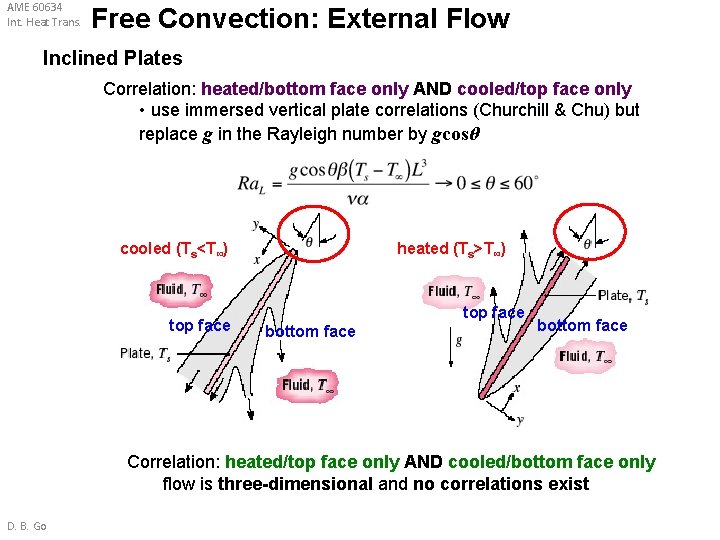
AME 60634 Int. Heat Trans. Free Convection: External Flow Inclined Plates Correlation: heated/bottom face only AND cooled/top face only • use immersed vertical plate correlations (Churchill & Chu) but replace g in the Rayleigh number by gcosθ cooled (Ts<T∞) top face heated (Ts>T∞) top face bottom face Correlation: heated/top face only AND cooled/bottom face only flow is three-dimensional and no correlations exist D. B. Go
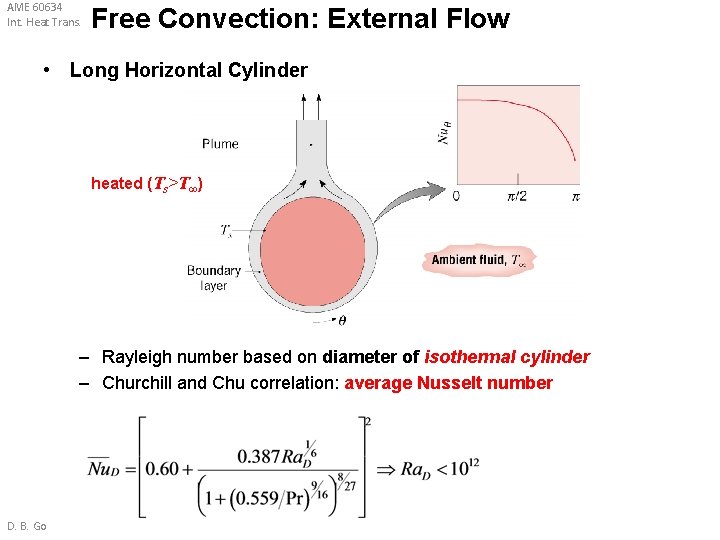
AME 60634 Int. Heat Trans. Free Convection: External Flow • Long Horizontal Cylinder heated (Ts>T∞) – Rayleigh number based on diameter of isothermal cylinder – Churchill and Chu correlation: average Nusselt number D. B. Go
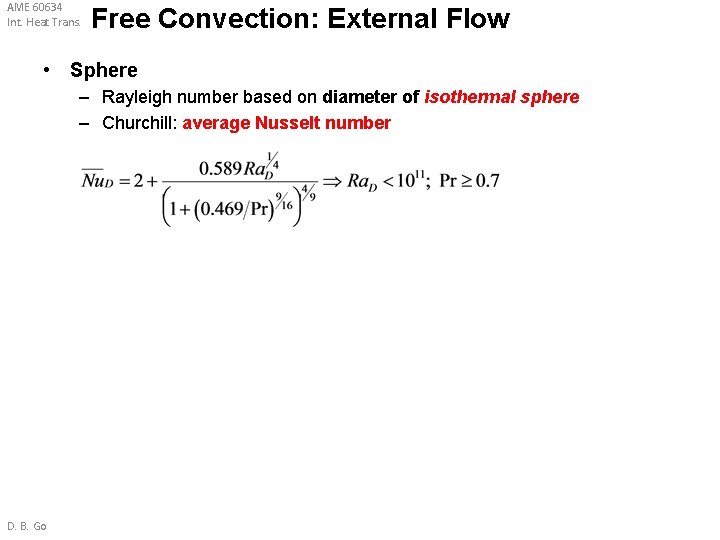
AME 60634 Int. Heat Trans. Free Convection: External Flow • Sphere – Rayleigh number based on diameter of isothermal sphere – Churchill: average Nusselt number D. B. Go
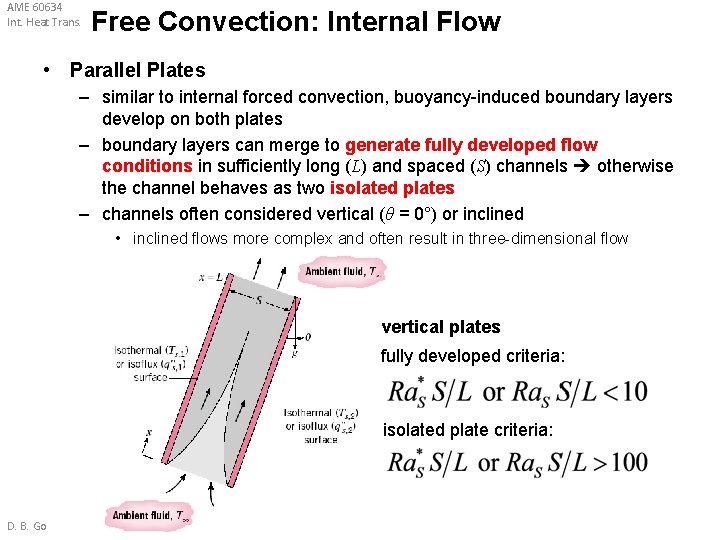
AME 60634 Int. Heat Trans. Free Convection: Internal Flow • Parallel Plates – similar to internal forced convection, buoyancy-induced boundary layers develop on both plates – boundary layers can merge to generate fully developed flow conditions in sufficiently long (L) and spaced (S) channels otherwise the channel behaves as two isolated plates – channels often considered vertical (θ = 0°) or inclined • inclined flows more complex and often result in three-dimensional flow structures vertical plates fully developed criteria: isolated plate criteria: D. B. Go
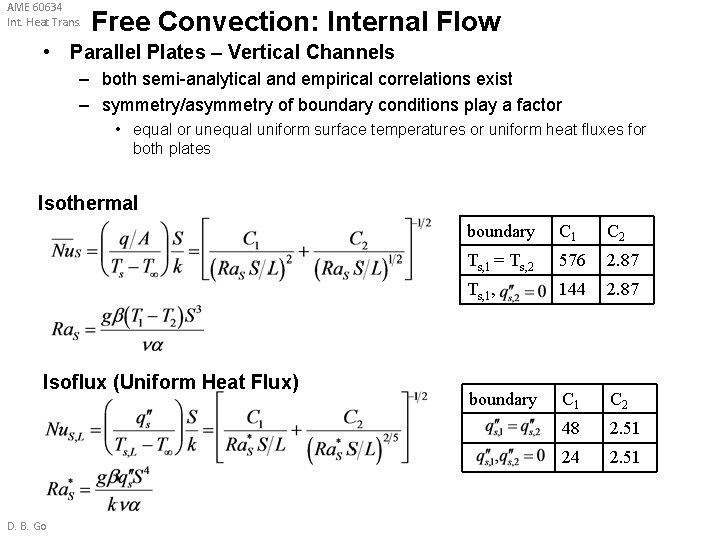
AME 60634 Int. Heat Trans. Free Convection: Internal Flow • Parallel Plates – Vertical Channels – both semi-analytical and empirical correlations exist – symmetry/asymmetry of boundary conditions play a factor • equal or unequal uniform surface temperatures or uniform heat fluxes for both plates Isothermal Isoflux (Uniform Heat Flux) D. B. Go boundary C 1 C 2 Ts, 1 = Ts, 2 576 2. 87 Ts, 1, 144 2. 87 boundary C 1 C 2 48 2. 51 24 2. 51
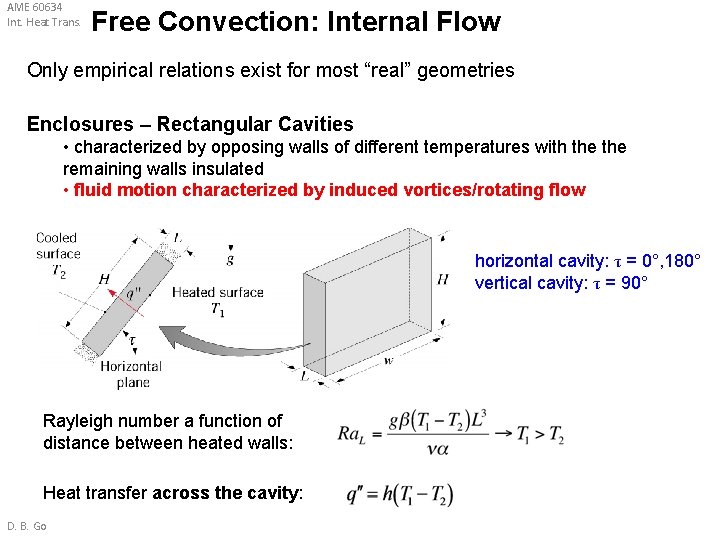
AME 60634 Int. Heat Trans. Free Convection: Internal Flow Only empirical relations exist for most “real” geometries Enclosures – Rectangular Cavities • characterized by opposing walls of different temperatures with the remaining walls insulated • fluid motion characterized by induced vortices/rotating flow horizontal cavity: τ = 0°, 180° vertical cavity: τ = 90° Rayleigh number a function of distance between heated walls: Heat transfer across the cavity: D. B. Go
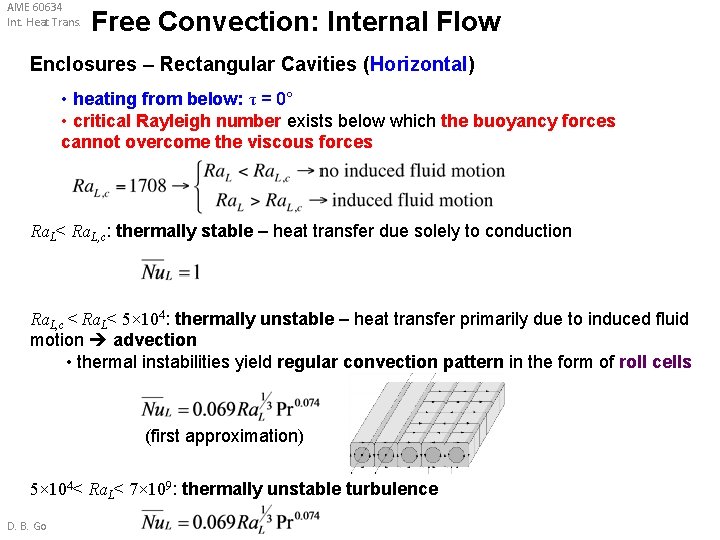
AME 60634 Int. Heat Trans. Free Convection: Internal Flow Enclosures – Rectangular Cavities (Horizontal) • heating from below: τ = 0° • critical Rayleigh number exists below which the buoyancy forces cannot overcome the viscous forces Ra. L< Ra. L, c: thermally stable – heat transfer due solely to conduction Ra. L, c < Ra. L< 5× 10⁴: thermally unstable – heat transfer primarily due to induced fluid motion advection • thermal instabilities yield regular convection pattern in the form of roll cells (first approximation) 5× 10⁴< Ra. L< 7× 10⁹: thermally unstable turbulence D. B. Go
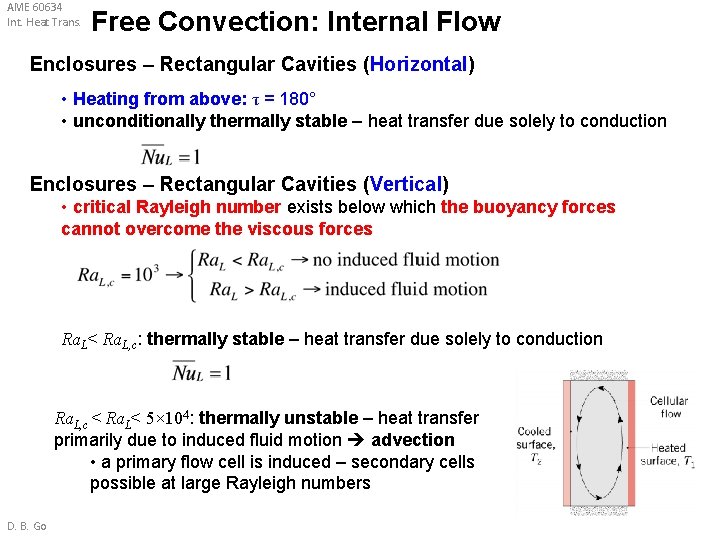
AME 60634 Int. Heat Trans. Free Convection: Internal Flow Enclosures – Rectangular Cavities (Horizontal) • Heating from above: τ = 180° • unconditionally thermally stable – heat transfer due solely to conduction Enclosures – Rectangular Cavities (Vertical) • critical Rayleigh number exists below which the buoyancy forces cannot overcome the viscous forces Ra. L< Ra. L, c: thermally stable – heat transfer due solely to conduction Ra. L, c < Ra. L< 5× 10⁴: thermally unstable – heat transfer primarily due to induced fluid motion advection • a primary flow cell is induced – secondary cells possible at large Rayleigh numbers D. B. Go
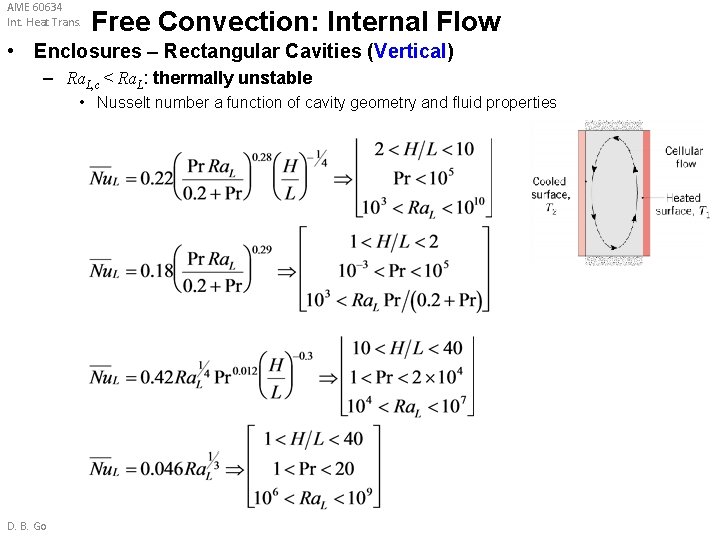
AME 60634 Int. Heat Trans. Free Convection: Internal Flow • Enclosures – Rectangular Cavities (Vertical) – Ra. L, c < Ra. L: thermally unstable • Nusselt number a function of cavity geometry and fluid properties D. B. Go
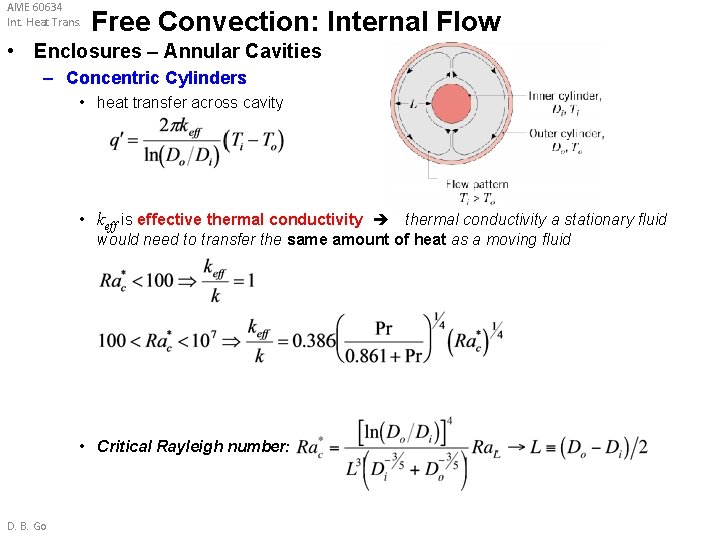
AME 60634 Int. Heat Trans. Free Convection: Internal Flow • Enclosures – Annular Cavities – Concentric Cylinders • heat transfer across cavity • keff is effective thermal conductivity a stationary fluid would need to transfer the same amount of heat as a moving fluid • Critical Rayleigh number: D. B. Go
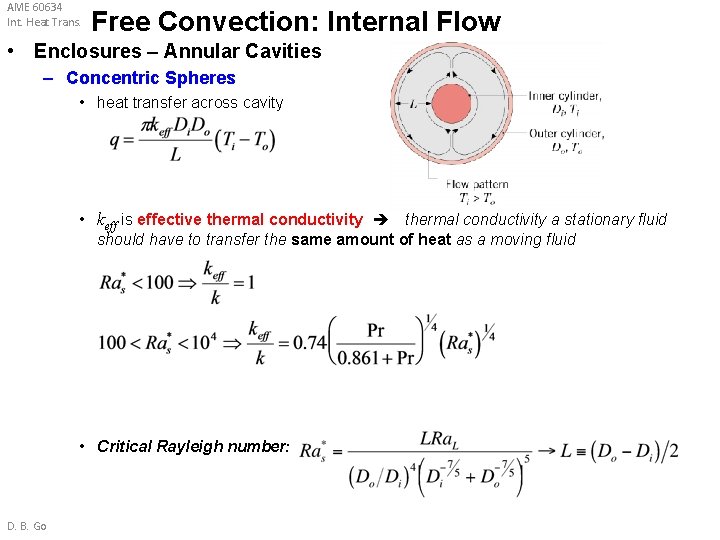
AME 60634 Int. Heat Trans. Free Convection: Internal Flow • Enclosures – Annular Cavities – Concentric Spheres • heat transfer across cavity • keff is effective thermal conductivity a stationary fluid should have to transfer the same amount of heat as a moving fluid • Critical Rayleigh number: D. B. Go