
AME 60634 Int Heat Trans Fluid Dynamics Boundary
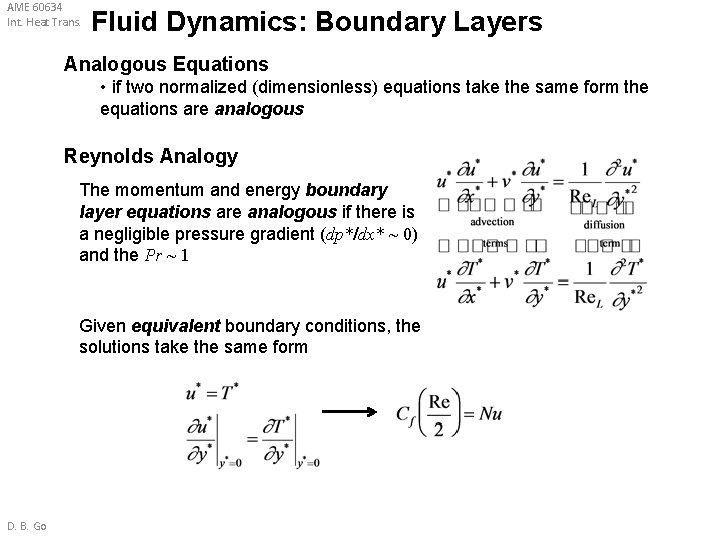
AME 60634 Int. Heat Trans. Fluid Dynamics: Boundary Layers Analogous Equations • if two normalized (dimensionless) equations take the same form the equations are analogous Reynolds Analogy The momentum and energy boundary layer equations are analogous if there is a negligible pressure gradient (dp*/dx* ~ 0) and the Pr ~ 1 Given equivalent boundary conditions, the solutions take the same form D. B. Go
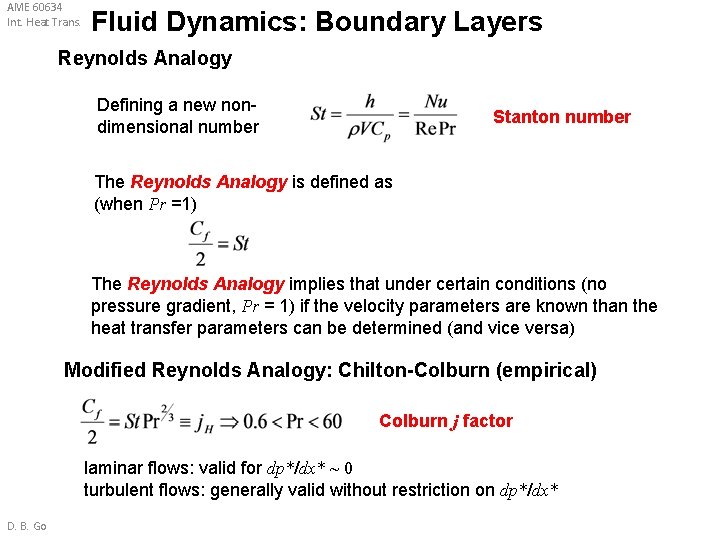
AME 60634 Int. Heat Trans. Fluid Dynamics: Boundary Layers Reynolds Analogy Defining a new nondimensional number Stanton number The Reynolds Analogy is defined as (when Pr =1) The Reynolds Analogy implies that under certain conditions (no pressure gradient, Pr = 1) if the velocity parameters are known than the heat transfer parameters can be determined (and vice versa) Modified Reynolds Analogy: Chilton-Colburn (empirical) Colburn j factor laminar flows: valid for dp*/dx* ~ 0 turbulent flows: generally valid without restriction on dp*/dx* D. B. Go
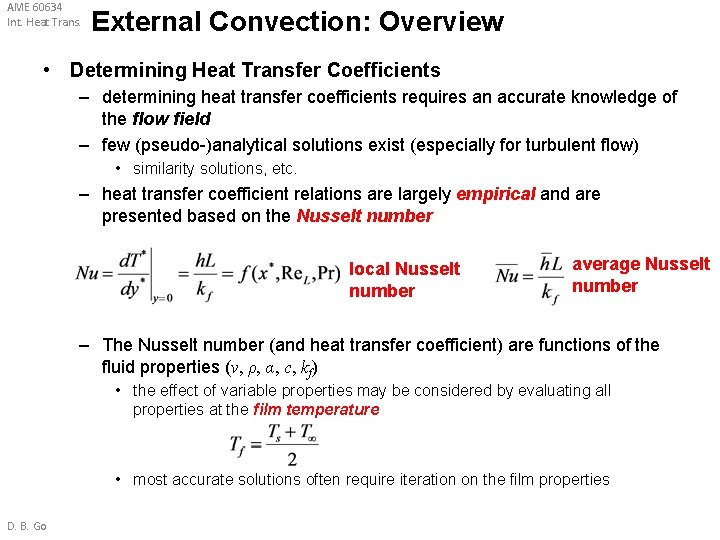
AME 60634 Int. Heat Trans. External Convection: Overview • Determining Heat Transfer Coefficients – determining heat transfer coefficients requires an accurate knowledge of the flow field – few (pseudo-)analytical solutions exist (especially for turbulent flow) • similarity solutions, etc. – heat transfer coefficient relations are largely empirical and are presented based on the Nusselt number local Nusselt number average Nusselt number – The Nusselt number (and heat transfer coefficient) are functions of the fluid properties (ν, ρ, α, c, kf) • the effect of variable properties may be considered by evaluating all properties at the film temperature • most accurate solutions often require iteration on the film properties D. B. Go
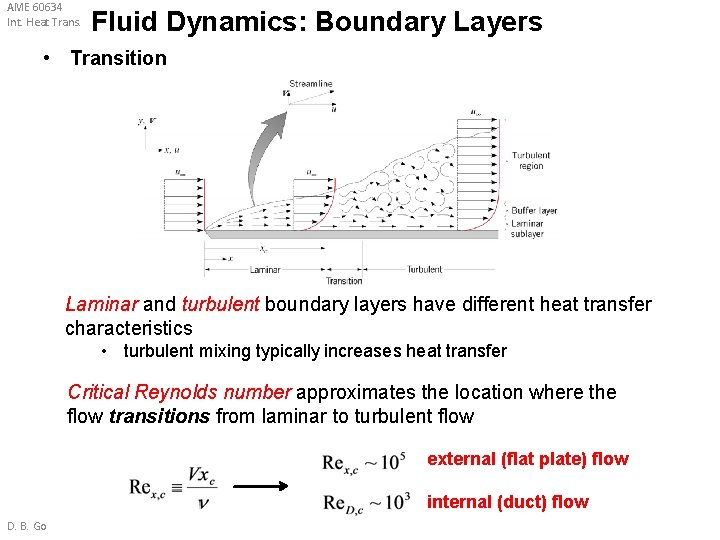
AME 60634 Int. Heat Trans. Fluid Dynamics: Boundary Layers • Transition Laminar and turbulent boundary layers have different heat transfer characteristics • turbulent mixing typically increases heat transfer Critical Reynolds number approximates the location where the flow transitions from laminar to turbulent flow external (flat plate) flow internal (duct) flow D. B. Go
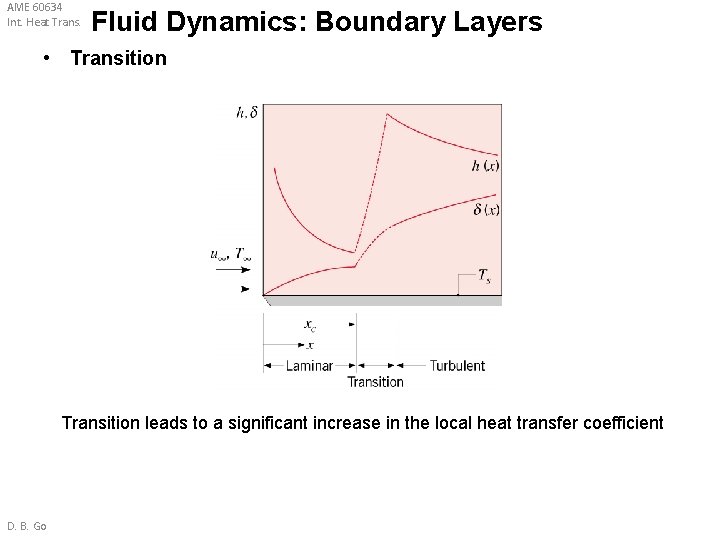
AME 60634 Int. Heat Trans. Fluid Dynamics: Boundary Layers • Transition leads to a significant increase in the local heat transfer coefficient D. B. Go
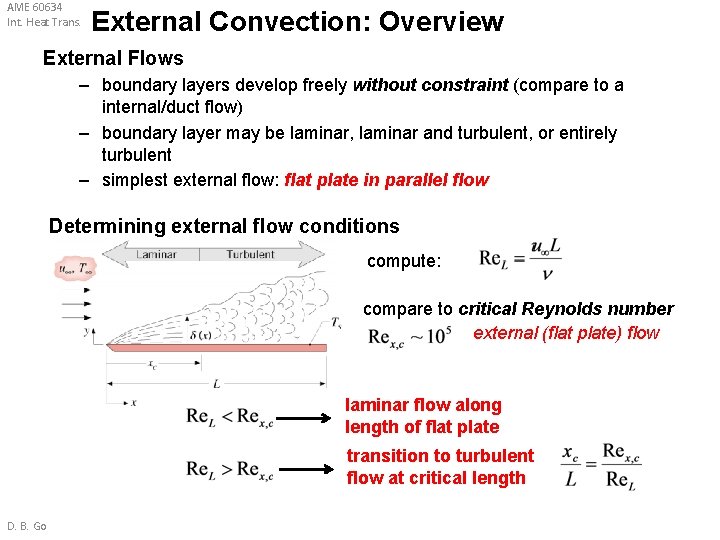
AME 60634 Int. Heat Trans. External Convection: Overview External Flows – boundary layers develop freely without constraint (compare to a internal/duct flow) – boundary layer may be laminar, laminar and turbulent, or entirely turbulent – simplest external flow: flat plate in parallel flow Determining external flow conditions compute: compare to critical Reynolds number external (flat plate) flow laminar flow along length of flat plate transition to turbulent flow at critical length D. B. Go
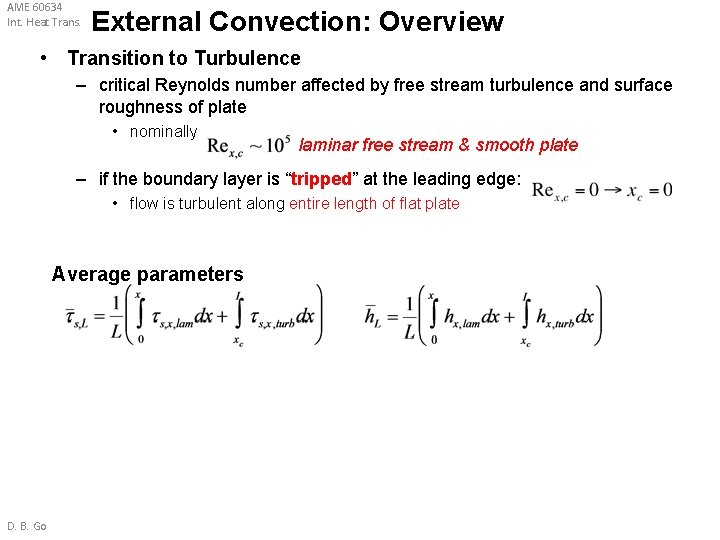
AME 60634 Int. Heat Trans. External Convection: Overview • Transition to Turbulence – critical Reynolds number affected by free stream turbulence and surface roughness of plate • nominally laminar free stream & smooth plate – if the boundary layer is “tripped” at the leading edge: • flow is turbulent along entire length of flat plate Average parameters D. B. Go
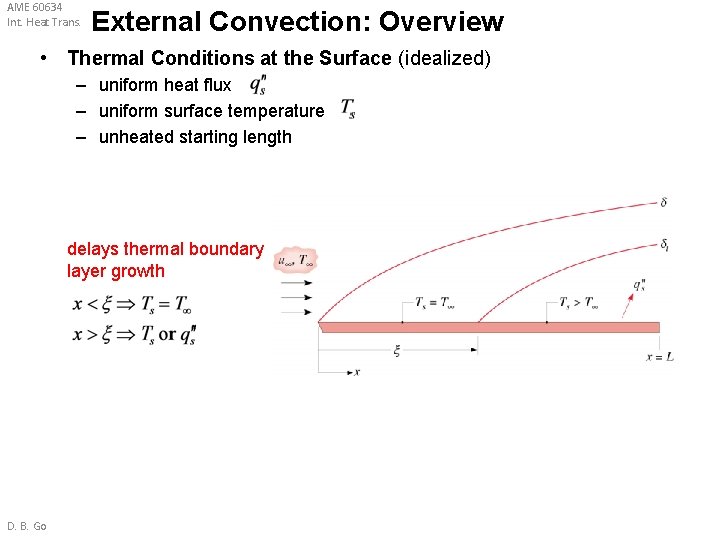
AME 60634 Int. Heat Trans. External Convection: Overview • Thermal Conditions at the Surface (idealized) – uniform heat flux – uniform surface temperature – unheated starting length delays thermal boundary layer growth D. B. Go
- Slides: 8