
Ambiguous Loss developed by Pauline Boss at the

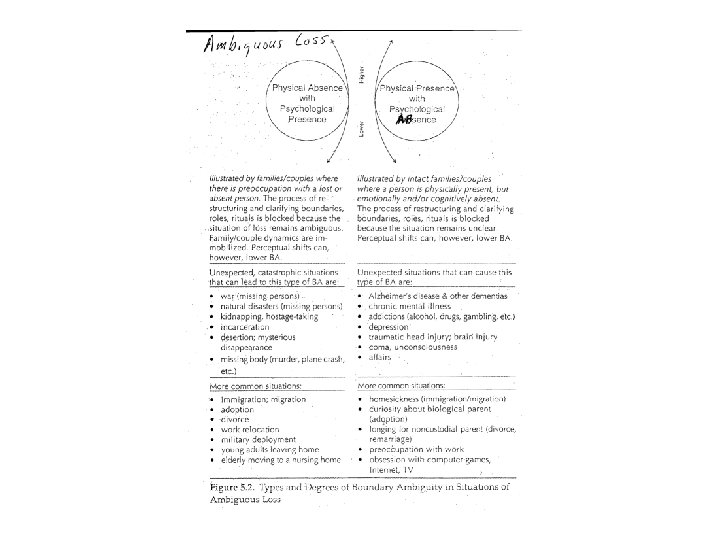
Ambiguous Loss -developed by Pauline Boss at the University of Minnesota -Was widely used following 9 -11 attacks - Defined in simplest terms as unresolved grief
When is ambiguous loss a problem? • When it leads to: – Ambivalence (anxiety, conflict, guilt) – Immobilization in family functioning, decisions, or tasks – Passivity: low mastery, depression – Frozen grief: depression, somatization
General principles • The more mastery oriented a person is, the harder it is to deal with ambiguous loss • While working through issues families may have to live with multiple realities of loss • Integrating roles and adding stability is the goal- not resolution of the loss • It is not unusual to have fluctuating and sometimes simultaneous emotions
Helps for Ambiguous loss • Label the experience • Gather the family into one room for discussion and get each persons perspective • Encourage them to get as much information as possible • Share interpretations of what has been lost and what can stay the same • Tolerate conflict while listening to interpretations
• Negotiate; problem solve to move forward to unfreeze couple or family • Reconstruct roles, rituals, and rules so the family can build some stability • Eliminate blame and shame, infuse hope and optimism • Help the family develop some meaning for the ambiguous loss • Continue meeting as long as it’s helpful to the family • It’s not unusual to take 5 years for new normality
- Slides: 6