
Ambiguity and Vagueness in Clinical Practice Guidelines Shlomi

Ambiguity and Vagueness in Clinical Practice Guidelines Shlomi Codish, MD Richard Shiffman, MD, MCIS Yale Center for Medical Informatics

Overview n Definitions and background n Classification model n Implications for authoring and implementation
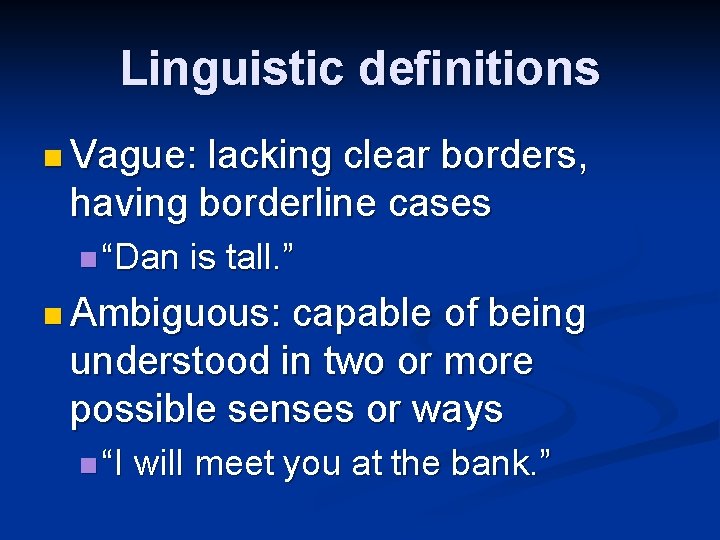
Linguistic definitions n Vague: lacking clear borders, having borderline cases n “Dan is tall. ” n Ambiguous: capable of being understood in two or more possible senses or ways n “I will meet you at the bank. ”
Introduction n Focus: human users of CPGs n Clinicians – reduced adherence or accuracy n Grol n n (1998), Shekelle (2000) Implementers Ambiguity is often used to describe vagueness n “disambiguation” has been used for the resolution of both ambiguity and vagueness
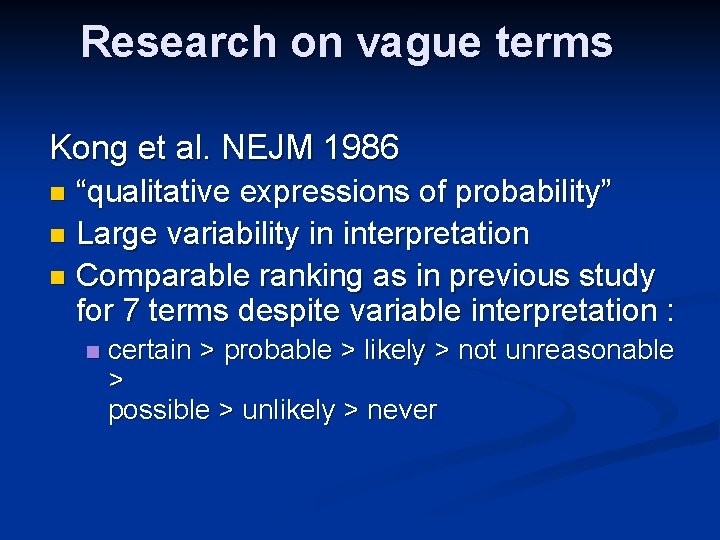
Research on vague terms Kong et al. NEJM 1986 “qualitative expressions of probability” n Large variability in interpretation n Comparable ranking as in previous study for 7 terms despite variable interpretation : n n certain > probable > likely > not unreasonable > possible > unlikely > never
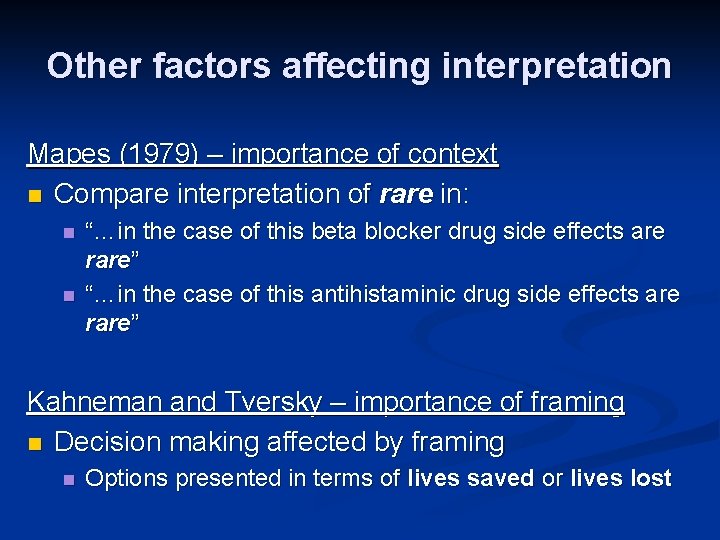
Other factors affecting interpretation Mapes (1979) – importance of context n Compare interpretation of rare in: n n “…in the case of this beta blocker drug side effects are rare” “…in the case of this antihistaminic drug side effects are rare” Kahneman and Tversky – importance of framing n Decision making affected by framing n Options presented in terms of lives saved or lives lost

ambiguity ≠ uncertainty NJ judge to rule on nude beach Stolen painting found by tree Prostitutes appeal to governor
Overview Introduction n Classification model for ambiguity and vagueness n Implications for authoring and implementation n
Development methodology n MEDLINE and Web of Science databases n Review of the linguistics literature Lists of terms and categories n Validation with random collection of 100 CPG n
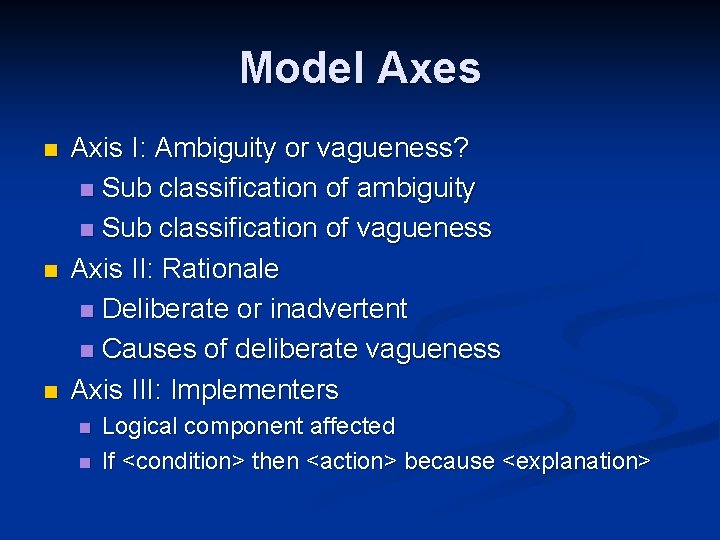
Model Axes n n n Axis I: Ambiguity or vagueness? n Sub classification of ambiguity n Sub classification of vagueness Axis II: Rationale n Deliberate or inadvertent n Causes of deliberate vagueness Axis III: Implementers n n Logical component affected If <condition> then <action> because <explanation>
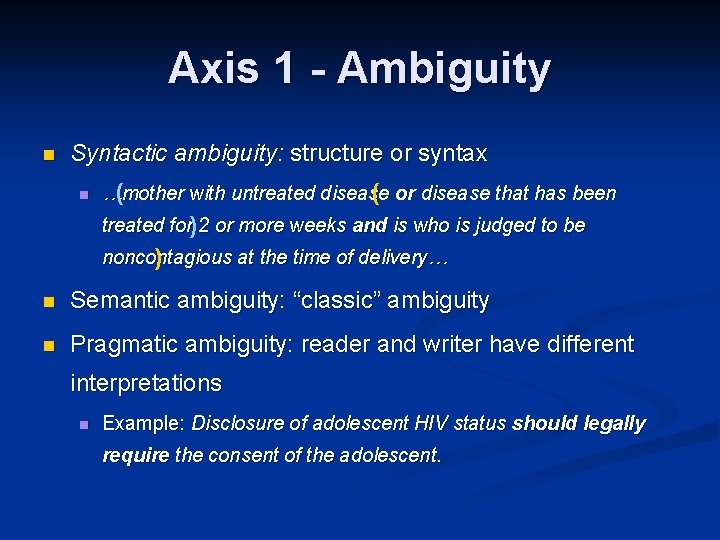
Axis 1 - Ambiguity n Syntactic ambiguity: structure or syntax n …mother with untreated disease ( or disease that has been ( treated for) 2 or more weeks and is who is judged to be noncontagious at the time of delivery… ) n Semantic ambiguity: “classic” ambiguity n Pragmatic ambiguity: reader and writer have different interpretations n Example: Disclosure of adolescent HIV status should legally require the consent of the adolescent.
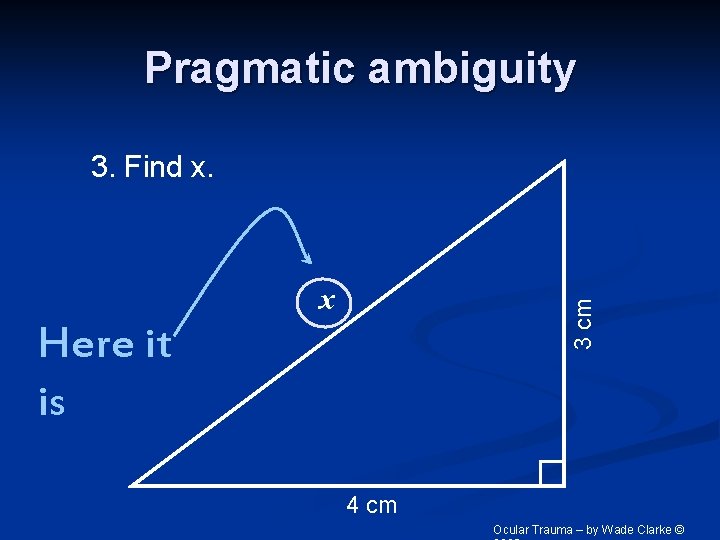
Pragmatic ambiguity 3. Find x. 3 cm x Here it is 4 cm Ocular Trauma – by Wade Clarke ©

Axis 1 - Vagueness n Underspecification is a form of vagueness that occurs when terms are used with insufficient details for interpretation. n n n moderate, severe, elderly, adult …should be treated promptly and aggressively. Ordinal scales of underspecified words Temporal scale: Probabilistic scale: Quantitative scale: Never Impossible None rare sometime s common Always unlikely possible probable Certain few some many All
Axis I - Vagueness n Strength qualifiers (a. k. a. hedges) n n n It is generally recommended that the antibiotic beads be removed 2 weeks… It is prudent to… Passive voice n Memory complaints should be evaluated and the individual followed to assess progression
Axis II - rationale Only the authors know the rationale n Inadvertent ambiguity or vagueness is a failure of authoring and editing n It might also result from a failure to recognize the problems ambiguity and vagueness create: n n “…please appreciate that we will not necessarily have full agreement on the fine points of wording as each of us has his or her own writing style…”
Axis II – deliberate vagueness Insufficient scientific evidence n Lack of consensus among authors n Other considerations n Legal n Economic n Ethical n Religious n
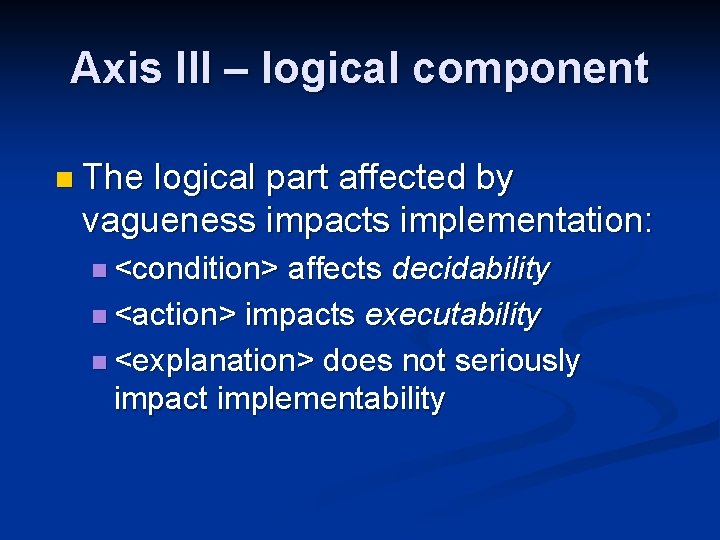
Axis III – logical component n The logical part affected by vagueness impacts implementation: n <condition> affects decidability n <action> impacts executability n <explanation> does not seriously impact implementability
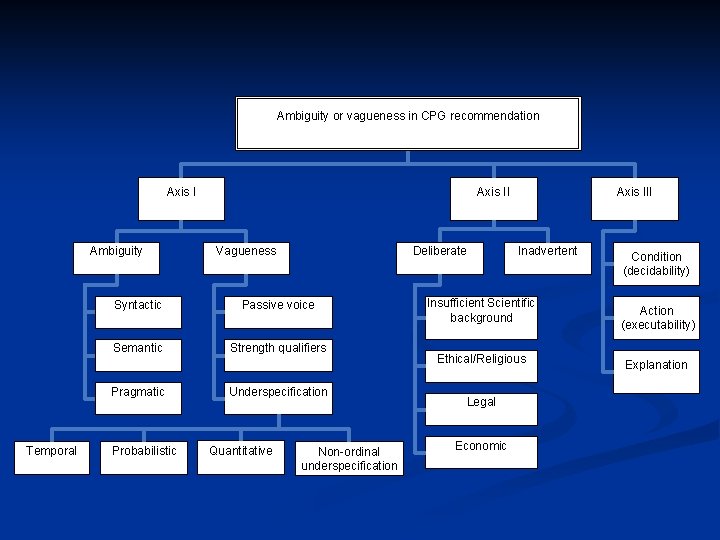
Ambiguity or vagueness in CPG recommendation Axis I Ambiguity Vagueness Deliberate Syntactic Passive voice Semantic Strength qualifiers Pragmatic Temporal Axis II Probabilistic Underspecification Quantitative Non-ordinal underspecification Axis III Inadvertent Insufficient Scientific background Ethical/Religious Legal Economic Condition (decidability) Action (executability) Explanation
Overview n Introduction n Classification model n Implications for authoring and implementation
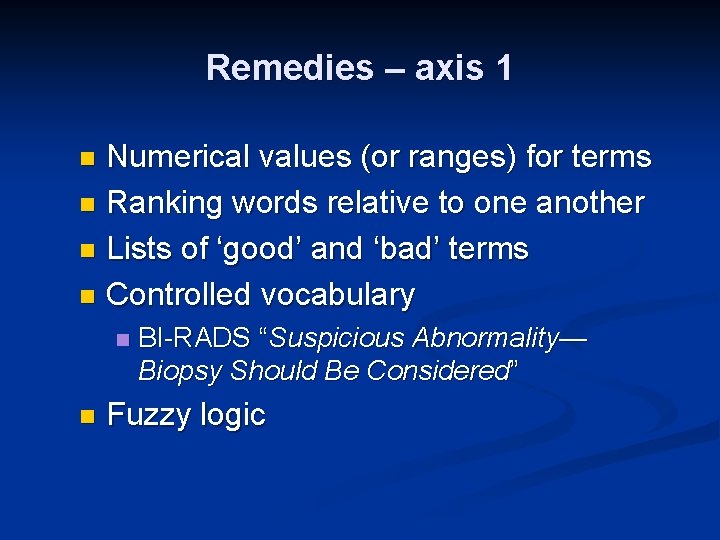
Remedies – axis 1 Numerical values (or ranges) for terms n Ranking words relative to one another n Lists of ‘good’ and ‘bad’ terms n Controlled vocabulary n n n BI-RADS “Suspicious Abnormality— Biopsy Should Be Considered” Fuzzy logic
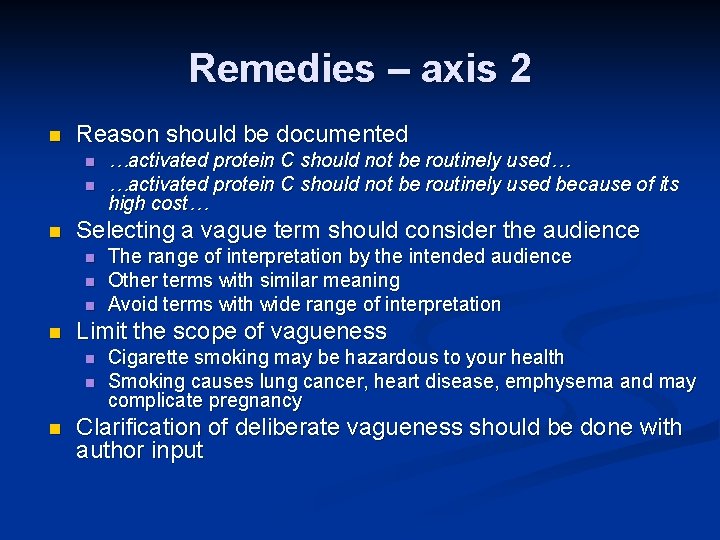
Remedies – axis 2 n Reason should be documented n n n Selecting a vague term should consider the audience n n The range of interpretation by the intended audience Other terms with similar meaning Avoid terms with wide range of interpretation Limit the scope of vagueness n n n …activated protein C should not be routinely used… …activated protein C should not be routinely used because of its high cost… Cigarette smoking may be hazardous to your health Smoking causes lung cancer, heart disease, emphysema and may complicate pregnancy Clarification of deliberate vagueness should be done with author input
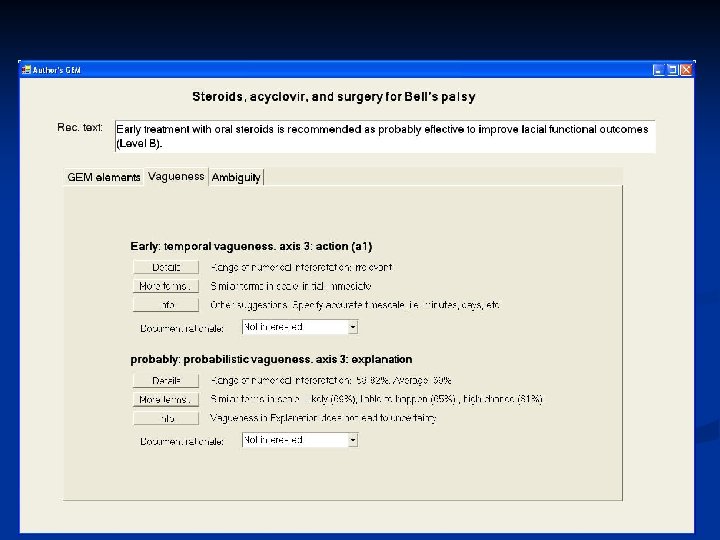
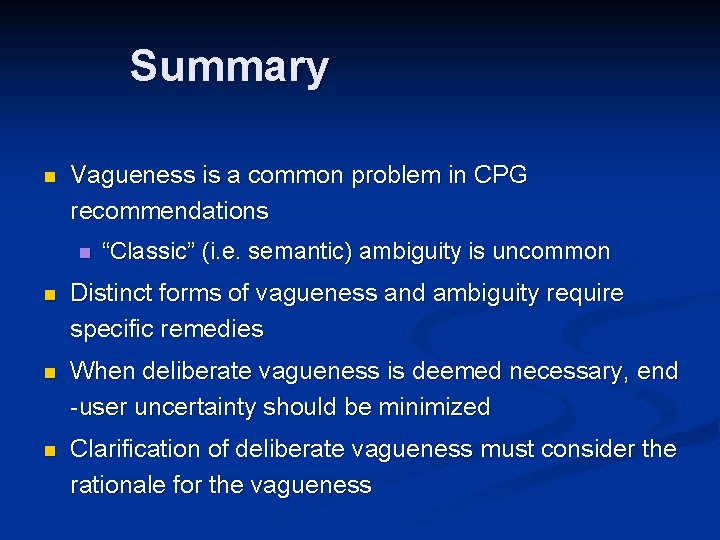
Summary n Vagueness is a common problem in CPG recommendations n “Classic” (i. e. semantic) ambiguity is uncommon n Distinct forms of vagueness and ambiguity require specific remedies n When deliberate vagueness is deemed necessary, end -user uncertainty should be minimized n Clarification of deliberate vagueness must consider the rationale for the vagueness

Everything is vague to a degree you do not realize till you have tried to make it precise. Bertrand Russell, 1918
Acknowledgements n n Prof. Laurence Horn Yale Linguistics National Library of Medicine
- Slides: 25