
ambient ROOM Integrating Ambient Media with Architectural Space
ambient. ROOM: Integrating Ambient Media with Architectural Space By Zubin Singh INF 131
This paper presents: n Presents the design of the ambient. ROOM – interface to information for processing in the background of awareness n This info. displayed through various subtle displays of light, sound, and movement.
Why do we need a ambient. Room? n most computer interfaces fail to take advantage of our background processing capabilities. n (GUI’s) demand constant foreground visual attention, as multiple information streams compete for screen space n keyboards and mice must be actively manipulated to be useful
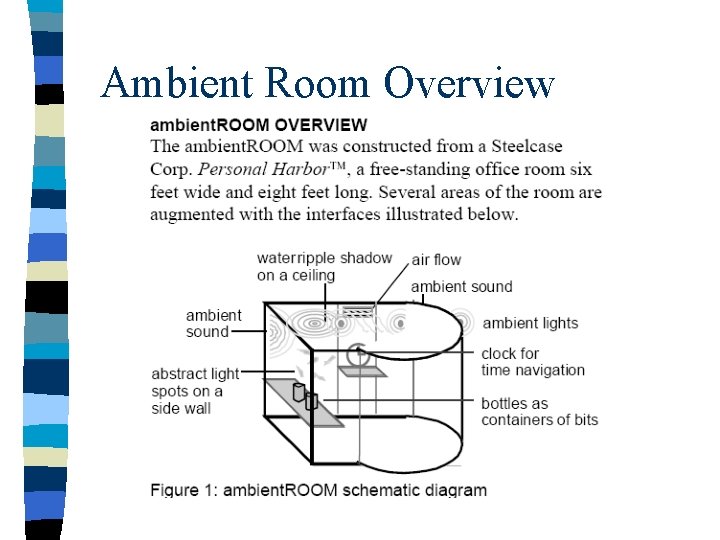
So how does an ambient room work? n An ambient room displays information through subtle cues of sound, light, or motion n Many of these “ambient media” displays are inspired by natural phenomena such as wind, sunlight, or the sounds of a rainforest
So how does an ambient room work? (contd. ) n ambient. ROOM uses graspable objects such as bottles to provide control of the ambient media n Some quick videos (start 01. 15) : – http: //youtube. com/watch? v=Ghob. Bh 30 w. TM n Dino The ambient egg – http: //youtube. com/watch? v=Av. ST 9 wjrk. C 4
Ambient Room Overview
Most interesting ambient media displays discussed n Water Ripples One display allows the user to have some awareness of the activity of a distant loved one. -Works by having a motorized “phicon” (physical icon) configured to vibrate as action is made – This action “transfers” the vibration to the motion of a solenoid in a shallow water tank. – A lamp reflecting off of the water then produces rippling shadows on the ceiling.
Most interesting ambient media displays discussed (contd. ) n Natural Soundscapes n This display explores a multi-modal approach to ambient displays, including the communication of information through sound. n The ambient. ROOM contains a subtle but audible soundtrack of birds and rainfall, whose sound volume and density are modulated in conjunction with variations in room lighting.
Most interesting graspable media controls discussed n Bottle n A small glass bottle is employed as a graspable “container” for digital content, such that uncorking the bottle “releases”information into the room. n In this case, the load on the computer network was instantiated as the sound of vehicular traffic.
Most interesting graspable media controls discussed (contd. ) n Clock n A second activity control, a large wall-mounted clock with exposed hands, allows navigation through temporal events. n The ambient. ROOM clock serves as a controller as well. n Manual rotation of the clock’s hands prompt the ambient. ROOM’s displays to shift to their former or future states. n Meanwhile, data including the actual time are projected onto the clock’s face.
The future of Ambient environments (goals) n environment would recognize individuals and some of their needs and wants, as well as changes in individuals, changes in needs and wants, and changes in the environment – Ambient intelligence is how to make technology learn about the people and their identity: habits, preferences, behavioral patterns, etc. and how to apply such knowledge in varying contexts. – Such situational awareness should be promoted simultaneously securing a sufficient degree of privacy and prevention against misuse. The more complex the systems become, the more vulnerable they are to malfunction.

Any Questions?
- Slides: 12