
AMBIENT AIR CONCENTRATION MODELING Types of Pollutant Sources
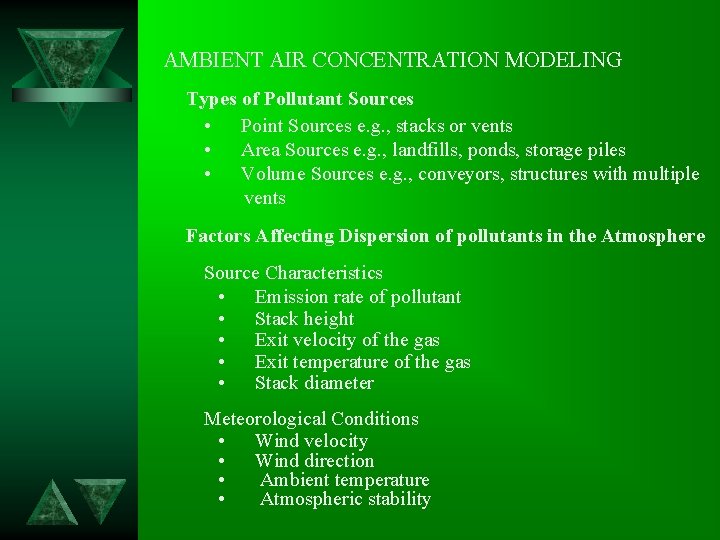
AMBIENT AIR CONCENTRATION MODELING Types of Pollutant Sources • Point Sources e. g. , stacks or vents • Area Sources e. g. , landfills, ponds, storage piles • Volume Sources e. g. , conveyors, structures with multiple vents Factors Affecting Dispersion of pollutants in the Atmosphere Source Characteristics • Emission rate of pollutant • Stack height • Exit velocity of the gas • Exit temperature of the gas • Stack diameter Meteorological Conditions • Wind velocity • Wind direction • Ambient temperature • Atmospheric stability
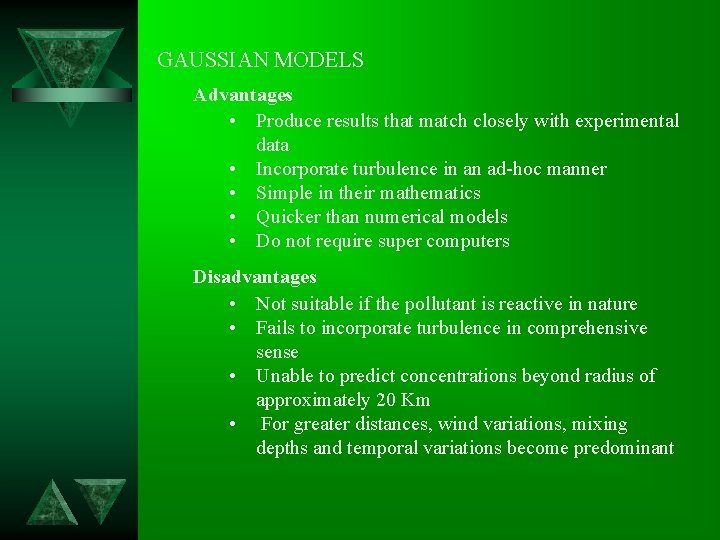
GAUSSIAN MODELS Advantages • Produce results that match closely with experimental data • Incorporate turbulence in an ad-hoc manner • Simple in their mathematics • Quicker than numerical models • Do not require super computers Disadvantages • Not suitable if the pollutant is reactive in nature • Fails to incorporate turbulence in comprehensive sense • Unable to predict concentrations beyond radius of approximately 20 Km • For greater distances, wind variations, mixing depths and temporal variations become predominant
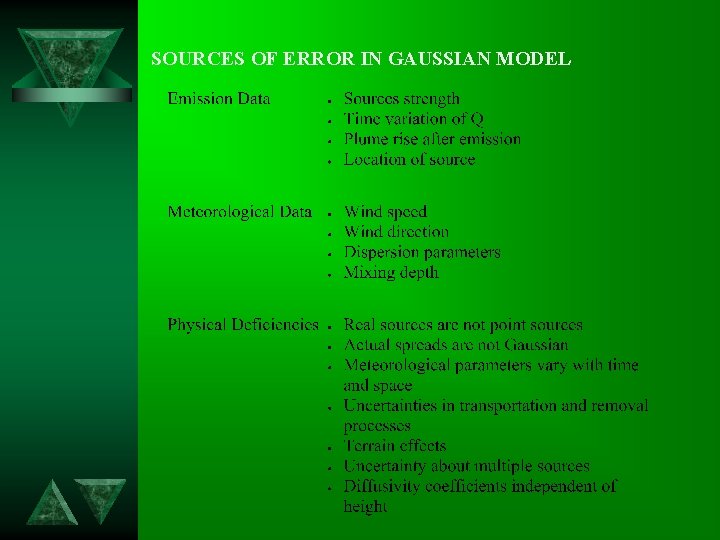
SOURCES OF ERROR IN GAUSSIAN MODEL
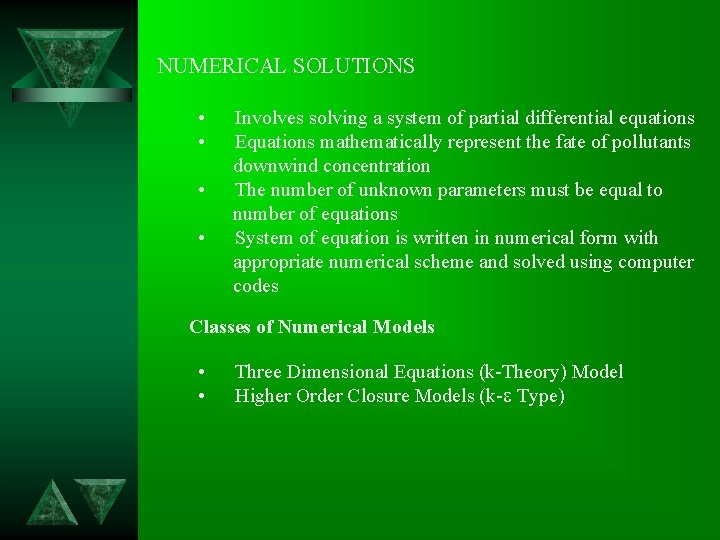
NUMERICAL SOLUTIONS • • Involves solving a system of partial differential equations Equations mathematically represent the fate of pollutants downwind concentration The number of unknown parameters must be equal to number of equations System of equation is written in numerical form with appropriate numerical scheme and solved using computer codes Classes of Numerical Models • • Three Dimensional Equations (k-Theory) Model Higher Order Closure Models (k- Type)
Difference between Numerical Models and Gaussian Model • The degree of completeness in the mathematical description of the atmospheric dispersion processes • Type of releases i. e. , stack, jet or area source are easy to handle manually • The models are designed to handle, degree of completeness in the description of non-transport processes like chemical reactions • Terrain feature complexities for which the model is designed
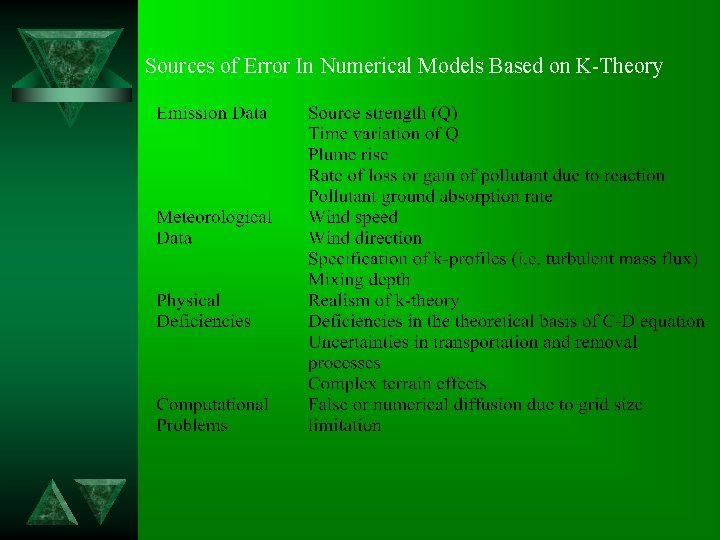
Sources of Error In Numerical Models Based on K-Theory
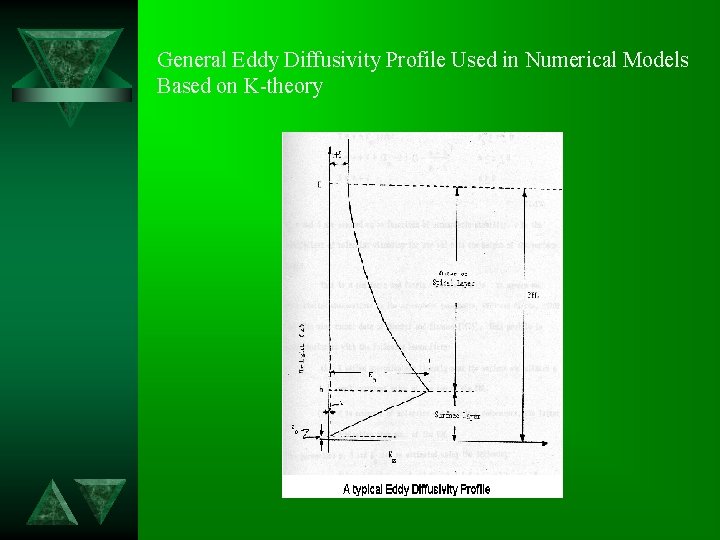
General Eddy Diffusivity Profile Used in Numerical Models Based on K-theory
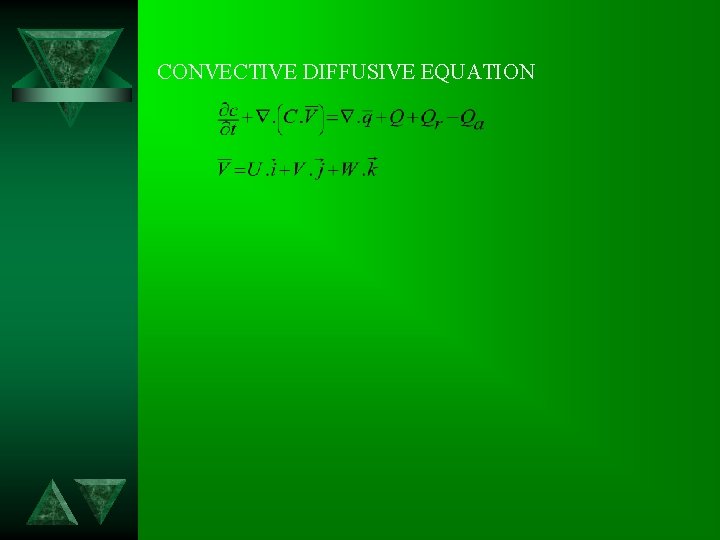
CONVECTIVE DIFFUSIVE EQUATION
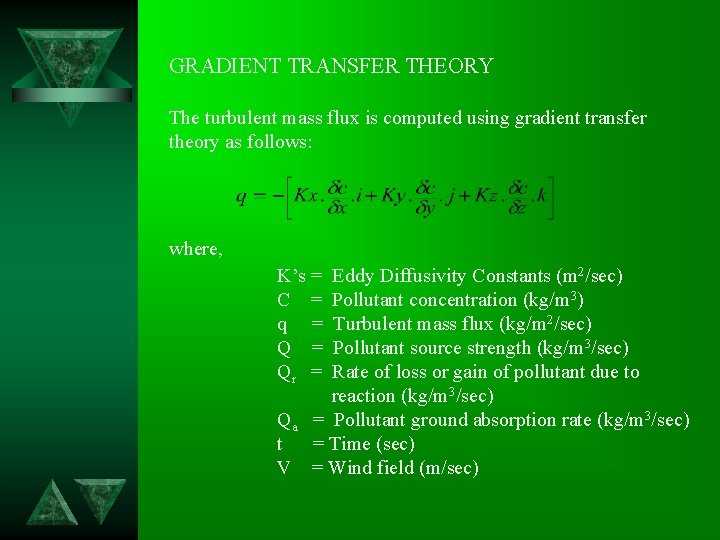
GRADIENT TRANSFER THEORY The turbulent mass flux is computed using gradient transfer theory as follows: where, K’s = C = q = Qr = Qa t V Eddy Diffusivity Constants (m 2/sec) Pollutant concentration (kg/m 3) Turbulent mass flux (kg/m 2/sec) Pollutant source strength (kg/m 3/sec) Rate of loss or gain of pollutant due to reaction (kg/m 3/sec) = Pollutant ground absorption rate (kg/m 3/sec) = Time (sec) = Wind field (m/sec)
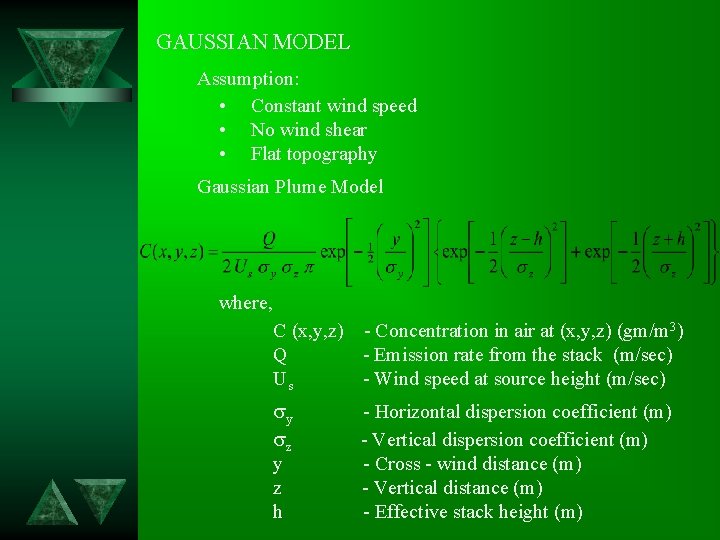
GAUSSIAN MODEL Assumption: • Constant wind speed • No wind shear • Flat topography Gaussian Plume Model where, C (x, y, z) - Concentration in air at (x, y, z) (gm/m 3) Q - Emission rate from the stack (m/sec) Us - Wind speed at source height (m/sec) sy sz y z h - Horizontal dispersion coefficient (m) - Vertical dispersion coefficient (m) - Cross - wind distance (m) - Vertical distance (m) - Effective stack height (m)
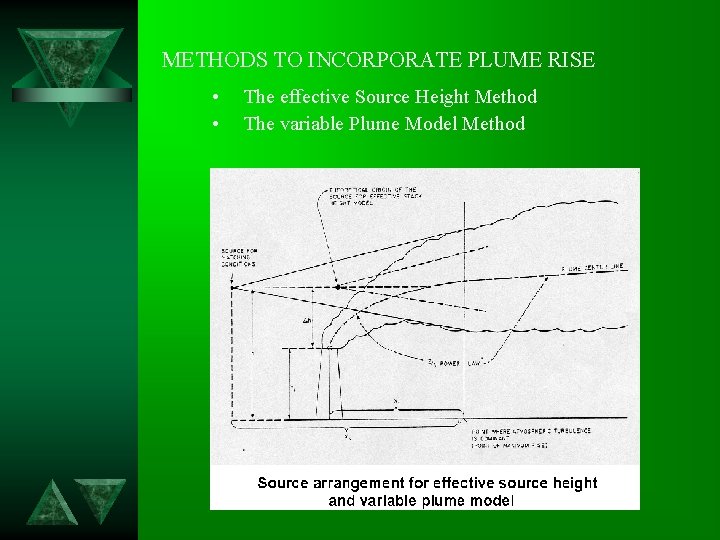
METHODS TO INCORPORATE PLUME RISE • • The effective Source Height Method The variable Plume Model Method
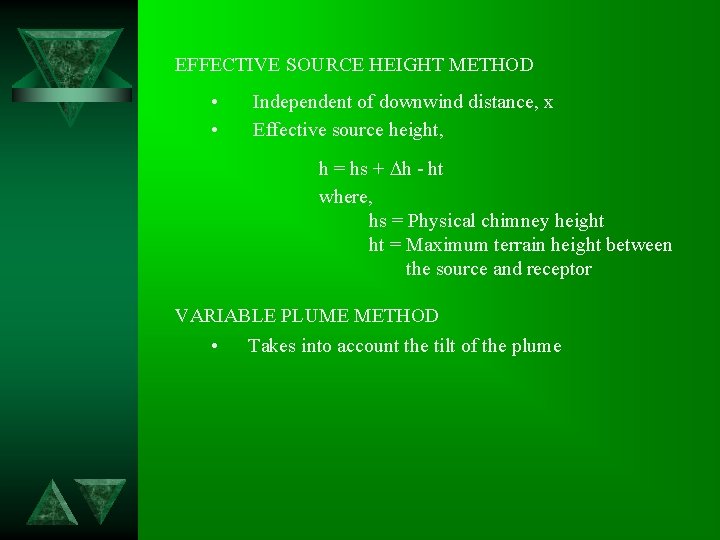
EFFECTIVE SOURCE HEIGHT METHOD • • Independent of downwind distance, x Effective source height, h = hs + Dh - ht where, hs = Physical chimney height ht = Maximum terrain height between the source and receptor VARIABLE PLUME METHOD • Takes into account the tilt of the plume
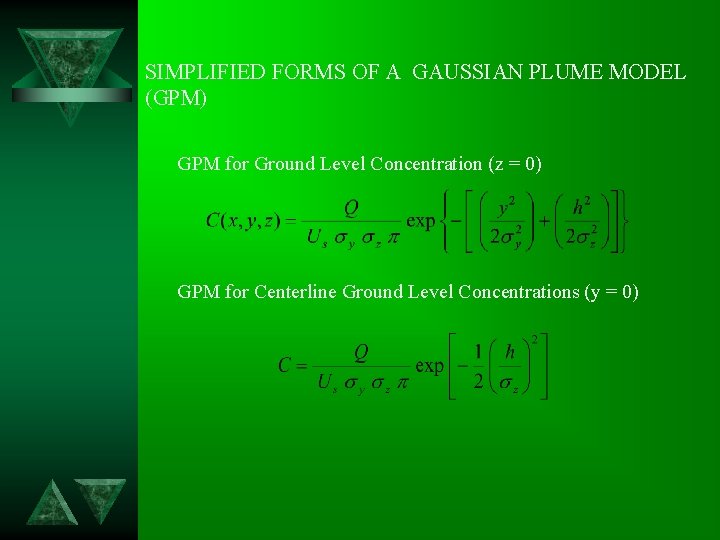
SIMPLIFIED FORMS OF A GAUSSIAN PLUME MODEL (GPM) GPM for Ground Level Concentration (z = 0) GPM for Centerline Ground Level Concentrations (y = 0)
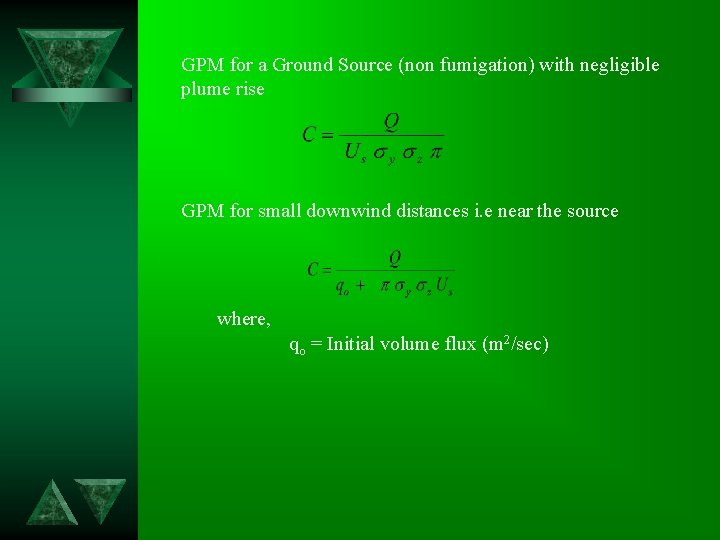
GPM for a Ground Source (non fumigation) with negligible plume rise GPM for small downwind distances i. e near the source where, qo = Initial volume flux (m 2/sec)
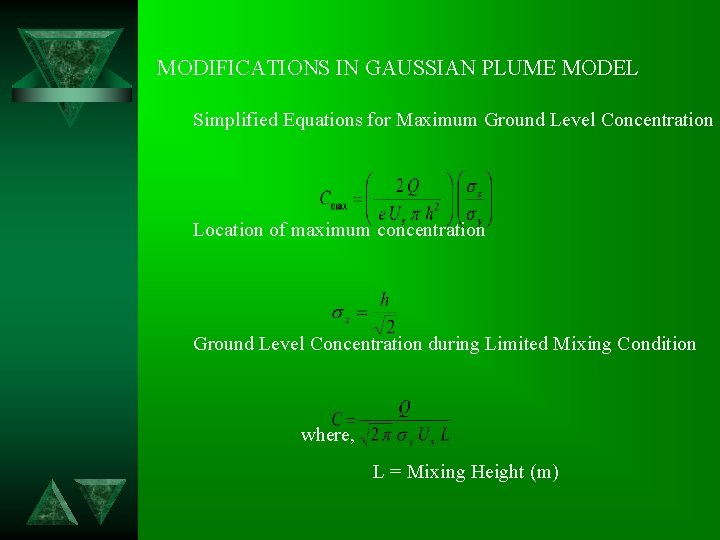
MODIFICATIONS IN GAUSSIAN PLUME MODEL Simplified Equations for Maximum Ground Level Concentration Location of maximum concentration Ground Level Concentration during Limited Mixing Condition where, L = Mixing Height (m)
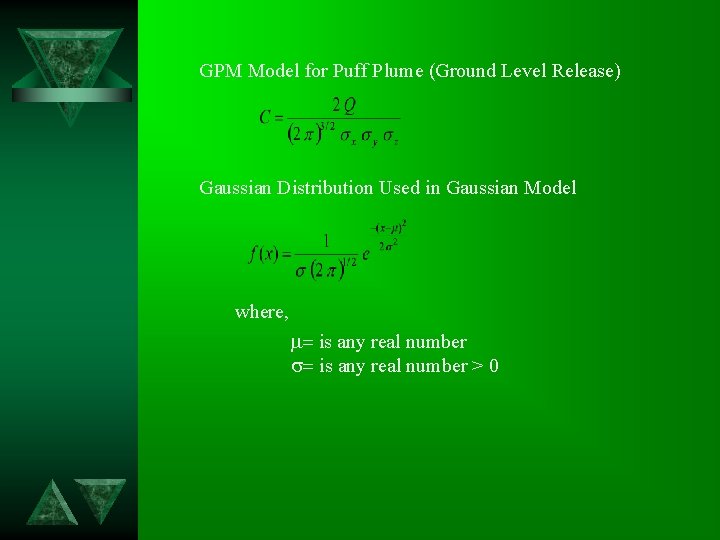
GPM Model for Puff Plume (Ground Level Release) Gaussian Distribution Used in Gaussian Model where, m= is any real number s= is any real number > 0
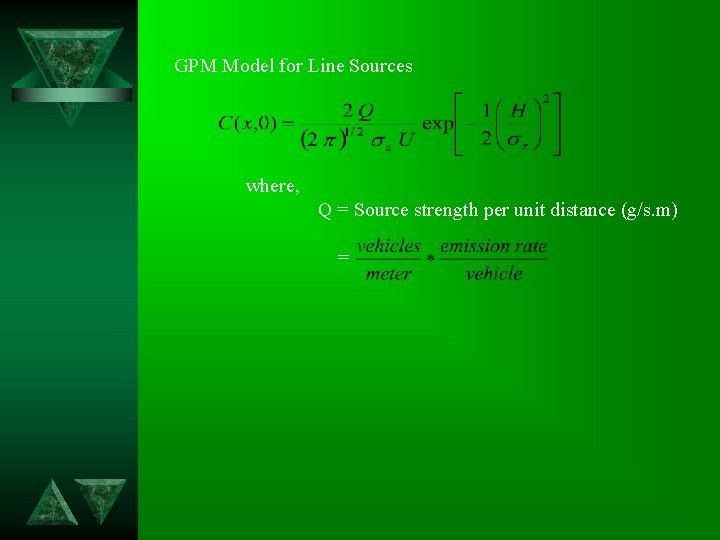
GPM Model for Line Sources where, Q = Source strength per unit distance (g/s. m) =
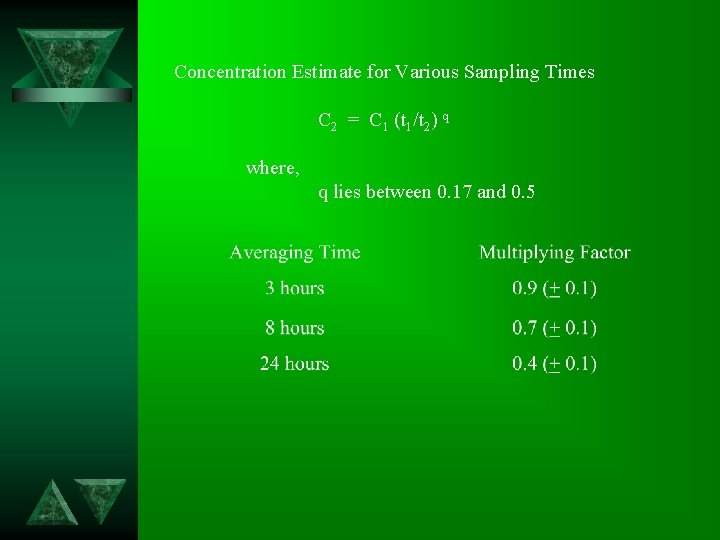
Concentration Estimate for Various Sampling Times C 2 = C 1 (t 1/t 2) q where, q lies between 0. 17 and 0. 5
PLUME DISPERSION PARAMETERS Different Methods to Calculate Sigmas • Experimental data • Modified Experimental Curves • Lagrangian Auto Correlation Function • Moment-Concentration Method • Taylor's Statistical Theory Factors Considered while Calculating Sigmas • Nature of Release • Sampling Time • Release Height • Terrain Features • Velocity Field
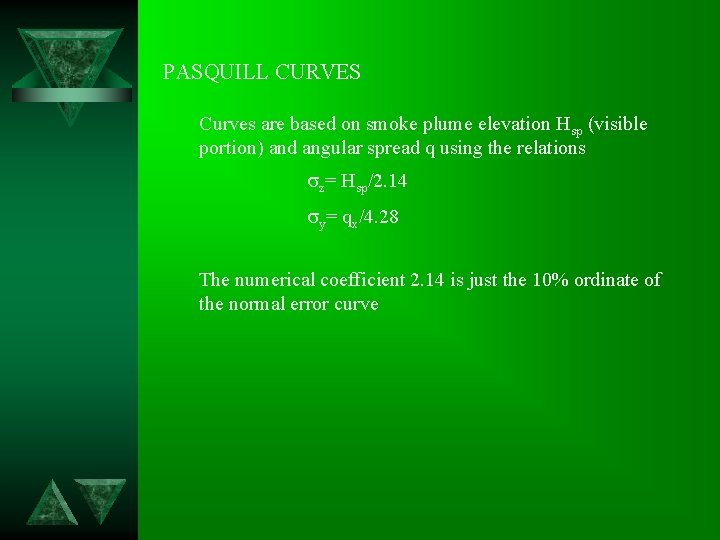
PASQUILL CURVES Curves are based on smoke plume elevation Hsp (visible portion) and angular spread q using the relations sz= Hsp/2. 14 sy= qx/4. 28 The numerical coefficient 2. 14 is just the 10% ordinate of the normal error curve
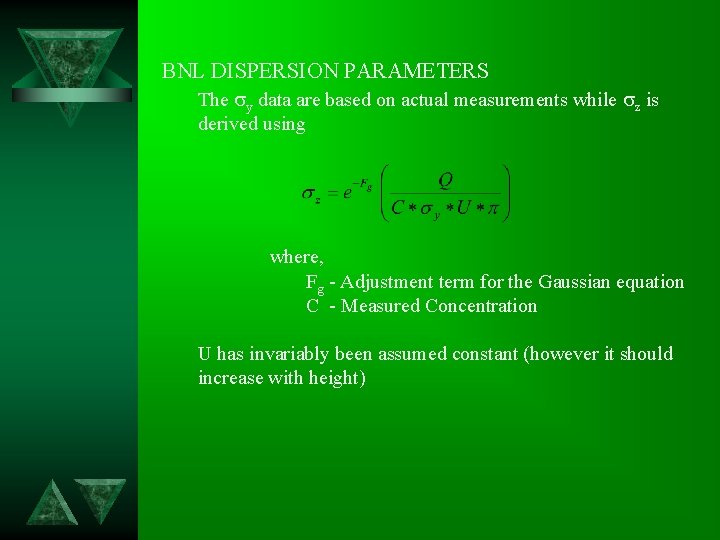
BNL DISPERSION PARAMETERS The sy data are based on actual measurements while sz is derived using where, Fg - Adjustment term for the Gaussian equation C - Measured Concentration U has invariably been assumed constant (however it should increase with height)
![TVA DISPERSION COEFFICIENTS Sigma's are calculated as: sp = Area / [Cpeak*(2*p)0. 5] where,](http://slidetodoc.com/presentation_image_h/973f13f351352b0a3cbd54a2b0b1fec9/image-22.jpg "TVA DISPERSION COEFFICIENTS Sigma's are calculated as: sp = Area / [Cpeak*(2*p)0. 5] where,")
TVA DISPERSION COEFFICIENTS Sigma's are calculated as: sp = Area / [Cpeak*(2*p)0. 5] where, Area Cpeak = Base times the average height of Concentration Profile along the axis = Maximum concentrations in that profile In a number of cases, sz is calculated using Cmax = Q / [2*U*sy*sz*p] and thus, the distribution is considered Gaussian i. e. , C = Cmax exp[-0. 5*(xg/s)2]
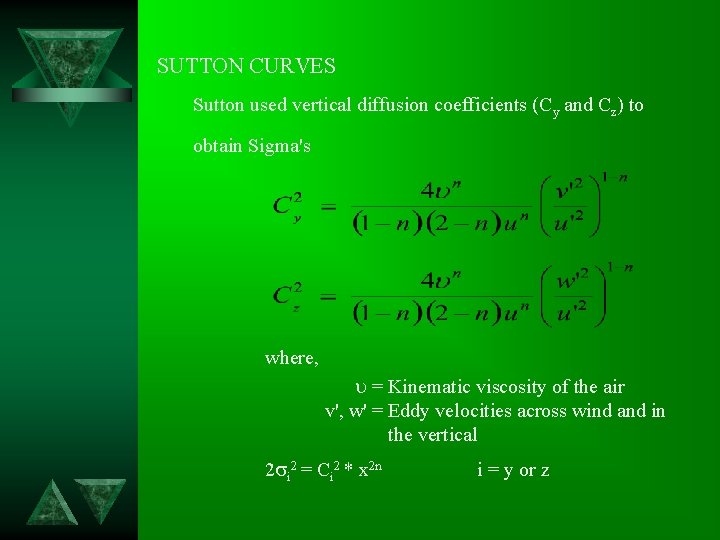
SUTTON CURVES Sutton used vertical diffusion coefficients (Cy and Cz) to obtain Sigma's where, u = Kinematic viscosity of the air v', w' = Eddy velocities across wind and in the vertical 2 si 2 = Ci 2 * x 2 n i = y or z
- Slides: 23