
Am I having Tangiers disease RESPONSIBILITY NAME MATRIC
Am I having Tangier’s disease ?
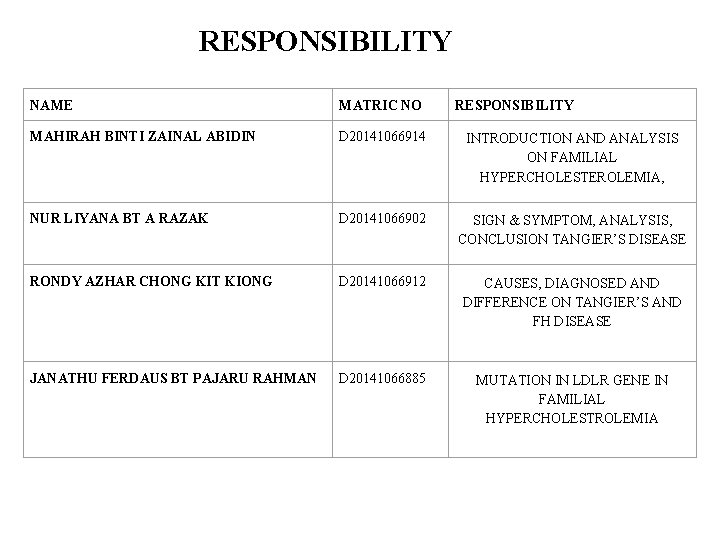
RESPONSIBILITY NAME MATRIC NO RESPONSIBILITY MAHIRAH BINTI ZAINAL ABIDIN D 20141066914 INTRODUCTION AND ANALYSIS ON FAMILIAL HYPERCHOLESTEROLEMIA, NUR LIYANA BT A RAZAK D 20141066902 SIGN & SYMPTOM, ANALYSIS, CONCLUSION TANGIER’S DISEASE RONDY AZHAR CHONG KIT KIONG D 20141066912 CAUSES, DIAGNOSED AND DIFFERENCE ON TANGIER’S AND FH DISEASE JANATHU FERDAUS BT PAJARU RAHMAN D 20141066885 MUTATION IN LDLR GENE IN FAMILIAL HYPERCHOLESTROLEMIA
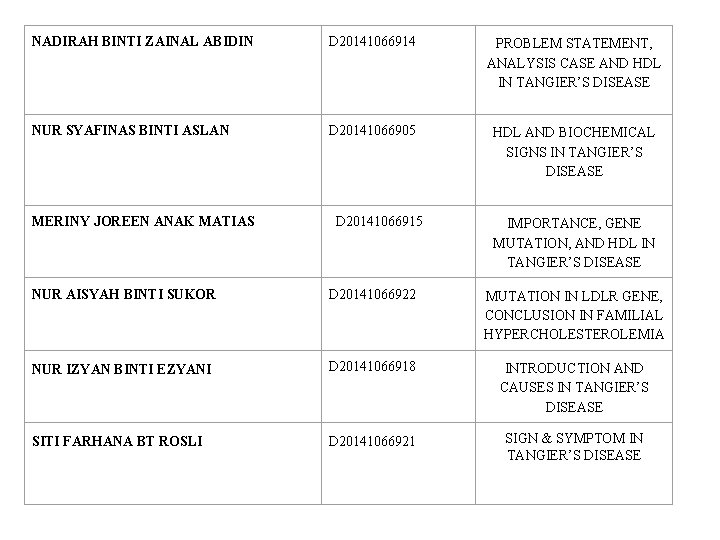
NADIRAH BINTI ZAINAL ABIDIN D 20141066914 PROBLEM STATEMENT, ANALYSIS CASE AND HDL IN TANGIER’S DISEASE NUR SYAFINAS BINTI ASLAN D 20141066905 HDL AND BIOCHEMICAL SIGNS IN TANGIER’S DISEASE MERINY JOREEN ANAK MATIAS D 20141066915 IMPORTANCE, GENE MUTATION, AND HDL IN TANGIER’S DISEASE NUR AISYAH BINTI SUKOR D 20141066922 MUTATION IN LDLR GENE, CONCLUSION IN FAMILIAL HYPERCHOLESTEROLEMIA NUR IZYAN BINTI EZYANI D 20141066918 INTRODUCTION AND CAUSES IN TANGIER’S DISEASE SITI FARHANA BT ROSLI D 20141066921 SIGN & SYMPTOM IN TANGIER’S DISEASE
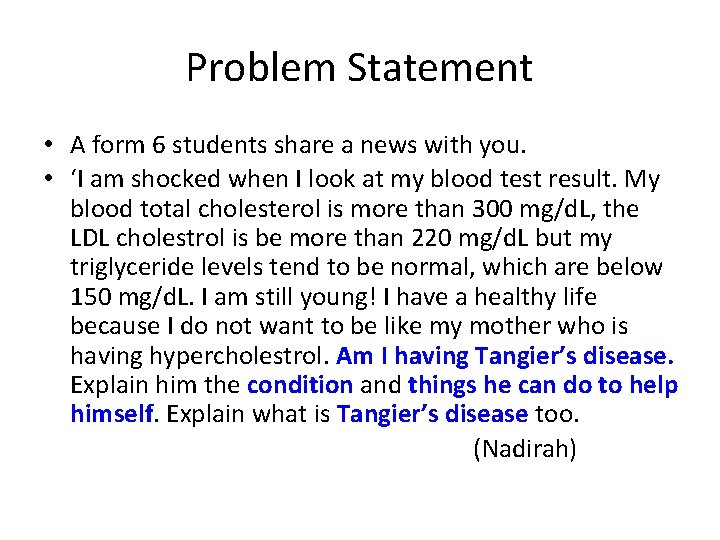
Problem Statement • A form 6 students share a news with you. • ‘I am shocked when I look at my blood test result. My blood total cholesterol is more than 300 mg/d. L, the LDL cholestrol is be more than 220 mg/d. L but my triglyceride levels tend to be normal, which are below 150 mg/d. L. I am still young! I have a healthy life because I do not want to be like my mother who is having hypercholestrol. Am I having Tangier’s disease. Explain him the condition and things he can do to help himself. Explain what is Tangier’s disease too. (Nadirah)
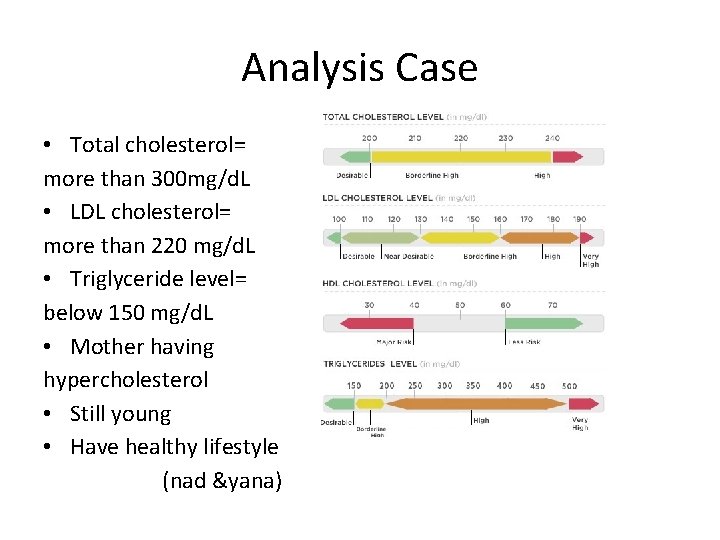
Analysis Case • Total cholesterol= more than 300 mg/d. L • LDL cholesterol= more than 220 mg/d. L • Triglyceride level= below 150 mg/d. L • Mother having hypercholesterol • Still young • Have healthy lifestyle (nad &yana)

FOCUS 1. What is Tangier’s disease ? 2. Why blood cholesterol is higher in familial hypercholesterolemia ? (yan&nad)

Focus 1 : What is Tangier’s disease ? - Autosomal recessive genetic disorder which is the condition of almost completely absence of HDL (high density level) that functioning as attaching with cholesterol in order for breaking down at liver. izyan

WHAT CAUSES TANGIER DISEASE? • Tangier disease due to mutation in ABCA 1 gene which official name is “ATP binding cassette subfamily A member 1. ”, which provides instructions for making proteins that transport molecules across cell membrane. izyan
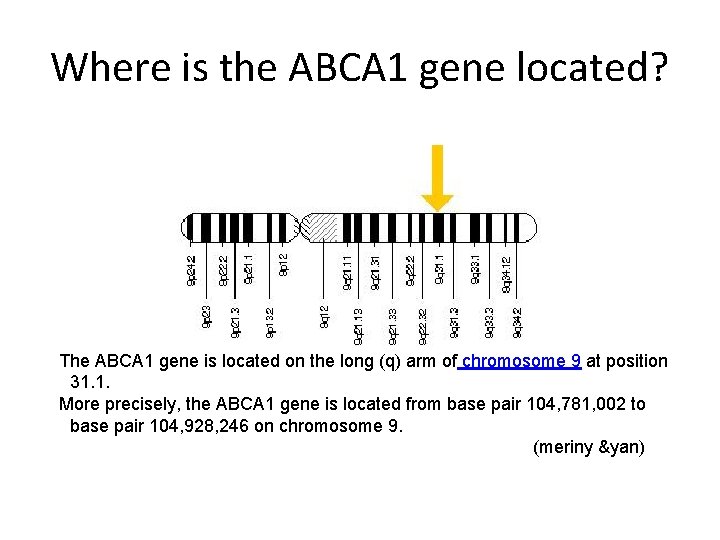
Where is the ABCA 1 gene located? The ABCA 1 gene is located on the long (q) arm of chromosome 9 at position 31. 1. More precisely, the ABCA 1 gene is located from base pair 104, 781, 002 to base pair 104, 928, 246 on chromosome 9. (meriny &yan)
What is the importance of ABCA 1 gene? • ABCA 1 gene provides instructions making proteins that transport molecules across membranes. • The ABCA 1 protein is produced in many tissues, with high amounts found in the liver and in immune system cells called macrophages. • This protein moves cholesterol and certain fats called phospholipids across the cell membrane to the outside of the cell. • These substances then picked up by a protein called apolipoprotein and combine to make high-density lipoprotein (HDL). meriny
● HDL= often referred to as “good cholesterol” because high levels of this substance reduce the chances of developing heart and blood vessel disease. ● HDL is a molecule that carries cholesterol and phospholipids through the bloodstream from the body’s tissues to the liver. ● The process of removing excess cholesterol from cells is extremely important for balancing cholesterol levels and maintaining cardiovascular health. meriny
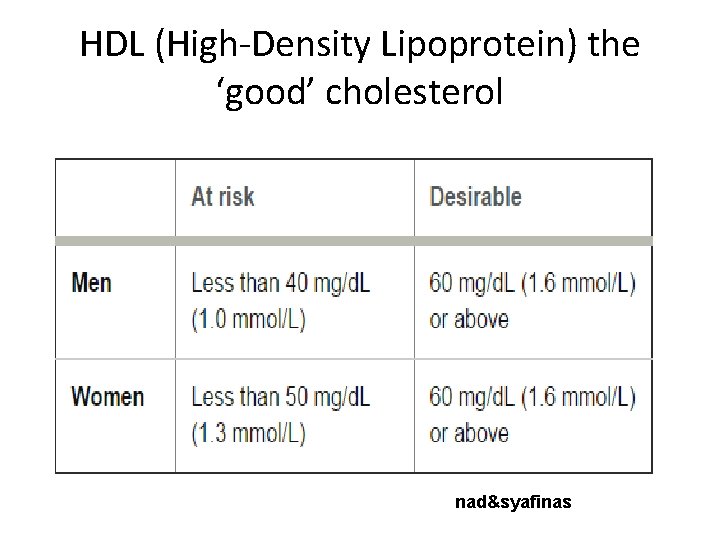
HDL (High-Density Lipoprotein) the ‘good’ cholesterol nad&syafinas

Biochemical signs of Tangier Disease • HDL concentrations= less than 5 mg/d. L • Low total cholesterol= below 150 mg/d. L • Normal or high triglycerides= more than or equal to 150 mg/d. L meriny&syafinas

Sign and Symptom of Tangier Disease ●Risk of cardiovascular disease ●Slightly elevated amount of fat in the blood ●Disturbance in nerve function ●Enlarged body ●Orange-colored tonsils ●Often develop atherosclerosis that is accumulation of fatty deposits and scar-like tissue in the lining of the arteries ● Enlarged spleen ● Enlarged liver ● Corneal clouding ● Type 2 diabetes liyana &farhana
How to boost up the HDL level • Exercise (can help pump up HDL ) • Quit smoking • Healthy weight ( avoid obesity ) medications • Niacin-to increase HDL cholesterol and have least side effects. • Fibrates- medications fenofibrate and gemfibrozil can help increase HDL cholesterol level • Statins-block a substance liver needs to make cholesterol and this will reduces cholesterol in liver cells which causes liver to remove cholesterol from blood. liyana &nad
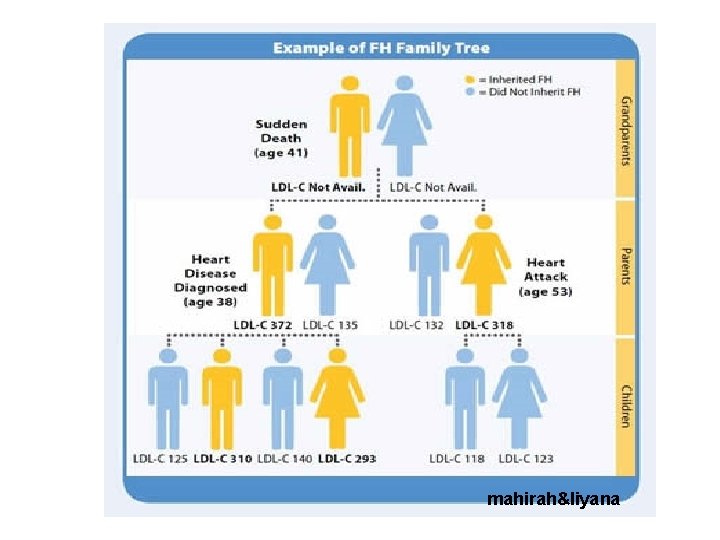
FOCUS 2 : Why blood cholesterol is higher in familial hypercholesterolemia ? - Alteration of gene on chromosome number 19 containing information of protein, LDL receptor responsible to clear up LDL cholesterol • The defect makes the body unable to remove low density lipoprotein (LDL, or "bad") cholesterol from the blood. The condition is typically passed down through families in an autosomal dominant manner which means only inherit abnormal gene from one parent will get this. (mahirah)
What is hypercholesterolemia ? • Hypercholesterolemia is a condition characterized by very high levels of cholesterol in the blood • People with hypercholesterolemia have a high risk of developing a form of heart disease called coronary artery disease. • This condition occurs when excess cholesterol in the bloodstream is deposited in the walls of blood vessels, particularly in the arteries that supply blood to the heart (coronary arteries) • The abnormal buildup of cholesterol forms clumps (plaque) that narrow and harden artery walls. As the clumps get bigger, they can clog the arteries and restrict the flow of blood to the heart (mahirah)
mahirah&liyana
Other problems ? • health problems related to the buildup of excess cholesterol in other tissue • If cholesterol accumulates in tendons, it causes characteristic growths called tendon xanthomas • Yellowish cholesterol deposits under the skin of the eyelids are known as xanthelasmata (Janathu)
What are genes affecting them ? 1. APOB, 2. LDLR, 3. LDLRAP 1, 4. PCSK 9 (Janathu)
Talking about LDLRAP 1 gene. . • When hypercholesterolemia is caused by mutations in the LDLRAP 1(Low-density lipoprotein receptor adapter protein 1) gene, • the condition is inherited in an autosomal recessive pattern. • Autosomal recessive inheritance means the condition results from two altered copies of the gene in each cell. The parents of an individual with autosomal recessive hypercholesterolemia each carry one copy of the altered gene, but their blood cholesterol levels are usually in the normal range. (janathu)
Mutations in the LDLR gene Those who suffers familial hypercholestrolemia have mutations in the LDLR gene that encodes the LDL receptor protein, which normally removes LDL from circulation. Some of these genetic changes reduce the number of low-density lipoprotein receptors produced within cells. Other mutations disrupt the receptor’s ability to remove low-density lipoproteins from the blood. aisyahsukor
"Autosomal" means that the gene in question is located on one of the numbered, or non-sex, chromosomes. "Dominant" means that a single copy of the diseaseassociated mutation is enough to cause the disease. aisyahsukor
Sign and symptom • Hereditary. It can be from heterozygous parent but if homozygous parent, it’s the worst. • Heart disease at young age • Angina from heart disease • Xanthomas (fatty skin deposits) on the elbows, buttocks, knees, and tendons • Cholesterol deposits around the eyelids, also known as xanthelasmas • Cholesterol deposits around the corneas, also known as corneal arcus (yana&ron)
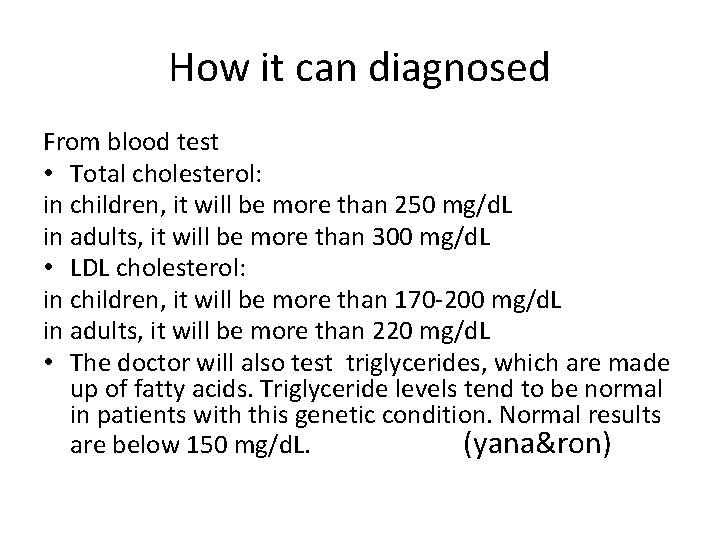
How it can diagnosed From blood test • Total cholesterol: in children, it will be more than 250 mg/d. L in adults, it will be more than 300 mg/d. L • LDL cholesterol: in children, it will be more than 170 -200 mg/d. L in adults, it will be more than 220 mg/d. L • The doctor will also test triglycerides, which are made up of fatty acids. Triglyceride levels tend to be normal in patients with this genetic condition. Normal results are below 150 mg/d. L. (yana&ron)
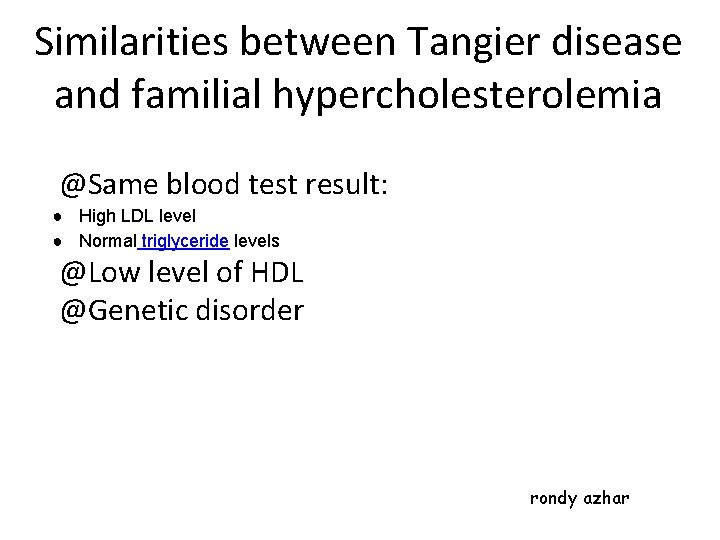
Similarities between Tangier disease and familial hypercholesterolemia @Same blood test result: ● High LDL level ● Normal triglyceride levels @Low level of HDL @Genetic disorder rondy azhar
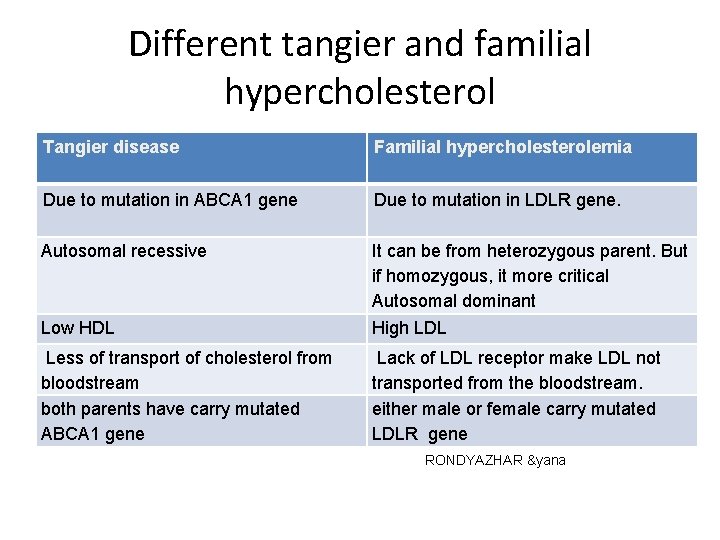
Different tangier and familial hypercholesterol Tangier disease Familial hypercholesterolemia Due to mutation in ABCA 1 gene Due to mutation in LDLR gene. Autosomal recessive It can be from heterozygous parent. But if homozygous, it more critical Autosomal dominant Low HDL High LDL Less of transport of cholesterol from bloodstream both parents have carry mutated ABCA 1 gene Lack of LDL receptor make LDL not transported from the bloodstream. either male or female carry mutated LDLR gene RONDYAZHAR &yana
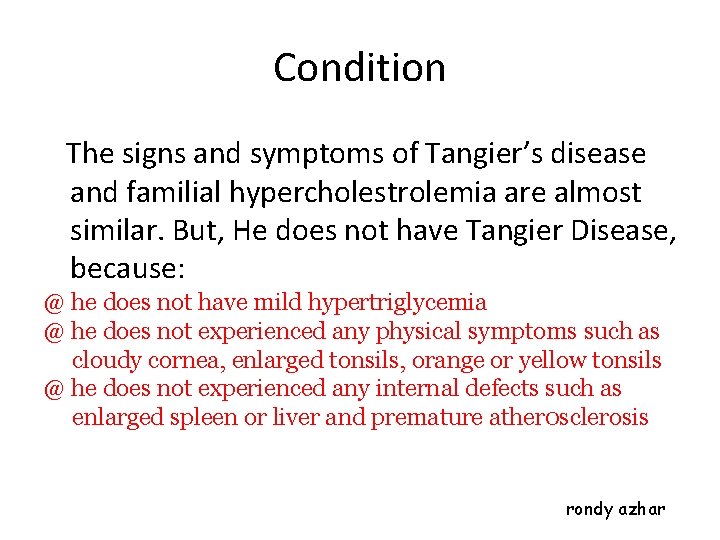
Condition The signs and symptoms of Tangier’s disease and familial hypercholestrolemia are almost similar. But, He does not have Tangier Disease, because: @ he does not have mild hypertriglycemia @ he does not experienced any physical symptoms such as cloudy cornea, enlarged tonsils, orange or yellow tonsils @ he does not experienced any internal defects such as enlarged spleen or liver and premature ather 0 sclerosis rondy azhar
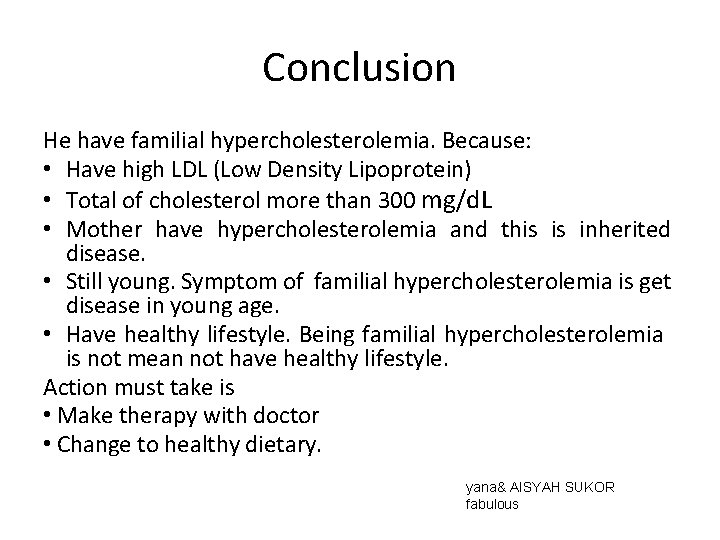
Conclusion He have familial hypercholesterolemia. Because: • Have high LDL (Low Density Lipoprotein) • Total of cholesterol more than 300 mg/d. L • Mother have hypercholesterolemia and this is inherited disease. • Still young. Symptom of familial hypercholesterolemia is get disease in young age. • Have healthy lifestyle. Being familial hypercholesterolemia is not mean not have healthy lifestyle. Action must take is • Make therapy with doctor • Change to healthy dietary. yana& AISYAH SUKOR fabulous
- Slides: 30