
Alwyn Rehabilitation Hospital Safe Use of Chemicals Training

Alwyn Rehabilitation Hospital Safe Use of Chemicals Training Module
Handling Cleaning Chemicals Safely in the Workplace We all use cleaning chemicals, both at work and at home. To be able to use chemicals safely we need to understand the potential risks, where to find information, and then be able to use this information in our everyday practices. For the sake of both ours and our colleague’s health, we need to take chemical safety seriously.
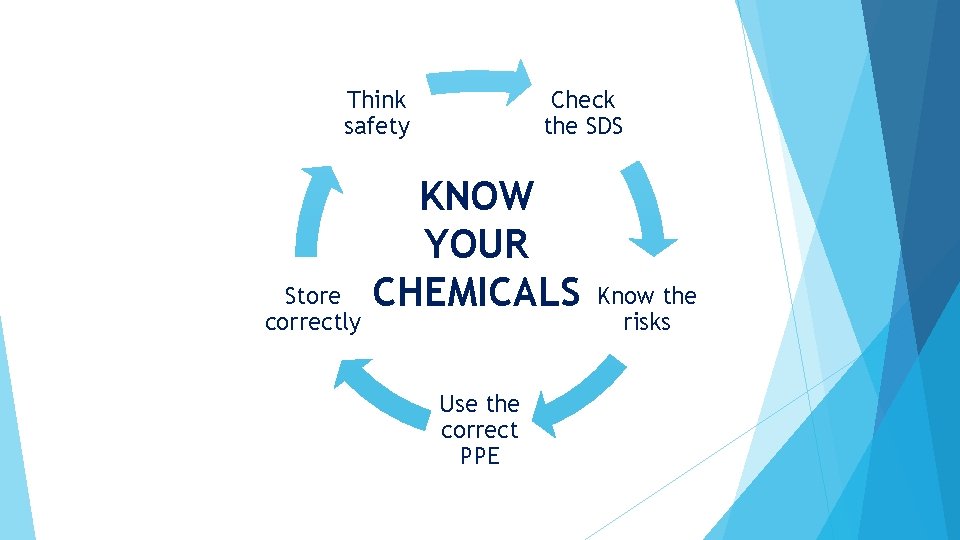
Think safety Store correctly Check the SDS KNOW YOUR CHEMICALS Use the correct PPE Know the risks
ABOUT THIS LEARNING MODULE By the end of this module you should have a basic understanding of the potential hazards connected to using chemicals. You should also know where to find safety information for each of the chemicals you use. Key sources of information that will be referred to are safety data sheets, commonly known as SDS’s.
RESPONSIBILITES Who is responsible for safety? WE ALL ARE! Each individual has a responsibility to create and maintain a safe working environment. Why is it so important? Because the part you play helps to keep YOU and OTHERS safe!
EMPLOYER RESPONSIBILITES While we are all responsible for safety, employers have some specific legal responsibilities. All employers must: Identify chemicals which are hazardous Ensure all safety data sheets (SDS’s) are on hand for all employees Ensure all products and containers are correctly labelled Conduct risk assessments Minimise any risks identified Consult with employees and provide safety training
HOW COULD CHEMICALS AFFECT YOUR HEALTH? There are three categories that we will examine today. Depending on the chemical, they can be classified as: TOXIC With toxic substances there is a likely risk of seriously damaging your health with continuous exposure above the recommended limits. Exposure can be via ingestion, contact with the skin or through inhalation. IRRITANTS Some chemicals are irritants and may result in skin inflammation, eye irritation, serious eye effects, and irritation of respiratory system. CORROSIVE Common chemicals that are classified as corrosive include dish-washing powders. Corrosive chemicals can burn the skin, eyes and other living tissue.
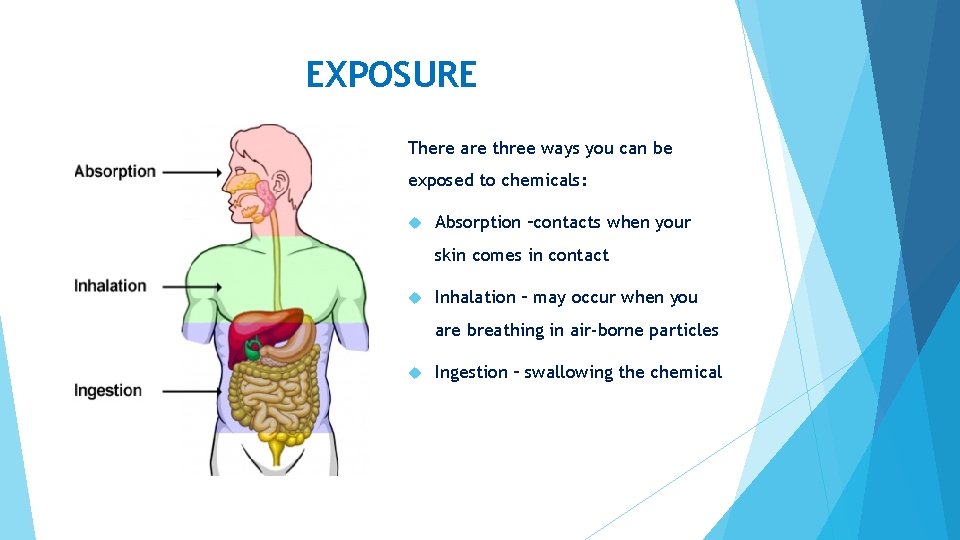
EXPOSURE There are three ways you can be exposed to chemicals: Absorption –contacts when your skin comes in contact Inhalation – may occur when you are breathing in air-borne particles Ingestion – swallowing the chemical
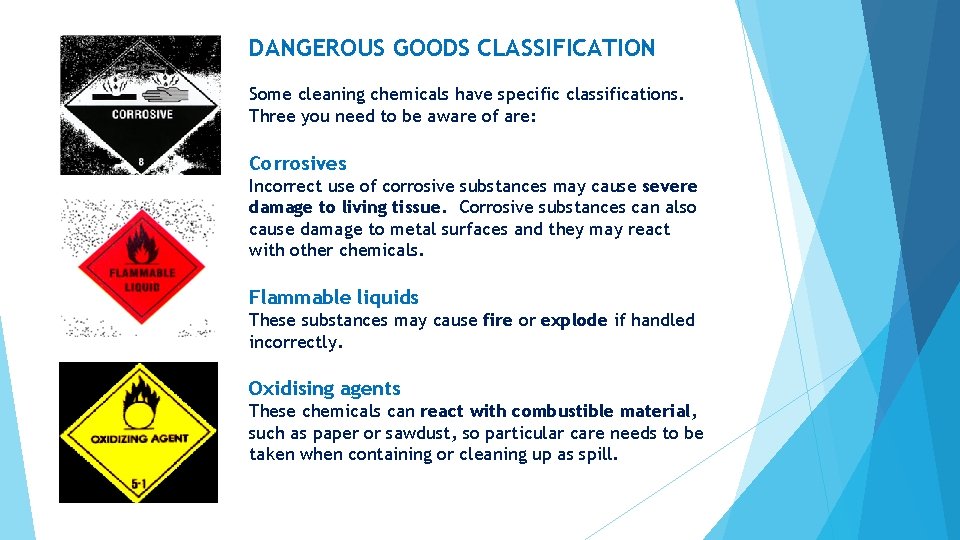
DANGEROUS GOODS CLASSIFICATION Some cleaning chemicals have specific classifications. Three you need to be aware of are: Corrosives Incorrect use of corrosive substances may cause severe damage to living tissue. Corrosive substances can also cause damage to metal surfaces and they may react with other chemicals. Flammable liquids These substances may cause fire or explode if handled incorrectly. Oxidising agents These chemicals can react with combustible material, such as paper or sawdust, so particular care needs to be taken when containing or cleaning up as spill.
IDENTIFYING RISKS Now that you know about some of the potential risks, where do you go to find out about risks for the product/s you are using? Manufacturer’s Labels These labels give you all the basic information you require. You should always read the label before using a product. NEVER remove the label. If you cannot find or read a label, or suspect it is incorrect, tell your manager and DO NOT use the contents. Safety Data Sheets (SDS) An SDS will give you very detailed information. They contain information necessary to use and store chemical products safely as well as cleaning up spills and first aid treatment for exposure. You should always read the SDS to familiarise yourself before using a product. Ask your Manager If you have more questions, or suspect anything is amiss, you should ask your manager. You should never use a product you are not sure about.

MANUFACTURER’S LABELS Labels contain important information about the product. These include: The product’s trade name The manufacturer’s contact details A list of any hazardous ingredients The possible harmful effects. Look for key words such as “hazardous”, any risk/hazard phrases and dangerous goods labels or diamonds. Safe usage directions Basic first aid information Basic emergency information

Safety Data Sheets or SDS An SDS contains additional information that you need to familiarise yourself with before using a product. An SDS has more detail than a label, and includes information such as: Product identification The ingredients and properties ofthe product Known potential health and physical hazards First aid and emergency actions Precautions you need to take when handling the product Correct storage, clean up and disposal
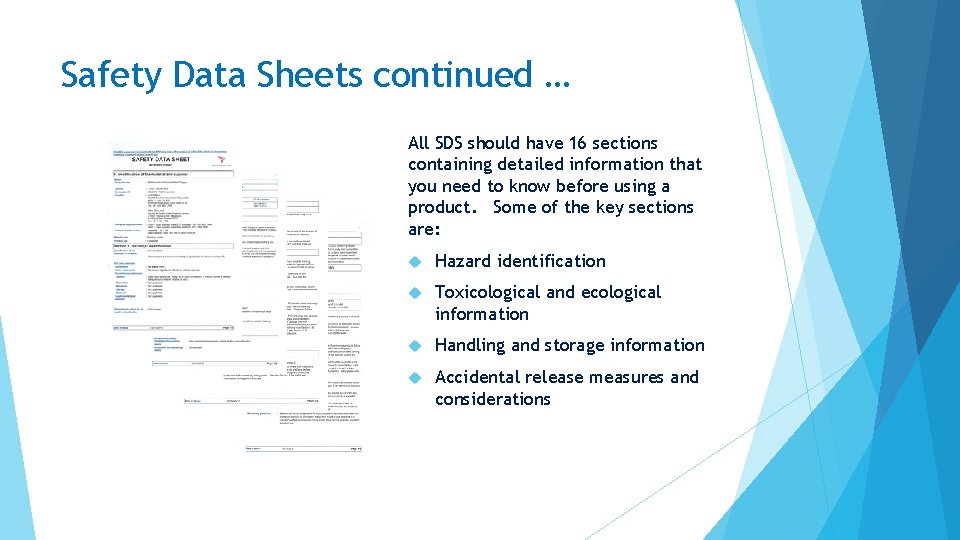
Safety Data Sheets continued … All SDS should have 16 sections containing detailed information that you need to know before using a product. Some of the key sections are: Hazard identification Toxicological and ecological information Handling and storage information Accidental release measures and considerations
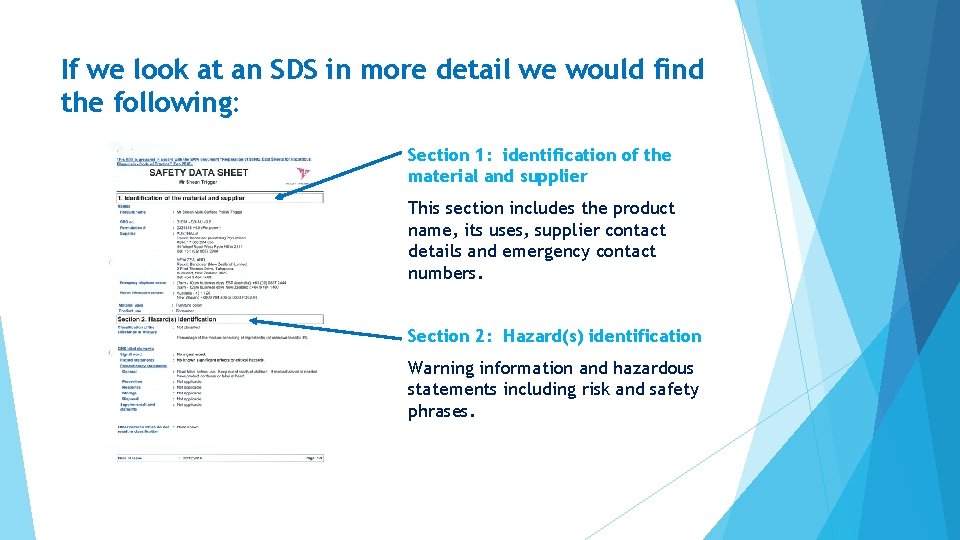
If we look at an SDS in more detail we would find the following: Section 1: identification of the material and supplier This section includes the product name, its uses, supplier contact details and emergency contact numbers. Section 2: Hazard(s) identification Warning information and hazardous statements including risk and safety phrases.
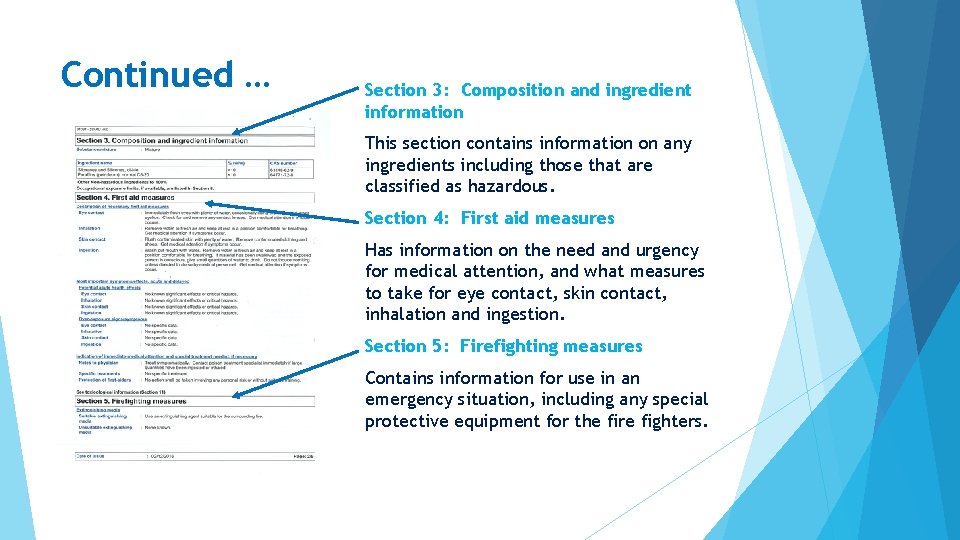
Continued … Section 3: Composition and ingredient information This section contains information on any ingredients including those that are classified as hazardous. Section 4: First aid measures Has information on the need and urgency for medical attention, and what measures to take for eye contact, skin contact, inhalation and ingestion. Section 5: Firefighting measures Contains information for use in an emergency situation, including any special protective equipment for the fire fighters.
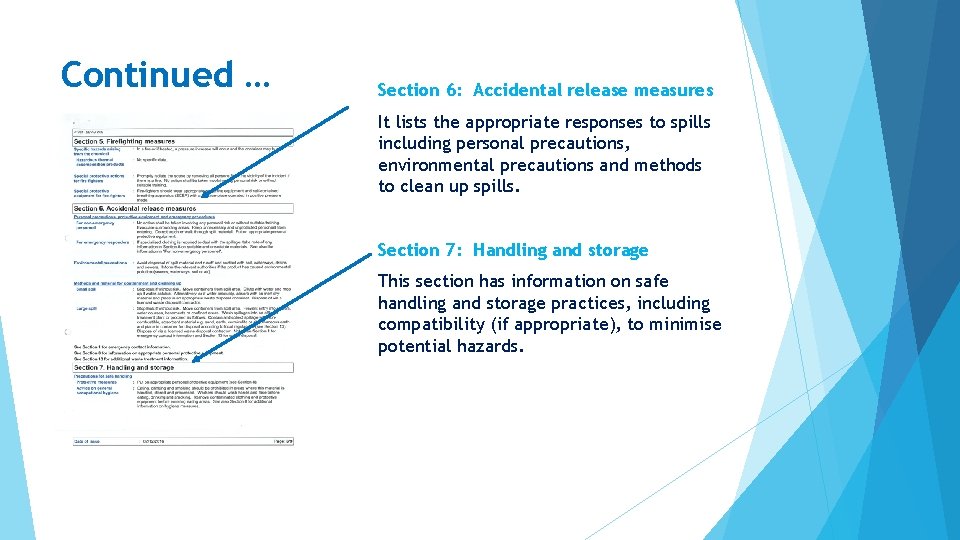
Continued … Section 6: Accidental release measures It lists the appropriate responses to spills including personal precautions, environmental precautions and methods to clean up spills. Section 7: Handling and storage This section has information on safe handling and storage practices, including compatibility (if appropriate), to minimise potential hazards.
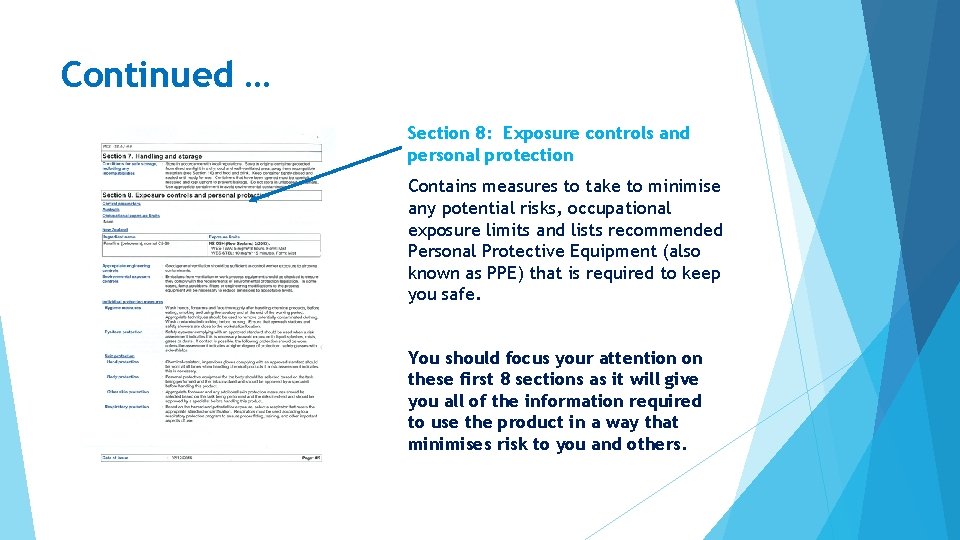
Continued … Section 8: Exposure controls and personal protection Contains measures to take to minimise any potential risks, occupational exposure limits and lists recommended Personal Protective Equipment (also known as PPE) that is required to keep you safe. You should focus your attention on these first 8 sections as it will give you all of the information required to use the product in a way that minimises risk to you and others.
Continued … The remaining sections are primarily for emergency services. Section names are included for completeness so that you may be aware of what is included: Section 9: Physical and chemical properties – lists its chemical properties Section 10: Stability and reactivity – tells you under what conditions this product is stable Section 11: Toxicological information – lists information on potential acute and chronic health effects when exposed to product. Section 12: Ecological information – lists ecological hazards Section 13: Disposal considerations – recommends safe methods of disposing of unused product and “empty containers” Section 14: Transport information – lists codes required for shipping/transport Section 15: Regulatory information – shows regulatory status of the product Section 16: Any other relevant information – lists changed information from previous SDS
Where do you find an SDS? Every product YOU use has an SDS and you should be familiar with their location. They will normally be kept close to where the product is used or stored. Please check that you have an SDS for every cleaning product you use, then review them from time to time. If you cannot find an SDS, ask your manager. There is also a central register containing copies of every SDS kept by the Business Manager.
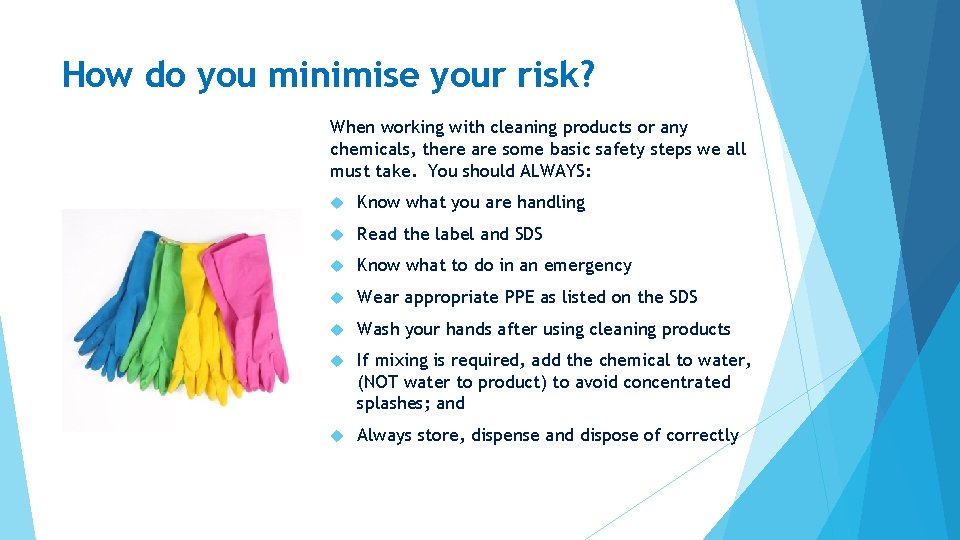
How do you minimise your risk? When working with cleaning products or any chemicals, there are some basic safety steps we all must take. You should ALWAYS: Know what you are handling Read the label and SDS Know what to do in an emergency Wear appropriate PPE as listed on the SDS Wash your hands after using cleaning products If mixing is required, add the chemical to water, (NOT water to product) to avoid concentrated splashes; and Always store, dispense and dispose of correctly

How do you minimise your risk? When working with cleaning products or any chemicals, there are some basic safety steps we all must take. You should NEVER: Use chemicals from an unlabelled container – unlabelled containers should be reported Store chemicals in an unlabelled container Store chemicals at high temperatures as it can make them unstable Never mix chemicals Inhale or ingest chemicals, eg do not sniff at chemicals to determine what it is Never allow contact with skin or eyes
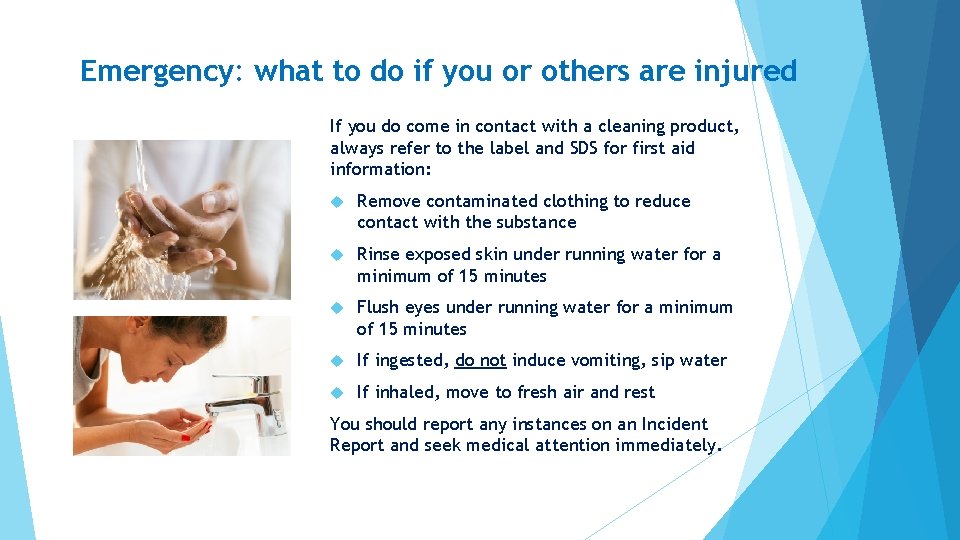
Emergency: what to do if you or others are injured If you do come in contact with a cleaning product, always refer to the label and SDS for first aid information: Remove contaminated clothing to reduce contact with the substance Rinse exposed skin under running water for a minimum of 15 minutes Flush eyes under running water for a minimum of 15 minutes If ingested, do not induce vomiting, sip water If inhaled, move to fresh air and rest You should report any instances on an Incident Report and seek medical attention immediately.
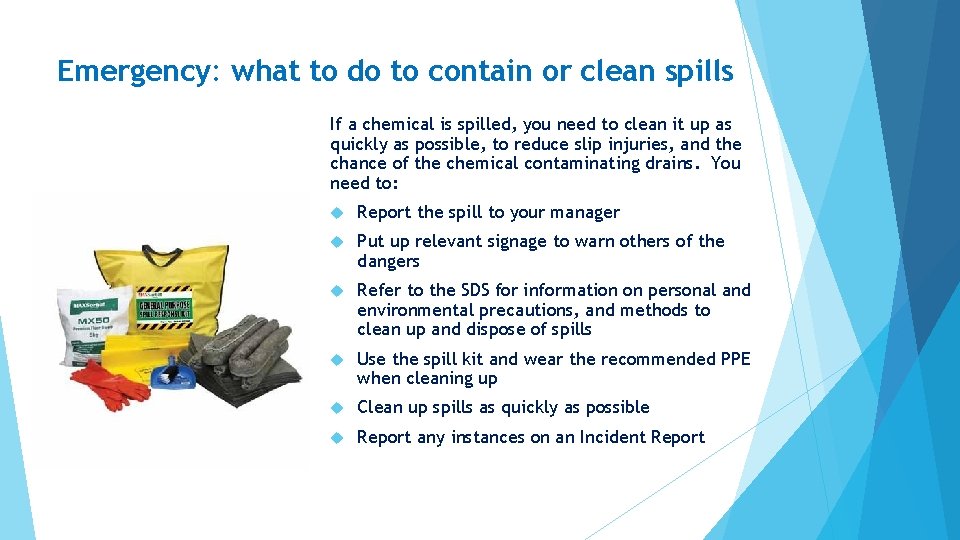
Emergency: what to do to contain or clean spills If a chemical is spilled, you need to clean it up as quickly as possible, to reduce slip injuries, and the chance of the chemical contaminating drains. You need to: Report the spill to your manager Put up relevant signage to warn others of the dangers Refer to the SDS for information on personal and environmental precautions, and methods to clean up and dispose of spills Use the spill kit and wear the recommended PPE when cleaning up Clean up spills as quickly as possible Report any instances on an Incident Report
Emergency: who to contact If you do have an emergency, who should you contact: Report all incidents to your manager Report any instances on an Incident Report Call the sister’s station for medical assistance in the first instance Call the Fire & Rescue NSW as they are equipped to deal with chemical spills Each chemical supplier has an emergency number you can contact for more information obtain the phone number from the SDS
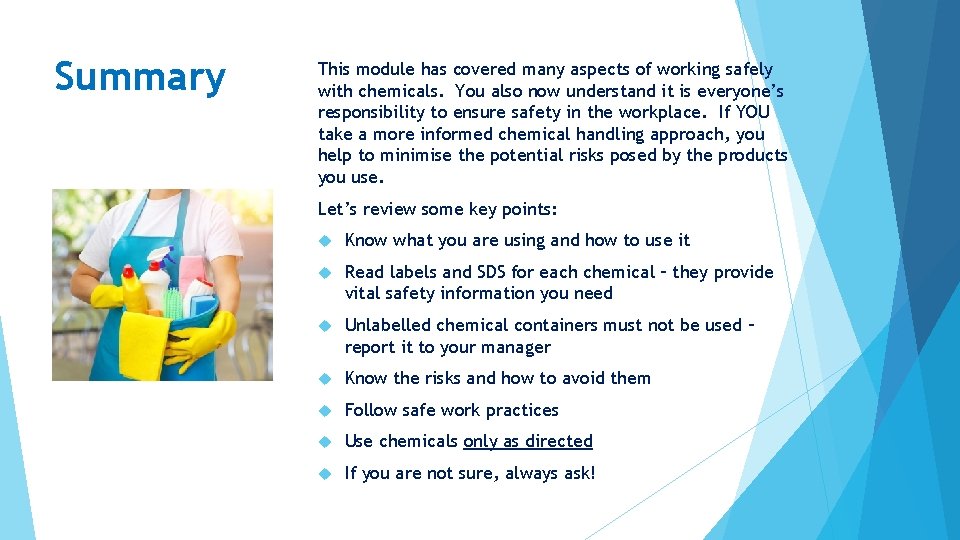
Summary This module has covered many aspects of working safely with chemicals. You also now understand it is everyone’s responsibility to ensure safety in the workplace. If YOU take a more informed chemical handling approach, you help to minimise the potential risks posed by the products you use. Let’s review some key points: Know what you are using and how to use it Read labels and SDS for each chemical – they provide vital safety information you need Unlabelled chemical containers must not be used – report it to your manager Know the risks and how to avoid them Follow safe work practices Use chemicals only as directed If you are not sure, always ask!

ASSESSMENT You have now completed this training module. You will be asked 20 randomly selected multiple choice questions. The pass mark is 90%. To access the assessment, click here.
- Slides: 26