
alveoli gills AP Biology Gas Exchange Respiratory Systems
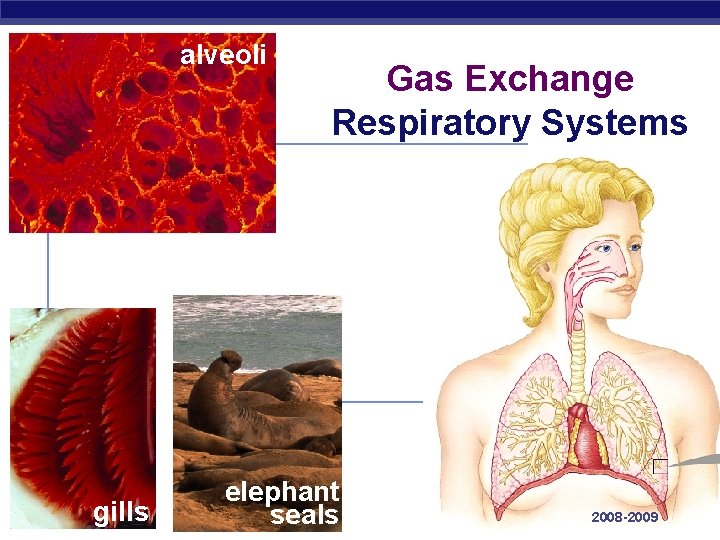
alveoli gills AP Biology Gas Exchange Respiratory Systems elephant seals 2008 -2009

AP Biology
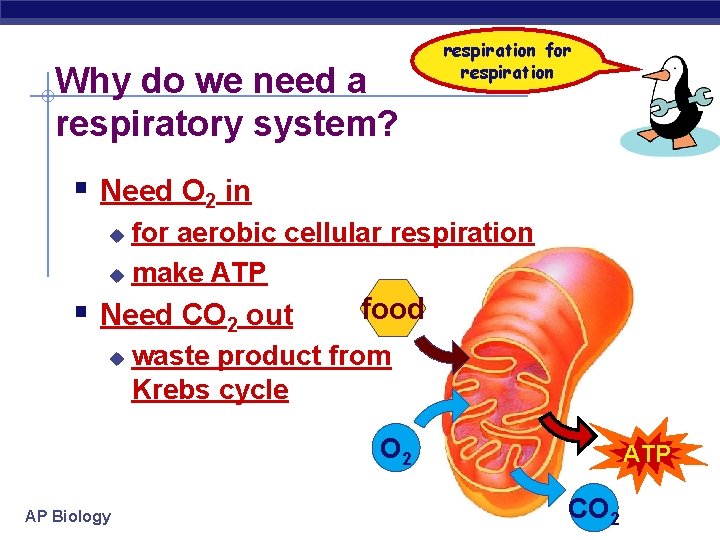
Why do we need a respiratory system? respiration for respiration § Need O 2 in for aerobic cellular respiration u make ATP u § Need CO 2 out u food waste product from Krebs cycle O 2 AP Biology ATP CO 2
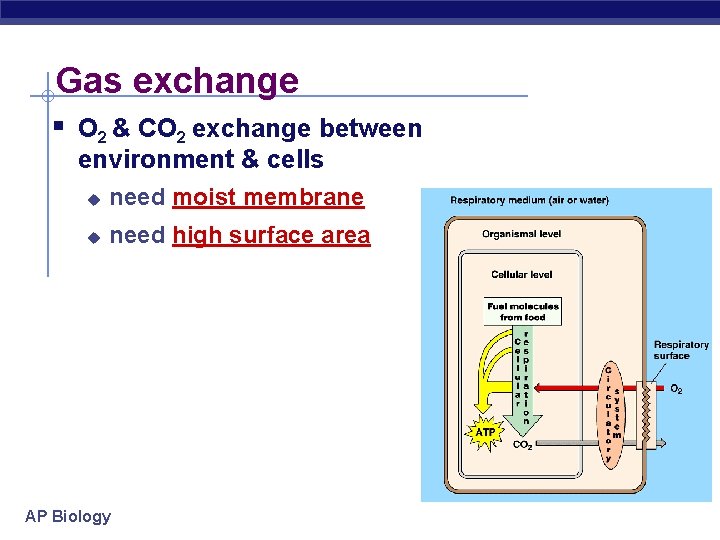
Gas exchange § O 2 & CO 2 exchange between environment & cells u need moist membrane u need high surface area AP Biology
Optimizing gas exchange § Why high surface area? maximizing rate of gas exchange u CO 2 & O 2 move across cell membrane by diffusion u § rate of diffusion proportional to surface area § Why moist membranes? moisture maintains cell membrane structure u gases diffuse only dissolved in water u AP Biology High surface area? High surface area! Where have we heard that before?
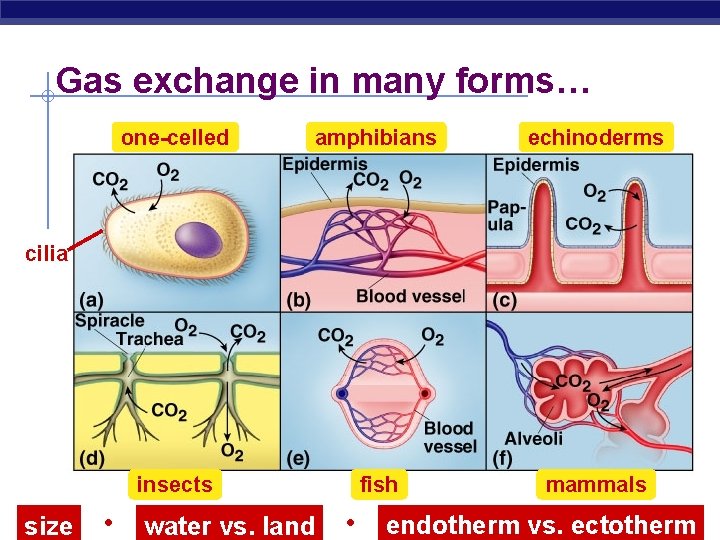
Gas exchange in many forms… one-celled amphibians echinoderms insects fish mammals cilia AP Biology • size water vs. land • endotherm vs. ectotherm

Evolution of gas exchange structures Aquatic organisms external systems with lots of surface area exposed to aquatic environment. Hemocyanin: uses copper instead of iron to carry O 2. Terrestrial moist internal respiratory tissues with lots of surface area AP Biology
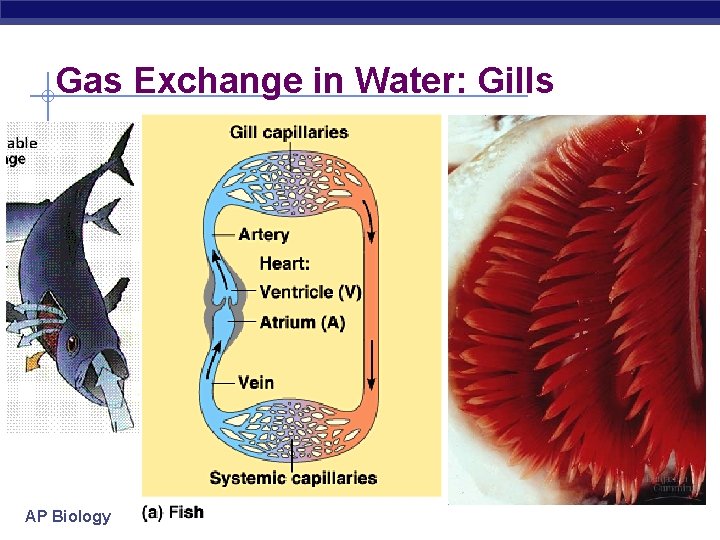
Gas Exchange in Water: Gills AP Biology
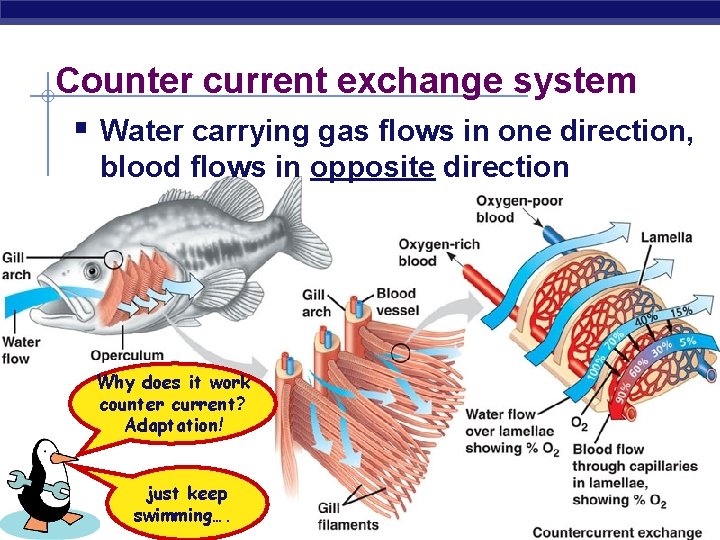
Counter current exchange system § Water carrying gas flows in one direction, blood flows in opposite direction Why does it work counter current? Adaptation! AP Biology just keep swimming….
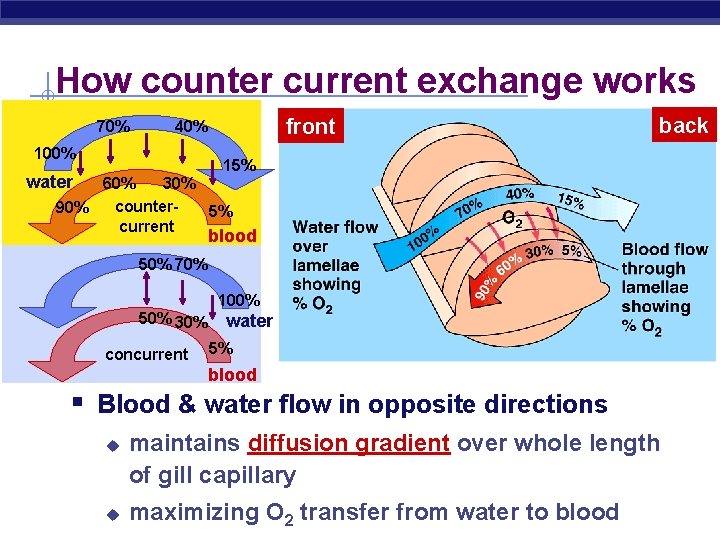
How counter current exchange works 70% front 40% 100% back 15% water 60% 30% counter 90% 5% current blood 50% 70% 100% 50% 30% concurrent water 5% blood § Blood & water flow in opposite directions u AP Biologyu maintains diffusion gradient over whole length of gill capillary maximizing O 2 transfer from water to blood
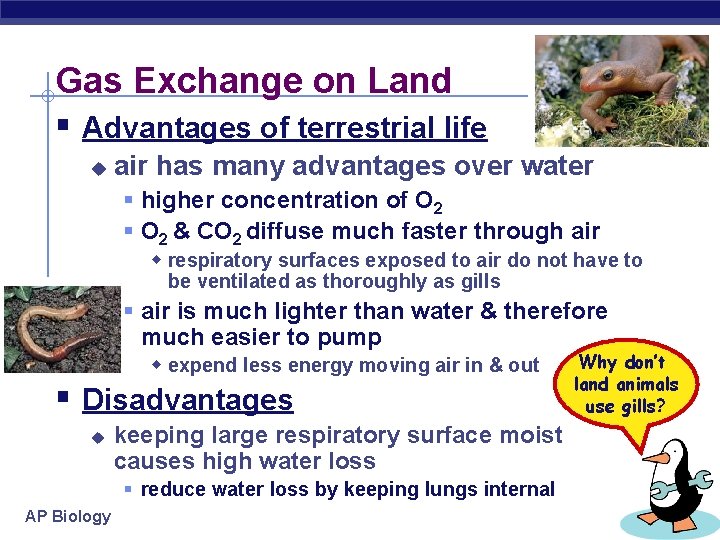
Gas Exchange on Land § Advantages of terrestrial life u air has many advantages over water § higher concentration of O 2 § O 2 & CO 2 diffuse much faster through air w respiratory surfaces exposed to air do not have to be ventilated as thoroughly as gills § air is much lighter than water & therefore much easier to pump Why w expend less energy moving air in & out § Disadvantages u keeping large respiratory surface moist causes high water loss § reduce water loss by keeping lungs internal AP Biology don’t land animals use gills?
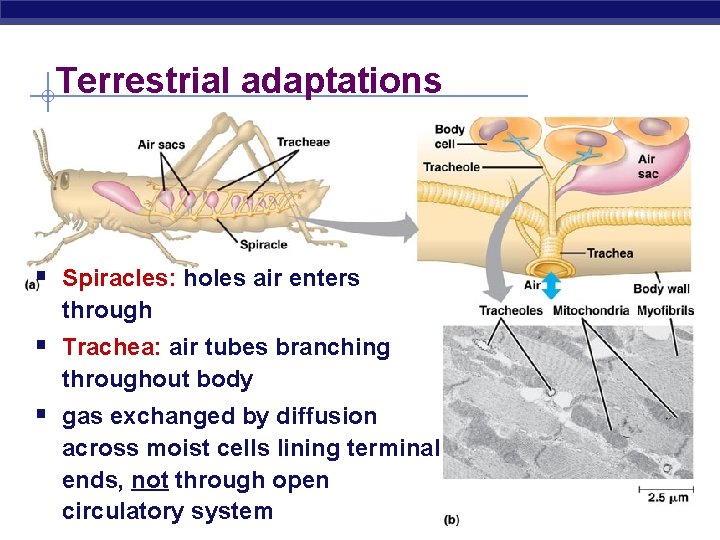
Terrestrial adaptations § Spiracles: holes air enters through § Trachea: air tubes branching throughout body § gas exchanged by diffusion across moist cells lining terminal ends, not through open circulatory system AP Biology
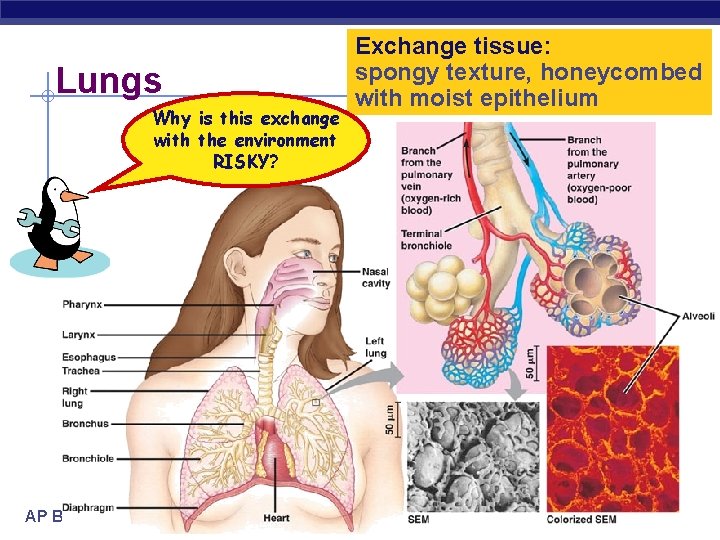
Lungs Why is this exchange with the environment RISKY? AP Biology Exchange tissue: spongy texture, honeycombed with moist epithelium
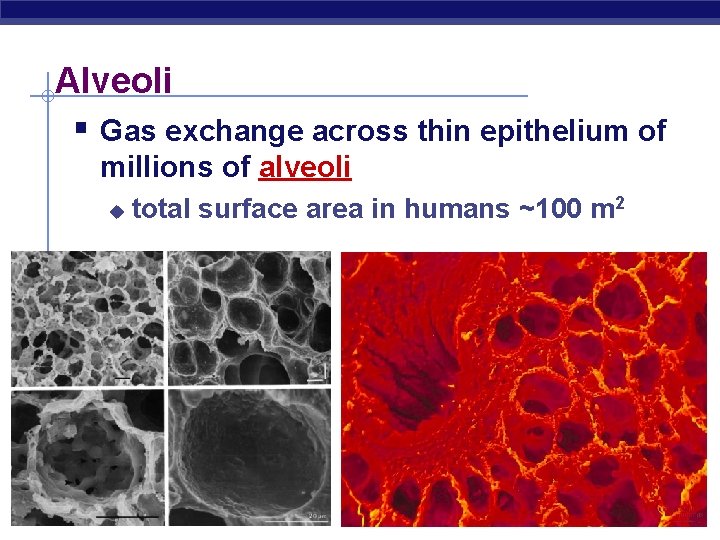
Alveoli § Gas exchange across thin epithelium of millions of alveoli u AP Biology total surface area in humans ~100 m 2
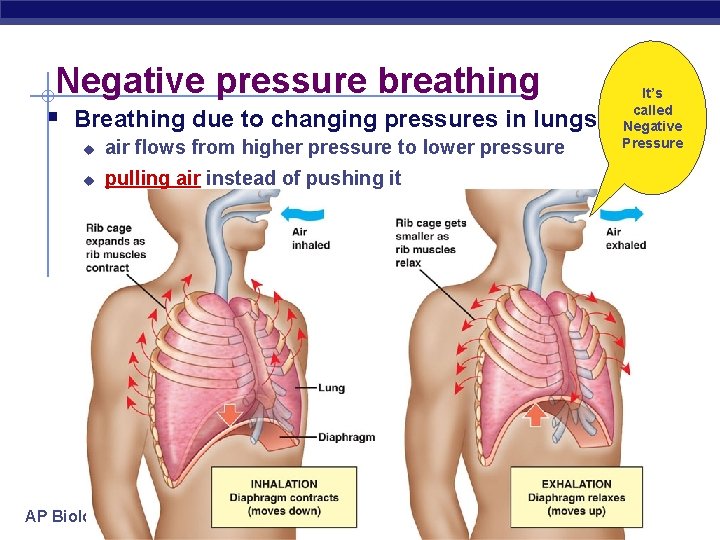
Negative pressure breathing § Breathing due to changing pressures in lungs u air flows from higher pressure to lower pressure u pulling air instead of pushing it AP Biology It’s called Negative Pressure
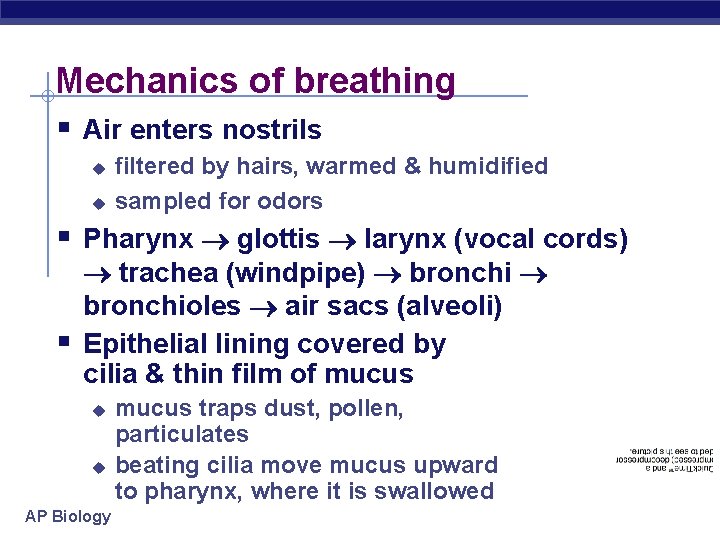
Mechanics of breathing § Air enters nostrils u u filtered by hairs, warmed & humidified sampled for odors § Pharynx glottis larynx (vocal cords) § trachea (windpipe) bronchioles air sacs (alveoli) Epithelial lining covered by cilia & thin film of mucus u u AP Biology mucus traps dust, pollen, particulates beating cilia move mucus upward to pharynx, where it is swallowed
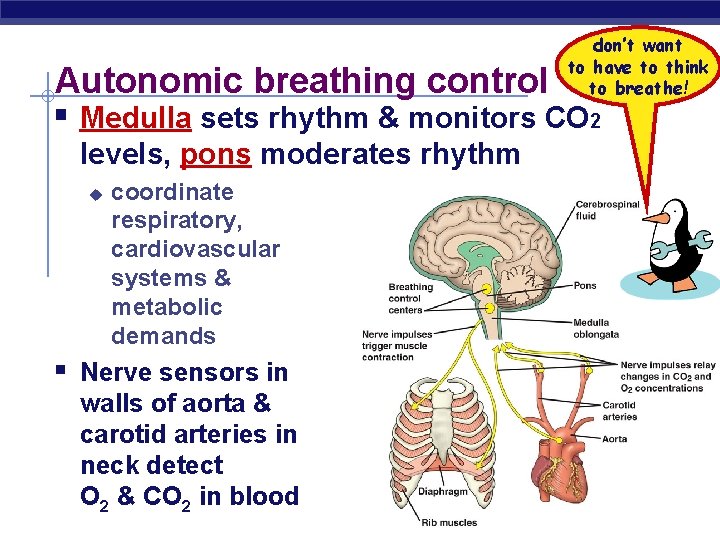
don’t want to have to think to breathe! Autonomic breathing control § Medulla sets rhythm & monitors CO 2 levels, pons moderates rhythm u coordinate respiratory, cardiovascular systems & metabolic demands § Nerve sensors in walls of aorta & carotid arteries in neck detect O 2 & CO 2 in blood AP Biology
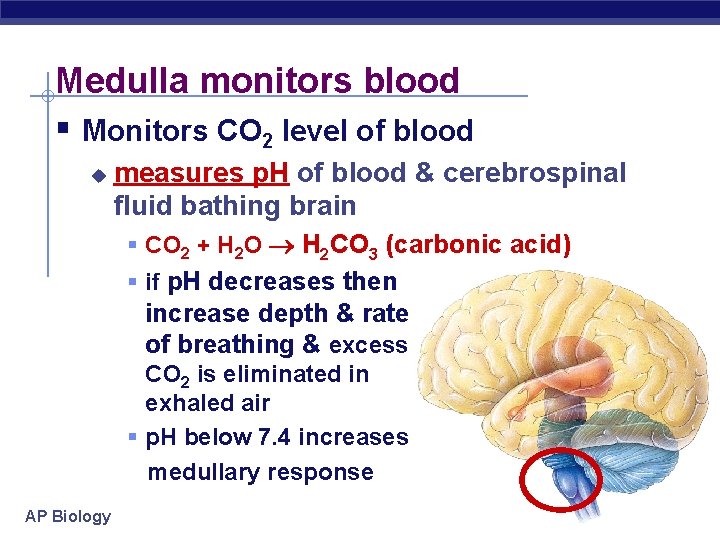
Medulla monitors blood § Monitors CO 2 level of blood u measures p. H of blood & cerebrospinal fluid bathing brain § CO 2 + H 2 O H 2 CO 3 (carbonic acid) § if p. H decreases then increase depth & rate of breathing & excess CO 2 is eliminated in exhaled air § p. H below 7. 4 increases medullary response AP Biology
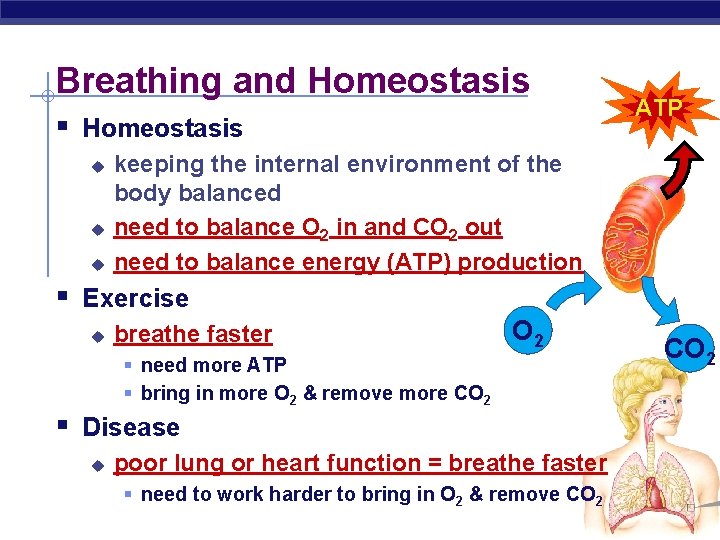
Breathing and Homeostasis § Homeostasis u u u ATP keeping the internal environment of the body balanced need to balance O 2 in and CO 2 out need to balance energy (ATP) production § Exercise u breathe faster O 2 § need more ATP § bring in more O 2 & remove more CO 2 § Disease u AP Biology poor lung or heart function = breathe faster § need to work harder to bring in O 2 & remove CO 2

Diffusion of gases § Concentration gradient & pressure drives movement of gases into & out of blood at both lungs & body tissue capillaries in lungs AP Biology capillaries in muscle O 2 O 2 CO 2 blood lungs blood body
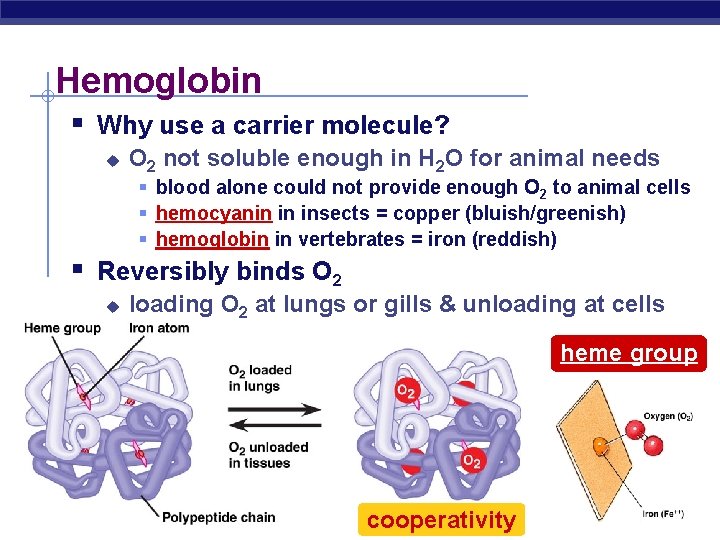
Hemoglobin § Why use a carrier molecule? u O 2 not soluble enough in H 2 O for animal needs § blood alone could not provide enough O 2 to animal cells § hemocyanin in insects = copper (bluish/greenish) § hemoglobin in vertebrates = iron (reddish) § Reversibly binds O 2 u loading O 2 at lungs or gills & unloading at cells heme group AP Biology cooperativity
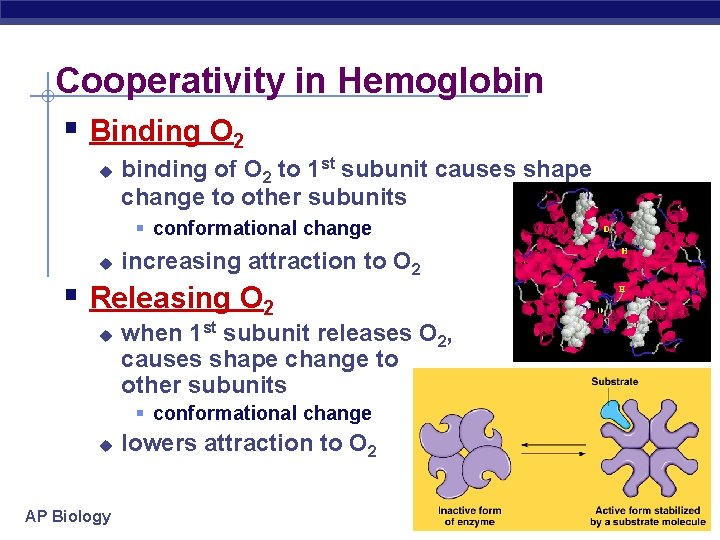
Cooperativity in Hemoglobin § Binding O 2 u binding of O 2 to 1 st subunit causes shape change to other subunits § conformational change u increasing attraction to O 2 § Releasing O 2 u when 1 st subunit releases O 2, causes shape change to other subunits § conformational change u AP Biology lowers attraction to O 2
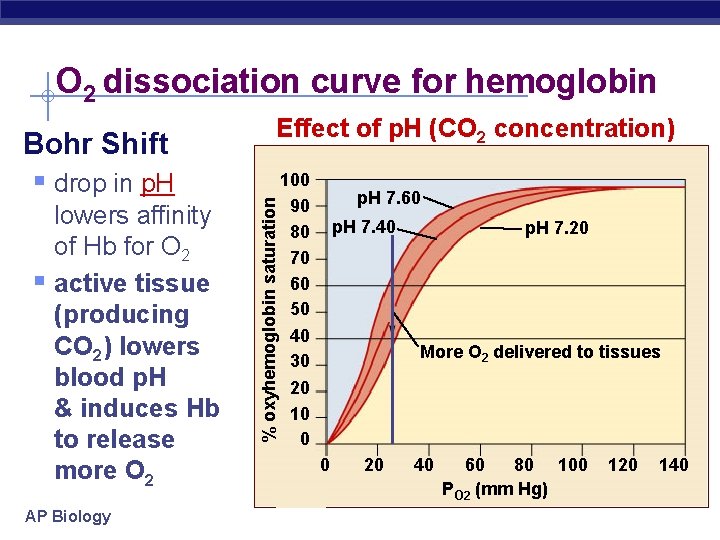
O 2 dissociation curve for hemoglobin § drop in p. H lowers affinity of Hb for O 2 § active tissue (producing CO 2) lowers blood p. H & induces Hb to release more O 2 AP Biology % oxyhemoglobin saturation Bohr Shift Effect of p. H (CO 2 concentration) 100 90 80 70 60 50 40 30 20 10 0 p. H 7. 60 p. H 7. 40 p. H 7. 20 More O 2 delivered to tissues 0 20 40 60 80 100 PO 2 (mm Hg) 120 140
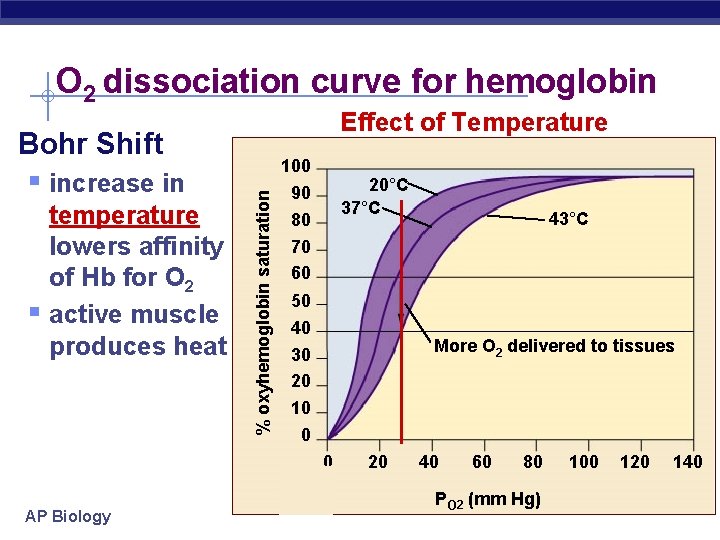
O 2 dissociation curve for hemoglobin Effect of Temperature § increase in temperature lowers affinity of Hb for O 2 § active muscle produces heat % oxyhemoglobin saturation Bohr Shift 100 90 80 20°C 37°C 70 60 50 40 30 20 10 0 More O 2 delivered to tissues 0 AP Biology 43°C 20 40 60 80 PO 2 (mm Hg) 100 120 140
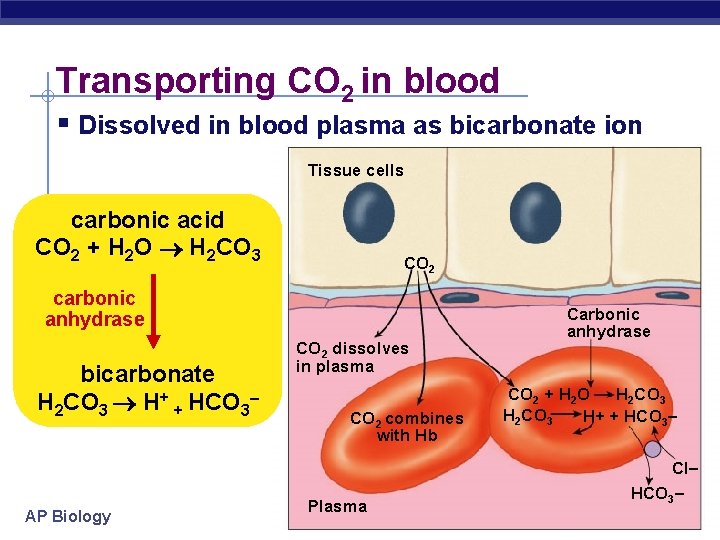
Transporting CO 2 in blood § Dissolved in blood plasma as bicarbonate ion Tissue cells carbonic acid CO 2 + H 2 O H 2 CO 3 CO 2 carbonic anhydrase bicarbonate H 2 CO 3 H+ + HCO 3– AP Biology CO 2 dissolves in plasma CO 2 combines with Hb Plasma Carbonic anhydrase CO 2 + H 2 O H 2 CO 3 H+ + HCO 3– Cl– HCO 3–
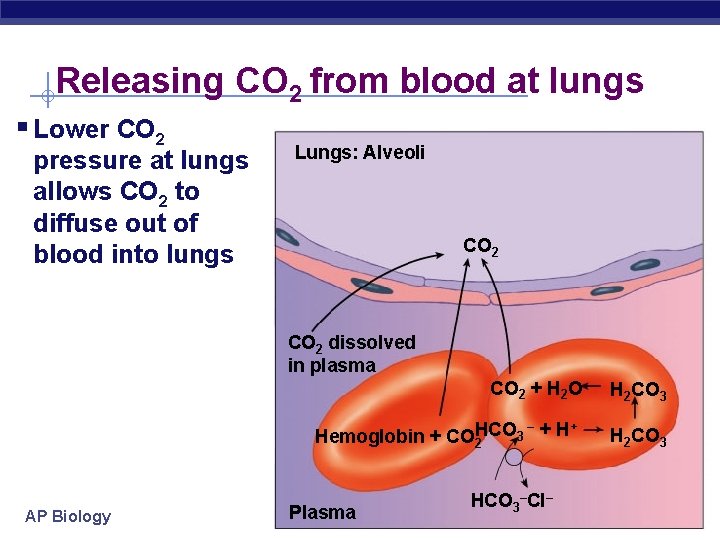
Releasing CO 2 from blood at lungs § Lower CO 2 pressure at lungs allows CO 2 to diffuse out of blood into lungs Lungs: Alveoli CO 2 dissolved in plasma CO 2 + H 2 O – + 3 + H Hemoglobin + COHCO 2 AP Biology Plasma HCO 3–Cl– H 2 CO 3
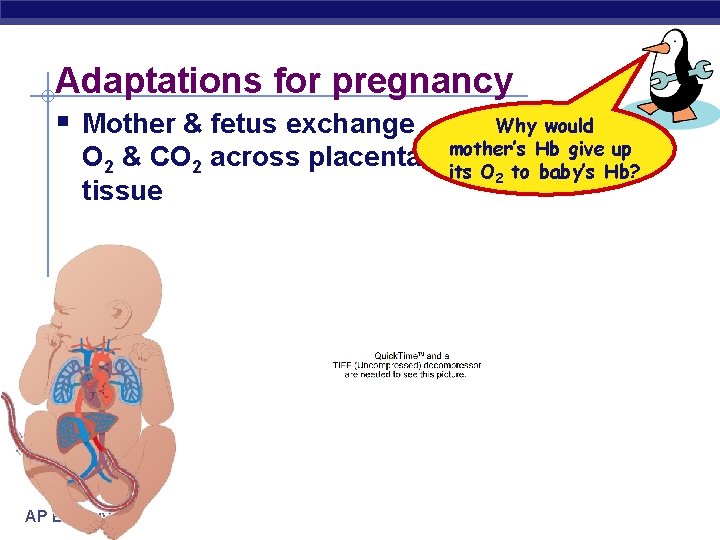
Adaptations for pregnancy § Mother & fetus exchange O 2 & CO 2 across placental tissue AP Biology Why would mother’s Hb give up its O 2 to baby’s Hb?
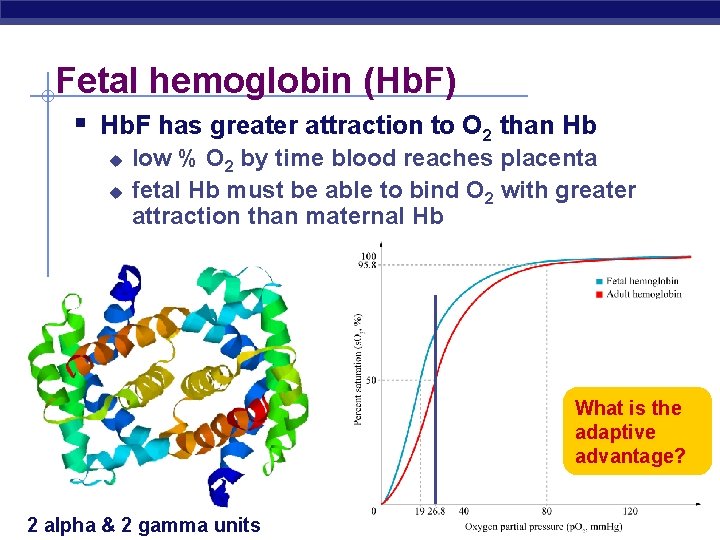
Fetal hemoglobin (Hb. F) § Hb. F has greater attraction to O 2 than Hb u u low % O 2 by time blood reaches placenta fetal Hb must be able to bind O 2 with greater attraction than maternal Hb What is the adaptive advantage? AP Biology 2 alpha & 2 gamma units
Don’t be such a baby… Ask Questions!! AP Biology 2008 -2009
- Slides: 29