
Alternative policy approaches Environmental standards Standard allowable levels
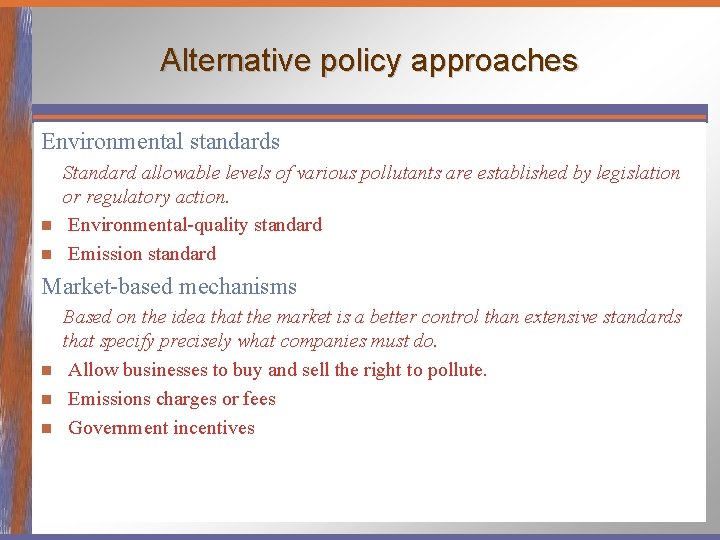
Alternative policy approaches Environmental standards Standard allowable levels of various pollutants are established by legislation or regulatory action. n Environmental-quality standard n Emission standard Market-based mechanisms Based on the idea that the market is a better control than extensive standards that specify precisely what companies must do. n Allow businesses to buy and sell the right to pollute. n Emissions charges or fees n Government incentives

Alternative policy approaches (continued) Information disclosure Regulation by publicity n The government encourages companies to pollute less by publishing information about the amount of pollutants individual companies emit each year. (E. g. , Toxic Release Inventory Program) n Civil and criminal enforcement The threat of prison can be an effective deterrent to corporate outlaws who would otherwise degrade the environment. n U. S. Sentencing Commission has established guidelines for sentencing environmental wrongdoers. n

Figure 12. 2 a Advantages and disadvantages of alternative policy approaches to reducing pollution Policy Approach Advantages Disadvantages Environmental standards n Enforceable in the courts n Compliance mandatory n Across-the-board Tradable allowances n Gives businesses more flexibility n Achieves goals at a lower overall cost n Saves jobs by allowing some less efficient plants to stay open n Permits the government and private organizations to buy allowances to take them off the market standards not equally relevant to all businesses n Requires large regulatory apparatus n Older, less efficient plants may be forced to close business a license to pollute n Allowance are hard to set n May cause regional imbalances in pollution levels n Enforcement is difficult

Figure 12. 2 b Advantages and disadvantages of alternative policy approaches to reducing pollution Policy Approach Advantages bad behavior (pollution) rather than good behavior (profits) Disadvantages Emissions fees and taxes n Taxes n Government incentives n. Rewards environmentally responsible behavior n. Encourages companies to exceed minimum standards n Incentives Information disclosure n Government n Does spends little on enforcement n Companies able to reduce pollution in the most costeffective way Fees hard to set n Taxes may be too low to curb pollution may not be strong enough to curb pollution not motivate all companies
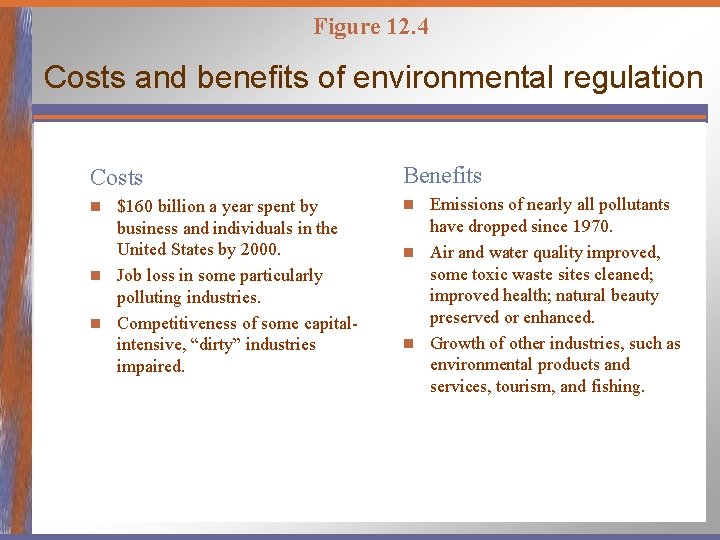
Figure 12. 4 Costs and benefits of environmental regulation Costs Benefits $160 billion a year spent by business and individuals in the United States by 2000. n Job loss in some particularly polluting industries. n Competitiveness of some capitalintensive, “dirty” industries impaired. n n Emissions of nearly all pollutants have dropped since 1970. n Air and water quality improved, some toxic waste sites cleaned; improved health; natural beauty preserved or enhanced. n Growth of other industries, such as environmental products and services, tourism, and fishing.
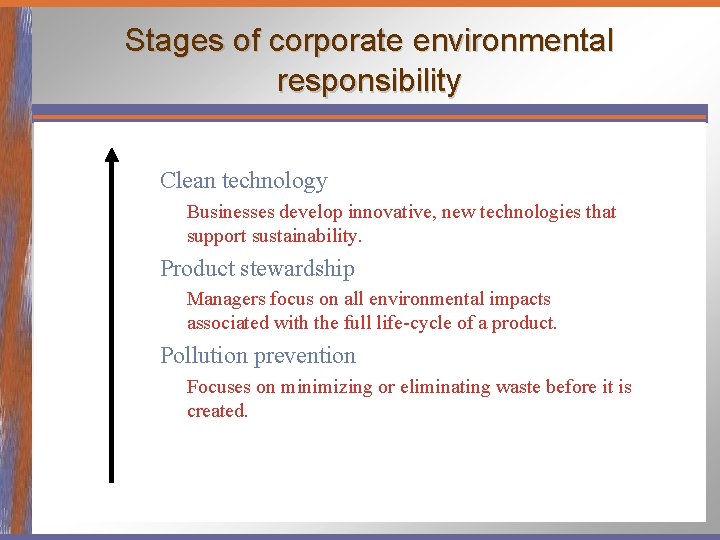
Stages of corporate environmental responsibility Clean technology Businesses develop innovative, new technologies that support sustainability. Product stewardship Managers focus on all environmental impacts associated with the full life-cycle of a product. Pollution prevention Focuses on minimizing or eliminating waste before it is created.
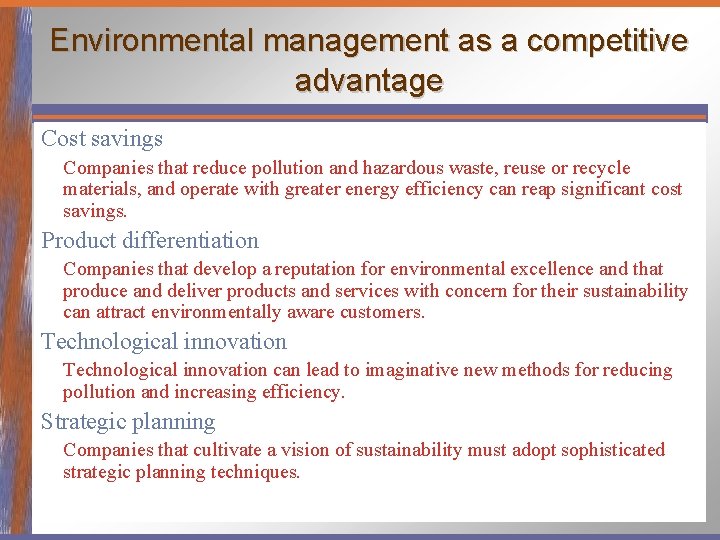
Environmental management as a competitive advantage Cost savings Companies that reduce pollution and hazardous waste, reuse or recycle materials, and operate with greater energy efficiency can reap significant cost savings. Product differentiation Companies that develop a reputation for environmental excellence and that produce and deliver products and services with concern for their sustainability can attract environmentally aware customers. Technological innovation can lead to imaginative new methods for reducing pollution and increasing efficiency. Strategic planning Companies that cultivate a vision of sustainability must adopt sophisticated strategic planning techniques.
- Slides: 7