
ALTERNATIVE OBJECTIVES OF THE FIRM OVERVIEW Managerial theories
ALTERNATIVE OBJECTIVES OF THE FIRM
OVERVIEW • Managerial theories of the firm (non-profit maximizing objective flowing from separation between ownership & management) • There are several models, but mainly concentrating on: – Baumol’s constrained sales maximization model – Marris’ maximization of managerial utility model • Behavioral theories of the firm (firm looked upon as a Satisficer rather than a Maximizer) – Cyert and March
Constrained Sales Maximization Model (Baumol) • Managers maximize sales revenue subject to earning a minimum acceptable level of profit – Minimum level of profit determined by need to be able to raise finance to pay for future sales expansion – Managers’ salaries more closely linked to sales than profits, so managers seek to maximize sales – Larger the firm, easier to raise capital at low rates of interest – Large sales encourage bandwagon effect and retains distributors
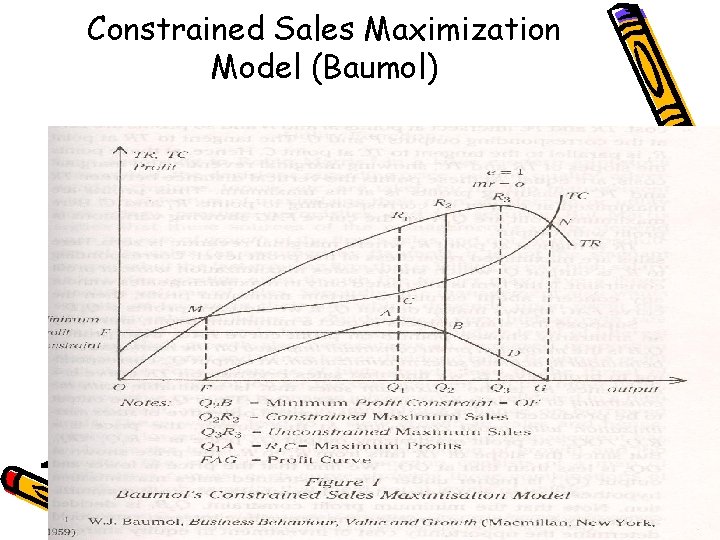
Constrained Sales Maximization Model (Baumol)
Extension of Constrained Sales Maximization Model (Baumol) • Extension of model – The firm’s objective is the maximization of long-run sales revenue – Firms may use the profits in excess of the required minimum to influence the demand conditions through marketing investment and product development. • Outward shift in demand curve – sales increase for any given price level • Assuming that any expenditure on advertising etc. increases sales, long run sales maximization requires that all profit in excess of the minimum be deployed in affecting demand • Then, long run sales maximization always leads to the profit constraint being operative
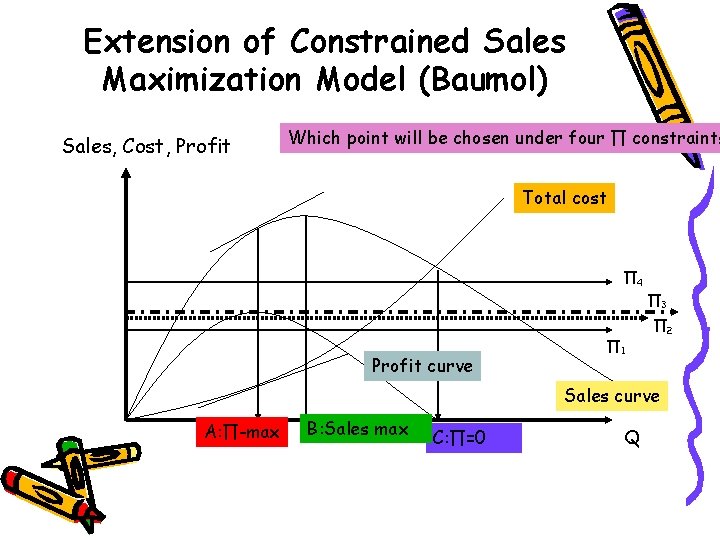
Extension of Constrained Sales Maximization Model (Baumol) Sales, Cost, Profit Which point will be chosen under four ∏ constraints Total cost ∏ 4 ∏ 3 Profit curve ∏ 1 ∏ 2 Sales curve A: ∏-max B: Sales max C: ∏=0 Q
Maximization of Managerial Utility Model (Marris) • Decisions on levels of investment and dividend payments taken by top level management • Top management maximizes a utility function with two arguments: long run sustainable growth of sales (desire for higher salary, power, and prestige) and job security (avoiding takeovers) • Tradeoff between growth and security: – High growth – higher interest charges from more borrowing (thus increased costs) and increased proportion of retained profits (thus lower dividend rates) – leads to threat of takeover and job loss – Excessive concern for job security (i. e. preference for high rate of profit) – minimize reliance on borrowed funds – slower growth in sales (lower salary, prestige etc. )

Maximization of Managerial Utility Model (Marris)
Cyert & March’s Behavioral Theory of the Firm • Firm’s objective: To achieve satisfactory values of profits, sales, managerial benefits, etc. rather than maximum values of these variables • Two important characteristics: – Firm is subject to bounded rationality i. e. its behavior is intendedly rational but limitedly so due to informational problems – The firm attempts to satisfy the goals/aspirations levels of different interest groups in terms of these variables
- Slides: 9