
Alternative Names HutchinsonGilford Syndrome HutchinsonGilford Progeria HutchinsonGilford Disease


- Slides: 12
Alternative Names • • Hutchinson-Gilford Syndrome Hutchinson-Gilford Progeria Hutchinson-Gilford Disease Souques-Charcot syndrome
Who is most likely to get Progeria? • There is no way of knowing who will get Progeria, it is not passed down in families. • 1 in 4 -8 million get Progeria. • It is rare that someone gets Progeria from a family member (1 in 400 million). • Gender does not matter in Progeria any one could get it.
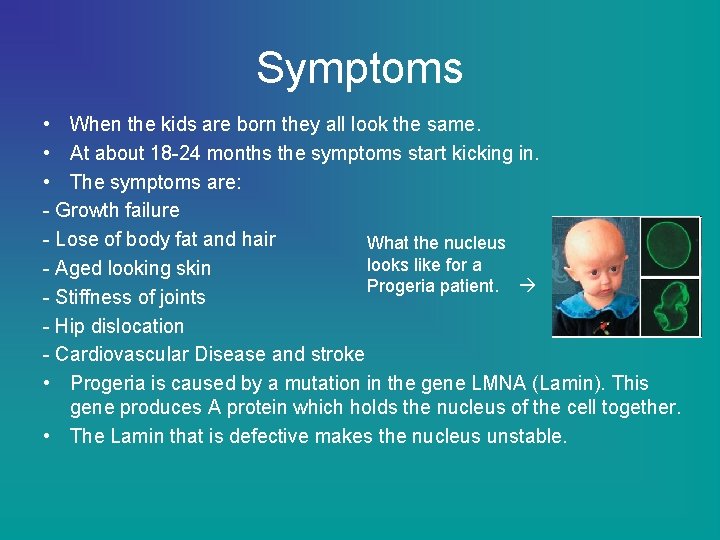
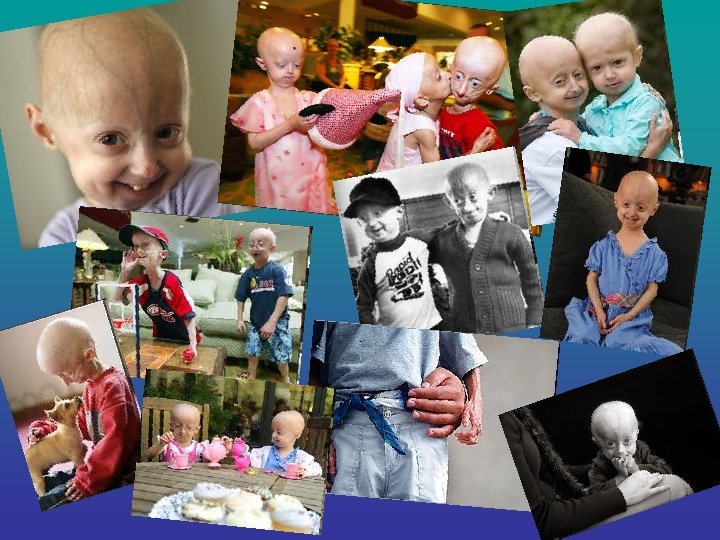
Symptoms • When the kids are born they all look the same. • At about 18 -24 months the symptoms start kicking in. • The symptoms are: - Growth failure - Lose of body fat and hair What the nucleus looks like for a - Aged looking skin Progeria patient. - Stiffness of joints - Hip dislocation - Cardiovascular Disease and stroke • Progeria is caused by a mutation in the gene LMNA (Lamin). This gene produces A protein which holds the nucleus of the cell together. • The Lamin that is defective makes the nucleus unstable.
How common is Progeria? • 1 in 4 -8 million • If contributed by a family member 1 in 400 million.
Is Progeria deadly? Can it shorten lifespan? • Yes, Progeria can be deadly most children die from heart disease. • The lifespan of someone who has Progeria averages about 13 but it ranges from 8 to 21.
Can you be tested for Progeria? • You can see when a child has the symptoms of Progeria at 18 -24 months. • Most people know what Progeria looks like so you don’t really know until they start changing when they grow older.
Is there a treatment for Progeria? • There is no treatment for this disease, sadly all they can do is live with it. • Physical Therapy can help lower the heart attacks that the patients have. • Also physical therapy can help the joint stiffness.
Are there any support groups? • There are many support groups for Progeria. One popular group is: http: //www. progeriaresearch. org/
Interesting Facts • People with Progeria age 7 times faster then we do. • Know number of kids with Progeria, 54 in 30 countries. • Have the mind of a 10 year old.
Works Cited "Progeria Facts. " Buzzle Web Portal: Intelligent Life on the Web. 18 Oct. 2010. Web. 26 Jan. 2011. <http: //www. buzzle. com/articles/progeriafacts. html>. Online, Credit Card. "Progeria Research Foundation | Progeria 101/FAQ. " Progeria Research Foundation | Home. Nov. 2008. Web. 26 Jan. 2011. <http: //www. progeriaresearch. org/progeria_101. html>. "Progeria - Symptoms, Diagnosis, Treatment of Progeria - NY Times Health Information. " Health News - The New York Times. 2007. Web. 26 Jan. 2011. <http: //health. nytimes. com/health/guides/disease/progeria/ove rview. html>.