
Alternative methods of feeding for small or sick
- Slides: 26
Alternative methods of feeding for small or sick neonates
Alternative feeding methods Objectives: To describe the options available for alternative methods of feeding Teach a mother how to use an alternative feeding method To explain how to express breast milk Teaching Aids: ENC AF - 2
Alternative feeding methods Indications: Baby ◦ Not breastfeeding effectively ◦ Not sucking effectively (e. g. preterm, ill, cleft lip/palate) Mother ◦ Is ill ◦ Has flat/inverted nipple or engorged breast ◦ Is HIV positive and decides not to breastfeed Teaching Aids: ENC AF - 3
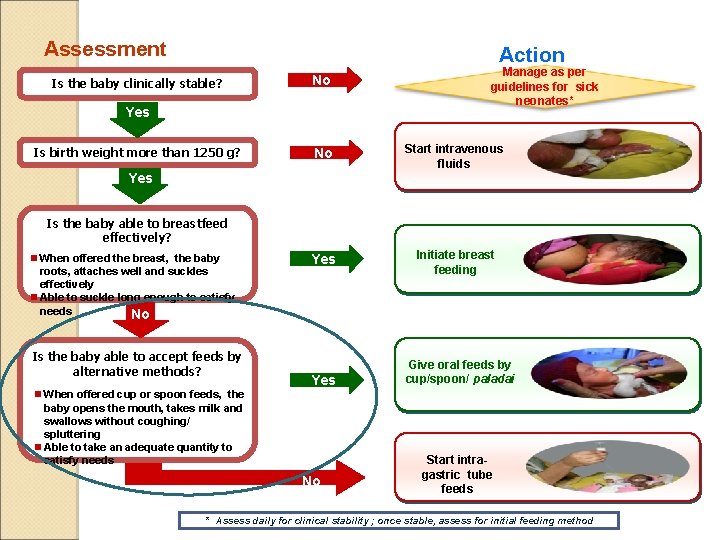
Assessment Action Is the baby clinically stable? No Yes Is birth weight more than 1250 g? Manage as per guidelines for sick neonates* No Start intravenous fluids Yes Initiate breast feeding Yes Is the baby able to breastfeed effectively? n When offered the breast, the baby roots, attaches well and suckles effectively n Able to suckle long enough to satisfy needs No Is the baby able to accept feeds by alternative methods? n When offered cup or spoon feeds, the baby opens the mouth, takes milk and swallows without coughing/ spluttering n Able to take an adequate quantity to satisfy needs Yes No Give oral feeds by cup/spoon/ paladai Start intragastric tube feeds * Assess daily for clinical stability ; once stable, assess for initial feeding method
Alternative feeding methods Options available: Cup Paladai Spoon Irrespective of the method, only expressed breast milk has to be fed to the baby Teaching Aids: ENC AF - 5
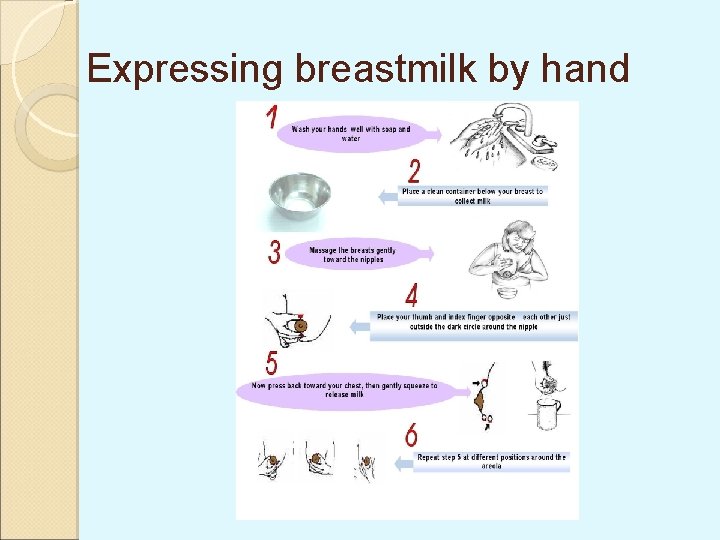
Expressing breastmilk by hand
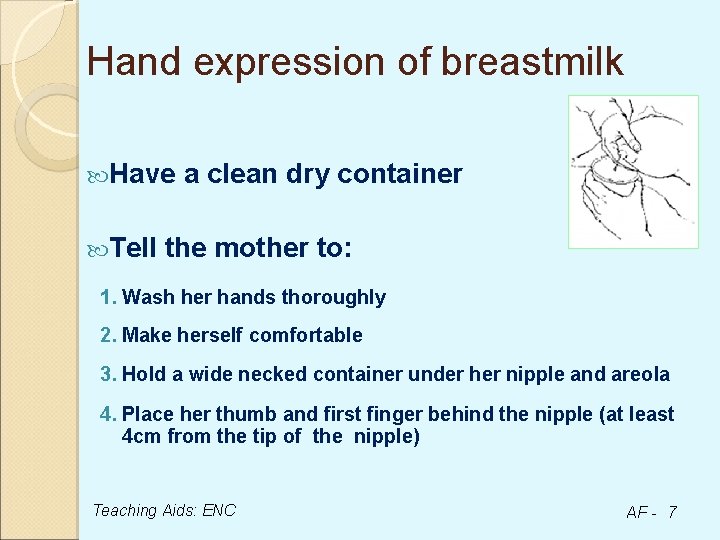
Hand expression of breastmilk Have Tell a clean dry container the mother to: 1. Wash her hands thoroughly 2. Make herself comfortable 3. Hold a wide necked container under her nipple and areola 4. Place her thumb and first finger behind the nipple (at least 4 cm from the tip of the nipple) Teaching Aids: ENC AF - 7
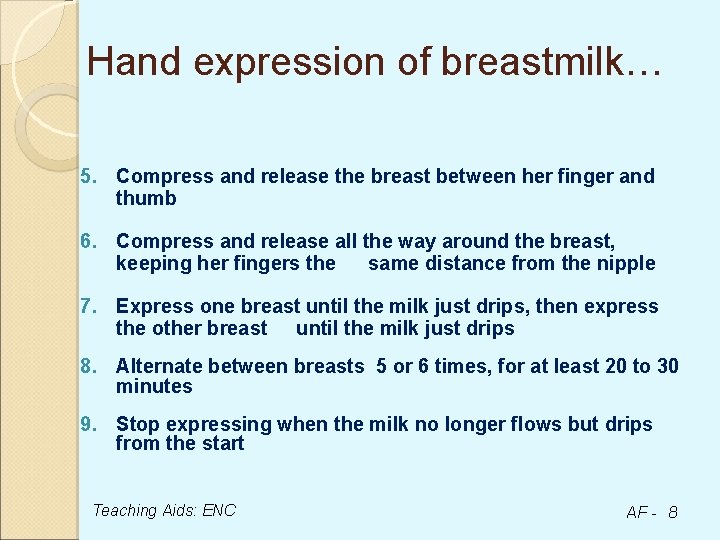
Hand expression of breastmilk… 5. Compress and release the breast between her finger and thumb 6. Compress and release all the way around the breast, keeping her fingers the same distance from the nipple 7. Express one breast until the milk just drips, then express the other breast until the milk just drips 8. Alternate between breasts 5 or 6 times, for at least 20 to 30 minutes 9. Stop expressing when the milk no longer flows but drips from the start Teaching Aids: ENC AF - 8
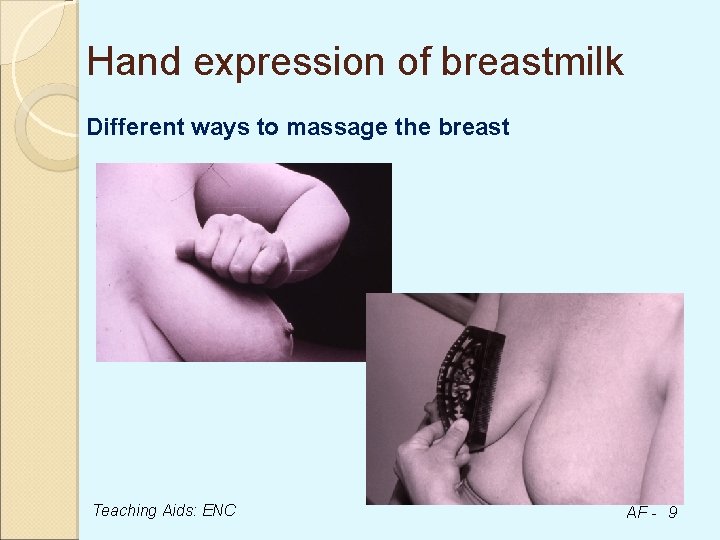
Hand expression of breastmilk Different ways to massage the breast Teaching Aids: ENC AF - 9
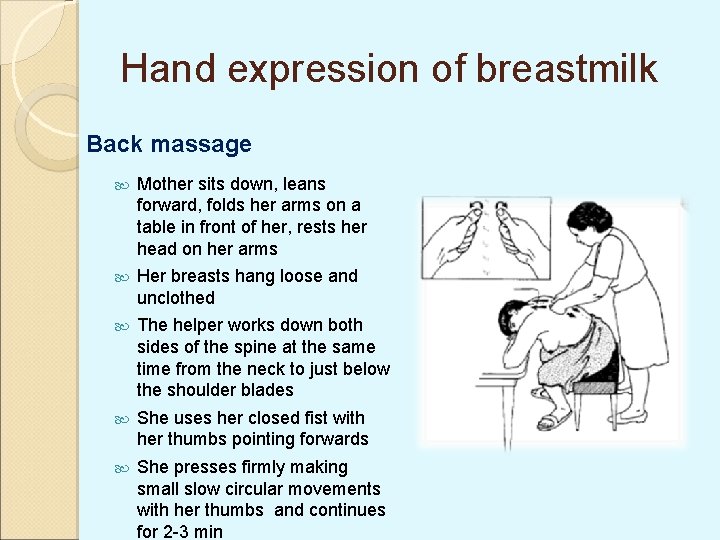
Hand expression of breastmilk Back massage Mother sits down, leans forward, folds her arms on a table in front of her, rests her head on her arms Her breasts hang loose and unclothed The helper works down both sides of the spine at the same time from the neck to just below the shoulder blades She uses her closed fist with her thumbs pointing forwards She presses firmly making small slow circular movements with her thumbs and continues for 2 -3 min
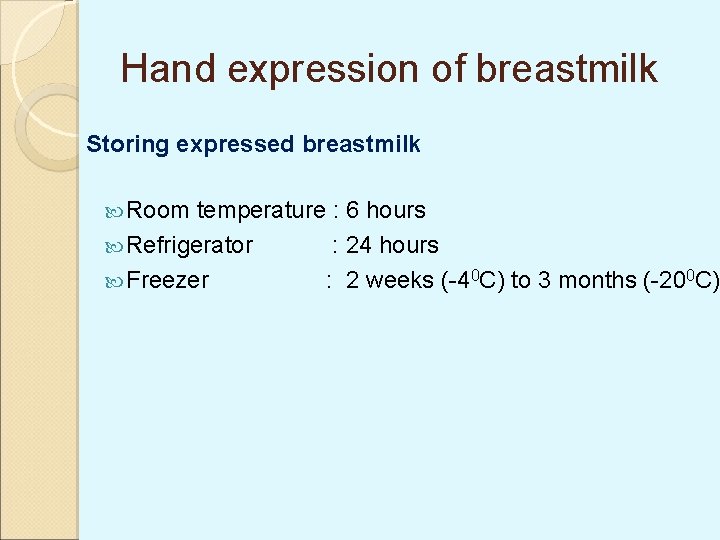
Hand expression of breastmilk Storing expressed breastmilk Room temperature : 6 hours Refrigerator : 24 hours Freezer : 2 weeks (-40 C) to 3 months (-200 C)
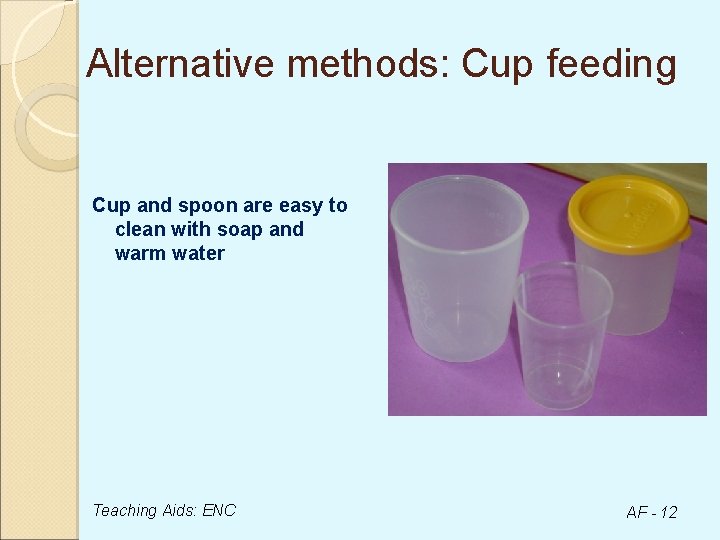
Alternative methods: Cup feeding Cup and spoon are easy to clean with soap and warm water Teaching Aids: ENC AF - 12
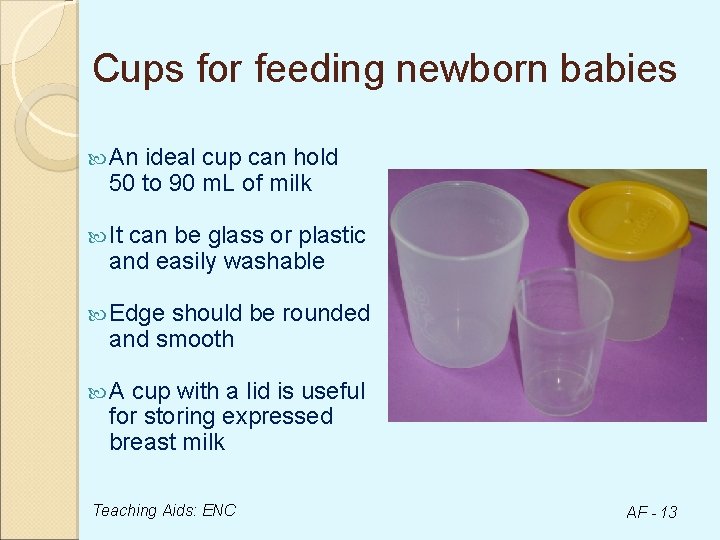
Cups for feeding newborn babies An ideal cup can hold 50 to 90 m. L of milk It can be glass or plastic and easily washable Edge should be rounded and smooth A cup with a lid is useful for storing expressed breast milk Teaching Aids: ENC AF - 13
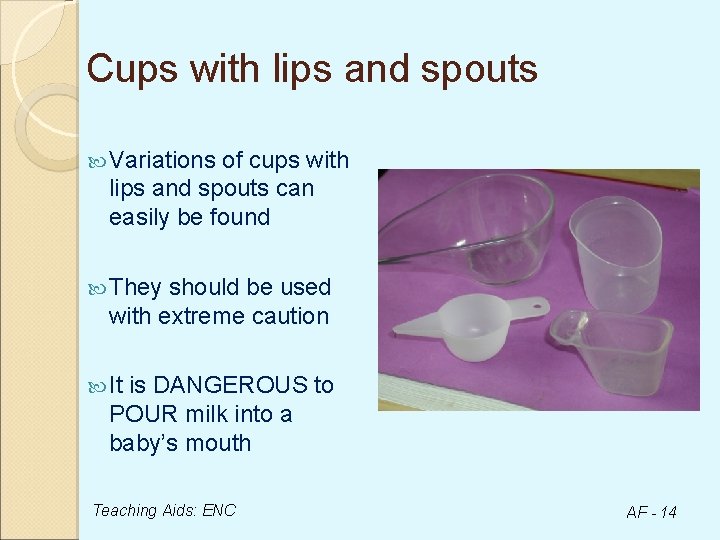
Cups with lips and spouts Variations of cups with lips and spouts can easily be found They should be used with extreme caution It is DANGEROUS to POUR milk into a baby’s mouth Teaching Aids: ENC AF - 14
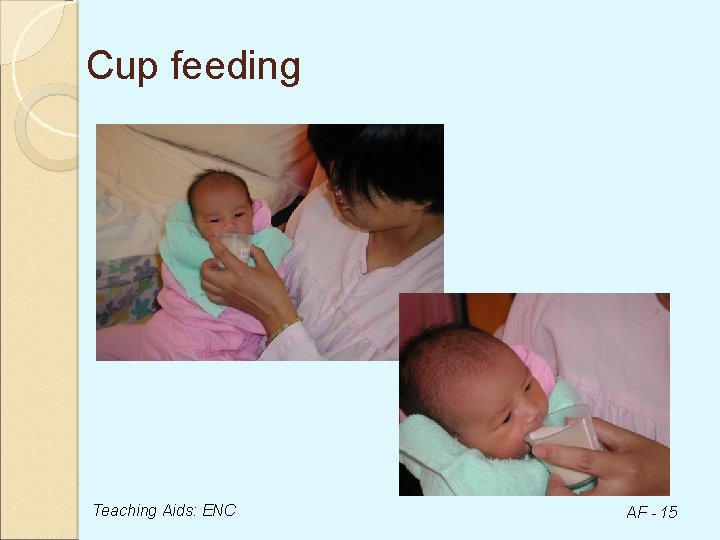
Cup feeding Teaching Aids: ENC AF - 15
Cup feeding Advantages Simple Baby can take what it needs in its own time Mother Good equipment ; easy to clean can do it herself eye contact between mother and baby Teaching Aids: ENC AF - 16
Cup feeding Steps Put a measured amount of milk in the cup Infant should be awake and held sitting semi-upright on caregiver's lap; put a small cloth on his or her front to catch drips of milk Touch the edge of the cup to the outer parts of the upper lip Tip the cup so that the milk reaches the baby’s lips Teaching Aids: ENC AF - 17
Cup feeding Steps Do not pour the milk into the infant's mouth Allow the infant to take the milk himself (upon smelling the breastmilk, the baby becomes alert, opens its mouth, and puts its tongue into the milk to start the feed) Feed the infant slowly; some milk may spill from the infant's mouth When the infant has had enough, he or she will close his or her mouth and will not take any more. Do not Pouringthe theinfant. milk into baby’s mouth can cause force-feed aspiration Teaching Aids: ENC AF - 18
Case study: cup feeding Measuring the correct amount of milk To measure 30 m. L Use a desert spoon which holds approx. 10 m. L Take 3 spoonfuls of milk Put a mark on the outside of the cup to guide her how much milk is needed each time If the baby does not take the required amount: feed more often or for longer Teaching Aids: ENC AF - 19
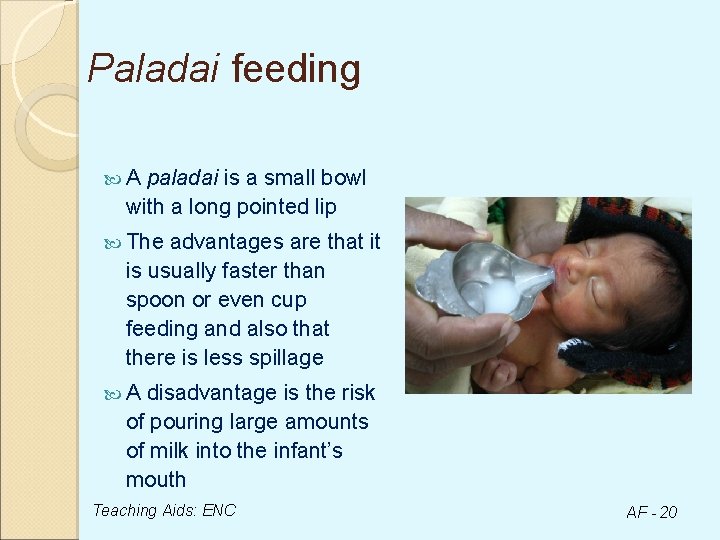
Paladai feeding A paladai is a small bowl with a long pointed lip The advantages are that it is usually faster than spoon or even cup feeding and also that there is less spillage A disadvantage is the risk of pouring large amounts of milk into the infant’s mouth Teaching Aids: ENC AF - 20
Paladai feeding Steps Infant should be awake and held sitting semi-upright on caregiver's lap; put a small cloth on his or her front to catch drips of milk Put a measured amount of milk in the paladai Hold the paladai so that the pointed tip rests lightly on the infant’s lower lip Teaching Aids: ENC AF - 21
Paladai feeding Steps Tip the paladai to pour a small amount of milk into the infant’s mouth Feed the infant slowly Make sure that the infant has swallowed the milk already taken before giving any more When the infant has had enough, he or she will close his or her mouth and will not take any more. Do not force-feed the infant. Teaching Aids: ENC AF - 22
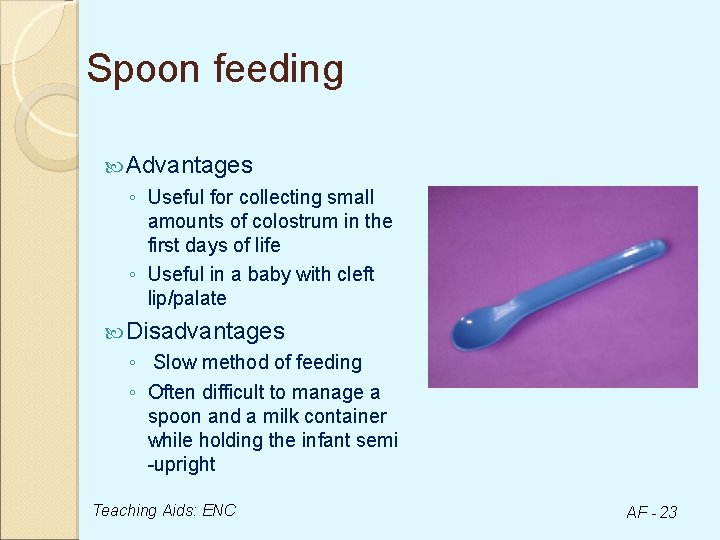
Spoon feeding Advantages ◦ Useful for collecting small amounts of colostrum in the first days of life ◦ Useful in a baby with cleft lip/palate Disadvantages ◦ Slow method of feeding ◦ Often difficult to manage a spoon and a milk container while holding the infant semi -upright Teaching Aids: ENC AF - 23
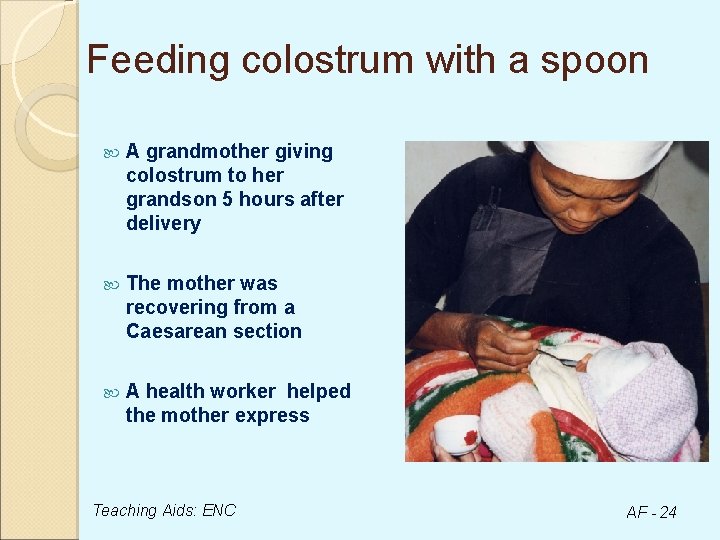
Feeding colostrum with a spoon A grandmother giving colostrum to her grandson 5 hours after delivery The mother was recovering from a Caesarean section A health worker helped the mother express Teaching Aids: ENC AF - 24
Ensuring adequacy of intake Weighing him/her once a day and assess weight gain Check that (s)he has several wet nappies every day Babies who are growing adequately are receiving enough milk Teaching Aids: ENC AF - 25
Summary Alternative methods - indicated in those who are NOT able to breastfeed effectively Methods available: Cup, spoon, Paladai ONLY expressed breast milk should be fed Ensure hygiene and adequacy of intake while giving feeds by alternative methods Teaching Aids: ENC AF - 26