
ALTERNATIVE METAL AND TRANSLUCENT ROOF CLADDING MATERIALS And


![Main Contractor [you the builder] � � As the main contractor there is certain](https://slidetodoc.com/presentation_image_h2/46fcf1260a0ed6d5c7d49cf0c15a87a7/image-9.jpg "Main Contractor [you the builder] � � As the main contractor there is certain")





- Slides: 31
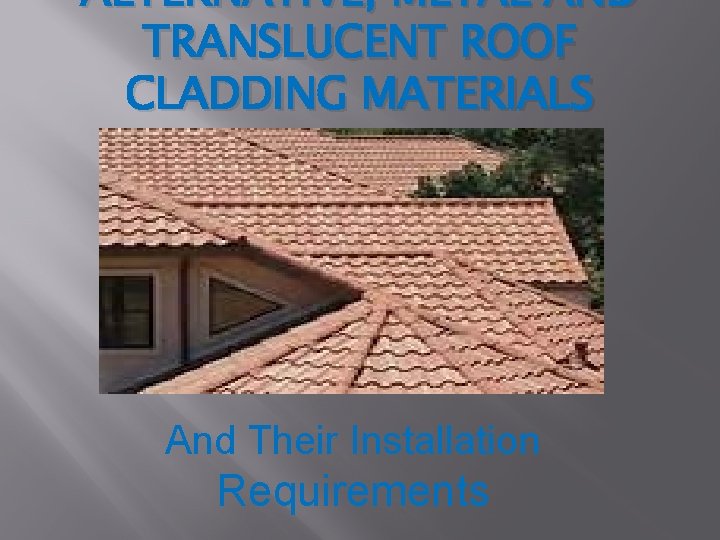
ALTERNATIVE, METAL AND TRANSLUCENT ROOF CLADDING MATERIALS And Their Installation Requirements
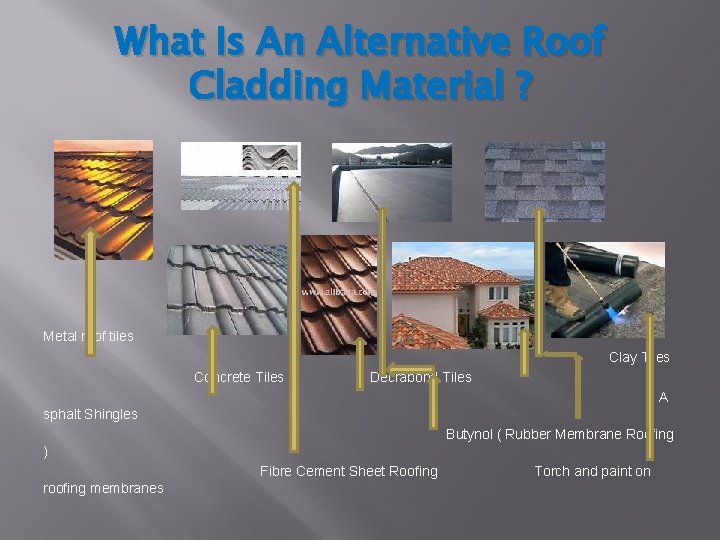
What Is An Alternative Roof Cladding Material ? Metal roof tiles Clay Tiles Concrete Tiles Decrabond Tiles A sphalt Shingles Butynol ( Rubber Membrane Roofing ) Fibre Cement Sheet Roofing roofing membranes Torch and paint on
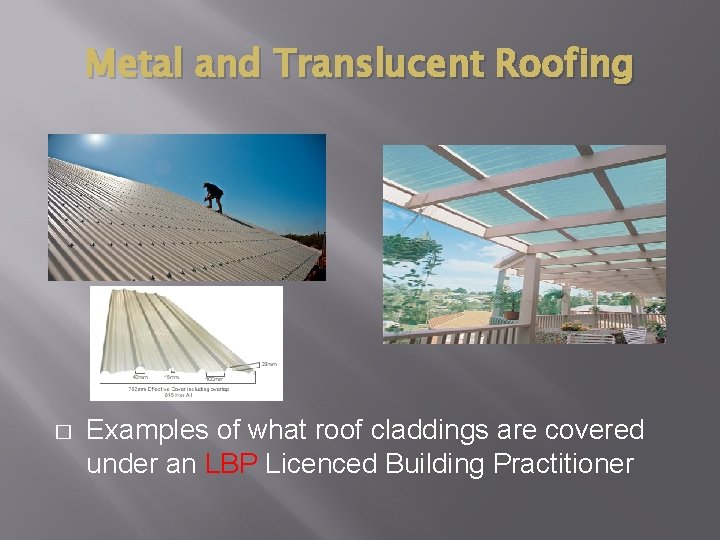
Metal and Translucent Roofing � Examples of what roof claddings are covered under an LBP Licenced Building Practitioner
Roofing Contractors : If you have to be a licenced installer to install Alternative roof claddings why do we need to learn about and have knowledge of this area of the building industry ?
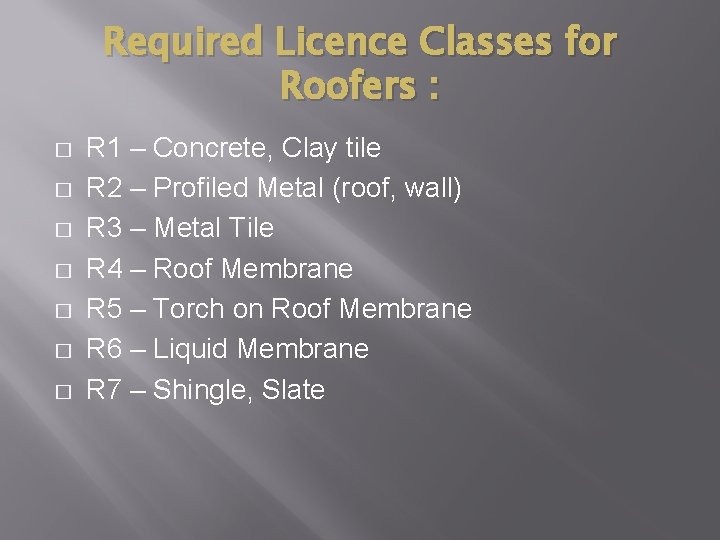
Required Licence Classes for Roofers : � � � � R 1 – Concrete, Clay tile R 2 – Profiled Metal (roof, wall) R 3 – Metal Tile R 4 – Roof Membrane R 5 – Torch on Roof Membrane R 6 – Liquid Membrane R 7 – Shingle, Slate
Receiving Your Roof Claddings On Site � � Prepare a clear area to store material prior to delivery Inspect the cladding for damage prior to accepting the delivery
Storing or Placement of your Roofing Claddings on Site � � � Store well clear of other construction activities Cover roof cladding to keep dry and protect it from dents and scratches Store roof cladding material clear of the ground on dunnage Store rolls of torch on membrane on edge Place over structural members when material is stored on the roof
Handling your roof cladding material � � � Each manufacturer will have their own product specific instructions; make sure you are familiar with them PPE – Soft soled shoes, Leather Gloves Remove any sharp debris immediately LIFT Sheets DO NOT Slide Sheets over each other or rough surfaces as this damages your sheets Minimize Roof traffic and Walk on purlin lines Tools and Potential Damage?
Main Contractor [you the builder] � � As the main contractor there is certain parts of the construction process that need to be finished and ready prior to the roofer arriving on site. This will vary depending on the roof cladding being used.
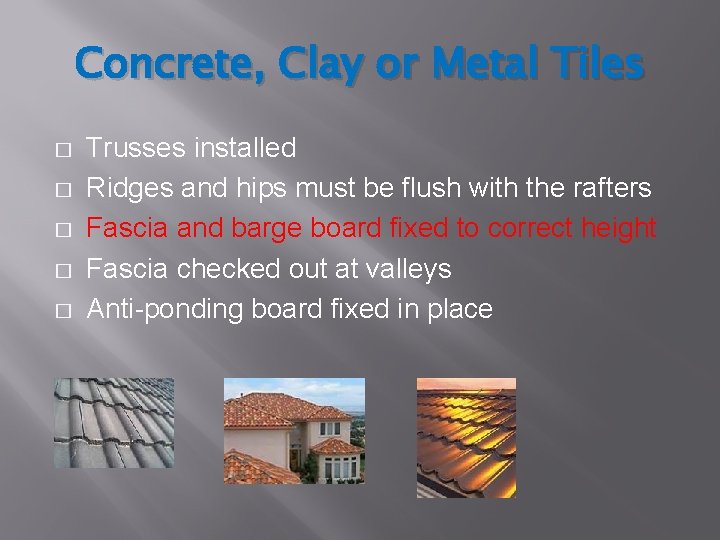
Concrete, Clay or Metal Tiles � � � Trusses installed Ridges and hips must be flush with the rafters Fascia and barge board fixed to correct height Fascia checked out at valleys Anti-ponding board fixed in place
Membrane Roofing (Butynol) � � � Plywood fixed properly. Angle fillets internal corners and chamfered edges external. Constructed to a 1. 5 degree minimum slope R. EE 2/AS 12004 BUT that only covers synthetic rubber membranes that have no applied finish. BRANZ recommends a 3 degree minimum slope. See Branz Pages 251 - 256 and 235 -236 Substrate is flush and straight (no ponding) Control joints formed as detailed/specified
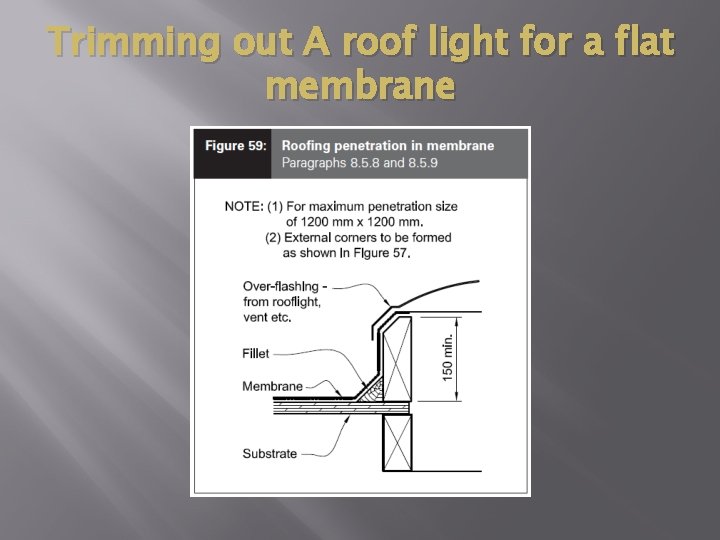
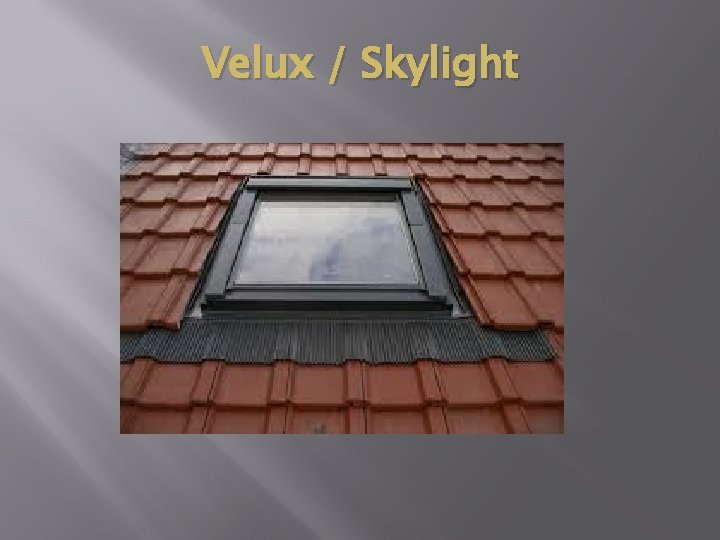
Trimming out A roof light for a flat membrane
Timber, Asphalt and Slate Shingles � � Close board or ply sarking fixed to rafters Valley boards cut in flush with the rafters Keep substrate dry See Branz Pages 247 -250 and 234
Barge Board and Fascia Board � � As the builder or main contractor on site it is our job/responsibility to ensure that all the fascia board and barge board is installed and completed prior to the roofer arriving on site to install the roof cladding. With the fascia we know that it needs to be installed to take the soffets and to sit just below the bottom purlin to ensure it doesn't interfere with the roof cladding. Which makes this a reasonably straight forward process. How ever !!!
BARGE BOARD � � What are two things that determine the height in which the barge board is fixed to the rafter. The type of barge capping weather its barrel or box capping ? The type of roof cladding being used E. G Metal or concrete tiles etc The manufacturers specs will give details for this.
Group Activity � � � Group one – What type of roof underlay is recommended under all tile roofs and is compulsory for roofs with pitches less than 17 degrees. Group Two – What type of roof underlay is installed under timber shingle roofs Group Three – What type of roof underlay is installed under the valleys of asphalt shingle roofing
Group Activity � � Group Four – Research and find the following drawings and give back to the class the resource you found it in and page number to complete required sketches. 1. A Detail showing Fascia board fixed at the correct height. 2. A Detail showing how sarking is installed for a shingle roof. 3. A Detail showing how a roof light is trimmed out for a flat membrane.
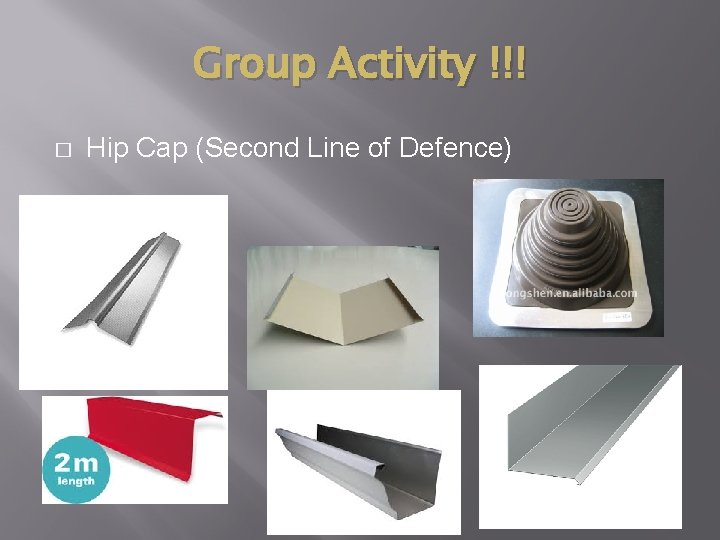
Describe the purpose of the following & there installation instructions: � � � � Ridging Hip Caps Barge Covers Valley Gutters Penetration Flashings Apron Flashings Check with manufacturer for the type of accessory to match the type of cladding and installation instructions.
Detail of how a roof finishes at the Barge and eaves ? � � � 10 mm gap required between downturn of flashing and crest and 5 mm clear of trough (see E 2/AS 1 figure 47 Barge flashing with drip edge to turn down Blocking Fascia Trim Cladding Vertical cavity batten Wall underlay Top cavity batten Rafter outrigger Rafter Roofing over underlay
Roofing underlay � � Is underlay required under all metal roofs Taut galvanised wire netting Taut plastic ribbon at 300 mm centres max Which way should underlay run if the roof pitch is over 10 degrees ?
Thermakraft 215 � � Bituminous self supporting building paper It is recommended that you keep laps to a minimum Laps are required to be 150 mm min for your ends and sides and 250 mm for fire retardent kraft paper If your roof pitch is less than 10 degrees which way are you required to run your underlay ?
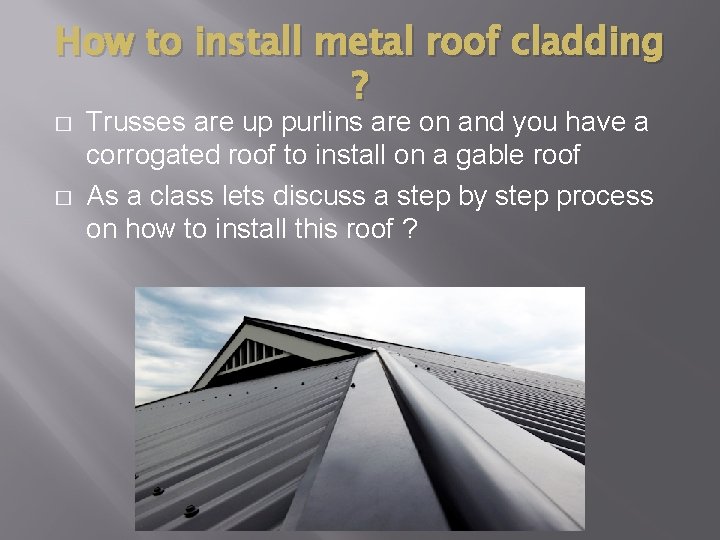
How to install metal roof cladding ? � � Trusses are up purlins are on and you have a corrogated roof to install on a gable roof As a class lets discuss a step by step process on how to install this roof ?
Translucent Roofing � http: //www. youtube. com/watch? v=8 kpcdmu. Qc DI&feature=player_detailpage
Velux / Skylight
Group Activity !!! � Hip Cap (Second Line of Defence)
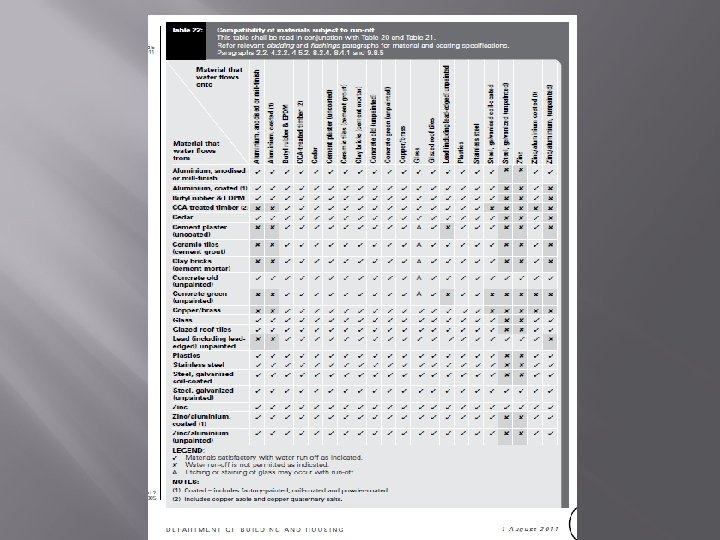
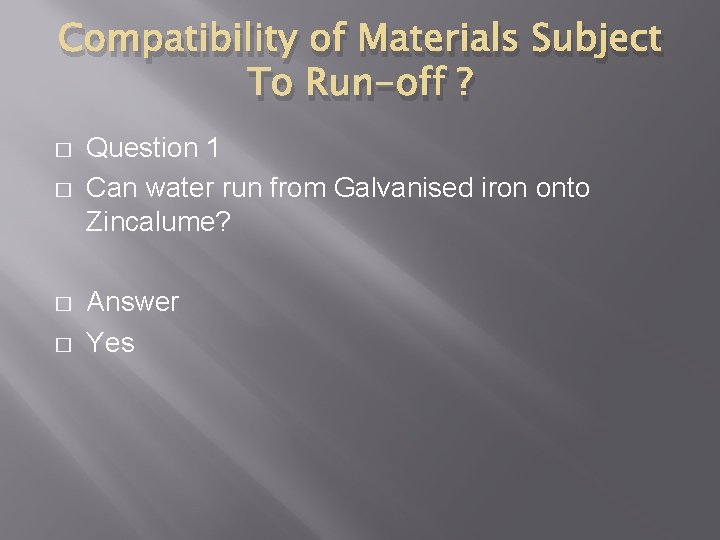
Compatibility of Materials Subject To Run-off ? � � Question 1 Can water run from Galvanised iron onto Zincalume? Answer Yes
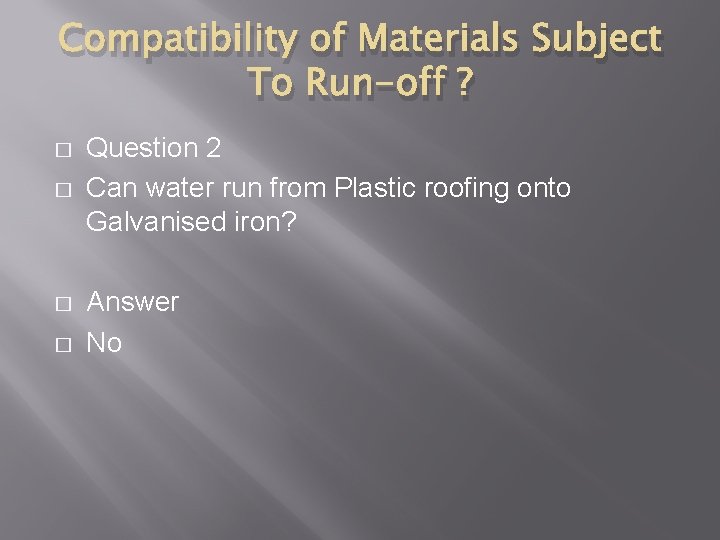
Compatibility of Materials Subject To Run-off ? � � Question 2 Can water run from Plastic roofing onto Galvanised iron? Answer No
Compatibility of Materials Subject To Run-off ? � � Question 3 Can water run from Cedar onto Zincalume? Answer No
Good Roof Cladding Practice : � � � Good roof cladding practice The following are good practice guidelines to follow when fixing all types of roof cladding: • Check before beginning to lay that: • there is adequate pitch for the material and/or profile chosen • the roof is square • the top and bottom corners of the roof framing are level. • Use the manufacturer’s recommended type of fixings for the roofing product and the environmental conditions. • Minimise the amount of traffic over the roof. • Have workers wear soft-soled non-slip footwear. • Walk along lines of support under the roof cladding (purlin or tile batten lines). • Store only sufficient materials on the roof for a 4 -hour work period. • Make periodic checks as roofing proceeds to maintain sheet, tile or shingle course alignment. • Accurately mark purlin positions before beginning to fix roofing (by using a chalk line) to prevent fixing misses. • Do not machine-cut materials on the roof (cut all metal roofing with nibblers). • Clean the roof of all debris when work is complete. • Test the roof for leaks when complete (with a hose) preferably on a windy day.
Useful References � � Branz Book Exterior work book E 2 AS 1 – Membrane roofing page 92 NZS 3604