
ALTERNATIVE LEARNING SYSTEM ACCREDITATION AND EQUIVALENCY PROGRAM Libner
ALTERNATIVE LEARNING SYSTEM ACCREDITATION AND EQUIVALENCY PROGRAM Libner M. Bautista Reporter
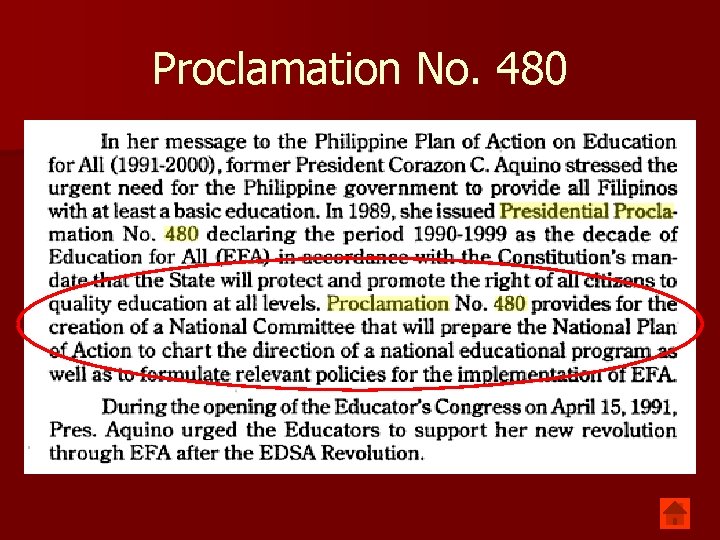
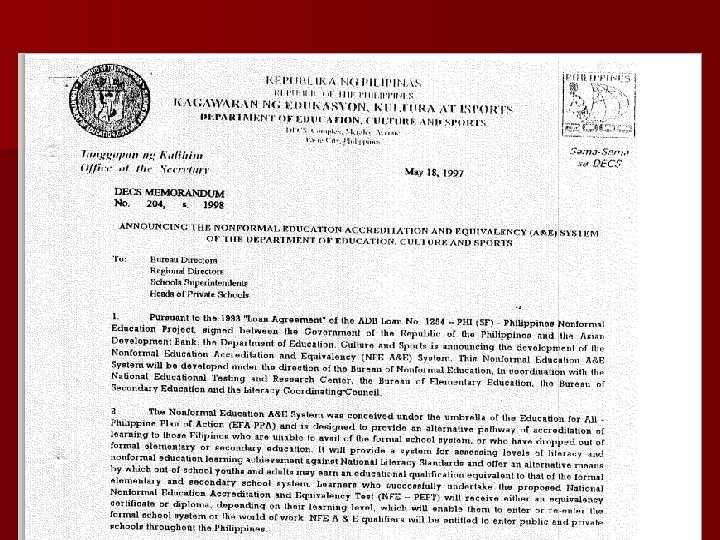
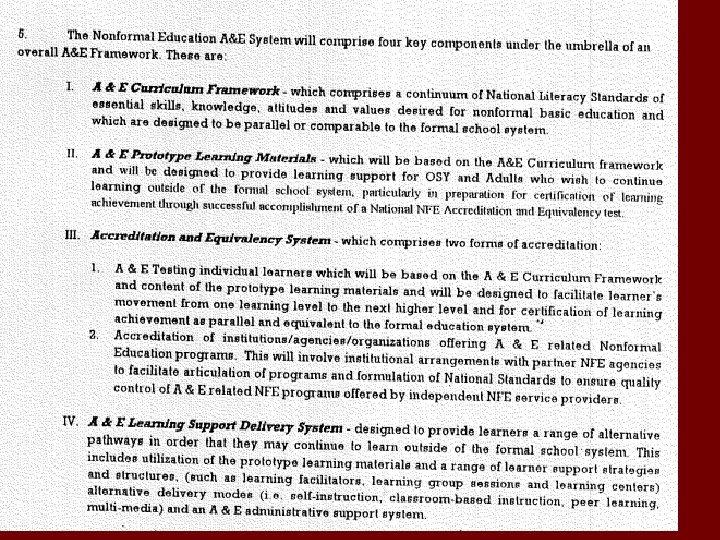
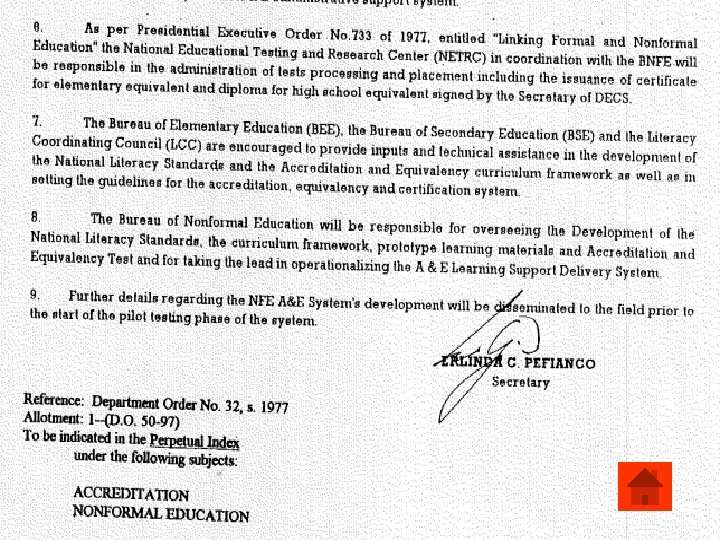
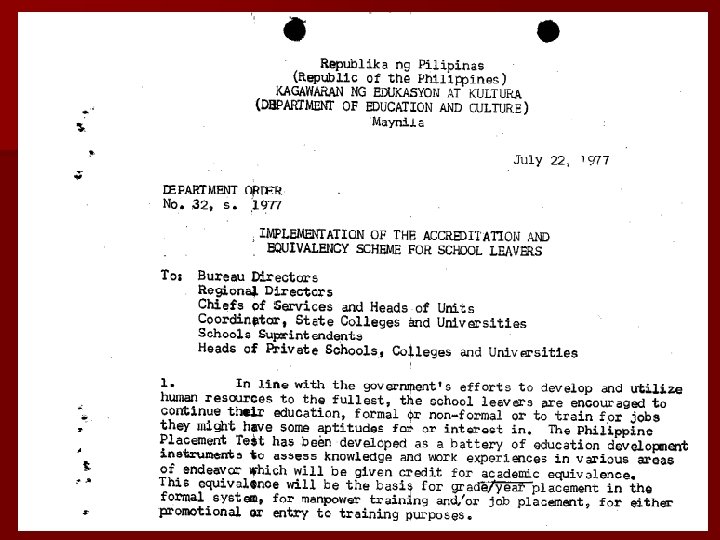
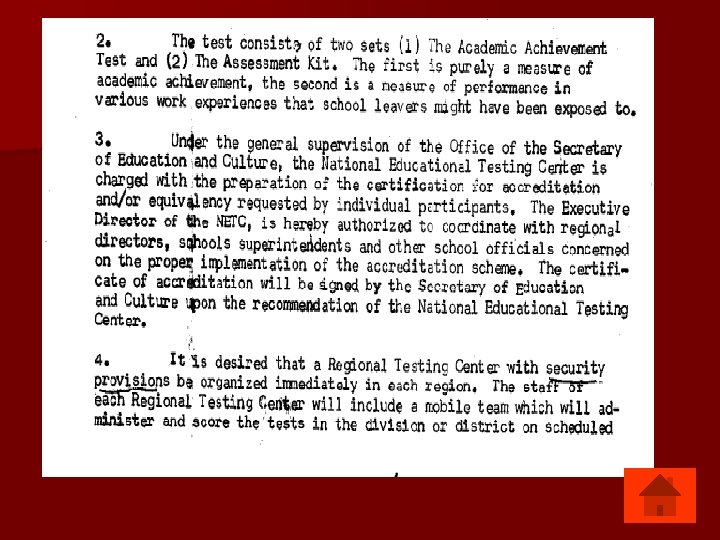
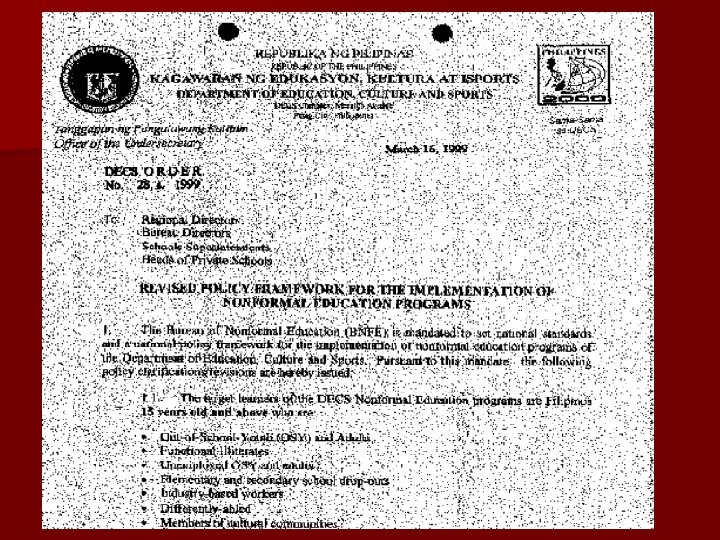
What are the legal bases of ALS? n n n Constitution of the Phil. 1987, Art. XIV Sec. 2 Executive Order No. 117 Sec. 15 Dep. Ed Order No. 32, 1977 DECS MEMO 204, 2, s. 1998 DECS Order 22, 28, s. 1999 Proclamation No. 480
What is Accreditation and Equivalency (A&E) Test? n Two Part Test: – Essay Test – Objective Type Test: Multiple choice paper and pencil test It is designed to measure the competencies of those who have not finished either formal elementary or secondary education. n Certificate/Diploma equivalency (which bears the seal and signature of the Dep. Ed Secretary) = that of a graduate of a formal school. n PASSERS = qualified to enroll to high school/ or college n
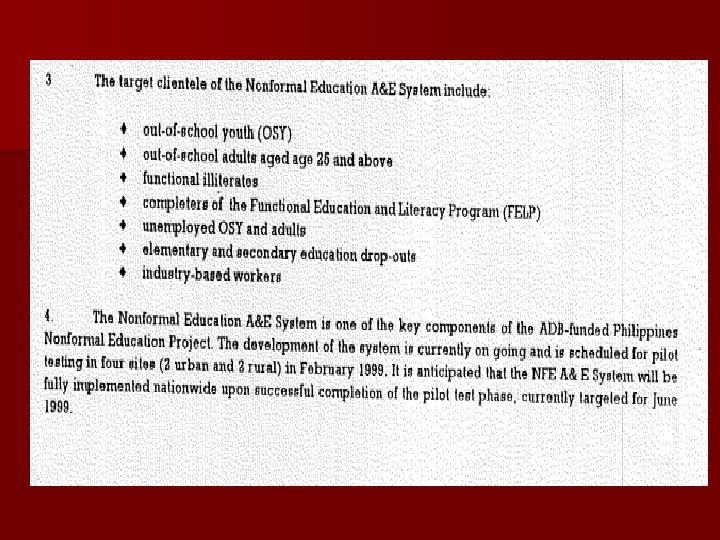
Who are the target clienteles of ALS? n Dropouts: – Elementary Level ages 11 above – High School at least 15 yrs old above – Non-Passers of previous A&E test. – Youth and Adults although in-school, BUT OVERAGED for Grade 6 (more than 11 yrs) or for 4 th Year (more than 15 yrs old)
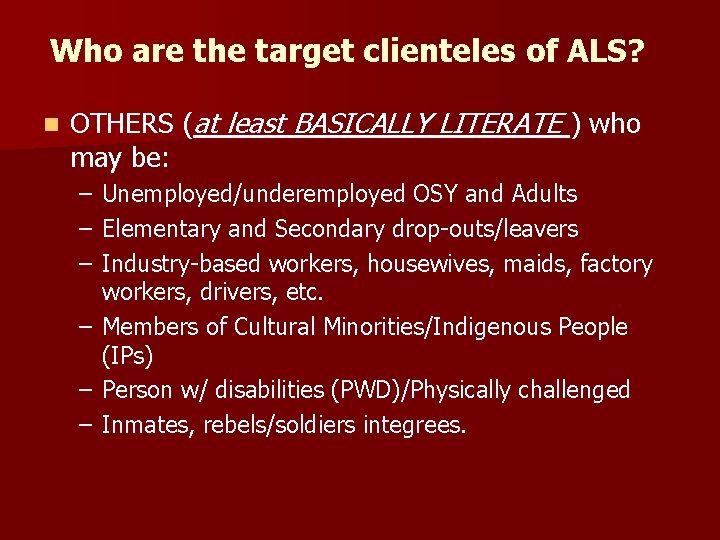
Who are the target clienteles of ALS? n OTHERS (at least BASICALLY LITERATE ) who may be: – – – Unemployed/underemployed OSY and Adults Elementary and Secondary drop-outs/leavers Industry-based workers, housewives, maids, factory workers, drivers, etc. – Members of Cultural Minorities/Indigenous People (IPs) – Person w/ disabilities (PWD)/Physically challenged – Inmates, rebels/soldiers integrees.
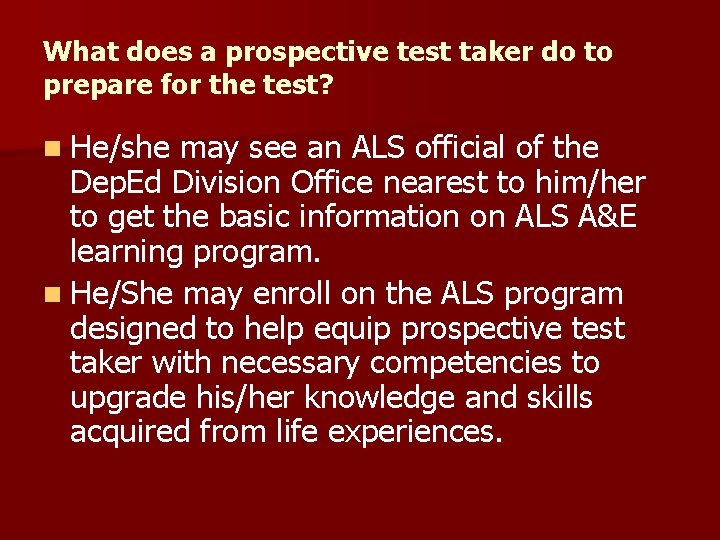
What does a prospective test taker do to prepare for the test? n He/she may see an ALS official of the Dep. Ed Division Office nearest to him/her to get the basic information on ALS A&E learning program. n He/She may enroll on the ALS program designed to help equip prospective test taker with necessary competencies to upgrade his/her knowledge and skills acquired from life experiences.
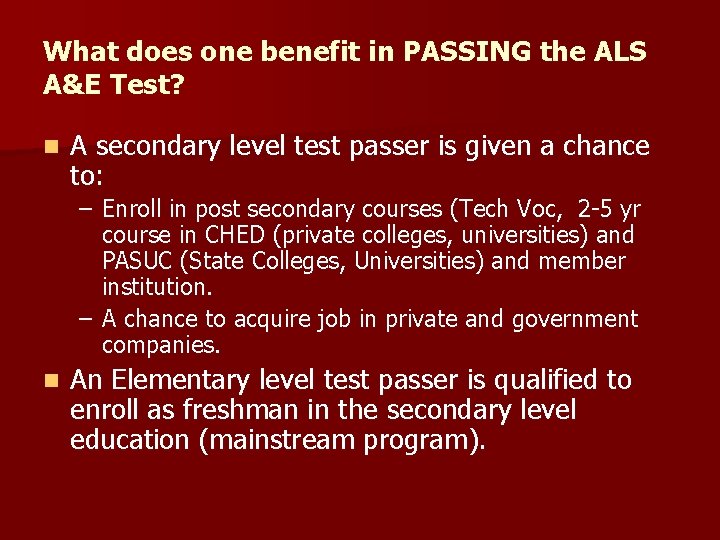
What does one benefit in PASSING the ALS A&E Test? n A secondary level test passer is given a chance to: – Enroll in post secondary courses (Tech Voc, 2 -5 yr course in CHED (private colleges, universities) and PASUC (State Colleges, Universities) and member institution. – A chance to acquire job in private and government companies. n An Elementary level test passer is qualified to enroll as freshman in the secondary level education (mainstream program).
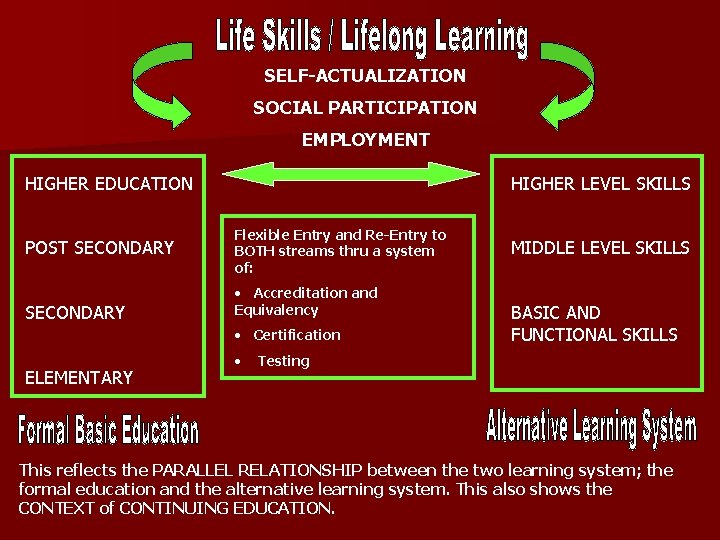
SELF-ACTUALIZATION SOCIAL PARTICIPATION EMPLOYMENT HIGHER EDUCATION POST SECONDARY HIGHER LEVEL SKILLS Flexible Entry and Re-Entry to BOTH streams thru a system of: • Accreditation and Equivalency • Certification ELEMENTARY • MIDDLE LEVEL SKILLS BASIC AND FUNCTIONAL SKILLS Testing This reflects the PARALLEL RELATIONSHIP between the two learning system; the formal education and the alternative learning system. This also shows the CONTEXT of CONTINUING EDUCATION.
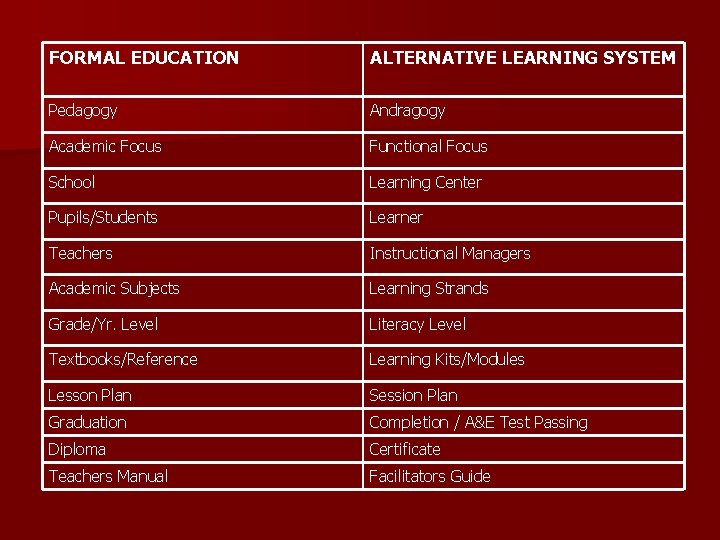
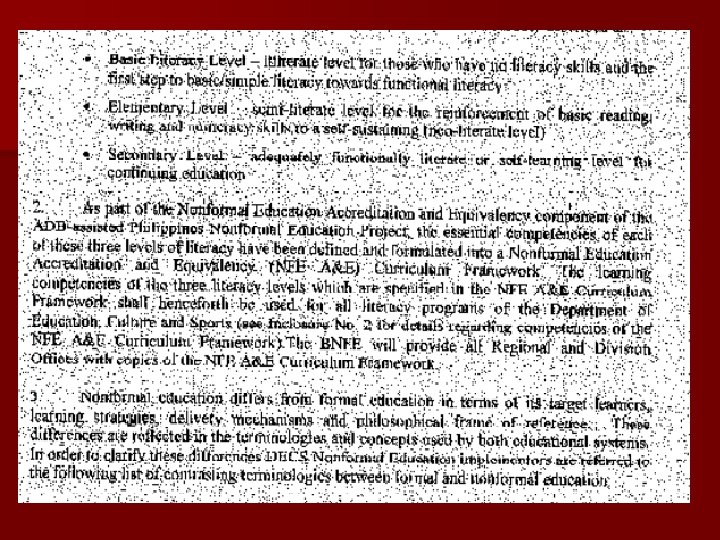
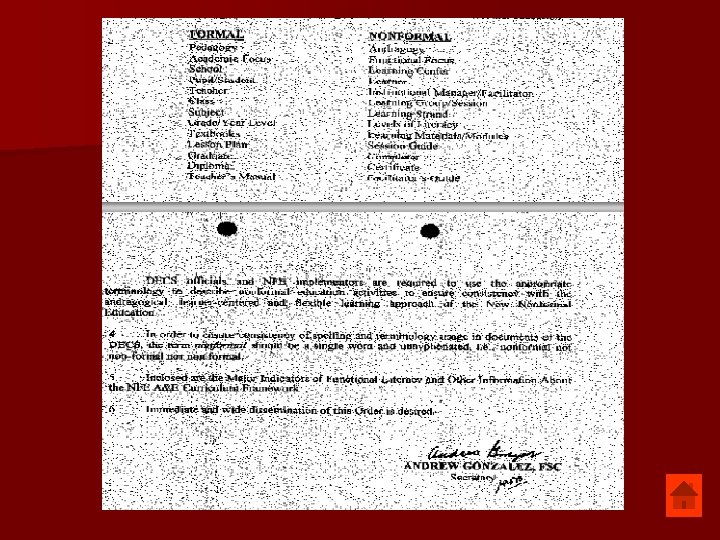
FORMAL EDUCATION ALTERNATIVE LEARNING SYSTEM Pedagogy Andragogy Academic Focus Functional Focus School Learning Center Pupils/Students Learner Teachers Instructional Managers Academic Subjects Learning Strands Grade/Yr. Level Literacy Level Textbooks/Reference Learning Kits/Modules Lesson Plan Session Plan Graduation Completion / A&E Test Passing Diploma Certificate Teachers Manual Facilitators Guide
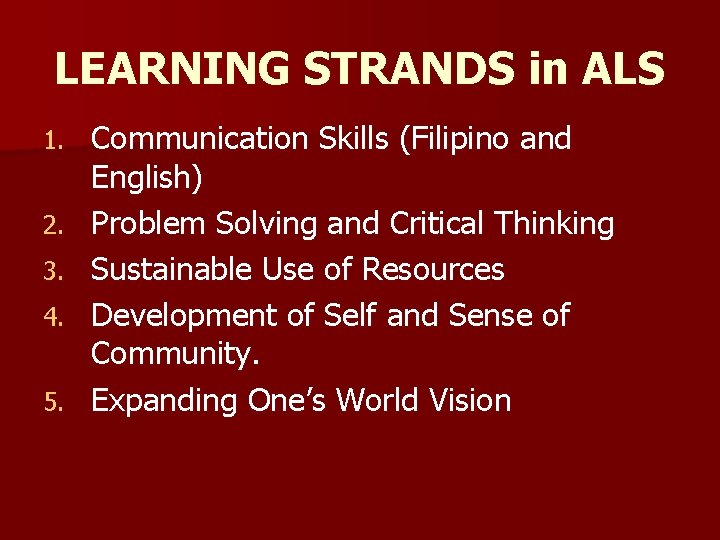
LEARNING STRANDS in ALS 1. 2. 3. 4. 5. Communication Skills (Filipino and English) Problem Solving and Critical Thinking Sustainable Use of Resources Development of Self and Sense of Community. Expanding One’s World Vision
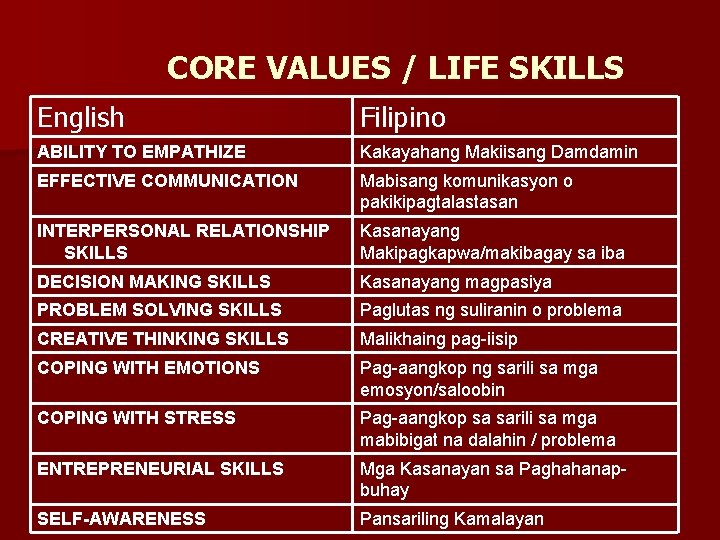
CORE VALUES / LIFE SKILLS English Filipino ABILITY TO EMPATHIZE Kakayahang Makiisang Damdamin EFFECTIVE COMMUNICATION Mabisang komunikasyon o pakikipagtalastasan INTERPERSONAL RELATIONSHIP SKILLS Kasanayang Makipagkapwa/makibagay sa iba DECISION MAKING SKILLS Kasanayang magpasiya PROBLEM SOLVING SKILLS Paglutas ng suliranin o problema CREATIVE THINKING SKILLS Malikhaing pag-iisip COPING WITH EMOTIONS Pag-aangkop ng sarili sa mga emosyon/saloobin COPING WITH STRESS Pag-aangkop sa sarili sa mga mabibigat na dalahin / problema ENTREPRENEURIAL SKILLS Mga Kasanayan sa Paghahanapbuhay SELF-AWARENESS Pansariling Kamalayan
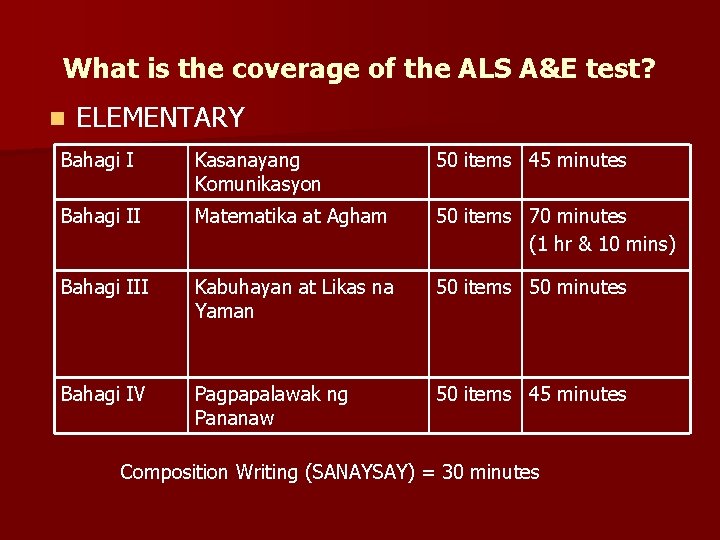
What is the coverage of the ALS A&E test? n ELEMENTARY Bahagi I Kasanayang Komunikasyon 50 items 45 minutes Bahagi II Matematika at Agham 50 items 70 minutes (1 hr & 10 mins) Bahagi III Kabuhayan at Likas na Yaman 50 items 50 minutes Bahagi IV Pagpapalawak ng Pananaw 50 items 45 minutes Composition Writing (SANAYSAY) = 30 minutes
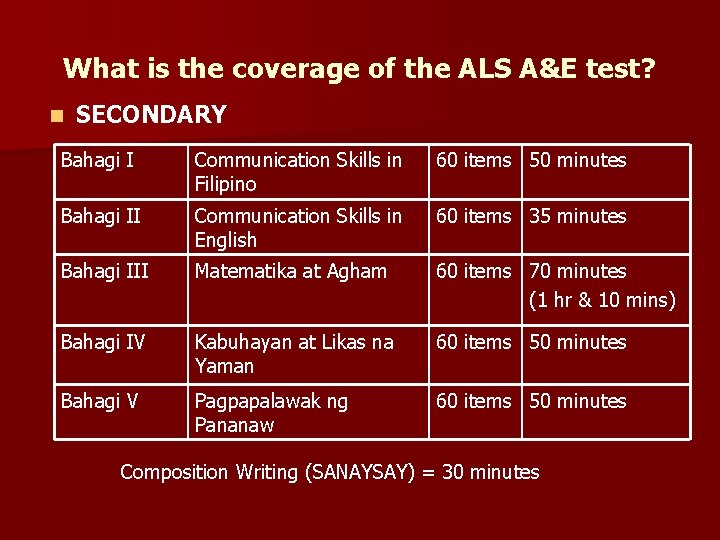
What is the coverage of the ALS A&E test? n SECONDARY Bahagi I Communication Skills in Filipino 60 items 50 minutes Bahagi II Communication Skills in English 60 items 35 minutes Bahagi III Matematika at Agham 60 items 70 minutes (1 hr & 10 mins) Bahagi IV Kabuhayan at Likas na Yaman 60 items 50 minutes Bahagi V Pagpapalawak ng Pananaw 60 items 50 minutes Composition Writing (SANAYSAY) = 30 minutes
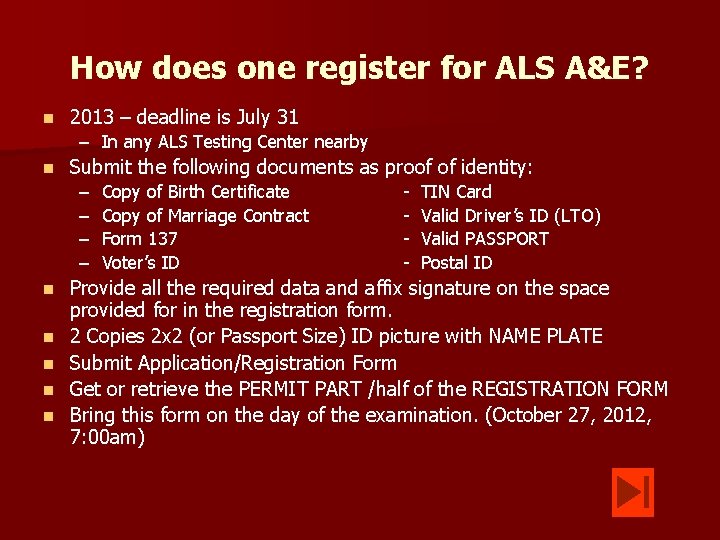
How does one register for ALS A&E? n 2013 – deadline is July 31 – In any ALS Testing Center nearby n Submit the following documents as proof of identity: – – n n n Copy of Birth Certificate Copy of Marriage Contract Form 137 Voter’s ID - TIN Card Valid Driver’s ID (LTO) Valid PASSPORT Postal ID Provide all the required data and affix signature on the space provided for in the registration form. 2 Copies 2 x 2 (or Passport Size) ID picture with NAME PLATE Submit Application/Registration Form Get or retrieve the PERMIT PART /half of the REGISTRATION FORM Bring this form on the day of the examination. (October 27, 2012, 7: 00 am)
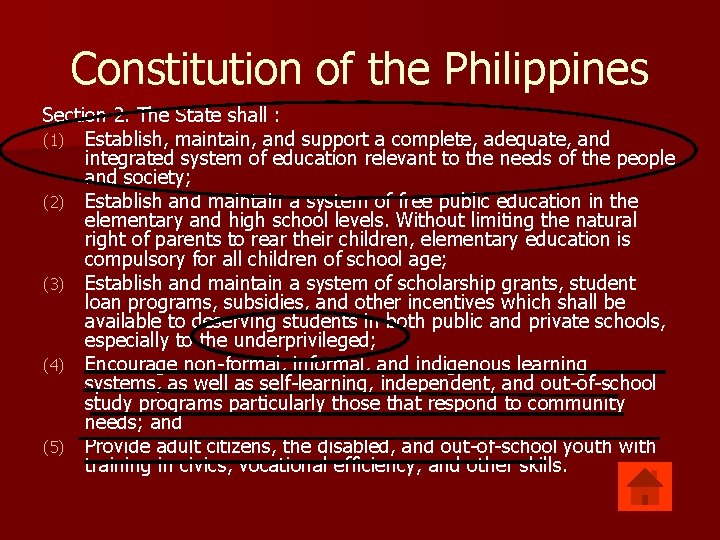
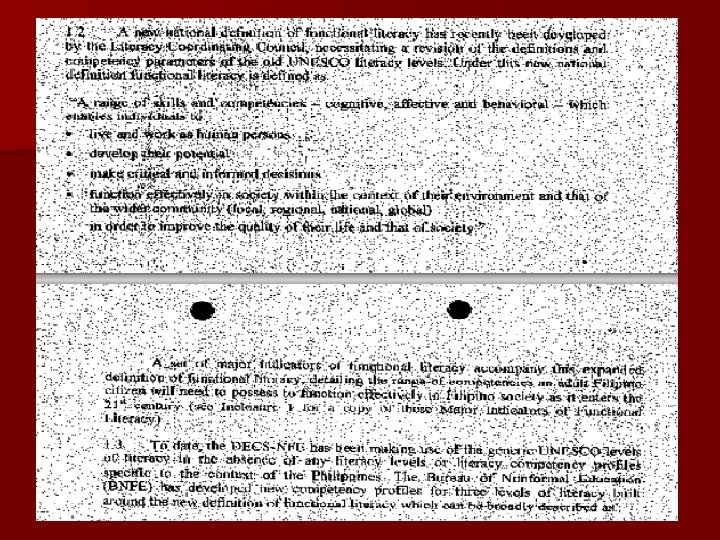
Constitution of the Philippines Section 2. The State shall : (1) Establish, maintain, and support a complete, adequate, and integrated system of education relevant to the needs of the people and society; (2) Establish and maintain a system of free public education in the elementary and high school levels. Without limiting the natural right of parents to rear their children, elementary education is compulsory for all children of school age; (3) Establish and maintain a system of scholarship grants, student loan programs, subsidies, and other incentives which shall be available to deserving students in both public and private schools, especially to the underprivileged; (4) Encourage non-formal, informal, and indigenous learning systems, as well as self-learning, independent, and out-of-school study programs particularly those that respond to community needs; and (5) Provide adult citizens, the disabled, and out-of-school youth with training in civics, vocational efficiency, and other skills.
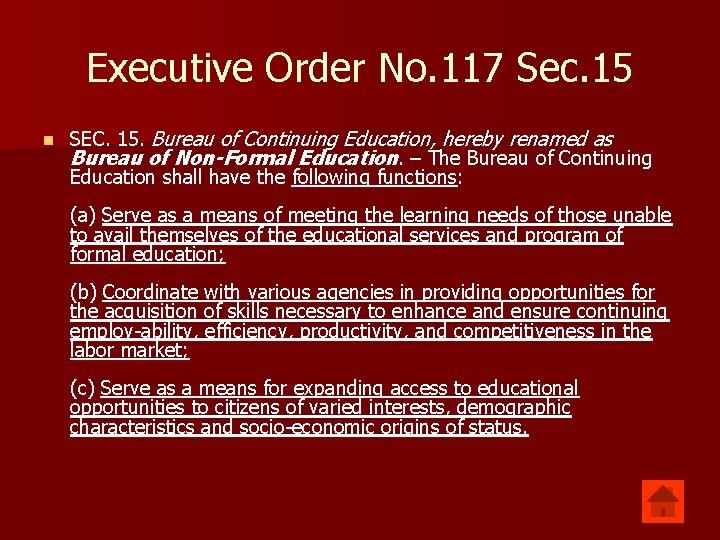
Executive Order No. 117 Sec. 15 n SEC. 15. Bureau of Continuing Education, hereby renamed as Bureau of Non-Formal Education. – The Bureau of Continuing Education shall have the following functions: (a) Serve as a means of meeting the learning needs of those unable to avail themselves of the educational services and program of formal education; (b) Coordinate with various agencies in providing opportunities for the acquisition of skills necessary to enhance and ensure continuing employ-ability, efficiency, productivity, and competitiveness in the labor market; (c) Serve as a means for expanding access to educational opportunities to citizens of varied interests, demographic characteristics and socio-economic origins of status.
Proclamation No. 480
THE PARABLE OF THE TOY BALLOON
The farmer’s son had a blind obsession for a “green toy balloon”. The boy’s feelings started when his father bought him once at a town fair the year before.
Unfortunately, it was also a traumatic experience, for he lost his grip on the string and the balloon soared upward. Heartbroken, he watched tearfully as the toy disappeared into the sky beyond his sight.
Since then, the boy had longed for a new toy balloon. But none were sold in the place where he lives. Wherever he went, he hoped to see a toy balloon peddler. In his pocket, he always carries with him his savings in case a peddler by some chance will appear.
At night, the boy thought and dreamt of the green balloon. In the morning, he would look out the window. Sometimes, a dot in the sky looked like his lost toy.
One day, the boy noticed that there are balloons for sale in front of their school. Excitedly, he bought a green one. He rushed home and inflated it. He tied it with a piece of string to look like his lost green balloon.
But to his disappointment, the balloon would not fly. He tried to toss it upward but still it glided down. He harbored his disappointments for months. Why my balloon shouldn’t fly when it looks exactly like the one I lost, he always thought to himself.
In one of those important religious festivities, his father took him along to the town church. His heart almost burst with excitement when he saw a peddler holding a bunch of multi-colored floating balloons.
He ran towards the church gate as he retrieved his long kept savings. “The green one please, ” requested the boy excitedly. Then he has to ask about the mystery that had baffled him for months.
“Mamang Tindero, why is it your balloons can fly? I had one and I even inflated it myself but it would not soar upward. Yet they look exactly alike. ”
The peddler smiled and replied, “It is not how the balloons look, that enable them to fly, but it is the one inside them that makes them soar high.
As an afterthought, the peddler added, “Just like you, young man. It is what inside you that will make you rise up to best of what you can be. ”
4 A’s of ADULT EXPERIENTIAL LEARNING PROCESS n ACTIVITY (Experience) – designed to engage the learner actively. – It may range from case analysis and questionnaires to stimulation exercise, role playing and personal disclosure sessions. n ANALYSIS (Reflective Feedback) – Describe the process of inquiry into the result of the activity.
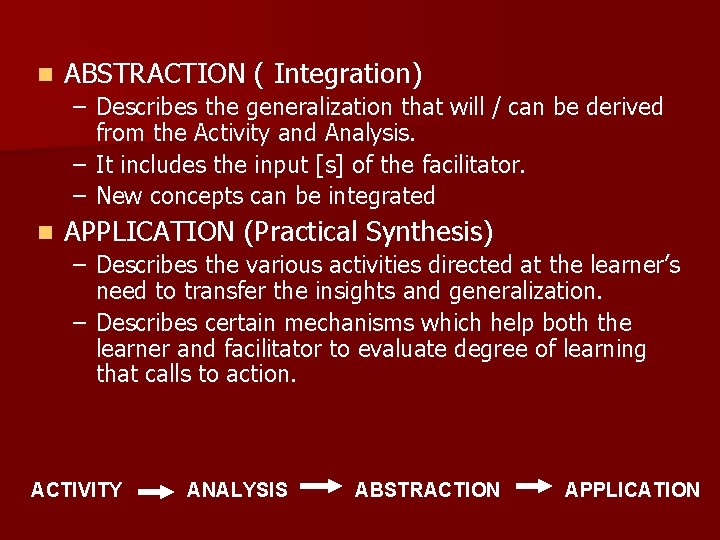
n ABSTRACTION ( Integration) – Describes the generalization that will / can be derived from the Activity and Analysis. – It includes the input [s] of the facilitator. – New concepts can be integrated n APPLICATION (Practical Synthesis) – Describes the various activities directed at the learner’s need to transfer the insights and generalization. – Describes certain mechanisms which help both the learner and facilitator to evaluate degree of learning that calls to action. ACTIVITY ANALYSIS ABSTRACTION APPLICATION
10 LITTLE TEACHERS
TEN Little Teachers standing in line ONE disliked her job, then there were NINE…
NINE little Teachers stayed up very late ONE oversleeps on class days, then there were EIGHT…
EIGHT little Teachers on their way to Heaven ONE took the low road and then there were SEVEN…
SEVEN little Teachers chirping like chicks ONE disliked music, then there were SIX…
SIX little Teachers seemed very much alive, but ONE lost his interest then there FIVE…
FIVE little Teachers pulling for Heaven's Shore, but ONE stopped to rest, then there were FOUR…
FOUR little Teachers each busy as a bee, ONE got his feelings hurt, then there were THREE…
THREE little Teachers knew not what to do, ONE joined the feudal crowd, then there were TWO…
TWO little Teachers, our rhyme is nearly done, differed with each other, then there was 0 NE…
ONE little Teacher can't do much 'tis true brought his friend to reflection -- then there were TWO…
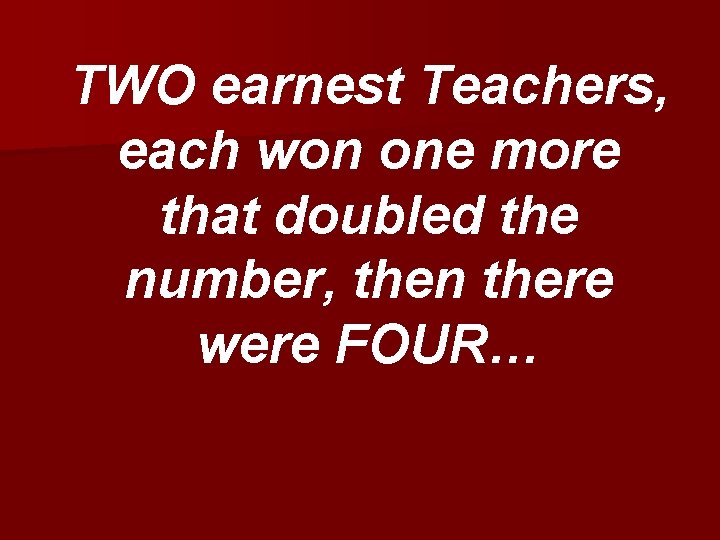
TWO earnest Teachers, each won one more that doubled the number, then there were FOUR…
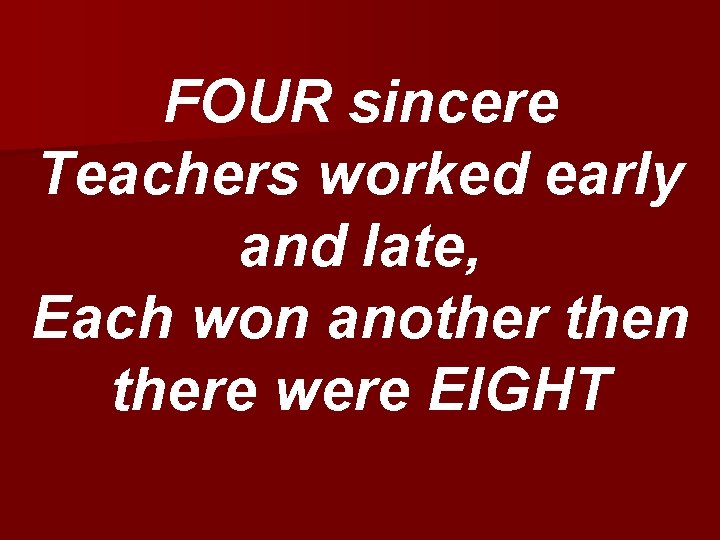
FOUR sincere Teachers worked early and late, Each won another then there were EIGHT
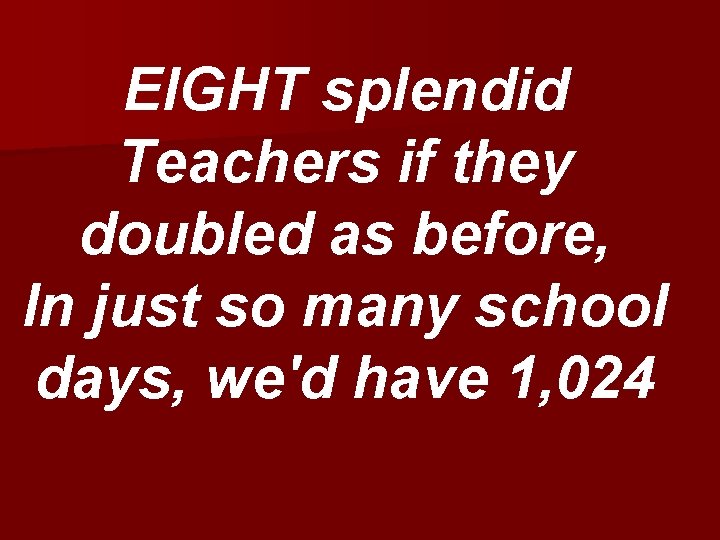
EIGHT splendid Teachers if they doubled as before, In just so many school days, we'd have 1, 024
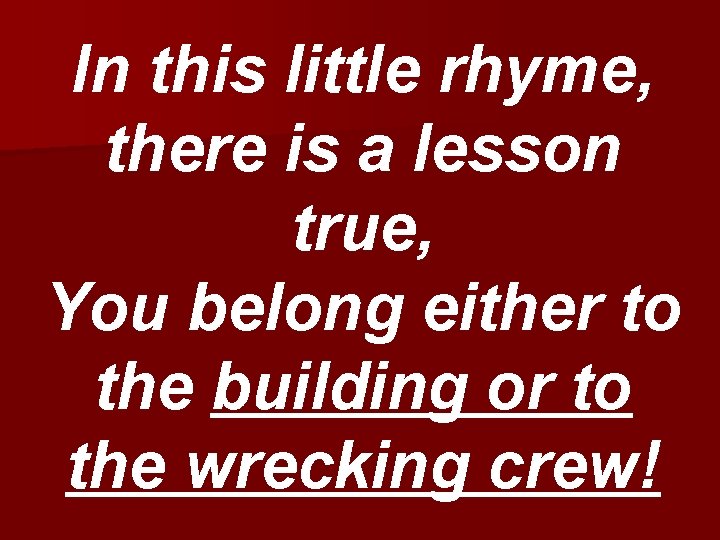
In this little rhyme, there is a lesson true, You belong either to the building or to the wrecking crew!
St. John Baptist De La Salle … …PRAY FOR US Live JESUS in Our Hearts… …FOREVER
TOGETHER and by ASSOCIATION LET US RISK OUR LIVES FOR THE YOUTH AT RISK! ( The Least, The Lost, and The Last) Kuya Iboh Libner M. Bautista
- Slides: 58