
Alternative Ion Injector Design V S Morozov JLEIC
- Slides: 20
Alternative Ion Injector Design V. S. Morozov JLEIC Weekly R&D Meeting April 7, 2016
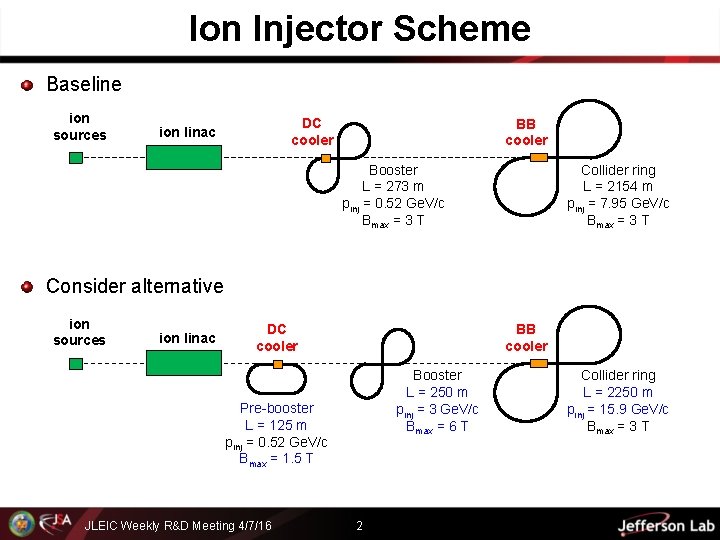
Ion Injector Scheme Baseline ion sources DC cooler ion linac BB cooler Booster L = 273 m pinj = 0. 52 Ge. V/c Bmax = 3 T Collider ring L = 2154 m pinj = 7. 95 Ge. V/c Bmax = 3 T Consider alternative ion sources ion linac DC cooler BB cooler Booster L = 250 m pinj = 3 Ge. V/c Bmax = 6 T Pre-booster L = 125 m pinj = 0. 52 Ge. V/c Bmax = 1. 5 T JLEIC Weekly R&D Meeting 4/7/16 2 Collider ring L = 2250 m pinj = 15. 9 Ge. V/c Bmax = 3 T
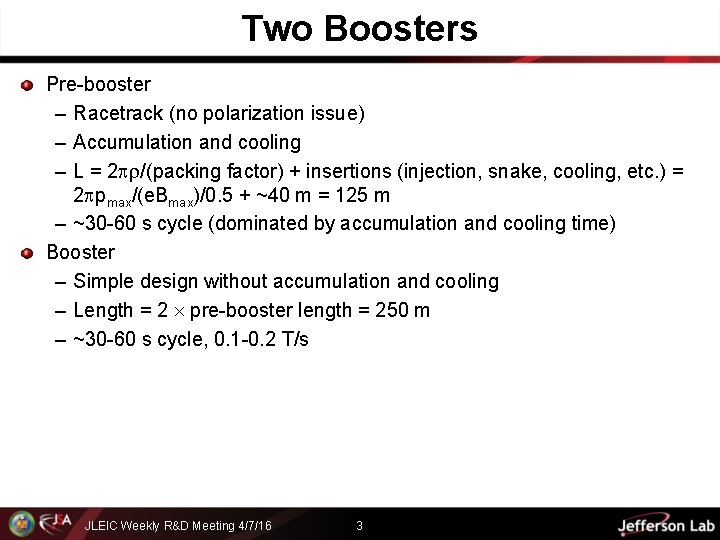
Two Boosters Pre-booster – Racetrack (no polarization issue) – Accumulation and cooling – L = 2 /(packing factor) + insertions (injection, snake, cooling, etc. ) = 2 pmax/(e. Bmax)/0. 5 + ~40 m = 125 m – ~30 -60 s cycle (dominated by accumulation and cooling time) Booster – Simple design without accumulation and cooling – Length = 2 pre-booster length = 250 m – ~30 -60 s cycle, 0. 1 -0. 2 T/s JLEIC Weekly R&D Meeting 4/7/16 3
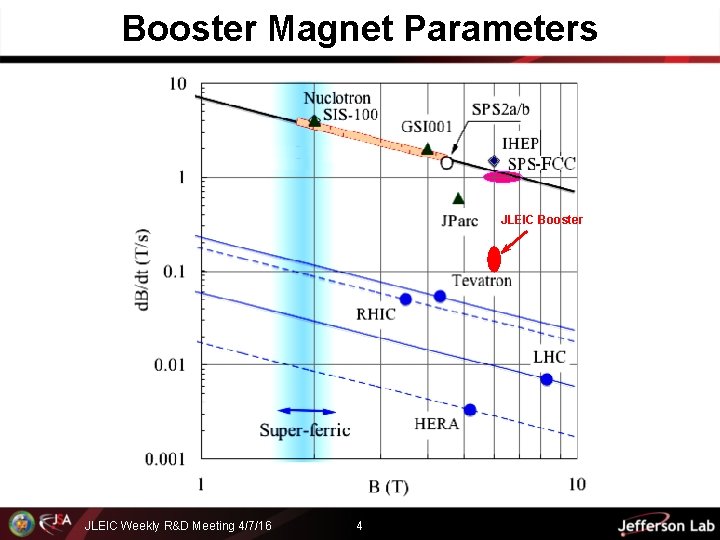
Booster Magnet Parameters JLEIC Booster JLEIC Weekly R&D Meeting 4/7/16 4
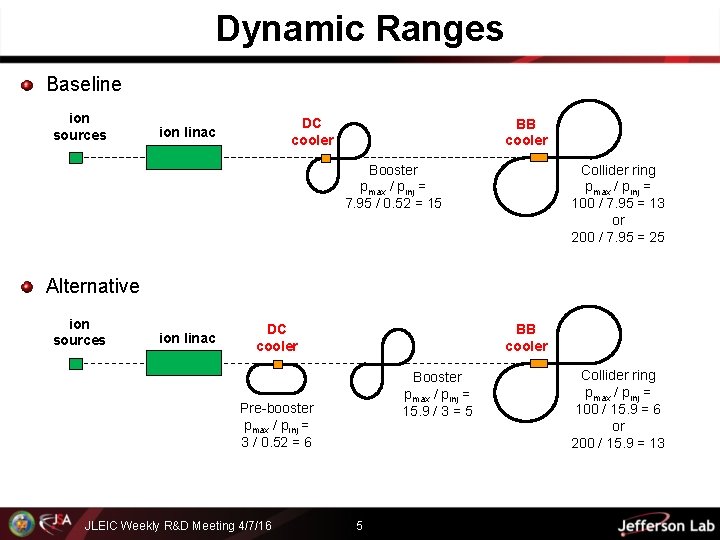
Dynamic Ranges Baseline ion sources DC cooler ion linac BB cooler Booster pmax / pinj = 7. 95 / 0. 52 = 15 Collider ring pmax / pinj = 100 / 7. 95 = 13 or 200 / 7. 95 = 25 Alternative ion sources ion linac DC cooler BB cooler Booster pmax / pinj = 15. 9 / 3 = 5 Pre-booster pmax / pinj = 3 / 0. 52 = 6 JLEIC Weekly R&D Meeting 4/7/16 5 Collider ring pmax / pinj = 100 / 15. 9 = 6 or 200 / 15. 9 = 13
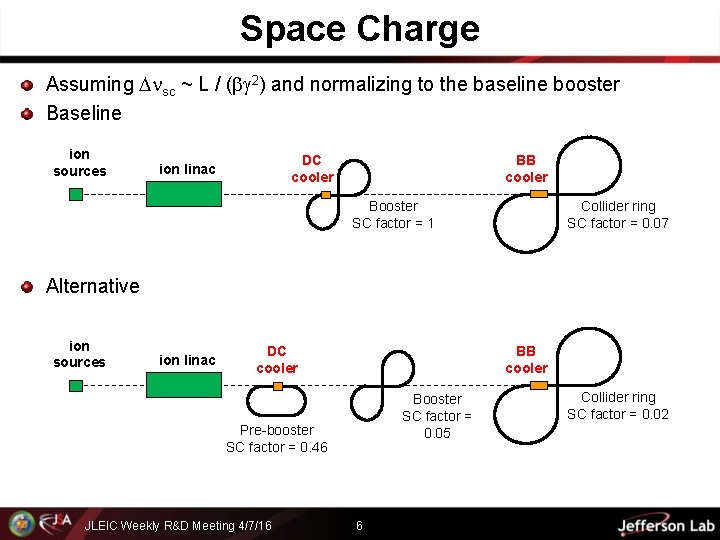
Space Charge Assuming sc ~ L / ( 2) and normalizing to the baseline booster Baseline ion sources DC cooler ion linac BB cooler Booster SC factor = 1 Collider ring SC factor = 0. 07 Alternative ion sources ion linac DC cooler BB cooler Booster SC factor = 0. 05 Pre-booster SC factor = 0. 46 JLEIC Weekly R&D Meeting 4/7/16 6 Collider ring SC factor = 0. 02
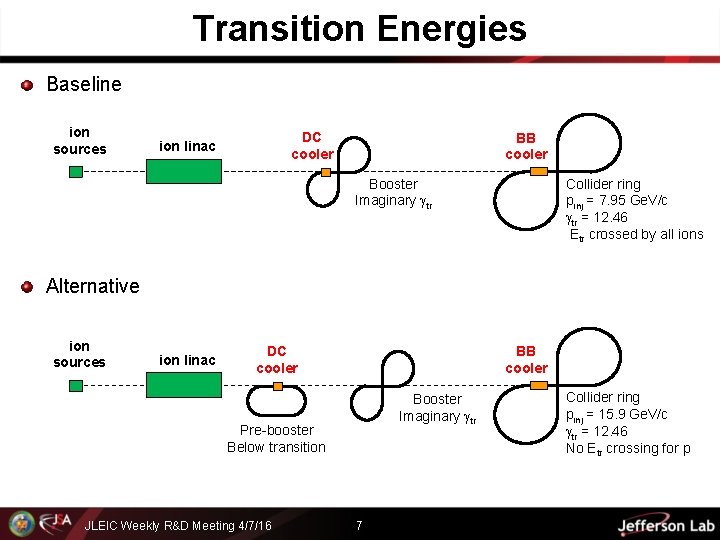
Transition Energies Baseline ion sources DC cooler ion linac BB cooler Booster Imaginary tr Collider ring pinj = 7. 95 Ge. V/c tr = 12. 46 Etr crossed by all ions Alternative ion sources ion linac DC cooler BB cooler Booster Imaginary tr Pre-booster Below transition JLEIC Weekly R&D Meeting 4/7/16 7 Collider ring pinj = 15. 9 Ge. V/c tr = 12. 46 No Etr crossing for p
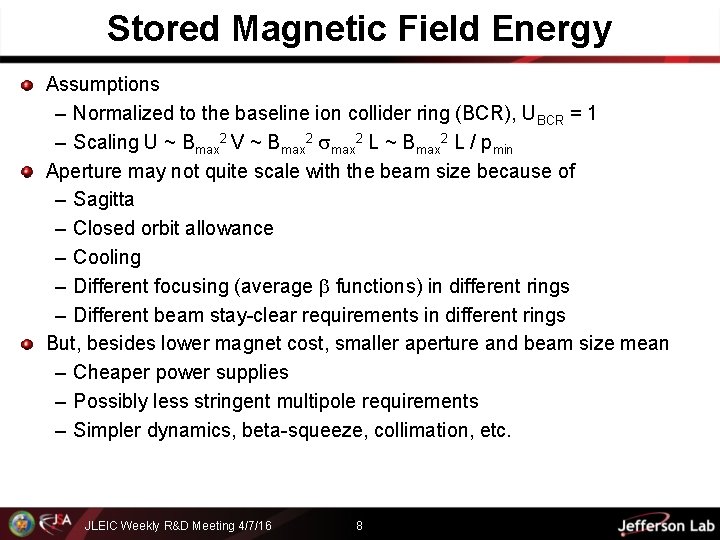
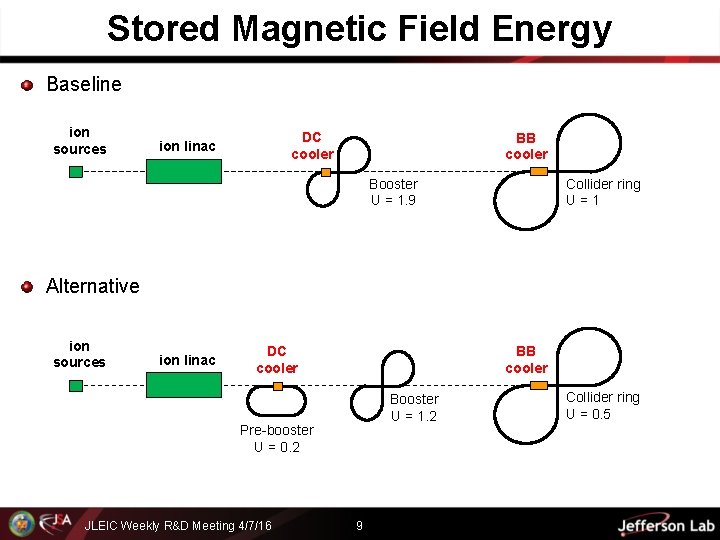
Stored Magnetic Field Energy Assumptions – Normalized to the baseline ion collider ring (BCR), UBCR = 1 – Scaling U ~ Bmax 2 V ~ Bmax 2 L / pmin Aperture may not quite scale with the beam size because of – Sagitta – Closed orbit allowance – Cooling – Different focusing (average functions) in different rings – Different beam stay-clear requirements in different rings But, besides lower magnet cost, smaller aperture and beam size mean – Cheaper power supplies – Possibly less stringent multipole requirements – Simpler dynamics, beta-squeeze, collimation, etc. JLEIC Weekly R&D Meeting 4/7/16 8
Stored Magnetic Field Energy Baseline ion sources DC cooler ion linac BB cooler Booster U = 1. 9 Collider ring U=1 Alternative ion sources ion linac DC cooler BB cooler Booster U = 1. 2 Pre-booster U = 0. 2 JLEIC Weekly R&D Meeting 4/7/16 9 Collider ring U = 0. 5
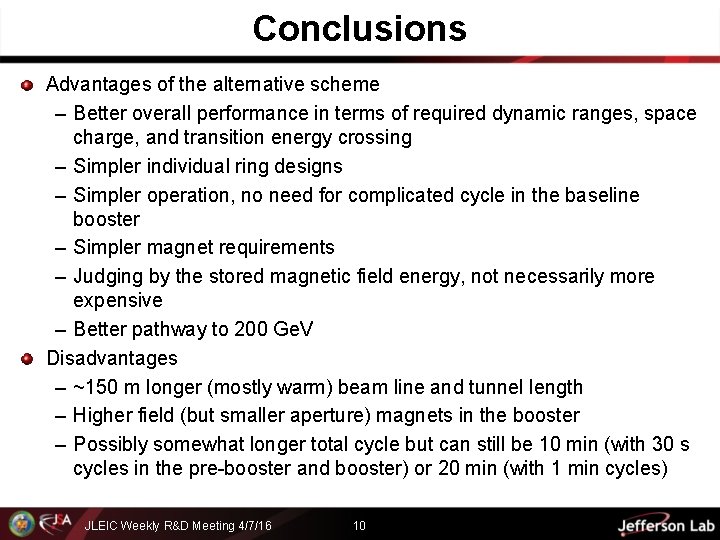
Conclusions Advantages of the alternative scheme – Better overall performance in terms of required dynamic ranges, space charge, and transition energy crossing – Simpler individual ring designs – Simpler operation, no need for complicated cycle in the baseline booster – Simpler magnet requirements – Judging by the stored magnetic field energy, not necessarily more expensive – Better pathway to 200 Ge. V Disadvantages – ~150 m longer (mostly warm) beam line and tunnel length – Higher field (but smaller aperture) magnets in the booster – Possibly somewhat longer total cycle but can still be 10 min (with 30 s cycles in the pre-booster and booster) or 20 min (with 1 min cycles) JLEIC Weekly R&D Meeting 4/7/16 10
Backup JLEIC Weekly R&D Meeting 4/7/16 11
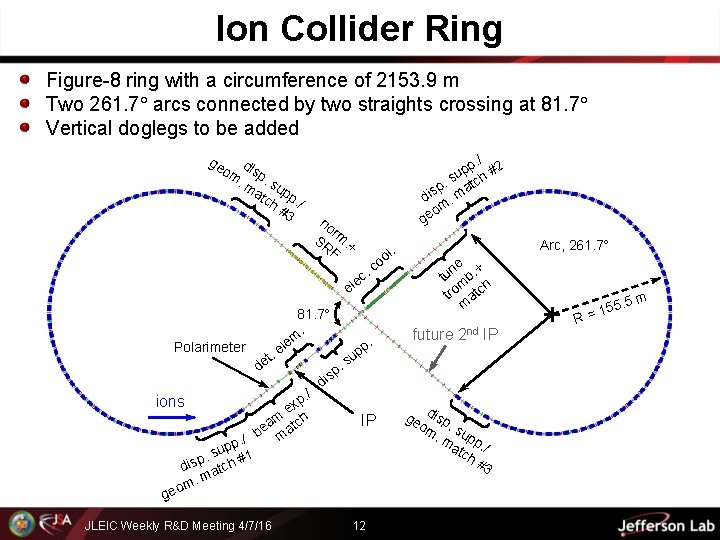
Ion Collider Ring Figure-8 ring with a circumference of 2153. 9 m Two 261. 7 arcs connected by two straights crossing at 81. 7 Vertical doglegs to be added ge om disp. m. su atc pp h #. / 3 p. / #2 p su tch. p a dis. m om e g no r SR m. + F. ec . ol o c el Polarimeter . t de 81. 7 . em el / p. x e m a atch e / b m. p p. su #1 p s di atch. m m o ge s p. . pp ne + tu b. m h tro atc m future 2 nd IP u s di ions JLEIC Weekly R&D Meeting 4/7/16 Arc, 261. 7 IP 12 ge disp om. s. m upp atc. / h# 3 R . 5 m 5 = 15
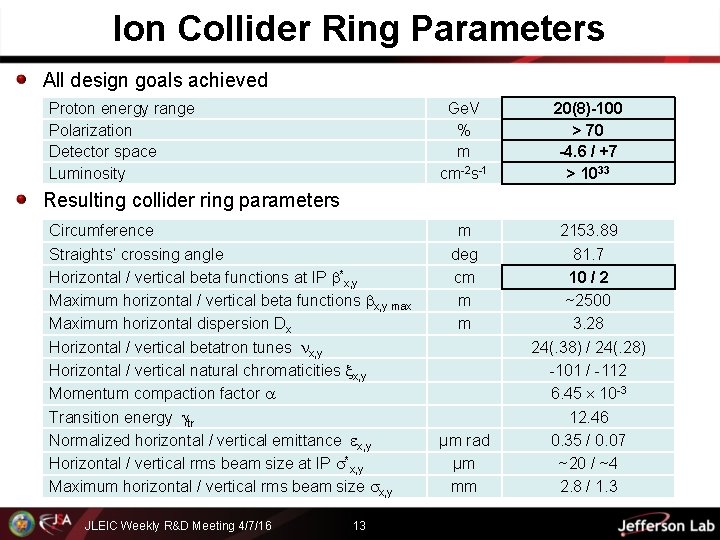
Ion Collider Ring Parameters All design goals achieved Proton energy range Polarization Detector space Luminosity Ge. V % m cm-2 s-1 20(8)-100 > 70 -4. 6 / +7 > 1033 m deg cm m m 2153. 89 81. 7 10 / 2 ~2500 3. 28 24(. 38) / 24(. 28) -101 / -112 6. 45 10 -3 12. 46 0. 35 / 0. 07 ~20 / ~4 2. 8 / 1. 3 Resulting collider ring parameters Circumference Straights’ crossing angle Horizontal / vertical beta functions at IP *x, y Maximum horizontal / vertical beta functions x, y max Maximum horizontal dispersion Dx Horizontal / vertical betatron tunes x, y Horizontal / vertical natural chromaticities x, y Momentum compaction factor Transition energy tr Normalized horizontal / vertical emittance x, y Horizontal / vertical rms beam size at IP *x, y Maximum horizontal / vertical rms beam size x, y JLEIC Weekly R&D Meeting 4/7/16 13 µm rad µm mm
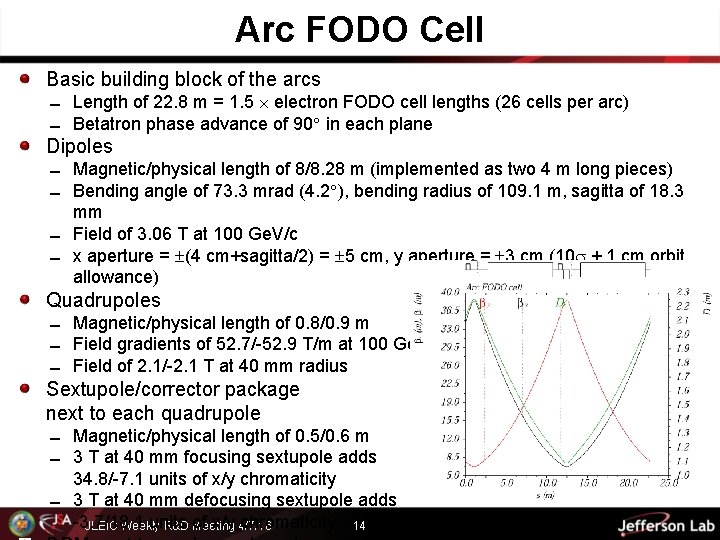
Arc FODO Cell Basic building block of the arcs Length of 22. 8 m = 1. 5 electron FODO cell lengths (26 cells per arc) Betatron phase advance of 90 in each plane Dipoles Magnetic/physical length of 8/8. 28 m (implemented as two 4 m long pieces) Bending angle of 73. 3 mrad (4. 2 ), bending radius of 109. 1 m, sagitta of 18. 3 mm Field of 3. 06 T at 100 Ge. V/c x aperture = (4 cm+sagitta/2) = 5 cm, y aperture = 3 cm (10 + 1 cm orbit allowance) Quadrupoles Magnetic/physical length of 0. 8/0. 9 m Field gradients of 52. 7/-52. 9 T/m at 100 Ge. V/c Field of 2. 1/-2. 1 T at 40 mm radius Sextupole/corrector package next to each quadrupole Magnetic/physical length of 0. 5/0. 6 m 3 T at 40 mm focusing sextupole adds 34. 8/-7. 1 units of x/y chromaticity 3 T at 40 mm defocusing sextupole adds -3. 7/18. 1 units x/y 4/7/16 chromaticity 14 JLEIC Weekly R&D of Meeting
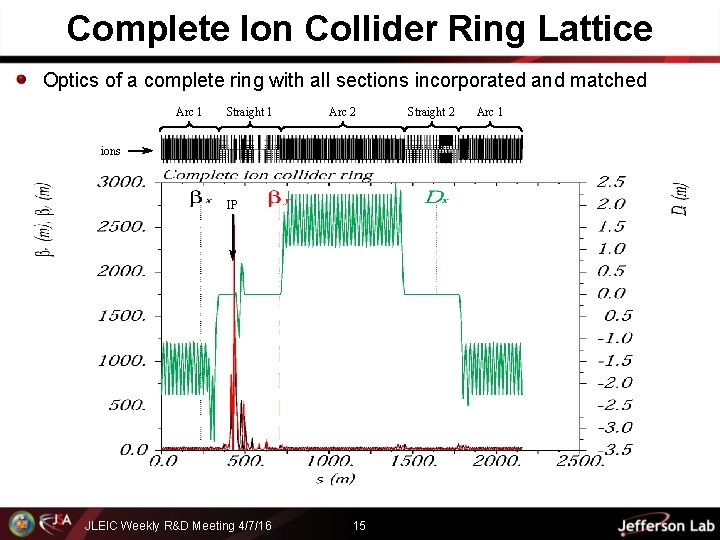
Complete Ion Collider Ring Lattice Optics of a complete ring with all sections incorporated and matched Arc 1 Straight 1 Arc 2 ions IP JLEIC Weekly R&D Meeting 4/7/16 15 Straight 2 Arc 1
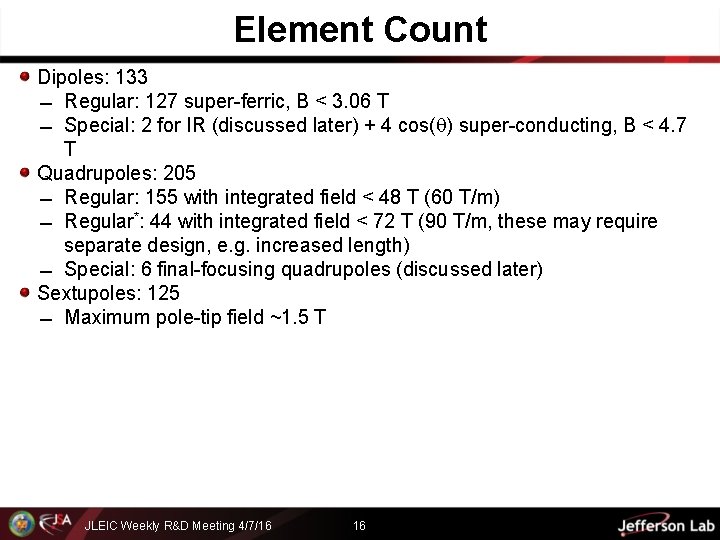
Element Count Dipoles: 133 Regular: 127 super-ferric, B < 3. 06 T Special: 2 for IR (discussed later) + 4 cos( ) super-conducting, B < 4. 7 T Quadrupoles: 205 Regular: 155 with integrated field < 48 T (60 T/m) Regular*: 44 with integrated field < 72 T (90 T/m, these may require separate design, e. g. increased length) Special: 6 final-focusing quadrupoles (discussed later) Sextupoles: 125 Maximum pole-tip field ~1. 5 T JLEIC Weekly R&D Meeting 4/7/16 16
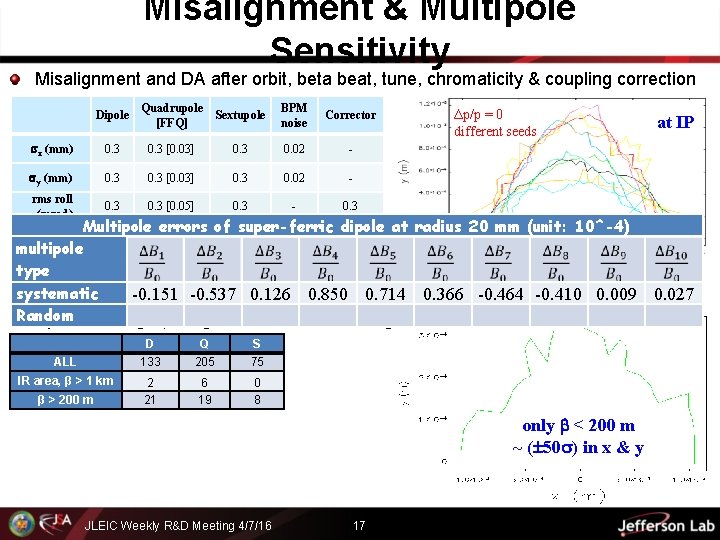
Misalignment & Multipole Sensitivity Misalignment and DA after orbit, beta beat, tune, chromaticity & coupling correction Dipole Quadrupole [FFQ] Sextupole BPM noise Corrector x (mm) 0. 3 [0. 03] 0. 3 0. 02 - y (mm) 0. 3 [0. 03] 0. 3 0. 02 - rms roll (mrad) 0. 3 [0. 05] 0. 3 - 0. 3 Δp/p = 0 different seeds at IP ~( 50 ) x&y Multipole errors of 0. 3 super-ferric dipole at radius 20 mm (unit: in 10^-4) 0. 3 [0. 03] multipole Strength 0. 1 0. 2 [0. 03] 0. 2 0. 01 error (%) type systematic -0. 537 0. 126 0. 850 arc 0. 714 -0. 464 -0. 410 0. 009 0. 027 Sensitivity to-0. 151 multipoles in super-ferric dipoles 0. 366 ( < 200 m) per TAMU specs. Random Specs for large- magnets are under investigation s (mm) D Q S ALL 133 205 75 IR area, β > 1 km 2 21 6 19 0 8 β > 200 m only < 200 m ~ ( 50 ) in x & y JLEIC Weekly R&D Meeting 4/7/16 17
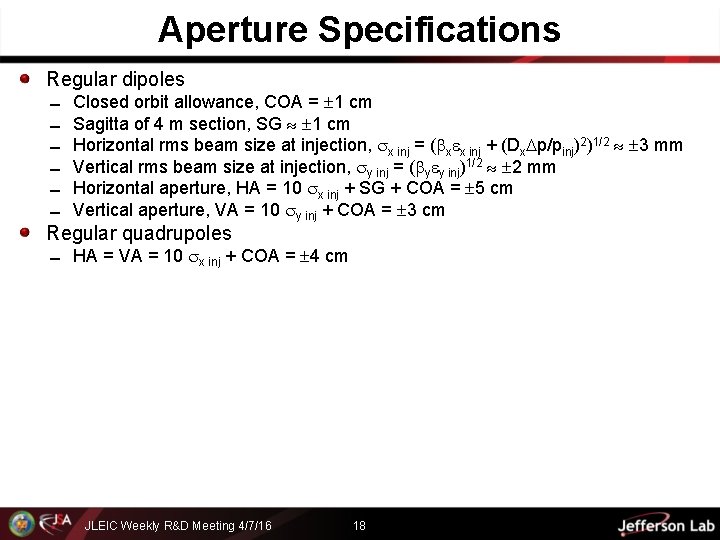
Aperture Specifications Regular dipoles Closed orbit allowance, COA = 1 cm Sagitta of 4 m section, SG 1 cm Horizontal rms beam size at injection, x inj = ( x x inj + (Dx p/pinj)2)1/2 3 mm Vertical rms beam size at injection, y inj = ( y y inj)1/2 2 mm Horizontal aperture, HA = 10 x inj + SG + COA = 5 cm Vertical aperture, VA = 10 y inj + COA = 3 cm Regular quadrupoles HA = VA = 10 x inj + COA = 4 cm JLEIC Weekly R&D Meeting 4/7/16 18
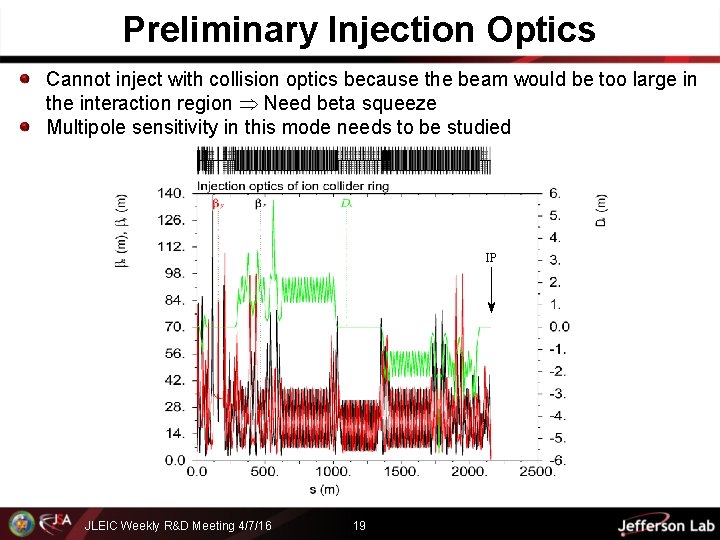
Preliminary Injection Optics Cannot inject with collision optics because the beam would be too large in the interaction region Need beta squeeze Multipole sensitivity in this mode needs to be studied IP JLEIC Weekly R&D Meeting 4/7/16 19
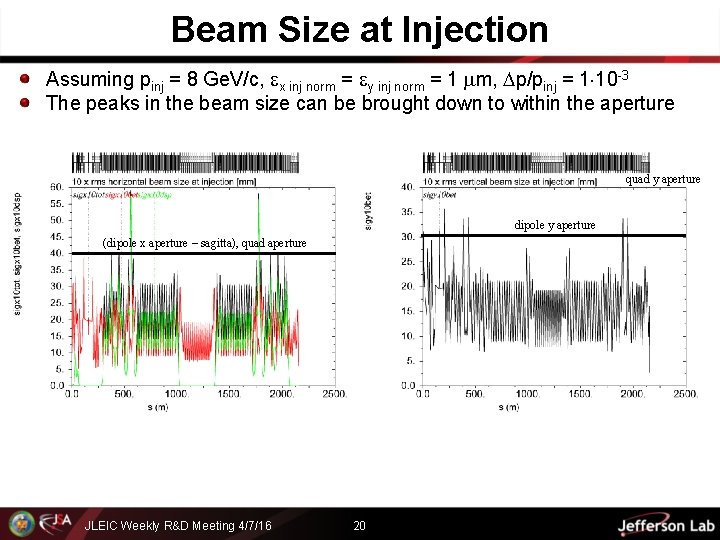
Beam Size at Injection Assuming pinj = 8 Ge. V/c, x inj norm = y inj norm = 1 m, p/pinj = 1 10 -3 The peaks in the beam size can be brought down to within the aperture quad y aperture dipole y aperture (dipole x aperture – sagitta), quad aperture JLEIC Weekly R&D Meeting 4/7/16 20