
Alternative accelerating structures for CLIC main linac based
Alternative accelerating structures for CLIC main linac based on dielectrics Yelong Wei, Alexej Grudiev CERN, European Organization for Nuclear Research Email: yelong. wei@cern. ch ALEGRO Workshop, 26 th – 29 th March 2019, CERN 1
Outline § Background & Introduction § Dielectric-Lined Accelerating (DLA) Structures § Dielectric Disk Accelerating (DDA) Structures v TM 01 operation mode v TM 02 operation mode v Wakefield Studies for a TM 02 DDA structure § Summary & Outlook ALEGRO Workshop, 26 th – 29 th March 2019, CERN 2
Outline § Background & Introduction ALEGRO Workshop, 26 th – 29 th March 2019, CERN 3
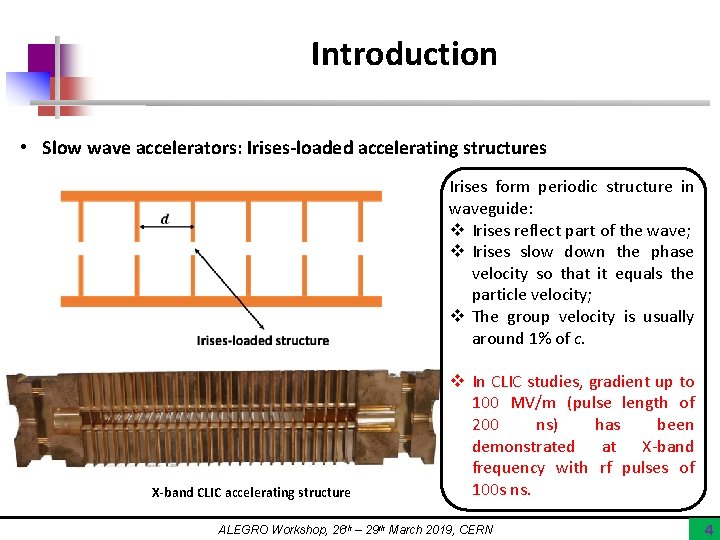
Introduction • Slow wave accelerators: Irises-loaded accelerating structures Irises form periodic structure in waveguide: v Irises reflect part of the wave; v Irises slow down the phase velocity so that it equals the particle velocity; v The group velocity is usually around 1% of c. X-band CLIC accelerating structure v In CLIC studies, gradient up to 100 MV/m (pulse length of 200 ns) has been demonstrated at X-band frequency with rf pulses of 100 s ns. ALEGRO Workshop, 26 th – 29 th March 2019, CERN 4

CLIC-G Accelerating Structure Without HOM Damping Undamped Geometry CST HFSS Phase advance 120° Frequency [GHz] 11. 9949 11. 9943 Unloaded Q 0 7295. 2 7245 r’/Q 0 [Ω/m] 15892 15924 vg/c 0. 018 With HOM Damping ALEGRO Workshop, 26 th – 29 th March 2019, CERN Design of the CLIC main linac accelerating structure for CLIC Conceptual Design Report, Proceedings of Linear Accelerator Conference LINAC 2010, A. Grudiev, W. Wuensch 5
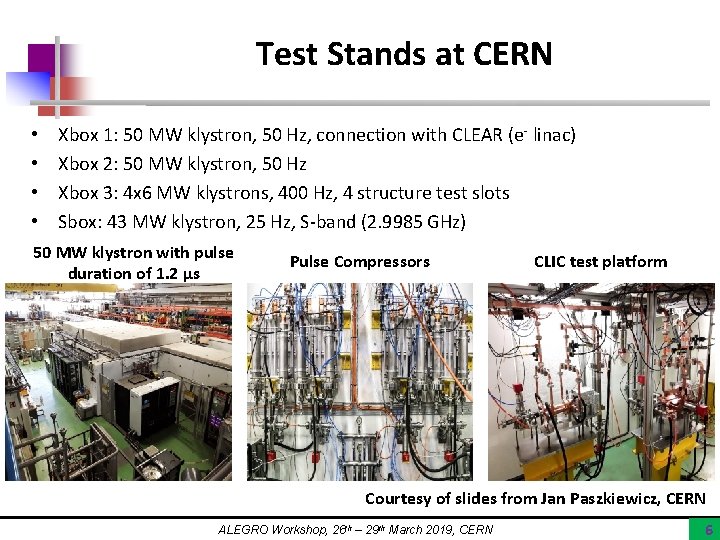
Test Stands at CERN • • Xbox 1: 50 MW klystron, 50 Hz, connection with CLEAR (e- linac) Xbox 2: 50 MW klystron, 50 Hz Xbox 3: 4 x 6 MW klystrons, 400 Hz, 4 structure test slots Sbox: 43 MW klystron, 25 Hz, S-band (2. 9985 GHz) 50 MW klystron with pulse duration of 1. 2 μs Pulse Compressors CLIC test platform Courtesy of slides from Jan Paszkiewicz, CERN ALEGRO Workshop, 26 th – 29 th March 2019, CERN 6
Outline § Dielectric-Lined Accelerating (DLA) Structures ALEGRO Workshop, 26 th – 29 th March 2019, CERN 7

Introduction • Slow wave accelerators: dielectric-lined accelerating (DLA) structures Advantages of DLA: v Simple geometry for easy fabrication; v No field enhancements on irises; v Potential high gradient; v Easy to damp HOMs; Disadvantages of DLA: v Low power efficiency due to high group velocity >10% of c ALEGRO Workshop, 26 th – 29 th March 2019, CERN 8
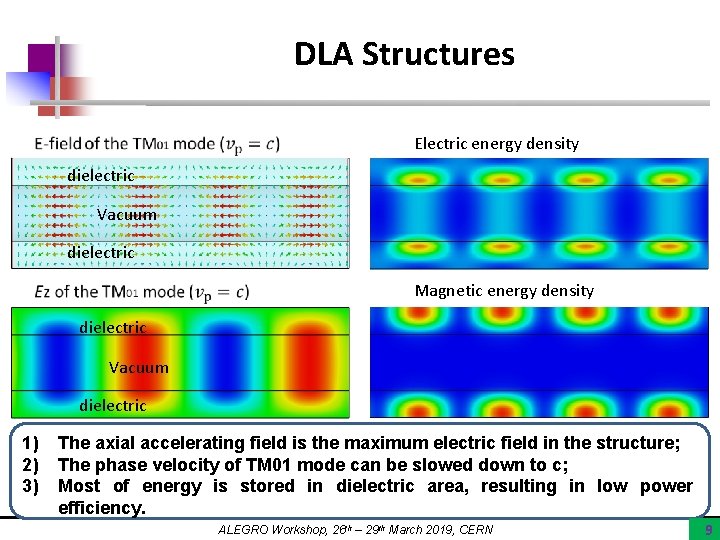
DLA Structures Electric energy density dielectric Vacuum dielectric Magnetic energy density dielectric Vacuum dielectric 1) 2) 3) The axial accelerating field is the maximum electric field in the structure; The phase velocity of TM 01 mode can be slowed down to c; Most of energy is stored in dielectric area, resulting in low power efficiency. ALEGRO Workshop, 26 th – 29 th March 2019, CERN 9
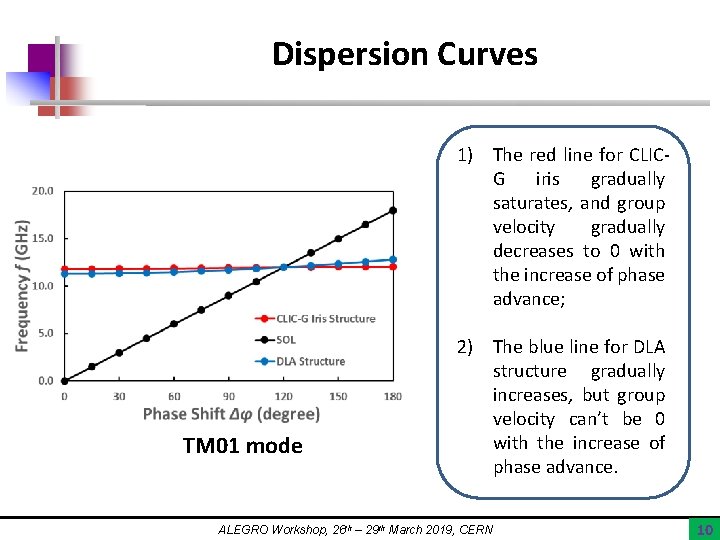
Dispersion Curves 1) The red line for CLICG iris gradually saturates, and group velocity gradually decreases to 0 with the increase of phase advance; TM 01 mode 2) The blue line for DLA structure gradually increases, but group velocity can’t be 0 with the increase of phase advance. ALEGRO Workshop, 26 th – 29 th March 2019, CERN 10
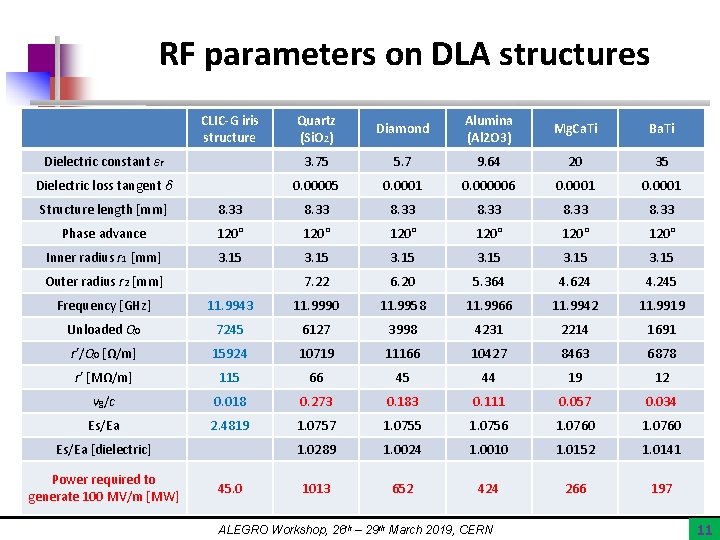
RF parameters on DLA structures CLIC-G iris structure Quartz (Si. O 2) Diamond Alumina (Al 2 O 3) Mg. Ca. Ti Ba. Ti Dielectric constant εr 3. 75 5. 7 9. 64 20 35 Dielectric loss tangent δ 0. 00005 0. 0001 0. 000006 0. 0001 Structure length [mm] 8. 33 Phase advance 120° 120° Inner radius r 1 [mm] 3. 15 7. 22 6. 20 5. 364 4. 624 4. 245 Outer radius r 2 [mm] Frequency [GHz] 11. 9943 11. 9990 11. 9958 11. 9966 11. 9942 11. 9919 Unloaded Q 0 7245 6127 3998 4231 2214 1691 r’/Q 0 [Ω/m] 15924 10719 11166 10427 8463 6878 r’ [MΩ/m] 115 66 45 44 19 12 vg/c 0. 018 0. 273 0. 183 0. 111 0. 057 0. 034 Es/Ea 2. 4819 1. 0757 1. 0755 1. 0756 1. 0760 1. 0289 1. 0024 1. 0010 1. 0152 1. 0141 1013 652 424 266 197 Es/Ea [dielectric] Power required to generate 100 MV/m [MW] 45. 0 ALEGRO Workshop, 26 th – 29 th March 2019, CERN 11
Outline § Dielectric Disk Accelerating (DDA) Structures v TM 01 operation mode ALEGRO Workshop, 26 th – 29 th March 2019, CERN 12
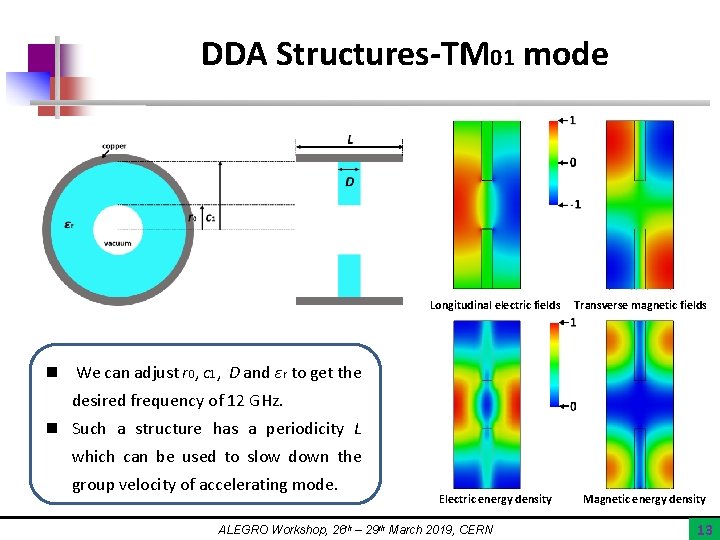
DDA Structures-TM 01 mode Longitudinal electric fields Transverse magnetic fields n We can adjust r 0, c 1, D and εr to get the desired frequency of 12 GHz. n Such a structure has a periodicity L which can be used to slow down the group velocity of accelerating mode. Electric energy density ALEGRO Workshop, 26 th – 29 th March 2019, CERN Magnetic energy density 13
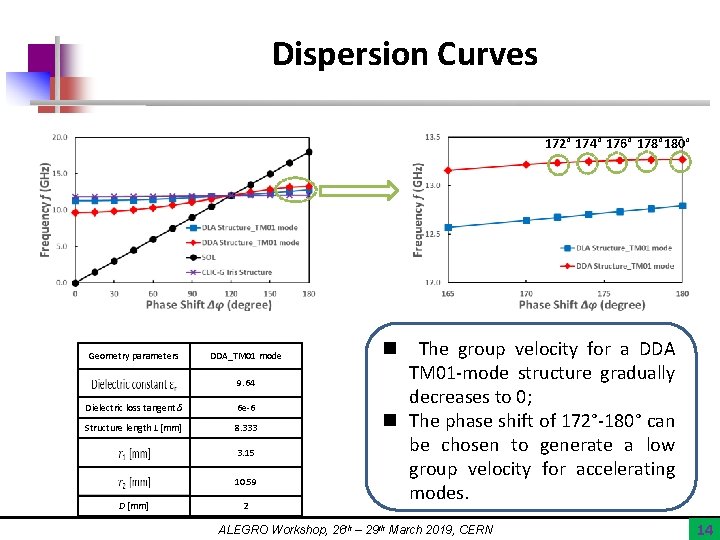
Dispersion Curves 172° 174° 176° 178° 180° Geometry parameters DDA_TM 01 mode 9. 64 Dielectric loss tangent δ 6 e-6 Structure length L [mm] 8. 333 3. 15 10. 59 D [mm] 2 The group velocity for a DDA TM 01 -mode structure gradually decreases to 0; n The phase shift of 172°-180° can be chosen to generate a low group velocity for accelerating modes. n ALEGRO Workshop, 26 th – 29 th March 2019, CERN 14
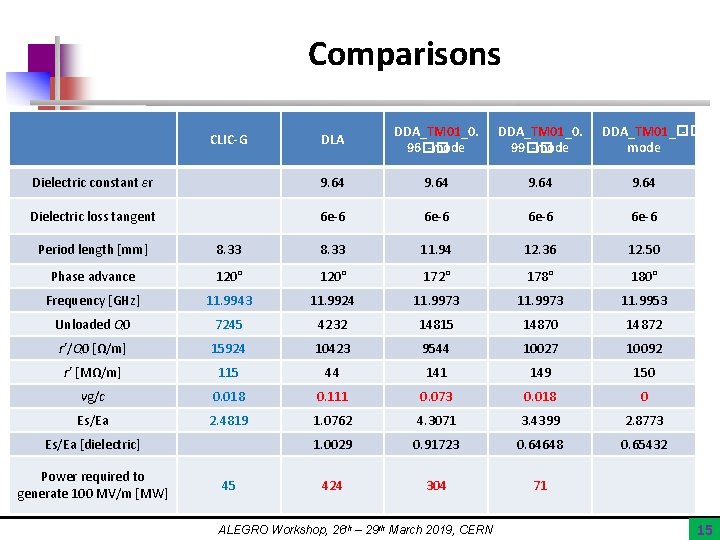
Comparisons DLA DDA_TM 01_0. 96�� -mode DDA_TM 01_0. 99�� -mode Dielectric constant εr 9. 64 Dielectric loss tangent 6 e-6 CLIC-G DDA_TM 01_�� mode Period length [mm] 8. 33 11. 94 12. 36 12. 50 Phase advance 120° 172° 178° 180° Frequency [GHz] 11. 9943 11. 9924 11. 9973 11. 9953 Unloaded Q 0 7245 4232 14815 14870 14872 r’/Q 0 [Ω/m] 15924 10423 9544 10027 10092 r’ [MΩ/m] 115 44 141 149 150 vg/c 0. 018 0. 111 0. 073 0. 018 0 Es/Ea 2. 4819 1. 0762 4. 3071 3. 4399 2. 8773 1. 0029 0. 91723 0. 64648 0. 65432 424 304 71 Es/Ea [dielectric] Power required to generate 100 MV/m [MW] 45 ALEGRO Workshop, 26 th – 29 th March 2019, CERN 15
Outline v TM 02 operation mode ALEGRO Workshop, 26 th – 29 th March 2019, CERN 16
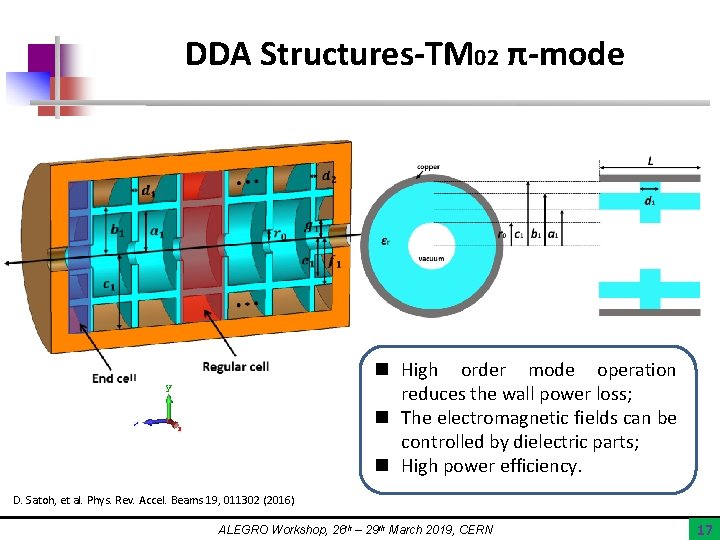
DDA Structures-TM 02 π-mode n High order mode operation reduces the wall power loss; n The electromagnetic fields can be controlled by dielectric parts; n High power efficiency. D. Satoh, et al. Phys. Rev. Accel. Beams 19, 011302 (2016) ALEGRO Workshop, 26 th – 29 th March 2019, CERN 17
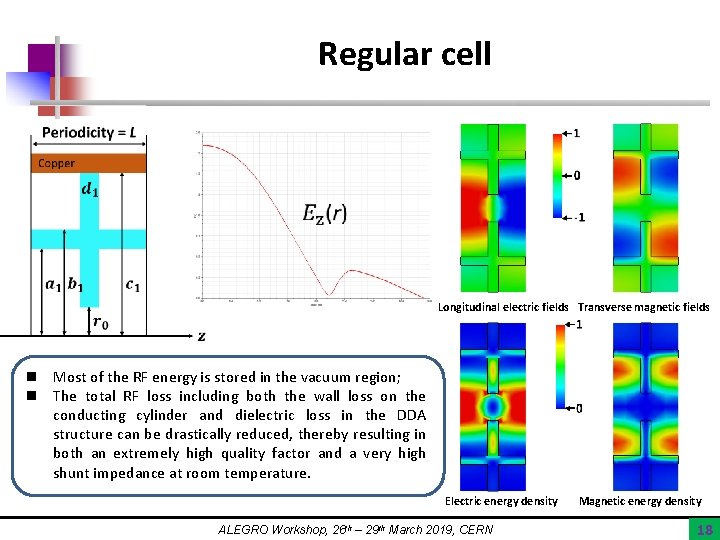
Regular cell Longitudinal electric fields Transverse magnetic fields n Most of the RF energy is stored in the vacuum region; n The total RF loss including both the wall loss on the conducting cylinder and dielectric loss in the DDA structure can be drastically reduced, thereby resulting in both an extremely high quality factor and a very high shunt impedance at room temperature. Electric energy density ALEGRO Workshop, 26 th – 29 th March 2019, CERN Magnetic energy density 18
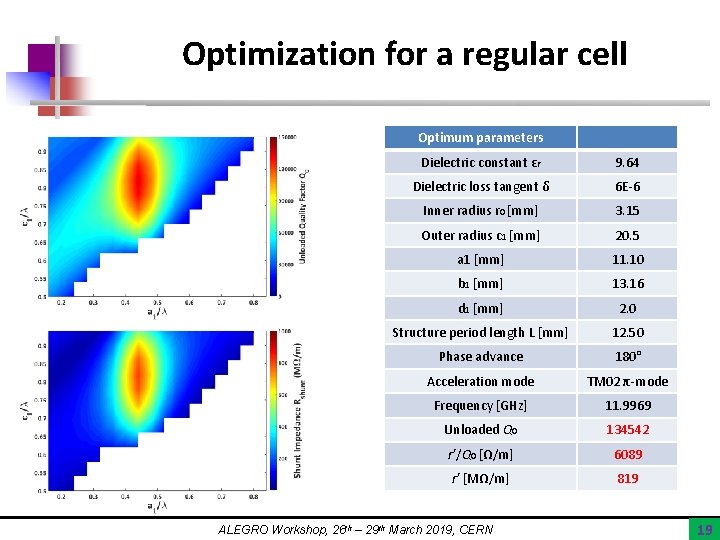
Optimization for a regular cell Optimum parameters Dielectric constant εr 9. 64 Dielectric loss tangent δ 6 E-6 Inner radius r 0 [mm] 3. 15 Outer radius c 1 [mm] 20. 5 a 1 [mm] 11. 10 b 1 [mm] 13. 16 d 1 [mm] 2. 0 Structure period length L [mm] 12. 50 Phase advance 180° Acceleration mode TM 02 π-mode Frequency [GHz] 11. 9969 Unloaded Q 0 134542 r’/Q 0 [Ω/m] 6089 r’ [MΩ/m] 819 ALEGRO Workshop, 26 th – 29 th March 2019, CERN 19
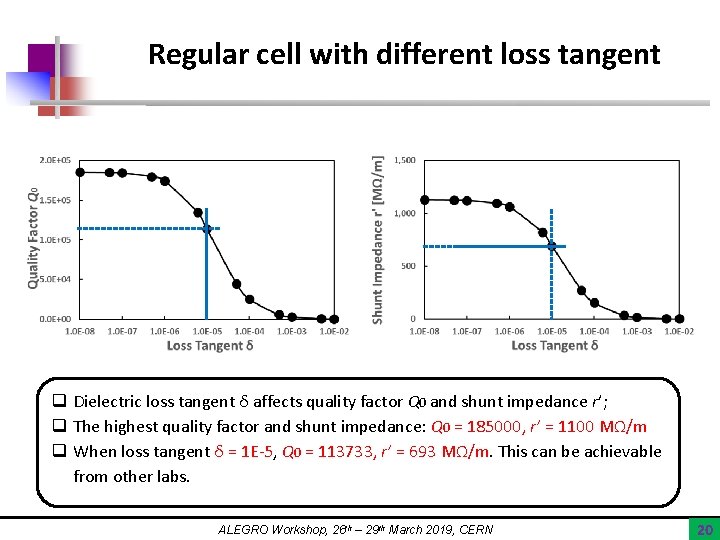
Regular cell with different loss tangent q Dielectric loss tangent δ affects quality factor Q 0 and shunt impedance r’; q The highest quality factor and shunt impedance: Q 0 = 185000, r’ = 1100 MΩ/m q When loss tangent δ = 1 E-5, Q 0 = 113733, r’ = 693 MΩ/m. This can be achievable from other labs. ALEGRO Workshop, 26 th – 29 th March 2019, CERN 20
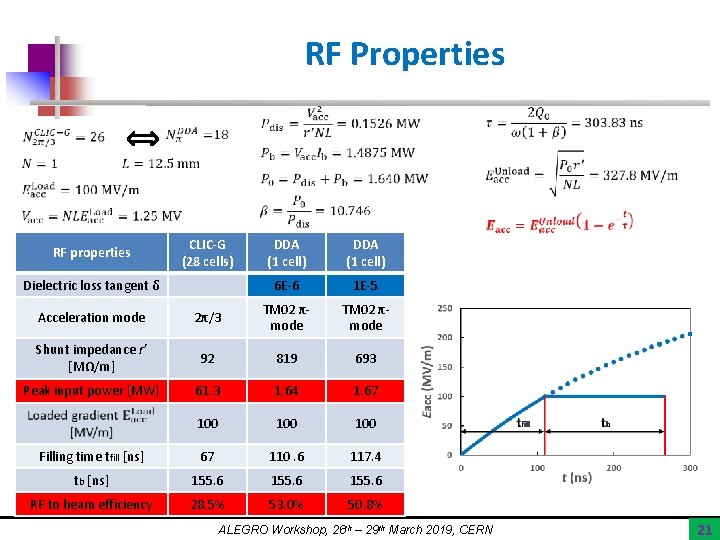
RF Properties RF properties CLIC-G (28 cells) Dielectric loss tangent δ DDA (1 cell) 6 E-6 1 E-5 Acceleration mode 2π/3 TM 02 πmode Shunt impedance r’ [MΩ/m] 92 819 693 Peak input power [MW] 61. 3 1. 64 1. 67 100 100 Filling time tfill [ns] 67 110. 6 117. 4 tb [ns] 155. 6 RF to beam efficiency 28. 5% 53. 0% 50. 8% ALEGRO Workshop, 26 th – 29 th March 2019, CERN 21
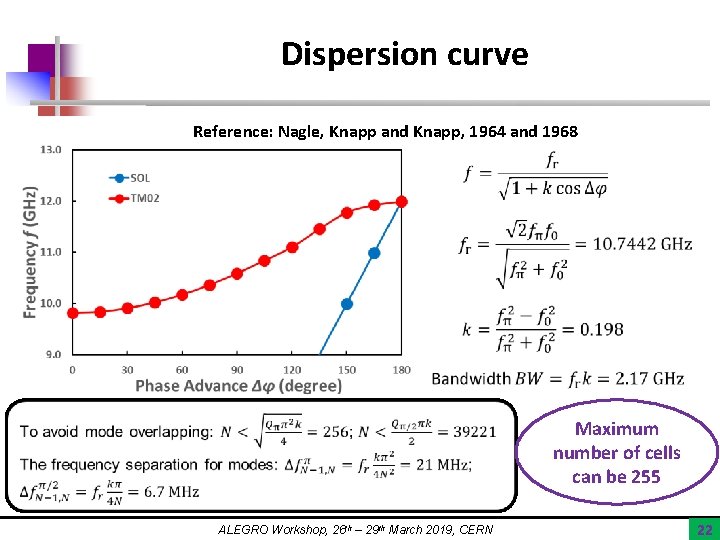
Dispersion curve Reference: Nagle, Knapp and Knapp, 1964 and 1968 Maximum number of cells can be 255 ALEGRO Workshop, 26 th – 29 th March 2019, CERN 22
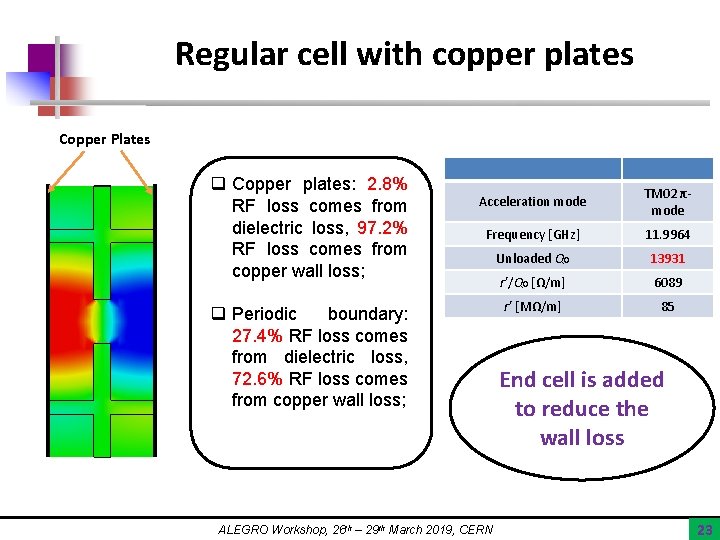
Regular cell with copper plates Copper Plates q Copper plates: 2. 8% RF loss comes from dielectric loss, 97. 2% RF loss comes from copper wall loss; Acceleration mode TM 02 πmode Frequency [GHz] 11. 9964 Unloaded Q 0 13931 r’/Q 0 [Ω/m] 6089 r’ [MΩ/m] 85 q Periodic boundary: 27. 4% RF loss comes from dielectric loss, 72. 6% RF loss comes from copper wall loss; ALEGRO Workshop, 26 th – 29 th March 2019, CERN End cell is added to reduce the wall loss 23
![Copper End cell 4. 6 6. 5 11. 1 13. 16 Frequency [GHz] 11.](http://slidetodoc.com/presentation_image_h2/86790e095be60ccaac4f330942ab669e/image-24.jpg "Copper End cell 4. 6 6. 5 11. 1 13. 16 Frequency [GHz] 11.")
Copper End cell 4. 6 6. 5 11. 1 13. 16 Frequency [GHz] 11. 9942 Unloaded Q 0 50464 r’ [MΩ/m] 181 ALEGRO Workshop, 26 th – 29 th March 2019, CERN 24
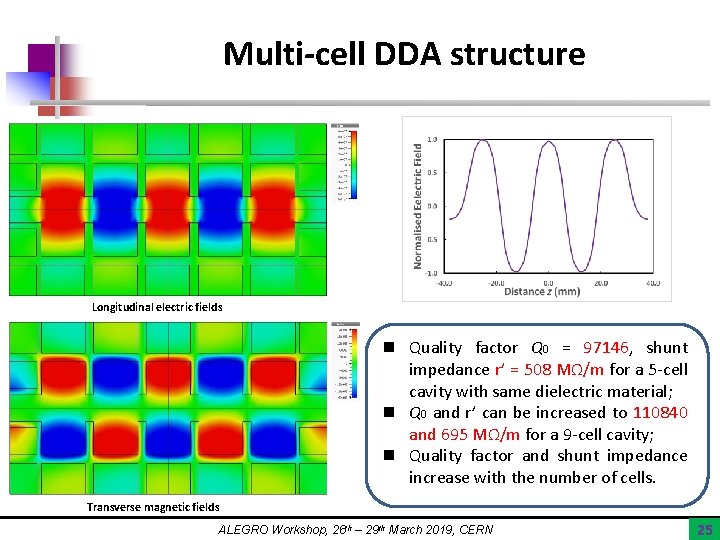
Multi-cell DDA structure Longitudinal electric fields n Quality factor Q 0 = 97146, shunt impedance r’ = 508 MΩ/m for a 5 -cell cavity with same dielectric material; n Q 0 and r’ can be increased to 110840 and 695 MΩ/m for a 9 -cell cavity; n Quality factor and shunt impedance increase with the number of cells. Transverse magnetic fields ALEGRO Workshop, 26 th – 29 th March 2019, CERN 25
Outline v Wakefield Studies for a TM 02 DDA structure ALEGRO Workshop, 26 th – 29 th March 2019, CERN 26
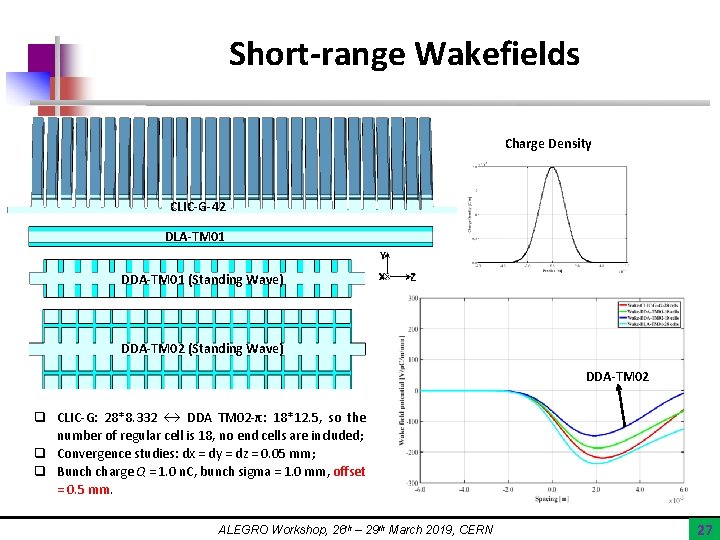
Short-range Wakefields Charge Density CLIC-G-42 DLA-TM 01 DDA-TM 01 (Standing Wave) DDA-TM 02 q CLIC-G: 28*8. 332 ↔ DDA TM 02 -π: 18*12. 5, so the number of regular cell is 18, no end cells are included; q Convergence studies: dx = dy = dz = 0. 05 mm; q Bunch charge Q = 1. 0 n. C, bunch sigma = 1. 0 mm, offset = 0. 5 mm. ALEGRO Workshop, 26 th – 29 th March 2019, CERN 27
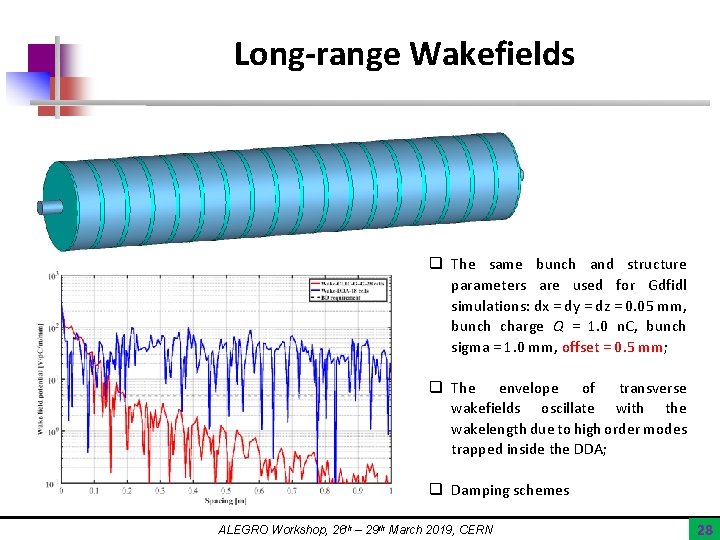
Long-range Wakefields q The same bunch and structure parameters are used for Gdfidl simulations: dx = dy = dz = 0. 05 mm, bunch charge Q = 1. 0 n. C, bunch sigma = 1. 0 mm, offset = 0. 5 mm; q The envelope of transverse wakefields oscillate with the wakelength due to high order modes trapped inside the DDA; q Damping schemes ALEGRO Workshop, 26 th – 29 th March 2019, CERN 28
![Adding Damping Waveguide W [mm] quality factor Q 0 shunt impedan ce r’ [MΩ/m]](http://slidetodoc.com/presentation_image_h2/86790e095be60ccaac4f330942ab669e/image-29.jpg "Adding Damping Waveguide W [mm] quality factor Q 0 shunt impedan ce r’ [MΩ/m]")
Adding Damping Waveguide W [mm] quality factor Q 0 shunt impedan ce r’ [MΩ/m] 0 134542 8 7 bunches Envelope [7 bunches] Fc Frms Fworst 819 149 752 5051 4086 2836 19483 113810 680 6 37 174 213 149 999 10 103330 612 8 67 408 269 211 1420 12 84336 489 6 26 149 123 101 661 20 < 40000 < 200 15 54 352 40 37 185 BD requirement ALEGRO Workshop, 26 th – 29 th March 2019, CERN 29
![Adding Dielectric Slots ( W=12 mm ) Number of dielectric slots D[mm] quality factor](http://slidetodoc.com/presentation_image_h2/86790e095be60ccaac4f330942ab669e/image-30.jpg "Adding Dielectric Slots ( W=12 mm ) Number of dielectric slots D[mm] quality factor")
Adding Dielectric Slots ( W=12 mm ) Number of dielectric slots D[mm] quality factor Q 0 shunt impedan ce r’ [MΩ/m] 4 2. 0 45286 8 1. 5 16 1. 0 7 bunches Envelope [7 bunches] Fc Frms Fworst 193 2. 1 3. 5 13. 4 12. 3 6. 2 34. 7 95052 457 2. 9 4. 6 19. 5 7. 6 5. 9 33. 6 95450 405 1. 1 1. 3 2. 7 1. 9 1. 4 4. 2 BD requirement q The unloaded quality factor and shunt impedance are decreased by 30% and 50% respectively; q Longer wakelength ( > 5 m) needs to be calculated in order to get accurate F parameters. ALEGRO Workshop, 26 th – 29 th March 2019, CERN 30
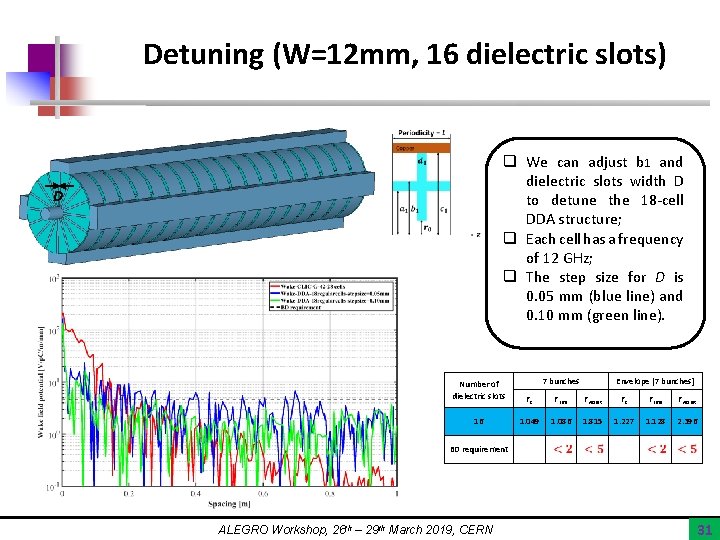
Detuning (W=12 mm, 16 dielectric slots) q We can adjust b 1 and dielectric slots width D to detune the 18 -cell DDA structure; q Each cell has a frequency of 12 GHz; q The step size for D is 0. 05 mm (blue line) and 0. 10 mm (green line). D 7 bunches Envelope [7 bunches] Number of dielectric slots Fc Frms Fworst 16 1. 049 1. 086 1. 815 1. 227 1. 128 2. 396 BD requirement ALEGRO Workshop, 26 th – 29 th March 2019, CERN 31
Summary and Outlook q DLA structures with different materials and DDA structures operating at TM 01 π-mode have been studied at 12 GHz; q DDA structures operating at TM 02 π-mode structure: § Extremely high quality factor and shunt impedance: Q 0 = 134542, r’ = 819 MΩ/m; § High RF-to-Beam efficiency of >50%; § The number of acceleration cells can be up to 255 due to high bandwidth; § Low short-range wakefields; § Using waveguides, dielectric slots and detuning are promising to damp longrange wakefields. q Further optimization and wakefield studies; q Design of RF high power coupler; q Fabrication and experimental studies. ALEGRO Workshop, 26 th – 29 th March 2019, CERN 32
- Slides: 32