
Alternate Acid Base Theory Mr Shields Regents Chemistry
- Alternate Acid Base Theory Mr. Shields Regents Chemistry U 15 L 02 1
Alternate Acid/Base Theory A different acid base theory was developed After the Arrhenius theory and was known as the Bronsted-Lowry Theory. We will refer to it as simply the Alternate Acid Base theory (AABT). But why was a new theory needed? What was the Problem with the Arrhenius Theory of acids And bases? 2
The Arrhenius theory is very restricted. It states That acids and bases must yield H+ or OH- It couldn’t explain why many compounds like NH 3 and Na 2 CO 3 are basic in solution - Neither of these compounds or compounds like them could be classified as an Arrhenius acid or base. For this reason The Alternate Acid Base Theory Was Proposed to provide a new definition of acids and bases 3
Alternate Acid Base Theory According to the alternate Acid-base theory: - An Acid is anything that is a hydrogen ion donor - i. e. a proton Donor - A Base is a hydrogen ion acceptor - i. e. a proton Acceptor Memory Aid: BAAD (base acceptor/acid donor) So how do we apply this theory? 4
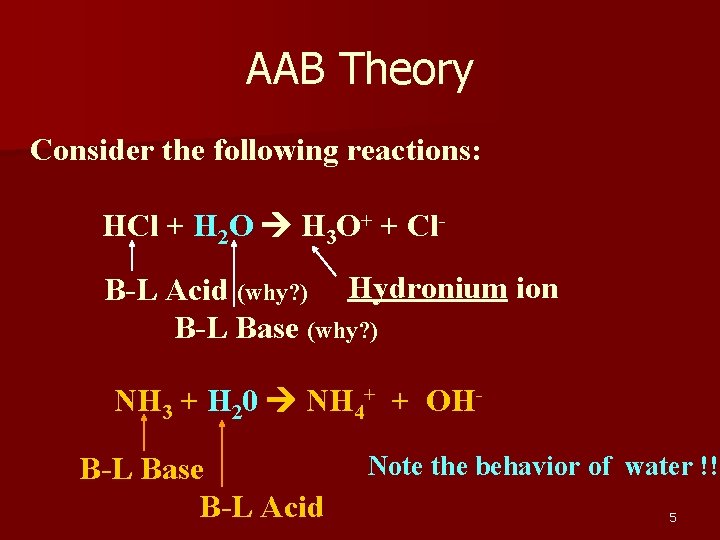
AAB Theory Consider the following reactions: HCl + H 2 O H 3 O+ + Cl. B-L Acid (why? ) Hydronium ion B-L Base (why? ) NH 3 + H 20 NH 4+ + OHB-L Base B-L Acid Note the behavior of water !! 5
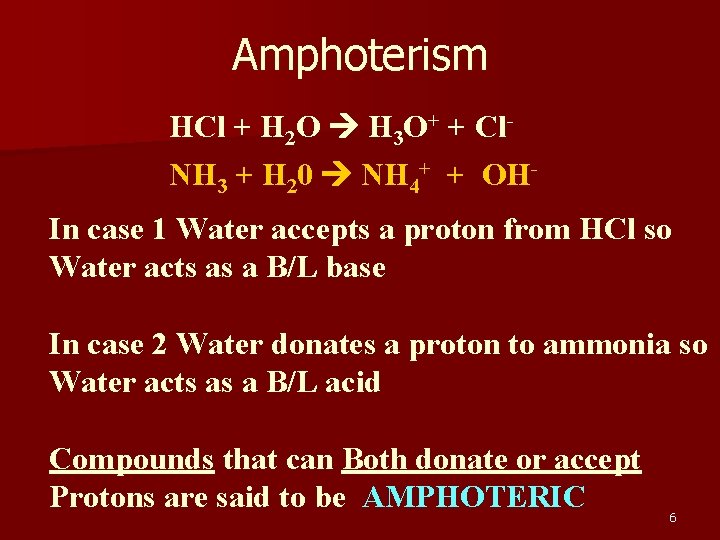
Amphoterism HCl + H 2 O H 3 O+ + Cl. NH 3 + H 20 NH 4+ + OHIn case 1 Water accepts a proton from HCl so Water acts as a B/L base In case 2 Water donates a proton to ammonia so Water acts as a B/L acid Compounds that can Both donate or accept Protons are said to be AMPHOTERIC 6
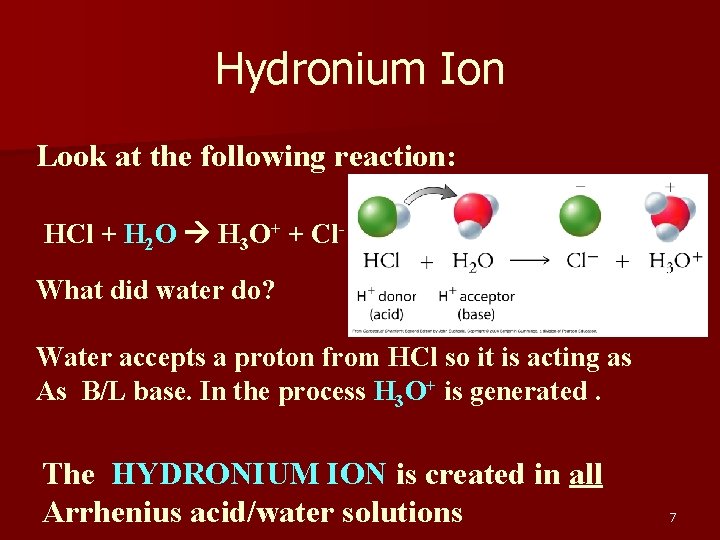
Hydronium Ion Look at the following reaction: HCl + H 2 O H 3 O+ + Cl. What did water do? Water accepts a proton from HCl so it is acting as As B/L base. In the process H 3 O+ is generated. The HYDRONIUM ION is created in all Arrhenius acid/water solutions 7

AAB Theory Let’s look at Na 2 CO 3: Na 2 CO 3 + H 2 O 2 Na+ +CO 3 -3 2 Na+ + CO 3 -2 +2 H 20 H 2 CO 3 + 2 Na. OH B-L Base B-L Acid The Solution left behind now contains hydroxide (a strong base) and a weak acid; The sol’n is Therfore now basic 8
Note that all Arrhenius acids have to be AABT acids also… Why? (Consider HCL, HNO 3 etc & their rxn with bases) And all Arrhenius bases are also AABT bases. Why? (Consider KOH, Ca(OH)2 etc. & their rxn with acid) 9
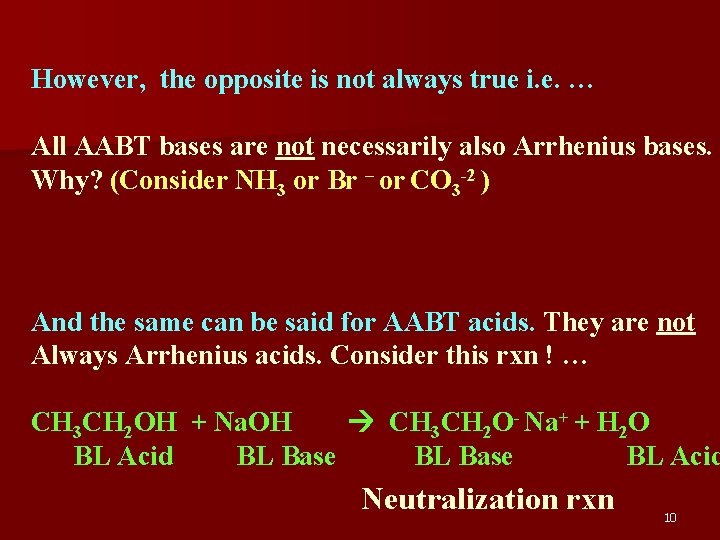
However, the opposite is not always true i. e. … All AABT bases are not necessarily also Arrhenius bases. Why? (Consider NH 3 or Br – or CO 3 -2 ) And the same can be said for AABT acids. They are not Always Arrhenius acids. Consider this rxn ! … CH 3 CH 2 OH + Na. OH CH 3 CH 2 O- Na+ + H 2 O BL Acid BL Base BL Acid Neutralization rxn 10
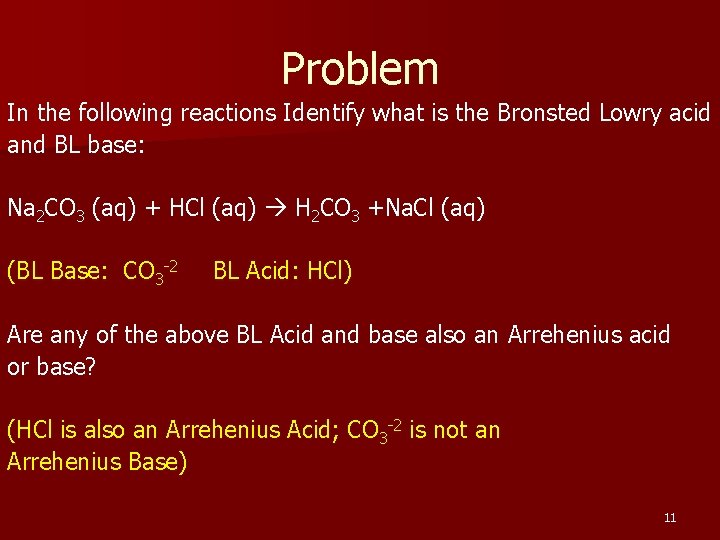
Problem In the following reactions Identify what is the Bronsted Lowry acid and BL base: Na 2 CO 3 (aq) + HCl (aq) H 2 CO 3 +Na. Cl (aq) (BL Base: CO 3 -2 BL Acid: HCl) Are any of the above BL Acid and base also an Arrehenius acid or base? (HCl is also an Arrehenius Acid; CO 3 -2 is not an Arrehenius Base) 11
- Slides: 11