
Alternate Access Transcatheter Aortic Valve Replacement TAVR A
- Slides: 5
Alternate Access Transcatheter Aortic Valve Replacement (TAVR): A single-site’s experience with a viable treatment option for extreme risk patients Zachary Fox, Lauren Di. Biase, Wilson Szeto, Saif Anwaruddin, Elizabeth Walsh, Robert Li, Howard Herrmann, Joseph Bavaria The University of Pennsylvania
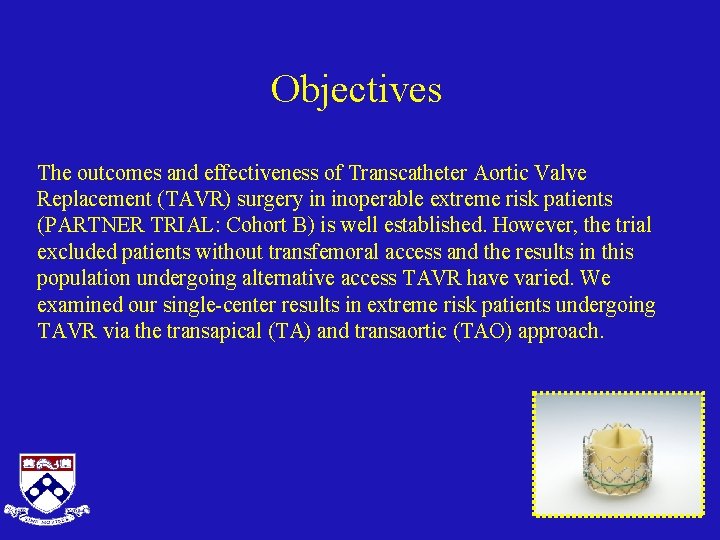
Objectives The outcomes and effectiveness of Transcatheter Aortic Valve Replacement (TAVR) surgery in inoperable extreme risk patients (PARTNER TRIAL: Cohort B) is well established. However, the trial excluded patients without transfemoral access and the results in this population undergoing alternative access TAVR have varied. We examined our single-center results in extreme risk patients undergoing TAVR via the transapical (TA) and transaortic (TAO) approach.
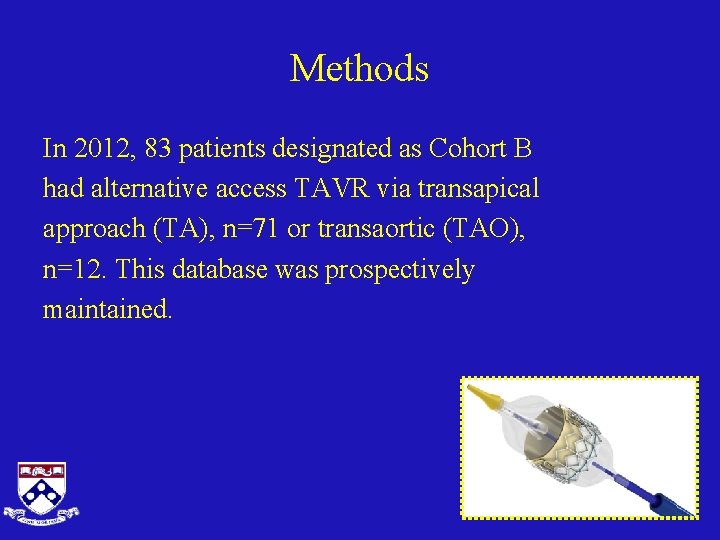
Methods In 2012, 83 patients designated as Cohort B had alternative access TAVR via transapical approach (TA), n=71 or transaortic (TAO), n=12. This database was prospectively maintained.
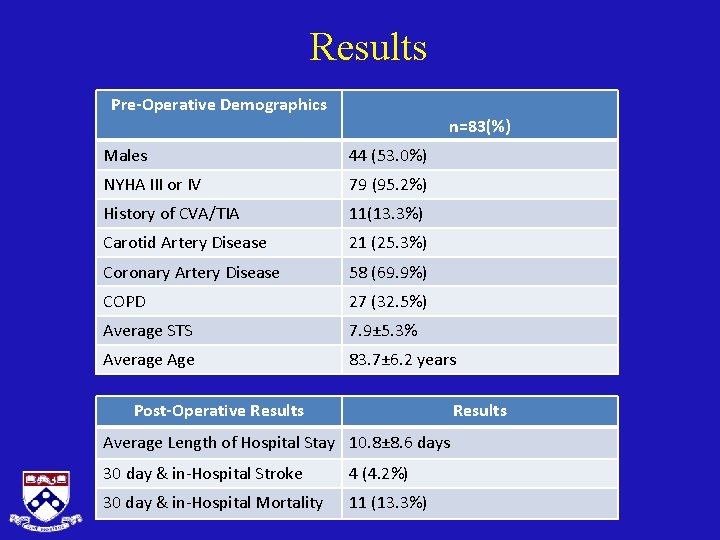
Results Pre-Operative Demographics n=83(%) Males 44 (53. 0%) NYHA III or IV 79 (95. 2%) History of CVA/TIA 11(13. 3%) Carotid Artery Disease 21 (25. 3%) Coronary Artery Disease 58 (69. 9%) COPD 27 (32. 5%) Average STS 7. 9± 5. 3% Average Age 83. 7± 6. 2 years Post-Operative Results Average Length of Hospital Stay 10. 8± 8. 6 days 30 day & in-Hospital Stroke 4 (4. 2%) 30 day & in-Hospital Mortality 11 (13. 3%)
Conclusion Due to the nature of these extreme risk patients, we propose that alternative access TAVR should be offered to Cohort B patients, ideally to be performed at high volume TAVR centers. Further follow-up will attest to the potential improvement in morbidity and mortality in this extreme risk cohort, as compared to the natural progression of critical aortic stenosis.