
Altered States of Consciousness Dream Experiment Is it


- Slides: 43
Altered States of Consciousness
Dream Experiment • Is it possible to successfully plan your dreams? • All students will keep a record of their dreams • Half of the students will write the following in their journal – A brief account of their day (1 paragraph) – What they want to dream about – In the morning record what you dreamed • The other half of the class – Only record what you dreamed about in the morning
Questions • Why do we sleep? What purpose does it serve? • What is consciousness? • What are some ways it can be altered?
Sleep Deprivation Article • Read the sleep deprivation article • How long did Peter Tripp stay awake? • What effects did long term sleep deprivation have on him? • What long term effects did the sleep deprivation cause?
Sleep and Dreams Altered States of Consciousness
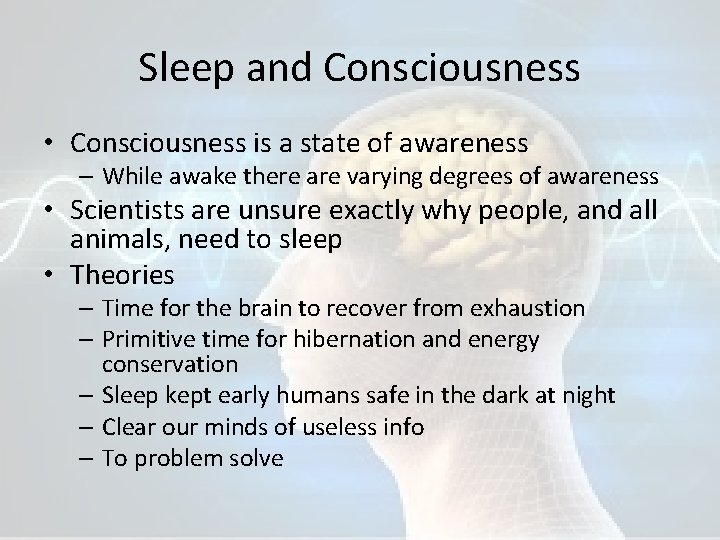
Sleep and Consciousness • Consciousness is a state of awareness – While awake there are varying degrees of awareness • Scientists are unsure exactly why people, and all animals, need to sleep • Theories – Time for the brain to recover from exhaustion – Primitive time for hibernation and energy conservation – Sleep kept early humans safe in the dark at night – Clear our minds of useless info – To problem solve
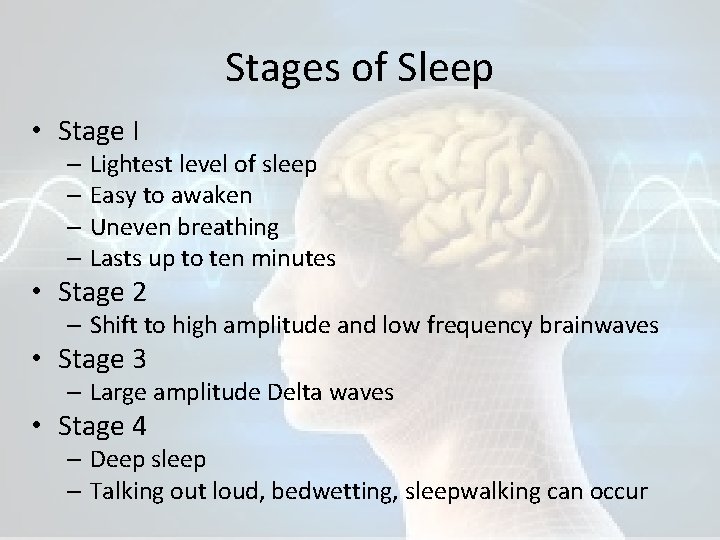
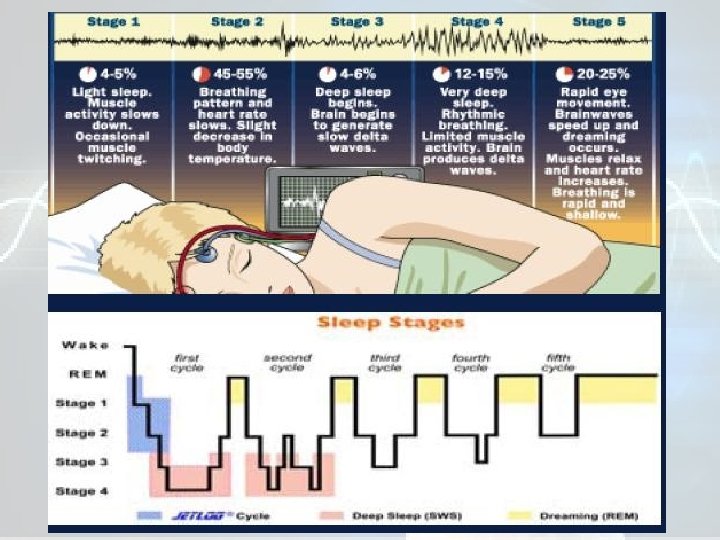
Stages of Sleep • Stage I – Lightest level of sleep – Easy to awaken – Uneven breathing – Lasts up to ten minutes • Stage 2 – Shift to high amplitude and low frequency brainwaves • Stage 3 – Large amplitude Delta waves • Stage 4 – Deep sleep – Talking out loud, bedwetting, sleepwalking can occur
REM Sleep • The fifth stage of sleep is REM or Rapid Eye Movement – Fingers twitch – Large muscles are paralyzed – Brainwaves match those of being awake – Dreaming occurs
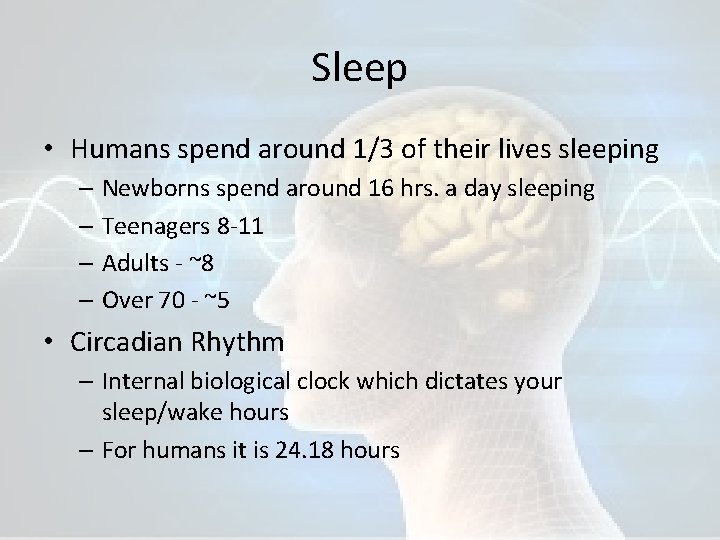
Sleep • Humans spend around 1/3 of their lives sleeping – Newborns spend around 16 hrs. a day sleeping – Teenagers 8 -11 – Adults - ~8 – Over 70 - ~5 • Circadian Rhythm – Internal biological clock which dictates your sleep/wake hours – For humans it is 24. 18 hours
Sleep Disorders • Insomnia – Inability to obtain adequate sleep • Sleep apnea – Interruption of breathing during sleep • Narcolepsy – Overwhelming sleepiness during the day. Sometimes causing sudden falling asleep • Nightmares – Bad dreams during REM sleep • Night Terrors – During stage IV – Cause sweating, thrashing, rapid heart rate – Generally cause a person to awaken with no memory
Crash Course Psychology • To Sleep: Perchance to Dream
Other States of Consciousness
Hypnosis • A state of altered consciousness where a person becomes highly susceptible to changes in behavior and thought • Very controversial among psychologists – Some argue that people who are hypnotized are just very enthusiastic and suggestible – Others believe it is an actual form of altered consciousness • All agree that people can not be compelled to do things they would not do while awake
Biofeedback • Learning how to control your physiological processes through feedback • Ex. A light turns on when your heart rate drops below 80 • Learning to control your heart rate in relation to the light
Drugs and Their Effects • Psychoactive Drugs – Chemicals that effect the nervous system and alter states of consciousness • Drugs are absorbed into the blood and then act as neurotransmitters • This will cause neurons to either fire more frequently, less frequently, or more erratically
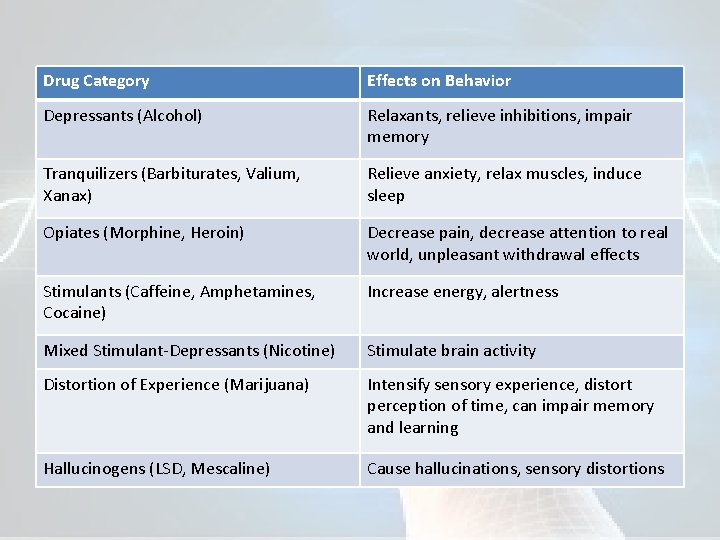
Drug Category Effects on Behavior Depressants (Alcohol) Relaxants, relieve inhibitions, impair memory Tranquilizers (Barbiturates, Valium, Xanax) Relieve anxiety, relax muscles, induce sleep Opiates (Morphine, Heroin) Decrease pain, decrease attention to real world, unpleasant withdrawal effects Stimulants (Caffeine, Amphetamines, Cocaine) Increase energy, alertness Mixed Stimulant-Depressants (Nicotine) Stimulate brain activity Distortion of Experience (Marijuana) Intensify sensory experience, distort perception of time, can impair memory and learning Hallucinogens (LSD, Mescaline) Cause hallucinations, sensory distortions
Sensation and Perception
Sense of Touch Experiment • Find a partner • Find two fine tip pens or sharp pencils • Begin by touching both pens about three inches apart on the person’s neck – Can the person being touched tell there are two distinct objects touching them? • Decrease the distance by about half an inch and test again • Continue until the person can only feel one object • Experiment again on the elbow or shin
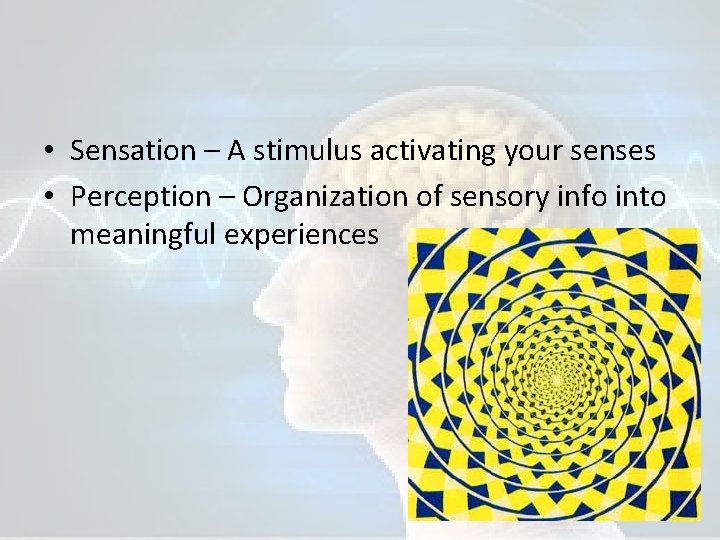
• Sensation – A stimulus activating your senses • Perception – Organization of sensory info into meaningful experiences
Selective Attention • Your senses take in about 11, 000 bits of information per second • You process about 40 • Your brain focuses and ignore other information – Your nose in front of your face – Your shoes constricting your feet – Etc. . • Cocktail Party Effect – Ability to speak to one person in a crowded space – Hearing your name stands out
Selective Attention • Watch Video on Selective Attention • What accounts for this?
Threshold • Absolute Threshold – The smallest amount of a stimulus for a human to detect it – Vision: Seeing a candle at 30 miles on a clear night – Hearing: Hearing a watch ticking 20 ft away – Taste: Tasting one teaspoon of sugar in 2 gallons of water – Smell: One drop of perfume in a 3 bedroom house – Touch: Feeling a bee’s wing falling 1 cm onto your cheeck
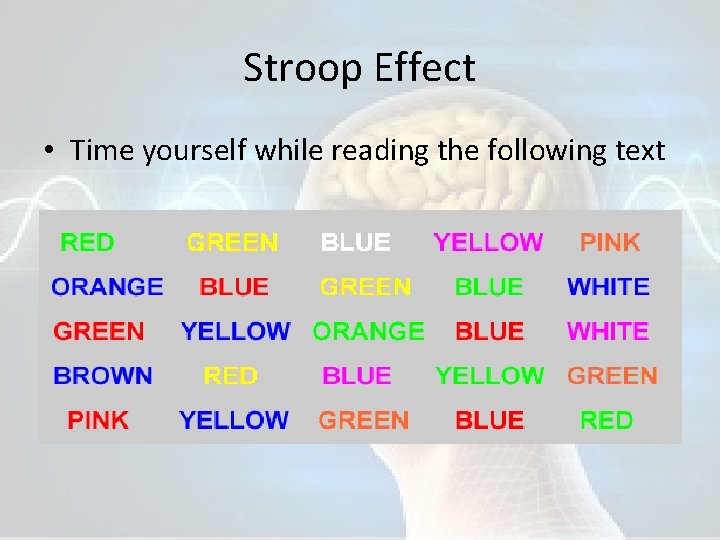
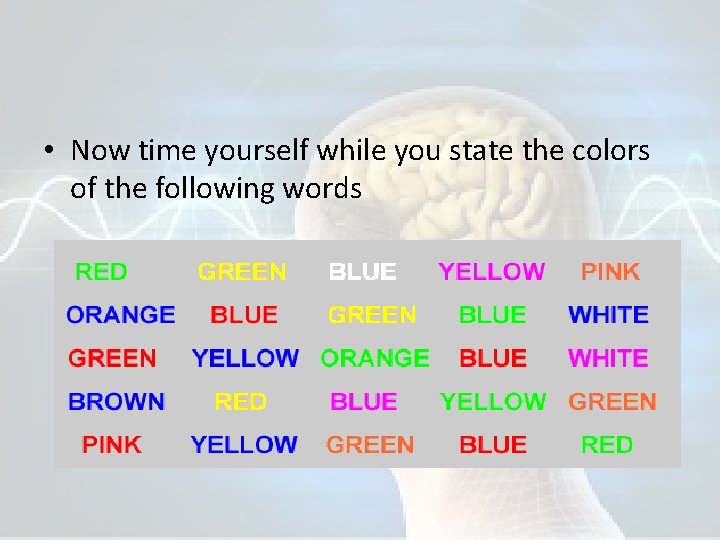
Signal Detection Theory • Summary of people’s tendencies to make correct judgments in detecting the presence of stimuli • There is not true absolute threshold • Stroop Effect: Sometimes stimuli interfere with your ability to perform a task
Stroop Effect • Time yourself while reading the following text
• Now time yourself while you state the colors of the following words
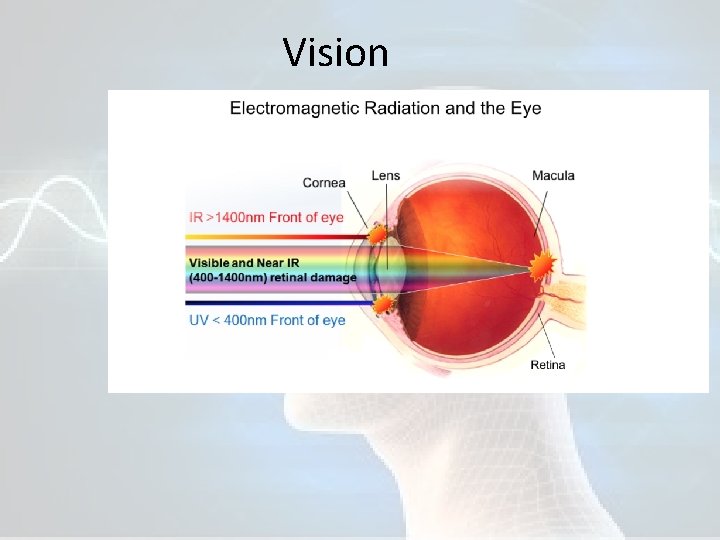
Vision
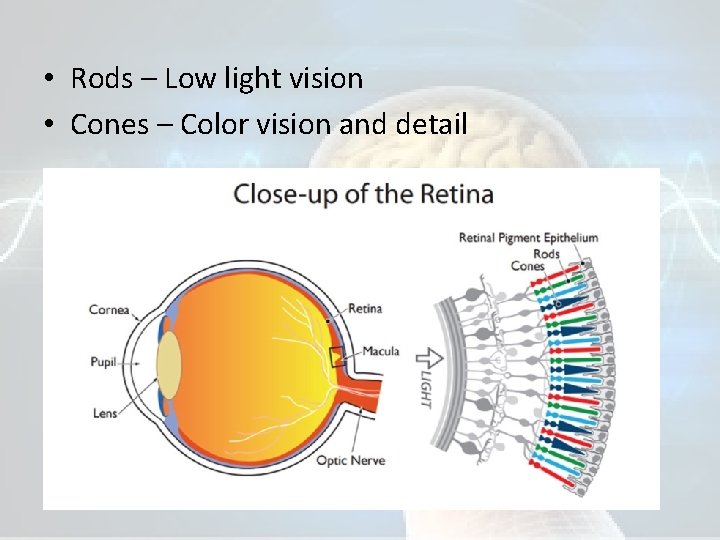
• Rods – Low light vision • Cones – Color vision and detail
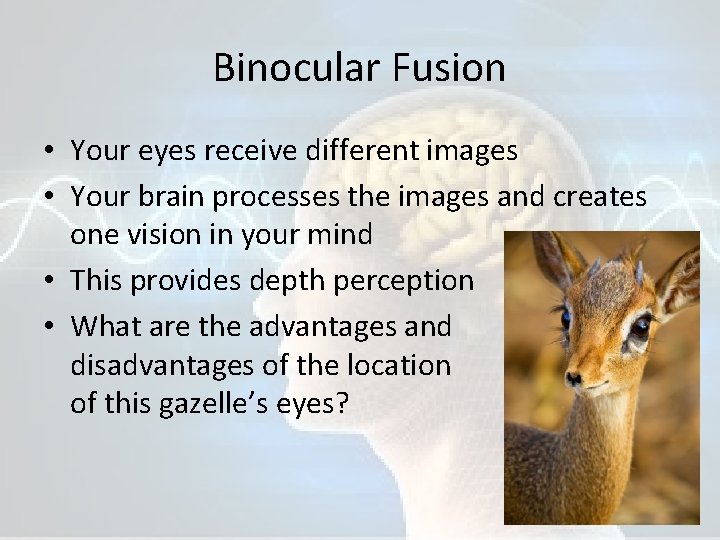
Binocular Fusion • Your eyes receive different images • Your brain processes the images and creates one vision in your mind • This provides depth perception • What are the advantages and disadvantages of the location of this gazelle’s eyes?
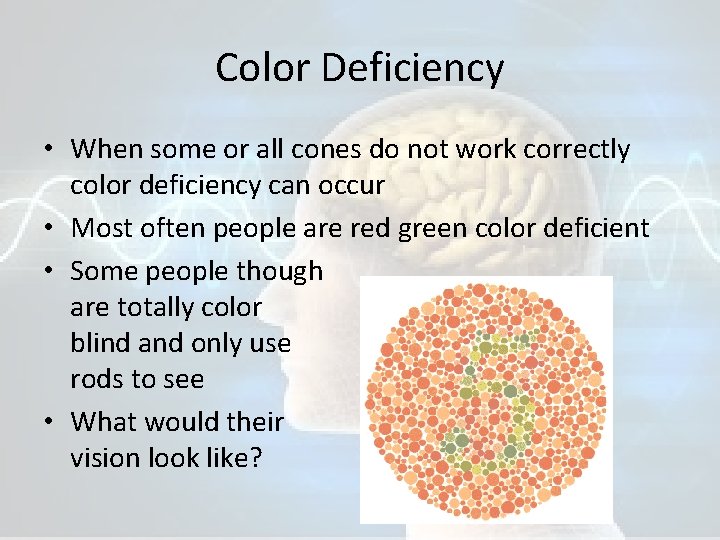
Color Deficiency • When some or all cones do not work correctly color deficiency can occur • Most often people are red green color deficient • Some people though are totally color blind and only use rods to see • What would their vision look like?
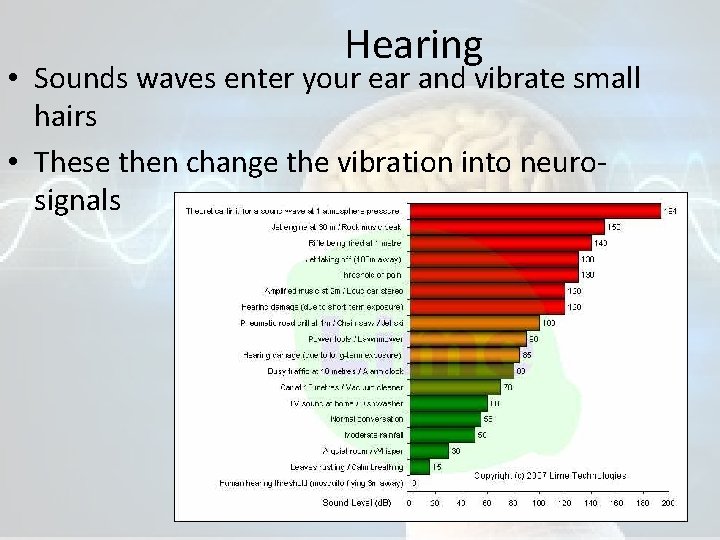
Hearing • Sounds waves enter your ear and vibrate small hairs • These then change the vibration into neurosignals
Chemical Senses • Taste and smell are closely linked • Most of what we perceive as taste is actually smell
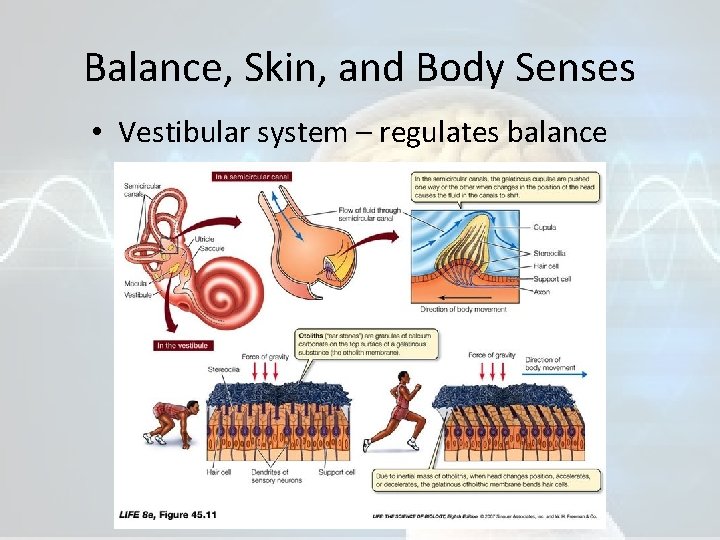
Balance, Skin, and Body Senses • Vestibular system – regulates balance
Skin Senses • Skin sensors detect – Warmth – Cold – Pressure – Pain
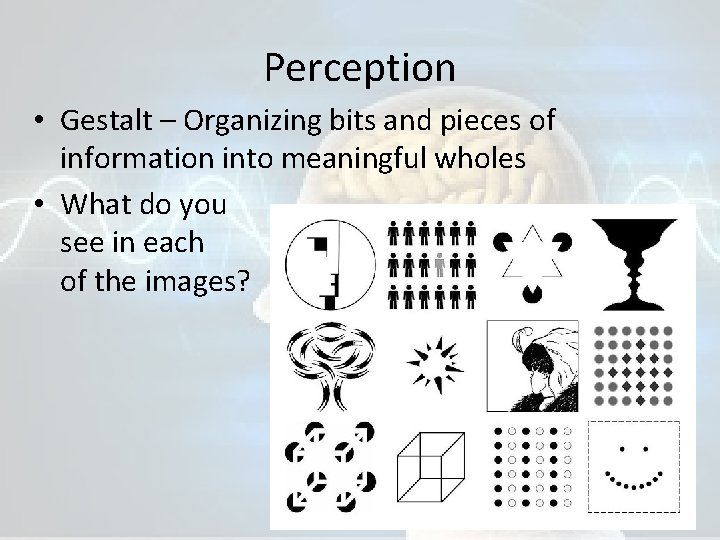
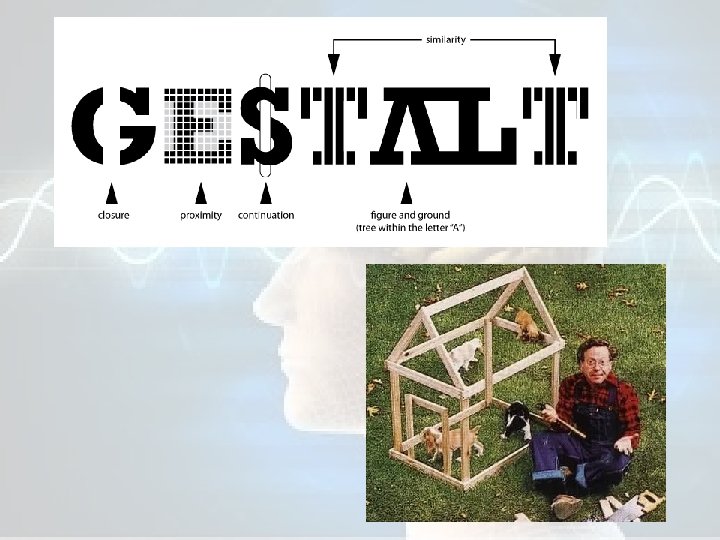
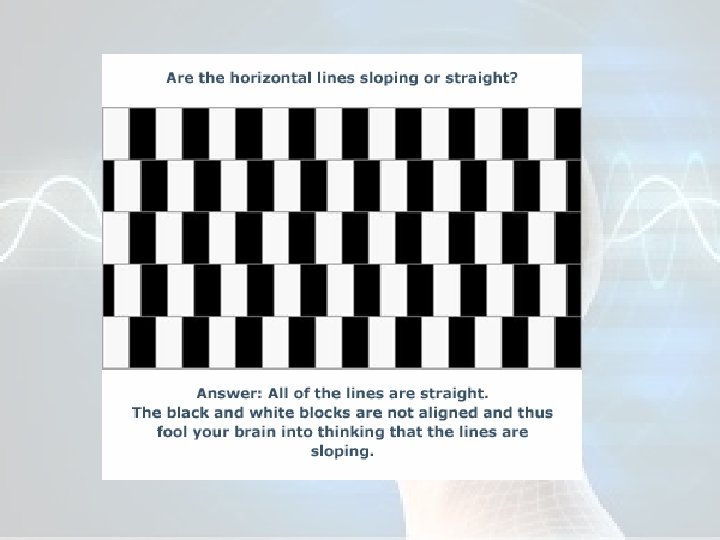
Perception • Gestalt – Organizing bits and pieces of information into meaningful wholes • What do you see in each of the images?
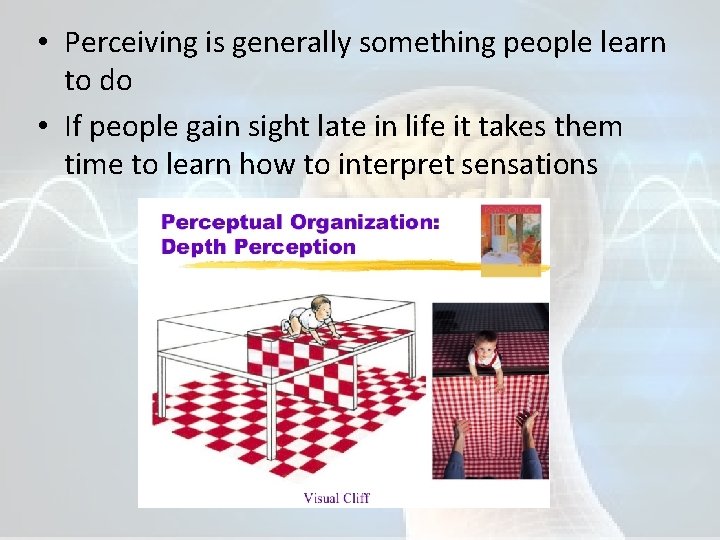
• Perceiving is generally something people learn to do • If people gain sight late in life it takes them time to learn how to interpret sensations
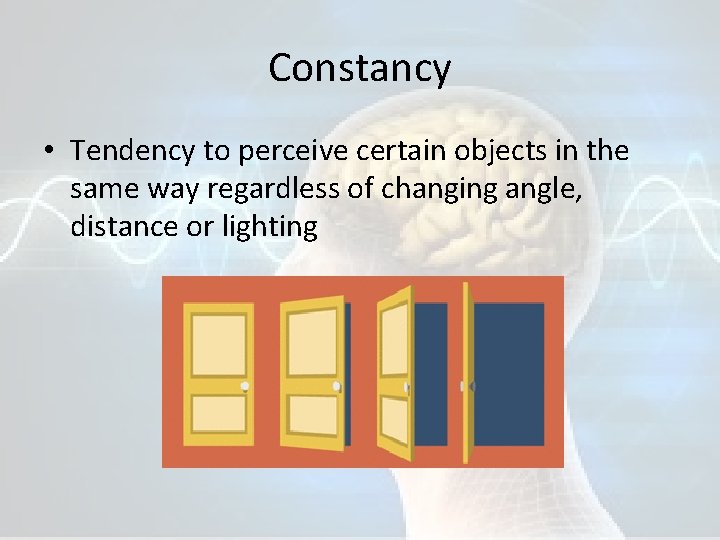
Constancy • Tendency to perceive certain objects in the same way regardless of changing angle, distance or lighting
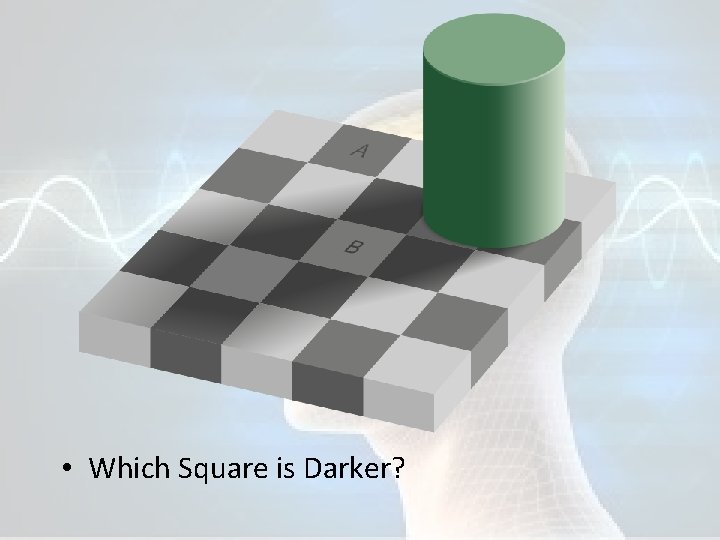
• Which Square is Darker?
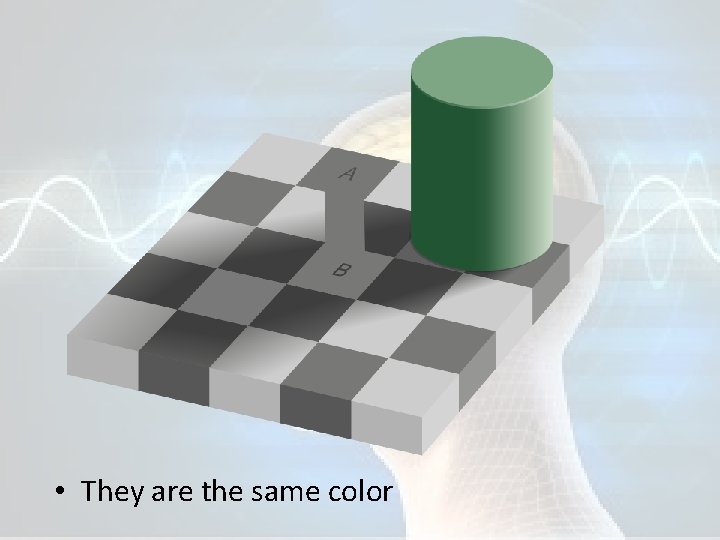
• They are the same color
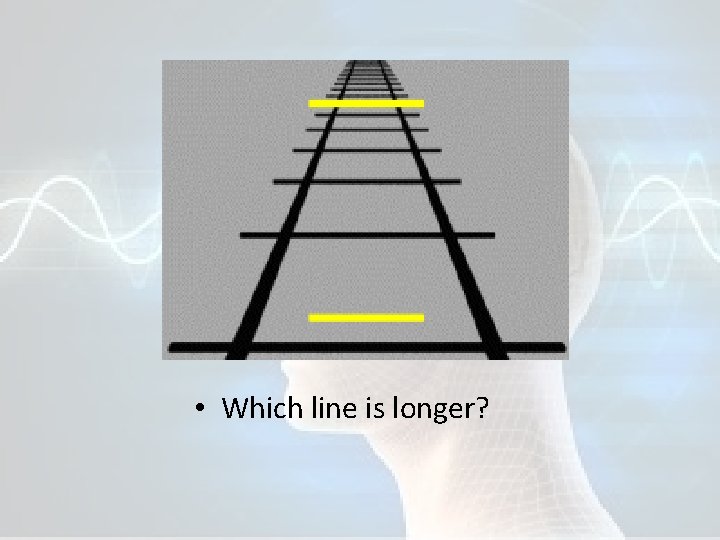
• Which line is longer?