
Alterations to the Classical Hand Wrapping Technique in
- Slides: 1
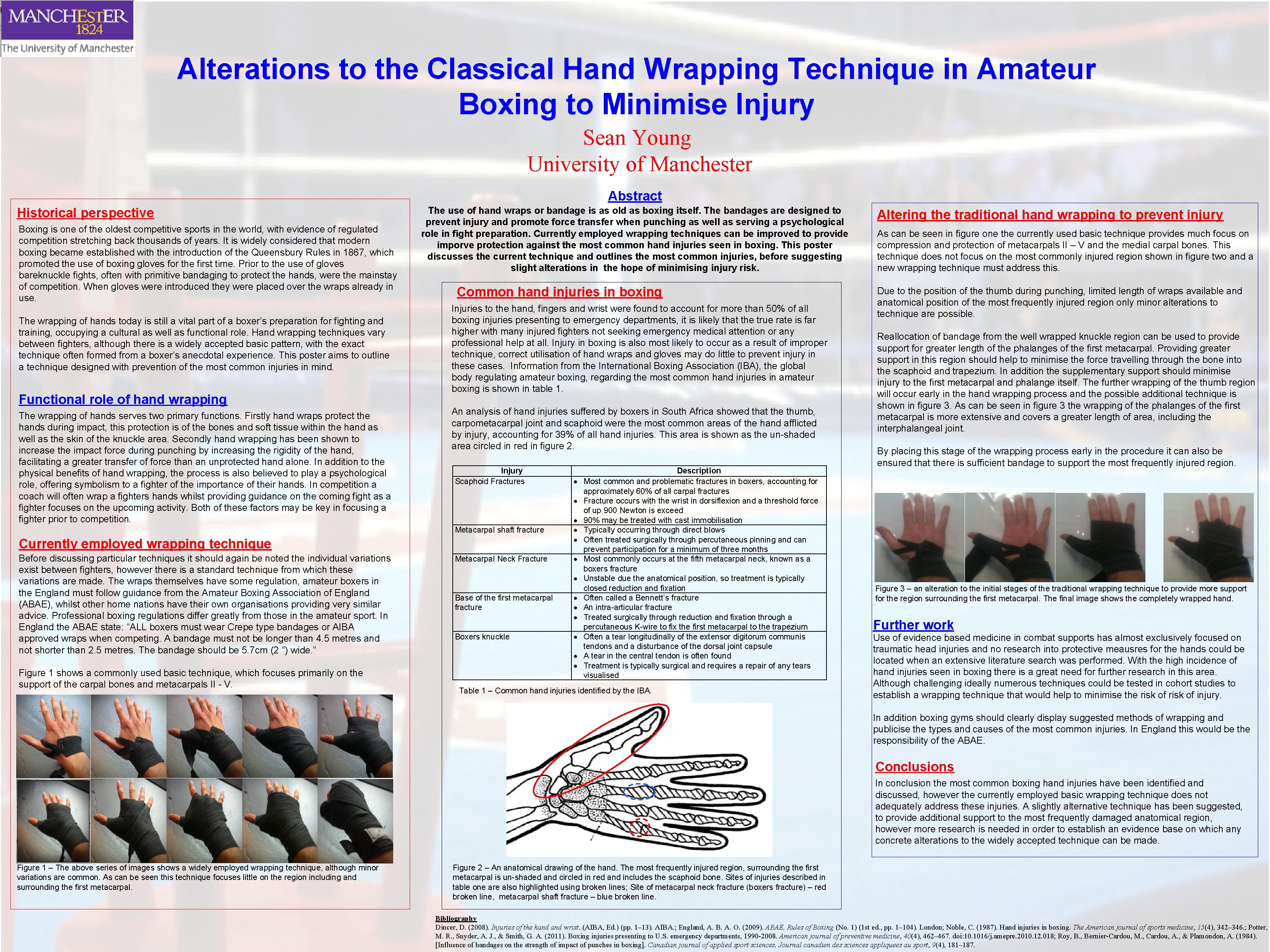
Alterations to the Classical Hand Wrapping Technique in Amateur Boxing to Minimise Injury Sean Young University of Manchester Abstract Historical perspective Boxing is one of the oldest competitive sports in the world, with evidence of regulated competition stretching back thousands of years. It is widely considered that modern boxing became established with the introduction of the Queensbury Rules in 1867, which promoted the use of boxing gloves for the first time. Prior to the use of gloves bareknuckle fights, often with primitive bandaging to protect the hands, were the mainstay of competition. When gloves were introduced they were placed over the wraps already in use. The wrapping of hands today is still a vital part of a boxer’s preparation for fighting and training, occupying a cultural as well as functional role. Hand wrapping techniques vary between fighters, although there is a widely accepted basic pattern, with the exact technique often formed from a boxer’s anecdotal experience. This poster aims to outline a technique designed with prevention of the most common injuries in mind. Functional role of hand wrapping The wrapping of hands serves two primary functions. Firstly hand wraps protect the hands during impact, this protection is of the bones and soft tissue within the hand as well as the skin of the knuckle area. Secondly hand wrapping has been shown to increase the impact force during punching by increasing the rigidity of the hand, facilitating a greater transfer of force than an unprotected hand alone. In addition to the physical benefits of hand wrapping, the process is also believed to play a psychological role, offering symbolism to a fighter of the importance of their hands. In competition a coach will often wrap a fighters hands whilst providing guidance on the coming fight as a fighter focuses on the upcoming activity. Both of these factors may be key in focusing a fighter prior to competition. The use of hand wraps or bandage is as old as boxing itself. The bandages are designed to prevent injury and promote force transfer when punching as well as serving a psychological role in fight preparation. Currently employed wrapping techniques can be improved to provide imporve protection against the most common hand injuries seen in boxing. This poster discusses the current technique and outlines the most common injuries, before suggesting slight alterations in the hope of minimising injury risk. Common hand injuries in boxing Injuries to the hand, fingers and wrist were found to account for more than 50% of all boxing injuries presenting to emergency departments, it is likely that the true rate is far higher with many injured fighters not seeking emergency medical attention or any professional help at all. Injury in boxing is also most likely to occur as a result of improper technique, correct utilisation of hand wraps and gloves may do little to prevent injury in these cases. Information from the International Boxing Association (IBA), the global body regulating amateur boxing, regarding the most common hand injuries in amateur boxing is shown in table 1. An analysis of hand injuries suffered by boxers in South Africa showed that the thumb, carpometacarpal joint and scaphoid were the most common areas of the hand afflicted by injury, accounting for 39% of all hand injuries. This area is shown as the un-shaded area circled in red in figure 2. Injury Scaphoid Fractures Metacarpal shaft fracture Metacarpal Neck Fracture Currently employed wrapping technique Before discussing particular techniques it should again be noted the individual variations exist between fighters, however there is a standard technique from which these variations are made. The wraps themselves have some regulation, amateur boxers in the England must follow guidance from the Amateur Boxing Association of England (ABAE), whilst other home nations have their own organisations providing very similar advice. Professional boxing regulations differ greatly from those in the amateur sport. In England the ABAE state: “ALL boxers must wear Crepe type bandages or AIBA approved wraps when competing. A bandage must not be longer than 4. 5 metres and not shorter than 2. 5 metres. The bandage should be 5. 7 cm (2 ”) wide. ” Figure 1 shows a commonly used basic technique, which focuses primarily on the support of the carpal bones and metacarpals II - V. Base of the first metacarpal fracture Boxers knuckle Description Most common and problematic fractures in boxers, accounting for approximately 60% of all carpal fractures Fracture occurs with the wrist in dorsiflexion and a threshold force of up 900 Newton is exceed 90% may be treated with cast immobilisation Typically occurring through direct blows Often treated surgically through percutaneous pinning and can prevent participation for a minimum of three months Most commonly occurs at the fifth metacarpal neck, known as a boxers fracture Unstable due the anatomical position, so treatment is typically closed reduction and fixation Often called a Bennett’s fracture An intra-articular fracture Treated surgically through reduction and fixation through a percutaneous K-wire to fix the first metacarpal to the trapezium Often a tear longitudinally of the extensor digitorum communis tendons and a disturbance of the dorsal joint capsule A tear in the central tendon is often found Treatment is typically surgical and requires a repair of any tears visualised Table 1 – Common hand injuries identified by the IBA. Altering the traditional hand wrapping to prevent injury As can be seen in figure one the currently used basic technique provides much focus on compression and protection of metacarpals II – V and the medial carpal bones. This technique does not focus on the most commonly injured region shown in figure two and a new wrapping technique must address this. Due to the position of the thumb during punching, limited length of wraps available and anatomical position of the most frequently injured region only minor alterations to technique are possible. Reallocation of bandage from the well wrapped knuckle region can be used to provide support for greater length of the phalanges of the first metacarpal. Providing greater support in this region should help to minimise the force travelling through the bone into the scaphoid and trapezium. In addition the supplementary support should minimise injury to the first metacarpal and phalange itself. The further wrapping of the thumb region will occur early in the hand wrapping process and the possible additional technique is shown in figure 3. As can be seen in figure 3 the wrapping of the phalanges of the first metacarpal is more extensive and covers a greater length of area, including the interphalangeal joint. By placing this stage of the wrapping process early in the procedure it can also be ensured that there is sufficient bandage to support the most frequently injured region. Figure 3 – an alteration to the initial stages of the traditional wrapping technique to provide more support for the region surrounding the first metacarpal. The final image shows the completely wrapped hand. Further work Use of evidence based medicine in combat supports has almost exclusively focused on traumatic head injuries and no research into protective meausres for the hands could be located when an extensive literature search was performed. With the high incidence of hand injuries seen in boxing there is a great need for further research in this area. Although challenging ideally numerous techniques could be tested in cohort studies to establish a wrapping technique that would help to minimise the risk of injury. In addition boxing gyms should clearly display suggested methods of wrapping and publicise the types and causes of the most common injuries. In England this would be the responsibility of the ABAE. Conclusions In conclusion the most common boxing hand injuries have been identified and discussed, however the currently employed basic wrapping technique does not adequately address these injuries. A slightly alternative technique has been suggested, to provide additional support to the most frequently damaged anatomical region, however more research is needed in order to establish an evidence base on which any concrete alterations to the widely accepted technique can be made. Figure 1 – The above series of images shows a widely employed wrapping technique, although minor variations are common. As can be seen this technique focuses little on the region including and surrounding the first metacarpal. Figure 2 – An anatomical drawing of the hand. The most frequently injured region, surrounding the first metacarpal is un-shaded and circled in red and includes the scaphoid bone. Sites of injuries described in table one are also highlighted using broken lines; Site of metacarpal neck fracture (boxers fracture) – red broken line, metacarpal shaft fracture – blue broken line. Bibliography Dincer, D. (2008). Injuries of the hand wrist. (AIBA, Ed. ) (pp. 1– 13). AIBA. ; England, A. B. A. O. (2009). ABAE, Rules of Boxing (No. 1) (1 st ed. , pp. 1– 104). London; Noble, C. (1987). Hand injuries in boxing. The American journal of sports medicine, 15(4), 342– 346. ; Potter, M. R. , Snyder, A. J. , & Smith, G. A. (2011). Boxing injuries presenting to U. S. emergency departments, 1990 -2008. American journal of preventive medicine, 40(4), 462– 467. doi: 10. 1016/j. amepre. 2010. 12. 018; Roy, B. , Bernier-Cardou, M. , Cardou, A. , & Plamondon, A. (1984). [Influence of bandages on the strength of impact of punches in boxing]. Canadian journal of applied sport sciences. Journal canadien des sciences appliquees au sport, 9(4), 181– 187.