
Alterations of the Reproductive Systems Chapter 32 Elsevier

- Slides: 114
Alterations of the Reproductive Systems Chapter 32 Elsevier items and derived items © 2008 by Mosby, Inc. , an affiliate of Elsevier Inc.
Alterations of Sexual Maturation Delayed Puberty Sexual maturation, or puberty, should begin in girls between the ages of 8 and 13 years and in boys between the ages of 9 and 14 years. Delayed puberty is the onset of sexual maturation: after age 13 in girls Ø after age 14 in boys Ø Elsevier items and derived items © 2008 by Mosby, Inc. , an affiliate of Elsevier Inc.
Alterations of Sexual Maturation Delayed Puberty 95% of cases are simply a constitutional delay in maturity. No treatment required. 5% are caused by some type of disruption of the hypothalamic-pituitary-gonadal axis. Ø Treatment depends on the underlying cause. Elsevier items and derived items © 2008 by Mosby, Inc. , an affiliate of Elsevier Inc.
Alterations of Sexual Maturation Precocious Puberty Precocious puberty is the onset of puberty before: age 6 in black girls and age 7 in white girls Ø age 9 in boys Ø Can cause long bones to stop growing before the child has reached normal height. Elsevier items and derived items © 2008 by Mosby, Inc. , an affiliate of Elsevier Inc.
Alterations of Sexual Maturation Precocious Puberty Isosexual precocious puberty Ø Premature development of sex characteristics appropriate for the child's gender. Ø Usually due to normal but premature functioning of hypothalamic-pituitary-ovarian axis. Ø In about 10% of cases caused by a lethal central nervous system tumor. Elsevier items and derived items © 2008 by Mosby, Inc. , an affiliate of Elsevier Inc.
Alterations of Sexual Maturation Precocious Puberty Heterosexual precocious puberty Ø Development of some secondary sex characteristics not appropriate for the child's gender (e. g. , breast enlargement in males). Ø Common causes are adrenal hyperplasia or androgen-secreting tumors. Elsevier items and derived items © 2008 by Mosby, Inc. , an affiliate of Elsevier Inc.
Alterations of Sexual Maturation Precocious Puberty Incomplete precocious puberty Ø Partial development of appropriate secondary sex characteristics. Ø May be a variant of normal pubertal development, but may be due to estrogensecreting neoplasms. Elsevier items and derived items © 2008 by Mosby, Inc. , an affiliate of Elsevier Inc.
Disorders of the Female Reproductive System Hormonal and Menstrual Alterations Dysmenorrhea a. Primary dysmenorrhea Ø Painful menstruation not associated with pelvic disease. Ø Results from excessive synthesis of prostaglandin F 2 alpha in the myometrium and endometrium. Elsevier items and derived items © 2008 by Mosby, Inc. , an affiliate of Elsevier Inc.
Disorders of the Female Reproductive System a. Primary dysmenorrhea (cont. ) • Prostaglandin F 2 alpha causes excessive uterine contractions and endometrial shedding. • Can also cause headache, nausea, abdominal cramping, and diarrhea. Elsevier items and derived items © 2008 by Mosby, Inc. , an affiliate of Elsevier Inc.
Hormonal and Menstrual Alterations Dysmenorrhea b. Secondary dysmenorrhea Ø Painful menstruation related to pelvic pathology, such as endometriosis, pelvic adhesions, inflammatory disease, uterine fibroids, or adenomyosis (endometrial tissue in myometrium of uterus). Ø Can occur any time in the menstrual cycle Elsevier items and derived items © 2008 by Mosby, Inc. , an affiliate of Elsevier Inc.
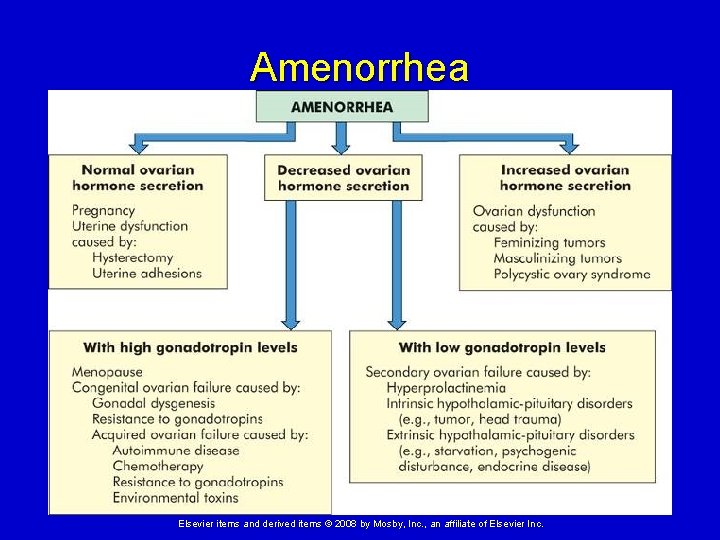
Hormonal and Menstrual Alterations Amenorrhea Absence of menstruation. Associated with anovulation. a. Primary amenorrhea Ø Absence of menstruation by age 14 without the development of secondary sex characteristics or by 16 years of age if these changes have occurred. Elsevier items and derived items © 2008 by Mosby, Inc. , an affiliate of Elsevier Inc.
Hormonal and Menstrual Alterations a. Primary amenorrhea Causes: Ø Congenital defects of gonadotropin production Ø Genetic disorders (Turner syndrome) Ø Congenital central nervous system defects (hydrocephalus) Ø Congenital anatomic malformations (absence of vagina or uterus) Ø Acquired CNS lesions (trauma, infections or tumors) Elsevier items and derived items © 2008 by Mosby, Inc. , an affiliate of Elsevier Inc.
Hormonal and Menstrual Alterations b. Secondary amenorrhea Ø Absence of menstruation for a time equivalent to more than 3 cycles or 6 months in women who have previously menstruated. Ø Normal during early adolescence, pregnancy, lactation, and perimenopausal period. Ø Causes: • Extreme weight loss, ovarian or uterine disease, chemotherapy, toxins, pituitary tumors (prolactinoma), thyroid disorders, and CNS trauma. Elsevier items and derived items © 2008 by Mosby, Inc. , an affiliate of Elsevier Inc.
Amenorrhea Elsevier items and derived items © 2008 by Mosby, Inc. , an affiliate of Elsevier Inc.
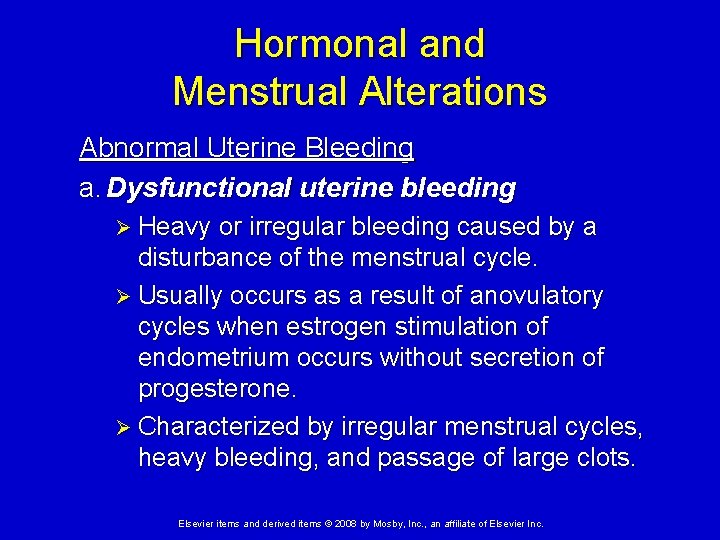
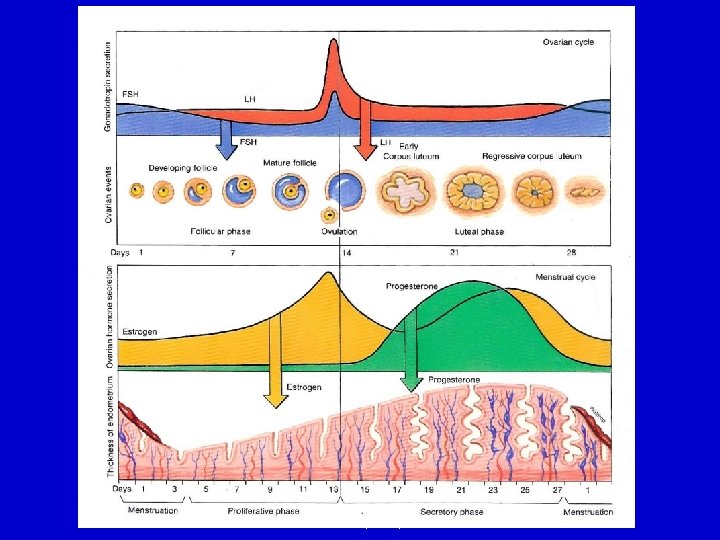
Hormonal and Menstrual Alterations Abnormal Uterine Bleeding a. Dysfunctional uterine bleeding Ø Heavy or irregular bleeding caused by a disturbance of the menstrual cycle. Ø Usually occurs as a result of anovulatory cycles when estrogen stimulation of endometrium occurs without secretion of progesterone. Ø Characterized by irregular menstrual cycles, heavy bleeding, and passage of large clots. Elsevier items and derived items © 2008 by Mosby, Inc. , an affiliate of Elsevier Inc.
Elsevier items and derived items © 2008 by Mosby, Inc. , an affiliate of Elsevier Inc.
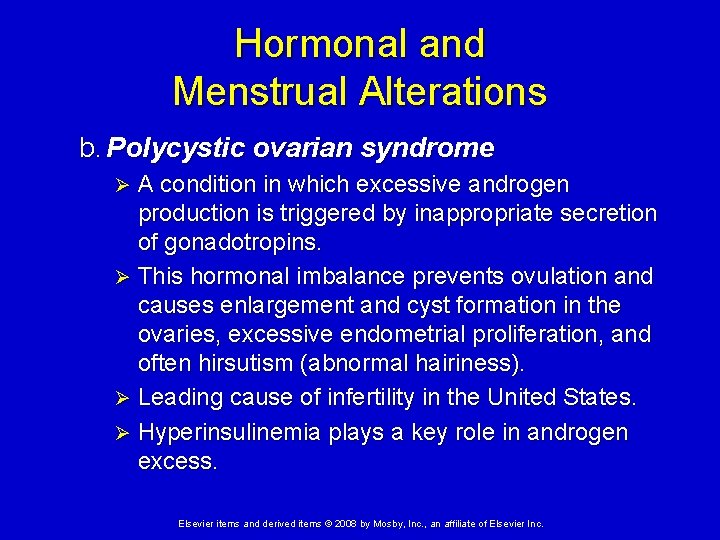
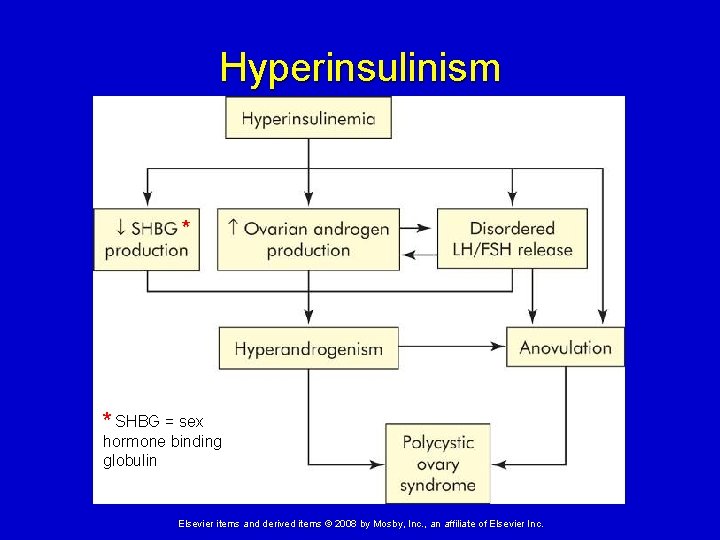
Hormonal and Menstrual Alterations b. Polycystic ovarian syndrome A condition in which excessive androgen production is triggered by inappropriate secretion of gonadotropins. Ø This hormonal imbalance prevents ovulation and causes enlargement and cyst formation in the ovaries, excessive endometrial proliferation, and often hirsutism (abnormal hairiness). Ø Leading cause of infertility in the United States. Ø Hyperinsulinemia plays a key role in androgen excess. Ø Elsevier items and derived items © 2008 by Mosby, Inc. , an affiliate of Elsevier Inc.
Ovarian Cysts Elsevier items and derived items © 2008 by Mosby, Inc. , an affiliate of Elsevier Inc.
Hyperinsulinism * * SHBG = sex hormone binding globulin Elsevier items and derived items © 2008 by Mosby, Inc. , an affiliate of Elsevier Inc.
Hormonal and Menstrual Alterations c. Premenstrual syndrome (PMS) Ø Cyclic recurrence about a week prior to menstruation of physical, psychologic, or behavioral changes distressing enough to disrupt normal activities or relationships. Ø Emotional symptoms, particularly depression, anger, irritability, and fatigue, are reported as the most distressing symptoms; physical symptoms tend to be less problematic. Elsevier items and derived items © 2008 by Mosby, Inc. , an affiliate of Elsevier Inc.
Hormonal and Menstrual Alterations c. Premenstrual syndrome (PMS) Ø Premenstrual dysphoric disorder - exaggerated feeling of depression. Ø Treatment for PMS is symptomatic and includes self-help techniques, lifestyle changes, counseling, and medication. Elsevier items and derived items © 2008 by Mosby, Inc. , an affiliate of Elsevier Inc.
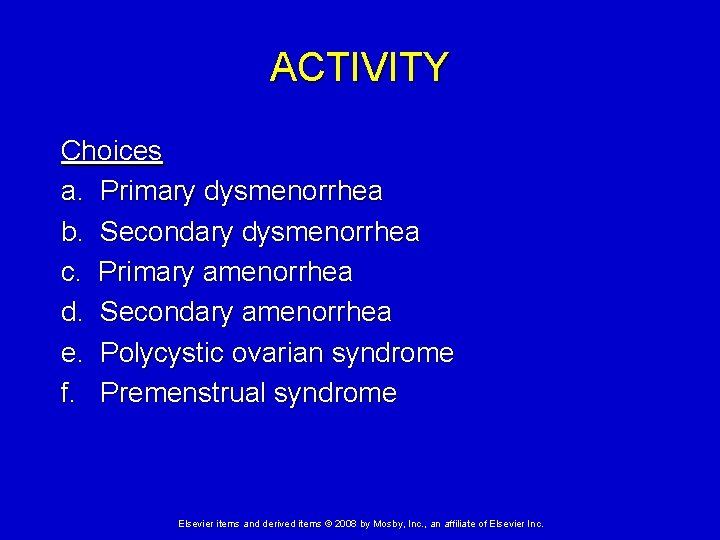
ACTIVITY Choices a. Primary dysmenorrhea b. Secondary dysmenorrhea c. Primary amenorrhea d. Secondary amenorrhea e. Polycystic ovarian syndrome f. Premenstrual syndrome Elsevier items and derived items © 2008 by Mosby, Inc. , an affiliate of Elsevier Inc.
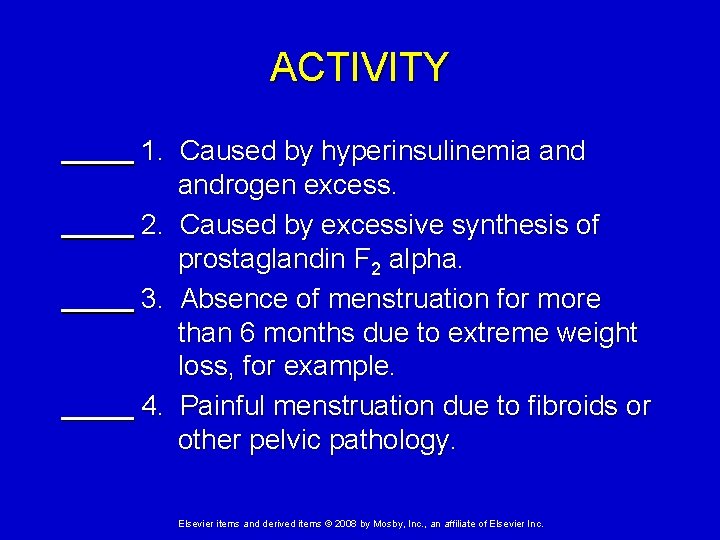
ACTIVITY 1. Caused by hyperinsulinemia androgen excess. 2. Caused by excessive synthesis of prostaglandin F 2 alpha. 3. Absence of menstruation for more than 6 months due to extreme weight loss, for example. 4. Painful menstruation due to fibroids or other pelvic pathology. Elsevier items and derived items © 2008 by Mosby, Inc. , an affiliate of Elsevier Inc.
Infection and Inflammation Infection and inflammation of the female genitalia can result from microorganisms from the environment or overproliferation of microorganisms that normally populate the genital tract. Elsevier items and derived items © 2008 by Mosby, Inc. , an affiliate of Elsevier Inc.
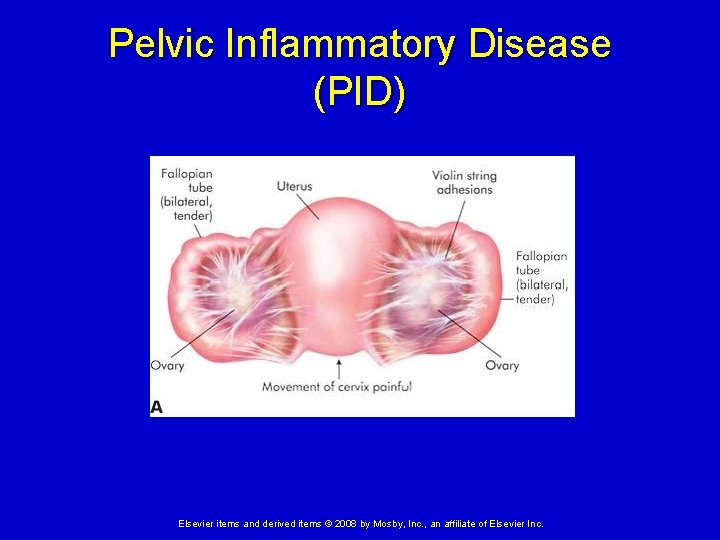
Infection and Inflammation 1. Pelvic inflammatory disease (PID) An acute ascending infection of the upper genital tract caused by a sexually transmitted pathogen. Infection that usually starts in the vagina, ascends through the uterus and fallopian tubes, and spreads into the abdominopelvic cavity. Inflammation causes severe pain, scarring, and formation of adhesions and abscesses. Elsevier items and derived items © 2008 by Mosby, Inc. , an affiliate of Elsevier Inc.
Pelvic Inflammatory Disease (PID) Elsevier items and derived items © 2008 by Mosby, Inc. , an affiliate of Elsevier Inc.
Pelvic Inflammatory Disease Often results in infertility and increases risk of ectopic pregnancy. Usually caused by sexually transmitted organisms. Most common in young, sexually active women. Symptoms - abdominal pain (often severe) and fever; dyspareunia (painful intercourse) and dyschezia (painful defecation) are also common. Elsevier items and derived items © 2008 by Mosby, Inc. , an affiliate of Elsevier Inc.
Pelvic Inflammatory Disease Treatment of PID Ø Antibiotics, usually two or more in combination to deal with multiple types of organisms Ø Surgery to drain abscesses and remove adhesions Elsevier items and derived items © 2008 by Mosby, Inc. , an affiliate of Elsevier Inc.
Infection and Inflammation 2. Vaginitis Infection of the vagina. Usually caused by sexually transmitted pathogens or Candida albicans (causes candidiasis, AKA yeast vaginitis). The acidic nature of the vagina normally provides protection. Ø Acidity is maintained by cervical secretions, normal flora, and lactobacillus acidophilus. Infection may occur after antibiotic use, since this kills normal flora, allowing pathogens to grow. Elsevier items and derived items © 2008 by Mosby, Inc. , an affiliate of Elsevier Inc.
Infection and Inflammation 3. Cervicitis Inflammation or infection of the cervix. Mucopurulent cervicitis (MPC) is an acute infection caused by one or more sexually transmitted pathogens, such as Trichomonas, gonorrhea, and Chlamydia. Elsevier items and derived items © 2008 by Mosby, Inc. , an affiliate of Elsevier Inc.
Infection and Inflammation 4. Vulvitis Inflammation of the female external genitalia. Causes: Ø Contact with soaps, detergents, lotions, hygienic sprays, shaving, menstrual pads, perfumed toilet paper, or nonabsorbing or tight-fitting clothing. Ø Vaginal infections that spread to the labia such as candidiasis. Elsevier items and derived items © 2008 by Mosby, Inc. , an affiliate of Elsevier Inc.
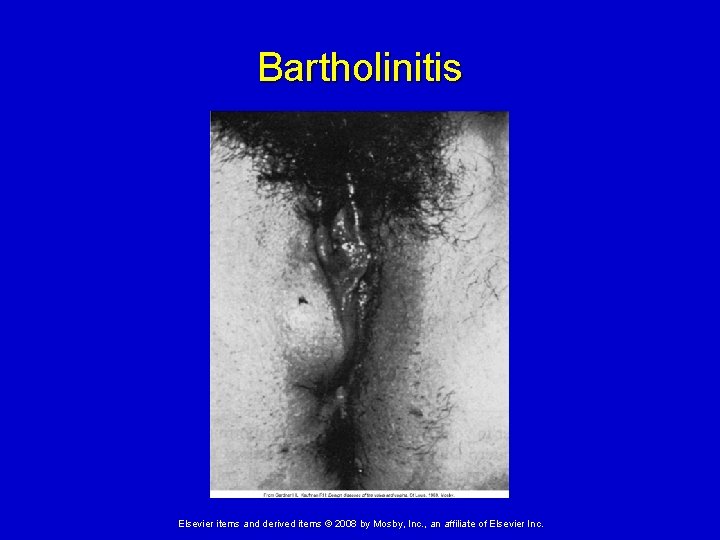
Infection and Inflammation 5. Bartholinitis (Bartholin cyst) An infection of the ducts that lead from the Bartholin glands to the surface of the vulva. Infection blocks the glands, preventing the outflow of glandular secretions. Elsevier items and derived items © 2008 by Mosby, Inc. , an affiliate of Elsevier Inc.
Bartholinitis Elsevier items and derived items © 2008 by Mosby, Inc. , an affiliate of Elsevier Inc.
Pelvic Relaxation Disorders The bladder, urethra, and rectum are supported by the endopelvic fascia and perineal muscles. The muscular and fascial tissue loses tone and strength with age or after childbirth or trauma. In pelvic relaxation disorders these structures fail to maintain organs in proper position. Elsevier items and derived items © 2008 by Mosby, Inc. , an affiliate of Elsevier Inc.
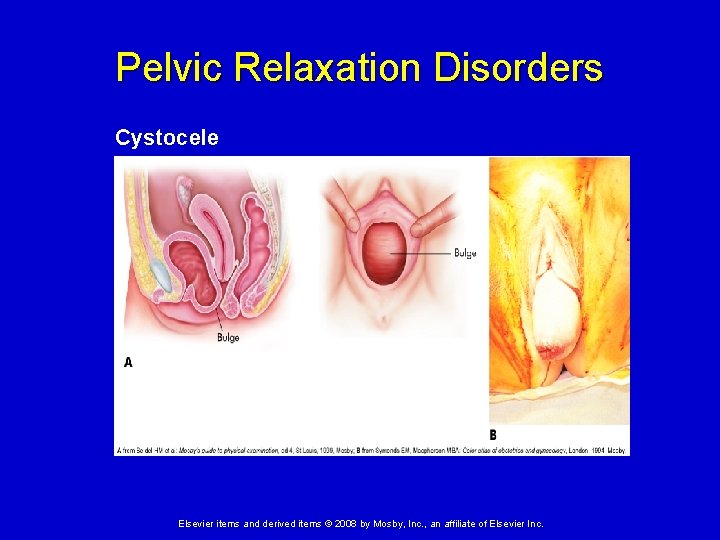
Pelvic Relaxation Disorders 1. Vaginal prolapse – bulging of anatomical structures into vaginal canal. Cystocele - descent of the bladder and anterior vaginal wall into the vaginal canal. Ø May cause stress incontinence (expulsion of urine during laughing, sneezing, etc. ) Urethrocele - sagging of the urethra that may accompany a cystocele and is most commonly the result of trauma during childbirth. Elsevier items and derived items © 2008 by Mosby, Inc. , an affiliate of Elsevier Inc.
Pelvic Relaxation Disorders Cystocele Elsevier items and derived items © 2008 by Mosby, Inc. , an affiliate of Elsevier Inc.
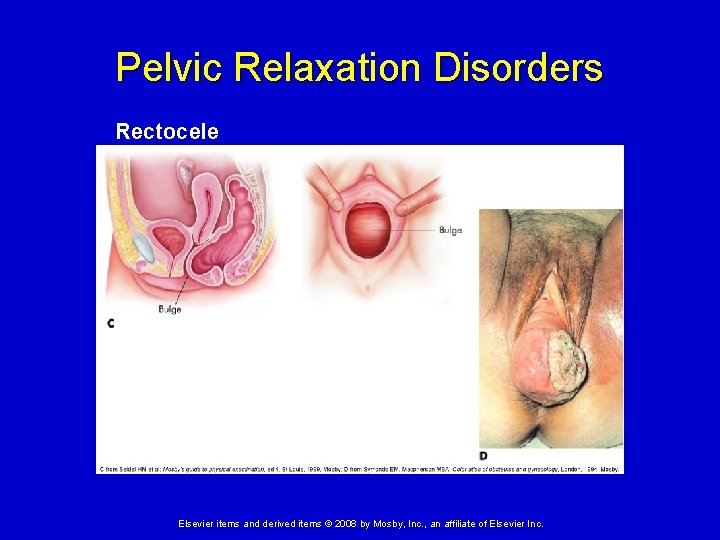
Pelvic Relaxation Disorders 1. Vaginal prolapse Rectocele - bulging of the rectum into the posterior vaginal wall that is associated with constipation. Elsevier items and derived items © 2008 by Mosby, Inc. , an affiliate of Elsevier Inc.
Pelvic Relaxation Disorders Rectocele Elsevier items and derived items © 2008 by Mosby, Inc. , an affiliate of Elsevier Inc.
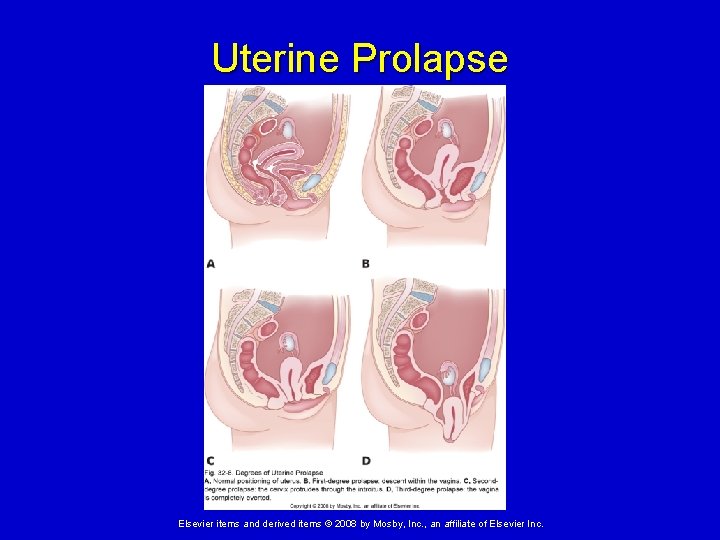
Pelvic Relaxation Disorders 2. Uterine prolapse - descent of the cervix or entire uterus into the vaginal canal. Ø Can progress to protrusion outside of the vagina. Elsevier items and derived items © 2008 by Mosby, Inc. , an affiliate of Elsevier Inc.
Uterine Prolapse Elsevier items and derived items © 2008 by Mosby, Inc. , an affiliate of Elsevier Inc.
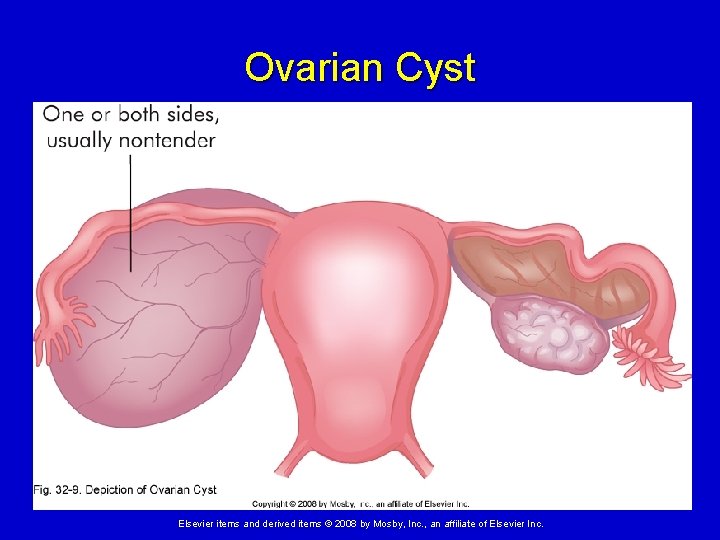
Benign Growths and Proliferative Conditions 1. Benign ovarian cysts Develop from mature ovarian follicles that do not release their ova (follicular cysts) or from a corpus luteum that persists abnormally instead of degenerating (corpus luteum cyst). Usually regress spontaneously. Elsevier items and derived items © 2008 by Mosby, Inc. , an affiliate of Elsevier Inc.
Ovarian Cyst Elsevier items and derived items © 2008 by Mosby, Inc. , an affiliate of Elsevier Inc.
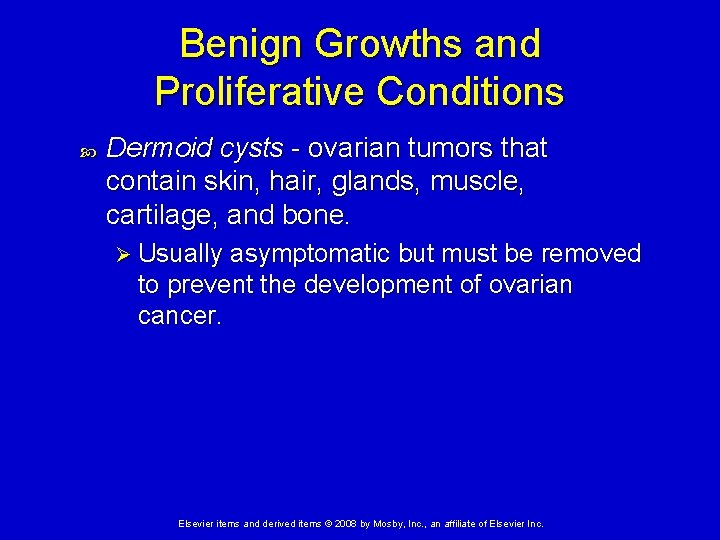
Benign Growths and Proliferative Conditions Dermoid cysts - ovarian tumors that contain skin, hair, glands, muscle, cartilage, and bone. Ø Usually asymptomatic but must be removed to prevent the development of ovarian cancer. Elsevier items and derived items © 2008 by Mosby, Inc. , an affiliate of Elsevier Inc.
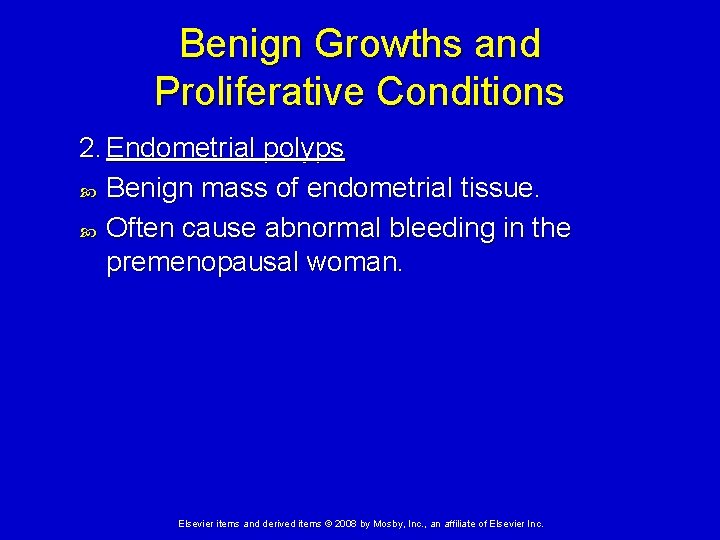
Benign Growths and Proliferative Conditions 2. Endometrial polyps Benign mass of endometrial tissue. Often cause abnormal bleeding in the premenopausal woman. Elsevier items and derived items © 2008 by Mosby, Inc. , an affiliate of Elsevier Inc.
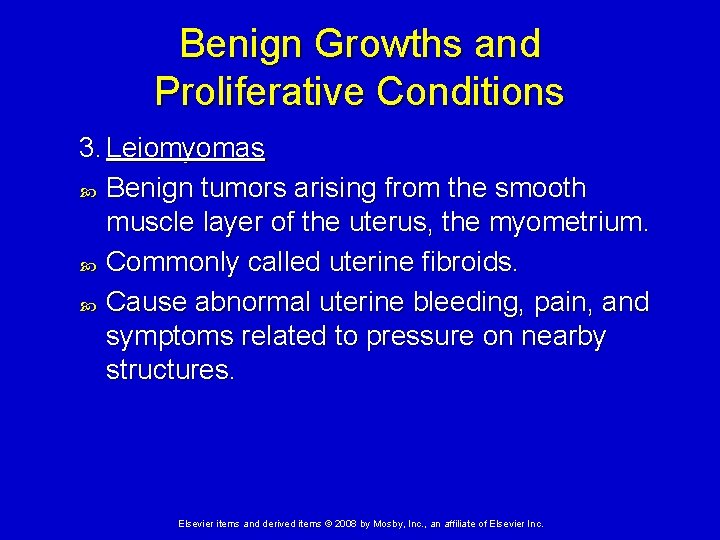
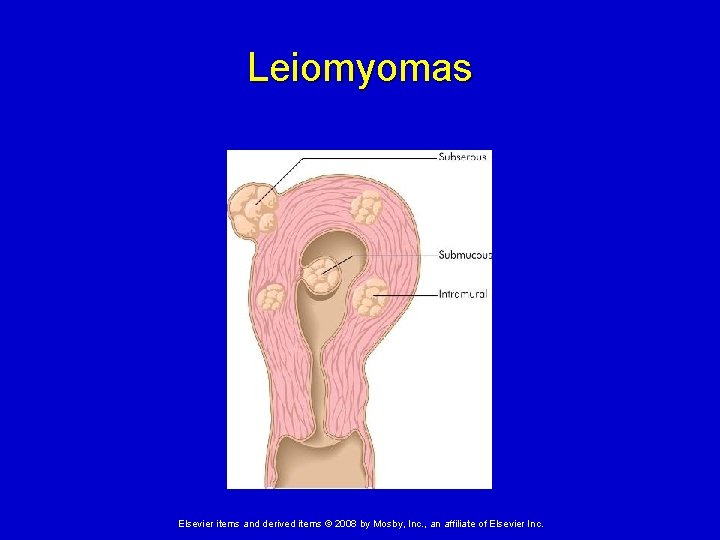
Benign Growths and Proliferative Conditions 3. Leiomyomas Benign tumors arising from the smooth muscle layer of the uterus, the myometrium. Commonly called uterine fibroids. Cause abnormal uterine bleeding, pain, and symptoms related to pressure on nearby structures. Elsevier items and derived items © 2008 by Mosby, Inc. , an affiliate of Elsevier Inc.
Leiomyomas Elsevier items and derived items © 2008 by Mosby, Inc. , an affiliate of Elsevier Inc.
Leiomyoma Elsevier items and derived items © 2008 by Mosby, Inc. , an affiliate of Elsevier Inc.
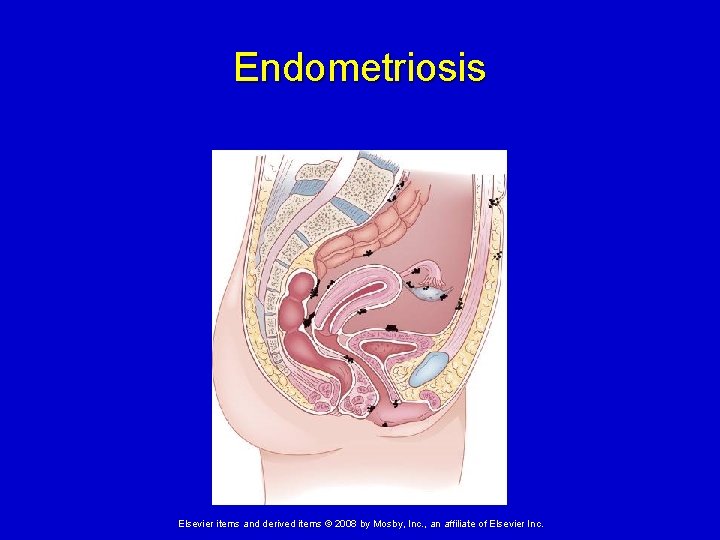
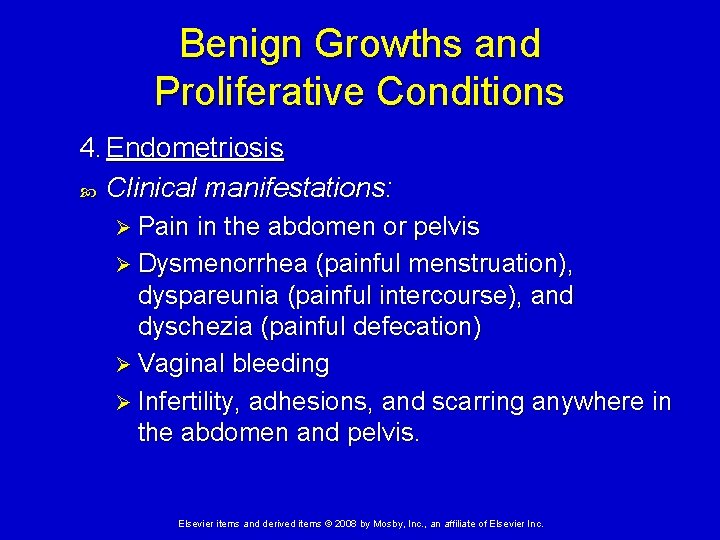
Benign Growths and Proliferative Conditions 4. Endometriosis The presence of functional endometrial tissue (i. e. , tissue that responds to hormonal stimulation) at sites outside the uterus. Causes an inflammatory reaction at the site of implantation. Responds to hormone fluctuations of the menstrual cycle, so deposits bleed each month. Elsevier items and derived items © 2008 by Mosby, Inc. , an affiliate of Elsevier Inc.
Endometriosis Elsevier items and derived items © 2008 by Mosby, Inc. , an affiliate of Elsevier Inc.
Benign Growths and Proliferative Conditions 4. Endometriosis Clinical manifestations: Ø Pain in the abdomen or pelvis Ø Dysmenorrhea (painful menstruation), dyspareunia (painful intercourse), and dyschezia (painful defecation) Ø Vaginal bleeding Ø Infertility, adhesions, and scarring anywhere in the abdomen and pelvis. Elsevier items and derived items © 2008 by Mosby, Inc. , an affiliate of Elsevier Inc.
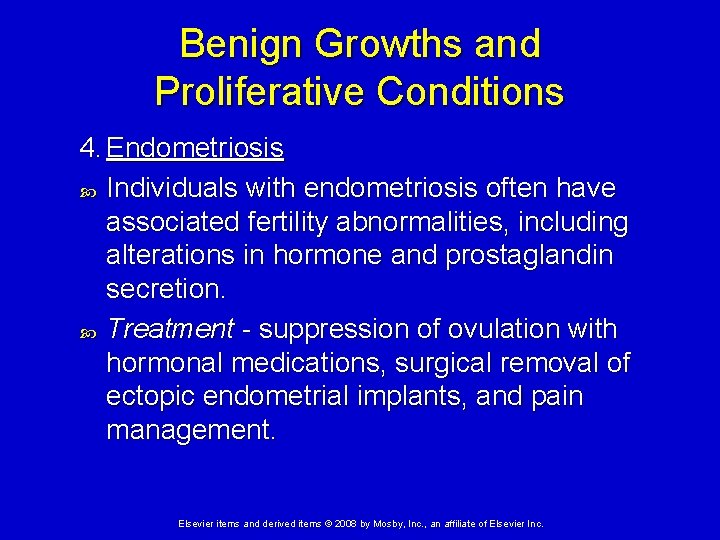
Benign Growths and Proliferative Conditions 4. Endometriosis Individuals with endometriosis often have associated fertility abnormalities, including alterations in hormone and prostaglandin secretion. Treatment - suppression of ovulation with hormonal medications, surgical removal of ectopic endometrial implants, and pain management. Elsevier items and derived items © 2008 by Mosby, Inc. , an affiliate of Elsevier Inc.
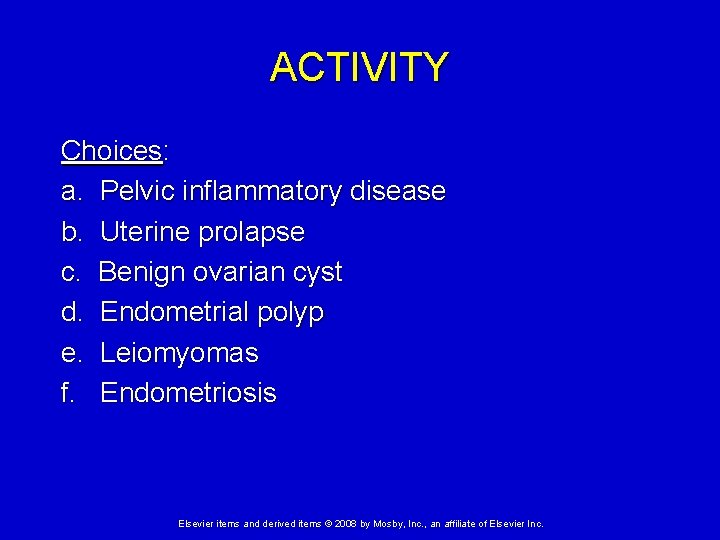
ACTIVITY Choices: a. Pelvic inflammatory disease b. Uterine prolapse c. Benign ovarian cyst d. Endometrial polyp e. Leiomyomas f. Endometriosis Elsevier items and derived items © 2008 by Mosby, Inc. , an affiliate of Elsevier Inc.
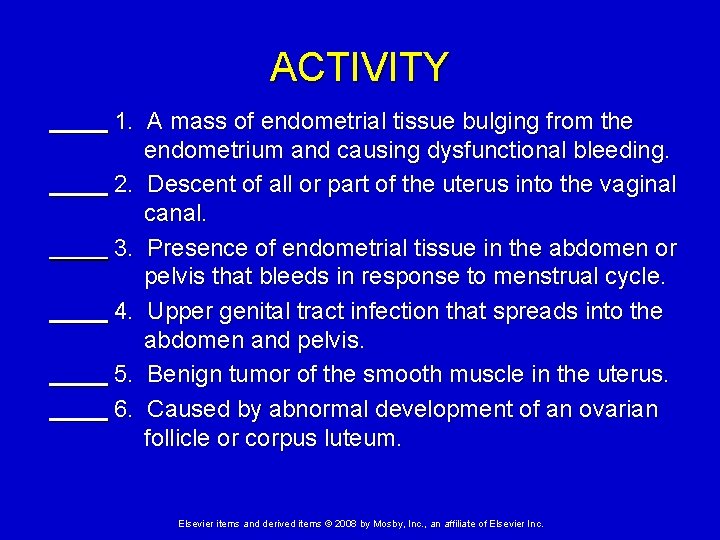
ACTIVITY 1. A mass of endometrial tissue bulging from the endometrium and causing dysfunctional bleeding. 2. Descent of all or part of the uterus into the vaginal canal. 3. Presence of endometrial tissue in the abdomen or pelvis that bleeds in response to menstrual cycle. 4. Upper genital tract infection that spreads into the abdomen and pelvis. 5. Benign tumor of the smooth muscle in the uterus. 6. Caused by abnormal development of an ovarian follicle or corpus luteum. Elsevier items and derived items © 2008 by Mosby, Inc. , an affiliate of Elsevier Inc.
Female Reproductive Cancer Most cancers of the female genitalia involve the uterus (particularly the endometrium), the cervix, and the ovaries. Cancer of the vagina is rare. Elsevier items and derived items © 2008 by Mosby, Inc. , an affiliate of Elsevier Inc.
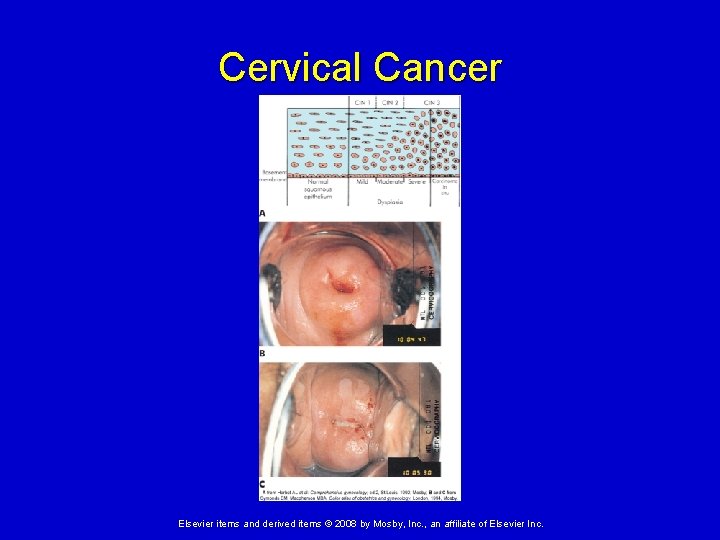
Female Reproductive Cancer 1. Cervical cancer Arises from the cervical epithelium. Triggered by human papillomavirus (HPV). Lesions go through a characteristic series of stages: Ø Cervical intraepithelial neoplasia (cervical dysplasia) - some epithelial cells are replaced by atypical, neoplastic cells. Elsevier items and derived items © 2008 by Mosby, Inc. , an affiliate of Elsevier Inc.
Female Reproductive Cancer 1. Cervical cancer (cont. ) Cervical carcinoma in situ - All or most of cervical epithelium replaced by atypical, neoplastic cells; progresses to this stage within 10 -12 years. Ø Invasive cervical carcinoma - Metastatic spread and invasion into adjacent tissues and metastasis through lymphatics; can spread to rectum, bladder, lungs, and bone. Ø Pap smear – used to detect these changes by analyzing a small sample of cervical tissue. Elsevier items and derived items © 2008 by Mosby, Inc. , an affiliate of Elsevier Inc.
Cervical Cancer Elsevier items and derived items © 2008 by Mosby, Inc. , an affiliate of Elsevier Inc.
Female Reproductive Cancer 2. Vaginal cancer Rarest of the female reproductive cancers. Arise from the vaginal squamous epithelium. Go through the same stages as cervical cancer. Most vaginal cancers are not invasive. Risk is greatly increased in women whose mothers took diethylstilbestrol (DES). Ø DES was given prior to 1971 to prevent an impending miscarriage. Elsevier items and derived items © 2008 by Mosby, Inc. , an affiliate of Elsevier Inc.
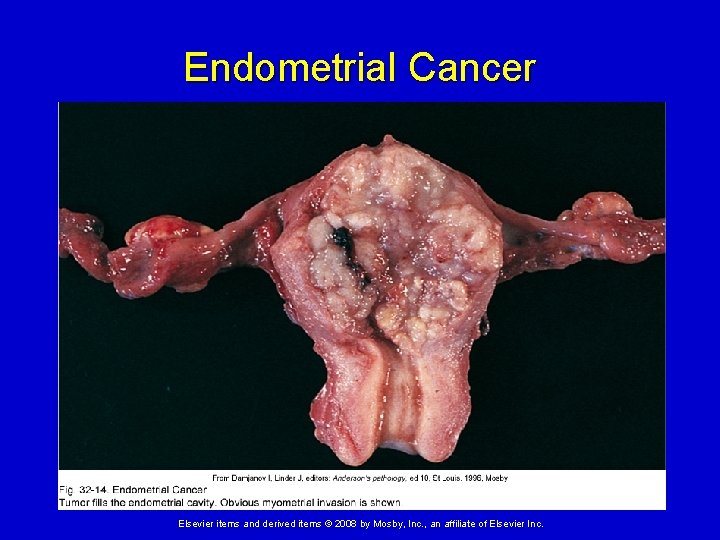
Female Reproductive Cancer 3. Endometrial cancer Cancer of the uterine lining. Most common gynecologic cancer; usually presents after menopause (50 s & 60 s). Primary risk factor - unopposed estrogen exposure. Additional risk factors - obesity, high-fat diet, infertility or no pregnancies, early menarche, late menopause, diabetes, and hypertension. Elsevier items and derived items © 2008 by Mosby, Inc. , an affiliate of Elsevier Inc.
Endometrial Cancer Elsevier items and derived items © 2008 by Mosby, Inc. , an affiliate of Elsevier Inc.
Female Reproductive Cancer 3. Endometrial cancer (cont. ) The use of contraceptives that contain estrogen and progestin appear to be protective against the development of endometrial cancer. Clinical manifestations - abnormal vaginal bleeding, pain, weight loss. Elsevier items and derived items © 2008 by Mosby, Inc. , an affiliate of Elsevier Inc.
Female Reproductive Cancer 4. Ovarian cancer Accounts for the most deaths of all cancers of the female reproductive tract. Usually occurs in older women, with a peak incidence in the eighth decade. Risk factors - family history, residence in an industrialized country, prior breast or endometrial cancer, infertility, early menarche, late menopause, obesity, and a high-fat diet. Elsevier items and derived items © 2008 by Mosby, Inc. , an affiliate of Elsevier Inc.
Female Reproductive Cancer 4. Ovarian cancer (cont. ) Factors that suppress ovulation decrease the risk of ovarian cancer (multiple pregnancies, prolonged lactation, and oral contraceptive use). Poor prognosis partially because it is usually asymptomatic, and symptoms are often associated with advanced disease. One of the most common and ominous symptoms is painless ascites resulting from widespread seeding of the peritoneum. Elsevier items and derived items © 2008 by Mosby, Inc. , an affiliate of Elsevier Inc.
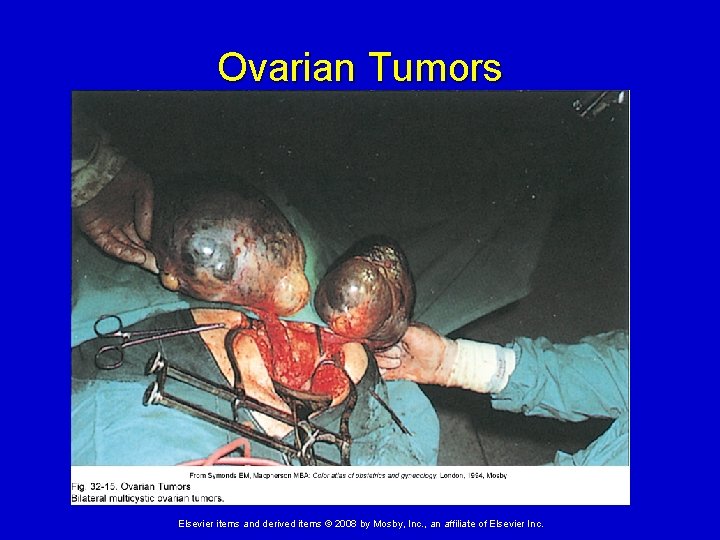
Ovarian Tumors Elsevier items and derived items © 2008 by Mosby, Inc. , an affiliate of Elsevier Inc.
Disorders of the Male Reproductive System Disorders of the Urethra 1. Urethritis Inflammation of the urethra. Most often caused by sexually transmitted disease organisms, especially Neisseria gonorrhoeae (most common) or Chlamydia trachomatis. Can develop secondary to urethral instrumentation or placement of urethral catheters. Clinical manifestations - dysuria and urinary frequency and urgency, possible urethral discharge. Elsevier items and derived items © 2008 by Mosby, Inc. , an affiliate of Elsevier Inc.
Disorders of the Male Reproductive System Disorders of the Urethra 2. Urethral strictures Fibrotic narrowing of the urethra caused by scarring. Commonly a result of trauma or untreated or severe urethral infections. Clinical manifestations - urinary frequency and hesitancy, diminished force and caliber of the urinary stream, dribbling after voiding, and nocturia. Elsevier items and derived items © 2008 by Mosby, Inc. , an affiliate of Elsevier Inc.
Disorders of the Male Reproductive System Disorders of the Penis 1. Penile cancer Carcinoma of the penis is rare. Risk factors - affects African American males twice as often as Caucasians; associated with smoking and HPV infection. Elsevier items and derived items © 2008 by Mosby, Inc. , an affiliate of Elsevier Inc.
Disorders of the Male Reproductive System Disorders of the Penis 1. Penile cancer (cont. ) Precancerous lesions such as leukoplakia and condylomas progress to carcinoma in situ and finally squamous cell carcinoma. Ø Begins as a small ulcerative lesion but can progress to involve the entire shaft of the penis. Requires surgery, radiation, or chemotherapy. Five-year survival rate 50% Elsevier items and derived items © 2008 by Mosby, Inc. , an affiliate of Elsevier Inc.
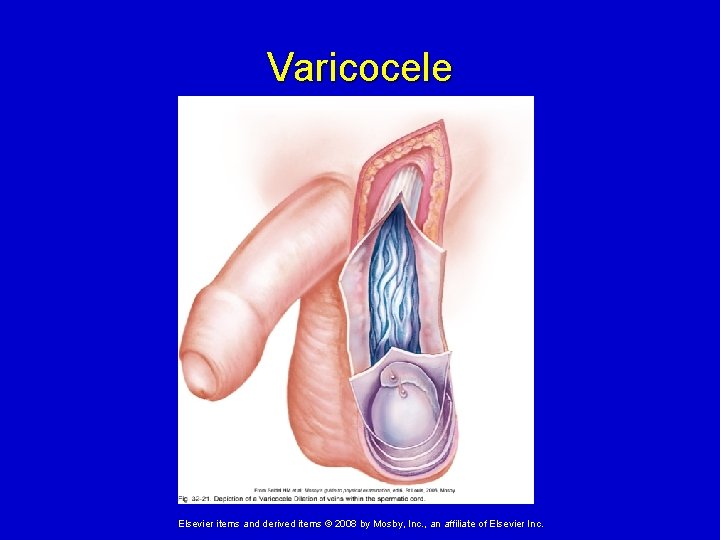
Disorders of the Scrotum and Testis Disorders of the scrotum a. Varicocele Abnormal dilation of the veins within the spermatic cord. Ø Caused by inadequate or absent valves in the spermatic veins. Ø Elsevier items and derived items © 2008 by Mosby, Inc. , an affiliate of Elsevier Inc.
Varicocele Elsevier items and derived items © 2008 by Mosby, Inc. , an affiliate of Elsevier Inc.
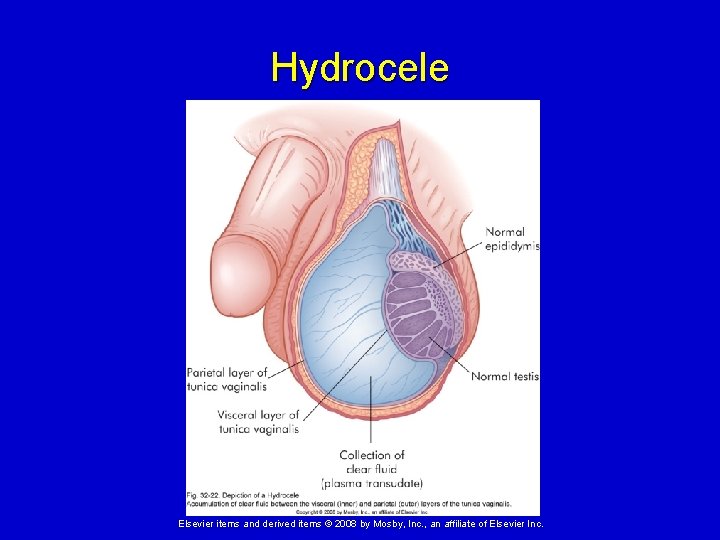
Disorders of the Scrotum and Testis Disorders of the scrotum b. Hydrocele Scrotal swelling caused by collection of fluid within the tunica vaginalis. Ø Most common cause of testicular swelling; especially common in newborns. Ø Hydroceles can be idiopathic or caused by trauma or infection of the testes. Ø Elsevier items and derived items © 2008 by Mosby, Inc. , an affiliate of Elsevier Inc.
Hydrocele Elsevier items and derived items © 2008 by Mosby, Inc. , an affiliate of Elsevier Inc.
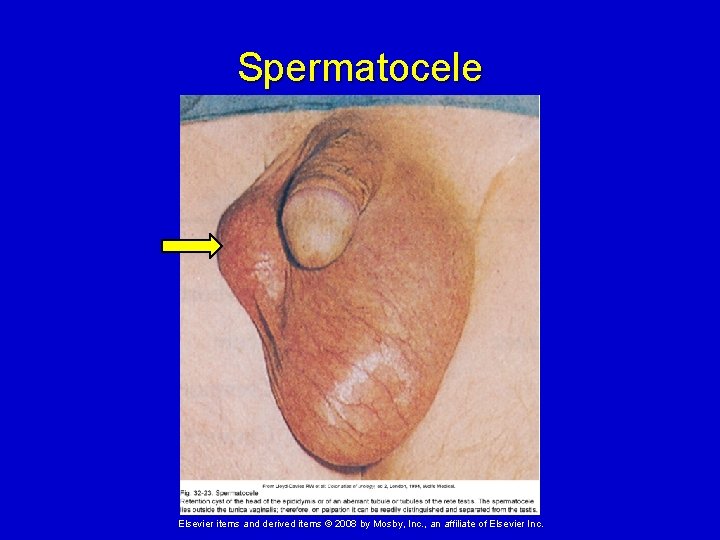
Disorders of the Scrotum and Testis Disorders of the scrotum c. Spermatocele A painless diverticulum (a bulging sac) of the epididymis located between the head of the epididymis and the testis. Ø Fills with sperm and can cause a distinct nodular mass in the scrotum. Ø Lies outside the tunica vaginalis so it is freely mobile and easy to separate from the testes. Ø Elsevier items and derived items © 2008 by Mosby, Inc. , an affiliate of Elsevier Inc.
Spermatocele Elsevier items and derived items © 2008 by Mosby, Inc. , an affiliate of Elsevier Inc.
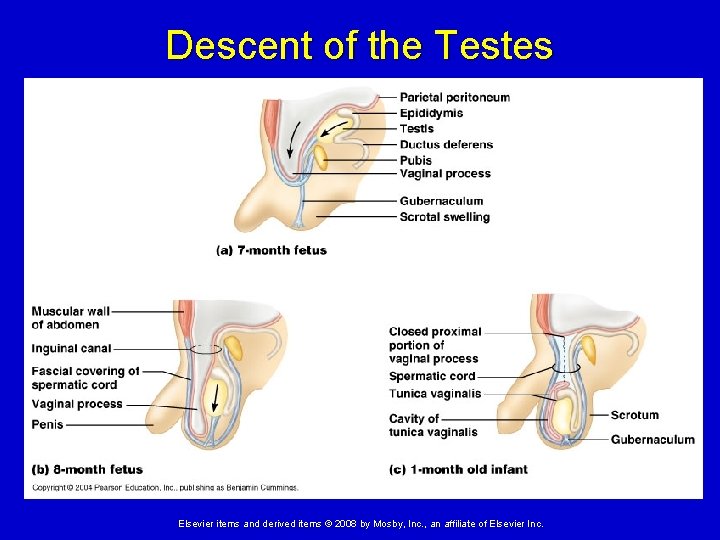
Disorders of the Scrotum, Testis, and Epididymis Disorders of the testis a. Cryptorchidism Ø Failure of one or more of the testes to descend from the abdominal cavity into the scrotum. Ø Caused by developmental, hormonal, or structural abnormalities such as adhesions or a narrowed inguinal canal. Ø Uncorrected cryptorchidism is associated with infertility and significantly increased risk of testicular cancer. Elsevier items and derived items © 2008 by Mosby, Inc. , an affiliate of Elsevier Inc.
Descent of the Testes Elsevier items and derived items © 2008 by Mosby, Inc. , an affiliate of Elsevier Inc.
Disorders of the Scrotum, Testis, and Epididymis Disorders of the testis a. Cryptorchidism Ø Usually descends spontaneously into the scrotum by one year of age without intervention. Ø Treatment – hormone therapy or surgery (orchiopexy) if it does not descend on its own. Elsevier items and derived items © 2008 by Mosby, Inc. , an affiliate of Elsevier Inc.
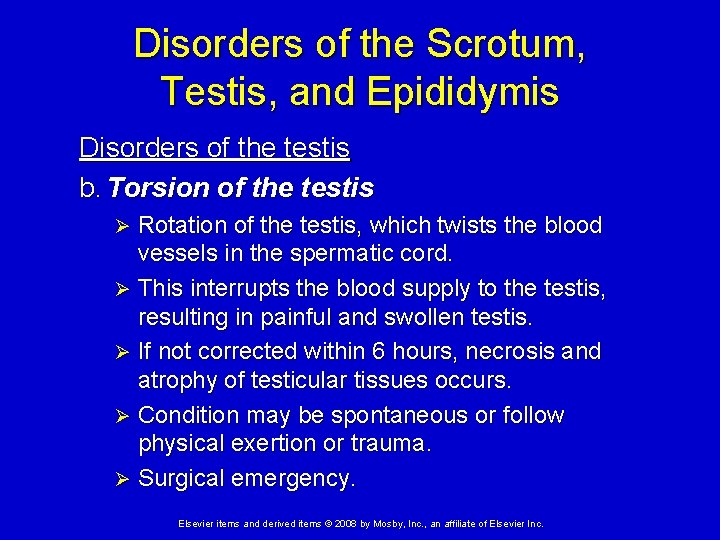
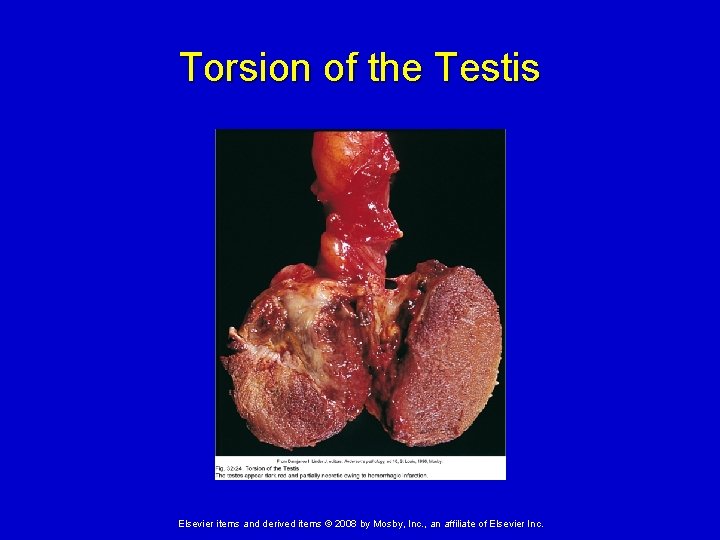
Disorders of the Scrotum, Testis, and Epididymis Disorders of the testis b. Torsion of the testis Rotation of the testis, which twists the blood vessels in the spermatic cord. Ø This interrupts the blood supply to the testis, resulting in painful and swollen testis. Ø If not corrected within 6 hours, necrosis and atrophy of testicular tissues occurs. Ø Condition may be spontaneous or follow physical exertion or trauma. Ø Surgical emergency. Ø Elsevier items and derived items © 2008 by Mosby, Inc. , an affiliate of Elsevier Inc.
Torsion of the Testis Elsevier items and derived items © 2008 by Mosby, Inc. , an affiliate of Elsevier Inc.
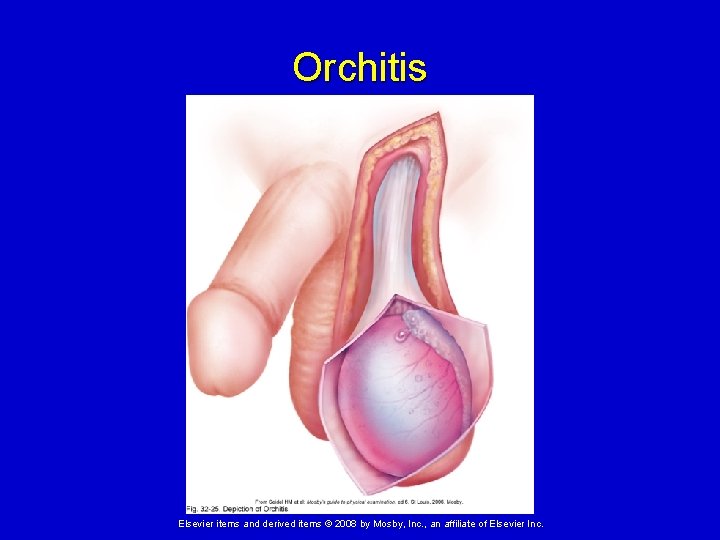
Disorders of the Scrotum, Testis, and Epididymis Disorders of the testis c. Orchitis Ø Acute inflammation of the testis. Ø May be a complication of a systemic disease or related to epididymitis. Ø Mumps is the most common cause. Elsevier items and derived items © 2008 by Mosby, Inc. , an affiliate of Elsevier Inc.
Orchitis Elsevier items and derived items © 2008 by Mosby, Inc. , an affiliate of Elsevier Inc.
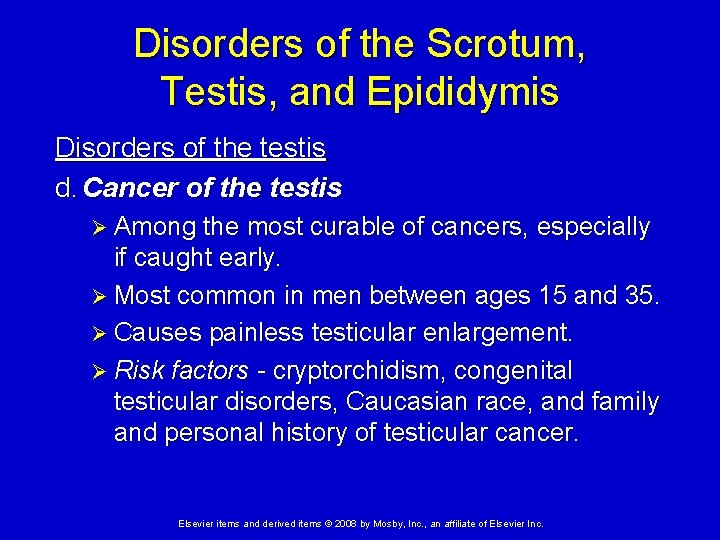
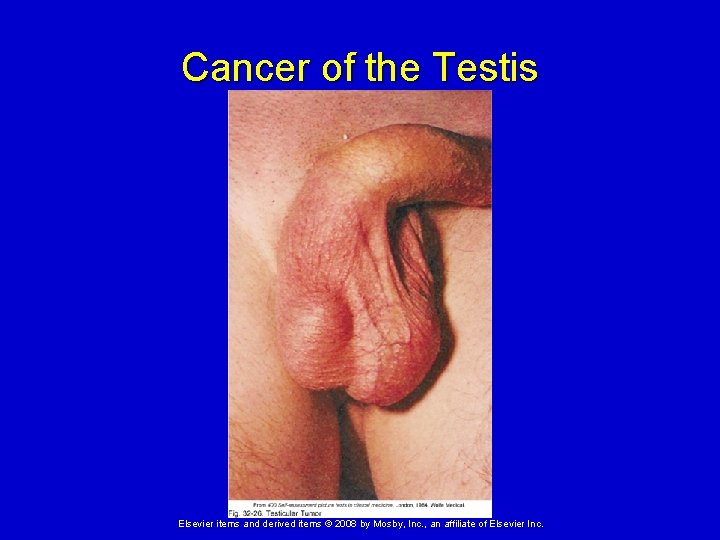
Disorders of the Scrotum, Testis, and Epididymis Disorders of the testis d. Cancer of the testis Ø Among the most curable of cancers, especially if caught early. Ø Most common in men between ages 15 and 35. Ø Causes painless testicular enlargement. Ø Risk factors - cryptorchidism, congenital testicular disorders, Caucasian race, and family and personal history of testicular cancer. Elsevier items and derived items © 2008 by Mosby, Inc. , an affiliate of Elsevier Inc.
Cancer of the Testis Elsevier items and derived items © 2008 by Mosby, Inc. , an affiliate of Elsevier Inc.
Disorders of the Prostate Gland Animation http: //www. youtube. com/watch? feature=endsc reen&v=x. YTjvqzyd 9 k&NR=1 (start at 1: 30; play to 6: 30) Elsevier items and derived items © 2008 by Mosby, Inc. , an affiliate of Elsevier Inc.
Disorders of the Prostate Gland 1. Benign prostatic hyperplasia (BPH) Enlargement of the prostate gland. The prostate gland normally increases in size starting at about age 45. Ø Growth is stimulated by a metabolite of testosterone (dihydrotestosterone). Ø Usually involves inner regions close to urethra. Elsevier items and derived items © 2008 by Mosby, Inc. , an affiliate of Elsevier Inc.
Disorders of the Prostate Gland 1. Benign prostatic hyperplasia (BPH) Enlargement of the prostate gland. The prostate gland normally increases in size starting at about age 45. Ø Growth is stimulated by a metabolite of testosterone (dihydrotestosterone). Ø Usually involves inner regions close to urethra. Elsevier items and derived items © 2008 by Mosby, Inc. , an affiliate of Elsevier Inc.
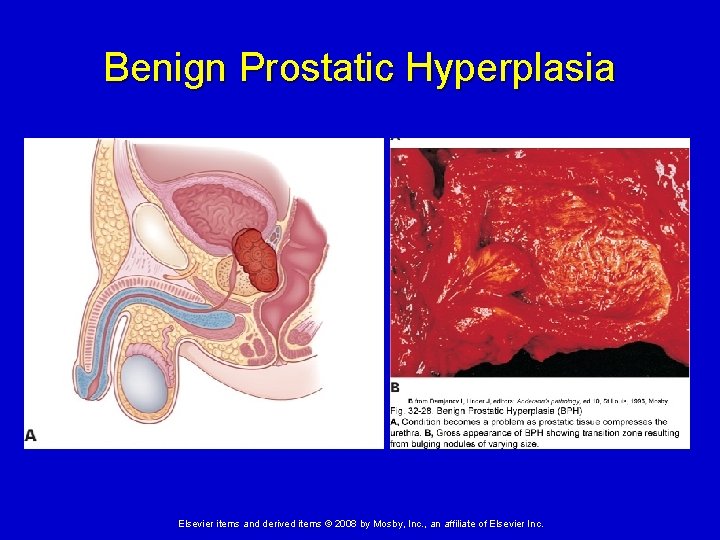
Benign Prostatic Hyperplasia Elsevier items and derived items © 2008 by Mosby, Inc. , an affiliate of Elsevier Inc.
Disorders of the Prostate Gland 1. Benign prostatic hyperplasia (BPH) (cont. ) Causes urinary obstruction - symptoms often arise by age 65. This increases the risk of bladder infections and pyelonephritis. Diagnosis is made by digital rectal examination, measurement of serum prostate-specific antigen (PSA)(to distinguish BHP from prostatic carcinoma), and transrectal ultrasound. Elsevier items and derived items © 2008 by Mosby, Inc. , an affiliate of Elsevier Inc.
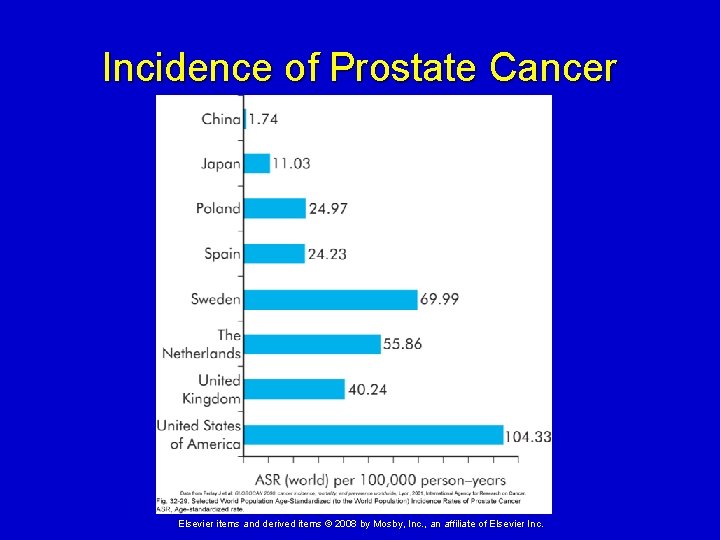
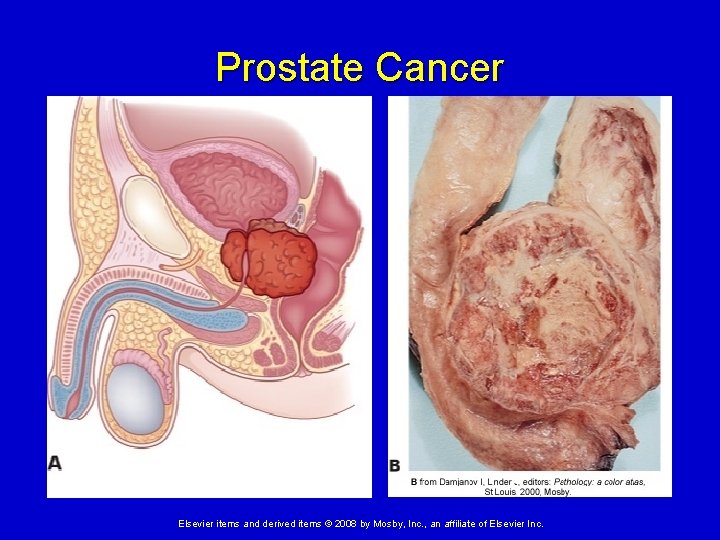
Disorders of the Prostate Gland 2. Cancer of the prostate Most common cancer in U. S. males. Risk factors – increased age (#1), high-fat diet, family history, and vasectomy. Elsevier items and derived items © 2008 by Mosby, Inc. , an affiliate of Elsevier Inc.
Incidence of Prostate Cancer Elsevier items and derived items © 2008 by Mosby, Inc. , an affiliate of Elsevier Inc.
Disorders of the Prostate Gland 2. Cancer of the prostate Pathophysiology: Ø Development is related to changes in levels of sex hormones (decreased dihydrotestosterone and increased estradiol) that occur with age, as well as increased levels of insulin and insulin-like growth factor 1 (IGF-1). Ø Usually begins in the periphery of the gland, so less likely than BHP to cause obstruction. Elsevier items and derived items © 2008 by Mosby, Inc. , an affiliate of Elsevier Inc.
Disorders of the Prostate Gland 2. Cancer of the prostate Pathophysiology: (cont. ) Ø It may be found while still confined to the prostate, but symptoms are rare at this stage. Ø If tumor compresses the urethra, symptoms similar to BPH are seen. Ø Progression of the tumor into lymphatic and blood vessels leads to metastasis to distant tissues. Elsevier items and derived items © 2008 by Mosby, Inc. , an affiliate of Elsevier Inc.
Disorders of the Prostate Gland 2. Cancer of the prostate (cont. ) Diagnosis is made by digital rectal examination, and measurement of serum prostate-specific antigen (PSA). Elsevier items and derived items © 2008 by Mosby, Inc. , an affiliate of Elsevier Inc.
Prostate Cancer Elsevier items and derived items © 2008 by Mosby, Inc. , an affiliate of Elsevier Inc.
ACTIVITY Choices: a. Hydrocele b. Cryptorchidism c. Torsion of the testis d. Cancer of the testis e. Benign prostatic hyperplasia f. Prostate cancer Elsevier items and derived items © 2008 by Mosby, Inc. , an affiliate of Elsevier Inc.
ACTIVITY 1. Failure of one or more of the testes to descend from the abdominal cavity into the scrotum. 2. A tumor that usually begins in the periphery of the prostate gland. 3. Scrotal swelling caused by collection of fluid within the membrane around the testes. 4. Malignant tumor that causes painless testicular enlargement. 5. Rotation of the testis and twisting of the testicular blood vessels causing ischemia. 6. Normal enlargement of the prostate gland that may cause urinary tract obstruction. Elsevier items and derived items © 2008 by Mosby, Inc. , an affiliate of Elsevier Inc.
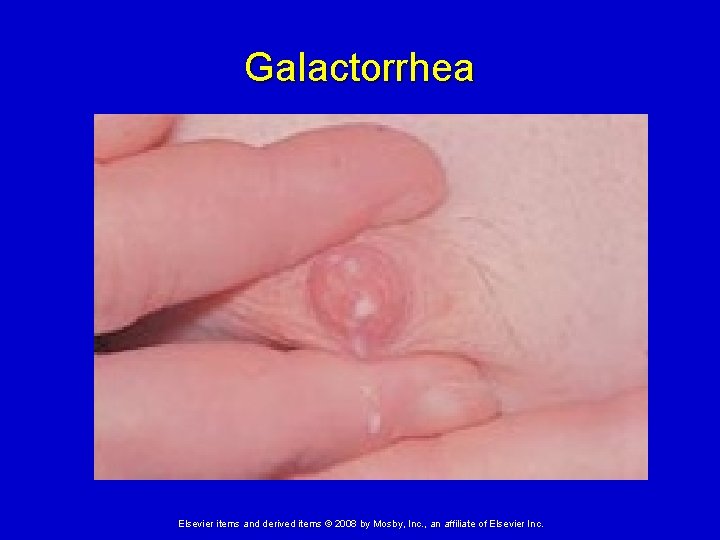
Disorders of the Female Breast 1. Galactorrhea Persistent and sometimes excessive secretion of milky fluid from the breasts of a woman who is not pregnant or nursing. Caused by a hormone imbalance that is usually related to an increase in prolactin levels. Women with galactorrhea often experience menstrual abnormalities. Elsevier items and derived items © 2008 by Mosby, Inc. , an affiliate of Elsevier Inc.
Galactorrhea Elsevier items and derived items © 2008 by Mosby, Inc. , an affiliate of Elsevier Inc.
Benign Breast Conditions Benign breast conditions are numerous and involve both ducts and lobules. Benign epithelial lesions can be broadly classified according to their future risk of developing breast cancer. Elsevier items and derived items © 2008 by Mosby, Inc. , an affiliate of Elsevier Inc.
Benign Breast Conditions a. Nonproliferative breast lesions Ø Not associated with increased breast cancer risk. Ø Fibrocytic changes cause breast tenderness with menstrual cycle. Ø Presence of lumps in the breast consisting of proliferated epithelium, fibrous stroma, or fluidfilled cysts. Ø Risk factors are genetics, age, parity, caffeine, lactation history, exogenous hormones. Elsevier items and derived items © 2008 by Mosby, Inc. , an affiliate of Elsevier Inc.
Benign Breast Conditions b. Proliferative breast lesions Ø Slight increase in breast cancer risk. Ø Proliferation of ductal epithelium and/or stroma without malignancy. c. Proliferative breast lesions with atypia Ø Moderate increase in breast cancer risk. Ø Cells exhibit atypical hyperplasia, in which there is an increase in the number of cells, and the cells have some variation in structure. Elsevier items and derived items © 2008 by Mosby, Inc. , an affiliate of Elsevier Inc.
Benign Breast Conditions Diagnosis - done using mammography, sonography, aspiration of lumps, and surgical or needle biopsy to distinguish from breast cancer. Treatment - supportive brassiere, draining cysts, and avoiding caffeine and chocolate. Elsevier items and derived items © 2008 by Mosby, Inc. , an affiliate of Elsevier Inc.
Breast Cancer Animation (1: 38 min) http: //www. youtube. com/watch? v=Q 1 S_Dl. Q 9 u. Vs&feature=related Elsevier items and derived items © 2008 by Mosby, Inc. , an affiliate of Elsevier Inc.
Breast Cancer Breast cancer is the most common form of cancer in women and second to lung cancer as the most common cause of cancer death. Ductal carcinoma in situ (DCIS) refers to a heterogenous group of lesions, presumably malignant epithelial cells, within the ductal system. It is unclear whether the increase in incidence of DCIS reflects an increase in cancer or increased detection by mammography. Elsevier items and derived items © 2008 by Mosby, Inc. , an affiliate of Elsevier Inc.
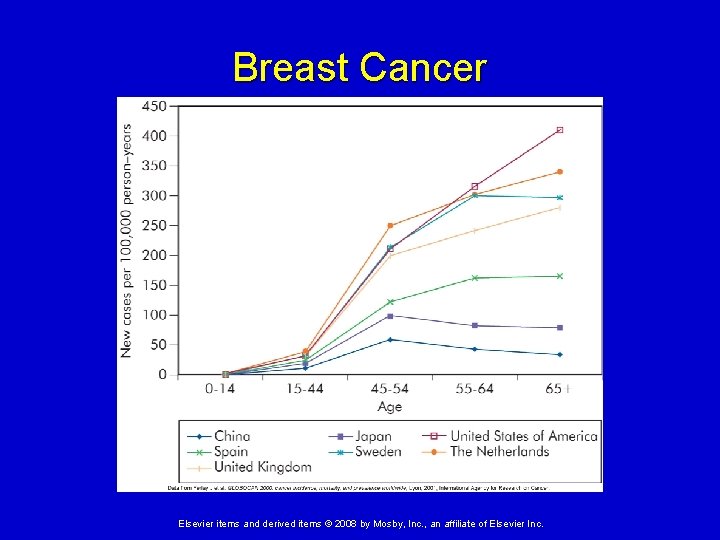
Breast Cancer Elsevier items and derived items © 2008 by Mosby, Inc. , an affiliate of Elsevier Inc.
Breast Cancer Major risk factors: Ø Reproductive factors - such as nulliparity (never giving birth), late pregnancy, early menarche, late menopause, and no breastfeeding. Ø Hormonal factors - high levels of endogenous estrogens, hormone replacement therapy, and increased insulin-like growth factor. Ø Familial factors - family history of breast cancer. Elsevier items and derived items © 2008 by Mosby, Inc. , an affiliate of Elsevier Inc.
Breast Cancer Major risk factors: (cont. ) Ø Environmental factors - cigarette smoke, ionizing radiation, high-fat diet, lack of physical exercise, chemical exposure. Protective factors - physical activity and human chorionic gonadotrophin hormone. Elsevier items and derived items © 2008 by Mosby, Inc. , an affiliate of Elsevier Inc.
Breast Cancer Pathophysiology: Ø Exposure of a genetically vulnerable individual to environmental carcinogens or high levels of growth factors (such as estrogen and progesterone) causes progressive mutations in the cellular DNA of the glandular breast tissue. Ø These mutations result in uncontrolled proliferation of breast cells. Elsevier items and derived items © 2008 by Mosby, Inc. , an affiliate of Elsevier Inc.
Breast Cancer Pathophysiology: (cont. ) Ø Breast cancer arises in breast tissue that contains undifferentiated terminal structures of the mammary gland called Lob 1. • Lob 1 tissue contains many undifferentiated cells with high proliferation rates that are particularly sensitive to carcinogens. • Pregnancy, especially when followed by breast feeding, reduces the amount of Lob 1 in the breast by maturing the breast tissue into what is called Lob 2 or Lob 3, which have more differentiated cells with fewer cell divisions and are less vulnerable to mutagenesis. Elsevier items and derived items © 2008 by Mosby, Inc. , an affiliate of Elsevier Inc.
Breast Cancer Pathophysiology: (cont. ) Breast cancer cells that retain their normal estrogen and progesterone receptors (ER and PR positive) are less anaplastic and more responsive to pharmacologic blockade of estrogen and progesterone growth factors. Ø If the cancer cells have lost their estrogen and progesterone receptors (ER and PR negative), they are able to sustain their own accelerated cell division through autocrine production of insulin-like growth factor, transforming growth factor, and epidermal growth factor. • These tumors are more aggressive and more difficult to treat. Ø Elsevier items and derived items © 2008 by Mosby, Inc. , an affiliate of Elsevier Inc.
Breast Cancer Pathophysiology: (cont. ) Ø The final steps in carcinogenesis of breast cells involve further mutations that allow the tumor to extend locally into surrounding tissues (e. g. , production of matrix proteases) and then metastasize to bone, lung, brain, and other organs. Elsevier items and derived items © 2008 by Mosby, Inc. , an affiliate of Elsevier Inc.
Breast Cancer Clinical manifestations: Ø The first is usually a small, painless lump in the breast. Ø Other manifestations include palpable lymph nodes in the axilla, dimpling of the skin, nipple and skin retraction, nipple discharge, ulcerations, reddened skin, and bone pain associated with bony metastases. Elsevier items and derived items © 2008 by Mosby, Inc. , an affiliate of Elsevier Inc.
Disorders of the Male Breast 1. Gynecomastia Overdevelopment (hyperplasia) of the breast tissue in a male. Typically occurs in adolescents and men over 50 years of age. Results from an imbalance of the estrogen/testosterone ratio May be idiopathic or be caused by systemic disorders, drugs, or neoplasms. Pubertal gynecomastia usually disappears within 4 to 6 months, while age-induced gynecomastia may last 6 to 12 months. Elsevier items and derived items © 2008 by Mosby, Inc. , an affiliate of Elsevier Inc.
Disorders of the Male Breast 2. Male breast cancer Rare, but most commonly seen after age 60. Tumors resemble carcinomas of the breast in women. Clinical manifestations - crusting and nipple discharge are common. Poor prognosis because men tend to delay seeking treatment until the disease is advanced. Most breast cancers in men are estrogen receptor positive. Elsevier items and derived items © 2008 by Mosby, Inc. , an affiliate of Elsevier Inc.