
Altera FPGAs deliver Tools Floating Point Compiler FPC
- Slides: 1
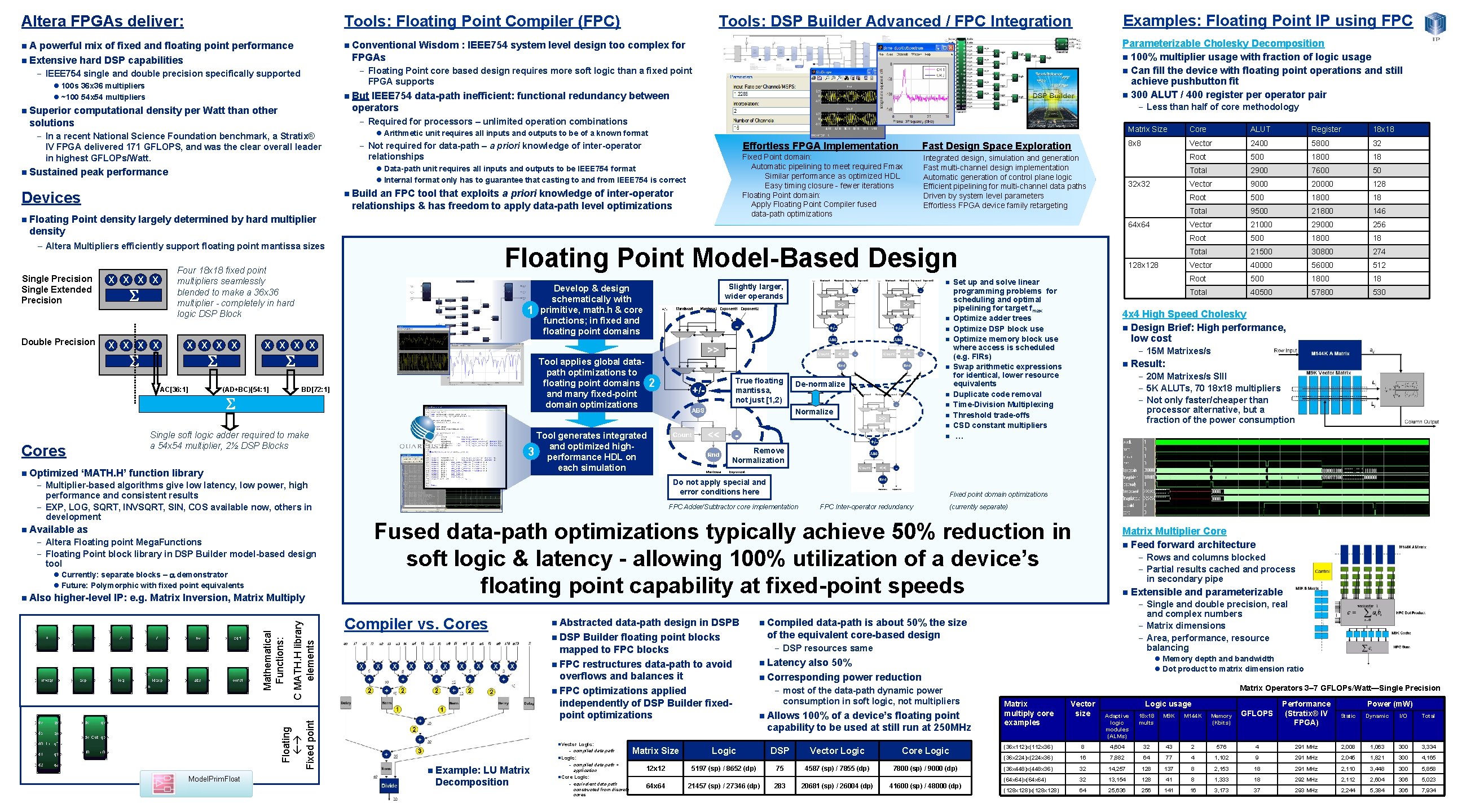
Altera FPGAs deliver: Tools: Floating Point Compiler (FPC) n. A n Conventional powerful mix of fixed and floating point performance n Extensive hard DSP capabilities - Floating Point core based design requires more soft logic than a fixed point FPGA supports l 100 s 36 x 36 multipliers n But IEEE 754 data-path inefficient: functional redundancy between operators l ~100 54 x 54 multipliers n Superior computational density per Watt than other solutions - Less than half of core methodology - Required for processors – unlimited operation combinations - In a recent National Science Foundation benchmark, a Stratix® IV FPGA delivered 171 GFLOPS, and was the clear overall leader in highest GFLOPs/Watt. l Arithmetic unit requires all inputs and outputs to be of a known format - Not required for data-path – a priori knowledge of inter-operator relationships l Data-path unit requires all inputs and outputs to be IEEE 754 format peak performance l Internal format only has to guarantee that casting to and from IEEE 754 is correct n Build an FPC tool that exploits a priori knowledge of inter-operator relationships & has freedom to apply data-path level optimizations Devices n Floating Parameterizable Cholesky Decomposition n 100% multiplier usage with fraction of logic usage n Can fill the device with floating point operations and still achieve pushbutton fit n 300 ALUT / 400 register per operator pair Wisdom : IEEE 754 system level design too complex for FPGAs - IEEE 754 single and double precision specifically supported n Sustained Examples: Floating Point IP using FPC Tools: DSP Builder Advanced / FPC Integration Point density largely determined by hard multiplier Effortless FPGA Implementation Fast Design Space Exploration Fixed Point domain: Automatic pipelining to meet required Fmax Similar performance as optimized HDL Easy timing closure - fewer iterations Floating Point domain: Apply Floating Point Compiler fused data-path optimizations Integrated design, simulation and generation Fast multi-channel design implementation Automatic generation of control plane logic Efficient pipelining for multi-channel data paths Driven by system level parameters Effortless FPGA device family retargeting Double Precision S X X S Floating Point Model-Based Design Four 18 x 18 fixed point multipliers seamlessly blended to make a 36 x 36 multiplier - completely in hard logic DSP Block X X S AC[36: 1] 1 n Slightly larger, wider operands Develop & design schematically with primitive, math. h & core functions; in fixed and floating point domains n n n X X S (AD+BC)[54: 1] Tool applies global datapath optimizations to floating point domains and many fixed-point domain optimizations BD[72: 1] S n True floating mantissa, not just [1, 2) 2 De-normalize n n Normalize n n Single soft logic adder required to make a 54 x 54 multiplier, 2½ DSP Blocks Cores n Optimized Tool generates integrated and optimized high 3 performance HDL on each simulation ‘MATH. H’ function library n Available as - Altera Floating point Mega. Functions - Floating Point block library in DSP Builder model-based design tool l Currently: separate blocks – a demonstrator l Future: Polymorphic with fixed point equivalents Floating Fixed point C MATH. H library elements higher-level IP: e. g. Matrix Inversion, Matrix Multiply Mathematical Functions: n Also n Register 18 x 18 8 x 8 Vector 2400 5800 32 Root 500 18 Total 2900 7600 50 Vector 9000 20000 128 Root 500 18 Total 9500 21800 146 Vector 21000 29000 256 Root 500 18 Total 21500 30800 274 Vector 40000 56000 512 Root 500 18 Total 40500 57800 530 128 x 128 Set up and solve linear programming problems for scheduling and optimal pipelining for target fmax Optimize adder trees Optimize DSP block use Optimize memory block use where access is scheduled (e. g. FIRs) Swap arithmetic expressions for identical, lower resource equivalents Duplicate code removal Time-Division Multiplexing Threshold trade-offs CSD constant multipliers … 4 x 4 High Speed Cholesky n Design Brief: High performance, low cost - 15 M Matrixes/s n Result: - 20 M Matrixes/s SIII - 5 K ALUTs, 70 18 x 18 multipliers - Not only faster/cheaper than processor alternative, but a fraction of the power consumption Remove Normalization Do not apply special and error conditions here - Multiplier-based algorithms give low latency, low power, high performance and consistent results - EXP, LOG, SQRT, INVSQRT, SIN, COS available now, others in development ALUT 64 x 64 - Altera Multipliers efficiently support floating point mantissa sizes X X Core 32 x 32 density Single Precision Single Extended Precision Matrix Size Fixed point domain optimizations FPC Adder/Subtractor core implementation FPC Inter-operator redundancy (currently separate) Fused data-path optimizations typically achieve 50% reduction in soft logic & latency - allowing 100% utilization of a device’s floating point capability at fixed-point speeds Matrix Multiplier Core n Feed forward architecture - Rows and columns blocked - Partial results cached and process in secondary pipe n Extensible and parameterizable - Single and double precision, real Compiler vs. Cores n Abstracted data-path design in DSPB n DSP Builder floating point blocks mapped to FPC blocks n FPC restructures data-path to avoid overflows and balances it n FPC optimizations applied independently of DSP Builder fixedpoint optimizations n Vector Logic: - compiled data-path n Logic: n Example: LU Matrix Decomposition - compiled data-path + application n Core n Compiled data-path is about 50% the size of the equivalent core-based design - DSP resources same l Memory depth and bandwidth l Dot product to matrix dimension ratio n Latency also 50% n Corresponding power reduction Matrix Operators 3– 7 GFLOPs/Watt—Single Precision - most of the data-path dynamic power consumption in soft logic, not multipliers n Allows 100% of a device’s floating point capability to be used at still run at 250 MHz Matrix multiply core examples Vector size Logic usage Adaptive logic modules (ALMs) 18 x 18 mults M 9 K M 144 K Memory (Kbits) GFLOPS Performance (Stratix® IV FPGA) Power (m. W) Static Dynamic I/O Total Matrix Size Logic DSP Vector Logic Core Logic (36 x 112)x(112 x 36) 8 4, 604 32 43 2 576 4 291 MHz 2, 008 1, 063 300 3, 334 (36 x 224)x(224 x 36) 16 7, 882 64 77 4 1, 102 9 291 MHz 2, 045 1, 821 300 4, 165 12 x 12 5197 (sp) / 8652 (dp) 75 4587 (sp) / 7855 (dp) 7800 (sp) / 9000 (dp) (36 x 448)x(448 x 36) 32 14, 257 128 137 8 2, 153 18 291 MHz 2, 110 3, 448 300 5, 858 64 x 64 21457 (sp) / 27346 (dp) 283 20681 (sp) / 26004 (dp) 41600 (sp) / 48000 (dp) (64 x 64)x(64 x 64) 32 13, 154 128 41 8 1, 333 18 292 MHz 2, 112 2, 604 306 5, 023 (128 x 128)x(128 x 128) 64 25, 636 256 141 16 3, 173 37 293 MHz 2, 244 5, 384 306 7, 934 Logic: - equivalent data-path constructed from discrete cores and complex numbers - Matrix dimensions - Area, performance, resource balancing