
Alt Water Leader City Training Workshop Alternative water
- Slides: 31
Alt. Water Leader City Training Workshop Alternative water supply systems: brief introduction and recap Surabaya, 02 -03 May, 2018 Funded by
CONTENT 1. Introduction 2. What to consider when determining important systems locally 3. Overview of possible alternative water supply systems
INTRODUCTION Objectives of this session To briefly introduce and recap some of the many alternative water systems To introduce their main aspects and considerations To act as a starting point for your city assessment of potentially feasible alternative water supply systems Note: you can access detailed presentations on alternative water systems on the website: http: //altwater. un-ihe. org/output
INTRODUCTION Note: By alternative water system, we mean any potentially useful water source that is not aleady being used. We mainly refer to anything other than traditional surface and groundwater sources
INTRODUCTION PURPOSE IN ALTWATER Alternative water supply systems are the central theme of the project The project aims to assess the potential contribution of feasible alternative water systems to existing and future water supply and demand – diversification of supply increased supply system resilience – use alternative water for non-potable use reduce pressure on traditional sources – use traditional sources more effectively – sustainability of resource use
CONTENT 1. Introduction 2. What to consider when determining important systems locally 3. Overview of possible alternative water supply systems
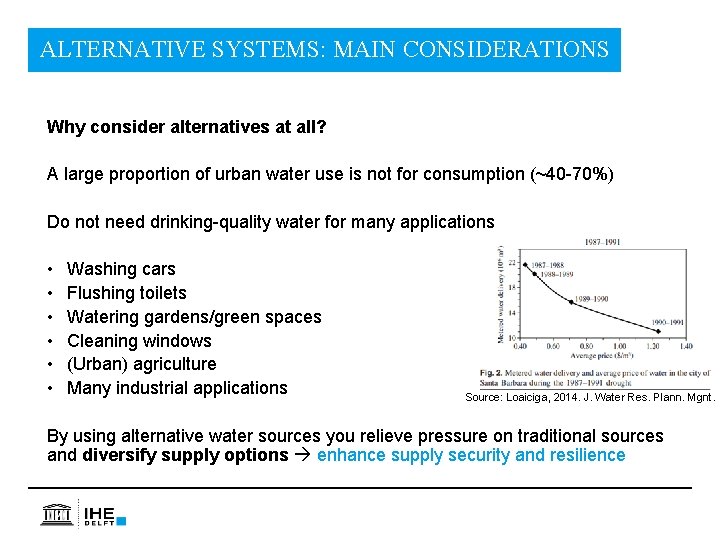
ALTERNATIVE SYSTEMS: MAIN CONSIDERATIONS Why consider alternatives at all? A large proportion of urban water use is not for consumption (~40 -70%) Do not need drinking-quality water for many applications • • • Washing cars Flushing toilets Watering gardens/green spaces Cleaning windows (Urban) agriculture Many industrial applications Source: Loaiciga, 2014. J. Water Res. Plann. Mgnt. By using alternative water sources you relieve pressure on traditional sources and diversify supply options enhance supply security and resilience
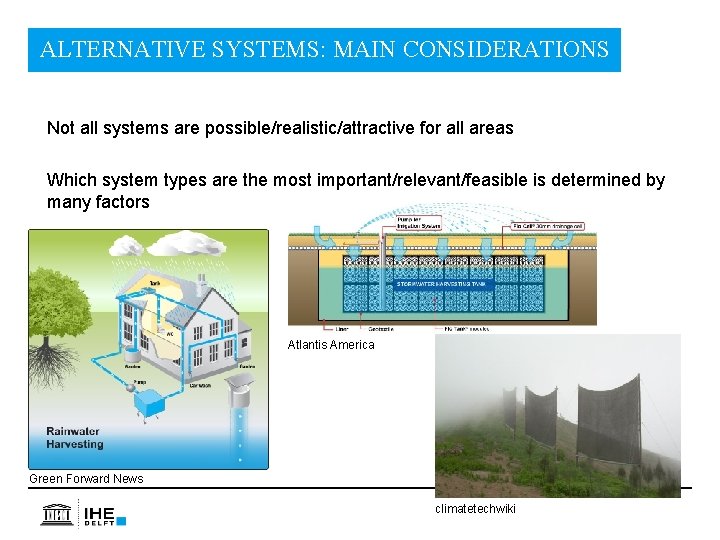
ALTERNATIVE SYSTEMS: MAIN CONSIDERATIONS Not all systems are possible/realistic/attractive for all areas Which system types are the most important/relevant/feasible is determined by many factors Atlantis America Green Forward News climatetechwiki
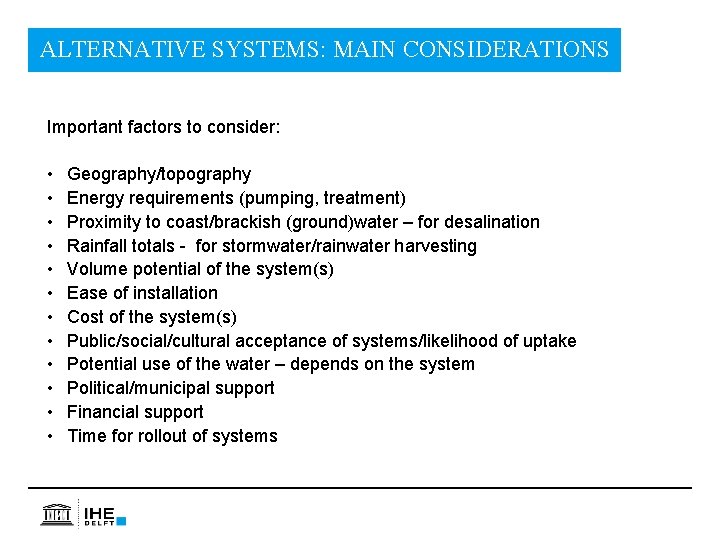
ALTERNATIVE SYSTEMS: MAIN CONSIDERATIONS Important factors to consider: • • • Geography/topography Energy requirements (pumping, treatment) Proximity to coast/brackish (ground)water – for desalination Rainfall totals - for stormwater/rainwater harvesting Volume potential of the system(s) Ease of installation Cost of the system(s) Public/social/cultural acceptance of systems/likelihood of uptake Potential use of the water – depends on the system Political/municipal support Financial support Time for rollout of systems
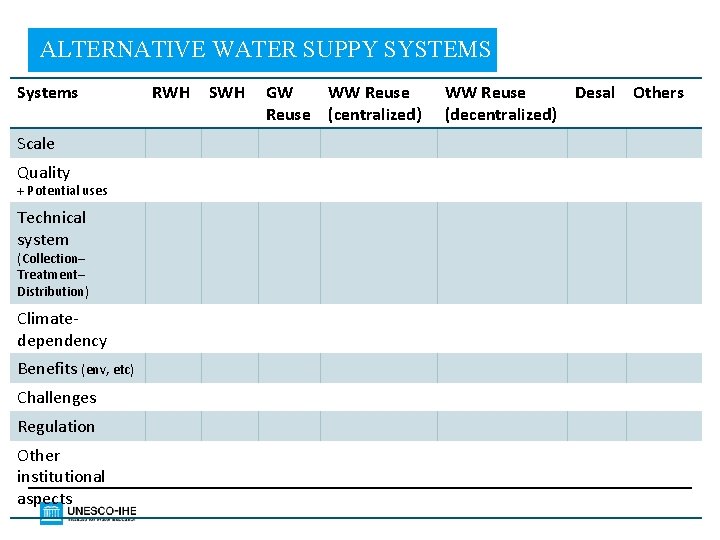
ALTERNATIVE WATER SUPPY SYSTEMS Systems Scale Quality + Potential uses Technical system (Collection– Treatment– Distribution) Climatedependency Benefits (env, etc) Challenges Regulation Other institutional aspects RWH SWH GW WW Reuse (centralized) WW Reuse Desal Others (decentralized)
CONTENT 1. Introduction 2. What to consider when determining important systems locally 3. Overview of possible alternative water supply systems
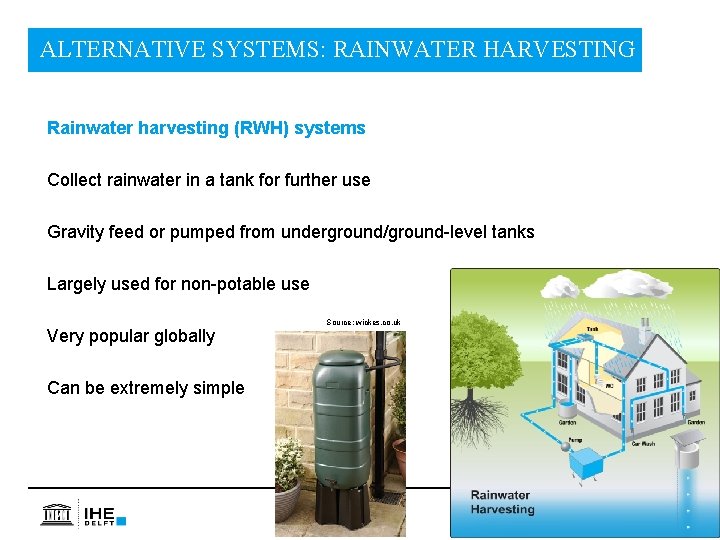
ALTERNATIVE SYSTEMS: RAINWATER HARVESTING Rainwater harvesting (RWH) systems Collect rainwater in a tank for further use Gravity feed or pumped from underground/ground-level tanks Largely used for non-potable use Very popular globally Can be extremely simple Source: wickes. co. uk
ALTERNATIVE SYSTEMS: RAINWATER HARVESTING Rainwater harvesting (RWH) systems Two systems: (1) water saving only or; (2) storm water control and water saving (1) Are simpler and cheaper. Simple design rule - normally 5% of annual demand or annual yield, whichever is smaller (2) Are more complicated and expensive, and must be more robustly designed Can use rainfall statistics for more comprehensive stochastic analysis
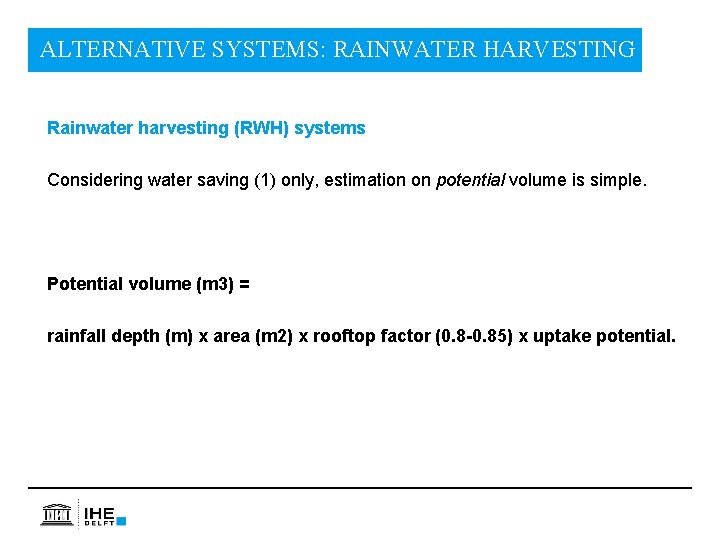
ALTERNATIVE SYSTEMS: RAINWATER HARVESTING Rainwater harvesting (RWH) systems Considering water saving (1) only, estimation on potential volume is simple. Potential volume (m 3) = rainfall depth (m) x area (m 2) x rooftop factor (0. 8 -0. 85) x uptake potential.
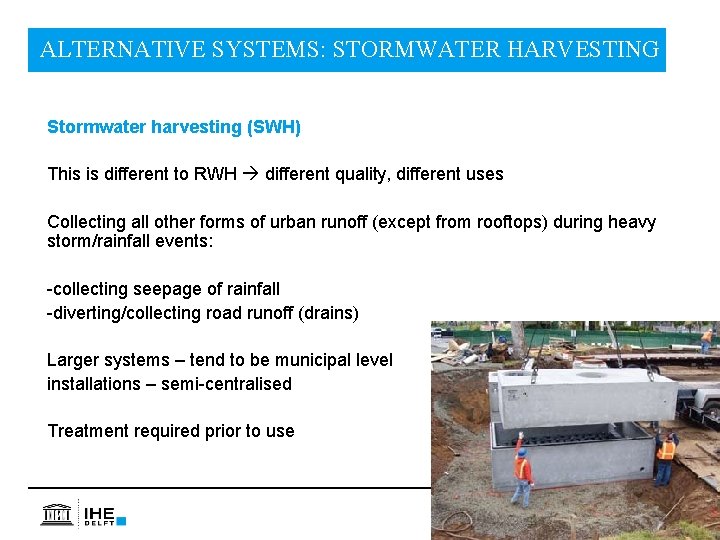
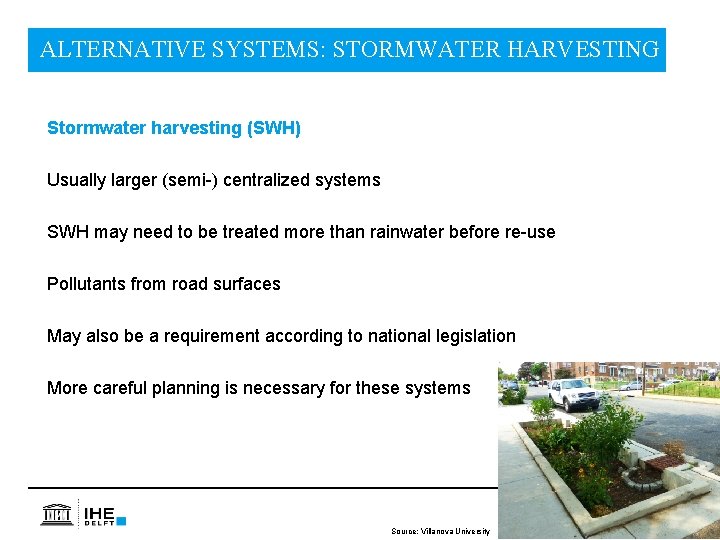
ALTERNATIVE SYSTEMS: STORMWATER HARVESTING Stormwater harvesting (SWH) This is different to RWH different quality, different uses Collecting all other forms of urban runoff (except from rooftops) during heavy storm/rainfall events: -collecting seepage of rainfall -diverting/collecting road runoff (drains) Larger systems – tend to be municipal level installations – semi-centralised Treatment required prior to use
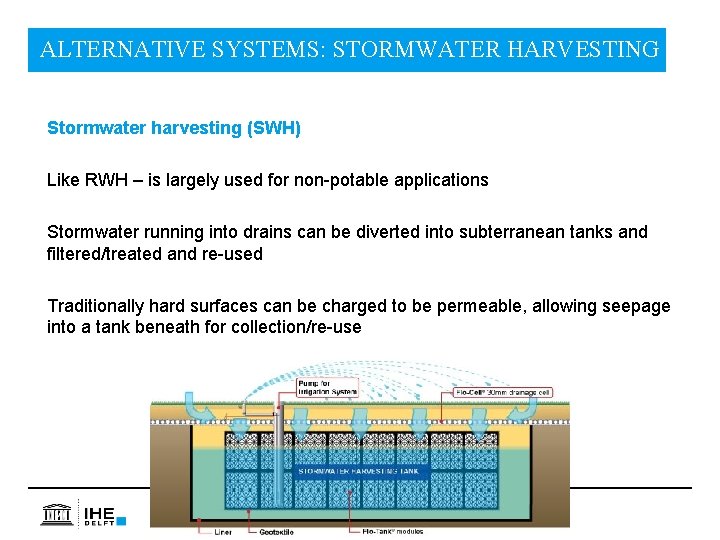
ALTERNATIVE SYSTEMS: STORMWATER HARVESTING Stormwater harvesting (SWH) Like RWH – is largely used for non-potable applications Stormwater running into drains can be diverted into subterranean tanks and filtered/treated and re-used Traditionally hard surfaces can be charged to be permeable, allowing seepage into a tank beneath for collection/re-use
ALTERNATIVE SYSTEMS: STORMWATER HARVESTING Stormwater harvesting (SWH) Usually larger (semi-) centralized systems SWH may need to be treated more than rainwater before re-use Pollutants from road surfaces May also be a requirement according to national legislation More careful planning is necessary for these systems Source: Villanova University
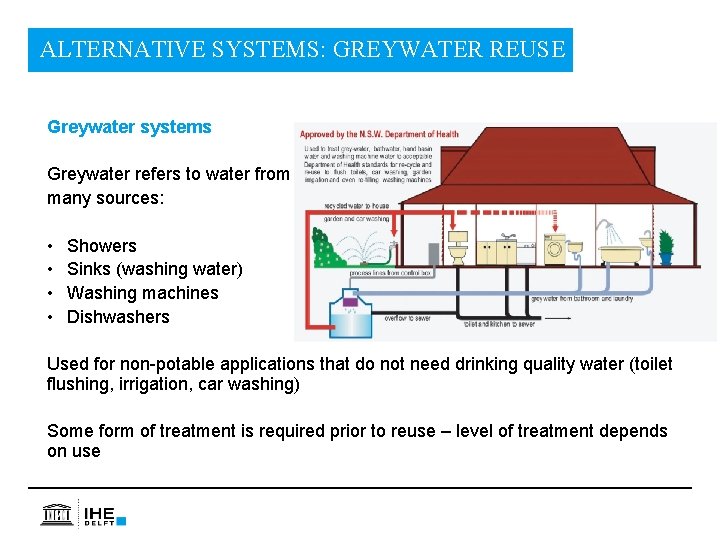
ALTERNATIVE SYSTEMS: GREYWATER REUSE Greywater systems Greywater refers to water from many sources: • • Showers Sinks (washing water) Washing machines Dishwashers Used for non-potable applications that do not need drinking quality water (toilet flushing, irrigation, car washing) Some form of treatment is required prior to reuse – level of treatment depends on use
ALTERNATIVE SYSTEMS: GREYWATER REUSE Greywater systems If used for toilet flushing, can reduce in-home water consumption by 40 -60 l/cap/day – 10 -20% of overall use (Friedler and Gross in Memon and Ward, 2015) With even moderate uptake, significant annual savings potentials are possible Treatment can range from simple filters and disinfection to membrane bioreactors Need to consider energy use for treatment. Social acceptability? – again it depends on the end-use
ALTERNATIVE SYSTEMS: WASTEWATER REUSE Wastewater capture, treatment and re-use Mine wastewater in WWTPs to: a) Recover nutrients and; b) Treat water to very high standards to further non-potable applications (irrigating public open spaces, industrial applications, etc. ). Still controversial with public acceptance issues. Centralised (at large WWTP, highly treated) or decentralized (large buildings, mining sewers)
ALTERNATIVE SYSTEMS: WASTEWATER REUSE Wastewater capture, treatment and re-use Advantages include: -reduced transportation costs -can operate at decentralised or centralized scales -organic material is effectively treated and can be reused (resource) -increase system resilience and offers disaster backup supply -can treat for the purpose used -enhance sustainability
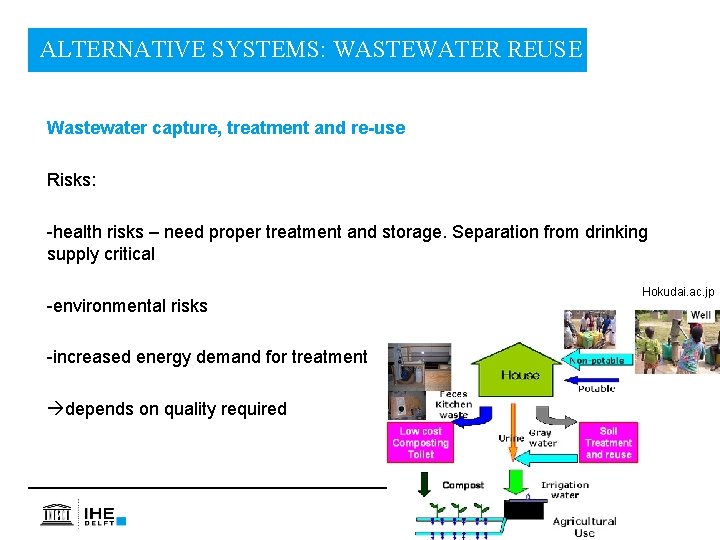
ALTERNATIVE SYSTEMS: WASTEWATER REUSE Wastewater capture, treatment and re-use Risks: -health risks – need proper treatment and storage. Separation from drinking supply critical -environmental risks -increased energy demand for treatment depends on quality required Hokudai. ac. jp
ALTERNATIVE SYSTEMS: WASTEWATER REUSE • WW reuse schemes can be used to provide fit-for-purpose water to near-by irrigation or industrial schemes. – In such cases, there is also the important environmental benefit of reducing polluted discharge to water bodies. • WW reuse schemes can also be used to provide recycled water for nondrinking residential uses in new developments. – There is a dilemma about building such schemes: - on the one hand, they are viewed as a one-time opportunity for new developments to integrate alternative supply during construction; - on the other hand, they tend to be viewed as cost-ineffective due to the necessity of building a second pipe network, and there are increasing concerns about the public health risks of
ALTERNATIVE SYSTEMS: WASTEWATER REUSE Wastewater capture, treatment and re-use Possible implementation will can on: -needs – is such a system required or desired? -public acceptance (end use critical here) -infrastructure requirements - usually need a separated storm/sewer network -willingness -funding -legal issues
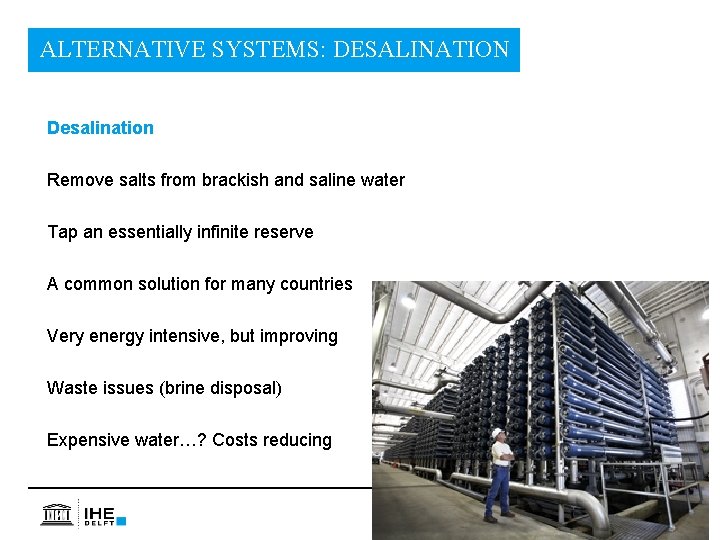
ALTERNATIVE SYSTEMS: DESALINATION Desalination Remove salts from brackish and saline water Tap an essentially infinite reserve A common solution for many countries Very energy intensive, but improving Waste issues (brine disposal) Expensive water…? Costs reducing
ALTERNATIVE SYSTEMS: DESALINATION Desalination Considerable capital expenditure Need to careful decide if: a) b) c) d) e) People can pay for the product Is the demand there Are other options more suitable How to cover the energy cost Waste disposal Can use the water for multiple purposes
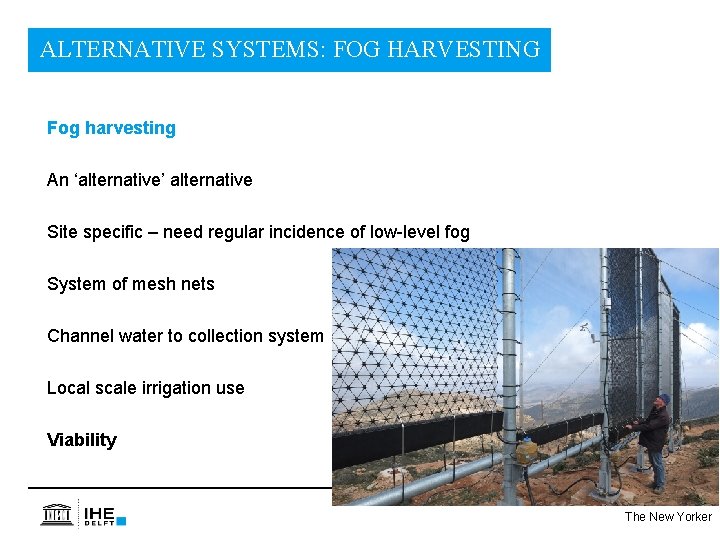
ALTERNATIVE SYSTEMS: FOG HARVESTING Fog harvesting An ‘alternative’ alternative Site specific – need regular incidence of low-level fog System of mesh nets Channel water to collection system Local scale irrigation use Viability The New Yorker
ALTERNATIVE SYSTEMS: FOG HARVESTING Fog harvesting Clean water for irrigation or domestic use. Little/no treatment needed. Cheap/easy to install (€ 150 -€ 2000). Little/no maintenance. But the mesh nets and collection systems need checking In some places up to 12 m 3 per day was captured. Source is unreliable
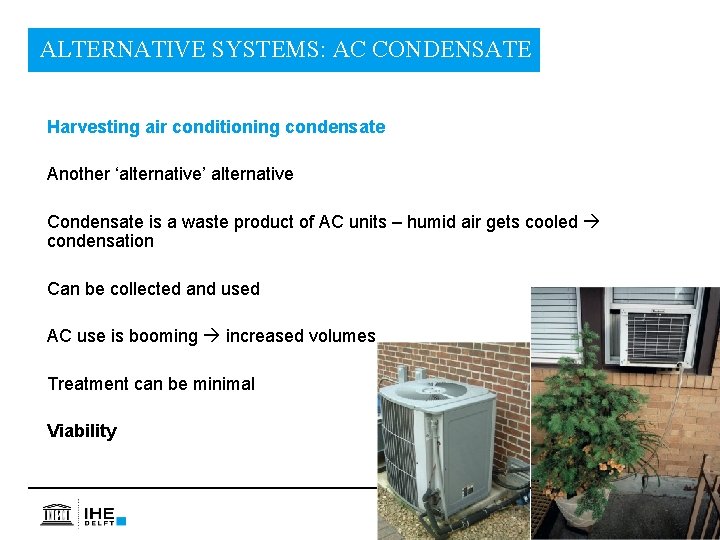
ALTERNATIVE SYSTEMS: AC CONDENSATE Harvesting air conditioning condensate Another ‘alternative’ alternative Condensate is a waste product of AC units – humid air gets cooled condensation Can be collected and used AC use is booming increased volumes Treatment can be minimal Viability
ALTERNATIVE SYSTEMS: AC CONDENSATE Harvesting air conditioning condensate Being more considered as a water source On-site means less energy demands But need to assess the potential volume contributions -geography (warm humid air is ideal) -number of units and their usage Some treatment recommended Used for outdoor purposes and non-potable applications Research still needed