
Also known as George Orwell Eric Arthur Blair
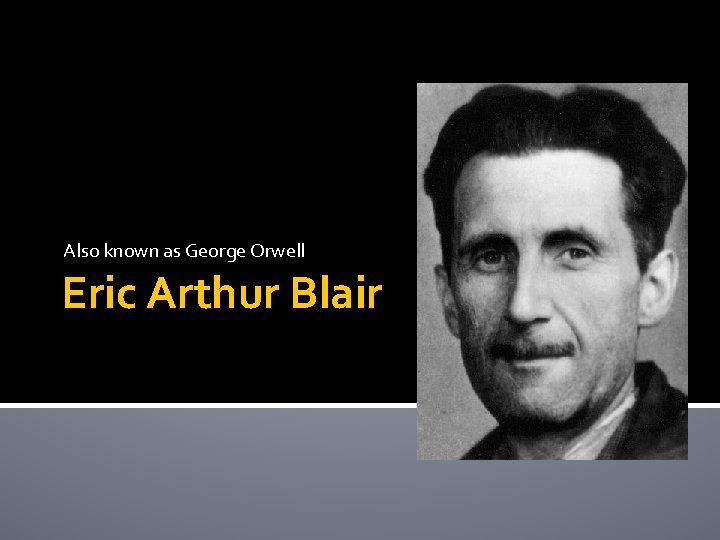
Also known as George Orwell Eric Arthur Blair
Early Life �Born 25 June, 1903 �Dreams of being an author. �‘Such, Such Were The Days’ �St Cyprian's �Henley and South Oxfordshire Standard �Second to Connolly in the Harrow History Prize.
University �Wellington College �King’s Scholar at Eton Trinity College �Briefly taught French by Aldous Huxley �Neglected his academic studies �Could not attend another university without another scholarship; parents not confident in his academic performance �Joined the Indian Police Service
Police Work in Burma �October 1922, sailed on the S. S. Herefordshire to Rangoon and joined police training at Mandalay. �Posted to frontier outpost Myaungmya in the Irrawaddy Delta at the beginning of 1924. �Assistant District Superintendent and posted to Syriam by end of 1924 � 1926 contracted dengue fever and returned to England. �Resigned from the Police to write.
London & Paris �Settled back with his family in Southwold. �End of 1927 he was lodging at Portobello Road. �Would often go and explore poor East London, sometimes pretending to be homeless. �Spring of 1928 he moved to a working-class district of Paris. �His experiences are recorded in ‘Down and Out in Paris and London’
Teaching in Southwold �He returned to Southwold in December 1929. �He began teaching at The Hawthorns High School. �It was around this time in 1932 that he adopted his nom de plume, George Orwell. �In 1933, he left The Hawthorns to teach at Frays College, Uxbridge. � 1934 contracted almost fatal pneumonia, and never returned to teaching after recovering.
Hampstead �He left for London to find another job— part- time assistant in Booklovers' Corner, a second -hand bookshop in Hampstead. �This was around this time he wrote ‘Keep the Aspidistra Flying’. �He would have mornings to write, afternoons working and evenings to socialize; this inspired the book. �Eventually his flatmates moved away and he could no longer afford the rent.
The Road to Wigan Pier �It was suggested to Orwell he should experience depressed northern England. �In 1936 he began a journey by foot and public transport to Manchester. �He observed social positions, went down coal mines, and consulted public health records. �The result of this was ‘The Road to Wigan Pier’ published in 1937
Spanish Civil War �Background to war �Orwell’s involvement
World War II & Death
- Slides: 10