
Also As well as Moreover In addition Furthermore
- Slides: 2
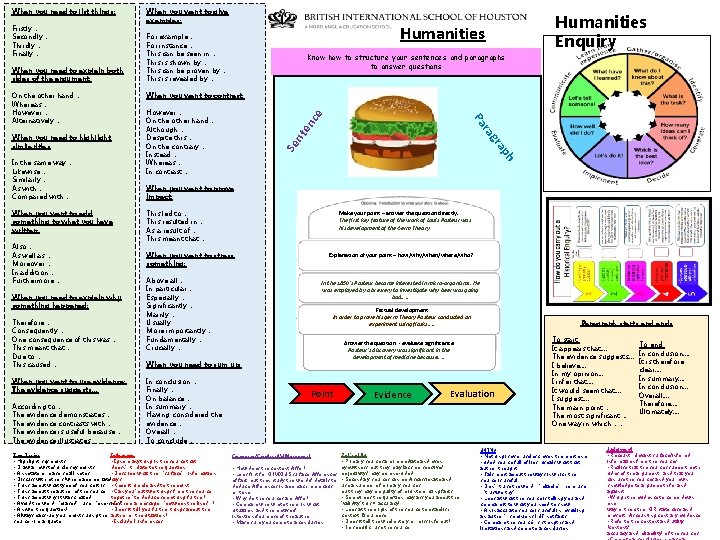
Also… As well as… Moreover… In addition… Furthermore… When you need to explain why something happened: Therefore… Consequently… One consequence of this was… This meant that… Due to… This caused… When you want to use evidence: The evidence suggests… According to… The evidence demonstrates… The evidence contrasts with… The evidence is useful because… The evidence illustrates ph When you want to add something to what you have written: a gr In the same way… Likewise… Similarly… As with… Compared with… However… On the other hand… Although… Despite this… On the contrary… Instead… Whereas… In contrast… ra When you need to highlight similarities When you want to contrast: Pa On the other hand… Whereas… However… Alternatively… Know how to structure your sentences and paragraphs to answer questions e When you need to explain both sides of the argument: Humanities Enquiry Humanities For example… For instance… This can be seen in… This is shown by… This can be proven by… This is revealed by… en c Firstly… Secondly… Thirdly… Finally… When you want to give examples: Se nt When you need to list things: When you want to prove impact: This led to… This resulted in… As a result of… This meant that… Make your point – answer the question directly. The first key feature of the work of Louis Pasteur was his development of the Germ Theory When you want to stress something: Above all… In particular… Especially… Significantly… Mainly… Usually More importantly… Fundamentally… Crucially… Explanation of your point – how/why/when/where/who? In the 1850’s Pasteur became interested in micro-organisms. He was employed by a brewery to investigate why beer was going bad…… Factual development In order to prove his germ Theory Pasteur conducted an experiment using flasks…. . Answer the question - evaluate significance Pasteur’s discovery was significant in the development of medicine because…. . When you need to sum up: In conclusion… Finally… On balance… In summary… Having considered the evidence… Overall… To conclude… The Basics Inference • Highlight key points • Ignore anything in the source that • Draw arrows to/circle key points doesn’t relate to the question • Annotate or make small notes • Describe what the ‘surface’ information • Discuss with others (where appropriate)says… • Think about what type of source it is • Keep it simple and to the point • Think about the author of the source • Can you 'put two things from the source • Think about why it was created together' to deduce something further? • Avoid the word ‘biased’ use ‘one-sided’ • Is there a message ‘between the lines’? • Answer the question! • Does it tell you further things about the • Always back-up your points using the author or the situation? source - i. e. a quote • Include 3 inferences Point Evidence Evaluation Reliability • Primary sources are immediate and even eyewitness, but they may lack perspective/ • How does the content differ? • Look first for OBVIOUS surface differences objectivity/ may be one-sided. of fact, but then study the words/ details to • Secondary sources can be dispassionate and use a number of primary sources, deduce differences in approach, emphasis but they may be guilty of misinterpreting facts. or tone. • Sometimes the question may ask you about the • Why do the sources are differ? 'validity' this = accuracy! • Compare who wrote them, in what • Look at the origin of the source to establish situation, and the motives/ context & purpose intentions/purpose of the author. • Does it tell the whole story or miss info out? • Make sure you come to a conclusion • Be specific…use the source. Compare/Contrast(differences) Paragraph starts and ends To start: It appears that. . The evidence suggests. . I believe. . In my opinion. . . I infer that. . It would seem that. . I suggest. . The main point… The most significant…. One way in which…… Utility • Nothing is ever useless; even the most one -sided source full of lies reveals what that author thought. • Talk most about the ways in which the source is useful. • Don’t use the word ‘reliable’ here, use ‘trustworthy’ • Look at what the source is telling you and compare it to what you need to know • An inaccurate source is useful in revealing an author’s opinions BUT not facts • Compare the source’s strengths and limitations and come to a conclusion To end: In conclusion. . It is therefore clear. . In summary. . In conclusion. . . Overall. . Therefore. . Ultimately. . Judgment • Recount relevant surface/inferred information from the sources. • Realise that the sources support both sides of the argument. , and that you can use the sources and your own knowledge to argue both for and against. • Weigh the evidence to come down one way or the other, OR state case and prove it, discounting contrary evidence • Refer to the content and utility (content/ accuracy and reliability) of the sources.
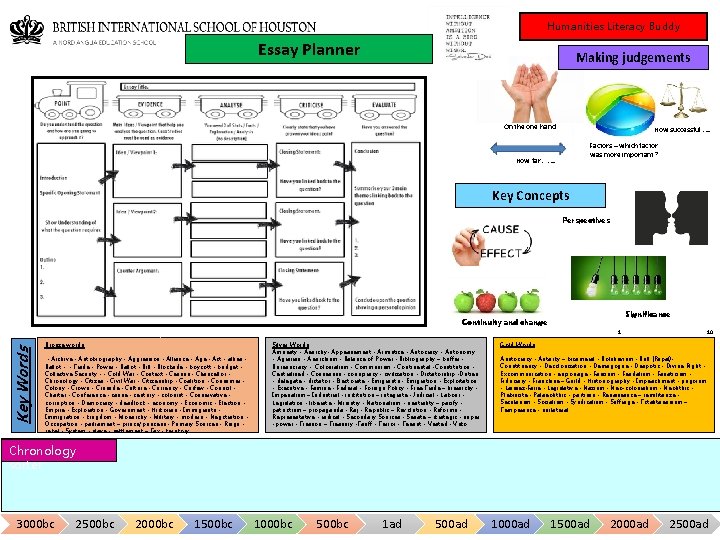
Humanities Literacy Buddy Essay Planner Making judgements On the one hand How successful…. . Factors – which factor was more important? How far……. . Key Concepts Perspectives Significance Continuity and change 10 Key Words 1 Bronze words - Archive - Autobiography - Aggression - Alliance - Age - Act - allies Ballot - - Trade - Power - Ballot - Bill - Blockade - boycott - budget Collective Security - - Cold War - Context - Census - Chancellor Chronology - Citizen - Civil War - Citizenship - Coalition - Consumer Colony - Crown - Crusade - Culture - Currency - Curfew - Council Charter - Conference - cause - century - colonist - Conservative corruption - Democracy - deadlock - economy - Economic - Election Empire - Exploration - Government - Historian - Immigrants Immigration - kingdom - Monarchy - Military - modern - Negotiation Occupation - parliament – prince/princess - Primary Sources - Reign rebel - System - slave - settlement – Tax - territory Silver Words Amnesty - Anarchy- Appeasement - Armistice - Autocracy - Autonomy - Agrarian - Anarchism - Balance of Power - Bibliography – buffer Bureaucracy - Colonialism - Communism - Continental -Constitution Centralised - Consensus - conspiracy - civilization - Dictatorship -Duties - delegate - dictator - Electorate - Emigrants - Emigration - Exploitation - Executive - Famine - Federal - Foreign Policy - Free Trade – hierarchy Imperialism – Industrial - institution – integrate - Judicial - Labour Legislation - liberate - Ministry - Nationalism - neutrality – pacify patriotism – propaganda - Raj - Republic – Revolution - Reforms Representative - radical - Secondary Sources - Senate – strategic - super -power - Treason – Treasury -Tariff - Terror - Tenant - Vested - Veto Gold Words Aristocracy - Autarky – bicameral - Bolshevism - Bull (Papal)Constituency - Decolonization - Demagogue - Despotic - Divine Right Excommunication - espionage - Fascism - Feudalism - Fanaticism Fiduciary - Franchise – Guild - Historiography - Impeachment - jingoism - Laissez-Faire - Legislative - Nazism - Neo-colonialism - Neolithic Plebiscite - Palaeolithic - partisan - Renaissance – remilitarize Secularism - Socialism - Syndicalism - Suffrage - Totalitarianism – Temperance - unilateral Chronology sorter 3000 bc 2500 bc 2000 bc 1500 bc 1000 bc 500 bc 1 ad 500 ad 1000 ad 1500 ad 2000 ad 2500 ad