
AlphaBeta Search Twoplayer games The object of a
Alpha-Beta Search
Two-player games • The object of a search is to find a path from the starting position to a goal position • In a puzzle-type problem, you (the searcher) get to choose every move • In a two-player competitive game, you alternate moves with the other player • The other player doesn’t want to reach your goal • Your search technique must be very different 2
Payoffs • Each game outcome has a payoff, which we can represent as a number • By convention, we prefer positive numbers • In some games, the outcome is either a simple win (+1) or a simple loss (-1) • In some games, you might also tie, or draw (0) • In other games, outcomes may be other numbers (say, the amount of money you win at Poker) 3
Zero-sum games • Most common games are zero-sum: What I win ($12), plus what you win (-$12), equals zero • Not all games are zero-sum games • For simplicity, we consider only zero-sum games • From our point of view, positive numbers are good, negative numbers are bad • From our opponents point of view, positive numbers are bad, negative numbers are good 4
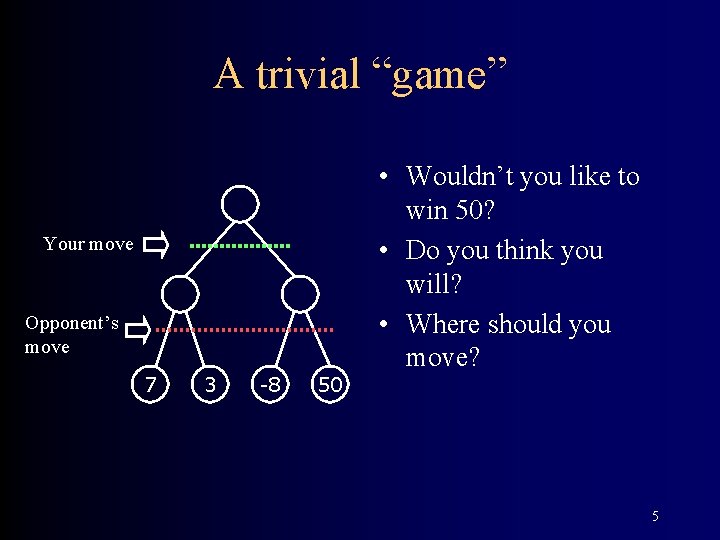
A trivial “game” Your move Opponent’s move 7 3 -8 50 • Wouldn’t you like to win 50? • Do you think you will? • Where should you move? 5

Minimaxing • Your opponent will choose smaller numbers • If you move left, your opponent will choose 3 3 Your move 3 • If you move right, your opponent will choose -8 -8 Opponent’s move 7 3 -8 50 • Therefore, your choices are really 3 or -8 • You should move left, and play will be as shown 6
Heuristics • In a large game, you don’t really know the payoffs • A heuristic function computes, for a given node, your best guess as to what the payoff will be • The heuristic function uses whatever knowledge you can build into the program • We make two key assumptions: – Your opponent uses the same heuristic function as you do – The more moves ahead you look, the better your heuristic function will work 7
PBVs • A PBV is a preliminary backed-up value – Explore down to a given level using depth-first search – As you reach lowest-level node, evaluate it using your heuristic function – Back up values to the next higher node, according to the following rules: • If it’s your move, bring up the largest value, possibly replacing a smaller value • If it’s your opponent’s move, bring up the smallest value, possible replacing a larger value 8
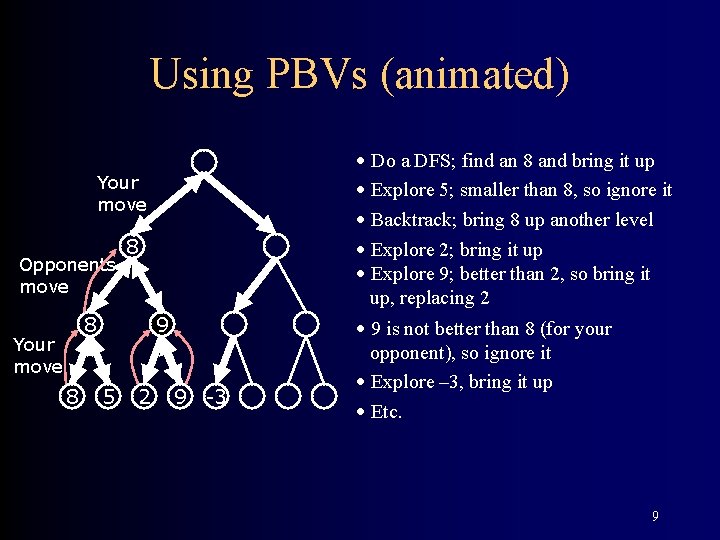
Using PBVs (animated) • Do a DFS; find an 8 and bring it up • Explore 5; smaller than 8, so ignore it • Backtrack; bring 8 up another level • Explore 2; bring it up • Explore 9; better than 2, so bring it up, replacing 2 Your move Opponents move 8 8 Your move 8 2 9 5 2 9 -3 • 9 is not better than 8 (for your opponent), so ignore it • Explore – 3, bring it up • Etc. 9
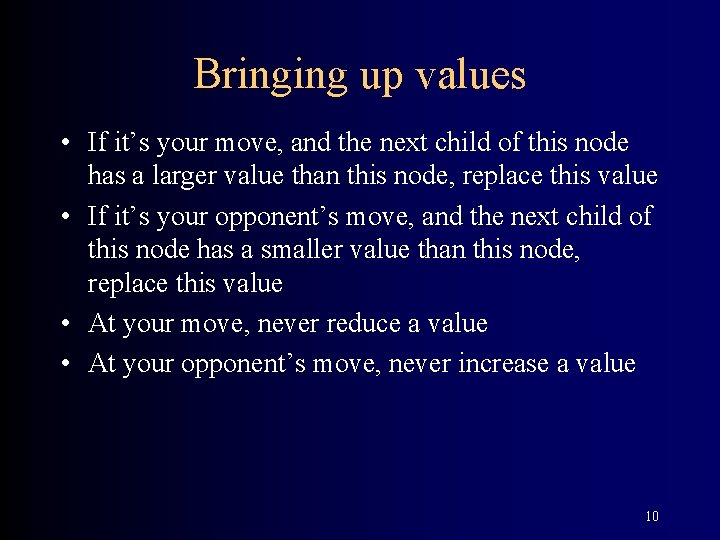
Bringing up values • If it’s your move, and the next child of this node has a larger value than this node, replace this value • If it’s your opponent’s move, and the next child of this node has a smaller value than this node, replace this value • At your move, never reduce a value • At your opponent’s move, never increase a value 10
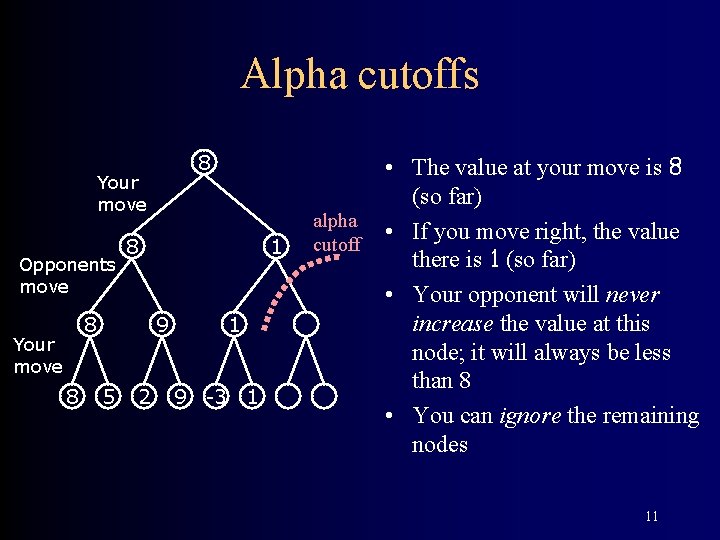
Alpha cutoffs 8 Your move Opponents move 8 8 Your move 8 1 9 5 2 1 9 -3 1 • The value at your move is 8 (so far) alpha • If you move right, the value cutoff there is 1 (so far) • Your opponent will never increase the value at this node; it will always be less than 8 • You can ignore the remaining nodes 11
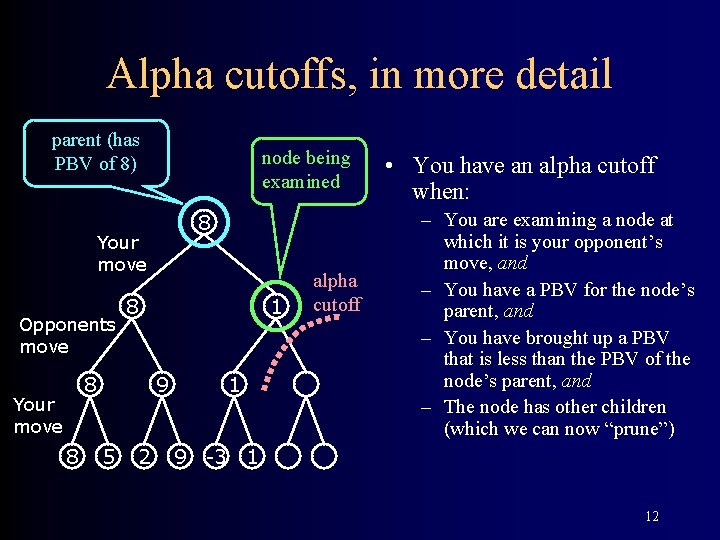
Alpha cutoffs, in more detail parent (has PBV of 8) node being examined 8 Your move Opponents move 8 8 Your move 8 1 9 5 2 1 alpha cutoff • You have an alpha cutoff when: – You are examining a node at which it is your opponent’s move, and – You have a PBV for the node’s parent, and – You have brought up a PBV that is less than the PBV of the node’s parent, and – The node has other children (which we can now “prune”) 9 -3 1 12
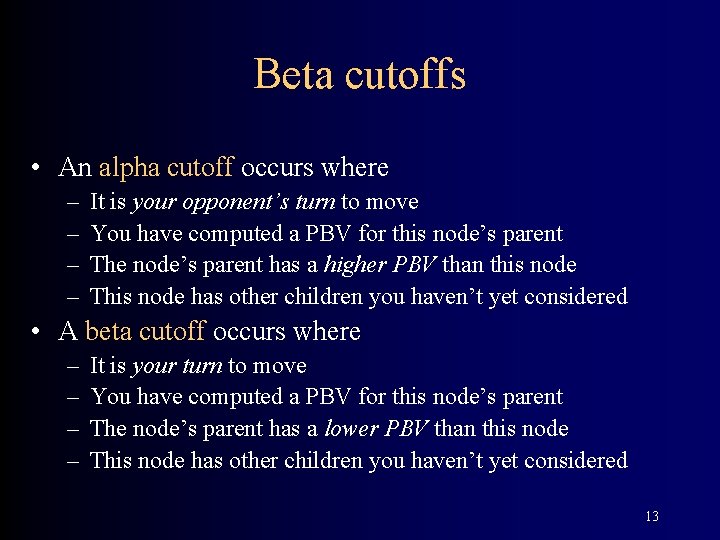
Beta cutoffs • An alpha cutoff occurs where – – It is your opponent’s turn to move You have computed a PBV for this node’s parent The node’s parent has a higher PBV than this node This node has other children you haven’t yet considered • A beta cutoff occurs where – – It is your turn to move You have computed a PBV for this node’s parent The node’s parent has a lower PBV than this node This node has other children you haven’t yet considered 13
Using beta cutoffs • Beta cutoffs are harder to understand, because you have to see things from your opponent’s point of view • Your opponent’s alpha cutoff is your beta cutoff • We assume your opponent is rational, and is using a heuristic function similar to yours • Even if this assumption is incorrect, it’s still the best we can do 14
The importance of cutoffs • If you can search to the end of the game, you know exactly how to play • The further ahead you can search, the better • If you can prune (ignore) large parts of the tree, you can search deeper on the other parts • Since the number of nodes at each level grows exponentially, the higher you can prune, the better • You can save exponential time 15
Heuristic alpha-beta searching • The higher in the search tree you can find a cutoff, the better (because of exponential growth) • To maximize the number of cutoffs you can make: – Apply the heuristic function at each node you come to, not just at the lowest level – Explore the “best” moves first – “Best” means best for the player whose move it is at that node 16
Best game playing strategies • For any game much more complicated than tic-tactoe, you have a time limit • Searching takes time; you need to use heuristics to minimize the number of nodes you search • But complex heuristics take time, reducing the number of nodes you can search • Seek a balance between simple (but fast) heuristics, and slow (but good) heuristics 17

The End 18
- Slides: 18