
Alpha Fusion in Stars AN EXPLANATION OF HOW

- Slides: 10
Alpha Fusion in Stars AN EXPLANATION OF HOW ELEMENTS ON THE PERIODIC TABLE, FROM HE TO FE, ARE PRODUCED IN STARS SUCH AS RED GIANTS AND SUPER GIANTS.
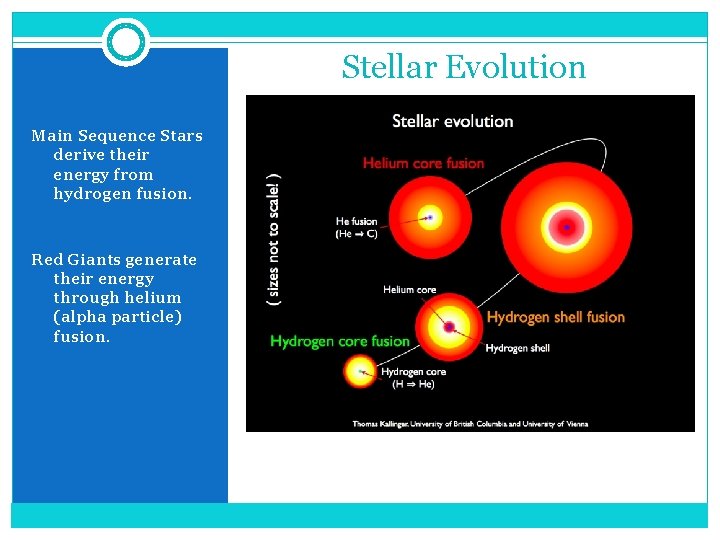
Stellar Evolution Main Sequence Stars derive their energy from hydrogen fusion. Red Giants generate their energy through helium (alpha particle) fusion.
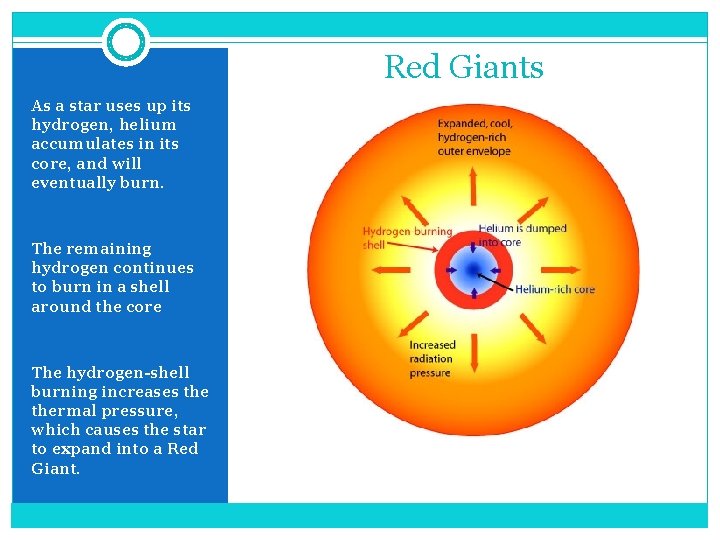
Red Giants As a star uses up its hydrogen, helium accumulates in its core, and will eventually burn. The remaining hydrogen continues to burn in a shell around the core The hydrogen-shell burning increases thermal pressure, which causes the star to expand into a Red Giant.
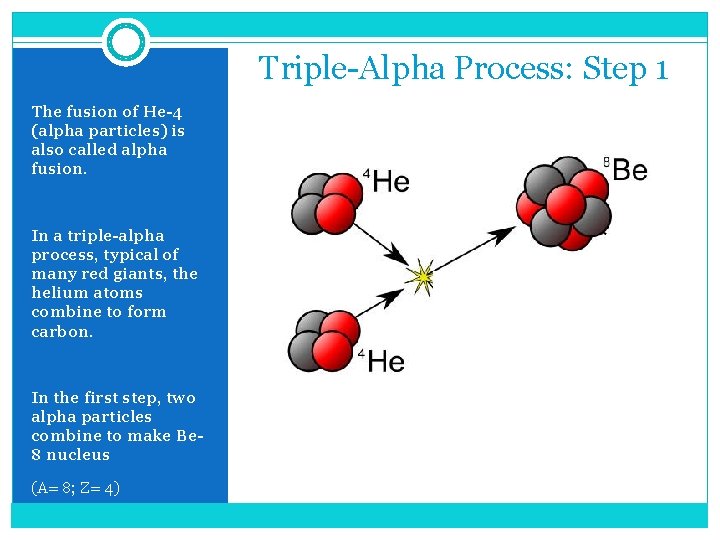
Triple-Alpha Process: Step 1 The fusion of He-4 (alpha particles) is also called alpha fusion. In a triple-alpha process, typical of many red giants, the helium atoms combine to form carbon. In the first step, two alpha particles combine to make Be 8 nucleus (A= 8; Z= 4)
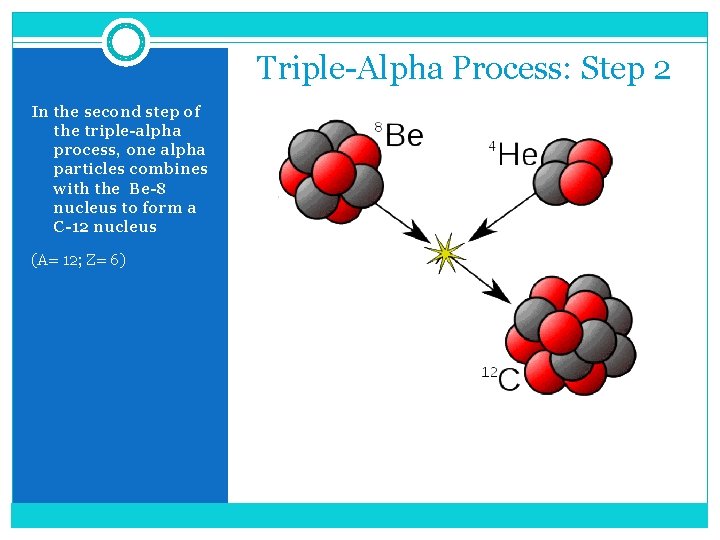
Triple-Alpha Process: Step 2 In the second step of the triple-alpha process, one alpha particles combines with the Be-8 nucleus to form a C-12 nucleus (A= 12; Z= 6)
Super Giant Stars More massive stars (>5 solar masses) can evolve to become Super Giants. These are important in the synthesis of heavier elements up to iron (Fe). In these stars, alpha fusion continues past the triple-alpha process. This forms a chain of alpha processes that result in subsequently heavier nuclei.
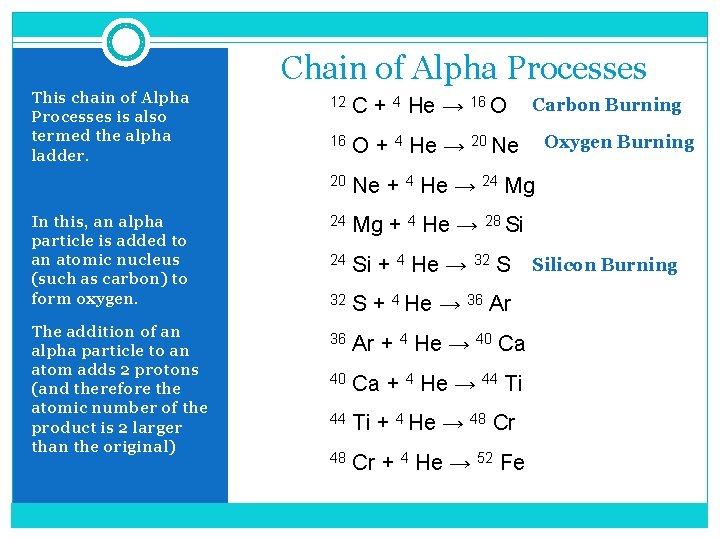
Chain of Alpha Processes This chain of Alpha Processes is also termed the alpha ladder. In this, an alpha particle is added to an atomic nucleus (such as carbon) to form oxygen. The addition of an alpha particle to an atom adds 2 protons (and therefore the atomic number of the product is 2 larger than the original) 12 C + 4 He → 16 O + 4 He → 20 Ne + 4 He → 24 Mg + 4 He → 28 Si 24 Si + 4 He → 32 S Silicon Burning 32 S + 4 He → 36 Ar + 4 He → 40 Ca + 4 He → 44 Ti + 4 He → 48 Cr + 4 He → 52 Fe Carbon Burning Oxygen Burning
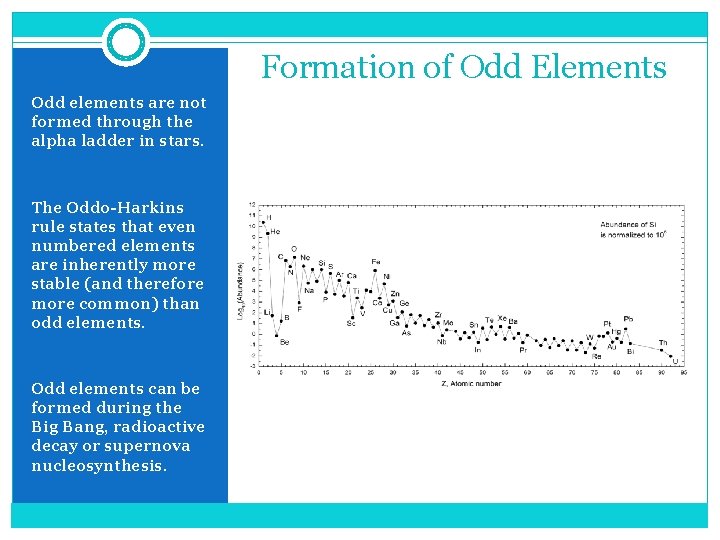
Formation of Odd Elements Odd elements are not formed through the alpha ladder in stars. The Oddo-Harkins rule states that even numbered elements are inherently more stable (and therefore more common) than odd elements. Odd elements can be formed during the Big Bang, radioactive decay or supernova nucleosynthesis.
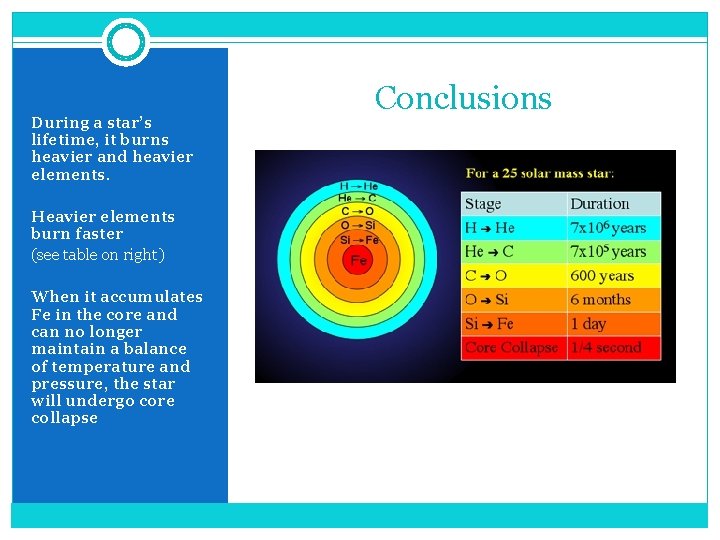
During a star’s lifetime, it burns heavier and heavier elements. Heavier elements burn faster (see table on right) When it accumulates Fe in the core and can no longer maintain a balance of temperature and pressure, the star will undergo core collapse Conclusions
Summary After hydrogen fusion, larger stars can continue with the fusion of heavier elements. Red Giants can fuse helium and form carbon (triple-alpha process). Super Giant Stars can form elements from later steps of alpha fusion. The alpha ladder can form the even elements lighter than iron. The odd elements can be formed in supernova or through nuclear decay. Even elements are more common than odd elements. After a star is exhausted of energy, its core will consist of Fe (and outer shells of lighter elements).