
Alpha Beta Gamma Lesson Contents 1 2 3
Alpha Beta Gamma
Lesson Contents 1. 2. 3. 4. Physical properties of a, b and g Penetrating power of a, b and g N v Z graphs Decay laws

Alpha Radiation Alpha particles contain two protons and two neutrons
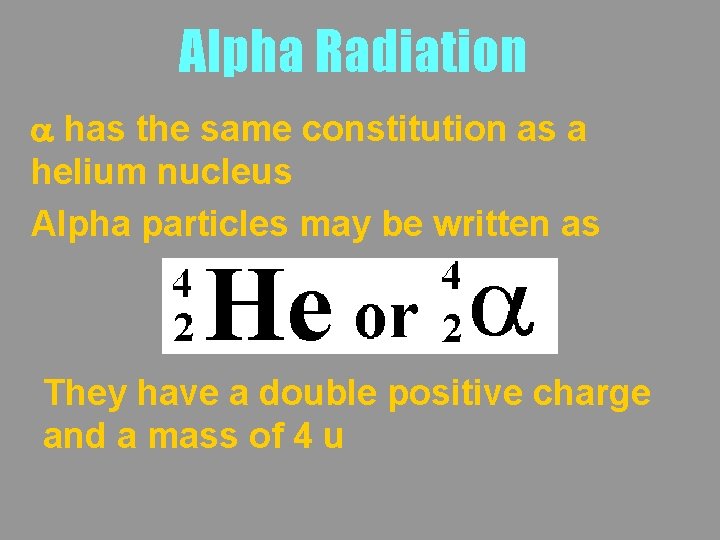
Alpha Radiation a has the same constitution as a helium nucleus Alpha particles may be written as They have a double positive charge and a mass of 4 u
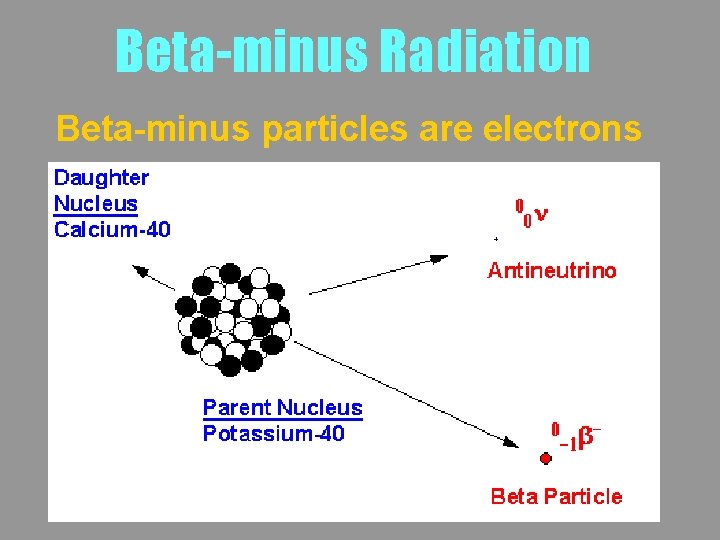
Beta-minus Radiation Beta-minus particles are electrons
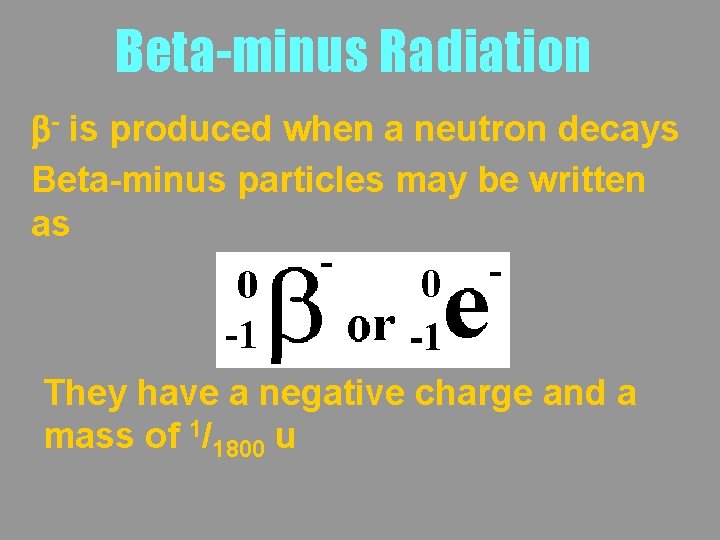
Beta-minus Radiation b- is produced when a neutron decays Beta-minus particles may be written as They have a negative charge and a mass of 1/1800 u
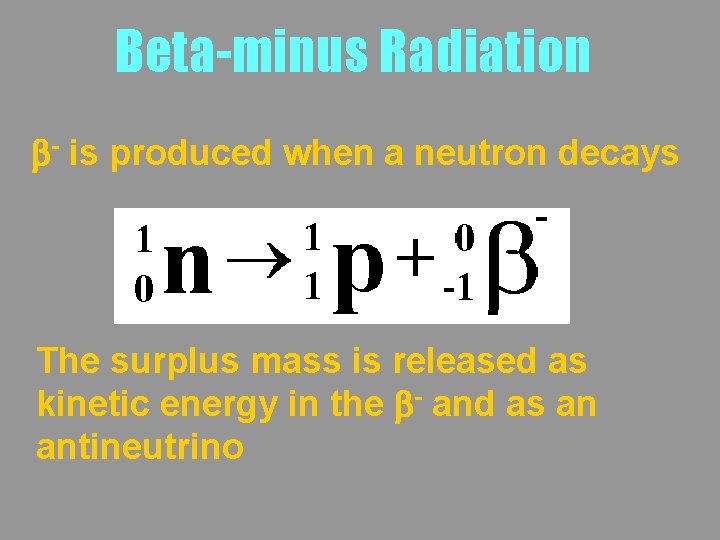
Beta-minus Radiation b- is produced when a neutron decays The surplus mass is released as kinetic energy in the b- and as an antineutrino
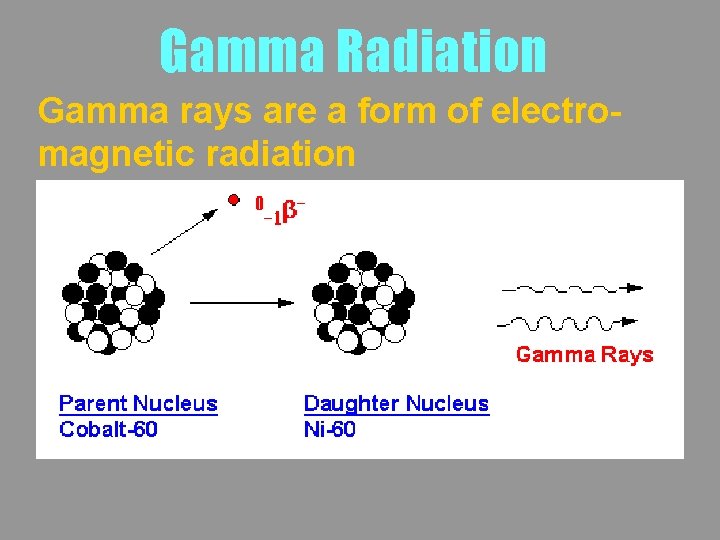
Gamma Radiation Gamma rays are a form of electromagnetic radiation

Gamma Radiation g release is often associated with a or b decay Gamma rays remove energy from an unstable nucleus
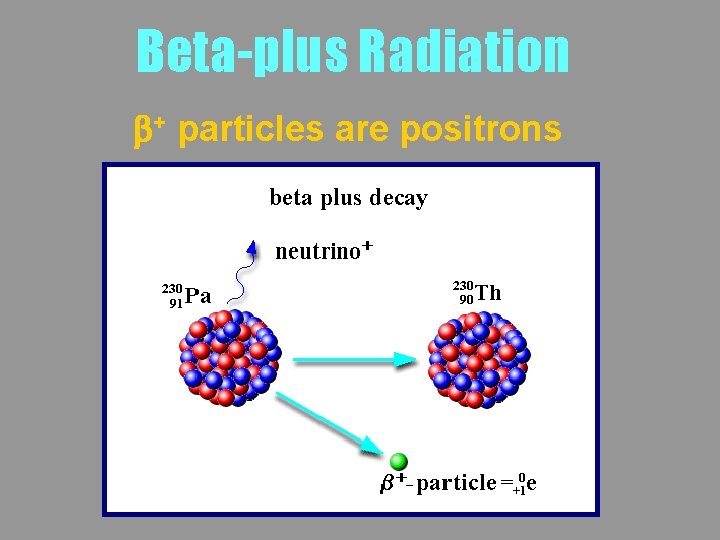
Beta-plus Radiation b+ particles are positrons
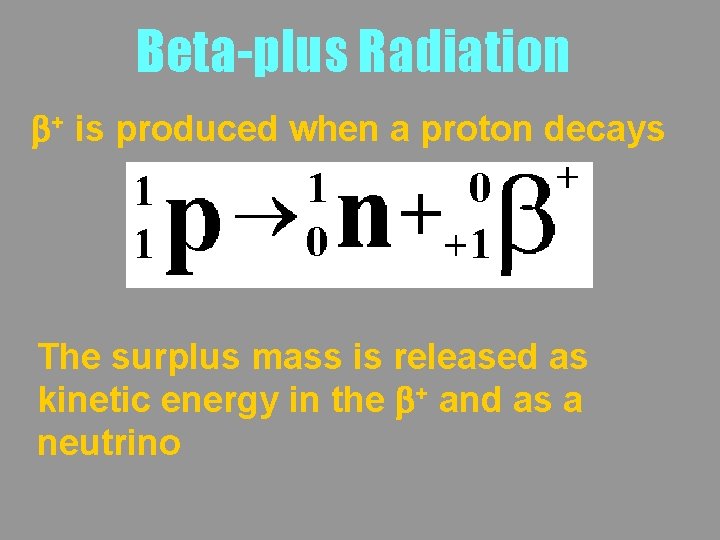
Beta-plus Radiation b+ is produced when a proton decays The surplus mass is released as kinetic energy in the b+ and as a neutrino
Penetrating power a has a high mass It is stopped by a few centimetres of air b has a small mass It is stopped by a few millimetres of aluminium g has zero mass It is stopped by thick lead or concrete
Penetrating power a has a high charge It is dangerous if swallowed b has a small charge It is dangerous at medium range g has high energy It is dangerous at distance

Penetrating power
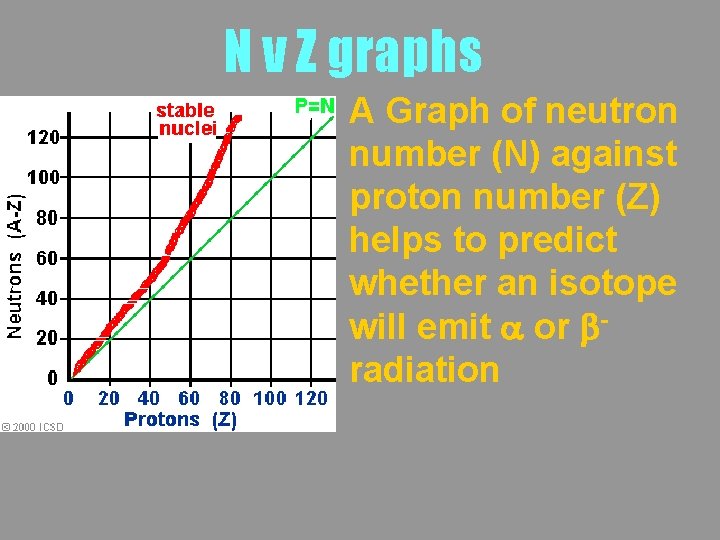
N v Z graphs A Graph of neutron number (N) against proton number (Z) helps to predict whether an isotope will emit a or bradiation
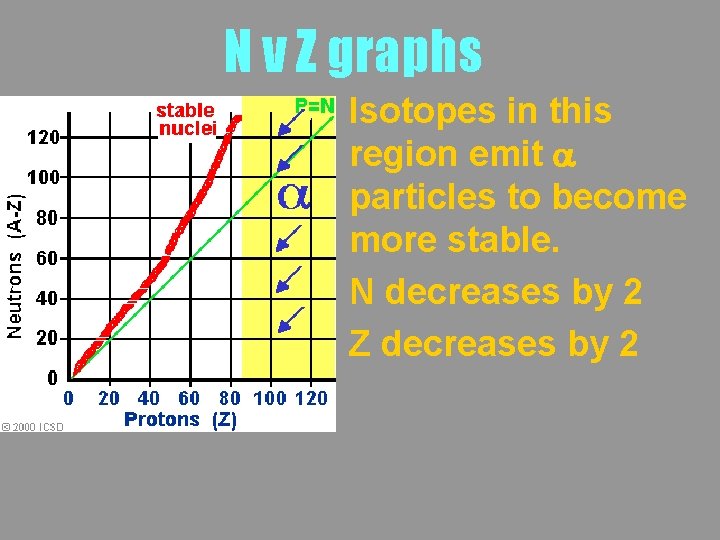
N v Z graphs Isotopes in this region emit a particles to become more stable. N decreases by 2 Z decreases by 2
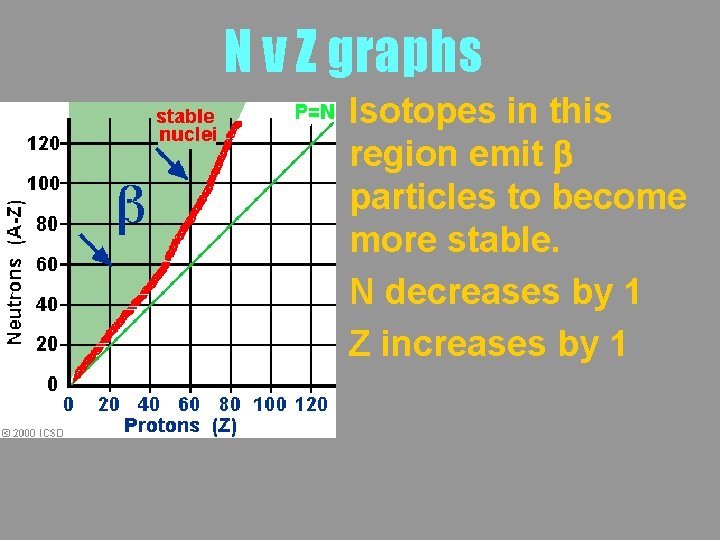
N v Z graphs Isotopes in this region emit b particles to become more stable. N decreases by 1 Z increases by 1
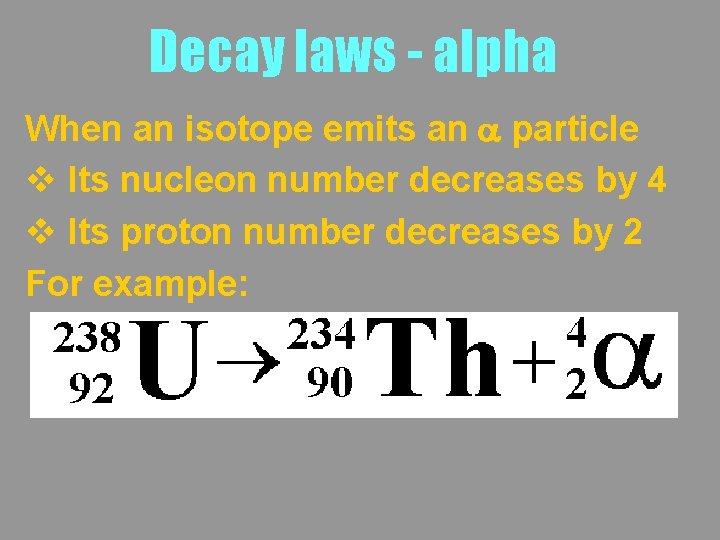
Decay laws - alpha When an isotope emits an a particle v Its nucleon number decreases by 4 v Its proton number decreases by 2 For example:

Decay laws – beta-minus When an isotope emits a b- particle v Its nucleon number is unchanged v Its proton number increases by 1 For example:
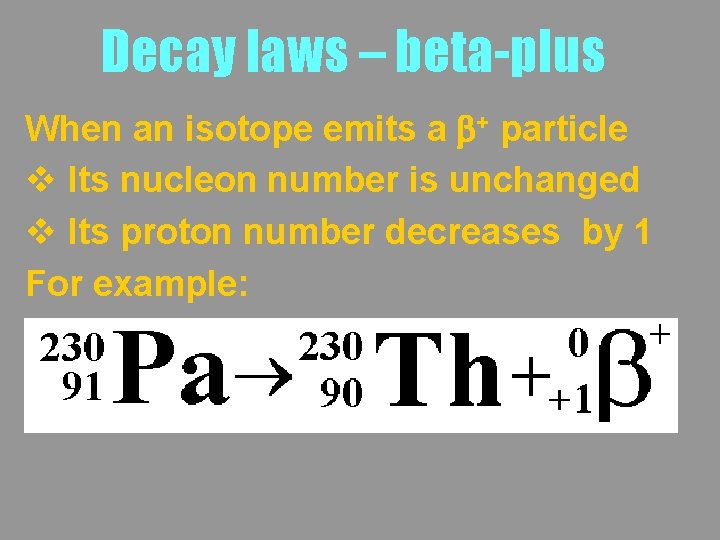
Decay laws – beta-plus When an isotope emits a b+ particle v Its nucleon number is unchanged v Its proton number decreases by 1 For example:
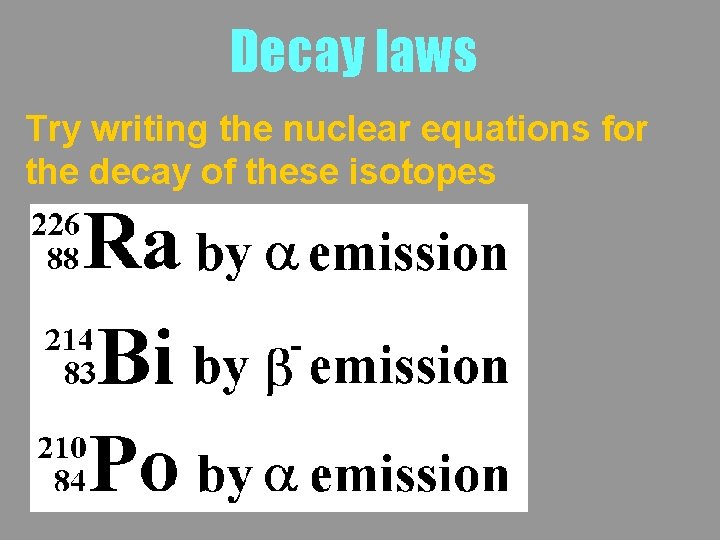
Decay laws Try writing the nuclear equations for the decay of these isotopes
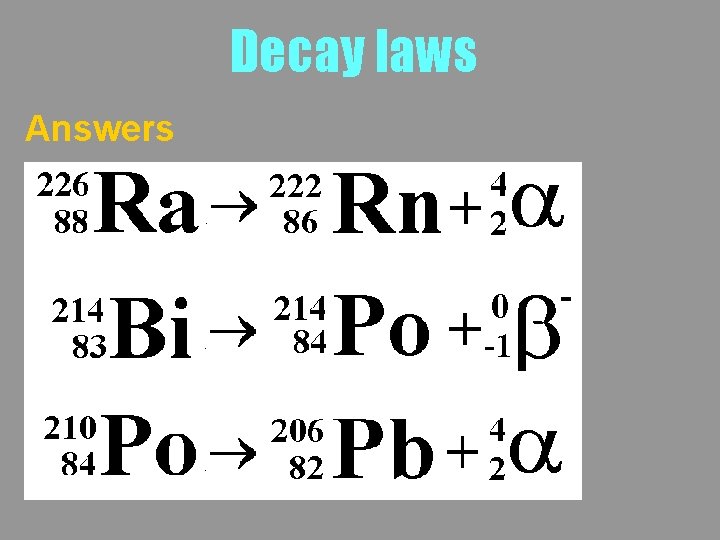
Decay laws Answers
Alpha Beta Gamma
- Slides: 23