
ALOS PALSAR interferometry of Taupo Volcanic Zone New
- Slides: 19
ALOS PALSAR interferometry of Taupo Volcanic Zone, New Zealand Sergey Samsonov 1, 3, John Beavan 1, Chris Bromley 2, Bradley Scott 2, Gill Jolly 2 and Kristy Tiampo 3 1 GNS Science, Lower Hutt, New Zealand Science, Wairakei Research Centre, Taupo, New Zealand 3 Department of Earth Sciences, University of Western Ontario, London, Ontario Canada 2 GNS Email: s. samsonov@gns. cri. nz
Outline I. Introduction to Taupo Volcanic Zone (TVZ), New Zealand - Previous studies using ERS and ENVISAT C-band data II. Current studies using ALOS PALSAR interferometry - Some examples III. Difficulties in processing and interpretation of ALOS PALSAR In. SAR data IV. Conclusions GNS Science
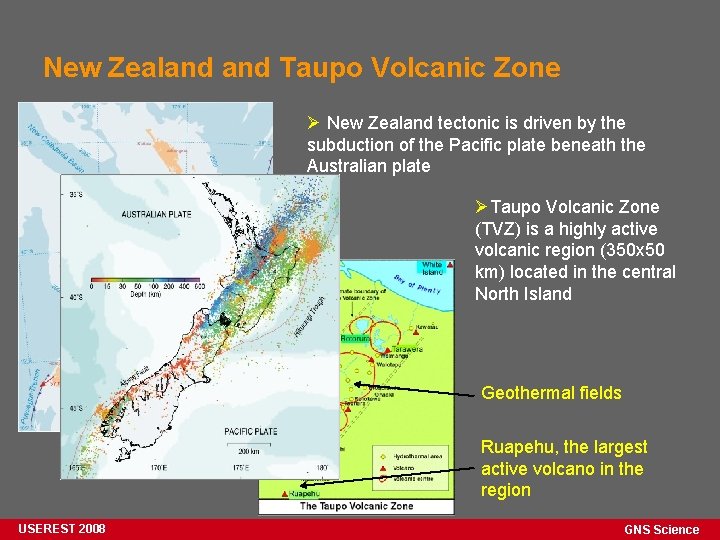
New Zealand Taupo Volcanic Zone Ø New Zealand tectonic is driven by the subduction of the Pacific plate beneath the Australian plate TVZ ØTaupo Volcanic Zone (TVZ) is a highly active volcanic region (350 x 50 km) located in the central North Island Geothermal fields Ruapehu, the largest active volcano in the region USEREST 2008 GNS Science
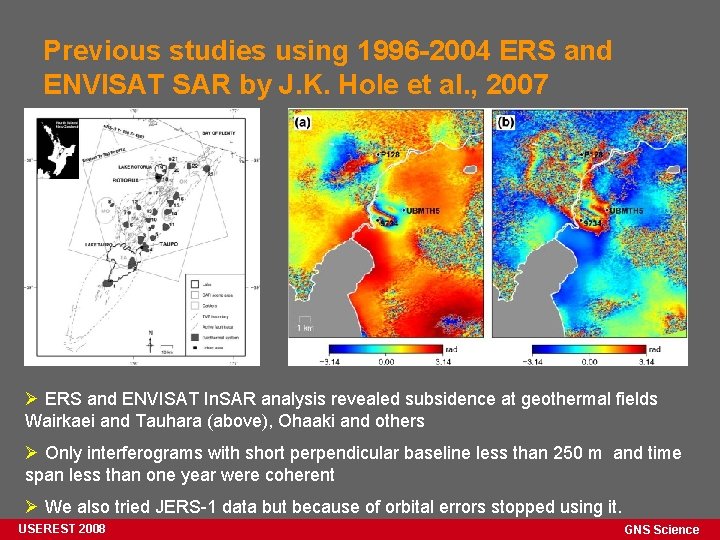
Previous studies using 1996 -2004 ERS and ENVISAT SAR by J. K. Hole et al. , 2007 Ø ERS and ENVISAT In. SAR analysis revealed subsidence at geothermal fields Wairkaei and Tauhara (above), Ohaaki and others Ø Only interferograms with short perpendicular baseline less than 250 m and time span less than one year were coherent Ø We also tried JERS-1 data but because of orbital errors stopped using it. USEREST 2008 GNS Science
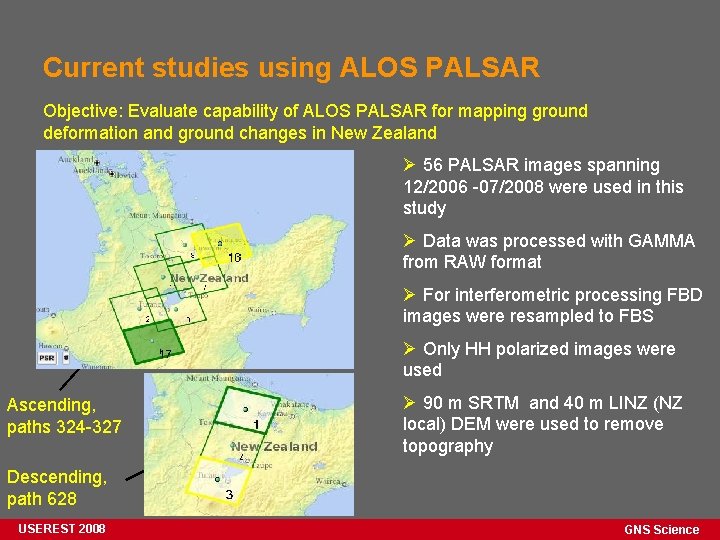
Current studies using ALOS PALSAR Objective: Evaluate capability of ALOS PALSAR for mapping ground deformation and ground changes in New Zealand Ø 56 PALSAR images spanning 12/2006 -07/2008 were used in this study Ø Data was processed with GAMMA from RAW format Ø For interferometric processing FBD images were resampled to FBS Ø Only HH polarized images were used Ascending, paths 324 -327 Ø 90 m SRTM and 40 m LINZ (NZ local) DEM were used to remove topography Descending, path 628 USEREST 2008 GNS Science
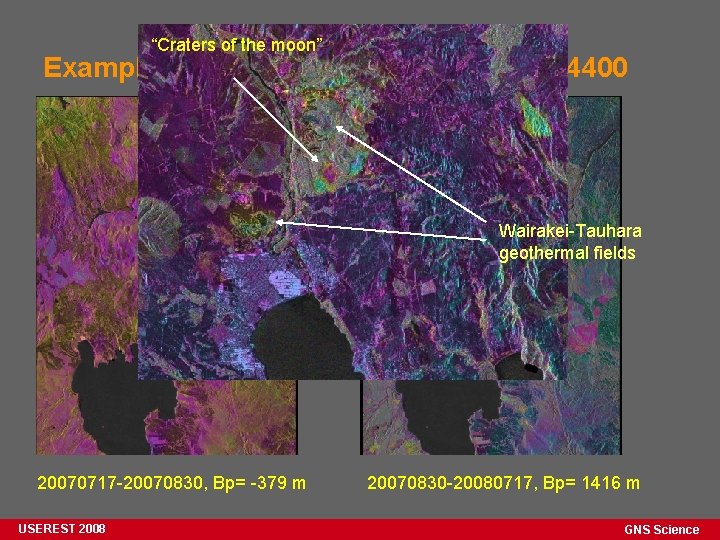
“Craters of the moon” Examples, descending path 628, frame 4400 Wairakei-Tauhara geothermal fields 20070717 -20070830, Bp= -379 m USEREST 2008 20070830 -20080717, Bp= 1416 m GNS Science
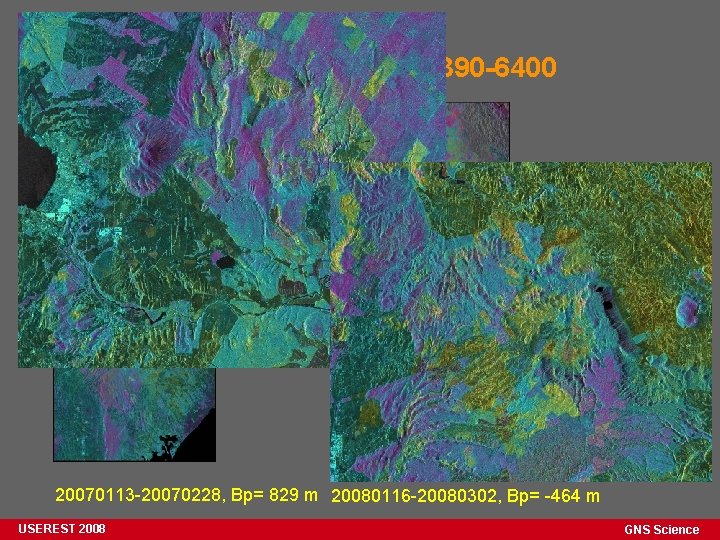
Ascending path 325, frames 6390 -6400 20070113 -20070228, Bp= 829 m 20080116 -20080302, Bp= -464 m USEREST 2008 GNS Science
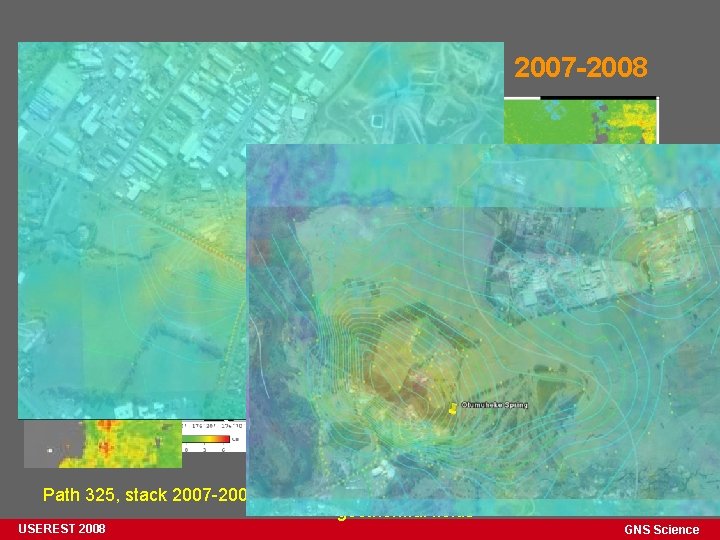
Interpretation, ascending path 325, 2007 -2008 Subsidence at Ohaaki geothermal field Path 325, stack 2007 -2008 USEREST 2008 Subsidence at Tauhara geothermal fields GNS Science
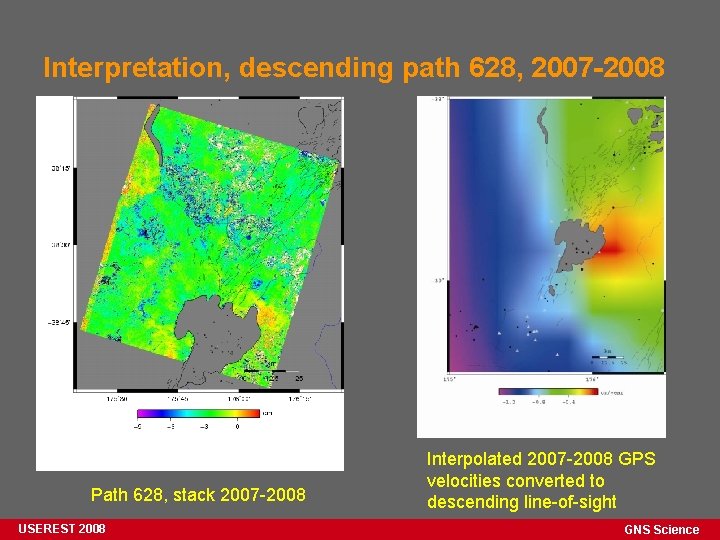
Interpretation, descending path 628, 2007 -2008 Path 628, stack 2007 -2008 USEREST 2008 Interpolated 2007 -2008 GPS velocities converted to descending line-of-sight GNS Science
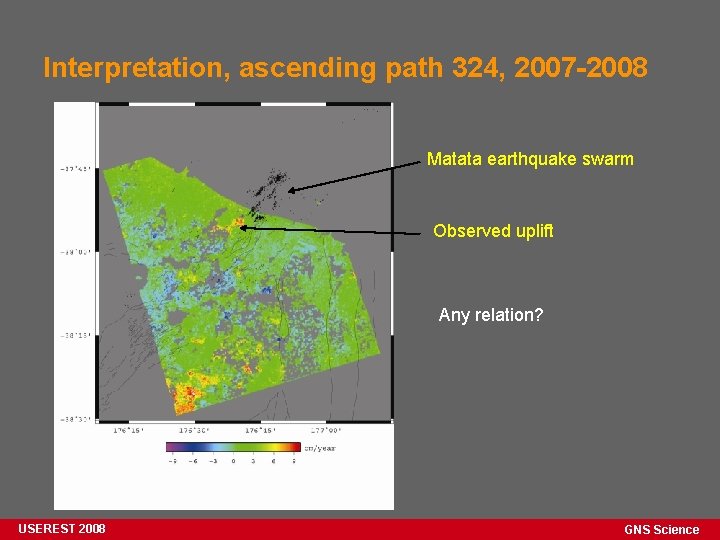
Interpretation, ascending path 324, 2007 -2008 Matata earthquake swarm Observed uplift Any relation? USEREST 2008 GNS Science
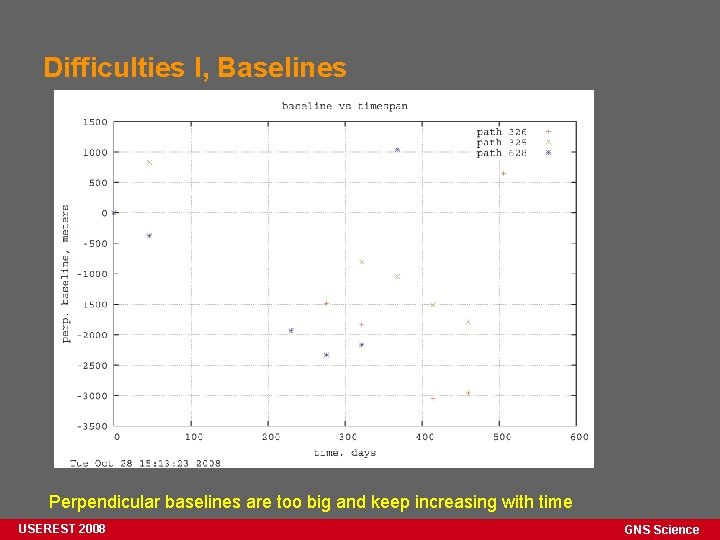
Difficulties I, Baselines Perpendicular baselines are too big and keep increasing with time USEREST 2008 GNS Science
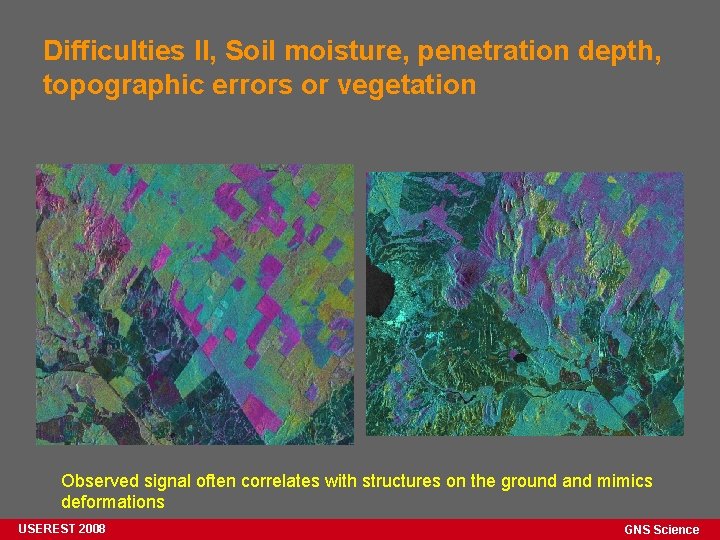
Difficulties II, Soil moisture, penetration depth, topographic errors or vegetation Observed signal often correlates with structures on the ground and mimics deformations USEREST 2008 GNS Science
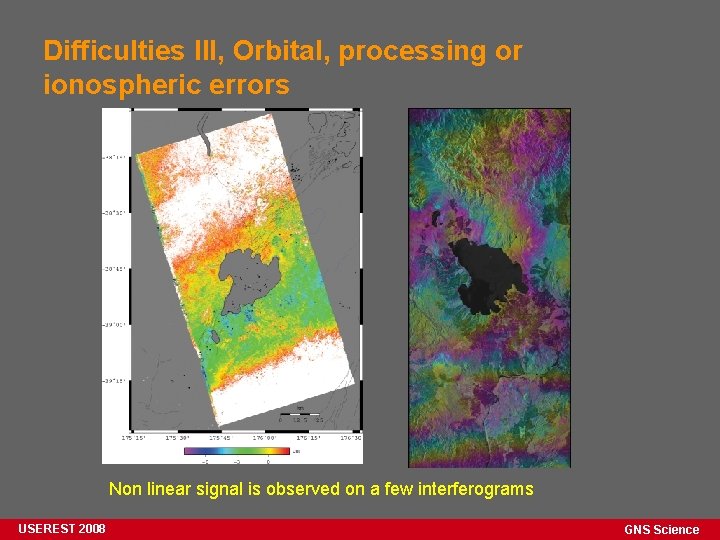
Difficulties III, Orbital, processing or ionospheric errors Non linear signal is observed on a few interferograms USEREST 2008 GNS Science
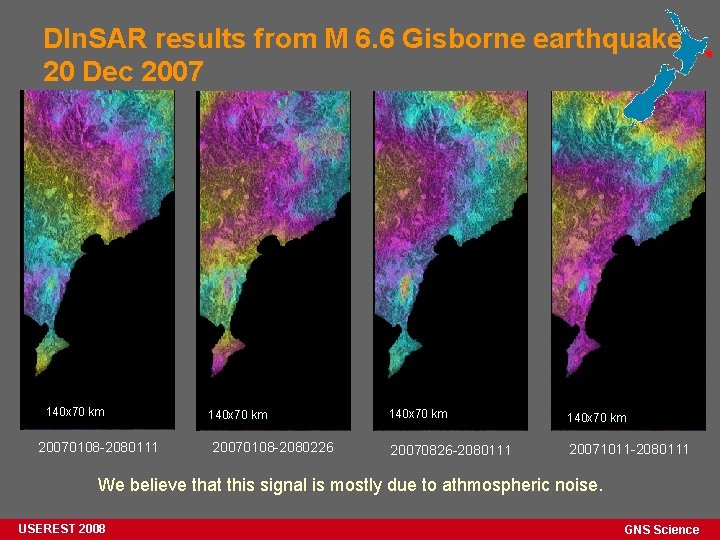
DIn. SAR results from M 6. 6 Gisborne earthquake 20 Dec 2007 140 x 70 km 20070108 -2080111 140 x 70 km 20070108 -2080226 140 x 70 km 20070826 -2080111 20071011 -2080111 We believe that this signal is mostly due to athmospheric noise. USEREST 2008 GNS Science
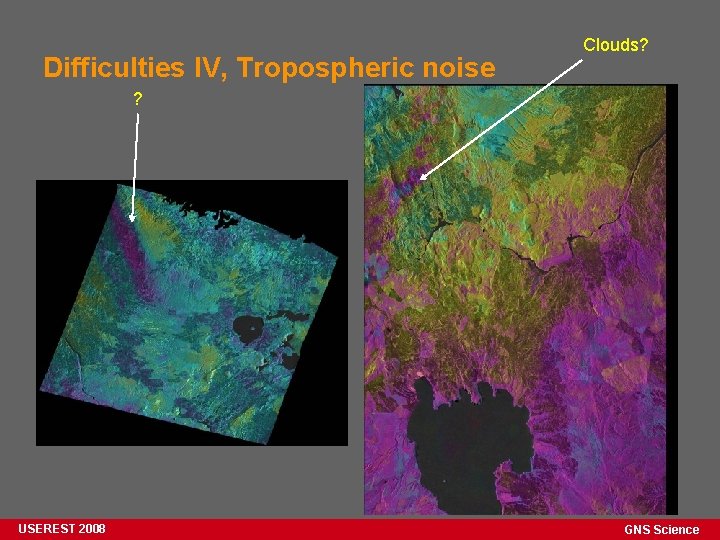
Difficulties IV, Tropospheric noise Clouds? ? USEREST 2008 GNS Science
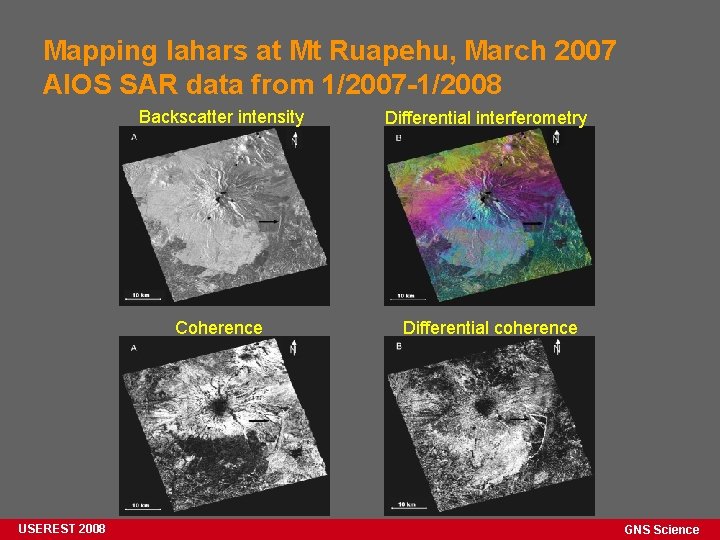
Mapping lahars at Mt Ruapehu, March 2007 Al. OS SAR data from 1/2007 -1/2008 USEREST 2008 Backscatter intensity Differential interferometry Coherence Differential coherence GNS Science
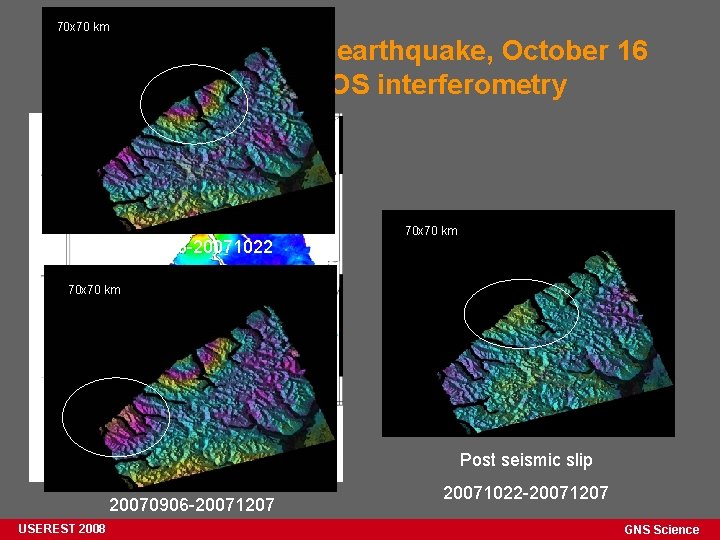
70 x 70 km M 6. 7 George Sounds earthquake, October 16 2007 mapped with ALOS interferometry 20070906 -20071022 70 x 70 km Post seismic slip 20070906 -20071207 USEREST 2008 20071022 -20071207 GNS Science
Conclusions 1. 56 ALOS PALSAR images spanning 12/2006 -07/2008 were used in this study of Taupo Volcanic Zone, New Zealand 2. We confirm that L-band interferometry can be successfully used for mapping ground deformations in densely vegetated regions such as TVZ, New Zealand 3. We could identified ground subsidence at a few geothermal fields (Wairakei, Tauhara, Ohaaki) and possibly uplift around Taupo 4. Created stacks are noisy because images with short time span were used (magnitude of noise is similar to magnitude of signal) 5. Orbital (processing, ionospheric) errors, atmospheric noise, soil water content (topographic errors) are significant limiting factors and more work needs to be done to eliminate them 6. We found that it is very hard, if possible at all, to map slow deformations with large wave-length 7. Perpendicular baselines are too big and continue increasing with time GNS Science
Acknowledgement These results incorporate data which is © Japan Aerospace Exploration Agency ("JAXA") and the Japanese Ministry of Economy, Trade and Industry ("METI") (2007). The ALOS PALSAR data has been used in this work with the permission of JAXA and METI and the Commonwealth of Australia (Geoscience Australia) ("the Commonwealth"). JAXA, METI and the Commonwealth have not evaluated the data as altered and incorporated within this work, and therefore give no warranty regarding its accuracy, completeness, currency or suitability for any particular purpose. www. geonet. org. nz www. gns. cri. nz GNS Science