
Almoiz Industries Limited www almoiz com Impact of


- Slides: 19
Almoiz Industries Limited www. almoiz. com
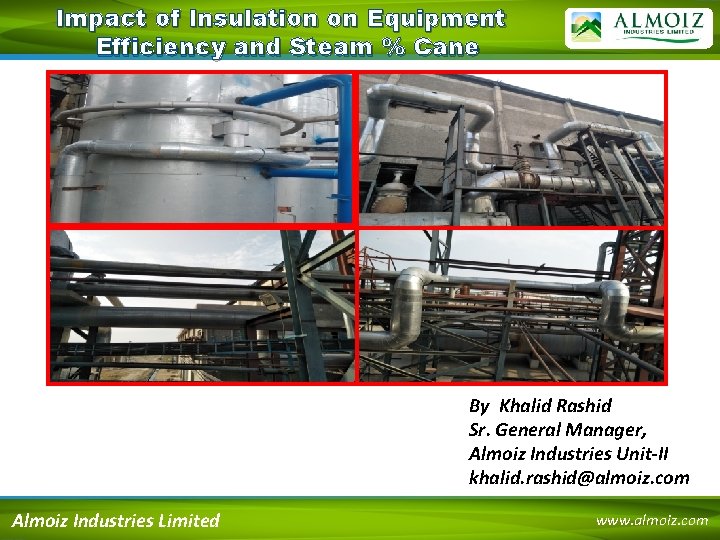
Impact of Insulation on Equipment Efficiency and Steam % Cane By Khalid Rashid Sr. General Manager, Almoiz Industries Unit-II khalid. rashid@almoiz. com Almoiz Industries Limited www. almoiz. com
Abstract of the paper Main focus is given to minimize heat losses through optimum insulation. If proper insulation is done on pipe lines, valves flanges and equipments then how it improves the efficiency of equipments, designed on steam temperature and pressure such as turbines. Similarly if low temperature Vapors are used for juice heating or massecuite boiling, it is important to maintain their temperature and pressure as they come out of evaporators, it is also discussed that how much it impacts on steam % cane. Almoiz Industries Limited www. almoiz. com
Discussions Insulation and its purpose Insulation classification Types of insulation material and their properties Hot insulation and design requirements Calculations of insulation thickness Effect of steam temperature and pressure on the efficiency of equipment ( steam turbines) Effect of steam temperature and pressure on the steam consumption Conclusions Almoiz Industries Limited www. almoiz. com
Insulation and its purpose • Any surface which is cooler or hotter than the surroundings will result in heat loss. the heat loss depends upon many factors but mainly on the surface area and its temperature. Heat loss is higher when ∆t (temperature difference between surface and surrounding) is lesser and it is lesser when ∆t is higher. Insulation minimizes this heat loss. • Thermal insulators are poor conductors and have less thermal conductivity, thermal insulation gives following benefits: Reduces energy consumption Better process control by maintaining required temperature Prevents corrosion by keeping surface temp. above due point Provides fire protection Absorbs vibration up to some extent. Human safety. Almoiz Industries Limited www. almoiz. com
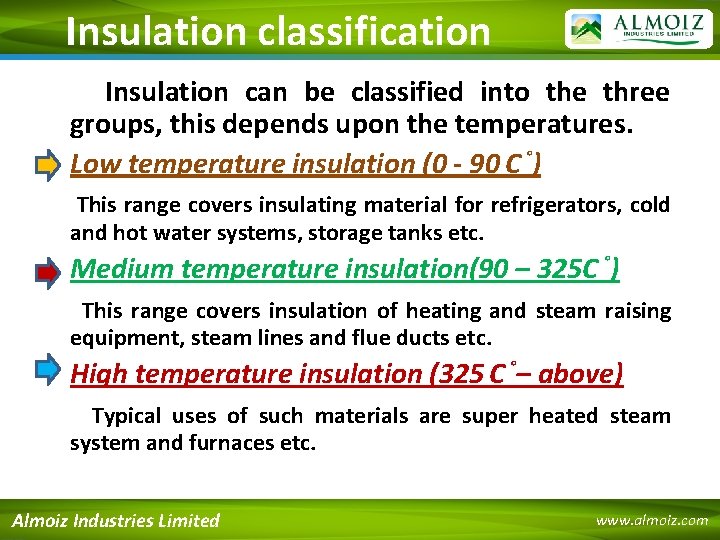
Insulation classification Insulation can be classified into the three groups, this depends upon the temperatures. • Low temperature insulation (0 - 90 C °) This range covers insulating material for refrigerators, cold and hot water systems, storage tanks etc. • Medium temperature insulation(90 – 325 C °) This range covers insulation of heating and steam raising equipment, steam lines and flue ducts etc. • High temperature insulation (325 C °– above) Typical uses of such materials are super heated steam system and furnaces etc. Almoiz Industries Limited www. almoiz. com
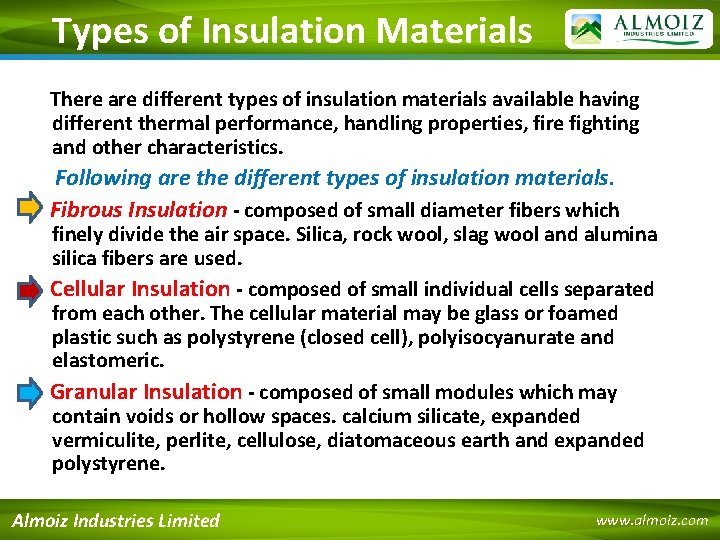
Types of Insulation Materials There are different types of insulation materials available having different thermal performance, handling properties, fire fighting and other characteristics. Following are the different types of insulation materials. Fibrous Insulation - composed of small diameter fibers which finely divide the air space. Silica, rock wool, slag wool and alumina silica fibers are used. Cellular Insulation - composed of small individual cells separated from each other. The cellular material may be glass or foamed plastic such as polystyrene (closed cell), polyisocyanurate and elastomeric. Granular Insulation - composed of small modules which may contain voids or hollow spaces. calcium silicate, expanded vermiculite, perlite, cellulose, diatomaceous earth and expanded polystyrene. Almoiz Industries Limited www. almoiz. com
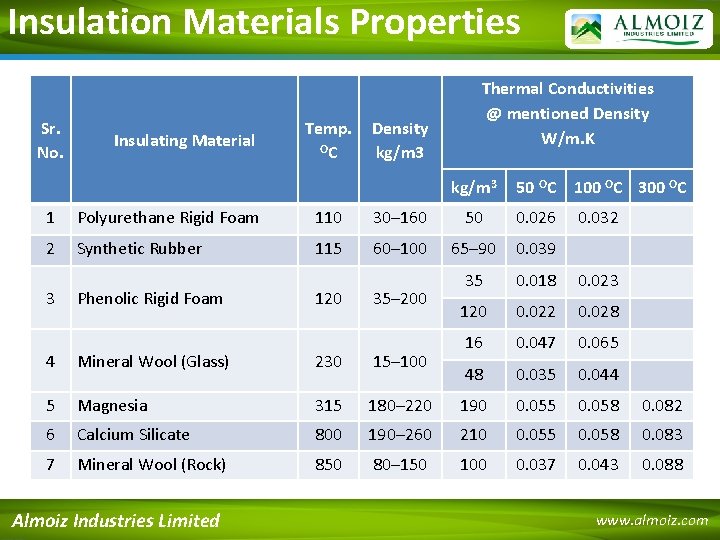
Insulation Materials Properties Sr. No. Insulating Material Temp. OC Density kg/m 3 Thermal Conductivities @ mentioned Density W/m. K kg/m 3 50 OC 100 OC 300 OC 1 Polyurethane Rigid Foam 110 30– 160 50 0. 026 2 Synthetic Rubber 115 60– 100 65– 90 0. 039 35 0. 018 0. 023 120 0. 022 0. 028 16 0. 047 0. 065 48 0. 035 0. 044 3 Phenolic Rigid Foam 120 35– 200 0. 032 4 Mineral Wool (Glass) 230 15– 100 5 Magnesia 315 180– 220 190 0. 055 0. 058 0. 082 6 Calcium Silicate 800 190– 260 210 0. 055 0. 058 0. 083 7 Mineral Wool (Rock) 850 80– 150 100 0. 037 0. 043 0. 088 Almoiz Industries Limited www. almoiz. com
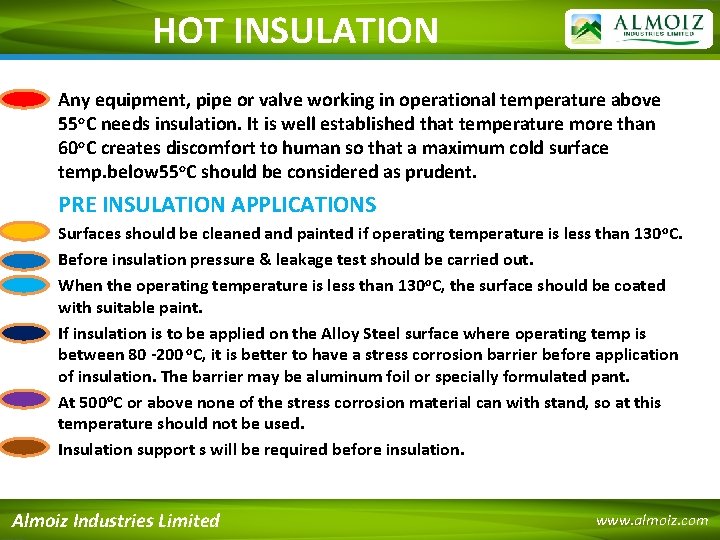
HOT INSULATION • Any equipment, pipe or valve working in operational temperature above 55 o. C needs insulation. It is well established that temperature more than 60 o. C creates discomfort to human so that a maximum cold surface temp. below 55 o. C should be considered as prudent. PRE INSULATION APPLICATIONS • • • Surfaces should be cleaned and painted if operating temperature is less than 130 o. C. Before insulation pressure & leakage test should be carried out. When the operating temperature is less than 130 o. C, the surface should be coated with suitable paint. If insulation is to be applied on the Alloy Steel surface where operating temp is between 80 -200 o. C, it is better to have a stress corrosion barrier before application of insulation. The barrier may be aluminum foil or specially formulated pant. At 500 o. C or above none of the stress corrosion material can with stand, so at this temperature should not be used. Insulation support s will be required before insulation. Almoiz Industries Limited www. almoiz. com
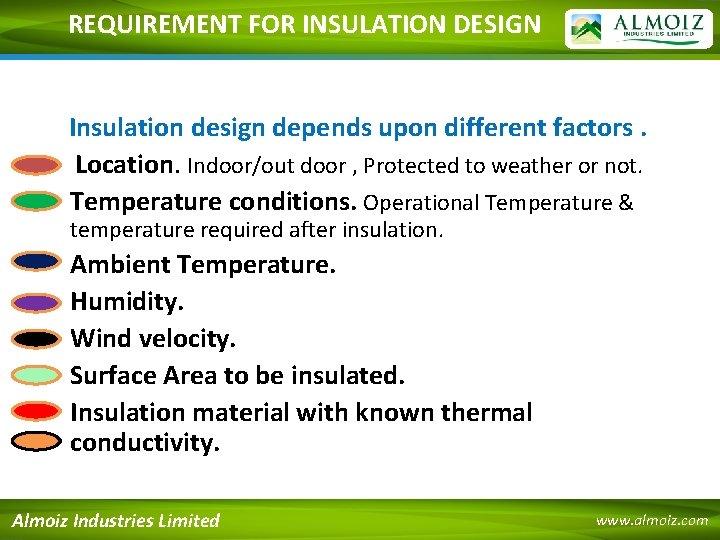
REQUIREMENT FOR INSULATION DESIGN Insulation design depends upon different factors. Location. Indoor/out door , Protected to weather or not. • Temperature conditions. Operational Temperature & temperature required after insulation. • • • Ambient Temperature. Humidity. Wind velocity. Surface Area to be insulated. Insulation material with known thermal conductivity. Almoiz Industries Limited www. almoiz. com
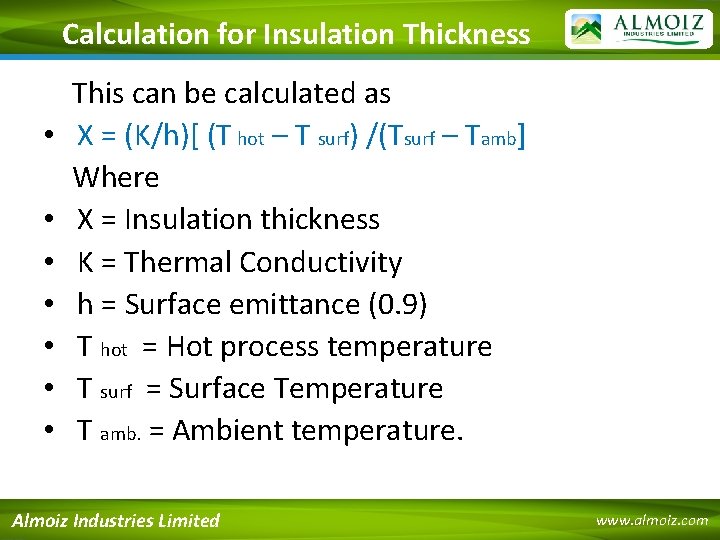
Calculation for Insulation Thickness • • This can be calculated as X = (K/h)[ (T hot – T surf) /(Tsurf – Tamb] Where X = Insulation thickness K = Thermal Conductivity h = Surface emittance (0. 9) T hot = Hot process temperature T surf = Surface Temperature T amb. = Ambient temperature. Almoiz Industries Limited www. almoiz. com
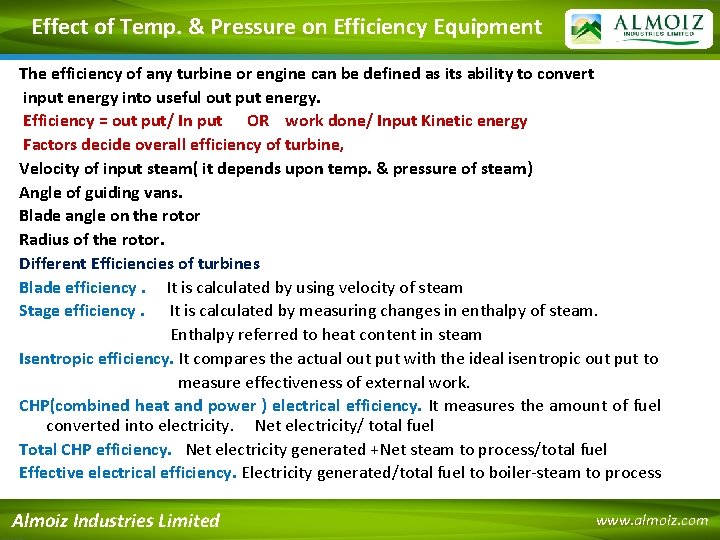
Effect of Temp. & Pressure on Efficiency Equipment The efficiency of any turbine or engine can be defined as its ability to convert input energy into useful out put energy. Efficiency = out put/ In put OR work done/ Input Kinetic energy Factors decide overall efficiency of turbine, Velocity of input steam( it depends upon temp. & pressure of steam) Angle of guiding vans. Blade angle on the rotor Radius of the rotor. Different Efficiencies of turbines Blade efficiency. It is calculated by using velocity of steam Stage efficiency. It is calculated by measuring changes in enthalpy of steam. Enthalpy referred to heat content in steam Isentropic efficiency. It compares the actual out put with the ideal isentropic out put to measure effectiveness of external work. CHP(combined heat and power ) electrical efficiency. It measures the amount of fuel converted into electricity. Net electricity/ total fuel Total CHP efficiency. Net electricity generated +Net steam to process/total fuel Effective electrical efficiency. Electricity generated/total fuel to boiler-steam to process Almoiz Industries Limited www. almoiz. com
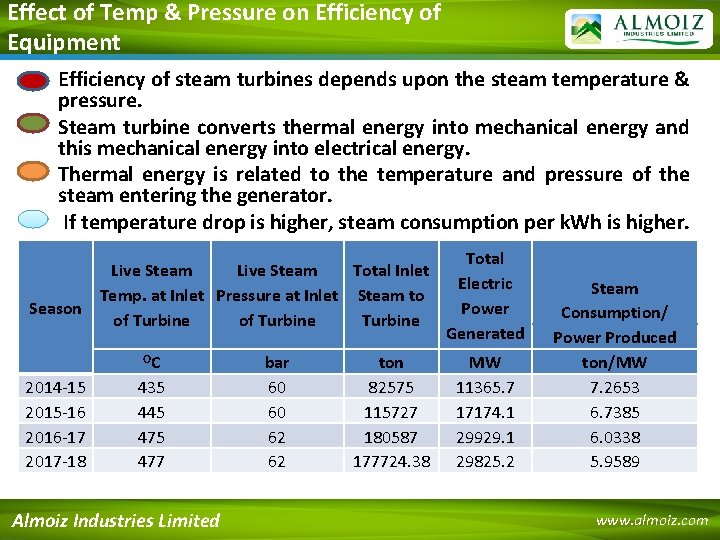
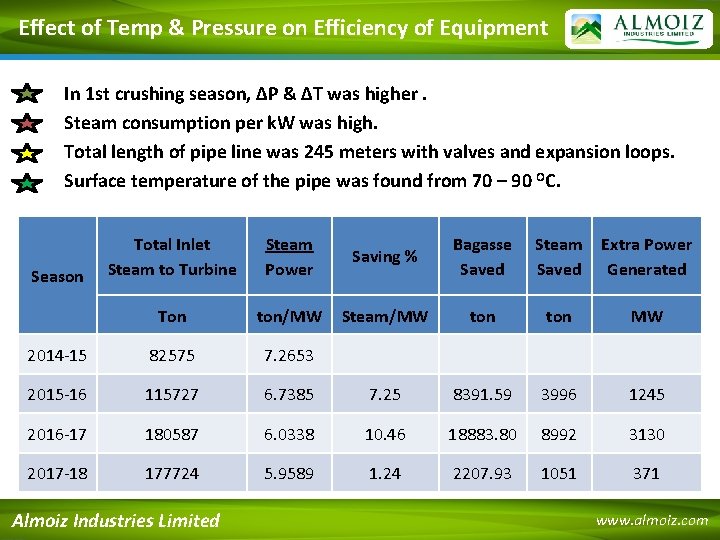
Effect of Temp & Pressure on Efficiency of Equipment • Efficiency of steam turbines depends upon the steam temperature & pressure. • Steam turbine converts thermal energy into mechanical energy and this mechanical energy into electrical energy. • Thermal energy is related to the temperature and pressure of the steam entering the generator. • If temperature drop is higher, steam consumption per k. Wh is higher. Live Steam Total Inlet Temp. at Inlet Pressure at Inlet Steam to Season of Turbine OC 2014 -15 2015 -16 2016 -17 2017 -18 435 445 477 Almoiz Industries Limited bar 60 60 62 62 ton 82575 115727 180587 177724. 38 Total Electric Power Generated MW 11365. 7 17174. 1 29929. 1 29825. 2 Steam Consumption/ Power Produced ton/MW 7. 2653 6. 7385 6. 0338 5. 9589 www. almoiz. com
Effect of Temp & Pressure on Efficiency of Equipment In 1 st crushing season, ∆P & ∆T was higher. Steam consumption per k. W was high. Total length of pipe line was 245 meters with valves and expansion loops. Surface temperature of the pipe was found from 70 – 90 OC. Total Inlet Steam to Turbine Steam Power Saving % Bagasse Saved Steam Saved Extra Power Generated Ton ton/MW Steam/MW ton MW 2014 -15 82575 7. 2653 2015 -16 115727 6. 7385 7. 25 8391. 59 3996 1245 2016 -17 180587 6. 0338 10. 46 18883. 80 8992 3130 2017 -18 177724 5. 9589 1. 24 2207. 93 1051 371 Season Almoiz Industries Limited www. almoiz. com
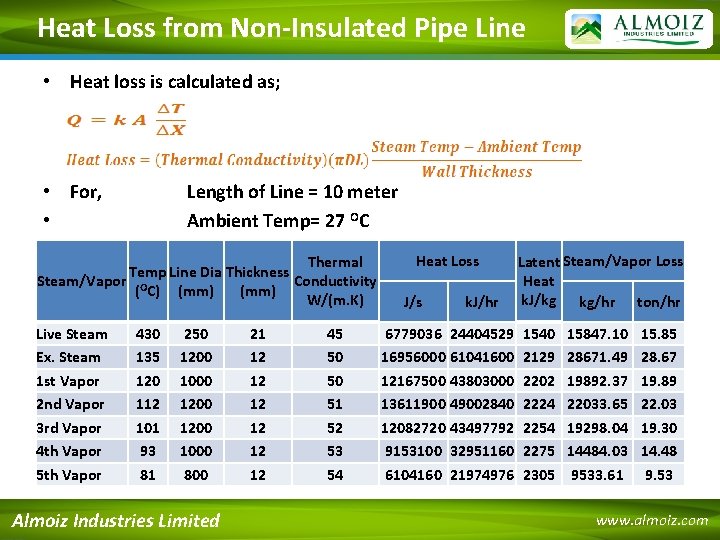
Heat Loss from Non-Insulated Pipe Line • Heat loss is calculated as; • For, • Length of Line = 10 meter Ambient Temp= 27 OC Thermal Temp Line Dia Thickness Steam/Vapor O Conductivity ( C) (mm) W/(m. K) Live Steam Ex. Steam 1 st Vapor 2 nd Vapor 3 rd Vapor 4 th Vapor 5 th Vapor 430 135 120 112 101 93 81 250 1200 1000 800 Almoiz Industries Limited 21 12 12 12 45 50 50 51 52 53 54 Heat Loss J/s k. J/hr 6779036 24404529 16956000 61041600 12167500 43803000 13611900 49002840 12082720 43497792 9153100 32951160 6104160 21974976 Latent Steam/Vapor Loss Heat k. J/kg kg/hr ton/hr 1540 2129 2202 2224 2254 2275 2305 15847. 10 28671. 49 19892. 37 22033. 65 19298. 04 14484. 03 9533. 61 15. 85 28. 67 19. 89 22. 03 19. 30 14. 48 9. 53 www. almoiz. com
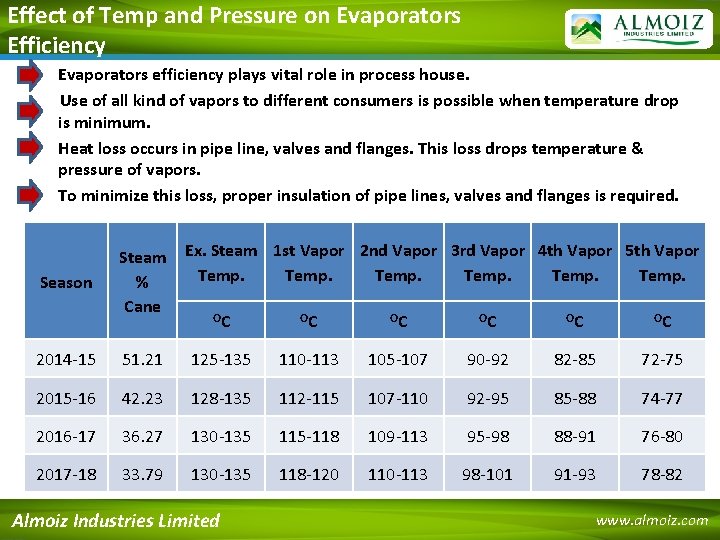
Effect of Temp and Pressure on Evaporators Efficiency Ø Evaporators efficiency plays vital role in process house. Use of all kind of vapors to different consumers is possible when temperature drop is minimum. Ø Heat loss occurs in pipe line, valves and flanges. This loss drops temperature & pressure of vapors. Ø To minimize this loss, proper insulation of pipe lines, valves and flanges is required. Season Steam % Cane Ex. Steam 1 st Vapor 2 nd Vapor 3 rd Vapor 4 th Vapor 5 th Vapor Temp. OC OC OC 2014 -15 51. 21 125 -135 110 -113 105 -107 90 -92 82 -85 72 -75 2015 -16 42. 23 128 -135 112 -115 107 -110 92 -95 85 -88 74 -77 2016 -17 36. 27 130 -135 115 -118 109 -113 95 -98 88 -91 76 -80 2017 -18 33. 79 130 -135 118 -120 110 -113 98 -101 91 -93 78 -82 Almoiz Industries Limited www. almoiz. com
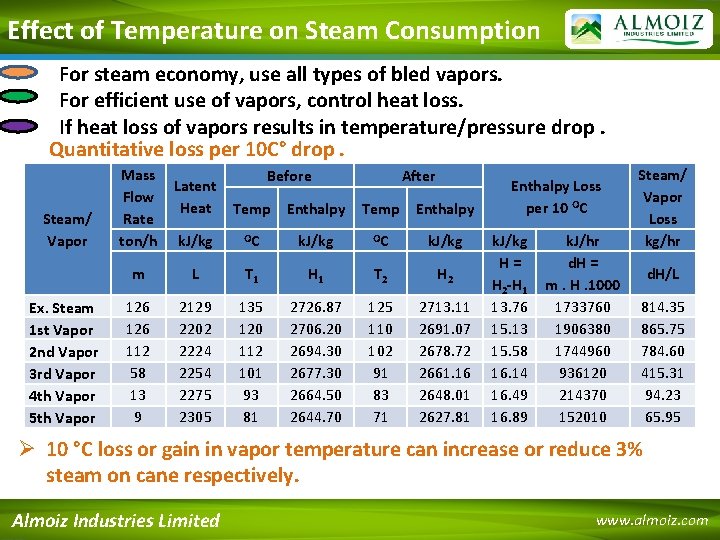
Effect of Temperature on Steam Consumption For steam economy, use all types of bled vapors. For efficient use of vapors, control heat loss. If heat loss of vapors results in temperature/pressure drop. Quantitative loss per 10 C° drop. Steam/ Vapor Ex. Steam 1 st Vapor 2 nd Vapor 3 rd Vapor 4 th Vapor 5 th Vapor Mass Flow Rate ton/h Before After Latent Heat Temp Enthalpy k. J/kg OC k. J/kg m L T 1 H 1 T 2 H 2 126 112 58 13 9 2129 2202 2224 2254 2275 2305 135 120 112 101 93 81 2726. 87 2706. 20 2694. 30 2677. 30 2664. 50 2644. 70 125 110 102 91 83 71 2713. 11 2691. 07 2678. 72 2661. 16 2648. 01 2627. 81 Enthalpy Loss per 10 OC k. J/kg H= H 2 -H 1 13. 76 15. 13 15. 58 16. 14 16. 49 16. 89 k. J/hr d. H = m. H. 1000 1733760 1906380 1744960 936120 214370 152010 Steam/ Vapor Loss kg/hr d. H/L 814. 35 865. 75 784. 60 415. 31 94. 23 65. 95 Ø 10 °C loss or gain in vapor temperature can increase or reduce 3% steam on cane respectively. Almoiz Industries Limited www. almoiz. com
Conclusion • Reduces energy consumption • Better process control by maintaining required temperature. • Human safety. • Right insulation material should be used according to classification. • Insulation design depends upon location, operational temperature, required surface temperature, ambient temperature and surface are. Almoiz Industries Limited www. almoiz. com
Almoiz Industries Limited www. almoiz. com