
ALMATY MANAGEMENT UNIVERSITY STRATEGY 2015 2020 Approved at
- Slides: 25
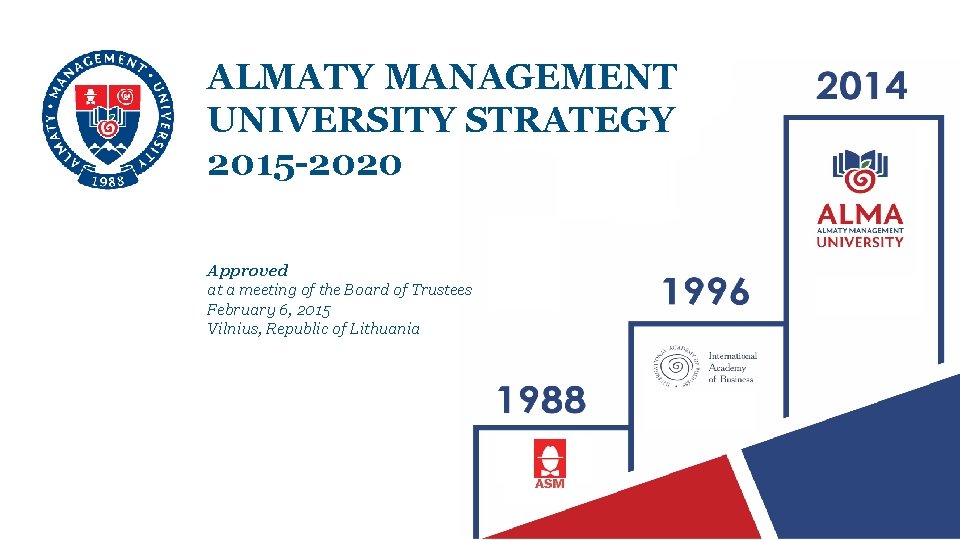
ALMATY MANAGEMENT UNIVERSITY STRATEGY 2015 -2020 Approved at a meeting of the Board of Trustees February 6, 2015 Vilnius, Republic of Lithuania
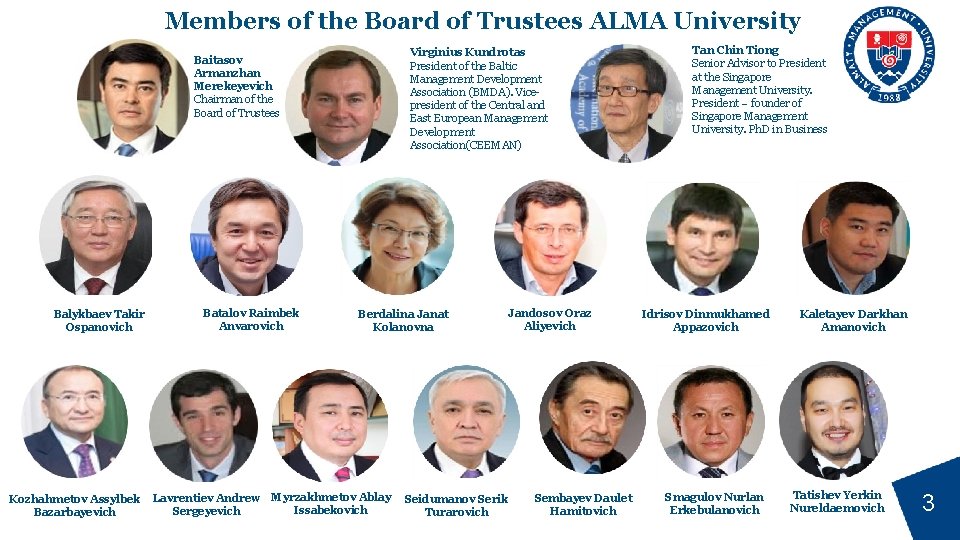
Members of the Board of Trustees ALMA University Virginius Kundrotas President of the Baltic Management Development Association (BMDA). Vicepresident of the Central and East European Management Development Association(CEEMAN) Baitasov Armanzhan Merekeyevich Chairman of the Board of Trustees Balykbaev Takir Ospanovich Kozhahmetov Assylbek Bazarbayevich Batalov Raimbek Anvarovich Berdalina Janat Kolanovna Lavrentiev Andrew Myrzakhmetov Ablay Issabekovich Sergeyevich Jandosov Oraz Aliyevich Seidumanov Serik Turarovich Sembayev Daulet Hamitovich Tan Chin Tiong Senior Advisor to President at the Singapore Management University. President – founder of Singapore Management University. Ph. D in Business Idrisov Dinmukhamed Appazovich Smagulov Nurlan Erkebulanovich Kaletayev Darkhan Amanovich Tatishev Yerkin Nureldaemovich 3
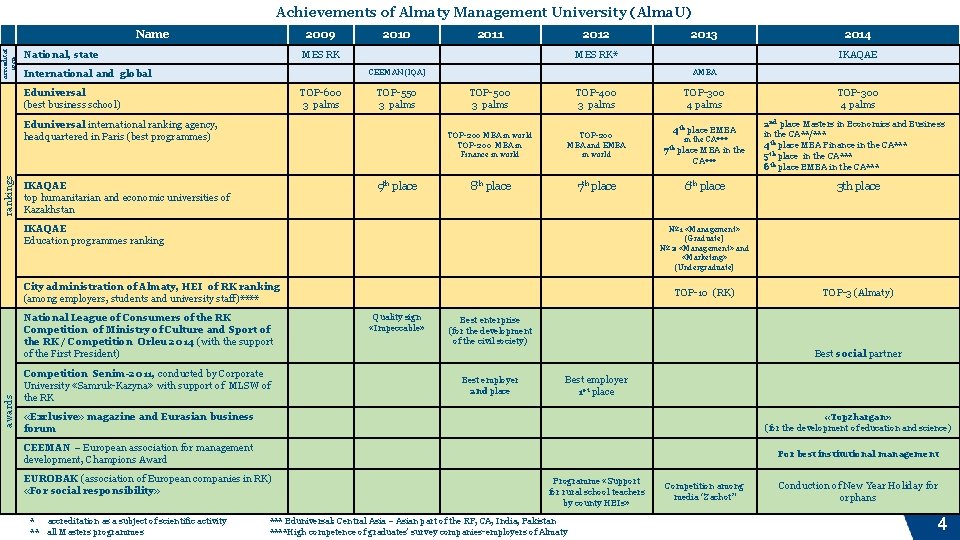
Achievements of Almaty Management University (Alma. U) accreditat ions Name 2009 National, state 2010 2012 MES RK TOP-600 3 palms TOP-550 3 palms Eduniversal international ranking agency, headquartered in Paris (best programmes) IKAQAE top humanitarian and economic universities of Kazakhstan 9 th place 2014 IKAQAE AMBA TOP-500 3 palms TOP-400 3 palms TOP-200 MBA in world TOP-200 MBA in Finance in world TOP-200 MBA and ЕMBA in world 8 th place 7 th place IKAQAE Education programmes ranking TOP-300 4 palms 4 th place ЕMBA in the CA*** 7 th place MBA in the CA*** 6 th place TOP-300 4 palms 2 nd place Masters in Economics and Business in the CA**/*** 4 th place MBA Finance in the CA*** 5 th place in the CA*** 6 th place ЕMBA in the CA*** 3 th place № 1 «Management» (Graduate) № 2 «Management» and «Marketing» (Undergraduate) City administration of Almaty, HEI of RK ranking (among employers, students and university staff)**** National League of Consumers of the RK Competition of Ministry of Culture and Sport of the RK / Competition Orleu 2014 (with the support of the First President) awards 2013 MES RK* CEEMAN (IQA) International and global Eduniversal (best business school) rankings 2011 Competition Senim-2011, conducted by Corporate University «Samruk-Kazyna» with support of MLSW of the RK TOP-10 (RK) Quality sign «Impeccable» TOP-3 (Almaty) Best enterprise (for the development of the civil society) Best social partner Best employer 2 nd place Best employer 1 st place «Exclusive» magazine and Eurasian business forum «Topzhargan» (for the development of education and science) CEEMAN – European association for management development, Champions Award For best institutional management EUROBAK (association of European companies in RK) «For social responsibility» * accreditation as a subject of scientific activity ** all Masters programmes Programme «Support for rural school teachers by county HEIs» *** Eduniversal: Central Asia – Asian part of the RF, CA, India, Pakistan ****High competence of graduates' survey companies-employers of Almaty Competition among media “Zachot” Conduction of New Year Holiday for orphans 4
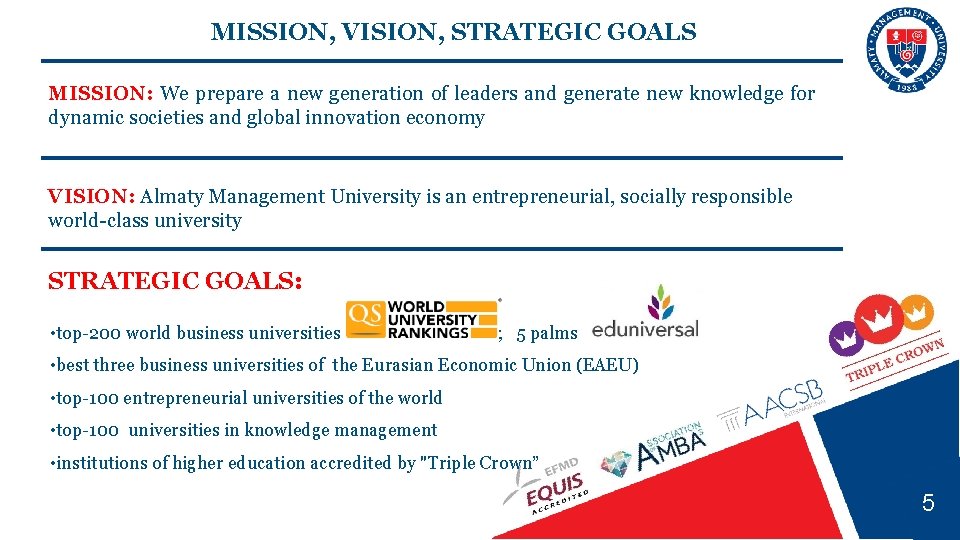
MISSION, VISION, STRATEGIC GOALS MISSION: We prepare a new generation of leaders and generate new knowledge for dynamic societies and global innovation economy VISION: Almaty Management University is an entrepreneurial, socially responsible world-class university STRATEGIC GOALS: • top-200 world business universities ; 5 palms • best three business universities of the Eurasian Economic Union (EAEU) • top-100 entrepreneurial universities of the world • top-100 universities in knowledge management • institutions of higher education accredited by "Triple Crown” 5
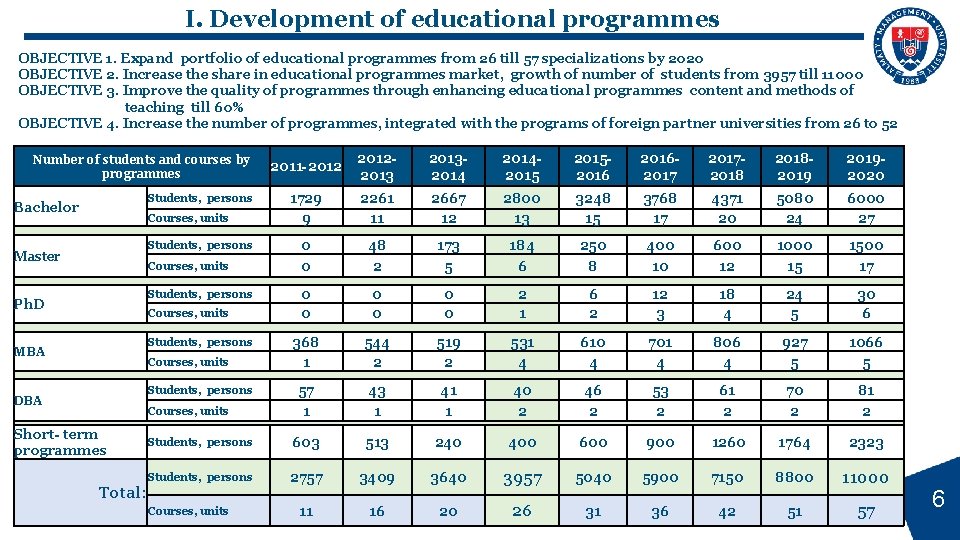
I. Development of educational programmes OBJECTIVE 1. Expand portfolio of educational programmes from 26 till 57 specializations by 2020 OBJECTIVE 2. Increase the share in educational programmes market, growth of number of students from 3957 till 11000 OBJECTIVE 3. Improve the quality of programmes through enhancing educational programmes content and methods of teaching till 60% OBJECTIVE 4. Increase the number of programmes, integrated with the programs of foreign partner universities from 26 to 52 2011 -201220132014201520162017201820192020 1729 9 2261 11 2667 12 2800 13 3248 15 3768 17 4371 20 5080 24 6000 27 0 0 48 2 173 5 184 6 250 8 400 10 600 12 1000 15 1500 17 0 0 0 2 1 6 2 12 3 18 4 24 5 30 6 368 1 544 2 519 2 531 4 610 4 701 4 806 4 927 5 1066 5 57 43 41 40 46 53 61 70 81 1 2 2 2 Students, persons 603 513 240 400 600 900 1260 1764 2323 Students, persons 2757 3409 3640 3957 5040 5900 7150 8800 11000 11 16 20 26 31 36 42 51 57 Number of students and courses by programmes Students, persons Bachelor Courses, units Students, persons Master Courses, units Students, persons Ph. D Courses, units Students, persons MBA Courses, units Students, persons DBA Courses, units Short- term programmes Total: Courses, units 6
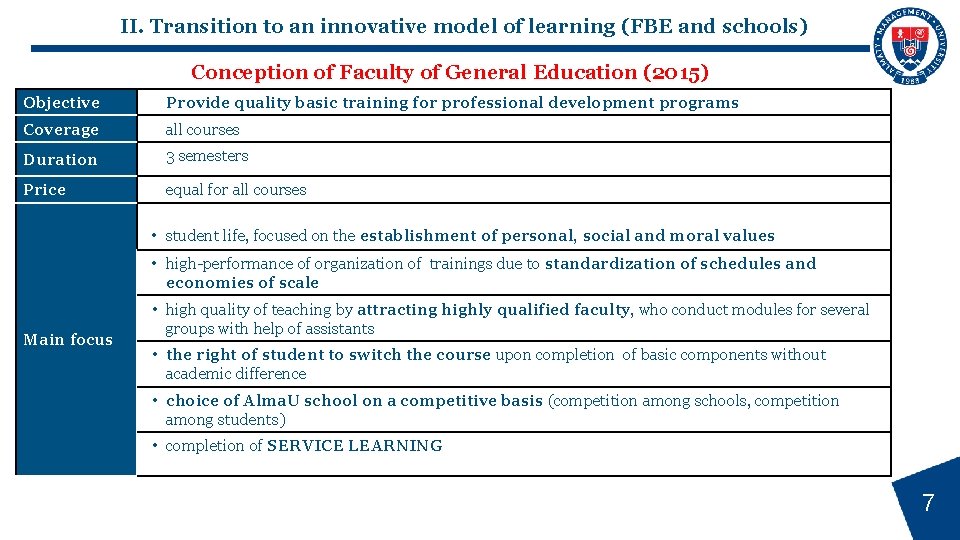
II. Transition to an innovative model of learning (FBE and schools) Conception of Faculty of General Education (2015) Objective Provide quality basic training for professional development programs Coverage all courses Duration 3 semesters Price equal for all courses • student life, focused on the establishment of personal, social and moral values • high-performance of organization of trainings due to standardization of schedules and economies of scale Main focus • high quality of teaching by attracting highly qualified faculty, who conduct modules for several groups with help of assistants • the right of student to switch the course upon completion of basic components without academic difference • choice of Alma. U school on a competitive basis (competition among schools, competition among students) • completion of SERVICE LEARNING 7
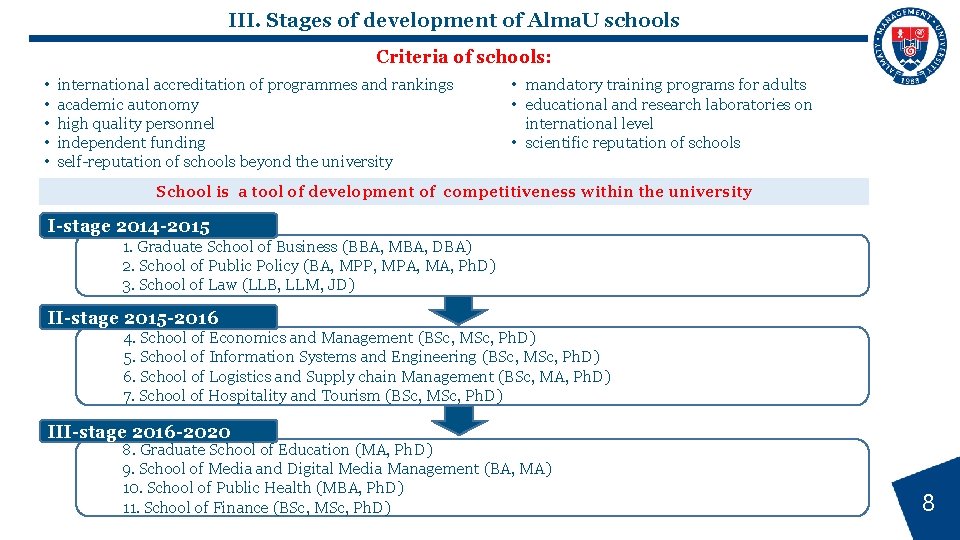
III. Stages of development of Alma. U schools Criteria of schools: • • • international accreditation of programmes and rankings academic autonomy high quality personnel independent funding self-reputation of schools beyond the university • mandatory training programs for adults • educational and research laboratories on international level • scientific reputation of schools School is a tool of development of competitiveness within the university I-stage 2014 -2015 1. Graduate School of Business (BBA, MBA, DBA) 2. School of Public Policy (BA, MPP, MPA, MA, Ph. D) 3. School of Law (LLB, LLM, JD) II-stage 2015 -2016 4. School of Economics and Management (BSc, MSc, Ph. D) 5. School of Information Systems and Engineering (BSc, MSc, Ph. D) 6. School of Logistics and Supply chain Management (BSc, MA, Ph. D) 7. School of Hospitality and Tourism (BSc, MSc, Ph. D) III-stage 2016 -2020 8. Graduate School of Education (MA, Ph. D) 9. School of Media and Digital Media Management (BA, MA) 10. School of Public Health (MBA, Ph. D) 11. School of Finance (BSc, MSc, Ph. D) 8
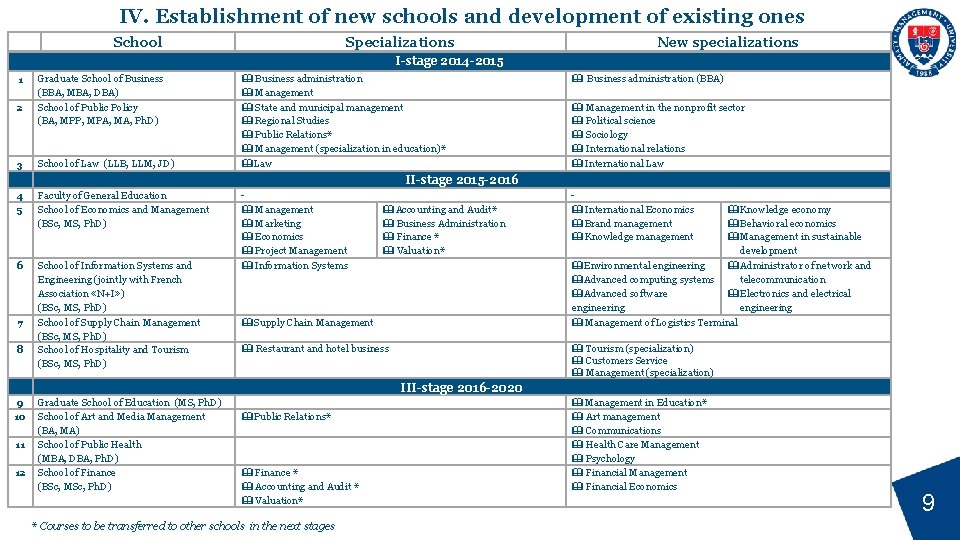
IV. Establishment of new schools and development of existing ones School Specializations New specializations I-stage 2014 -2015 1 2 Graduate School of Business (BBA, MBA, DBA) School of Public Policy (BA, MPP, MPA, MA, Ph. D) 3 School of Law (LLB, LLM, JD) 4 5 Faculty of General Education School of Economics and Management (BSc, MS, Ph. D) 6 School of Information Systems and Engineering (jointly with French Association «N+I» ) (BSc, MS, Ph. D) 7 School of Supply Chain Management (BSc, MS, Ph. D) School of Hospitality and Tourism (BSc, MS, Ph. D) Business administration Management State and municipal management Regional Studies Public Relations* Management (specialization in education)* Law Business administration (BBA) Management in the nonprofit sector Political science Sociology International relations International Law II-stage 2015 -2016 8 - Management Marketing Economics Project Management Information Systems - Accounting and Audit* Business Administration Finance * Valuation* Supply Chain Management Restaurant and hotel business International Economics Brand management Knowledge economy Behavioral economics Management in sustainable development Environmental engineering Administrator of network and Advanced computing systems telecommunication Advanced software Electronics and electrical engineering Management of Logistics Terminal Tourism (specialization) Customers Service Management (specialization) III-stage 2016 -2020 9 10 11 12 Graduate School of Education (MS, Ph. D) School of Art and Media Management (BA, MA) School of Public Health (MBA, DBA, Ph. D) School of Finance (BSc, MSc, Ph. D) Public Relations* Finance * Accounting and Audit * Valuation* * Courses to be transferred to other schools in the next stages Management in Education* Art management Communications Health Care Management Psychology Financial Management Financial Economics 9
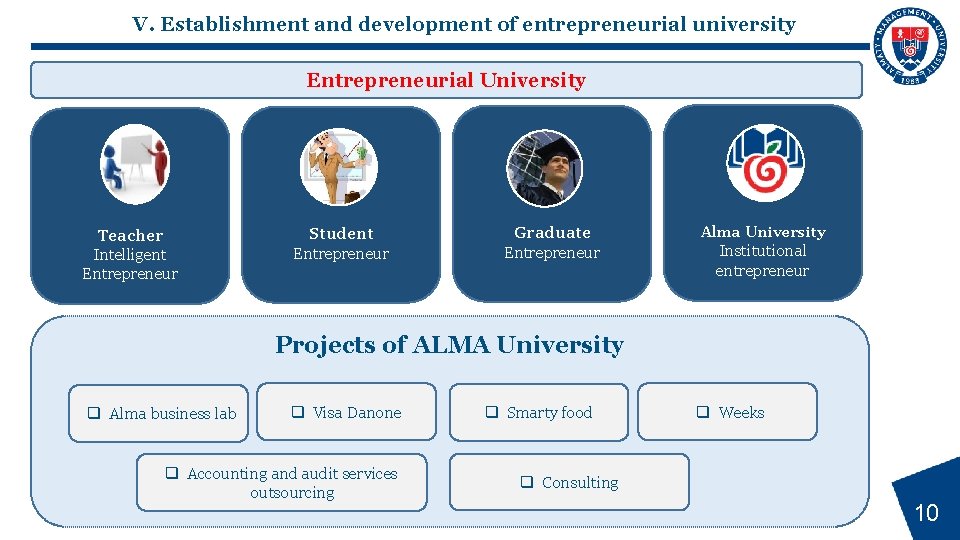
V. Establishment and development of entrepreneurial university Entrepreneurial University Teacher Intelligent Entrepreneur Student Entrepreneur Graduate Entrepreneur Alma University Institutional entrepreneur Projects of ALMA University q Alma business lab q Visa Danone q Accounting and audit services outsourcing q Smarty food q Weeks q Consulting 10
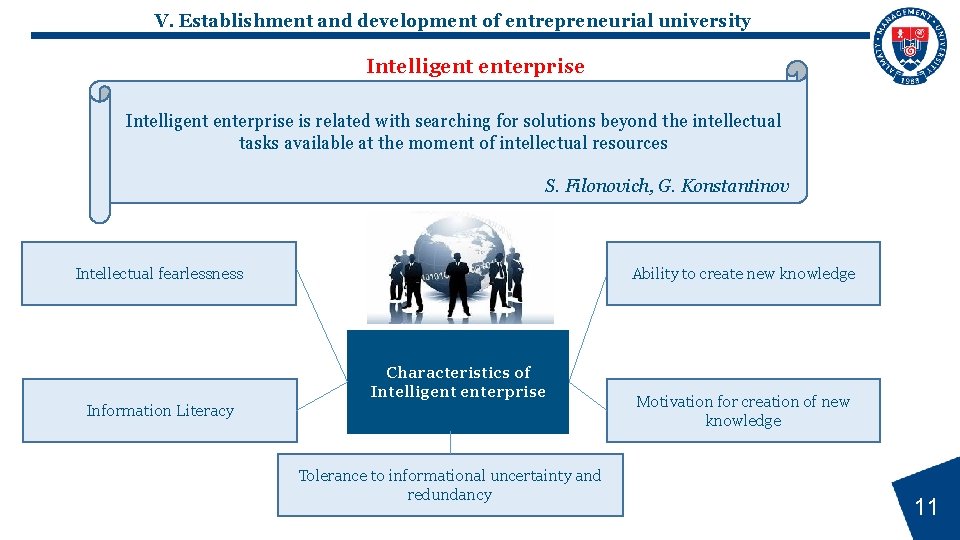
V. Establishment and development of entrepreneurial university Intelligent enterprise is related with searching for solutions beyond the intellectual tasks available at the moment of intellectual resources S. Filonovich, G. Konstantinov Intellectual fearlessness Ability to create new knowledge Characteristics of Intelligent enterprise Information Literacy Tolerance to informational uncertainty and redundancy Motivation for creation of new knowledge 11
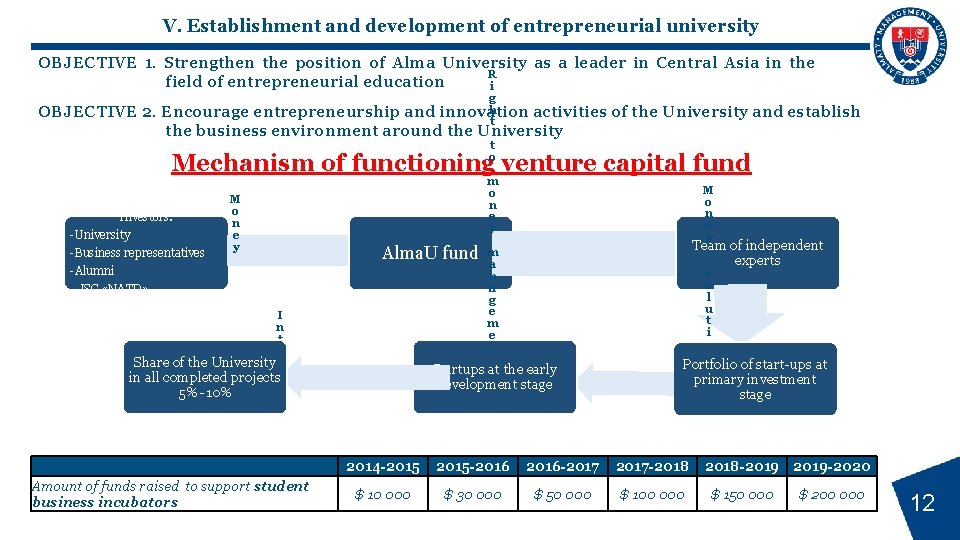
V. Establishment and development of entrepreneurial university OBJECTIVE 1. Strengthen the position of Alma University as a leader in Central Asia in the R field of entrepreneurial education i g h OBJECTIVE 2. Encourage entrepreneurship and innovation activities of the University and establish t the business environment around the University t o m M o n o n e Investors: n e y e -University y Team of independent y , m -Business representatives experts a -Alumni s n o a - JSC «NATD» l g u e I t m n i e t o M n e n o t Share of the University r Portfolio of start-ups at s n Startups at the early in all completed projects e primary investment development stage e s y 5% -10% stage t Mechanism of functioning venture capital fund Alma. U fund Amount of funds raised to support student business incubators 2014 -2015 -2016 -2017 -2018 $ 10 000 $ 30 000 $ 50 000 $ 100 000 2018 -2019 -2020 $ 150 000 $ 200 000 12
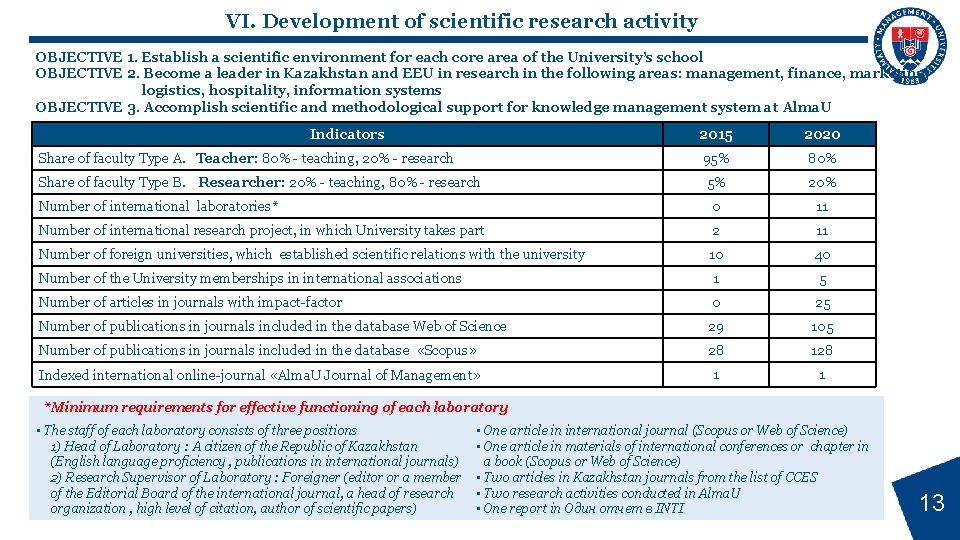
VI. Development of scientific research activity OBJECTIVE 1. Establish a scientific environment for each core area of the University’s school OBJECTIVE 2. Become a leader in Kazakhstan and EEU in research in the following areas: management, finance, marketing, logistics, hospitality, information systems OBJECTIVE 3. Accomplish scientific and methodological support for knowledge management system at Alma. U Indicators 2015 2020 Share of faculty Type A. Teacher: 80% - teaching, 20% - research 95% 80% Share of faculty Type B. Researcher: 20% - teaching, 80% - research 5% 20% Number of international laboratories* 0 11 Number of international research project, in which University takes part 2 11 Number of foreign universities, which established scientific relations with the university 10 40 Number of the University memberships in international associations 1 5 Number of articles in journals with impact-factor 0 25 Number of publications in journals included in the database Web of Science 29 105 Number of publications in journals included in the database «Scopus» 28 128 Indexed international online-journal «Alma. U Journal of Management» 1 1 *Minimum requirements for effective functioning of each laboratory • The staff of each laboratory consists of three positions 1) Head of Laboratory : A citizen of the Republic of Kazakhstan (English language proficiency , publications in international journals) 2) Research Supervisor of Laboratory : Foreigner (editor or a member of the Editorial Board of the international journal, a head of research organization , high level of citation, author of scientific papers) • One article in international journal (Scopus or Web of Science) • One article in materials of international conferences or chapter in a book (Scopus or Web of Science) • Two articles in Kazakhstan journals from the list of CCES • Two research activities conducted in Alma. U • One report in Один отчет в INTI 13
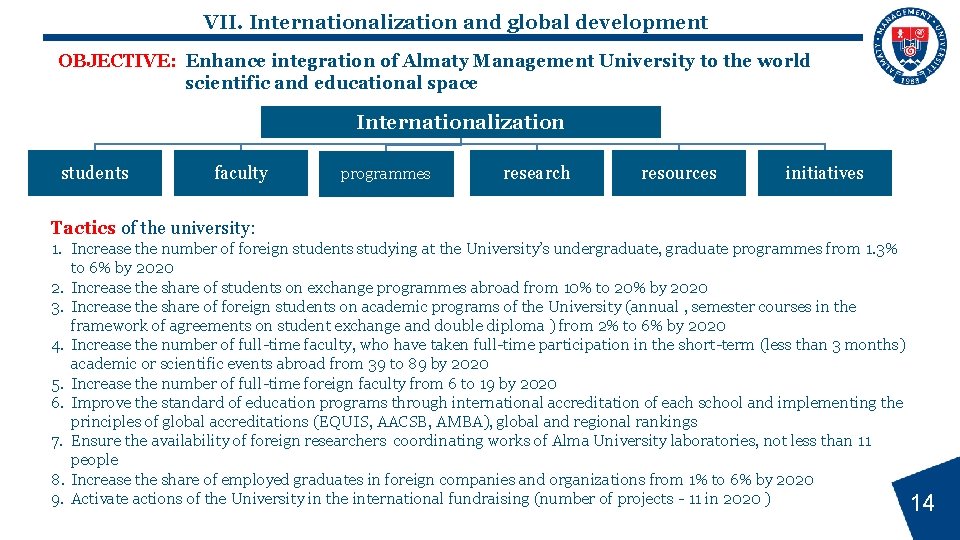
VII. Internationalization and global development OBJECTIVE: Enhance integration of Almaty Management University to the world scientific and educational space Internationalization students faculty programmes research resources initiatives Tactics of the university: 1. Increase the number of foreign students studying at the University’s undergraduate, graduate programmes from 1. 3% to 6% by 2020 2. Increase the share of students on exchange programmes abroad from 10% to 20% by 2020 3. Increase the share of foreign students on academic programs of the University (annual , semester courses in the framework of agreements on student exchange and double diploma ) from 2% to 6% by 2020 4. Increase the number of full-time faculty, who have taken full-time participation in the short-term (less than 3 months) academic or scientific events abroad from 39 to 89 by 2020 5. Increase the number of full-time foreign faculty from 6 to 19 by 2020 6. Improve the standard of education programs through international accreditation of each school and implementing the principles of global accreditations (EQUIS, AACSB, AMBA), global and regional rankings 7. Ensure the availability of foreign researchers coordinating works of Alma University laboratories, not less than 11 people 8. Increase the share of employed graduates in foreign companies and organizations from 1% to 6% by 2020 9. Activate actions of the University in the international fundraising (number of projects - 11 in 2020 ) 14
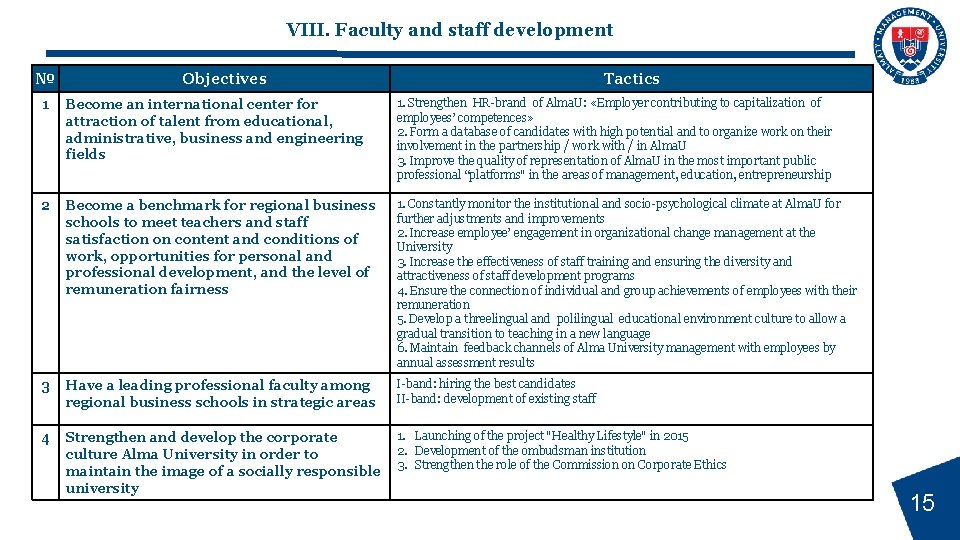
VIII. Faculty and staff development № Objectives Tactics 1 Become an international center for attraction of talent from educational, administrative, business and engineering fields 1. Strengthen HR-brand of Alma. U: «Employer contributing to capitalization of employees’ competences» 2. Form a database of candidates with high potential and to organize work on their involvement in the partnership / work with / in Alma. U 3. Improve the quality of representation of Alma. U in the most important public professional “platforms" in the areas of management, education, entrepreneurship 2 Become a benchmark for regional business schools to meet teachers and staff satisfaction on content and conditions of work, opportunities for personal and professional development, and the level of remuneration fairness 1. Constantly monitor the institutional and socio-psychological climate at Alma. U for further adjustments and improvements 2. Increase employee’ engagement in organizational change management at the University 3. Increase the effectiveness of staff training and ensuring the diversity and attractiveness of staff development programs 4. Ensure the connection of individual and group achievements of employees with their remuneration 5. Develop a threelingual and polilingual educational environment culture to allow a gradual transition to teaching in a new language 6. Maintain feedback channels of Alma University management with employees by annual assessment results 3 Have a leading professional faculty among regional business schools in strategic areas I-band: hiring the best candidates II-band: development of existing staff 4 1. Launching of the project "Healthy Lifestyle" in 2015 Strengthen and develop the corporate 2. Development of the ombudsman institution culture Alma University in order to maintain the image of a socially responsible 3. Strengthen the role of the Commission on Corporate Ethics university 15
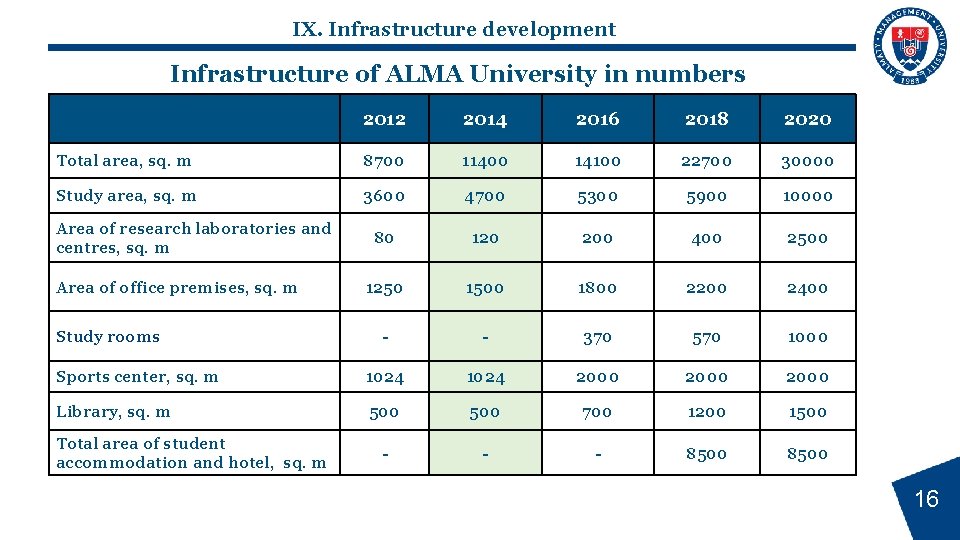
IX. Infrastructure development Infrastructure of ALMA University in numbers 2012 2014 2016 2018 2020 Total area, sq. m 8700 11400 14100 22700 30000 Study area, sq. m 3600 4700 5300 5900 10000 80 120 200 400 2500 1250 1500 1800 2200 2400 - - 370 570 1000 Sports center, sq. m 1024 2000 Library, sq. m 500 700 1200 1500 - - - 8500 Area of research laboratories and centres, sq. m Area of office premises, sq. m Study rooms Total area of student accommodation and hotel, sq. m 16
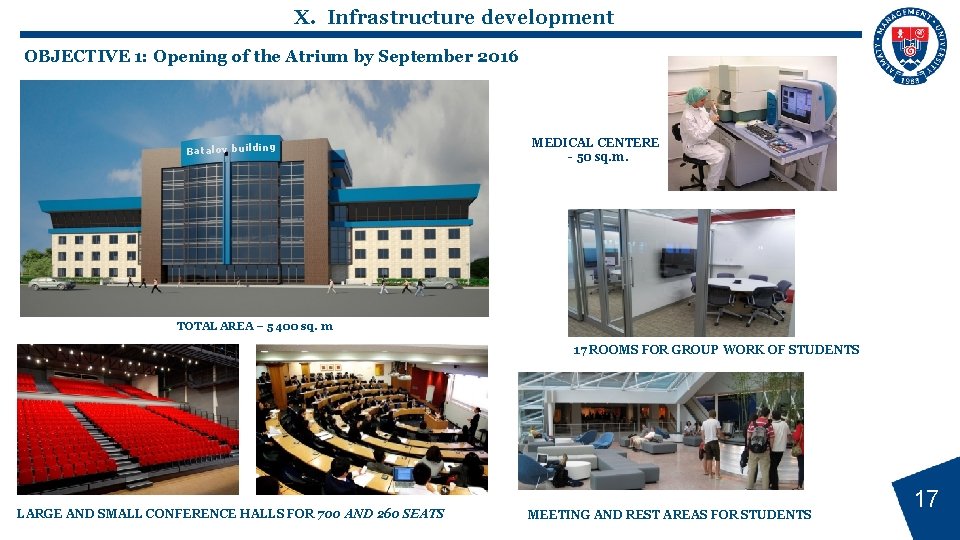
X. Infrastructure development OBJECTIVE 1: Opening of the Atrium by September 2016 Ba ta lo v bu ild in g MEDICAL CENTERE - 50 sq. m. TOTAL AREA – 5 400 sq. m 17 ROOMS FOR GROUP WORK OF STUDENTS LARGE AND SMALL CONFERENCE HALLS FOR 700 AND 260 SEATS MEETING AND REST AREAS FOR STUDENTS 17
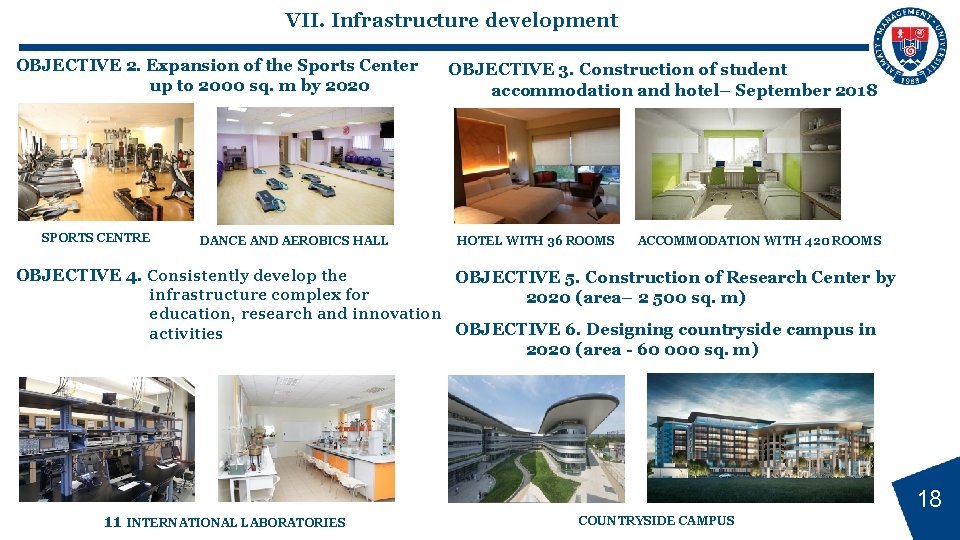
VII. Infrastructure development OBJECTIVE 2. Expansion of the Sports Center up to 2000 sq. m by 2020 SPORTS CENTRE DANCE AND AEROBICS HALL OBJECTIVE 4. Consistently develop the OBJECTIVE 3. Construction of student accommodation and hotel– September 2018 HOTEL WITH 36 ROOMS ACCOMMODATION WITH 420 ROOMS OBJECTIVE 5. Construction of Research Center by 2020 (area– 2 500 sq. m) infrastructure complex for education, research and innovation OBJECTIVE 6. Designing countryside campus in activities 2020 (area - 60 000 sq. m) 11 INTERNATIONAL LABORATORIES 18 COUNTRYSIDE CAMPUS
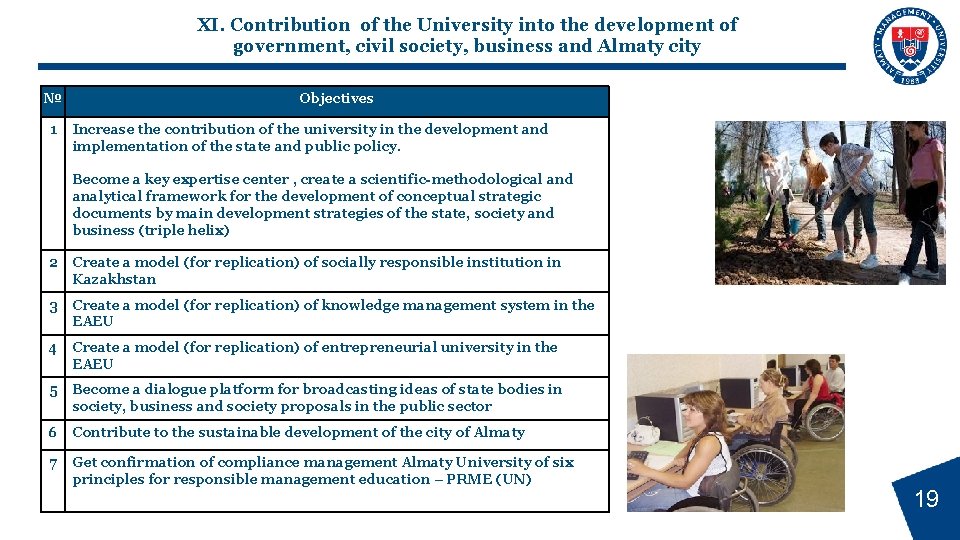
XI. Contribution of the University into the development of government, civil society, business and Almaty city № 1 Objectives Increase the contribution of the university in the development and implementation of the state and public policy. Become a key expertise center , create a scientific-methodological and analytical framework for the development of conceptual strategic documents by main development strategies of the state, society and business (triple helix) 2 Create a model (for replication) of socially responsible institution in Kazakhstan 3 Create a model (for replication) of knowledge management system in the EAEU 4 Create a model (for replication) of entrepreneurial university in the EAEU 5 Become a dialogue platform for broadcasting ideas of state bodies in society, business and society proposals in the public sector 6 Contribute to the sustainable development of the city of Almaty 7 Get confirmation of compliance management Almaty University of six principles for responsible management education – PRME (UN) 19
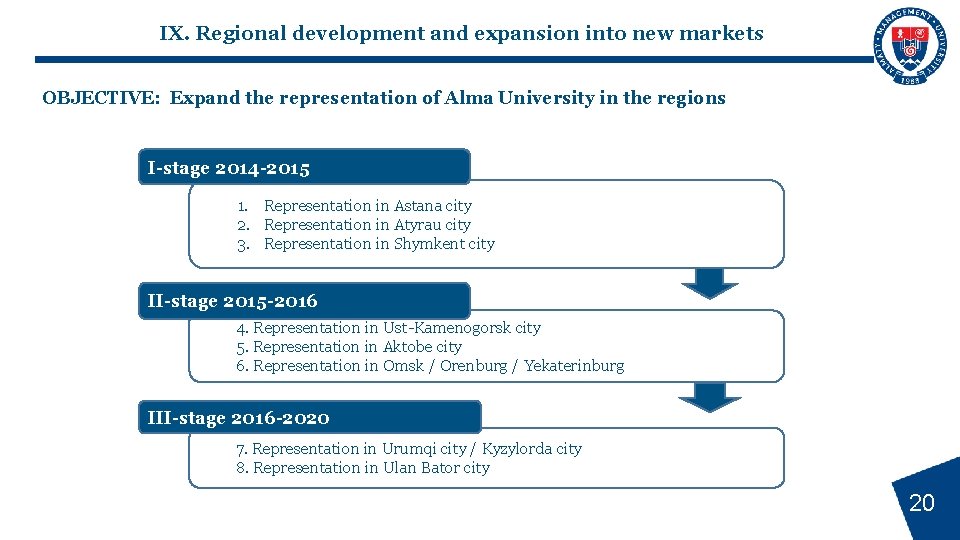
IX. Regional development and expansion into new markets OBJECTIVE: Expand the representation of Alma University in the regions I-stage 2014 -2015 1. Representation in Astana city 2. Representation in Atyrau city 3. Representation in Shymkent city II-stage 2015 -2016 4. Representation in Ust-Kamenogorsk city 5. Representation in Aktobe city 6. Representation in Omsk / Orenburg / Yekaterinburg III-stage 2016 -2020 7. Representation in Urumqi city / Kyzylorda city 8. Representation in Ulan Bator city 20
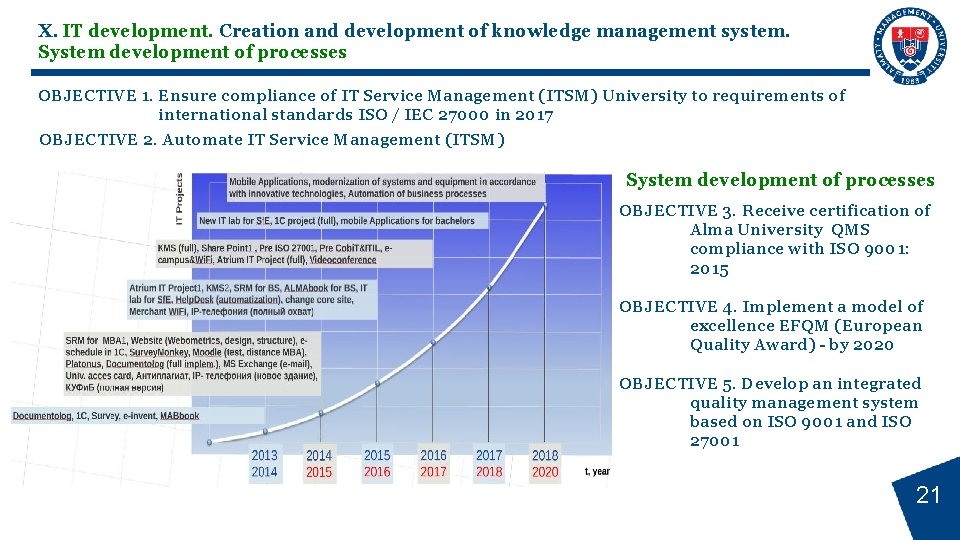
X. IT development. Creation and development of knowledge management system. System development of processes OBJECTIVE 1. Ensure compliance of IT Service Management (ITSM) University to requirements of international standards ISO / IEC 27000 in 2017 OBJECTIVE 2. Automate IT Service Management (ITSM) System development of processes OBJECTIVE 3. Receive certification of Alma University QMS compliance with ISO 9001: 2015 OBJECTIVE 4. Implement a model of excellence EFQM (European Quality Award) - by 2020 OBJECTIVE 5. Develop an integrated quality management system based on ISO 9001 and ISO 27001 21
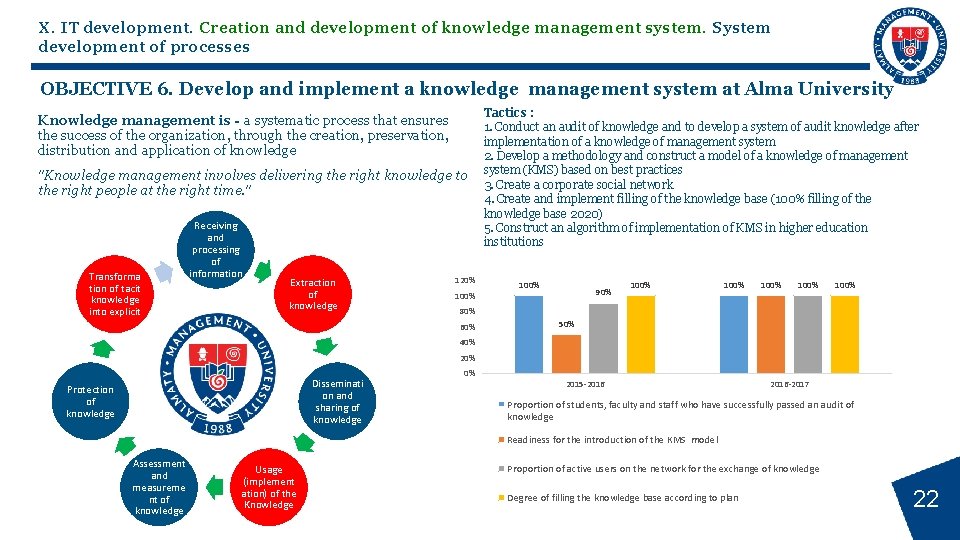
X. IT development. Creation and development of knowledge management system. System development of processes OBJECTIVE 6. Develop and implement a knowledge management system at Alma University Knowledge management is - a systematic process that ensures the success of the organization, through the creation, preservation, distribution and application of knowledge "Knowledge management involves delivering the right knowledge to the right people at the right time. " Transforma tion of tacit knowledge into explicit Receiving and processing of information Extraction of knowledge 120% 100% Tactics : 1. Conduct an audit of knowledge and to develop a system of audit knowledge after implementation of a knowledge of management system 2. Develop a methodology and construct a model of a knowledge of management system (KMS) based on best practices 3. Create a corporate social network 4. Create and implement filling of the knowledge base (100% filling of the knowledge base 2020) 5. Construct an algorithm of implementation of KMS in higher education institutions 100% 90% 100% 100% 80% 60% 50% 40% 20% Disseminati on and sharing of knowledge Protection of knowledge 0% 2015 -2016 -2017 Proportion of students, faculty and staff who have successfully passed an audit of knowledge Readiness for the introduction of the KMS model Assessment and measureme nt of knowledge Usage (implement ation) of the Knowledge Proportion of active users on the network for the exchange of knowledge Degree of filling the knowledge base according to plan 22 79
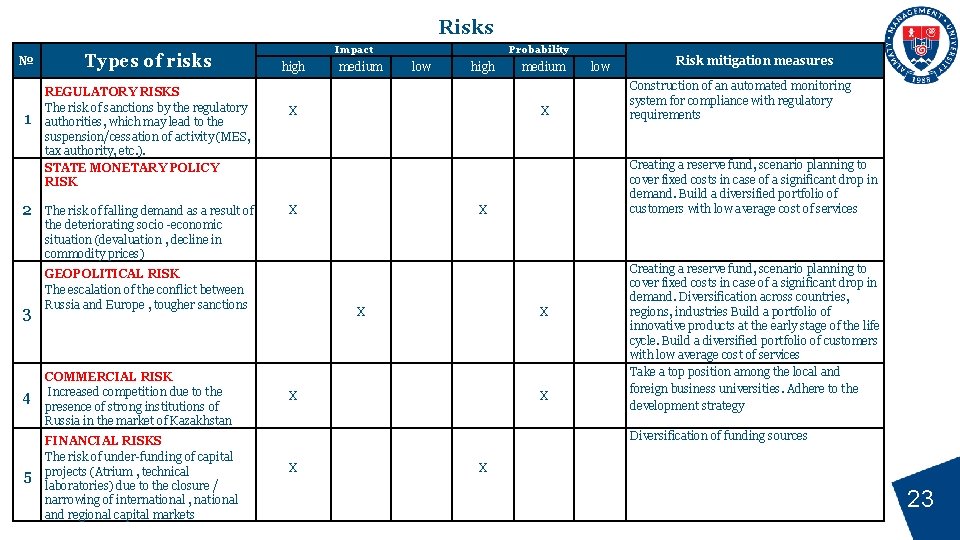
Risks № 1 2 3 Types of risks REGULATORY RISKS The risk of sanctions by the regulatory authorities, which may lead to the suspension/cessation of activity (MES, tax authority, etc. ). STATE MONETARY POLICY RISK The risk of falling demand as a result of the deteriorating socio -economic situation (devaluation , decline in commodity prices) GEOPOLITICAL RISK The escalation of the conflict between Russia and Europe , tougher sanctions 4 COMMERCIAL RISK Increased competition due to the presence of strong institutions of Russia in the market of Kazakhstan 5 FINANCIAL RISKS The risk of under-funding of capital projects (Atrium , technical laboratories) due to the closure / narrowing of international , national and regional capital markets Impact high Х Х medium Х Probability low high Х Х medium Х Х Х low Risk mitigation measures Construction of an automated monitoring system for compliance with regulatory requirements Creating a reserve fund, scenario planning to cover fixed costs in case of a significant drop in demand. Build a diversified portfolio of customers with low average cost of services Creating a reserve fund, scenario planning to cover fixed costs in case of a significant drop in demand. Diversification across countries, regions, industries Build a portfolio of innovative products at the early stage of the life cycle. Build a diversified portfolio of customers with low average cost of services Take a top position among the local and foreign business universities. Adhere to the development strategy Diversification of funding sources Х Х 23
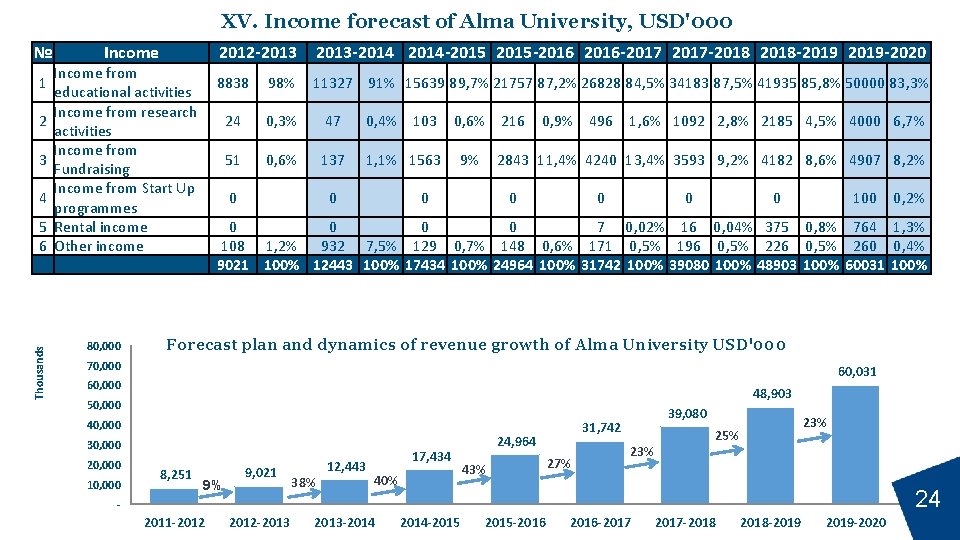
XV. Income forecast of Alma University, USD'000 № 1 2 3 4 Thousands 5 6 Income from educational activities Income from research activities Income from Fundraising Income from Start Up programmes Rental income Other income Total 80, 000 2012 -2013 -2014 -2015 -2016 -2017 -2018 -2019 -2020 8838 98% 11327 91% 15639 89, 7% 21757 87, 2% 26828 84, 5% 34183 87, 5% 41935 85, 8% 50000 83, 3% 24 0, 3% 47 0, 4% 51 0, 6% 137 1, 1% 1563 0 0 103 0, 6% 9% 216 0, 9% 496 1, 6% 1092 2, 8% 2185 4, 5% 4000 6, 7% 2843 11, 4% 4240 13, 4% 3593 9, 2% 4182 8, 6% 4907 8, 2% 0 0 0 100 0 0 7 0, 02% 16 0, 04% 375 0, 8% 764 1, 3% 108 1, 2% 932 7, 5% 129 0, 7% 148 0, 6% 171 0, 5% 196 0, 5% 226 0, 5% 260 0, 4% 9021 100% 12443 100% 17434 100% 24964 100% 31742 100% 39080 100% 48903 100% 60031 100% Forecast plan and dynamics of revenue growth of Alma University USD'000 70, 000 60, 031 60, 000 48, 903 50, 000 40, 000 30, 000 20, 000 10, 000 0, 2% 8, 251 9% 9, 021 38% 12, 443 17, 434 40% 31, 742 24, 964 43% 39, 080 27% 23% 25% 24 - 2011 -2012 -2013 -2014 -2015 -2016 -2017 -2018 -2019 -2020
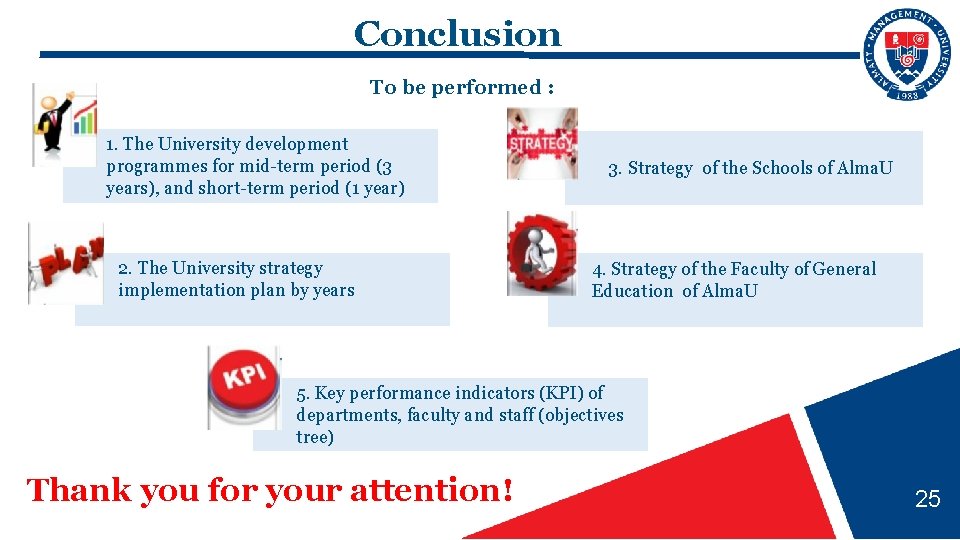
Conclusion To be performed : 1. The University development programmes for mid-term period (3 years), and short-term period (1 year) 2. The University strategy implementation plan by years 3. Strategy of the Schools of Alma. U 4. Strategy of the Faculty of General Education of Alma. U 5. Key performance indicators (KPI) of departments, faculty and staff (objectives tree) Thank you for your attention! 25