
ALMA Cycle 7 Capabilities ALMA Antennas Bands Configs
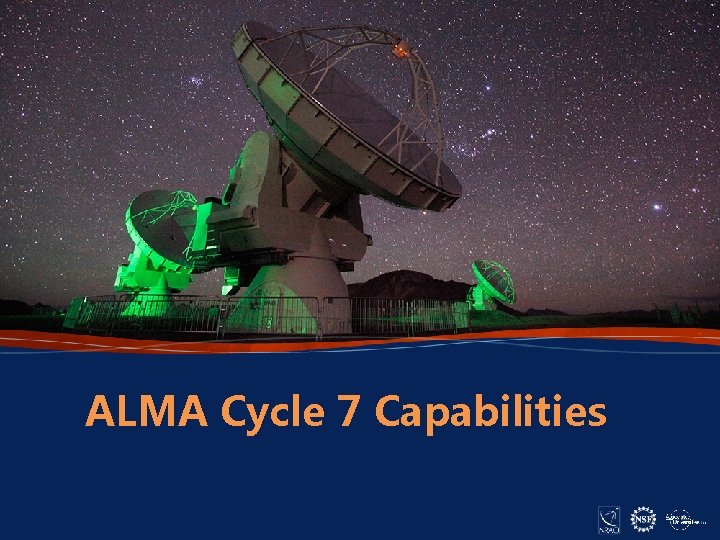
ALMA Cycle 7 Capabilities
ALMA Antennas, Bands & Configs Number of antennas • At least forty-three (43) antennas in the 12 -m Array • At least ten (10) 7 -m antennas (for short baselines) and three (3) 12 m antennas (for making single-dish maps) in the ACA Receiver bands • Receiver Bands 3, 4, 5, 6, 7, 8, 9, and 10 • Wavelengths ~ 3. 1, 2. 1, 1. 6, 1. 3, 0. 87, 0. 74, 0. 44, and 0. 32 mm, respectively 12 -m Array Configurations • Maximum baselines for the antenna configurations between 0. 15 km and 16 km • Maximum baselines of 3. 6 km for Bands 8, 9 and 10 See the ALMA Guide available at: 7 • Maximum baselines of 16 Proposers km for Bands 3, 4, 5, 6 and (https: //almascience. nrao. edu/documents-and-tools)
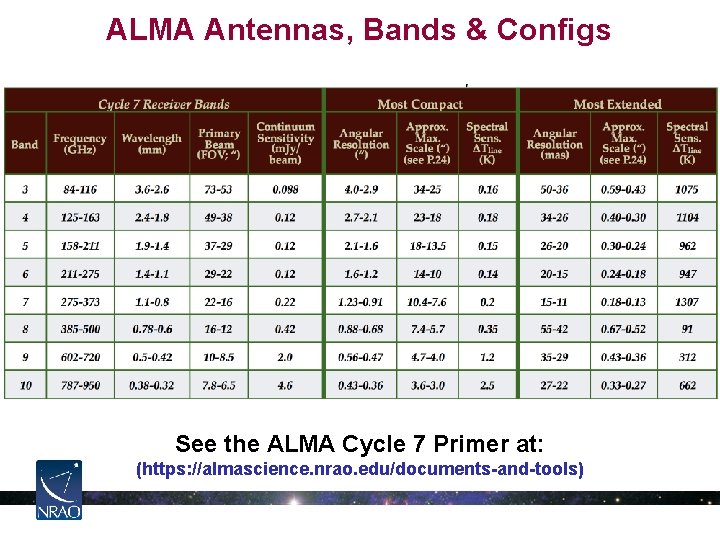
ALMA Antennas, Bands & Configs See the ALMA Cycle 7 Primer at: (https: //almascience. nrao. edu/documents-and-tools)
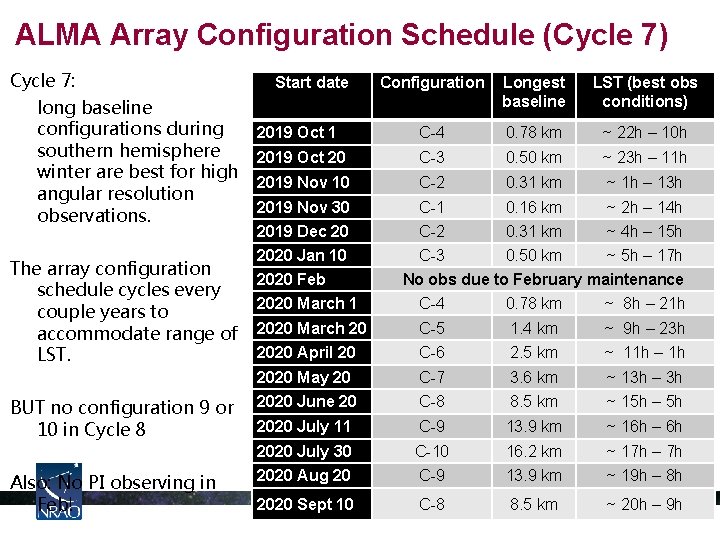
ALMA Array Configuration Schedule (Cycle 7) Cycle 7: long baseline configurations during southern hemisphere winter are best for high angular resolution observations. The array configuration schedule cycles every couple years to accommodate range of LST. BUT no configuration 9 or 10 in Cycle 8 Also: No PI observing in Feb! Start date Configuration Longest baseline LST (best obs conditions) 2019 Oct 1 C-4 0. 78 km ~ 22 h – 10 h 2019 Oct 20 C-3 0. 50 km ~ 23 h – 11 h 2019 Nov 10 C-2 0. 31 km ~ 1 h – 13 h 2019 Nov 30 2019 Dec 20 C-1 C-2 0. 16 km 0. 31 km ~ 2 h – 14 h ~ 4 h – 15 h 2020 Jan 10 C-3 0. 50 km ~ 5 h – 17 h 2020 Feb 2020 March 1 No obs due to February maintenance C-4 0. 78 km ~ 8 h – 21 h 2020 March 20 C-5 1. 4 km ~ 9 h – 23 h 2020 April 20 C-6 2. 5 km ~ 11 h – 1 h 2020 May 20 C-7 3. 6 km ~ 13 h – 3 h 2020 June 20 C-8 8. 5 km ~ 15 h – 5 h 2020 July 11 C-9 13. 9 km ~ 16 h – 6 h 2020 July 30 C-10 16. 2 km ~ 17 h – 7 h 2020 Aug 20 C-9 13. 9 km ~ 19 h – 8 h 2020 Sept 10 C-8 8. 5 km ~ 20 h – 9 h
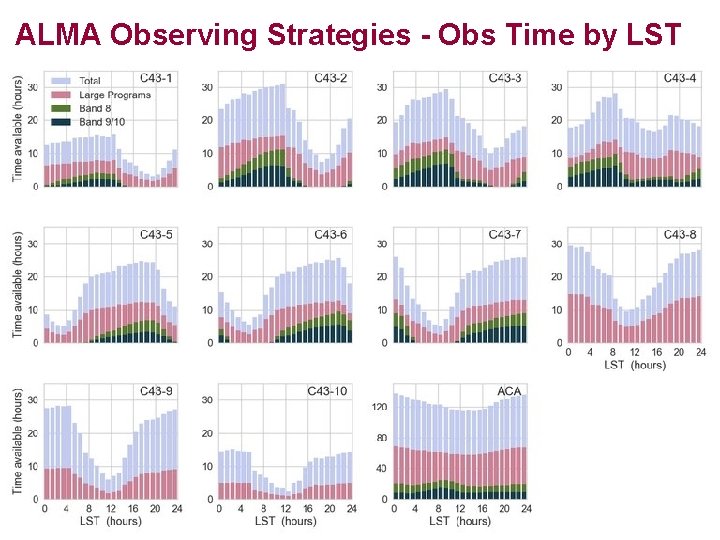
ALMA Observing Strategies - Obs Time by LST
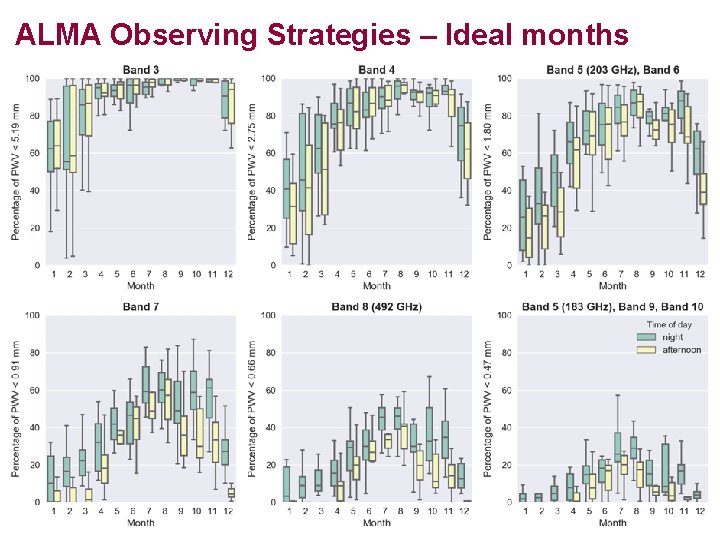
ALMA Observing Strategies – Ideal months
ALMA Capabilities Spectral line, continuum, and mosaic observations • Spectral line and continuum observations with the 12 m Array and the 7 -m Array in all bands • Single field interferometry (all bands) & mosaics (Bands 3 -9) with the 12 -m Array and the 7 -m Array • TP spectral line observations in Bands 3 -8 Observing Time: • 4300 hours for successful proposals of PI programs expected on the 12 m Array (includes DDT, Cycle 6 Carryover and resubmissions) • 3750 hours available on the ACA • 3750 hours available on the Total Power Array • ~750 Hours of ACA time through the Supplemental Call in mid-Cycle 7.
ALMA in Cycle 7 In Cycle 7 ALMA continues “Steady State Operations”* New Observing Modes for Cycle 7: Long baseline (up to 16 km) in B 7 • For the first time, Band 7 available out to 16 km baselines as a standard mode if a suitable calibrator is found within 5 degrees (if not, project observed in a non-standard mode) • NO C-9 or C-10 in Cycle 8 Improved Spectral Scan Mode • Refined, 25% faster & offered as a standard observing mode Band 7 Solar Observations • Band 7 continuum observations will be available for Solar observing (including continuum single-dish mapping of the sun Relaxed restrictions on data rates
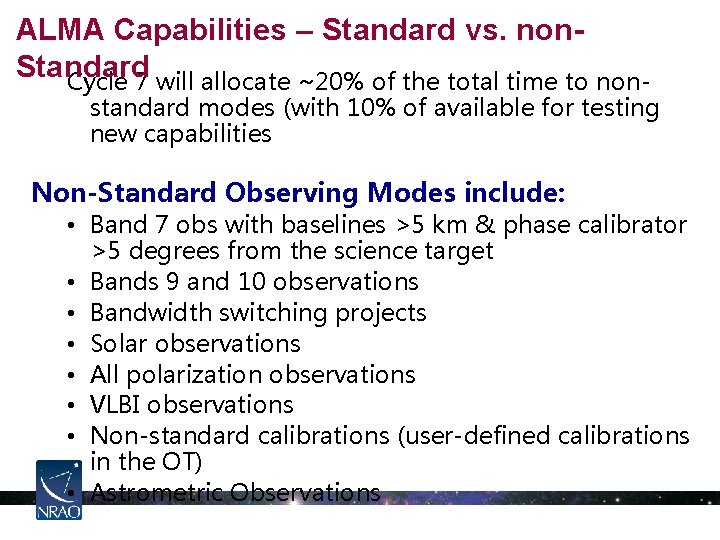
ALMA Capabilities – Standard vs. non. Standard Cycle 7 will allocate ~20% of the total time to non- standard modes (with 10% of available for testing new capabilities Non-Standard Observing Modes include: • Band 7 obs with baselines >5 km & phase calibrator >5 degrees from the science target • Bands 9 and 10 observations • Bandwidth switching projects • Solar observations • All polarization observations • VLBI observations • Non-standard calibrations (user-defined calibrations in the OT) • Astrometric Observations
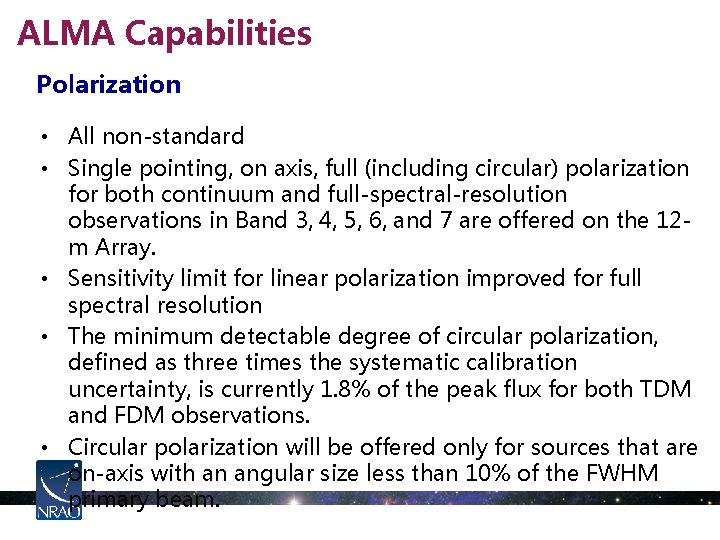
ALMA Capabilities Polarization • All non-standard • Single pointing, on axis, full (including circular) polarization for both continuum and full-spectral-resolution observations in Band 3, 4, 5, 6, and 7 are offered on the 12 m Array. • Sensitivity limit for linear polarization improved for full spectral resolution • The minimum detectable degree of circular polarization, defined as three times the systematic calibration uncertainty, is currently 1. 8% of the peak flux for both TDM and FDM observations. • Circular polarization will be offered only for sources that are on-axis with an angular size less than 10% of the FWHM primary beam.
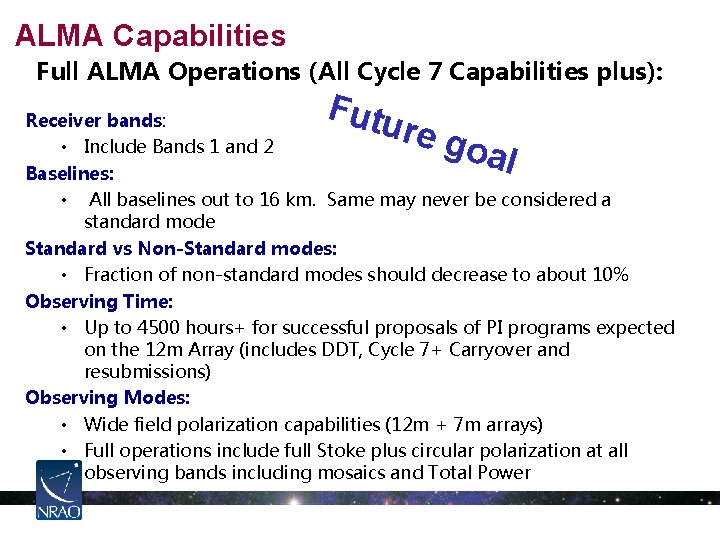
ALMA Capabilities Full ALMA Operations (All Cycle 7 Capabilities plus): Futu Receiver bands: • Include Bands 1 and 2 Baselines: • All baselines out to 16 km. Same may never be considered a standard mode Standard vs Non-Standard modes: • Fraction of non-standard modes should decrease to about 10% Observing Time: • Up to 4500 hours+ for successful proposals of PI programs expected on the 12 m Array (includes DDT, Cycle 7+ Carryover and resubmissions) Observing Modes: • Wide field polarization capabilities (12 m + 7 m arrays) • Full operations include full Stoke plus circular polarization at all observing bands including mosaics and Total Power re g oal
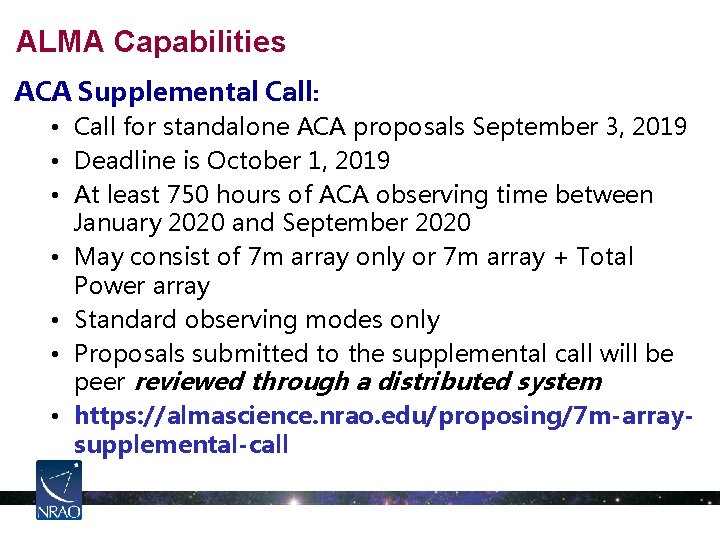
ALMA Capabilities ACA Supplemental Call: • Call for standalone ACA proposals September 3, 2019 • Deadline is October 1, 2019 • At least 750 hours of ACA observing time between January 2020 and September 2020 • May consist of 7 m array only or 7 m array + Total Power array • Standard observing modes only • Proposals submitted to the supplemental call will be peer reviewed through a distributed system • https: //almascience. nrao. edu/proposing/7 m-arraysupplemental-call
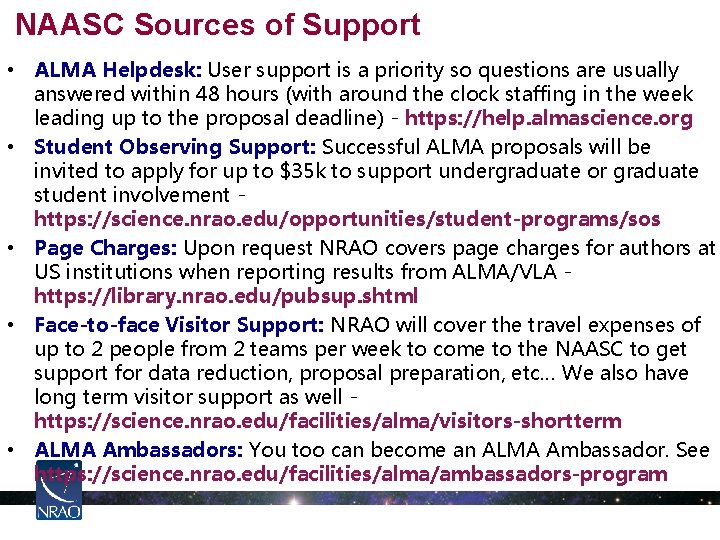
NAASC Sources of Support • ALMA Helpdesk: User support is a priority so questions are usually answered within 48 hours (with around the clock staffing in the week leading up to the proposal deadline) - https: //help. almascience. org • Student Observing Support: Successful ALMA proposals will be invited to apply for up to $35 k to support undergraduate or graduate student involvement https: //science. nrao. edu/opportunities/student-programs/sos • Page Charges: Upon request NRAO covers page charges for authors at US institutions when reporting results from ALMA/VLA https: //library. nrao. edu/pubsup. shtml • Face-to-face Visitor Support: NRAO will cover the travel expenses of up to 2 people from 2 teams per week to come to the NAASC to get support for data reduction, proposal preparation, etc… We also have long term visitor support as well https: //science. nrao. edu/facilities/alma/visitors-shortterm • ALMA Ambassadors: You too can become an ALMA Ambassador. See https: //science. nrao. edu/facilities/alma/ambassadors-program
www. nrao. edu science. nrao. edu The National Radio Astronomy Observatory is a facility of the National Science Foundation operated under cooperative agreement by Associated Universities, Inc.
- Slides: 14