
ALMA 2016 Fast Rub and Buzz Testing Peter
ALMA 2016: Fast Rub and Buzz Testing 快速异音�� Peter Larsen
ABSTRACT概述 An overview over traditional and up-to-date Rub and Buzz testing in the loudspeaker industry. 概括��在�声器行���和�代异音��方 法 Harmonic distortion is widely used for amplifiers, why is that not good for Rub and Buzz testing of speakers? �波失真的方法被广泛地�用于功率放大器的�� ,但�什么 不适合���声器的异音 ? Is human testing always good? What can modern Rub and Buzz methods achieve and how can they be utilized in today’s high speed production of speakers including micro speakers? 人耳听音��是好的方法�?最�代化先�的异音��可以达 到何种程度?�种方法是如何�用在包括微型喇叭在内的�声 器的高效生�之中?
Is human testing at the Assembly Line always good? �装�的人耳听音���是有效的� ? – Trained operators must be more sensitive than the end user (Golden Ears) to be able to find all annoying sounds. – � 了��出令人不快的声音����的听音人�需要比 最�消�者更�敏感 。 – Loudspeaker SPL to be as actual application (Distance, load etc. ) as it is important to test using the maximum level at the correct SPL. – �声器 的SPL�需要和��使用的状况如距离��相符, 使用最大的音量和正确声��非常重 要
Is human testing at the Assembly Line always good? �装�的人耳听音���是有效的� ? – Listener fatigue of the human testers must be avoided. Take regular breaks and make sure the max SPL is limited within the law. – 需要必�避免听音�的听�疲�,�常性的休息和依据 �范限制最大声��在合理的范�内 – Legislation: Max 90 d. BA (8 hours) Europe/USA/ -. 最大 90 d. BA��。 This can be difficult, in practice the human testers may only work for short periods with breaks between. 欧洲和美国立法�定:最大 90 d. BA(8小� )声 ��,但在����中��起来非常困�,意味着听音 �只能在�歇之�持�很短的 作��。
Is human testing at the Assembly Line always good? �装�的人耳听音���是有效的�? – Testing time: One short sweep or repeated sweeps? Ideally the human testing should be the same every time. – �� ��: 采用一次�是多次�� ?理想的��每一次��都 �� 得到相同的�果 。 – When the tester is unsure she repeats the sweep several times. This makes the human testing non- ideal. – 当���无法确��果�,可能会重复多次��,�也是人耳 听音��不理想的原因 。 Conclusion�� Human testing is slow, expensive, and not reliable! 人耳的听音��速度�慢,成本高且不可靠。
Harmonic distortion is widely used for amplifiers, why is that not good for Rub and Buzz testing of speakers? �波失真被广泛用于功放的��中,�什么它不用于�声 器的异音��? – Harmonic distortion is defined as additional harmonics added to the (sine) wave signal. Moir [1] [2] have found very little correlation between THD / Harmonic Distortion and listener annoyance. For example adding even-order harmonics to music can sound more pleasing (like tube amplifiers). – � 波失真是用在原始正弦信号之外�生�外的�波来定�的。 一些研究表明,THD�波失真和令人不快的异音之�只有很低 的关�度。例如在真空管放大器播放的音�中增加偶次�波会 使声音听起来更舒服。
Harmonic distortion is widely used for amplifiers, why is that not good for Rub and Buzz testing of speakers? � 波失真被广泛用于功放的��中,�什么它不用于 �声器的异音��? – Steady state distortion is not representative for music, and instruments. This will appear in chapters 4. ) and 5. ) later. – 音�和�器中多出的��失真并不能代表什么,�一点 我�将会在第 4和第 5章中介�。
High Harmonics Testing. 高次�波失真�� – Ortofon in Denmark [3] found in the 1980’s that Rub & Buzz created high harmonics components, often much higher than 5 th, maybe up to 15 th harmonic or even higher. This was used in their successful P 400 Test system. – 丹麦的奥特峰在 20世� 80年代��异音可以�生高次� 波失真,通常�高� 5次甚至是 15次或更高。�个理�被 成功地用于他�的 P 400��系�。
High Harmonics Testing. 高次�波失真�� • The higher harmonics correlated to indicate much of the audible Rub & Buzz, but not all. This method is therefore not suitable for replacing human testing. • 高次�波失真可以��很多异音,但并不是全部。所以�个方 法不适合替代人耳听音� � – This principle is still used in many test systems, however with enhancements. �个原理至今�有用在�多改良� 的��系�中。
Human Audio perception人�声音的感知 Bosse Lincoln/Stanford University [4]: 斯坦福大 学的博斯. 林肯[4]指出: “The human auditory system has some interesting properties. We have a dynamic frequency range from about 20 to 20000 Hz, and we hear sounds with intensity varying over many magnitudes. The hearing system may thus seem to be a very wide-range instrument, which is not altogether true. 来自人� 的听�系�有一些很有意思的特性,我�听�的�率范�从 20 Hz 到 20000 Hz,我�听到的声音幅度�化范�也非常大。听�系�看起来是 一个有很大��范�的��,但��并不是 �� 。
Human Audio perception人�的听�感知 Bosse Lincoln/Stanford University [4]来自斯坦福大学的博世林 肯: To obtain those characteristics, the hearing is very adaptive -- what we hear depends on what kind of audio environment we are in. In the presence of a strong white noise, for example, many weaker sounds get masked and thus we cannot hear them at all. Some of these masking characteristics are due to the physical ear, and some are due to the processing in the brain”. 听�系�有�的自适�特征。我�能听到的依�于我�所在的 声音�境。例如在一个白噪声很�的�境中,使我�根本无法 听到被掩蔽的很多微小的声音。一部分掩蔽效�是由于我�的 耳�的物理特性决定的,也有部分是由于大��理的�果。
• Human Audio perception人�声音的感知 Bosse Lincoln/Stanford University [4]: 来自斯坦 福大学的博斯. 林肯[4]指出: “Using masking principles, experiments have been performed by others where correctly shaped noise has been added to audio data without audible effect down to an SNR of 25 d. B. On the other hand, deliberately “wrongly'' shaped noise, i. e. noise with high energy in sensitive areas can be audible up to an SNR of 90 d. B” [4]. � 用掩蔽的原理,���示把某些 “适当”的噪声加到声音的数据中,甚至在 只有25 d. B的信噪比的情况下也听不到�些噪声。相反地,人�加入一些 “� � ”的噪声信号, 例如在人耳敏感区域包含内�高能量的噪声,�些噪声甚至 在超� 90 d. B的信噪比�仍然可以被听到。
Human Audio perception人�的听�感知 • Some authorities have reported that the threshold of audible FM distortion (Frequency Modulation) is very low. Moir [1] [2] has shown that as low as 0. 002% (i. e. -94 d. B below the signal) is detectable when using a modulation frequency of 20 Hz and a pure tone fundamental. 一 • 些�威�道 FM(�率�制)噪声的听���非常低,摩� [1, 2]�明其小于 原始信号 94 d. B, 即 0. 002%的失真,采用 20 Hz基�的�音�制仍然可以被听 到。
Danish Research丹麦的研究 The Human brain has not changed significantly since prehistoric times. When the hunter walked in the forest and heard the sound of a tiny twig breaking at a distance, that could be an early warning of an enemy. 人�的大�到�在并没有�生明�的�化。当�人在森林 中行走在一定的距离听到很小的如�枝断裂的声音,就有可 能是�人的早期警示信号。
Danish Research丹麦的研究 So the human audio system is strongly supported by the brain, which as a self-defense mechanism has learned to focus on extremely faint abrupt sounds. These may be very low level and containing extremely little energy, but could be strong signs of enemy activity. 人�的大�很�烈地支持着我�的听�系�,�种自我保 �机制使我�能聚焦于非常微弱的断裂音,�然可能只有很 低的幅度和能量,但却可能是�人活�的非常�烈的信号。
Danish Research丹麦的研究 The Danish Researcher F. Leonhard [5] has invented a new method to simulate this brain activity by “processing an auditory signal to facilitate identification of abrupt energy changes within the auditory signal, which abrupt energy changes have a rise time of at the most 3 ms”. 丹麦的学者F. LEONHARD�明了一种新的方法来模�大�从音 响信号中��断�能量�化的声音,大��种能量的上升�� 最多� 3 ms。
Danish Research丹麦的研究 A recognized German company [6] seem to be using these principles: “High-order distortion is analyzed in the time domain … to detect even the tiniest impulses from loose particles which may be 80 d. B below the main signal level”. 一 家知名的德国公司[6]也在�用�个理�,在�域上分析高次� 波失真,��到甚至是非常微小的小于主信号 80 d. B的松散粒子。
What are the requirements for QC testing in today’s high speed production of speakers, including micro speakers? 在包括微型�声器的高速�声器生��,在���的需 求是什么? The system must be able to find all audible Rub & Buzz, especially extremely low level Rub & Buzz components, down to -90 (-94) d. B below signal. 系�需要能��所有可能的异音,特�是非常低的,低�信号 94 d. B的异音。
What are the requirements for QC testing in today’s high speed production of speakers, including micro speakers? 在包括微型�声器的高速�声器生��,在���的需 求是什么? The testing must be consistent. Therefore it should be equal to or rather better than human ear testing. (which is not really consistent, see section 1 e) � �必�非常的�定,因此必�要等同于或好于人耳的听音� �(�然人耳听音��也不可能��地的�定,�� 1 E)
What are the requirements for QC testing in today’s high speed production of speakers, including micro speakers? 在包括微型�声器的高速�声器生��,在���的需 求是什么? Fast testing is a must. The best systems can test well in less than 0. 5 -1 second (including SPL with limits, Sensitivity, Polarity and impedance). However too fast testing may not excite all Rub & Buzz. 快速��是必�的,最好的系�可以在 0. 5 -1秒内��包括�公 差的SPL曲�,灵敏度,极性和阻抗。但是�快��也会不足以 激�所有异音的信号。
What are the requirements for QC testing in today’s high speed production of speakers, including micro speakers? ‘在包括微型�声器的高速�声器生��,在���的需求 是什么? The system should show Rub & Buzz at the correct frequency, i. e. at the excitation frequency. Even though the Rub & Buzz components contains both low and very high harmonics, it must be shown at the excitation frequency in order to be correlated with the frequency and impedance responses. 系�需要将异音�示在正确的�率上,例如激励�率。�示的异音 也要包括低次和高次�波�率,需要相关到�响和阻抗曲�。
What are the requirements for QC testing in today’s high speed production of speakers, including micro speakers? 在包括微型�声器的高速�声器生��,在���的需求 是什么? Very high repeatability is necessary for measuring small differences. This is especially true when using the (average band) sensitivity, which is sometimes used to sort units in a batch. This could be for pair-matching or individual (mid-band) sensitivity with <0. 10 d. B tolerance for the best systems. � 了能��到小的差异��系�需要有很高的一致性,尤其是需 要用到某个�段的灵敏度来�行分�,比如是一些高�的系�要 求配�或�独�段灵敏度�差小于 0. 1 d. B的要求。
What are the requirements for QC testing in today’s high speed production of speakers, including micro speakers? 在包括微型�声器的高速�声器生��,在���的需求 是什么? Rub & Buzz limits can be absolute or relative. Setting the limits using units with acceptable Rub & Buzz (Good), and nonacceptable (Bad) Rub & Buzz is preferable as these units don’t have to be perfect, but can have some acceptable distortion (see Fig 2. ). Automatic Learning by Good & Bad units is therefore preferable. 异音的��公差可能是��的或相�的。�定公差需要用到异音合 格和不合格的�体。�些�体不一定要完美,允�有在一定条件下 有可接受的失真。
FINE QC: FINEBuzz - Rub & Buzz [7] FINEQC的异音模 � FINEBuzz has been tested in a full scale high speed production. The most difficult is QC testing of micro speakers on high speed production lines. Therefore more than 1000 micro speakers have first been tested by experienced human testers at For. Grand in China [8], and following tested with FINE QC. The results were very similar within 1 -2%. FINEQC的异音模�已�被大�模地�用于高效率的生����。 最具有挑�性的是微型喇叭的在���。在我�客�富佑��� 的1000只�体中,由有��的���听音���后再由 FINEQC 再�行异音��,�示两者的���果一致,�果差异在 1 -2%之 �。
FINE QC: FINEBuzz - Rub & Buzz [7] FINEQC的异音模� – The complete Rub + Buzz test takes <0. 5 second including SPL + tolerances, Sensitivity, Polarity and Impedance. – Complete test is so fast there is a considerable time saving. • In addition the production engineers automatically gets full statistics with running average for spotting deviating production trends, as an early indication of for example failing glue dispensers. • 完整的包括�公差的 SPL曲�,灵敏度,极性和阻抗的����不超 � 0. 5 S。 • 考�到所有的���目都已包含在内,系�整体的����比人耳� 短了很多。 • ��在�的�品平均��和�品�本中��的差异被自��示出来, 使得生�技� 程�可以提前得到像打胶不良��缺陷的提示。
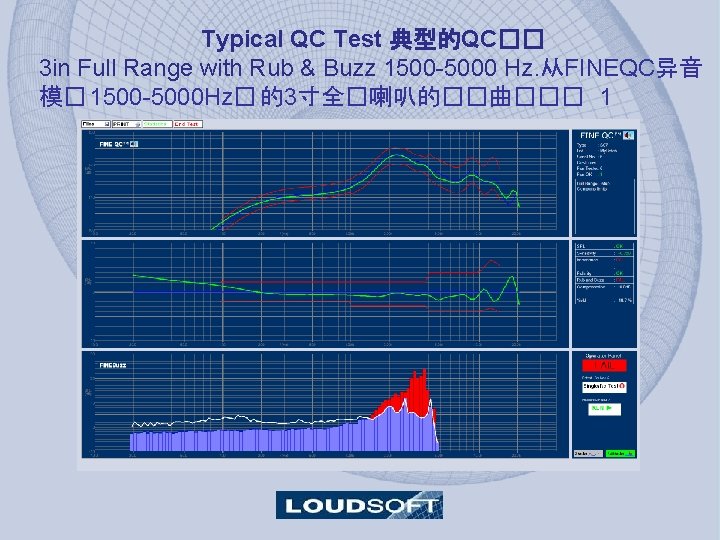
Typical QC Test 典型的QC�� 3 in Full Range with Rub & Buzz 1500 -5000 Hz. 从FINEQC异音 模� 1500 -5000 Hz� 的3寸全�喇叭的��曲��� 1
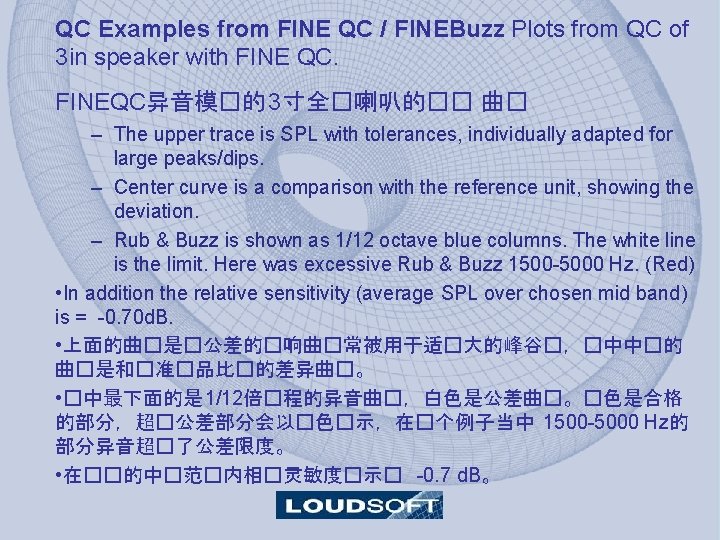
QC Examples from FINE QC / FINEBuzz Plots from QC of 3 in speaker with FINE QC. FINEQC异音模�的 3寸全�喇叭的�� 曲� – The upper trace is SPL with tolerances, individually adapted for large peaks/dips. – Center curve is a comparison with the reference unit, showing the deviation. – Rub & Buzz is shown as 1/12 octave blue columns. The white line is the limit. Here was excessive Rub & Buzz 1500 -5000 Hz. (Red) • In addition the relative sensitivity (average SPL over chosen mid band) is = -0. 70 d. B. • 上面的曲�是�公差的�响曲�常被用于适�大的峰谷�,�中中�的 曲�是和�准�品比�的差异曲�。 • �中最下面的是 1/12倍�程的异音曲�,白色是公差曲�。�色是合格 的部分,超�公差部分会以�色�示,在�个例子当中 1500 -5000 Hz的 部分异音超�了公差限度。 • 在��的中�范�内相�灵敏度�示� -0. 7 d. B。
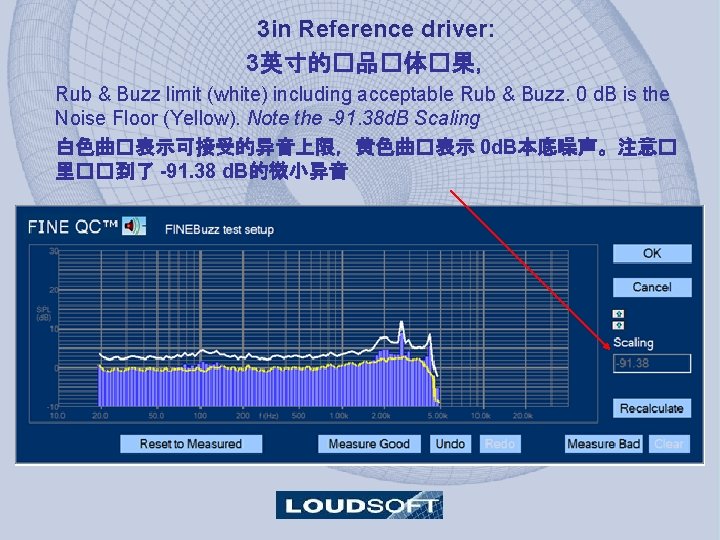
3 in Reference driver: 3英寸的�品�体�果, Rub & Buzz limit (white) including acceptable Rub & Buzz. 0 d. B is the Noise Floor (Yellow). Note the -91. 38 d. B Scaling 白色曲�表示可接受的异音上限,黄色曲�表示 0 d. B本底噪声。注意� 里��到了 -91. 38 d. B的微小异音
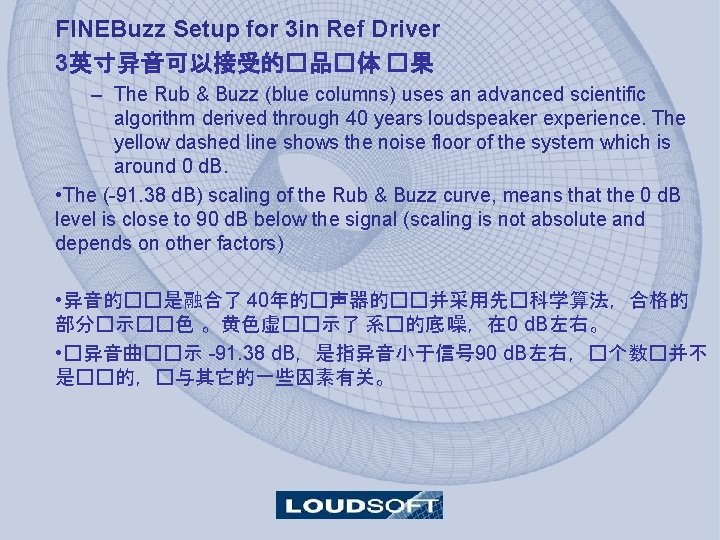
FINEBuzz Setup for 3 in Ref Driver 3英寸异音可以接受的�品�体 �果 – The Rub & Buzz (blue columns) uses an advanced scientific algorithm derived through 40 years loudspeaker experience. The yellow dashed line shows the noise floor of the system which is around 0 d. B. • The (-91. 38 d. B) scaling of the Rub & Buzz curve, means that the 0 d. B level is close to 90 d. B below the signal (scaling is not absolute and depends on other factors) • 异音的��是融合了 40年的�声器的��并采用先�科学算法,合格的 部分�示��色 。黄色虚��示了 系�的底 噪,在 0 d. B左右。 • �异音曲��示 -91. 38 d. B,是指异音小于信号 90 d. B左右,�个数�并不 是��的,�与其它的一些因素有关。
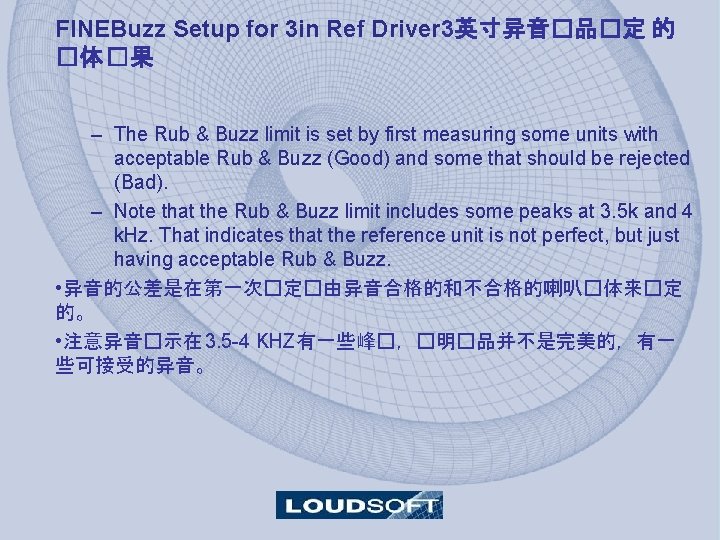
FINEBuzz Setup for 3 in Ref Driver 3英寸异音�品�定 的 �体 �果 – The Rub & Buzz limit is set by first measuring some units with acceptable Rub & Buzz (Good) and some that should be rejected (Bad). – Note that the Rub & Buzz limit includes some peaks at 3. 5 k and 4 k. Hz. That indicates that the reference unit is not perfect, but just having acceptable Rub & Buzz. • 异音的公差是在第一次�定�由异音合格的和不合格的喇叭�体来�定 的。 • 注意异音�示在 3. 5 -4 KHZ有一些峰�,�明�品并不是完美的,有一 些可接受的异音。
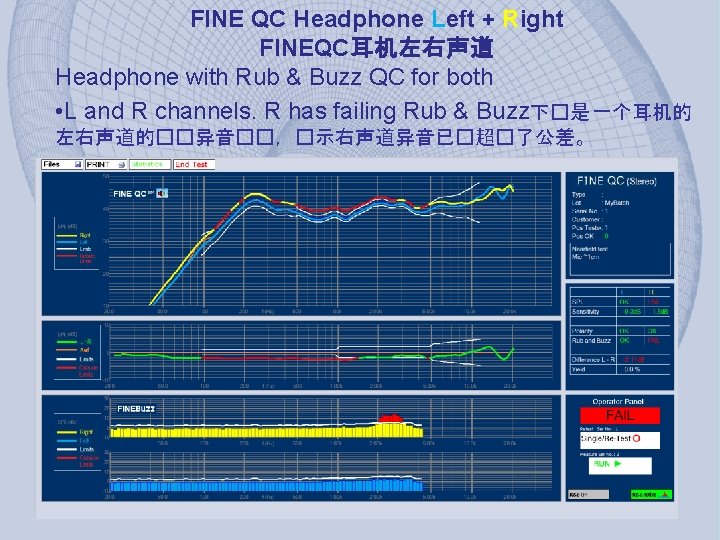
FINE QC Headphone Left + Right FINEQC耳机左右声道 Headphone with Rub & Buzz QC for both • L and R channels. R has failing Rub & Buzz下�是 一个耳机的 左右声道的��异音��,�示右声道异音已�超�了公差。 • (Red)
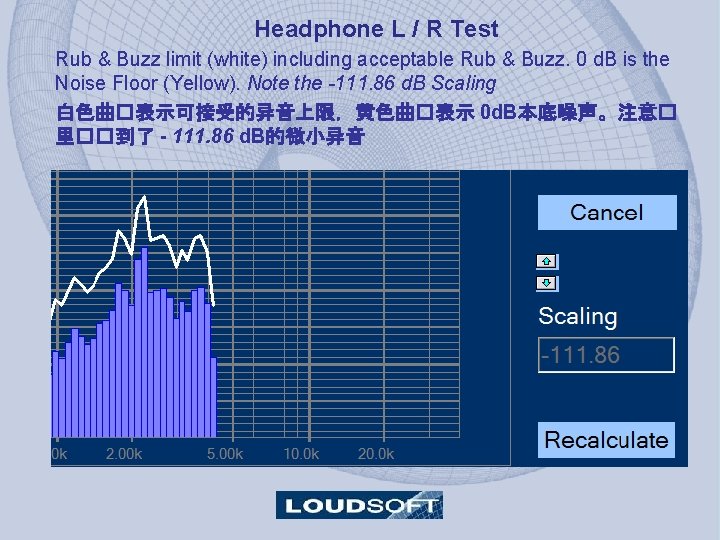
Headphone L / R Test Rub & Buzz limit (white) including acceptable Rub & Buzz. 0 d. B is the Noise Floor (Yellow). Note the -111. 86 d. B Scaling 白色曲�表示可接受的异音上限,黄色曲�表示 0 d. B本底噪声。注意� 里��到了 - 111. 86 d. B的微小异音
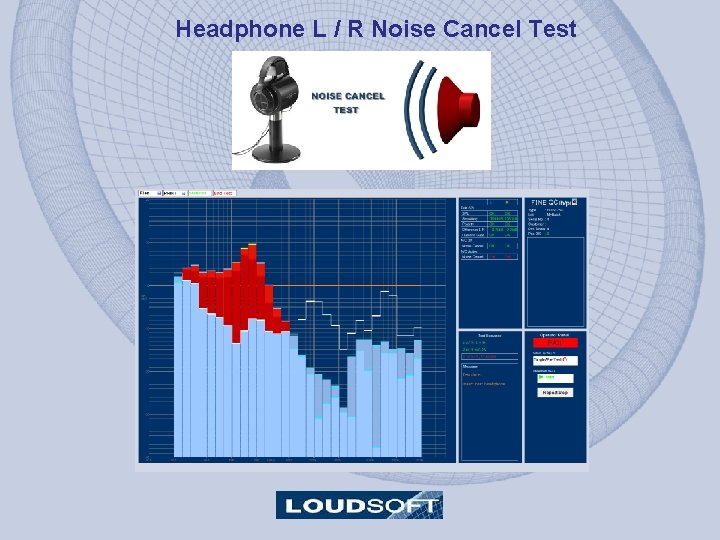
Headphone L / R Noise Cancel Test
Conclusion�� • Human testing is no longer the preferred Rub & Buzz method, especially in high speed micro- speaker and headphone production. • Human testing is becoming a problem due to Max SPL regulations. • Modern Rub & Buzz QC test methods are better and faster in today’s high speed production of speakers and headphones. These are more reliable than human testing. • 人耳听音��异音尤其是�高速的微型�声器�� 不再是好的方法。 • 人耳听音��由于最大音�的限制会不理想。 • 在高效率的�声器尤其是微型�声器的在���,采用�代的异音算法可以 更好地更快地��,比人耳听音��更可靠。
ALMA 2016: The end�束 Thank you for listening 感�聆听. Peter Larsen
- Slides: 35