
ALM Refrigerant Dryers ALM Refrigerant Dryers Contents ALMi


- Slides: 34
ALM Refrigerant Dryers
ALM Refrigerant Dryers Contents ALMi. G refrigeration dryers Why use dry compressed air? What is refrigeration drying? Refrigeration dryer function Overview of ALM refrigeration dryers ALM 25 – 110 ALM 150 – 1100 ALM 1320 – 2150 ALM 2400 – 5300 Advantages of „energy-saving-speed controlled version“ ALM -E Refrigeration dryer design 2
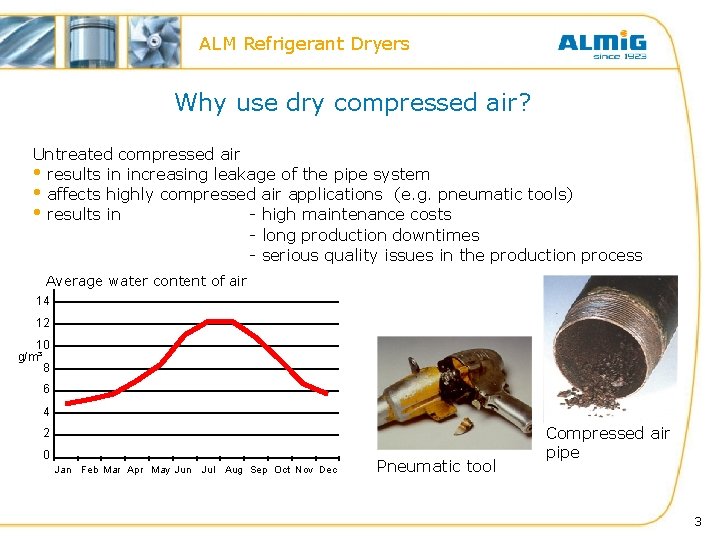
ALM Refrigerant Dryers Why use dry compressed air? Untreated compressed air • results in increasing leakage of the pipe system • affects highly compressed air applications (e. g. pneumatic tools) • results in - high maintenance costs - long production downtimes - serious quality issues in the production process Average water content of air 14 12 10 g/m³ 8 6 4 2 0 Jan Feb Mar Apr May Jun Jul Aug Sep Oct Nov Dec Pneumatic tool Compressed air pipe 3
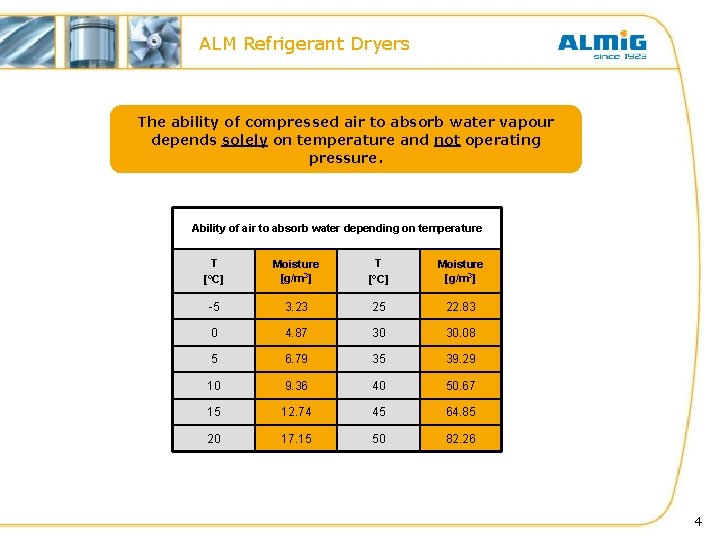
ALM Refrigerant Dryers The ability of compressed air to absorb water vapour depends solely on temperature and not operating pressure. Ability of air to absorb water depending on temperature T [°C] Moisture [g/m 3] -5 3. 23 25 22. 83 0 4. 87 30 30. 08 5 6. 79 35 39. 29 10 9. 36 40 50. 67 15 12. 74 45 64. 85 20 17. 15 50 82. 26 4
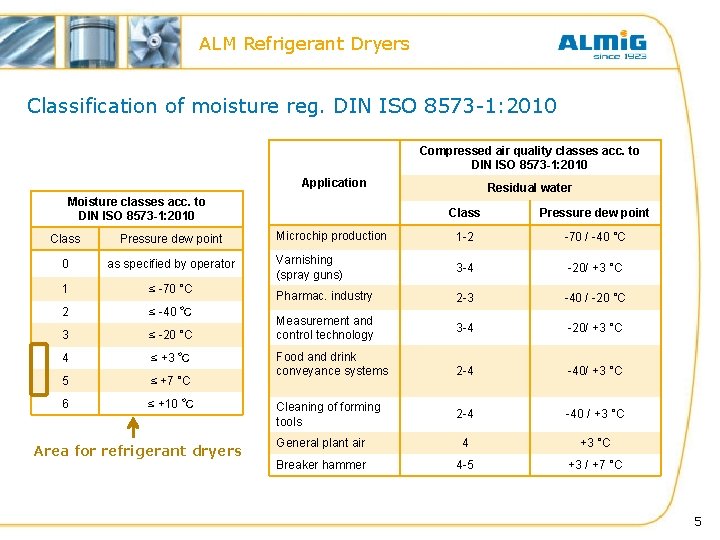
ALM Refrigerant Dryers Classification of moisture reg. DIN ISO 8573 -1: 2010 Compressed air quality classes acc. to DIN ISO 8573 -1: 2010 Application Moisture classes acc. to DIN ISO 8573 -1: 2010 Class Pressure dew point 0 as specified by operator 1 ≤ -70 °C 2 ≤ -40 ℃ 3 ≤ -20 °C 4 ≤ +3 ℃ 5 ≤ +7 °C 6 ≤ +10 ℃ Area for refrigerant dryers Residual water Class Pressure dew point Microchip production 1 -2 -70 / -40 °C Varnishing (spray guns) 3 -4 -20/ +3 °C Pharmac. industry 2 -3 -40 / -20 °C Measurement and control technology 3 -4 -20/ +3 °C 2 -4 -40 / +3 °C General plant air 4 +3 °C Breaker hammer 4 -5 +3 / +7 °C Food and drink conveyance systems Cleaning of forming tools 5
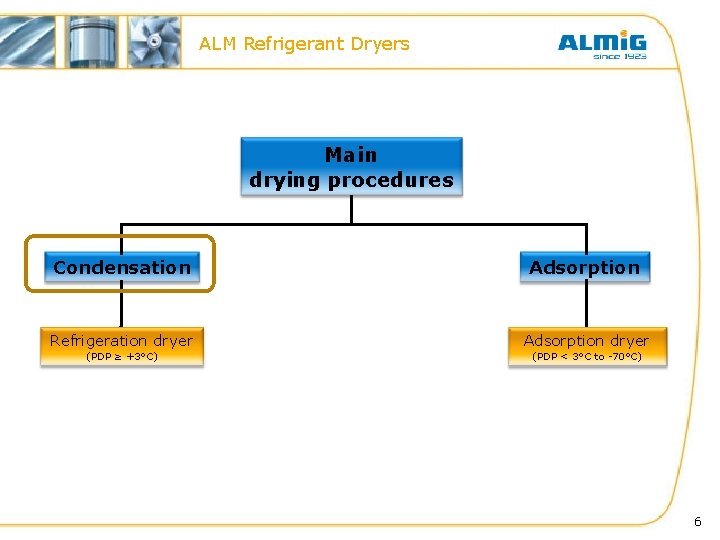
ALM Refrigerant Dryers Main drying procedures Condensation Adsorption Refrigeration dryer Adsorption dryer (PDP ≥ +3°C) (PDP < 3°C to -70°C) 6
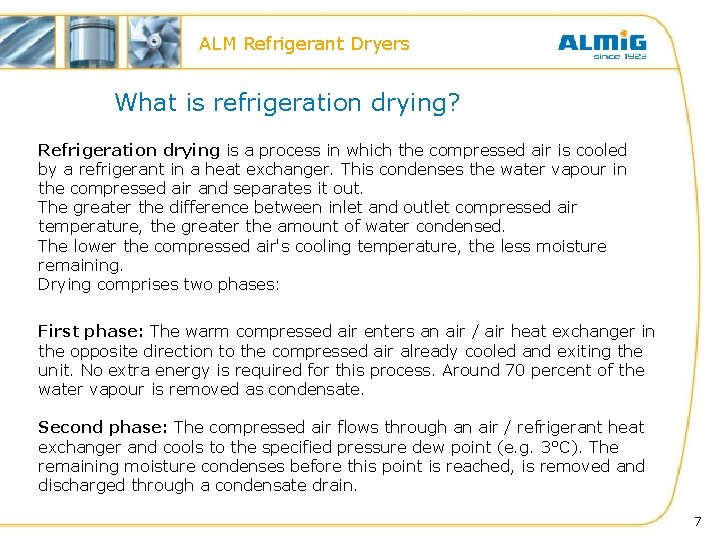
ALM Refrigerant Dryers What is refrigeration drying? Refrigeration drying is a process in which the compressed air is cooled by a refrigerant in a heat exchanger. This condenses the water vapour in the compressed air and separates it out. The greater the difference between inlet and outlet compressed air temperature, the greater the amount of water condensed. The lower the compressed air's cooling temperature, the less moisture remaining. Drying comprises two phases: First phase: The warm compressed air enters an air / air heat exchanger in the opposite direction to the compressed air already cooled and exiting the unit. No extra energy is required for this process. Around 70 percent of the water vapour is removed as condensate. Second phase: The compressed air flows through an air / refrigerant heat exchanger and cools to the specified pressure dew point (e. g. 3°C). The remaining moisture condenses before this point is reached, is removed and discharged through a condensate drain. 7
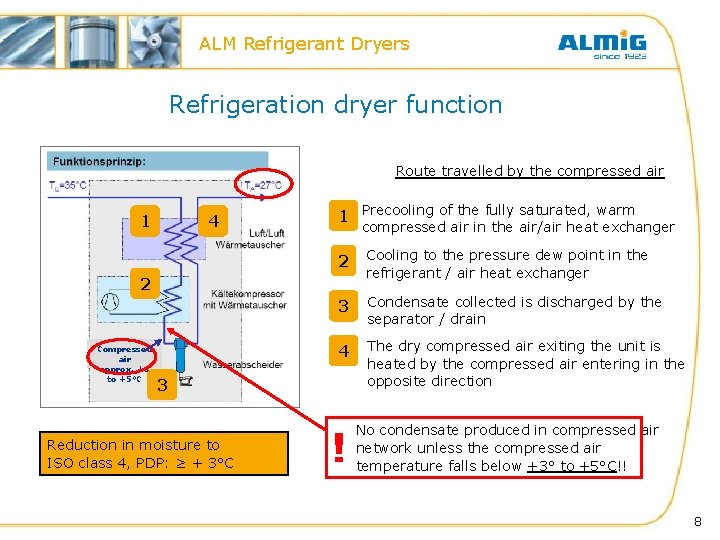
ALM Refrigerant Dryers Refrigeration dryer function Route travelled by the compressed air 1 4 1 Precooling of the fully saturated, warm compressed air in the air/air heat exchanger 2 Cooling to the pressure dew point in the refrigerant / air heat exchanger 3 Condensate collected is discharged by the separator / drain 4 The dry compressed air exiting the unit is heated by the compressed air entering in the opposite direction 2 Compressed air approx. +3 to +5°C 3 Reduction in moisture to ISO class 4, PDP: ≥ + 3°C ! No condensate produced in compressed air network unless the compressed air temperature falls below +3° to +5°C!! 8
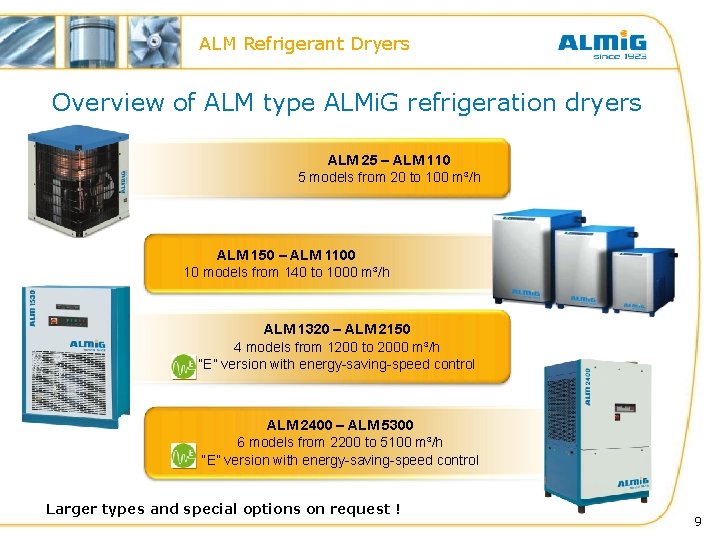
ALM Refrigerant Dryers Overview of ALM type ALMi. G refrigeration dryers ALM 25 – ALM 110 5 models from 20 to 100 m³/h ALM 150 – ALM 1100 10 models from 140 to 1000 m³/h ALM 1320 – ALM 2150 4 models from 1200 to 2000 m³/h “E” version with energy-saving-speed control ALM 2400 – ALM 5300 6 models from 2200 to 5100 m³/h “E” version with energy-saving-speed control Larger types and special options on request ! 9
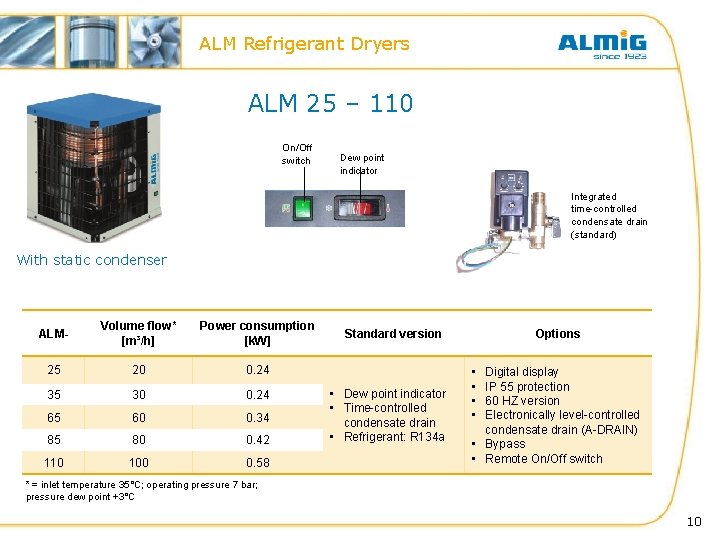
ALM Refrigerant Dryers ALM 25 – 110 On/Off switch Dew point indicator Integrated time-controlled condensate drain (standard) With static condenser ALM- Volume flow* [m³/h] Power consumption [k. W] 25 20 0. 24 35 30 0. 24 65 60 0. 34 85 80 0. 42 110 100 0. 58 Standard version • Dew point indicator • Time-controlled condensate drain • Refrigerant: R 134 a Options • • Digital display IP 55 protection 60 HZ version Electronically level-controlled condensate drain (A-DRAIN) • Bypass • Remote On/Off switch * = inlet temperature 35°C; operating pressure 7 bar; pressure dew point +3°C 10
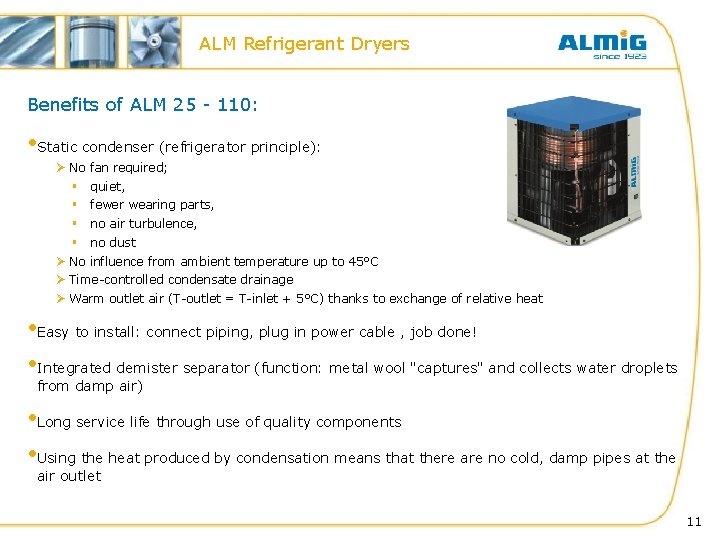
ALM Refrigerant Dryers Benefits of ALM 25 - 110: • Static condenser (refrigerator principle): Ø No fan required; § quiet, § fewer wearing parts, § no air turbulence, § no dust Ø No influence from ambient temperature up to 45°C Ø Time-controlled condensate drainage Ø Warm outlet air (T-outlet = T-inlet + 5°C) thanks to exchange of relative heat • Easy to install: connect piping, plug in power cable , job done! • Integrated demister separator (function: metal wool "captures" and collects water droplets from damp air) • Long service life through use of quality components • Using the heat produced by condensation means that there are no cold, damp pipes at the air outlet 11
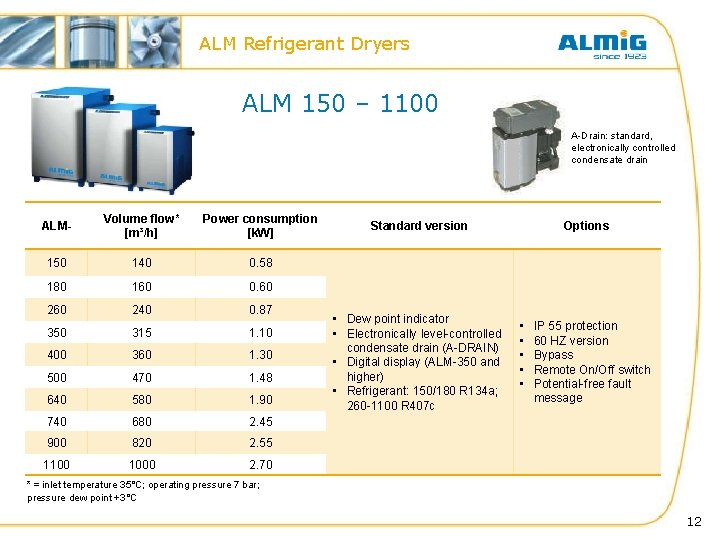
ALM Refrigerant Dryers ALM 150 – 1100 A-Drain: standard, electronically controlled condensate drain ALM- Volume flow* [m³/h] Power consumption [k. W] 150 140 0. 58 180 160 0. 60 240 0. 87 350 315 1. 10 400 360 1. 30 500 470 1. 48 640 580 1. 90 740 680 2. 45 900 820 2. 55 1100 1000 2. 70 Standard version • Dew point indicator • Electronically level-controlled condensate drain (A-DRAIN) • Digital display (ALM-350 and higher) • Refrigerant: 150/180 R 134 a; 260 -1100 R 407 c Options • • • IP 55 protection 60 HZ version Bypass Remote On/Off switch Potential-free fault message * = inlet temperature 35°C; operating pressure 7 bar; pressure dew point +3°C 12
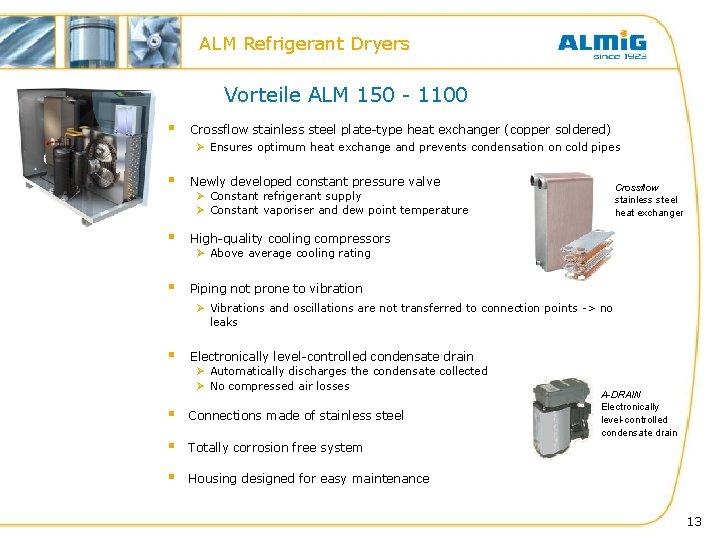
ALM Refrigerant Dryers Vorteile ALM 150 - 1100 § Crossflow stainless steel plate-type heat exchanger (copper soldered) Ø Ensures optimum heat exchange and prevents condensation on cold pipes § Newly developed constant pressure valve Ø Constant refrigerant supply Ø Constant vaporiser and dew point temperature § High-quality cooling compressors Ø Above average cooling rating § Piping not prone to vibration Crossflow stainless steel heat exchanger Ø Vibrations and oscillations are not transferred to connection points -> no leaks § Electronically level-controlled condensate drain Ø Automatically discharges the condensate collected Ø No compressed air losses § Connections made of stainless steel § Totally corrosion free system § Housing designed for easy maintenance A-DRAIN Electronically level-controlled condensate drain 13
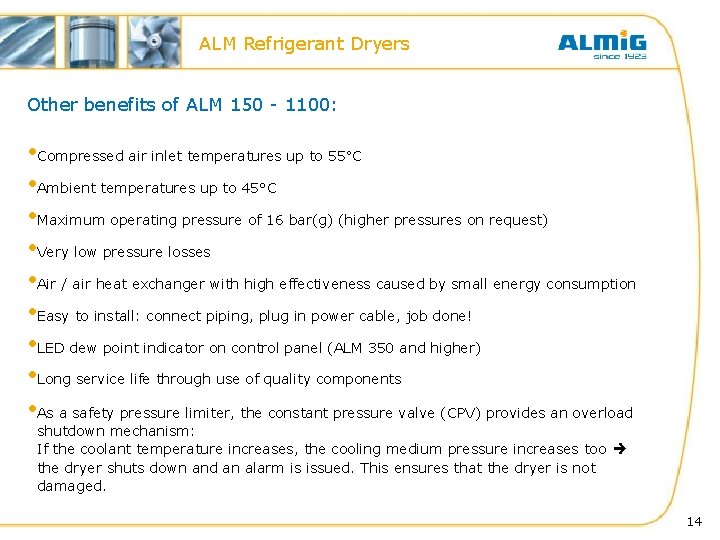
ALM Refrigerant Dryers Other benefits of ALM 150 - 1100: • Compressed air inlet temperatures up to 55°C • Ambient temperatures up to 45°C • Maximum operating pressure of 16 bar(g) (higher pressures on request) • Very low pressure losses • Air / air heat exchanger with high effectiveness caused by small energy consumption • Easy to install: connect piping, plug in power cable, job done! • LED dew point indicator on control panel (ALM 350 and higher) • Long service life through use of quality components • As a safety pressure limiter, the constant pressure valve (CPV) provides an overload shutdown mechanism: If the coolant temperature increases, the cooling medium pressure increases too the dryer shuts down and an alarm is issued. This ensures that the dryer is not damaged. 14
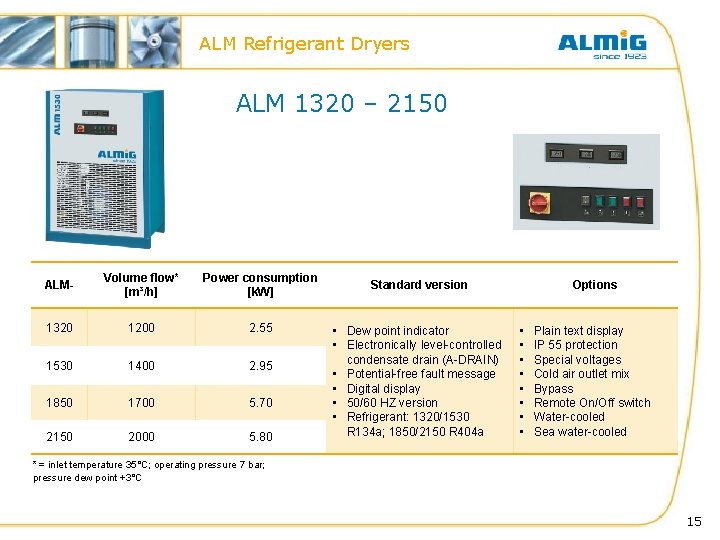
ALM Refrigerant Dryers ALM 1320 – 2150 ALM- Volume flow* [m³/h] Power consumption [k. W] 1320 1200 2. 55 1530 1400 2. 95 1850 1700 5. 70 2150 2000 5. 80 Standard version • Dew point indicator • Electronically level-controlled condensate drain (A-DRAIN) • Potential-free fault message • Digital display • 50/60 HZ version • Refrigerant: 1320/1530 R 134 a; 1850/2150 R 404 a Options • • Plain text display IP 55 protection Special voltages Cold air outlet mix Bypass Remote On/Off switch Water-cooled Sea water-cooled * = inlet temperature 35°C; operating pressure 7 bar; pressure dew point +3°C 15
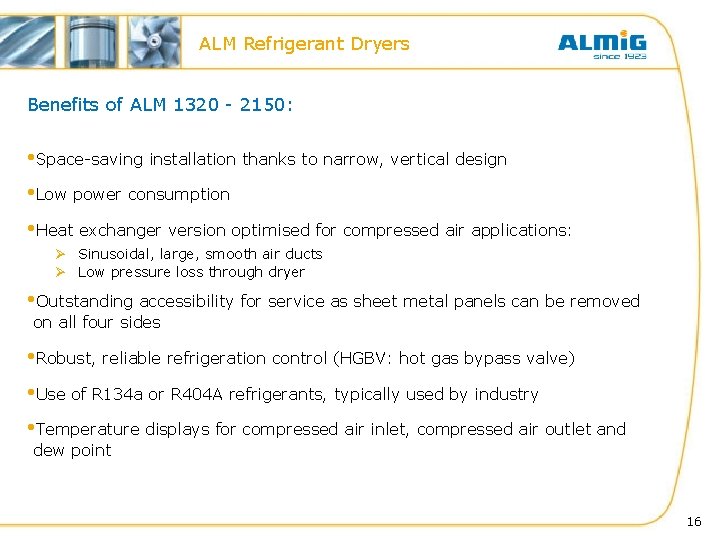
ALM Refrigerant Dryers Benefits of ALM 1320 - 2150: • Space-saving installation thanks to narrow, vertical design • Low power consumption • Heat exchanger version optimised for compressed air applications: Ø Sinusoidal, large, smooth air ducts Ø Low pressure loss through dryer • Outstanding accessibility for service as sheet metal panels can be removed on all four sides • Robust, reliable refrigeration control (HGBV: hot gas bypass valve) • Use of R 134 a or R 404 A refrigerants, typically used by industry • Temperature displays for compressed air inlet, compressed air outlet and dew point 16
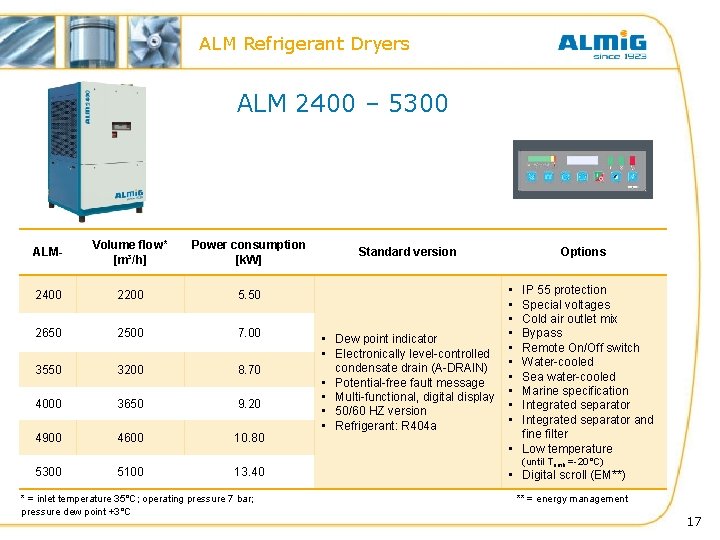
ALM Refrigerant Dryers ALM 2400 – 5300 ALM- Volume flow* [m³/h] Power consumption [k. W] 2400 2200 5. 50 2650 2500 7. 00 3550 3200 8. 70 4000 3650 9. 20 4900 4600 10. 80 5300 5100 13. 40 * = inlet temperature 35°C; operating pressure 7 bar; pressure dew point +3°C Standard version • Dew point indicator • Electronically level-controlled condensate drain (A-DRAIN) • Potential-free fault message • Multi-functional, digital display • 50/60 HZ version • Refrigerant: R 404 a Options • • • IP 55 protection Special voltages Cold air outlet mix Bypass Remote On/Off switch Water-cooled Sea water-cooled Marine specification Integrated separator and fine filter • Low temperature (until Tamb =-20°C) • Digital scroll (EM**) ** = energy management 17
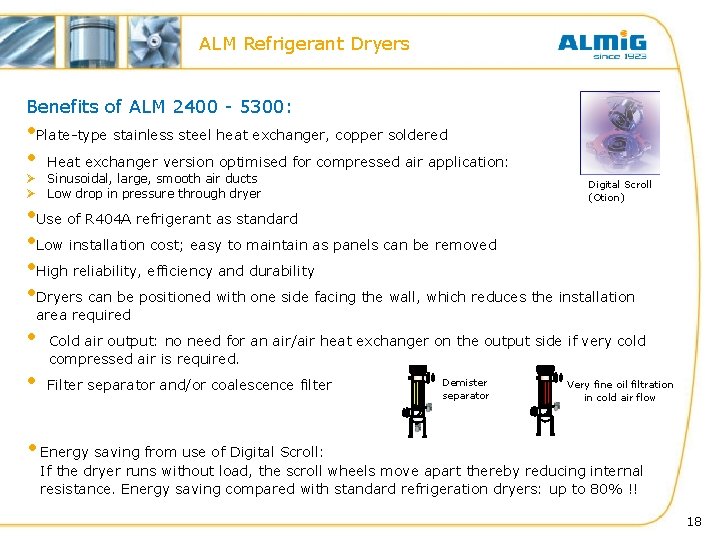
ALM Refrigerant Dryers Benefits of ALM 2400 - 5300: • Plate-type stainless steel heat exchanger, copper soldered • Heat exchanger version optimised for compressed air application: Ø Sinusoidal, large, smooth air ducts Ø Low drop in pressure through dryer Digital Scroll (Otion) • Use of R 404 A refrigerant as standard • Low installation cost; easy to maintain as panels can be removed • High reliability, efficiency and durability • Dryers can be positioned with one side facing the wall, which reduces the installation area required • • Cold air output: no need for an air/air heat exchanger on the output side if very cold compressed air is required. Filter separator and/or coalescence filter Demister separator Very fine oil filtration in cold air flow • Energy saving from use of Digital Scroll: If the dryer runs without load, the scroll wheels move apart thereby reducing internal resistance. Energy saving compared with standard refrigeration dryers: up to 80% !! 18
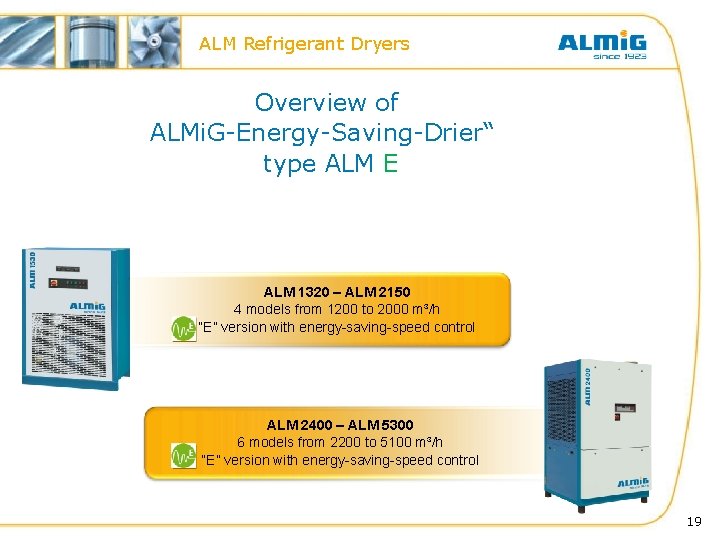
ALM Refrigerant Dryers Overview of ALMi. G-Energy-Saving-Drier“ type ALM E ALM 1320 – ALM 2150 4 models from 1200 to 2000 m³/h “E” version with energy-saving-speed control ALM 2400 – ALM 5300 6 models from 2200 to 5100 m³/h “E” version with energy-saving-speed control 19
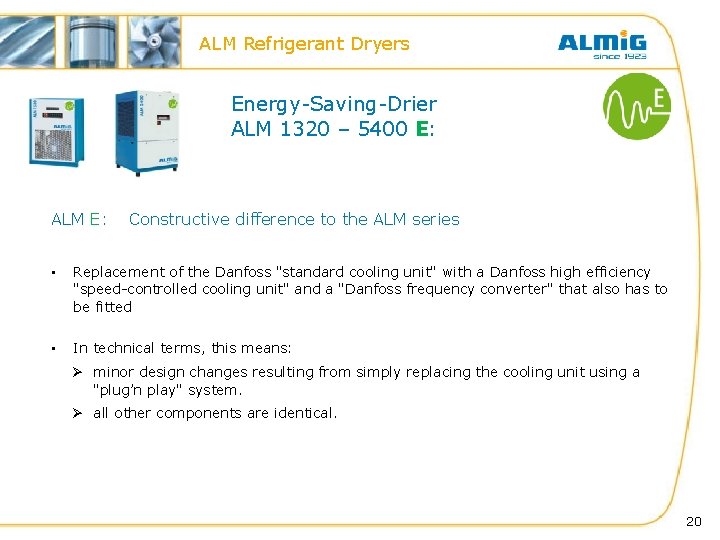
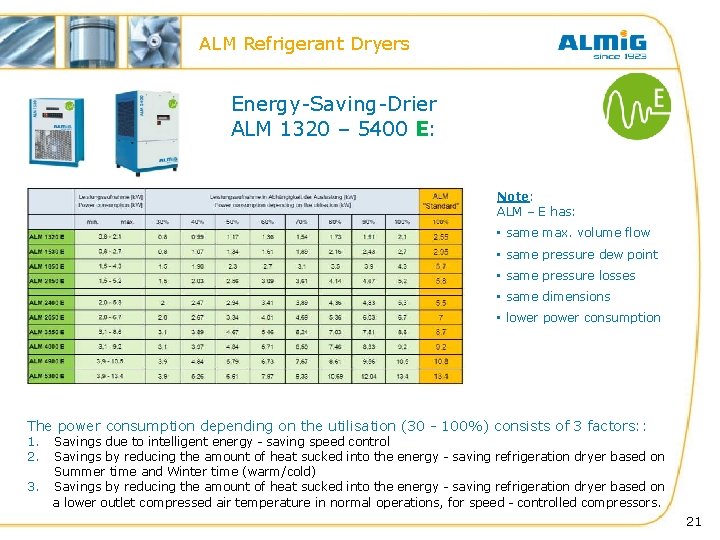
ALM Refrigerant Dryers Energy-Saving-Drier ALM 1320 – 5400 E: ALM E: Constructive difference to the ALM series • Replacement of the Danfoss "standard cooling unit" with a Danfoss high efficiency "speed-controlled cooling unit" and a "Danfoss frequency converter" that also has to be fitted • In technical terms, this means: Ø minor design changes resulting from simply replacing the cooling unit using a "plug’n play" system. Ø all other components are identical. 20
ALM Refrigerant Dryers Energy-Saving-Drier ALM 1320 – 5400 E: Note: ALM – E has: • same max. volume flow • same pressure dew point • same pressure losses • same dimensions • lower power consumption The power consumption depending on the utilisation (30 - 100%) consists of 3 factors: : 1. 2. 3. Savings due to intelligent energy‐saving speed control Savings by reducing the amount of heat sucked into the energy ‐saving refrigeration dryer based on Summer time and Winter time (warm/cold) Savings by reducing the amount of heat sucked into the energy ‐saving refrigeration dryer based on a lower outlet compressed air temperature in normal operations, for speed‐controlled compressors. 21
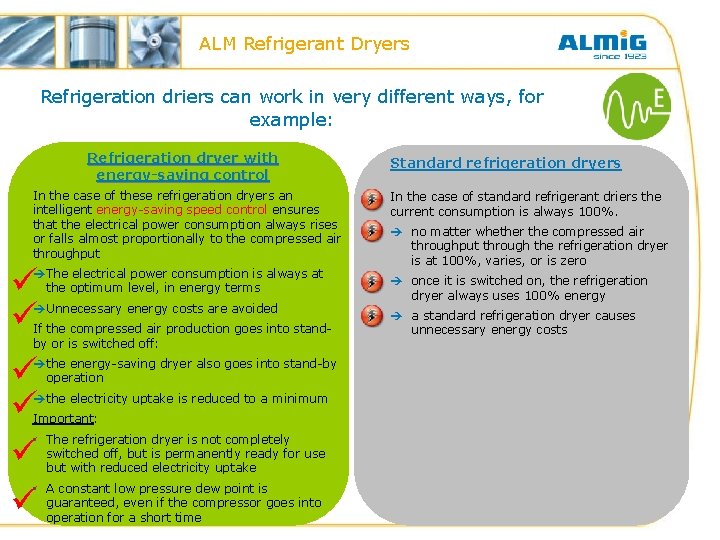
ALM Refrigerant Dryers Refrigeration driers can work in very different ways, for example: Refrigeration dryer with energy-saving control In the case of these refrigeration dryers an intelligent energy-saving speed control ensures that the electrical power consumption always rises or falls almost proportionally to the compressed air throughput ü ü ü The electrical power consumption is always at the optimum level, in energy terms Unnecessary energy costs are avoided If the compressed air production goes into standby or is switched off: the energy-saving dryer also goes into stand-by operation the electricity uptake is reduced to a minimum Important: • The refrigeration dryer is not completely switched off, but is permanently ready for use but with reduced electricity uptake • A constant low pressure dew point is guaranteed, even if the compressor goes into operation for a short time Standard refrigeration dryers In the case of standard refrigerant driers the current consumption is always 100%. no matter whether the compressed air throughput through the refrigeration dryer is at 100%, varies, or is zero once it is switched on, the refrigeration dryer always uses 100% energy a standard refrigeration dryer causes unnecessary energy costs
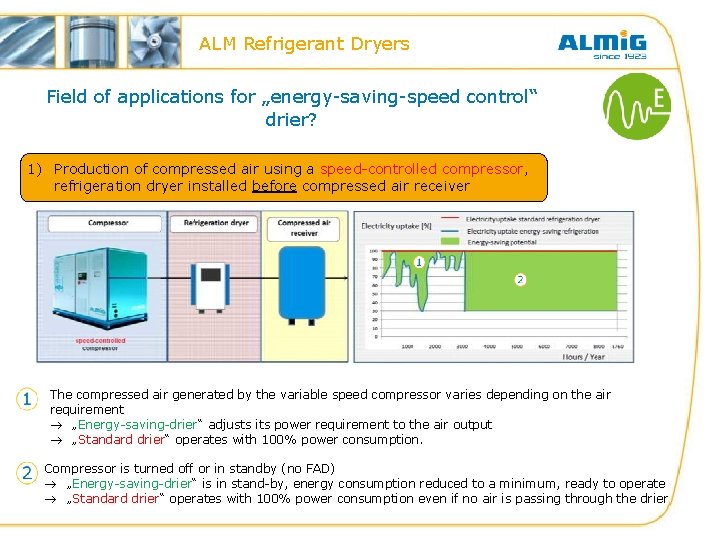
ALM Refrigerant Dryers Field of applications for „energy-saving-speed control“ drier? 1) Production of compressed air using a speed-controlled compressor, refrigeration dryer installed before compressed air receiver The compressed air generated by the variable speed compressor varies depending on the air requirement „Energy-saving-drier“ adjusts its power requirement to the air output „Standard drier“ operates with 100% power consumption. Compressor is turned off or in standby (no FAD) „Energy-saving-drier“ is in stand-by, energy consumption reduced to a minimum, ready to operate „Standard drier“ operates with 100% power consumption even if no air is passing through the drier
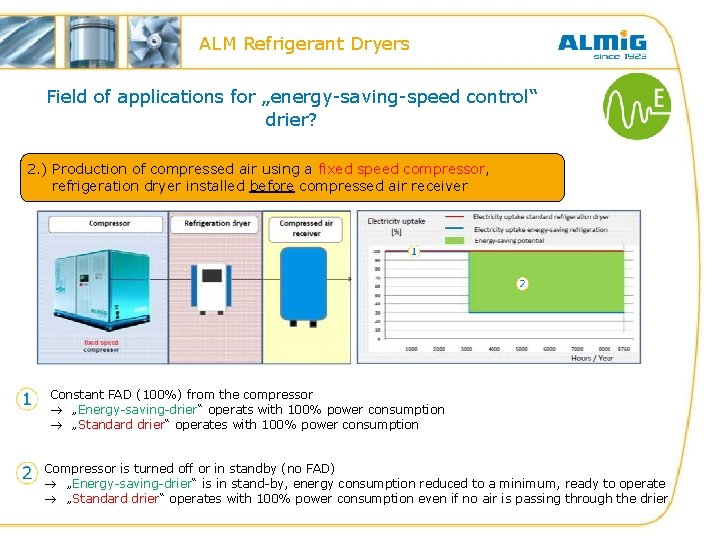
ALM Refrigerant Dryers Field of applications for „energy-saving-speed control“ drier? 2. ) Production of compressed air using a fixed speed compressor, refrigeration dryer installed before compressed air receiver Constant FAD (100%) from the compressor „Energy-saving-drier“ operats with 100% power consumption „Standard drier“ operates with 100% power consumption Compressor is turned off or in standby (no FAD) „Energy-saving-drier“ is in stand-by, energy consumption reduced to a minimum, ready to operate „Standard drier“ operates with 100% power consumption even if no air is passing through the drier
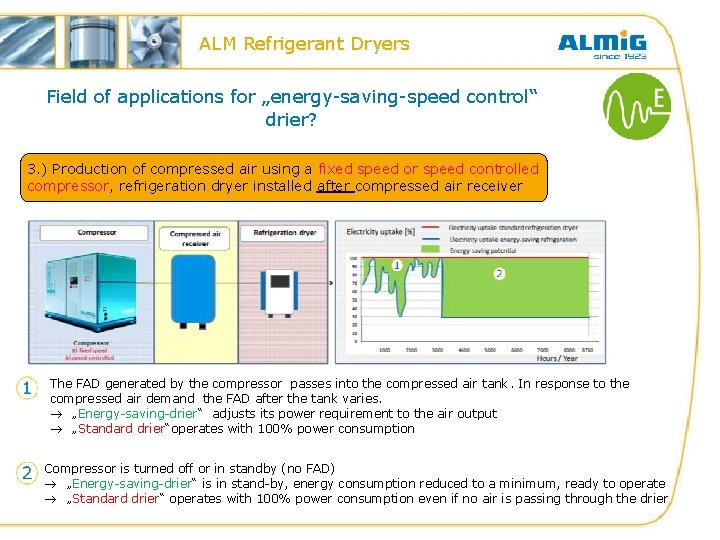
ALM Refrigerant Dryers Field of applications for „energy-saving-speed control“ drier? 3. ) Production of compressed air using a fixed speed or speed controlled compressor, refrigeration dryer installed after compressed air receiver The FAD generated by the compressor passes into the compressed air tank. In response to the compressed air demand the FAD after the tank varies. „Energy-saving-drier“ adjusts its power requirement to the air output „Standard drier“operates with 100% power consumption Compressor is turned off or in standby (no FAD) „Energy-saving-drier“ is in stand-by, energy consumption reduced to a minimum, ready to operate „Standard drier“ operates with 100% power consumption even if no air is passing through the drier
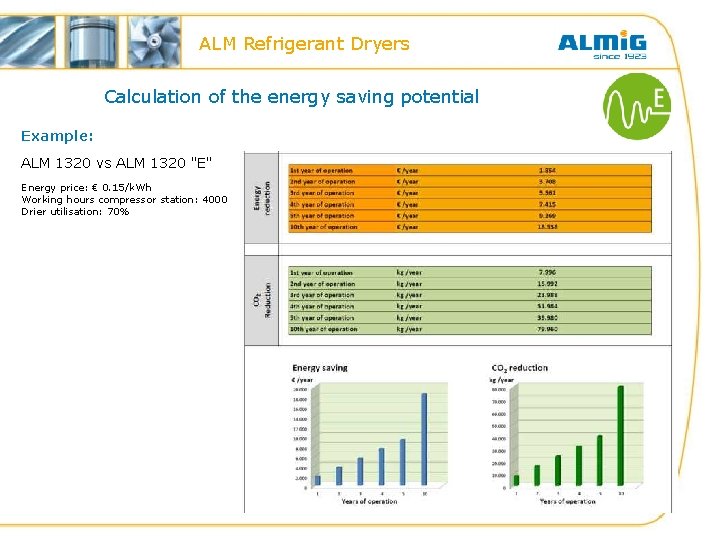
ALM Refrigerant Dryers Calculation of the energy saving potential Example: ALM 1320 vs ALM 1320 "E" Energy price: € 0. 15/k. Wh Working hours compressor station: 4000 Drier utilisation: 70%
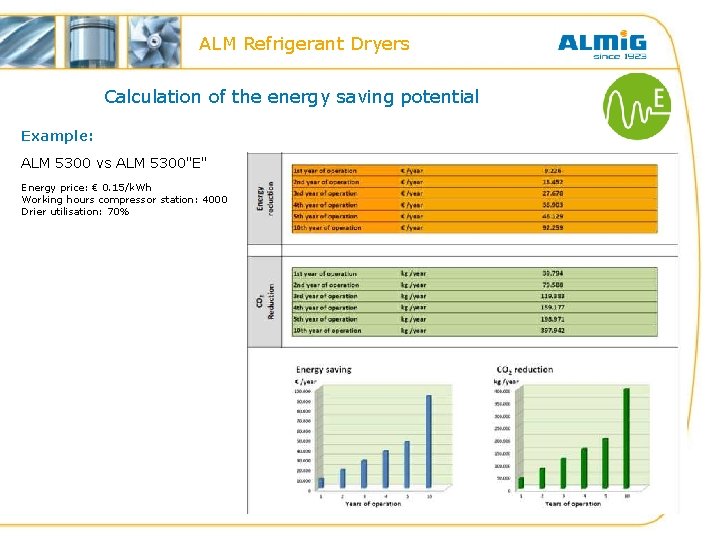
ALM Refrigerant Dryers Calculation of the energy saving potential Example: ALM 5300 vs ALM 5300"E" Energy price: € 0. 15/k. Wh Working hours compressor station: 4000 Drier utilisation: 70%
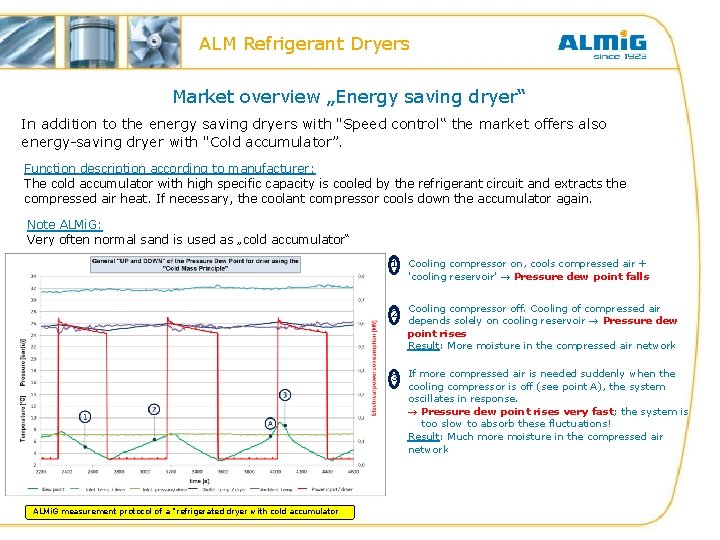
ALM Refrigerant Dryers Market overview „Energy saving dryer“ In addition to the energy saving dryers with "Speed control“ the market offers also energy-saving dryer with "Cold accumulator”. Function description according to manufacturer: The cold accumulator with high specific capacity is cooled by the refrigerant circuit and extracts the compressed air heat. If necessary, the coolant compressor cools down the accumulator again. Note ALMi. G: Very often normal sand is used as „cold accumulator“ 1 2 3 ALMi. G measurement protocol of a "refrigerated dryer with cold accumulator Cooling compressor on, cools compressed air + 'cooling reservoir' Pressure dew point falls Cooling compressor off. Cooling of compressed air depends solely on cooling reservoir Pressure dew point rises Result: More moisture in the compressed air network If more compressed air is needed suddenly when the cooling compressor is off (see point A), the system oscillates in response. Pressure dew point rises very fast; the system is too slow to absorb these fluctuations! Result: Much more moisture in the compressed air network
ALM Refrigerant Dryers Installation upstream or downstream of receiver? or Installation upstream of receiver + Dryer is always subject to constant volume flow by compressor (dryer is not "bypassed"). + No condensate is collected in the compressed air receiver Receiver remains dry. - High compressed air inlet temperature because short cooling section (install larger dryer if required). Installation downstream of receiver - In the event of high consumption, the refrigeration dryer can be "bypassed" – especially if there a only few, but large compressed air consumers. - Condensate collects in the receiver Inner walls must be protected from rust. + Compressed air cooling up to dryer inlet (smaller dryer available if required). 29
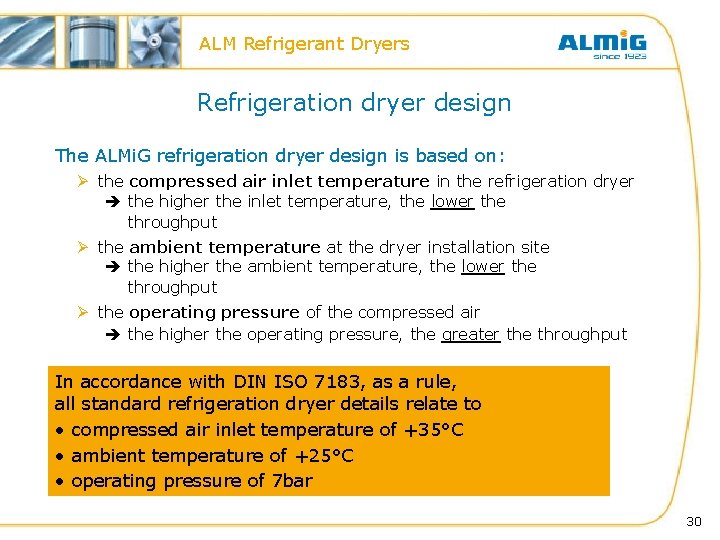
ALM Refrigerant Dryers Refrigeration dryer design The ALMi. G refrigeration dryer design is based on: Ø the compressed air inlet temperature in the refrigeration dryer the higher the inlet temperature, the lower the throughput Ø the ambient temperature at the dryer installation site the higher the ambient temperature, the lower the throughput Ø the operating pressure of the compressed air the higher the operating pressure, the greater the throughput In accordance with DIN ISO 7183, as a rule, all standard refrigeration dryer details relate to • compressed air inlet temperature of +35°C • ambient temperature of +25°C • operating pressure of 7 bar 30
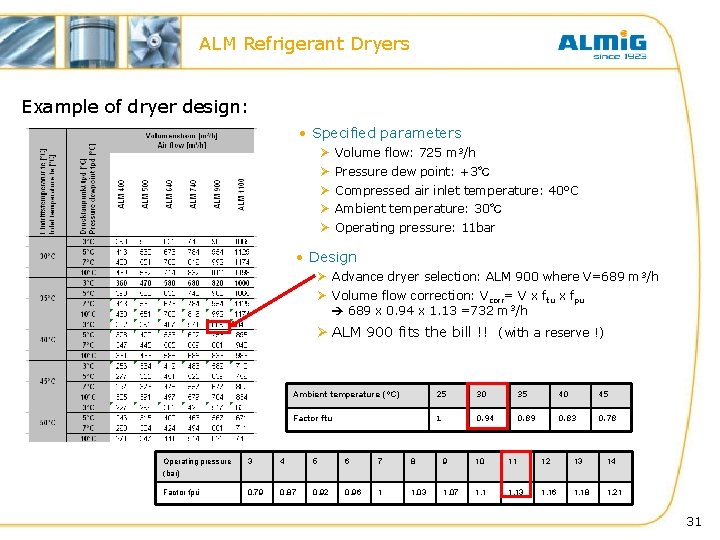
ALM Refrigerant Dryers Example of dryer design: • Specified parameters Ø Ø Ø Volume flow: 725 m 3/h Pressure dew point: +3℃ Compressed air inlet temperature: 40°C Ambient temperature: 30℃ Operating pressure: 11 bar • Design Ø Advance dryer selection: ALM 900 where V=689 m 3/h Ø Volume flow correction: Vcorr= V x ftu x fpu 689 x 0. 94 x 1. 13 =732 m 3/h Ø ALM 900 fits the bill !! (with a reserve !) Ambient temperature (°C) 25 30 35 40 45 Factor ftu 1 0. 94 0. 89 0. 83 0. 78 Operating pressure (bar) 3 4 5 6 7 8 9 10 11 12 13 14 Factor fpü 0. 79 0. 87 0. 92 0. 96 1 1. 03 1. 07 1. 13 1. 16 1. 18 1. 21 31
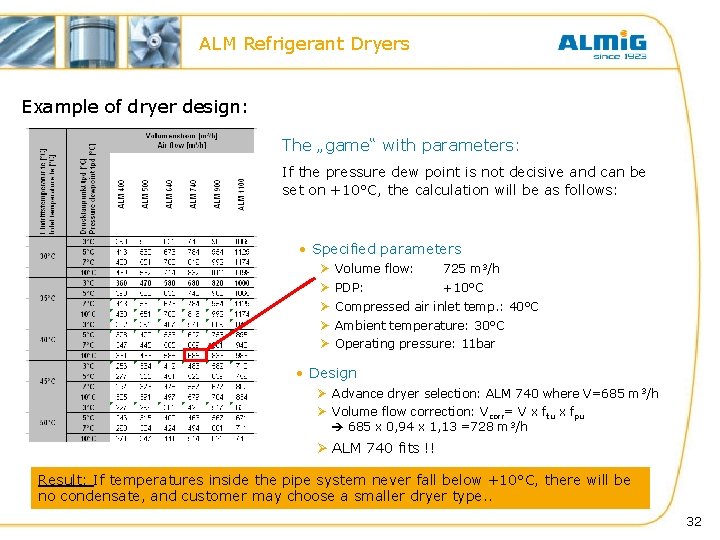
ALM Refrigerant Dryers Example of dryer design: The „game“ with parameters: If the pressure dew point is not decisive and can be set on +10°C, the calculation will be as follows: • Specified parameters Ø Ø Ø Volume flow: 725 m 3/h PDP: +10°C Compressed air inlet temp. : 40°C Ambient temperature: 30°C Operating pressure: 11 bar • Design Ø Advance dryer selection: ALM 740 where V=685 m 3/h Ø Volume flow correction: Vcorr= V x ftu x fpu 685 x 0, 94 x 1, 13 =728 m 3/h Ø ALM 740 fits !! Result: If temperatures inside the pipe system never fall below +10°C, there will be no condensate, and customer may choose a smaller dryer type. . 32
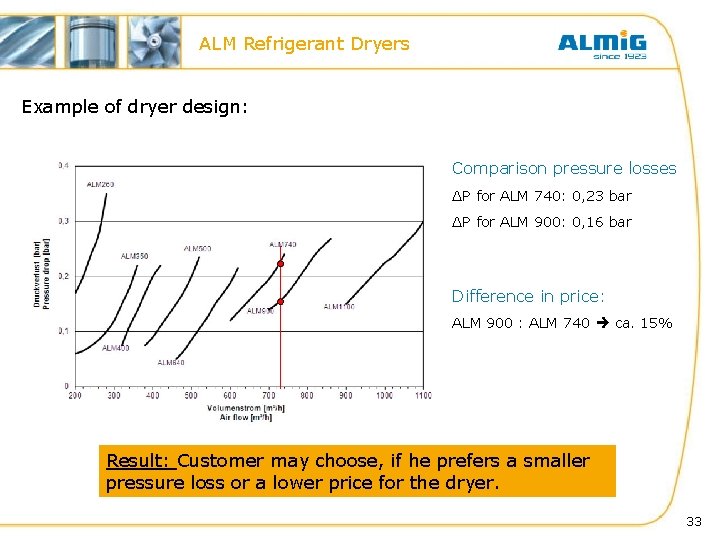
ALM Refrigerant Dryers Example of dryer design: Comparison pressure losses ∆P for ALM 740: 0, 23 bar ∆P for ALM 900: 0, 16 bar Difference in price: ALM 900 : ALM 740 ca. 15% Result: Customer may choose, if he prefers a smaller pressure loss or a lower price for the dryer. 33
ALM Refrigerant Dryers ALMi. G Kompressoren Gmb. H Adolf-Ehmann-Strasse 2 • 73257 Köngen Sales tel. no. : +49 (0)7024 9614 -240 Sales e-mail address: sales@almig. de www. almig. de 34