
Ally Training 101 Presented by GIESORC Getting Started
Ally Training 101 Presented by GIESORC
Getting Started: The Zoom Platform
Getting Started
A Few Thoughts On Virtual Etiquette • • Cameras on Keep Microphone on Mute when not engaging in discussion Use earphones when possible/close door, etc. Indicate the need to step away
Land Acknowledgement Washington State University, Pullman is located on the ancestral homelands of the Palus people and on the ceded lands of the Niimíipuu (Nez Perce) Tribe.
Instructor Introductions Matthew Jeffries, Ph. D (he/him/his) Marco Cerqueira (he, him, his) Melissa Maldonado (she/hers)
"Speaking Up" Guidelines • • • § Following the "ROPESS" Respect others Open-mind/Opps/Ouch Participation/Pass § It's okay to pass on answering a question to gather your thoughts § Empathy/Education § Be empathetic. Be educational. § Said here, stays here
Strategies for “Speaking Up” • Acknowledge; Correct; Move Forward • I’m really nervous/scared/uncomfortable saying this and/but… • From my experience/perspective as [identity]… • I’m afraid I may offend someone, and please let me know if I do, but… • I’m not sure if this will make any sense, and/but… • I just felt something shift in the space. I’m wondering if anyone else did too. • It seems as though some people may have had a reaction to that. Can you help me understand why? • Can you help me understand whether what I’m thinking right now is problematic? • I’m having a “yeah but. ” Can you help me work through it? Adopted from Özlem Sensoy, Robin Di. Angelo, & Equity Series Collective
What is an ally? Unpacking what the LGBTQ+ Umbrella is An Overview Definitions & Concepts Coming Out Overview on Pronouns Campus Policies & Procedures Case studies
Why Does the LGBTQ+ Community Need Allies? • Allies can help cultivate change • Raise awareness to LGBTQ+ issues • Allies can influence those around them
What roles do allies serve? • “Allies are some of the most effective and powerful voices of the LGBT movement. [They] help people in the coming-out process…help others understand the importance of equality, fairness, acceptance and mutual respect” GLAAD • Educate others whose knowledge of the LGBTQ+ community might not be as up-to-date or accurate • Support members of the LGBTQ+ community • Addressing acts of discrimination
1. Understanding why the LGBTQ+ community needs allies Steps to Being an Ally 2. Supporting & listening to those around you 3. Continuously educating yourself on current LGBTQ+ events and up-to-date language 4. Advocating for the LGBTQ+ community that is the most educational for your given environment https: //www. glsen. org/sites/default/files/Safe%20 Spac e%20 Kit. pdf
Who Belongs to the LGBTQ+ Community • Simply put, anyone that does not identify as heterosexual and cisgender belongs in the LGBTQ+ or Queer community • List of LGBTQ+ Identities • • Gay Transgender Bisexual Intersex Pansexual Asexual Queer Non-binary
Ally Pro Tip #1 People in dominant groups must respectfully listen to how oppressed people define their own needs, work with them to support getting those needs met, and operate in solidarity with their organizations, efforts, and social movements” (Bell, 21; Kivel, 2006)
§ Gay: When someone is attracted to one’s own gender. § Bisexual: Attraction to both one’s own gender and other genders Explanation of Terms: § Queer: Applicable for both gender identity and sexual/romantic orientation as well. It is a term that can be used by anyone who does not identify as heterosexual or cisgender. Sexual § Asexual: Someone who does not experience sexual attraction. Exists on a spectrum. Orientations § Pansexual: When a person is attracted to someone regardless of their gender
Romantic vs. Sexual Orientations The Difference • Romantic orientation: describes who someone is romantically attracted to. • Sexual orientation: describes who someone is sexually attracted to • They are both separate identities ex. ) Tyree identifies as biromantic and asexual. ex. ) Andrea identifies as aromantic and straight.
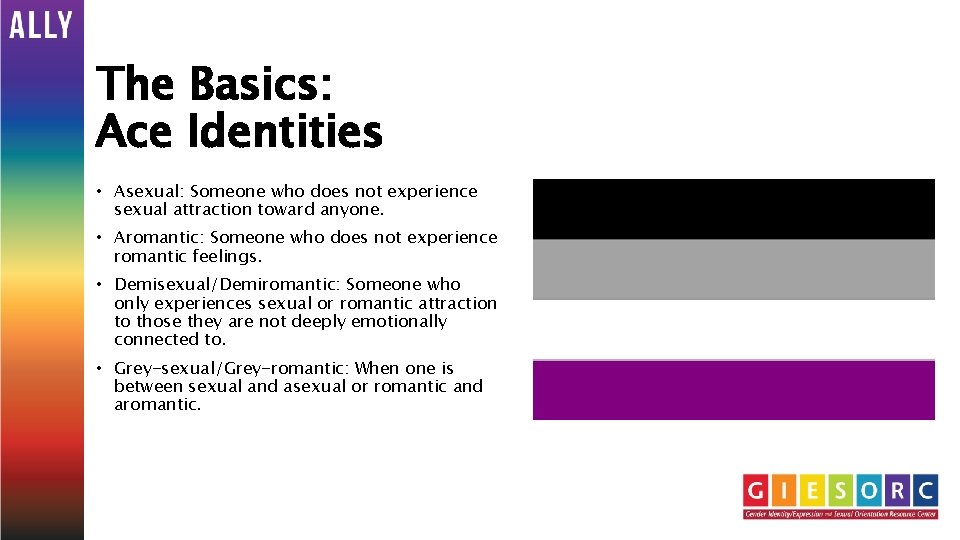
The Basics: Ace Identities • Asexual: Someone who does not experience sexual attraction toward anyone. • Aromantic: Someone who does not experience romantic feelings. • Demisexual/Demiromantic: Someone who only experiences sexual or romantic attraction to those they are not deeply emotionally connected to. • Grey-sexual/Grey-romantic: When one is between sexual and asexual or romantic and aromantic.
Ally Pro-Tip #2: Following LGBTQ+ Media • • Them Color Bloq Into The Advocate
GENDER IDENTITY & EXPRESSION 101
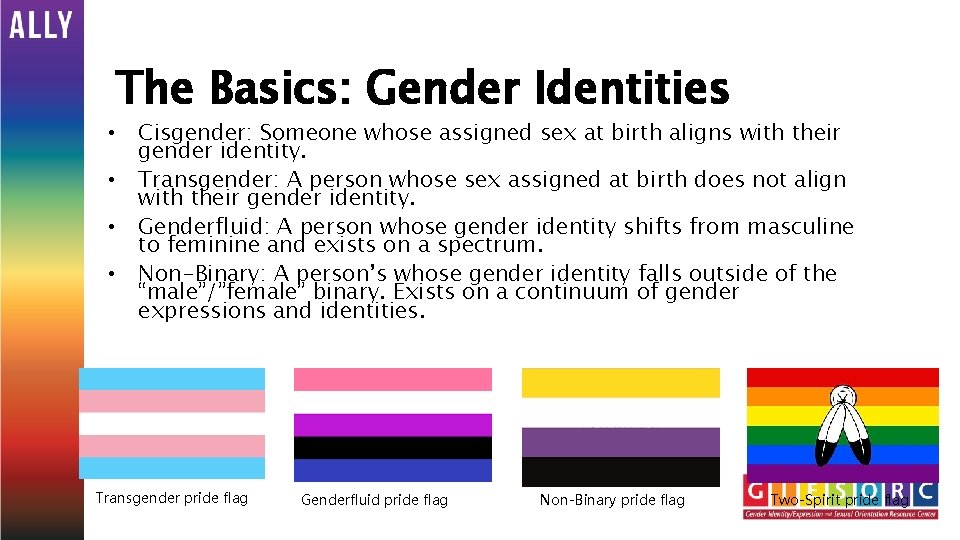
The Basics: Gender Identities • Cisgender: Someone whose assigned sex at birth aligns with their gender identity. • Transgender: A person whose sex assigned at birth does not align with their gender identity. • Genderfluid: A person whose gender identity shifts from masculine to feminine and exists on a spectrum. • Non-Binary: A person’s whose gender identity falls outside of the “male”/”female” binary. Exists on a continuum of gender expressions and identities. Transgender pride flag Genderfluid pride flag Non-Binary pride flag Two-Spirit pride flag
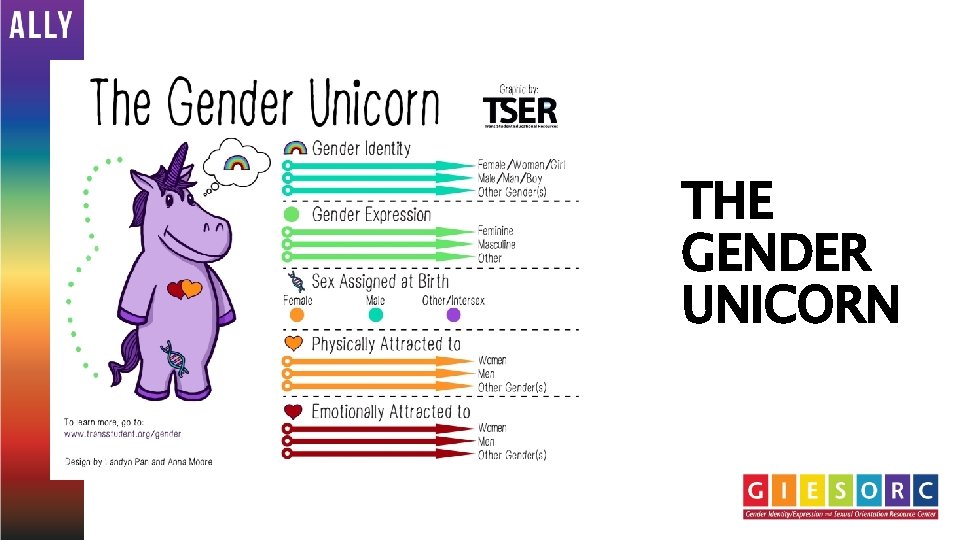
THE GENDER UNICORN
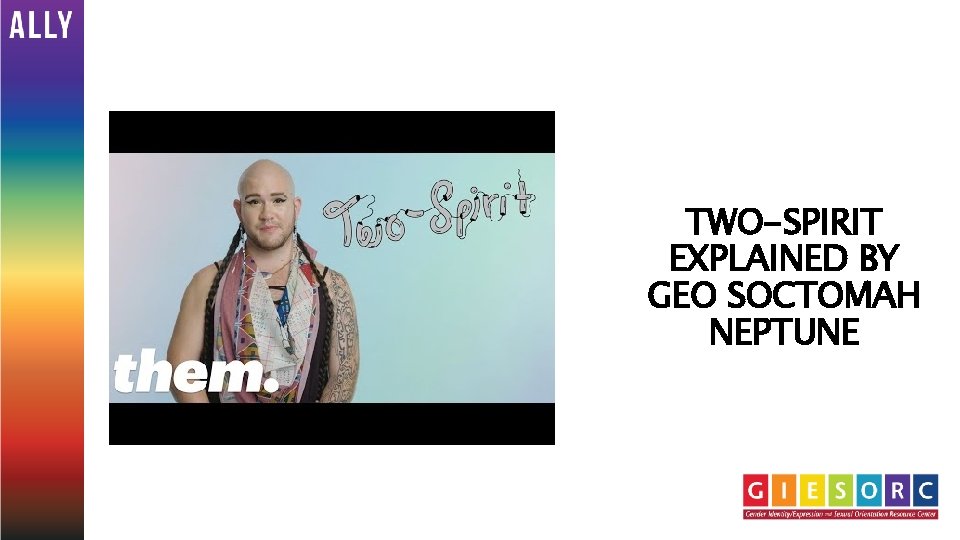
TWO-SPIRIT EXPLAINED BY GEO SOCTOMAH NEPTUNE
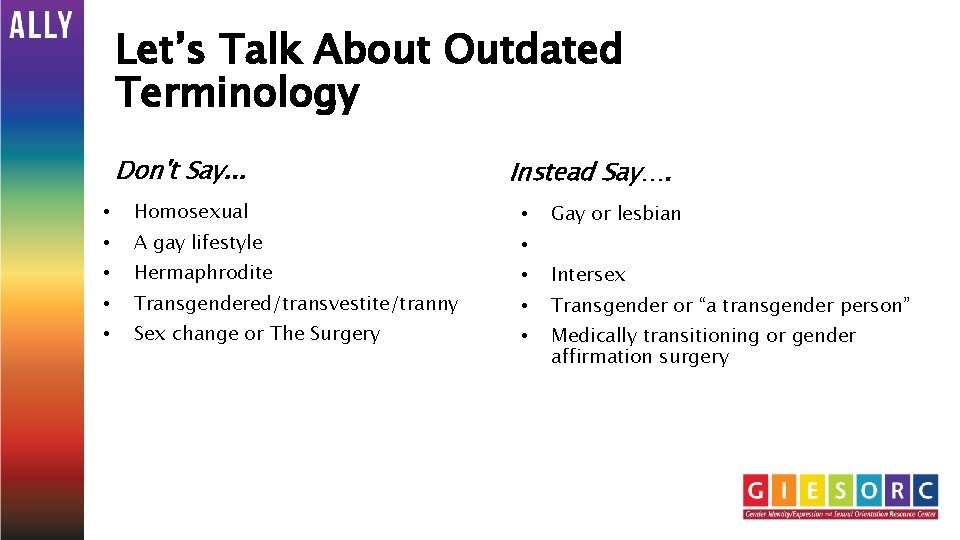
Let’s Talk About Outdated Terminology Don't Say. . . Instead Say…. • Homosexual • • A gay lifestyle • • Hermaphrodite • • Transgendered/transvestite/tranny Intersex • • Sex change or The Surgery Transgender or “a transgender person” • Medically transitioning or gender affirmation surgery Gay or lesbian

SHORT BREAK (5 MINUTES)
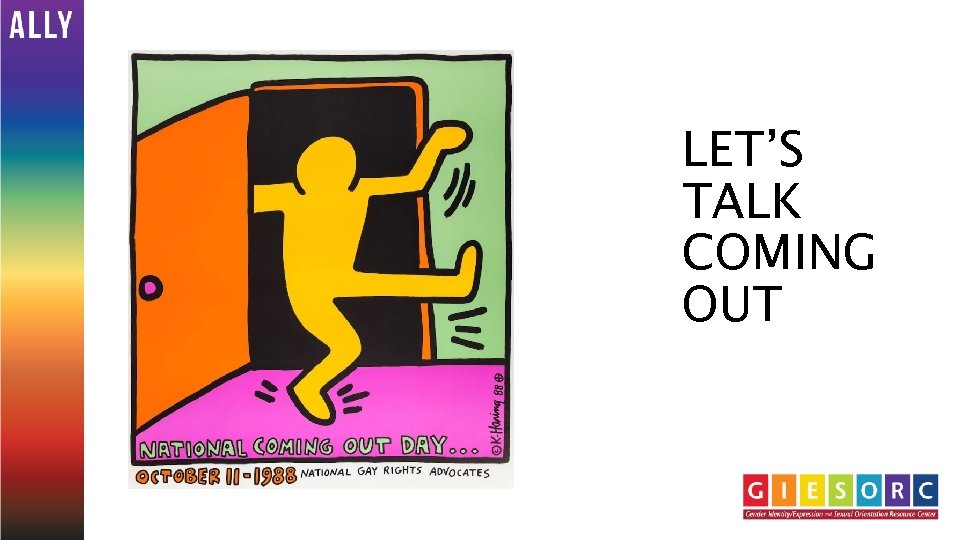
LET’S TALK COMING OUT
Coming Out: The Basics • What does it mean to “come out”? • How many times does one have to come out? • Is it the same for everyone?
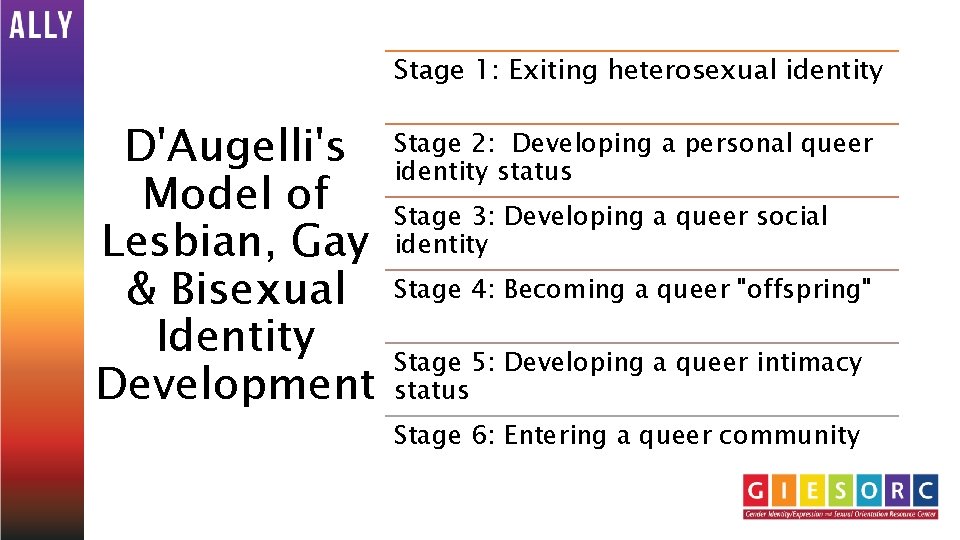
Stage 1: Exiting heterosexual identity D'Augelli's Model of Lesbian, Gay & Bisexual Identity Development Stage 2: Developing a personal queer identity status Stage 3: Developing a queer social identity Stage 4: Becoming a queer "offspring" Stage 5: Developing a queer intimacy status Stage 6: Entering a queer community
Barriers to Coming Out • Are all coming out experiences the same? • What are some things to people consider prior to coming out? - Am I ready to come out? - Cultural background - Is it safe to come out? - Will my family/friends still love me? - Can I keep my religious beliefs and still be true to myself?
Why is Coming Out Different for Everyone? • Well…because everyone has a different journey • Everyone has a different cultural context • Some folks have more at stake to loose than others depending on identity and social circumstances
How to Be an Ally in the Coming Out Process • • • Be attune to the other person’s needs Understand that coming out is a lifelong process Do not judge someone for the way they come out Be supportive Take them seriously Know that identity can change over time • ex. ) Someone may initially come out as a queer man, but then later come out as a queer transwoman.
Pronouns 101 • Names & pronouns are used in reference to others • Ex. ) He went grocery shopping at his favorite grocery store. • Pronouns affirm someone’s genderidentity • Pronouns that are used today • She/hers • He/him/his • They/them/there’s • Xe/xirs
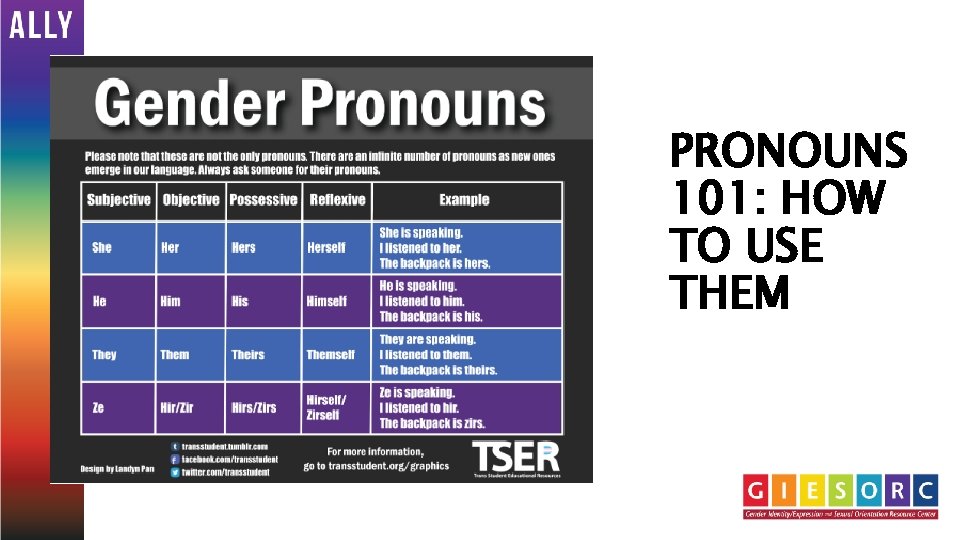
PRONOUNS 101: HOW TO USE THEM
Pronouns 101: How to Ask • Worried about misgendering someone? Ask their pronouns! • ex. ) “Hi my name is Melissa, I use she/hers pronouns. What’s your name and what pronouns do you use? • It’s always better to ask than to assume someone’s pronouns
Ally Training Pro-Tip #3: Showing Up While attending "fun" LGBTQ+ related events like Pride parades and drag shows are both important and fun, it is equally if not more important for allies to the LGBTQ+ community to also attend events that might not be as "fun", but still are important, such as events like Trans Day of Remembrance and World AIDS Day.

LAWS & POLICIES
LGBTQ+ Laws & Policies in the U. S. • In 28 states, a company can legally fire you for being part of the LGBTQ+ community • It can be hard for transgender people to get jobs • Conversion therapy is still legal within 32 states • Washington banned conversation therapy in 2018
Laws & Policies: WSU Specific • • Bathroom policy Housing policy Student rights Using chosen name/pronouns in our system Changing one’s email address Cougar Cards Legal sex change/legal name change Student Financial Services (Financial Aid)
Resources at WSU & on the Palouse • Human Resource Services • Office of Civil Rights Compliance & Investigation (CRCI) • Gender Identity/Expression & Sexual Orientation Resource Center (GIESORC) • Student Organizations: GPAWs, GSA, QIA • President's Commission on Gender Identity/Expression and Sexual Orientation (GIESO) • LGBTQ+ Faculty/Staff Association • Inland Oasis • PFLAG Moscow • Free Mom Hugs- Pullman; Free Mom Hugs- Moscow • Ombuds Office

SHORT BREAK (5 MINUTES)
Move into break out groups Case Studies/ What Would You Do’s Read the prompts on the following slides to yourself Discuss your thoughts on how you'd handle this situation We’ll reconvene to discuss these case studies as a group
What Would You Do #1 A student that you’ve been working with for a few months visits you during your office hours. You know him rather well as he often visits you to talk. He tells you that he’s been stressed out due personal reasons and comes out to you as bisexual. He already out to his family but he is worried that his friends and teammates will not accept him. 1. What is your immediate reaction? 2. What do you tell the student after he comes out to you? 3. What words of encouragement/advice would you give to them? 4. What resources would you give to them? 5. What kind of follow-up is needed for this situation?
What Would You Do #2 One of your students, Cassie, tells you during your office hours that she is being harassed by someone in her group who keeps asking her out. Cassie has denied his advances, informing him that she is gay. The other student refuses to believe this, and once told Cassie “she’s too beautiful to be a lesbian”. She does not want to be in the same group as this student. 1. What is your immediate reaction? 2. What would you say to comfort her? 3. What would you do in order to help this student feel comfortable within her group? 4. What resources would you provide to Cassie? 5. Would you communicate with the male student in Cassie’s group?
Well, What Now? • Practice inclusive practices in the classroom • Keeping up with articles and current events in the LGBTQ+ community • When you see prejudice/homophobia/transphobia in person, do you best to educate others • Learn what you share with others! • Attending queer-supporting events • Trans Day of Remembrance • Pride celebrations • Queer speakers & educators
QUESTIONS? COMMENTS?
Facilitator Contact Information • Matthew Jeffries • Email: matthew. jeffries@wsu. edu • Phone: 509 -335 -8841 • Melissa Maldonado • Email: melissa. a. maldonado@wu. edu • Phone: 509 -335 -9166 • Marco Cerqueira • Email: marco. cerqueira@wsu. edu • Phone: 509 -335 -6388

THANK YOU!
What Would You Do #2 A student comes to your office hours and is visibly nervous. The student is in one of your smaller classes of about 30 students, and they’re very active in class. The student reminds you that they emailed you earlier in the semester before classes started, informing you that they use “they/them” pronouns and you had responded to their email confirming that you understood and would use the correct pronouns. The student admits that you have been misgendering them since the start of the semester and have never used their correct pronouns in class. 1. What is your immediate reaction? 2. How do you go about apologizing to this student? 3. What are some ways you can help repair your relationship with the student? 4. What things can you do to make sure something like this doesn’t happen again in your classes?
- Slides: 47