
Allweather Global Surface Water Extent and River Width
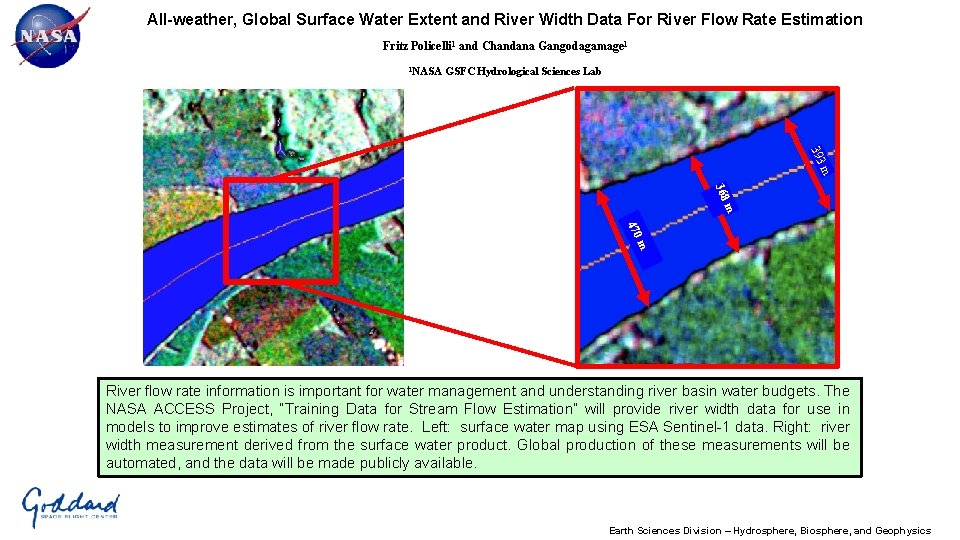
All-weather, Global Surface Water Extent and River Width Data For River Flow Rate Estimation Fritz Policelli 1 and Chandana Gangodagamage 1 1 NASA GSFC Hydrological Sciences Lab 393 m 368 m 470 m 566 m River flow rate information is important for water management and understanding river basin water budgets. The NASA ACCESS Project, “Training Data for Stream Flow Estimation” will provide river width data for use in models to improve estimates of river flow rate. Left: surface water map using ESA Sentinel-1 data. Right: river width measurement derived from the surface water product. Global production of these measurements will be automated, and the data will be made publicly available. Earth Sciences Division – Hydrosphere, Biosphere, and Geophysics
Name: Fritz Policelli, Hydrological Sciences Lab, NASA GSFC E-mail: Frederick. s. policelli@nasa. gov Phone: 301 -614 -6573 References: https: //earthdata. nasa. gov/esds/competitive-programs/access/streamflow-estimation Andre Twele, Wenxi Cao, Simon Plank & Sandro Martinis, (2016) Sentinel-1 -based flood mapping: a fully automated processing chain, International Journal Of Remote Sensing, 2016 Vol. 37, No. 13, 2990– 3004 http: //dx. doi. org/10. 1080/01431161. 2016. 1192304 T. M. Pavelsky, L. C. Smith (2008) Riv. Width: a software tool for the calculation of river widths from remotely sensed imagery IEEE Geosci. Remote Sens. Lett. , 5 p. 70 -73 Gangodagamage, C. , E. Barnes, and E. Foufoula-Georgiou (2007) Scaling in river corridor widths depicts organization in valley morphology, Geomorphology, 91, pp. 198 -215 doi: 10. 1016/j. geomorph. 2007. 04. 014 Data Sources: ESA Sentinel-1 C-band SAR data, slope derived from USGS SRTM Digital Elevation Model and other DEMs, along with derived Height Above Nearest Drainage (HAND) data will be used in this project Technical Description of Figures: Figure 1: Prototype surface water map derived from Sentinel-1 data using the method of Twele et al. , 2016. Figure 2: Prototype river width measurement derived from Sentinel-1 data, using a method derived from Pavelsky et al. , 2008 and Gangodagamage et al. , 2007 Scientific significance, societal relevance, and relationships to future missions: The primary product of this project will be global, near real time and historical all-weather river width measurements corresponding to the river reaches to be measured by the SWOT mission. It is expected that these measurements will be useful to enable decreased temporal gaps in NASA SWOT mission estimates of river flow rate - a critical measurement for closing the water budget and for hydrological applications. A secondary/intermediate product of the project will be global, near real time and historical all-weather surface water extent maps for which we expect to find utility for flood depth measurement, flood mapping, and/or evaluation of other surface water mapping efforts. Earth Sciences Division – Hydrosphere,
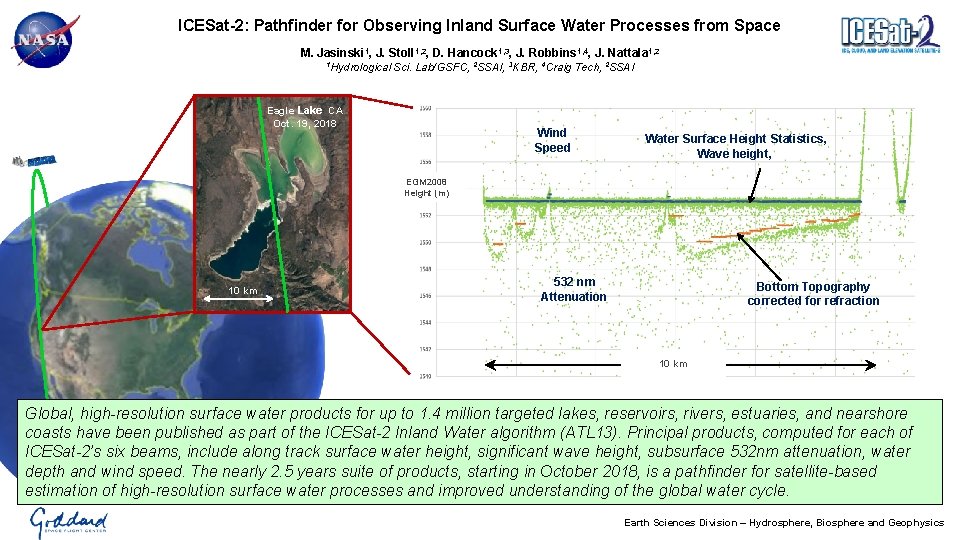
ICESat-2: Pathfinder for Observing Inland Surface Water Processes from Space M. Jasinski 1, J. Stoll 1, 2, D. Hancock 1, 3, J. Robbins 1, 4, J. Nattala 1, 2 1 Hydrological Sci. Lab/GSFC, 2 SSAI, 3 KBR, 4 Craig Tech, 2 SSAI Eagle Lake CA Oct. 19, 2018 Wind Speed Water Surface Height Statistics, Wave height, EGM 2008 Height (m) 10 km 532 nm Attenuation Bottom Topography corrected for refraction 10 km Global, high-resolution surface water products for up to 1. 4 million targeted lakes, reservoirs, rivers, estuaries, and nearshore coasts have been published as part of the ICESat-2 Inland Water algorithm (ATL 13). Principal products, computed for each of ICESat-2’s six beams, include along track surface water height, significant wave height, subsurface 532 nm attenuation, water depth and wind speed. The nearly 2. 5 years suite of products, starting in October 2018, is a pathfinder for satellite-based estimation of high-resolution surface water processes and improved understanding of the global water cycle. Earth Sciences Division – Hydrosphere, Biosphere and Geophysics
Name: Michael Jasinski, Hydrological Sciences Lab/617, NASA GSFC E-mail: Michael. F. Jasinski@nasa. gov Phone: 301 -614 -5782 References: M. Jasinski, J. Stoll, D. Hancock, J. Robbins, J. Nattala, T. Pavelsky, J. Morrison, B. Jones, M. Ondrusek, C. Parrish, and the ICESat-2 Science Team, : (2020) Algorithm Theoretical Basis Document (ATBD) for Inland Water Data Products, ATL 13, Version 3, Release Date March 1, 2020, NASA Goddard Space Flight Center, Greenbelt, MD, 112 pp. https: //doi: 10. 5067/L 870 NVUK 02 YA; and https: //nsidc. org/sites/nsidc. org/files/technical-references/ICESat 2_ATL 13_ATBD_r 003. pdf ( March 2020) Data Sources: M. Jasinski, J. Stoll, D. Hancock, J. Robbins, J. Nattala, T. Pavelsky, B. Jones, M. Ondrusek, C. Parrish, and the ICESat-2 Science Team, (2020) ATLAS/ICESat -2 L 3 A Inland Water Surface Height, Version 3. Boulder, Colorado USA. NASA National Snow and Ice Data Center Distributed Active Archive Center. https: //nsidc. org/data/atl 13/versions/3. (April 2020) Technical Description of Figures: Figure 1 (Left): This figure shows a typical ICESat-2 crossing over California on October 19, 2018. The ATL 13 Inland Water Body Shape Mask, constructed from a variety of high -resolution sources, interfaces with the crossing to define water bodies for which to compute products. The mask includes lakes and reservoirs greater than ~ 0. 1 km 2, rivers > 50100 m, and a 7 km coastal buffer. In this figure, at Eagle Lake in northern California, an ascending ICESat-2 pass along reference ground track 326 is represented by a green line. The center strong beam GT 2 R crosses the lake for approximately 10 km. Figure 2 (Right): The ICESat-2 ATL 13 water body crossing analysis generates a suite of operational inland water products over 1. 4 million water bodies. For the Eagle Lake transect, the ATL 03 georeferenced photons are shown as green points. The ATL 13 operational algorithm derives water surface height (blue), wave height, wind speed, subsurface attenuation, and bottom topography (orange). As of Spring 2021, ATL 13 version 3 products covering the start of the observational record in mid-October 2018 to present are publicly available at the National Snow and Ice Data Center, with Release 4 expected in mid 2021. Each subsequent ATL 13 release reprocesses the entire record from the beginning providing both improvements and accuracy to earlier version products, and also new hydrologic products. Scientific significance, societal relevance, and relationships to future missions: The ATL 13 Inland Water Body suite of products provide unprecedented accuracy compared to previous satellite altimetry. It is useful for numerous global hydrologic studies including water balance, lake and reservoir height and storage analysis, flooding extent, discharge estimation, drought monitoring, near shore bathymetry, and operational water resources management. Operational retrievals of surface height demonstrate a precision of approximately 5 -7 cm per 100 m segment length, depending on atmospheric conditions. The deepest bathymetry observations are generally observed in the near shore coastal zone where water is clearer than in rivers. The current ATL 13 algorithms with 2+ years of products is a pathfinder for future satellite-based estimation of high-resolution surface water processes which can be used for global hydrologic science and water cycle analyses. Earth Sciences Division – Hydrosphere, Biosphere and Geophysics
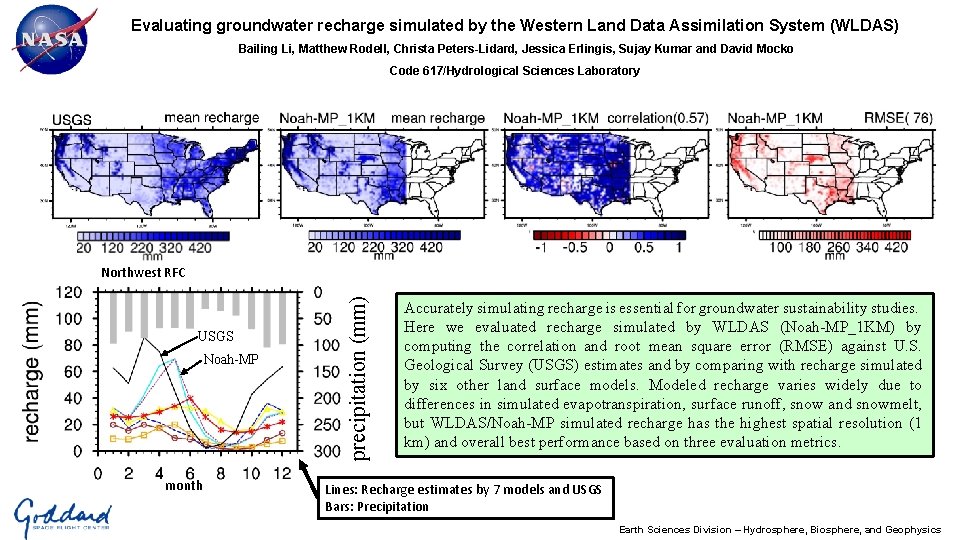
Evaluating groundwater recharge simulated by the Western Land Data Assimilation System (WLDAS) Bailing Li, Matthew Rodell, Christa Peters-Lidard, Jessica Erlingis, Sujay Kumar and David Mocko Code 617/Hydrological Sciences Laboratory USGS Noah-MP month precipitation (mm) Northwest RFC Accurately simulating recharge is essential for groundwater sustainability studies. Here we evaluated recharge simulated by WLDAS (Noah-MP_1 KM) by computing the correlation and root mean square error (RMSE) against U. S. Geological Survey (USGS) estimates and by comparing with recharge simulated by six other land surface models. Modeled recharge varies widely due to differences in simulated evapotranspiration, surface runoff, snow and snowmelt, but WLDAS/Noah-MP simulated recharge has the highest spatial resolution (1 km) and overall best performance based on three evaluation metrics. Lines: Recharge estimates by 7 models and USGS Bars: Precipitation Earth Sciences Division – Hydrosphere, Biosphere, and Geophysics
Name: Bailing Li, Hydrological Sciences Branch, NASA GSFC/ ESSIC UMD E-mail: bailing. li@nasa. gov Phone: 301 -286 -6020 References: Li, B. , M. Rodell, C. Peters-Lidard, J. Erlingis, S. Kumar & D. Mocko (2021). Groundwater recharge estimated by land surface models: an evaluation in the conterminous U. S. , Journal of Hydrometeorology, 22(2), https: //doi. org/10. 1175/JHM-D-20 -0130. 1. Data Sources: Western Land Data assimilation System (WLDAS), North America Land Data Assimilation (NLDAS-2), USGS recharge estimates. This work was supported by the NASA Western Water Application Office. Technical Description of Figures: a) USGS 1 km mean annual recharge for 2000 -2013; and WLDAS mean annual recharge for 2000 -2013, correlation, and root mean square error (RMSE) of annual recharge compared to USGS estimates, respectively. Numbers in parentheses represent domain average values. b) Mean monthly recharge from USGS, WLDAS, and six NLDAS-2 models [Noah, VIC, Mosaic, SAC, Noah-MP and the Catchment](colored lines) over the National Weather Service Northwest River Forecast Center region. Gray bars represent mean monthly precipitation from NLDAS 2. Scientific significance, societal relevance, and relationships to future missions: Groundwater is a vital resource for agriculture and for domestic and municipal water needs. Depletion of groundwater resources in the central and western U. S. has prompted California and certain other states to enact legislation to conserve and ensure equitable use of groundwater. Models such as WLDAS are valuable for helping local governments to comply with regulations. WLDAS is capable of integrating data from GRACE, GRACE-FO, SMAP, and other satellite missions, which are valuable because they provide much more complete spatial and temporal coverage than that afforded by the ground-based observations used by the USGS to estimate recharge. Groundwater recharge is one of the parameters targeted by the 2017 Decadal Survey in Earth Sciences, particularly via the proposed Mass Change mission. Earth Sciences Division – Hydrosphere, Biosphere, and Geophysics
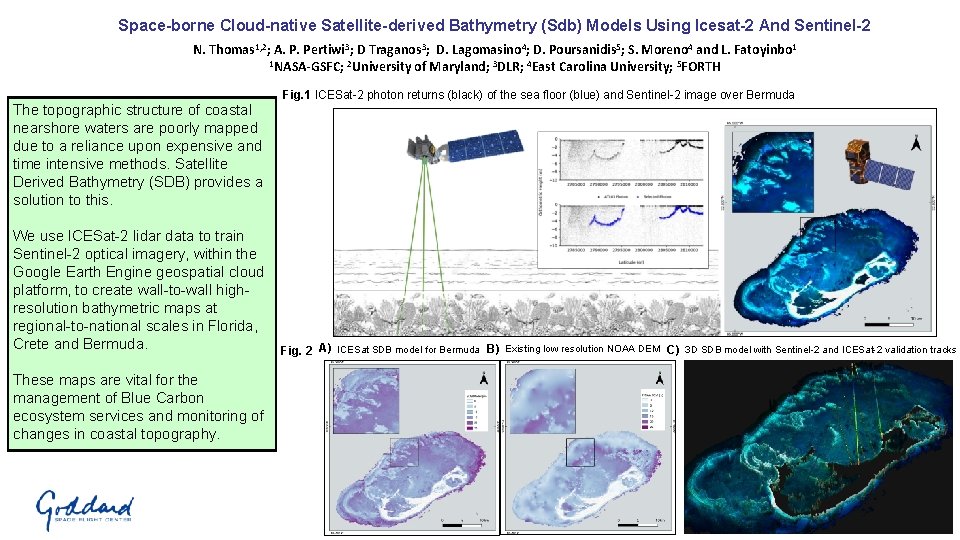
Space-borne Cloud-native Satellite-derived Bathymetry (Sdb) Models Using Icesat-2 And Sentinel-2 N. Thomas 1, 2; A. P. Pertiwi 3; D Traganos 3; D. Lagomasino 4; D. Poursanidis 5; S. Moreno 4 and L. Fatoyinbo 1 1 NASA-GSFC; 2 University of Maryland; 3 DLR; 4 East Carolina University; 5 FORTH The topographic structure of coastal nearshore waters are poorly mapped due to a reliance upon expensive and time intensive methods. Satellite Derived Bathymetry (SDB) provides a solution to this. We use ICESat-2 lidar data to train Sentinel-2 optical imagery, within the Google Earth Engine geospatial cloud platform, to create wall-to-wall highresolution bathymetric maps at regional-to-national scales in Florida, Crete and Bermuda. These maps are vital for the management of Blue Carbon ecosystem services and monitoring of changes in coastal topography. Fig. 1 ICESat-2 photon returns (black) of the sea floor (blue) and Sentinel-2 image over Bermuda Fig. 2 A) ICESat SDB model for Bermuda B) Existing low resolution NOAA DEM C) 3 D SDB model with Sentinel-2 and ICESat-2 validation tracks
Name: Lola Fatoyinbo, 618, NASA GSFC E-mail: lola. fatoyinbo@nasa. gov Phone: References: Thomas, N. , Pertiwi, A. P. , Traganos, D. , Lagomasino, D. , Poursanidis, D. , Moreno, S. G. , Fatoyinbo, L. (2021) SPACE-BORNE CLOUD-NATIVE SATELLITE-DERIVED BATHYMETRY (SDB) MODELS USING ICESat-2 and SENTINEL-2. Geophysical Research Letters, 8, (6). DOI: https: //doi. org/10. 1029/2020 GL 092170 Data Sources: ICESat-2 ATL 03 geolocated photon data to train and validate SDB models. Sentinel-2 imagery to build spatially continuous SDB models using regression between Sentinel-2 bands and ICESat-2 depths. NOAA DEM data for model validation. Technical Description of Figures: Figure 1: A simplified overview of the method for retrieving Satellite Derived Bathymetry (SDB) models using ICESat-2 and Sentinel-2. Sub-aquatic surface photons are located and selected from ICESat-2 tracks. The depth of each photon is calculated accounting for refraction of the laser through the water column. Sentinel-2 composites are created in Google Earth Engine (GEE) from which relationships are derived between reflectance and ICESat-2 depth. The relationship is applied to the whole Sentinel-2 image. Figure 2: A) SDB model for Bermuda, trained and validated with ICEsat-2 data. B) The existing openly available NOAA DEM for Bermuda, which lacks the spatial detail of our SDB model. C) A 3 D rendering of our SDB model with Sentinel-2 composite overlain with ICESat-2 tracks used for validation. Scientific significance, societal relevance, and relationships to future missions: An ability to routinely derive SDB models of nearshore shallow water bathymetry will revolutionize the management of coastal ecosystem services and anthropogenic use of coastal environments. Current methods of retrieving this data are manual, time intensive and sometimes dangerous. Accurate SDB models will help us characterize sub-aquatic environments which are a vital piece of missing information in important Blue Carbon environments. Rapid repeat surveys are critical for shipping and response to natural hazards. Future VHR and hyperspectral missions can be expected to achieve similar results at finer spatial detail with greater accuracy. Earth Sciences Division – Hydrosphere, Biosphere, and Geophysics
Apache Point Observatory Lunar Laser Ranging Station Joins the NASA Space Geodesy Network Stephen Merkowitz, NASA/GSFC Code 61 A New partnership established with New Mexico State University for continued operation of the Lunar Laser Ranging system installed on the 3. 5 -meter telescope at the Apache Point Observatory in Sunspot, New Mexico as part of the NASA Space Geodesy Network. The system boasts the world’s most precise lunar ranging capability, approaching 1 mm normal point precision, and supports studies of the Moon’s interior structure, tests of General Relativity, and positioning and navigation applications on and around the Moon. Earth Sciences Division – Hydrosphere, Biosphere, and Geophysics
Name: Stephen Merkowitz, NASA GSFC Code 61 A E-mail: Stephen. M. Merkowitz@nasa. gov Phone: 301 -286 -9412 References: Space Geodesy Project: https: //space-geodesy. nasa. gov Data Sources: Lunar Laser Ranging Data from the Apache Point station will be available from the Crustal Dynamics Data Information System (CDDIS) https: //cddis. gsfc. nasa. gov/ Technical Description of Figures: Pictures of the 3. 5 -meter Telescope at the Apache Point Observatory in Sunspot, New Mexico Scientific significance, societal relevance, and relationships to future missions: The Apache Point station boasts the world’s most precise lunar ranging capability, approaching 1 mm normal point precision, and is the only remaining lunar capable laser ranging station within the USA. Its continued operation under NASA leadership in partnership with New Mexico State University will continue the legacy of Lunar Laser Ranging to the retroreflectors deployed by the Apollo astronauts and the Soviet Luna missions as well as to future lunar retroreflectors planned for upcoming NASA CLPS missions. These measurements will further help to answer important scientific questions, including: • • • What is the interior structure of the Moon? Does the strength of gravity vary with space and time? Does gravitational self-energy obey the Equivalence Principle? What is the nature of spacetime? Do extra dimensions or other new physics alter the inverse square law of gravity? The measurements also contribute to establishing and maintaining a lunar reference frame necessary for positioning and navigation on and around the Moon. Earth Sciences Division – Hydrosphere, Biosphere, and Geophysics
- Slides: 10